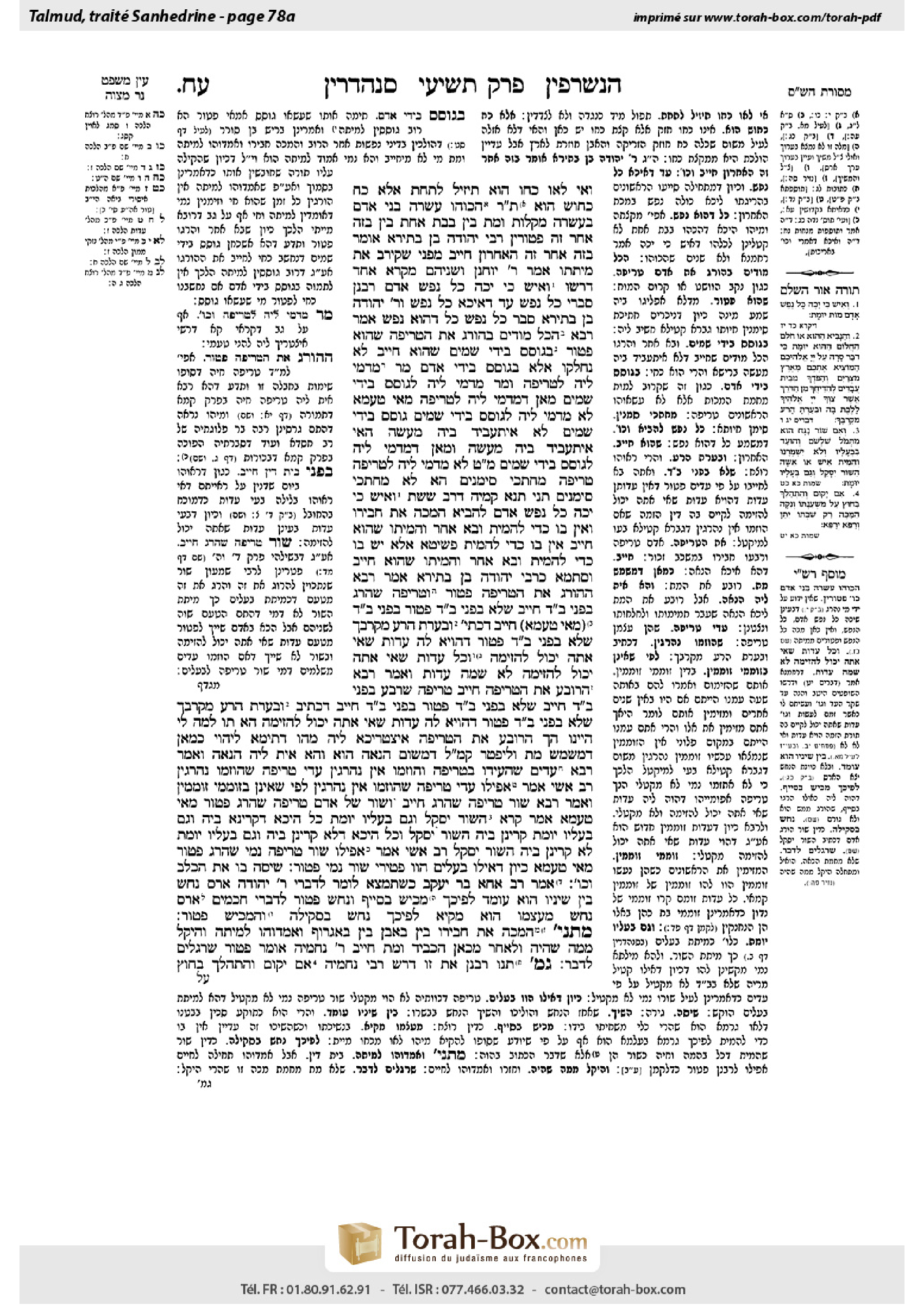
Sanhedrin 78a: Talmud study for Daf Yomi
Daf Yomi is the daily study of one Talmud folio. Explore 37 tractates with scans, Hebrew text, Sefaria English and AI-generated French translations where annotated.
Passage selection and English or AI-generated French translation are available where the scan has annotations. Daf Study is independent of Torah-Box and Sefaria.
Browse Sanhedrin · סנהדרין · All tractatesSanhedrin 78a text and translations
This page of Sanhedrin includes the Aramaic text, an English translation and an AI-generated French translation, alongside the scan above.
סנהדרין ע״ח א · Aramaic and Hebrew text
וְאִי לָאו כֹּחוֹ הוּא – תֵּיזִיל לְתַחַת. אֶלָּא, כֹּחַ כָּחוּשׁ הוּא.
תָּנוּ רַבָּנַן: הִכּוּהוּ עֲשָׂרָה בְּנֵי אָדָם בַּעֲשָׂרָה מַקְלוֹת וָמֵת, בֵּין בְּבַת אַחַת, בֵּין בְּזֶה אַחַר זֶה – פְּטוּרִין. רַבִּי יְהוּדָה בֶּן בְּתִירָא אוֹמֵר: בְּזֶה אַחַר זֶה, הָאַחֲרוֹן חַיָּיב, מִפְּנֵי שֶׁקֵּירַב אֶת מִיתָתוֹ.
אָמַר רַבִּי יוֹחָנָן: וּשְׁנֵיהֶם מִקְרָא אֶחָד דָּרְשׁוּ, ״וְאִישׁ כִּי יַכֶּה כׇּל נֶפֶשׁ אָדָם״. רַבָּנַן סָבְרִי: ״כָּל נֶפֶשׁ״ – עַד דְּאִיכָּא כׇּל נֶפֶשׁ, וְרַבִּי יְהוּדָה בֶּן בְּתִירָא סָבַר: ״כׇּל נֶפֶשׁ״ – כׇּל דְּהוּא נֶפֶשׁ.
אָמַר רָבָא: הַכֹּל מוֹדִים בְּהוֹרֵג אֶת הַטְּרֵיפָה שֶׁהוּא פָּטוּר, בְּגוֹסֵס בִּידֵי שָׁמַיִם שֶׁהוּא חַיָּיב. לֹא נֶחְלְקוּ אֶלָּא בְּגוֹסֵס בִּידֵי אָדָם. מָר מְדַמֵּי לֵיהּ לִטְרֵיפָה, וּמָר מְדַמֵּי לֵיהּ לְגוֹסֵס בִּידֵי שָׁמַיִם.
מַאן דִּמְדַמֵּי לֵיהּ לִטְרֵיפָה, מַאי טַעְמָא לָא מְדַמֵּי לֵיהּ לְגוֹסֵס בִּידֵי שָׁמַיִם? גּוֹסֵס בִּידֵי שָׁמַיִם לָא אִיתְעֲבִיד בֵּיהּ מַעֲשֶׂה, הַאי אִיתְעֲבִיד בֵּיהּ מַעֲשֶׂה.
וּמַאן דִּמְדַמֵּי לֵיהּ לְגוֹסֵס בִּידֵי שָׁמַיִם, מַאי טַעְמָא לָא מְדַמֵּי לֵיהּ לִטְרֵיפָה? טְרֵיפָה – מְחַתְּכִי סִימָנִים, הָא לָא מְחַתְּכִי סִימָנִים.
תָּנֵי תַּנָּא קַמֵּיהּ דְּרַב שֵׁשֶׁת: ״וְאִישׁ כִּי יַכֶּה כׇּל נֶפֶשׁ אָדָם״ – לְהָבִיא הַמַּכֶּה אֶת חֲבֵירוֹ וְאֵין בּוֹ כְּדֵי לְהָמִית, וּבָא אַחֵר וֶהֱמִיתוֹ, שֶׁהוּא חַיָּיב.
אֵין בּוֹ כְּדֵי לְהָמִית? פְּשִׁיטָא! אֶלָּא, יֵשׁ בּוֹ כְּדֵי לְהָמִית וּבָא אַחֵר וֶהֱמִיתוֹ, שֶׁהוּא חַיָּיב. וּסְתָמָא כְּרַבִּי יְהוּדָה בֶּן בְּתִירָא.
אָמַר רָבָא: הַהוֹרֵג אֶת הַטְּרֵיפָה – פָּטוּר. וּטְרֵיפָה שֶׁהָרַג בִּפְנֵי בֵּית דִּין – חַיָּיב, שֶׁלֹּא בִּפְנֵי בֵּית דִּין – פָּטוּר.
בִּפְנֵי בֵּית דִּין, מַאי טַעְמָא חַיָּיב? דִּכְתִיב: ״וּבִעַרְתָּ הָרָע מִקִּרְבֶּךָ״. שֶׁלֹּא בִּפְנֵי בֵּית דִּין – פָּטוּר, דְּהָוְיָא לַהּ עֵדוּת שֶׁאִי אַתָּה יָכוֹל לַהֲזִימָּהּ, וְכׇל עֵדוּת שֶׁאִי אַתָּה יָכוֹל לַהֲזִימָּהּ – לֹא שְׁמָהּ עֵדוּת.
וְאָמַר רָבָא: הָרוֹבֵעַ אֶת הַטְּרֵיפָה – חַיָּיב. טְרֵיפָה שֶׁרָבַע, בִּפְנֵי בֵּית דִּין – חַיָּיב, שֶׁלֹּא בִּפְנֵי בֵּית דִּין – פָּטוּר. בִּפְנֵי בֵּית דִּין חַיָּיב, דִּכְתִיב: ״וּבִעַרְתָּ הָרַע מִקִּרְבֶּךָ״. שֶׁלֹּא בִּפְנֵי בֵּית דִּין פָּטוּר, דְּהָוְיָא לַהּ עֵדוּת שֶׁאִי אַתָּה יָכוֹל לַהֲזִימָּהּ.
הָא תּוּ לְמָה לִי? הַיְינוּ הָךְ! הָרוֹבֵעַ אֶת הַטְּרֵיפָה אִיצְטְרִיכָא לֵיהּ. מַהוּ דְּתֵימָא: לֶיהֱוֵי כְּמַאן דִּמְשַׁמֵּשׁ מֵת, וְלִיפְּטַר? קָא מַשְׁמַע לַן, דְּמִשּׁוּם הֲנָאָה הוּא, וְהָא אִית לֵיהּ הֲנָאָה.
וְאָמַר רָבָא: עֵדִים שֶׁהֵעִידוּ בִּטְרֵיפָה וְהוּזַּמּוּ, אֵין נֶהֱרָגִין. עֵדֵי טְרֵיפָה שֶׁהוּזַּמּוּ, נֶהֱרָגִין. רַב אָשֵׁי אָמַר: אֲפִילּוּ עֵדֵי טְרֵיפָה שֶׁהוּזַּמּוּ אֵין נֶהֱרָגִין, לְפִי שֶׁאֵינָן בְּזוֹמְמֵי זוֹמְמִין.
וְאָמַר רָבָא: שׁוֹר טְרֵיפָה שֶׁהָרַג – חַיָּיב, וְשׁוֹר שֶׁל אָדָם טְרֵיפָה שֶׁהָרַג – פָּטוּר. מַאי טַעְמָא? אָמַר קְרָא: ״הַשּׁוֹר יִסָּקֵל וְגַם בְּעָלָיו יוּמָת״. כֹּל הֵיכָא דְּקָרֵינָא בֵּיהּ ״וְגַם בְּעָלָיו יוּמָת״, קָרֵינַן בֵּיהּ ״הַשּׁוֹר יִסָּקֵל״, וְכֹל הֵיכָא דְּלָא קָרֵינַן בֵּיהּ ״וְגַם בְּעָלָיו יוּמָת״, לָא קָרֵינַן בֵּיהּ ״הַשּׁוֹר יִסָּקֵל״.
רַב אָשֵׁי אָמַר: אֲפִילּוּ שׁוֹר טְרֵיפָה נָמֵי שֶׁהָרַג – פָּטוּר. מַאי טַעְמָא? כֵּיוָן דְּאִילּוּ בְּעָלִים הֲווֹ פְּטִירִי, שׁוֹר נָמֵי פָּטוּר.
שִׁיסָּה בּוֹ אֶת הַכֶּלֶב וְכוּ׳. אָמַר רַב אַחָא בַּר יַעֲקֹב: כְּשֶׁתִּמְצָא לוֹמַר, לְדִבְרֵי רַבִּי יְהוּדָה – אֶרֶס נָחָשׁ בֵּין שִׁינָּיו הוּא עוֹמֵד. לְפִיכָךְ: מַכִּישׁ בְּסַיִיף, וְנָחָשׁ פָּטוּר.
לְדִבְרֵי חֲכָמִים, אֶרֶס נָחָשׁ מֵעַצְמוֹ הוּא מֵקִיא. לְפִיכָךְ: נָחָשׁ בִּסְקִילָה, וְהַמַּכִּישׁ פָּטוּר.
מַתְנִי׳ הַמַּכֶּה אֶת חֲבֵירוֹ, בֵּין בְּאֶבֶן בֵּין בְּאֶגְרוֹף, וַאֲמָדוּהוּ לְמִיתָה, וְהֵיקֵל מִמַּה שֶּׁהָיָה, וּלְאַחַר מִכָּאן הִכְבִּיד וָמֵת – חַיָּיב. רַבִּי נְחֶמְיָה אוֹמֵר: פָּטוּר, שֶׁרַגְלַיִם לַדָּבָר.
גְּמָ׳ תָּנוּ רַבָּנַן: אֶת זוֹ דָּרַשׁ רַבִּי נְחֶמְיָה, ״אִם יָקוּם וְהִתְהַלֵּךְ בַּחוּץ
Sanhedrin 78a · English translation
Rav Pappa answered: And were it not for the force of his action, the stone would go down and not to the side. Rather, although it is a weak force, the force of his action is a partial cause of the damage caused by the stone going to the side; therefore, he is liable.
The Sages taught: If ten people struck an individual with ten sticks and as a result of the beating he died, whether they beat him simultaneously, or whether they beat him one after the other, they are exempt from liability for killing him, as two people are not liable for an action that they performed together. Rabbi Yehuda ben Beteira says: If they struck him one after the other, the one who struck him last is liable, because he hastened his death.
Rabbi Yoḥanan says: And both Rabbis, i.e., the first tanna and Rabbi Yehuda ben Beteira, interpreted the same verse in drawing their halakhic conclusion. The verse states: “And a man who strikes any soul mortally, he shall be put to death” (Leviticus 24:17). The Rabbis hold that “any soul” means that one is liable for murder only when there is an entire soul, i.e., when the murderer alone is responsible for taking the entire life of the victim. And Rabbi Yehuda ben Beteira holds that “any soul” means that one is liable for murder for taking any soul, even if the victim had already been beaten and was close to death.
§ Rava says: All concede that in the case of one who kills one who has a wound that will cause him to die within twelve months [tereifa] he is exempt from liability, as in a certain sense the legal status of the victim is that of a dead person. All concede in a case where one kills an individual dying from an illness caused at the hand of Heaven that he is liable, as no other individual took action contributing to his death, and the murderer alone took his remaining soul. They disagree only in a case where one kills an individual dying from injury caused at the hand of a person. One Sage, the Rabbis, likens this case to the case of a tereifa, and therefore rules that the one who kills him is exempt. And one Sage, Rabbi Yehuda, likens this case to the case of an individual dying from an illness caused at the hand of Heaven, and therefore rules that the one who kills him is liable.
The Gemara asks: As for the one who likens this case to the case of a tereifa, what is the reason that he does not liken it to the case of an individual dying from an illness caused at the hand of Heaven? The Gemara answers: In the case of an individual dying from an illness caused at the hand of Heaven, no action was performed by a person to kill him, whereas in this case of an individual dying from injury caused at the hand of a person, an action was performed by an individual to kill him. Therefore, it is a case of two people who performed an action together, and they are not liable.
The Gemara asks: And as for the one who likens this case to the case of an individual dying from an illness caused at the hand of Heaven, what is the reason that he does not liken it to a tereifa? The Gemara answers: In the case of a tereifa, his status is like that of one whose organs, the trachea and the esophagus, are cut, who is considered to be slaughtered. The status of this individual dying from injury caused at the hand of a person is not like that of one whose organs, the trachea and the esophagus, are cut, as there is no particular defect; rather, he is like one suffering from general frailty, like any frail or elderly individual.
A tanna taught a baraita before Rav Sheshet: The verse that states: “And a man who strikes any soul mortally, he shall be put to death” (Leviticus 24:17), serves to include the case of one who strikes another and it is a blow in which there is not sufficient force to kill, and then another individual comes and kills him; the verse teaches that the second individual is liable.
The Gemara challenges: If the first individual struck him with a blow in which there is not sufficient force to kill, this halakha is obvious, as the first did not perform an act of killing at all, and it is only the second who killed him. Rather, emend the baraita to teach: The verse serves to include the case of one who strikes another and it is a blow in which there is sufficient force to kill, and then another individual comes and kills him; the verse teaches that the second individual is liable. And this unattributed baraita is in accordance with the opinion of Rabbi Yehuda ben Beteira, who holds that one who completes the killing of an individual is liable to be executed as a murderer.
Rava says: One who kills a tereifa is exempt as it is as though he killed a dead person. And as for a tereifa who kills another individual, if he killed him before the judges in court, he is liable to be executed. If the killing was not before the judges in court, he is exempt.
The Gemara explains: In the case of a tereifa who killed before the court, what is the reason that he is liable? He is liable, as it is written: “And you shall eradicate the evil from your midst” (Deuteronomy 13:6), from which it is derived that there is a mitzva for the court to eradicate evil that it witnesses firsthand. In the case where the killing was not before the judges in court, he is exempt, as any testimony against the tereifa is testimony that you cannot render conspiratory testimony. Even if the witnesses testifying that the tereifa committed murder are found to be conspiring witnesses, they cannot be executed, as they conspired to kill a tereifa. And any testimony that you cannot render conspiratory testimony is not characterized as testimony, and is not accepted in court.
And Rava says: One who sodomizes a male who is a tereifa is liable to be executed for committing an act of sodomy. And as for a tereifa who sodomizes a male, if he does so before the judges in court, he is liable to be executed. If the act of sodomy was not before a court, he is exempt. The Gemara explains: If he committed an act of sodomy before the court, he is liable, as it is written: “And you shall eradicate the evil from your midst.” If the act of sodomy was not before a court, he is exempt, as any testimony against a tereifa is testimony that you cannot render conspiratory testimony.
The Gemara asks: Why do I also need this ruling? This case of sodomy is identical to that case of murder; why then does Rava cite two cases with regard to capital transgressions involving a tereifa? The Gemara answers: It was necessary for him to mention the case of one who sodomizes a tereifa, as there is a novel element introduced in that halakha. Lest you say: Let the status of one who sodomizes a male who is a tereifa be like one who engages in necrophilia, and let him be exempt from execution. To counter this, Rava teaches us that his liability is due to the pleasure that he experiences, and this man who sodomizes a tereifa has pleasure, as, although the legal status of a tereifa is that of a dead person in certain senses, he is, in fact, alive.
And Rava says: Witnesses who testified with regard to a tereifa that he committed a capital transgression, and then they were rendered conspiring witnesses are not executed, as they conspired to kill one whose status is that of a dead person. Witnesses who are themselves tereifa who were rendered conspiring witnesses are executed. Rav Ashi says: Even witnesses who are themselves tereifa who were rendered conspiring witnesses are not executed, due to the fact that they are not susceptible to a situation where witnesses who rendered them conspiring witnesses can themselves be rendered conspiring witnesses. Witnesses who render the witnesses who are themselves tereifa conspiring witnesses who then are rendered conspiring witnesses are not executed, because they sought to kill a tereifa, whose status is that of a dead person. Therefore, their testimony is testimony that you cannot render conspiratory testimony and is disregarded.
And Rava says: An ox that is a tereifa that killed an individual is liable to be executed, like any animal that kills a person. And an ox belonging to a person who is a tereifa that killed an individual is exempt. What is the reason for this halakha? It is as the verse states: “The ox shall be stoned and its owner shall also be put to death” (Exodus 21:29). Based on the juxtaposition between the owner and his ox it is derived: Anywhere that we can read concerning the situation: “And its owner shall also be put to death,” we read, i.e., apply, concerning it: “The ox shall be stoned.” And anywhere that we cannot read concerning it: “And its owner shall also be put to death,” we do not read concerning it: “The ox shall be stoned.” Since the owner of the ox cannot be executed, as he is a tereifa, his ox is also not liable to be stoned.
Rav Ashi says: Even an ox that is a tereifa that killed an individual is exempt. What is the reason for this halakha? Based on the juxtaposition between the ox and the owner, since if the owner were a tereifa he would be exempt, an ox that is a tereifa that killed an individual is also exempt.
§ The mishna teaches: If one set a dog against an individual and the dog killed him, or if one set a snake against an individual and the snake killed him, the one who set the dog or the snake is exempt from punishment. If he imbedded the snake’s fangs into another person and caused the snake to bite him and kill him, Rabbi Yehuda deems him liable to be executed, and the Rabbis exempt him. Rav Aḥa bar Ya’akov says: When you analyze the matter you will find that according to the statement of Rabbi Yehuda, venom of a snake stands within its fangs, and in this case the entire action is performed by the individual who imbeds the fang in the other person’s skin. The snake is passive. Therefore, the one who causes the snake to bite is liable to be executed by beheading with a sword as a murderer, and the snake is exempt.
According to the statement of the Rabbis, venom of a snake is discharged by the snake itself. The snake directly causes the death, while the individual who imbeds the fang is merely an indirect cause. Consequently, the snake is executed by stoning, and the one who caused the snake to bite is exempt from execution.
MISHNA: In the case of one who strikes another, whether he does so with a stone or with his fist, and the doctors assessed his condition, estimating that it would lead to death, and then his condition eased from what it was, and the doctors revised their prognosis and predicted that he would live, and thereafter his condition worsened and he died, the assailant is liable to be executed as a murderer. Rabbi Neḥemya says: He is exempt, as there is a basis for the matter of assuming that he is not liable. Since the victim’s condition eased in the interim, a cause other than the blow struck by the assailant ultimately caused his death.
GEMARA: The Sages taught: Rabbi Neḥemya interpreted this verse in arriving at his ruling. It is written: “If he rises and walks outside
Sanhedrin 78a · Traduction française (IA)
Rav Pappa répondit : Sans la force de son action, la pierre serait descendue sans dévier sur le côté. En réalité, bien que cette force soit faible, son action contribue en partie au dommage causé par la déviation de la pierre ; il est donc responsable.
Les Sages ont enseigné : Si dix hommes frappent un individu avec dix bâtons et que celui-ci meurt à la suite des coups, qu’ils le frappent simultanément ou l’un après l’autre, ils sont exempts de responsabilité pour l’avoir tué, car deux personnes ne sont pas responsables d’un acte qu’elles ont accompli ensemble. Rabbi Yehouda ben Beteira dit : S’ils l’ont frappé l’un après l’autre, celui qui l’a frappé en dernier est responsable, car il a hâté sa mort.
Rabbi Yoḥanan dit : Les deux rabbins, c’est-à-dire le premier tanna et Rabbi Yehouda ben Beteira, ont tiré leur conclusion halakhique du même verset. Il est écrit : « Un homme qui frappe mortellement une âme sera mis à mort » (Lévitique 24,17). Les Sages estiment que les mots « une âme » signifient qu’on n’est responsable de meurtre que lorsqu’il s’agit d’une âme entière, c’est-à-dire lorsque le meurtrier, à lui seul, est responsable d’avoir ôté toute la vie de la victime. Rabbi Yehouda ben Beteira estime que les mots « une âme » signifient qu’on est responsable de meurtre pour avoir ôté la vie à n’importe quelle âme, même si la victime avait déjà été frappée et était proche de la mort.
§ Rava dit : Tous reconnaissent que celui qui tue une personne atteinte d’une blessure qui entraînera sa mort dans les douze mois [tereifa] est exempt de responsabilité, car, à certains égards, la victime a le statut juridique d’un mort. Tous reconnaissent que celui qui tue un individu mourant d’une maladie causée par le Ciel est responsable, car aucun autre individu n’a agi de manière à contribuer à sa mort, et seul le meurtrier lui a ôté le reste de sa vie. Ils ne sont en désaccord que dans le cas où quelqu’un tue un individu mourant d’une blessure causée par un homme. Les Sages assimilent ce cas à celui d’un tereifa et statuent donc que celui qui le tue est exempt. Rabbi Yehouda assimile ce cas à celui d’un individu mourant d’une maladie causée par le Ciel et statue donc que celui qui le tue est responsable.
La Guemara demande : Quant à celui qui assimile ce cas à celui d’un tereifa, pourquoi ne l’assimile-t-il pas plutôt au cas d’un individu mourant d’une maladie causée par le Ciel ? La Guemara répond : Dans le cas d’un individu mourant d’une maladie causée par le Ciel, aucun homme n’a accompli d’action pour le tuer, tandis que, dans le cas d’un individu mourant d’une blessure causée par un homme, un individu a accompli une action pour le tuer. Il s’agit donc du cas de deux personnes ayant accompli ensemble une action, et elles ne sont pas responsables.
La Guemara demande : Quant à celui qui assimile ce cas à celui d’un individu mourant d’une maladie causée par le Ciel, pourquoi ne l’assimile-t-il pas à un tereifa ? La Guemara répond : Dans le cas d’un tereifa, son statut est celui d’une personne dont les organes, la trachée et l’œsophage, ont été sectionnés ; elle est considérée comme égorgée. Le statut de cet individu mourant d’une blessure causée par un homme n’est pas celui d’une personne dont les organes, la trachée et l’œsophage, ont été sectionnés, car il ne présente aucun défaut précis ; il ressemble plutôt à une personne généralement affaiblie, comme n’importe quel individu fragile ou âgé.
Un tanna enseigna une baraïta devant Rav Sheshet : Le verset qui dit : « Un homme qui frappe mortellement une âme sera mis à mort » (Lévitique 24,17) inclut le cas d’un homme qui en frappe un autre d’un coup insuffisamment puissant pour le tuer, puis un autre individu vient et le tue ; le verset enseigne que le second individu est responsable.
La Guemara objecte : Si le premier individu l’a frappé d’un coup insuffisamment puissant pour le tuer, cette halakha est évidente, puisque le premier n’a absolument pas accompli d’acte de meurtre et que seul le second l’a tué. Il faut plutôt corriger la baraïta ainsi : Le verset inclut le cas d’un homme qui en frappe un autre d’un coup suffisamment puissant pour le tuer, puis un autre individu vient et le tue ; le verset enseigne que le second individu est responsable. Cette baraïta anonyme est conforme à l’opinion de Rabbi Yehouda ben Beteira, selon laquelle celui qui achève de tuer un individu est passible d’exécution comme meurtrier.
Rava dit : Celui qui tue un tereifa est exempt, car c’est comme s’il avait tué un mort. Quant à un tereifa qui tue un autre individu, s’il le tue en présence des juges au tribunal, il est passible d’exécution. Si le meurtre n’a pas lieu en présence des juges au tribunal, il est exempt.
La Guemara explique : Dans le cas d’un tereifa qui a tué devant le tribunal, pourquoi est-il responsable ? Il l’est, car il est écrit : « Tu élimineras le mal du milieu de toi » (Deutéronome 13,6), ce dont on déduit que le tribunal a la mitsva d’éliminer le mal dont il est lui-même témoin. Dans le cas où le meurtre n’a pas eu lieu devant les juges au tribunal, il est exempt, car tout témoignage contre un tereifa est un témoignage qui ne peut pas être rendu conspiratoire. Même si les témoins qui attestent que le tereifa a commis un meurtre sont reconnus comme témoins conspirateurs, ils ne peuvent pas être exécutés, puisqu’ils ont conspiré pour tuer un tereifa. Or, un témoignage qui ne peut pas être rendu conspiratoire n’est pas considéré comme un témoignage et n’est pas accepté au tribunal.
Et Rava dit : Celui qui sodomise un homme qui est un tereifa est passible d’exécution pour avoir commis un acte de sodomie. Quant à un tereifa qui sodomise un homme, s’il le fait devant les juges au tribunal, il est passible d’exécution. Si l’acte de sodomie n’a pas lieu devant un tribunal, il est exempt. La Guemara explique : S’il a commis l’acte de sodomie devant le tribunal, il est responsable, car il est écrit : « Tu élimineras le mal du milieu de toi. » Si l’acte de sodomie n’a pas eu lieu devant un tribunal, il est exempt, car tout témoignage contre un tereifa est un témoignage qui ne peut pas être rendu conspiratoire.
La Guemara demande : Pourquoi ai-je également besoin de cette règle ? Ce cas de sodomie est identique à celui du meurtre ; pourquoi Rava cite-t-il donc deux cas de transgressions passibles de la peine capitale impliquant un tereifa ? La Guemara répond : Il était nécessaire de mentionner le cas de celui qui sodomise un tereifa, car cette halakha comporte un élément nouveau. On aurait pu croire : Que le statut de celui qui sodomise un homme qui est un tereifa soit celui de quelqu’un qui a des relations avec un cadavre, et qu’il soit donc exempt d’exécution. Pour écarter cette hypothèse, Rava nous enseigne que sa responsabilité tient au plaisir qu’il éprouve, et cet homme qui sodomise un tereifa éprouve du plaisir, car, bien que le tereifa ait le statut juridique d’un mort à certains égards, il est en fait vivant.
Et Rava dit : Les témoins qui ont attesté qu’un tereifa avait commis une transgression passible de la peine capitale, puis qui ont été reconnus comme témoins conspirateurs, ne sont pas exécutés, car ils ont conspiré pour tuer une personne qui a le statut d’un mort. Les témoins qui sont eux-mêmes des tereifa et qui ont été reconnus comme témoins conspirateurs sont exécutés. Rav Ashi dit : Même les témoins qui sont eux-mêmes des tereifa et qui ont été reconnus comme témoins conspirateurs ne sont pas exécutés, car il est impossible que les témoins qui les ont reconnus comme témoins conspirateurs soient eux-mêmes reconnus comme témoins conspirateurs. Les témoins qui ont reconnu comme témoins conspirateurs les témoins qui sont eux-mêmes des tereifa, puis qui ont à leur tour été reconnus comme témoins conspirateurs, ne sont pas exécutés, car ils ont cherché à tuer un tereifa, qui a le statut d’un mort. Par conséquent, leur témoignage est un témoignage qui ne peut pas être rendu conspiratoire et il est écarté.
Et Rava dit : Un bœuf qui est un tereifa et qui a tué un individu est passible d’exécution, comme tout animal qui tue une personne. Mais le bœuf appartenant à un homme qui est un tereifa et qui a tué un individu est exempt. Quelle est la raison de cette halakha ? Le verset dit : « Le bœuf sera lapidé et son propriétaire sera lui aussi mis à mort » (Exode 21,29). On déduit du rapprochement entre le propriétaire et son bœuf que partout où l’on peut dire de la situation : « Son propriétaire sera lui aussi mis à mort », on applique aussi à son sujet : « Le bœuf sera lapidé. » Et partout où l’on ne peut pas dire à son sujet : « Son propriétaire sera lui aussi mis à mort », on ne peut pas dire à son sujet : « Le bœuf sera lapidé. » Puisque le propriétaire du bœuf ne peut pas être exécuté, car il est un tereifa, son bœuf ne peut pas non plus être lapidé.
Rav Ashi dit : Même un bœuf qui est un tereifa et qui a tué un individu est exempt. Quelle est la raison de cette halakha ? En vertu du rapprochement entre le bœuf et son propriétaire, puisque le propriétaire serait exempt s’il était un tereifa, un bœuf qui est un tereifa et qui a tué un individu est lui aussi exempt.
§ La Michna enseigne : Si quelqu’un lance un chien contre un individu et que le chien le tue, ou s’il lance un serpent contre un individu et que le serpent le tue, celui qui a lancé le chien ou le serpent est exempt de peine. S’il enfonce les crochets du serpent dans une autre personne et provoque ainsi la morsure mortelle, Rabbi Yehouda le déclare passible d’exécution, tandis que les Sages l’en exemptent. Rav Aḥa bar Ya’akov dit : À l’examen, on constate que, selon l’opinion de Rabbi Yehouda, le venin du serpent se trouve dans ses crochets ; dans ce cas, l’action entière est accomplie par l’individu qui enfonce le crochet dans la peau de l’autre personne. Le serpent reste passif. Celui qui fait mordre le serpent est donc passible d’exécution par décapitation à l’épée comme meurtrier, tandis que le serpent est exempt.
Selon l’opinion des Sages, le serpent libère lui-même son venin. Le serpent provoque directement la mort, tandis que l’individu qui enfonce le crochet n’en est qu’une cause indirecte. Par conséquent, le serpent est lapidé, et celui qui l’a fait mordre est exempt d’exécution.
MICHNA : Dans le cas de quelqu’un qui frappe une autre personne, que ce soit avec une pierre ou avec son poing, et dont l’état est évalué par des médecins qui estiment que la blessure entraînera sa mort, puis s’améliore et que les médecins révisent leur pronostic en prédisant qu’il vivra, avant que son état ne s’aggrave de nouveau et qu’il meure, l’agresseur est passible d’exécution comme meurtrier. Rabbi Neḥemya dit : Il est exempt, car il existe un fondement permettant de supposer qu’il n’est pas responsable. Puisque l’état de la victime s’est amélioré entre-temps, une cause autre que le coup porté par l’agresseur a finalement entraîné sa mort.
GUEMARA : Les Sages ont enseigné : Rabbi Neḥemya a interprété ce verset pour parvenir à sa décision. Il est écrit : « S’il se relève et marche dehors
Traduction française générée par IA à partir de l’édition anglaise de Sefaria. Vérifie toujours un passage avec le texte source.
Text from Sefaria: William Davidson Edition - Vocalized Aramaic (CC BY NC); William Davidson Edition - English (CC BY NC).