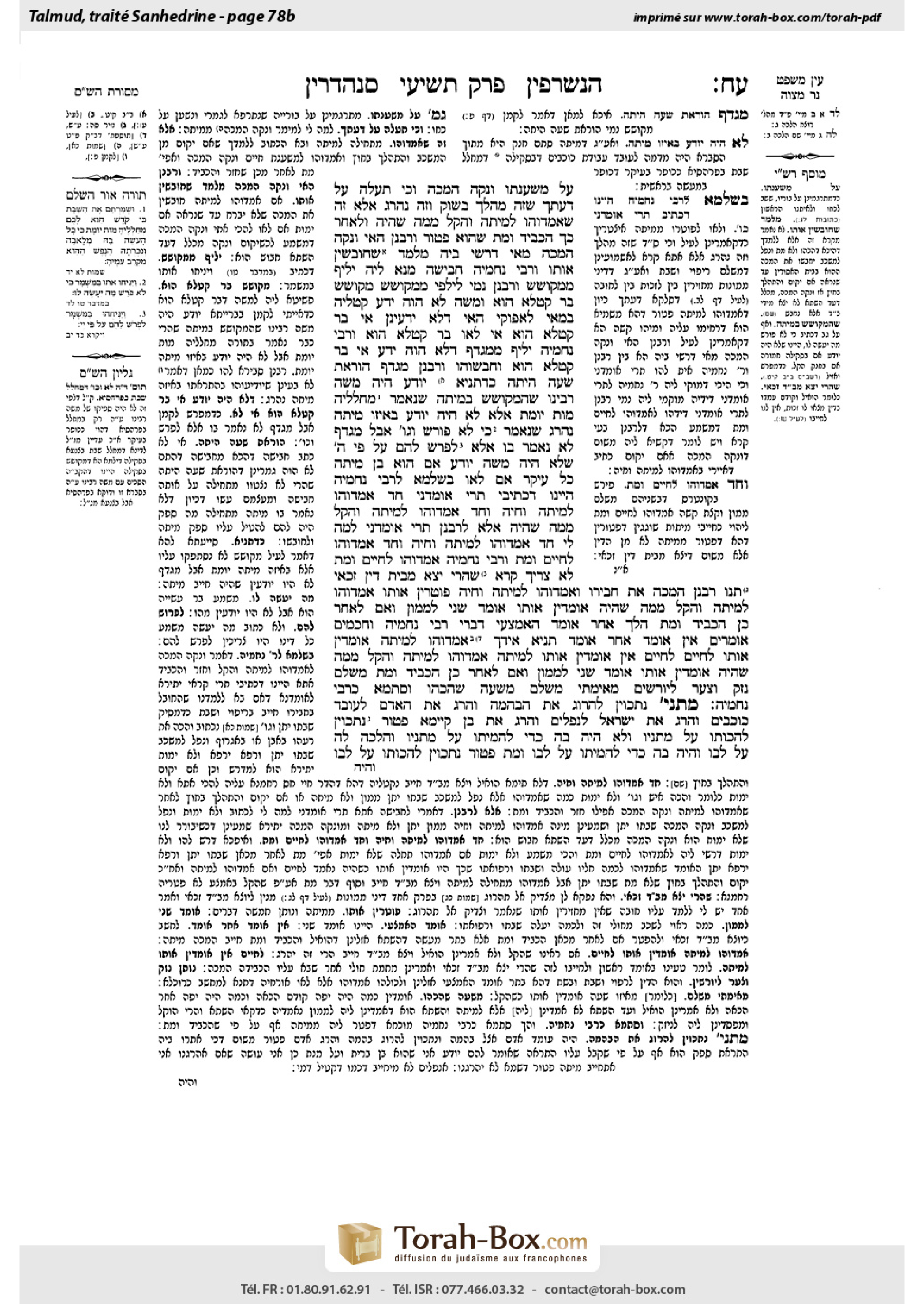
Sanhedrin 78b: Talmud study for Daf Yomi
Daf Yomi is the daily study of one Talmud folio. Explore 37 tractates with scans, Hebrew text, Sefaria English and AI-generated French translations where annotated.
Passage selection and English or AI-generated French translation are available where the scan has annotations. Daf Study is independent of Torah-Box and Sefaria.
Browse Sanhedrin · סנהדרין · All tractatesSanhedrin 78b text and translations
This page of Sanhedrin includes the Aramaic text, an English translation and an AI-generated French translation, alongside the scan above.
סנהדרין ע״ח ב · Aramaic and Hebrew text
עַל מִשְׁעַנְתּוֹ וְנִקָּה הַמַּכֶּה״. וְכִי תַּעֲלֶה עַל דַּעְתְּךָ שֶׁזֶּה מְהַלֵּךְ בַּשּׁוּק וְזֶה נֶהֱרָג? אֶלָּא זֶה שֶׁאֲמָדוּהוּ לְמִיתָה, וְהֵקֵל מִמַּה שֶּׁהָיָה, וּלְאַחַר כָּךְ הִכְבִּיד וָמֵת – שֶׁהוּא פָּטוּר.
וְרַבָּנַן, הַאי ״וְנִקָּה הַמַּכֶּה״ מַאי דָּרְשִׁי בֵּיהּ? מְלַמֵּד שֶׁחוֹבְשִׁין אוֹתוֹ.
וְרַבִּי נְחֶמְיָה, חֲבִישָׁה מְנָא לֵיהּ? יָלֵיף מִמְּקוֹשֵׁשׁ.
וְרַבָּנַן נָמֵי לֵילְפוּ מִמְּקוֹשֵׁשׁ? מְקוֹשֵׁשׁ בַּר קְטָלָא הוּא, וּמֹשֶׁה לָא הֲוָה יָדַע קְטָלֵיהּ בְּמַאי. לְאַפּוֹקֵי הַאי, דְּלָא יָדְעִינַן אִי בַּר קְטָלָא הוּא אִי לָאו בַּר קְטָלָא הוּא.
וְרַבִּי נְחֶמְיָה יָלֵיף מִמְּגַדֵּף, דְּלָא הֲוָה יָדַע אִי בַּר קְטָלָא הוּא, וְחַבְשׁוּהּ.
וְרַבָּנַן: מְגַדֵּף – הוֹרָאַת שָׁעָה הָיְתָה.
כִּדְתַנְיָא: יוֹדֵעַ הָיָה מֹשֶׁה רַבֵּינוּ שֶׁהַמְקוֹשֵׁשׁ בְּמִיתָה, שֶׁנֶּאֱמַר: ״מְחַלְּלֶיהָ מוֹת יוּמָת״, אֶלָּא לֹא הָיָה יוֹדֵעַ בְּאֵיזוֹ מִיתָה נֶהֱרָג, שֶׁנֶּאֱמַר: ״כִּי לֹא פֹרַשׁ וְגוֹ׳״. אֲבָל מְגַדֵּף לֹא נֶאֱמַר בּוֹ אֶלָּא ״לִפְרֹשׁ לָהֶם עַל פִּי ה׳״, שֶׁלֹּא הָיָה מֹשֶׁה יוֹדֵעַ אִם הוּא בֶּן מִיתָה כׇּל עִיקָּר אִם לָאו.
בִּשְׁלָמָא לְרַבִּי נְחֶמְיָה, הַיְינוּ דִּכְתִיבִי תְּרֵי אוּמְדָּנֵי: חַד – אֲמָדוּהוּ לְמִיתָה וְחָיָה, וְחַד – אֲמָדוּהוּ לְמִיתָה וְהֵקֵל מִמַּה שֶּׁהָיָה. אֶלָּא לְרַבָּנַן, תְּרֵי אוּמְדָּנֵי לְמָה לִי?
חַד אֲמָדוּהוּ לְמִיתָה וְחָיָה, וְחַד אֲמָדוּהוּ לְחַיִּים וָמֵת.
וְרַבִּי נְחֶמְיָה, אֲמָדוּהוּ לְחַיִּים וָמֵת – לָא צְרִיךְ קְרָא, שֶׁהֲרֵי יָצָא מִבֵּית דִּין זַכַּאי.
תָּנוּ רַבָּנַן: הַמַּכֶּה אֶת חֲבֵירוֹ, וַאֲמָדוּהוּ לְמִיתָה, וְחָיָה – פּוֹטְרִין אוֹתוֹ. אֲמָדוּהוּ לְמִיתָה וְהֵקֵל מִמַּה שֶּׁהָיָה – אוֹמְדִין אוֹתוֹ אוֹמֶד שֵׁנִי לְמָמוֹן. וְאִם לְאַחַר כֵּן הִכְבִּיד וָמֵת – הַלֵּךְ אַחַר אוֹמֶד הָאֶמְצָעִי, דִּבְרֵי רַבִּי נְחֶמְיָה. וַחֲכָמִים אוֹמְרִים: אֵין אוֹמֶד אַחַר אוֹמֶד.
תַּנְיָא אִידַּךְ: אֲמָדוּהוּ לְמִיתָה – אוֹמְדִין אוֹתוֹ לְחַיִּים. לְחַיִּים – אֵין אוֹמְדִין אוֹתוֹ לְמִיתָה. אֲמָדוּהוּ לְמִיתָה וְהֵקֵל מִמַּה שֶּׁהָיָה – אוֹמְדִין אוֹתוֹ אוֹמֶד שֵׁנִי לְמָמוֹן, וְאִם לְאַחַר כֵּן הִכְבִּיד וָמֵת – מְשַׁלֵּם נֶזֶק וָצַעַר לַיּוֹרְשִׁים.
מֵאֵימָתַי מְשַׁלֵּם? מִשָּׁעָה שֶׁהִכָּהוּ. וּסְתָמָא כְּרַבִּי נְחֶמְיָה.
מַתְנִי׳ נִתְכַּוֵּין לַהֲרוֹג אֶת הַבְּהֵמָה, וְהָרַג אֶת הָאָדָם; לַנׇּכְרִי, וְהָרַג אֶת יִשְׂרָאֵל; לַנְּפָלִים, וְהָרַג אֶת בֶּן קַיָּימָא – פָּטוּר.
נִתְכַּוֵּין לְהַכּוֹתוֹ עַל מׇתְנָיו, וְלֹא הָיָה בָּהּ כְּדֵי לַהֲמִיתוֹ עַל מׇתְנָיו, וְהָלְכָה לָהּ עַל לִבּוֹ, וְהָיָה בָּהּ כְּדֵי לַהֲמִיתוֹ עַל לִבּוֹ, וָמֵת – פָּטוּר. נִתְכַּוֵּין לְהַכּוֹתוֹ עַל לִבּוֹ
Sanhedrin 78b · English translation
upon his staff, then he that struck him is absolved; only for his loss of livelihood shall he give and he shall heal him” (Exodus 21:19). The phrase: “Then he that struck him is absolved,” is superfluous; would it enter your mind to say that this individual whom he struck is walking in the marketplace, and that individual who struck him will be executed as a murderer? Rather, this is referring to a case where the doctors assessed his condition, saying that it would lead to death, and his condition eased somewhat from what it was and he walked in the marketplace, and thereafter his condition worsened and he died, and the verse is teaching that he is exempt.
The Gemara asks: And as for the Rabbis who disagree with Rabbi Neḥemya and hold that he is liable in that case, what do they interpret from that phrase: “Then he that struck him is absolved”? The Gemara explains that according to the Rabbis, the verse teaches that they incarcerate him until the fate of the victim can be determined, and the phrase: “Then he that struck him is absolved,” means that he is freed from incarceration.
The Gemara asks: And as for Rabbi Neḥemya, from where does he derive the halakha of incarceration? The Gemara answers: He derives it from the incident of the wood gatherer in the wilderness with regard to whom it is written: “And they placed him under guard” (Numbers 15:34).
The Gemara challenges: And the Rabbis too, let them derive the halakha of incarceration from the incident of the wood gatherer. The Gemara explains: With regard to the wood gatherer, he was incarcerated because it was known from the outset that he was liable to be killed, and Moses did not know with what form of capital punishment his death would be implemented. This is to the exclusion of this individual who struck another, with regard to whom we do not know if he is liable to be killed or if he is not liable to be killed. Therefore, one cannot derive the halakha in this case from the case of the wood gatherer.
The Gemara asks: And Rabbi Neḥemya, from where does he derive the halakha? He too should not be able to derive the halakha from the case of the wood gatherer. The Gemara answers: Rabbi Neḥemya derives the halakha with regard to one who strikes another from the incident of the blasphemer (see Leviticus 24:12), where Moses did not know if he was liable to be killed, and he nevertheless imprisoned the blasphemer.
The Gemara asks: And the Rabbis, why don’t they derive the halakha from the incident of the blasphemer? The Gemara answers: The Rabbis hold that the case of the blasphemer was a provisional edict.
The difference between the uncertainty in the case of the wood gatherer and the uncertainty in the case of the blasphemer is as it is taught in a baraita: Moses our teacher knew that the wood gatherer was liable to be sentenced to death, as it is stated: “And you shall observe the Shabbat as it is sacred to you; one who desecrates it shall be put to death” (Exodus 31:14). But he did not know with which death penalty he was to be killed, as it is stated: “And they placed him under guard, as it had not been declared what should be done to him” (Numbers 15:34). But concerning the blasphemer it is stated only: “And they placed him under guard that it might be declared to them according to the Lord” (Leviticus 24:12), as Moses did not know if the blasphemer was liable to be killed at all, or not.
The Gemara asks: Granted, according to Rabbi Neḥemya, that is the reason that two assessments are written. It is written in one verse: “And if men quarrel and one strikes the other with a stone or with his fist, and he did not die but is bedridden” (Exodus 21:18), indicating that after the initial blow the victim is assessed to determine whether or not he is expected to die. In the following verse it is written: “If he rises and walks outside upon his staff, then he that struck him is absolved” (Exodus 21:19), indicating that there is an additional assessment to determine whether or not he fully recovers. One verse is where they assessed his condition, saying that it would lead to death, and he recovered fully; and one verse is where they assessed his condition, saying that it would lead to death, and his condition eased from what it was and he died thereafter. But according to the Rabbis, why do I need two assessments?
The Gemara answers: According to the Rabbis, one assessment is where they assessed his condition, saying that it would lead to death and he recovered fully, in which case the assailant is certainly not executed but pays compensation. And one assessment is where they assessed his condition, saying that it would lead to life and he died, in which case the assailant is also not executed but pays compensation.
The Gemara asks: And Rabbi Neḥemya, from where does he derive these two halakhot? The Gemara answers: He holds that in the case where they assessed his condition, saying that it would lead to life, and he died, one does not need an explicit verse to exempt the assailant from execution, as he emerged from the court after the first hearing innocent when they predicted that the victim would live, and the court does not rescind its initial ruling and convict him.
The Sages taught: In the case of one who strikes another and they assessed his condition, saying that it would lead to death, and he recovered fully, the court exempts the assailant. If they assessed his condition saying that it would lead to death and his condition eased from what it was, they assess the victim with a second assessment to determine the monetary restitution for damages. And if thereafter his medical condition worsened and he died, the halakha is: Follow the assessment that was assessed at the intermediate stage, which determined that the victim would live, and the assailant is not executed; this is the statement of Rabbi Neḥemya. And the Rabbis say: There is no assessment after assessment. The death of the victim proves that the assessment at the intermediate stage was erroneous, and the assailant is executed.
It is taught in another baraita: If they assessed his condition, saying that it would lead to death, and his condition improved, they assess his condition to determine whether it would lead to life. If they assessed his condition, saying that it would lead to life, and his condition deteriorated, they do not then assess his condition to determine whether it would lead to death, but the assailant is exempted based on the initial determination. If they assessed his condition, saying that it would lead to death, and his condition eased from what it was, they assess the victim with a second assessment to determine the monetary restitution for damages, as the assailant is certainly liable to pay restitution for the injury that he caused. And if thereafter his medical condition worsened and he died, the assailant pays restitution to the heirs for injury and suffering that he caused.
The Gemara asks: From when is the initial assessment of the value of the victim performed to determine the sum of the damages that the assailant pays? It is the assessment of his value from the moment that the assailant struck him. The Gemara notes: And this unattributed baraita is in accordance with the opinion of Rabbi Neḥemya, as according to the opinion of the Rabbis, he is liable to be executed even if there was a temporary improvement in his condition before he died.
MISHNA: If one intended to kill an animal, and he killed a person standing adjacent to it, or if he intended to kill a gentile, for whose murder he is not liable to be executed in court, and he killed a Jew, or if he intended to kill non-viable newborns, for whose murder one is not liable, and he killed a viable person, the assailant is exempt from execution, since his intent was to kill one for whose murder he is not liable.
If one intended to strike another on his loins, and the blow was not powerful enough to kill him if it were to land on his loins, but instead the blow landed on his chest over the victim’s heart, and it was powerful enough to kill him when it landed on his chest over his heart, and the victim died as a result of the blow, the assailant is exempt from execution, as he did not intend to strike the victim a blow that would cause his death. If he intended to strike him on his chest over his heart
Sanhedrin 78b · Traduction française (IA)
sur son bâton, alors celui qui l’a frappé est quitte ; il ne paiera que pour la perte de son gain, et il le fera soigner » (Exode 21,19). L’expression « alors celui qui l’a frappé est quitte » est superflue. Vous viendrait-il à l’esprit de dire que l’homme qu’il a frappé se promène sur la place du marché et que celui qui l’a frappé serait exécuté comme meurtrier ? Il s’agit plutôt d’un cas où les médecins ont évalué son état et estimé qu’il entraînerait sa mort ; son état s’est ensuite quelque peu amélioré et il a marché sur la place du marché, puis il s’est aggravé et il est mort. Le verset enseigne alors que l’agresseur est quitte.
La Guemara demande : Et les Rabbins, qui sont en désaccord avec Rabbi Neḥemya et estiment qu’il est passible dans ce cas, que déduisent-ils de cette expression : « alors celui qui l’a frappé est quitte » ? La Guemara explique que, selon les Rabbins, le verset enseigne qu’on l’incarcère jusqu’à ce que le sort de la victime puisse être déterminé ; l’expression « alors celui qui l’a frappé est quitte » signifie qu’il est libéré de l’incarcération.
La Guemara demande : Et Rabbi Neḥemya, de quoi déduit-il la halakha de l’incarcération ? La Guemara répond : Il la déduit de l’épisode du ramasseur de bois dans le désert, au sujet duquel il est écrit : « On le plaça sous garde » (Nombres 15,34).
La Guemara objecte : Les Rabbins aussi devraient déduire la halakha de l’incarcération de l’épisode du ramasseur de bois. La Guemara explique : Dans le cas du ramasseur de bois, il fut incarcéré parce qu’on savait d’emblée qu’il était passible de mort, et Moïse ignorait quelle peine capitale devait lui être infligée. Ce cas se distingue de celui de l’homme qui en a frappé un autre, à propos duquel nous ignorons s’il est passible de mort ou non. On ne peut donc pas déduire la halakha dans ce cas de celui du ramasseur de bois.
La Guemara demande : Et Rabbi Neḥemya, de quel cas déduit-il la halakha ? Lui non plus ne devrait pas pouvoir la déduire du cas du ramasseur de bois. La Guemara répond : Rabbi Neḥemya déduit la halakha concernant celui qui frappe un autre de l’épisode du blasphémateur (voir Lévitique 24,12), où Moïse ignorait s’il était passible de mort et l’a néanmoins emprisonné.
La Guemara demande : Et les Rabbins, pourquoi ne déduisent-ils pas la halakha de l’épisode du blasphémateur ? La Guemara répond : Les Rabbins estiment que le cas du blasphémateur relevait d’un décret provisoire.
La différence entre l’incertitude dans le cas du ramasseur de bois et celle dans le cas du blasphémateur est exposée dans une baraïta : Moïse notre maître savait que le ramasseur de bois était passible de mort, comme il est dit : « Vous observerez le Chabbat, car il est saint pour vous ; celui qui le profane sera mis à mort » (Exode 31,14). Mais il ignorait quelle peine capitale devait lui être infligée, comme il est dit : « On le plaça sous garde, car il n’avait pas été déclaré ce qu’il fallait lui faire » (Nombres 15,34). En revanche, au sujet du blasphémateur, il est seulement dit : « On le plaça sous garde, afin que leur soit indiqué ce que le Seigneur ordonnerait » (Lévitique 24,12), car Moïse ignorait si le blasphémateur était passible de mort ou non.
La Guemara demande : C’est compréhensible selon Rabbi Neḥemya : voilà pourquoi deux évaluations sont mentionnées. Un verset dit : « Si des hommes se querellent et que l’un frappe l’autre avec une pierre ou avec le poing, sans le faire mourir, mais en le clouant au lit » (Exode 21,18), ce qui indique qu’après le premier coup, on évalue l’état de la victime pour déterminer si elle est susceptible de mourir ou non. Le verset suivant dit : « S’il se relève et marche dehors sur son bâton, alors celui qui l’a frappé est quitte » (Exode 21,19), ce qui indique qu’une autre évaluation est effectuée afin de déterminer s’il se rétablit complètement. Un verset concerne le cas où l’on a évalué son état en estimant qu’il entraînerait sa mort, mais où il s’est complètement rétabli ; l’autre concerne le cas où l’on a évalué son état en estimant qu’il entraînerait sa mort, puis où son état s’est amélioré par rapport à ce qu’il était, avant qu’il ne meure. Mais selon les Rabbins, pourquoi faut-il deux évaluations ?
La Guemara répond : Selon les Rabbins, une évaluation concerne le cas où l’on a évalué son état en estimant qu’il entraînerait sa mort, mais où il s’est complètement rétabli ; dans ce cas, l’agresseur n’est certainement pas exécuté, mais paie une indemnité. L’autre évaluation concerne le cas où l’on a évalué son état en estimant qu’il survivrait, mais où il est mort ; dans ce cas également, l’agresseur n’est pas exécuté, mais paie une indemnité.
La Guemara demande : Et Rabbi Neḥemya, de quoi déduit-il ces deux halakhot ? La Guemara répond : Il estime que, dans le cas où l’on a évalué son état en estimant qu’il survivrait, mais où il est mort, aucun verset explicite n’est nécessaire pour exempter l’agresseur de l’exécution : après la première audience, il a quitté le tribunal acquitté, puisque l’on avait prédit que la victime survivrait, et le tribunal ne revient pas sur son premier jugement pour le déclarer coupable.
Les Sages ont enseigné : Si l’on a évalué l’état d’un homme qui en a frappé un autre et estimé que cela entraînerait sa mort, mais que la victime s’est complètement rétablie, le tribunal exempte l’agresseur. Si l’on a évalué son état en estimant que cela entraînerait sa mort et que son état s’est amélioré par rapport à ce qu’il était, on procède à une seconde évaluation de la victime afin de déterminer le montant de l’indemnité pour les dommages. Et si, par la suite, son état s’aggrave et qu’il meure, la halakha est la suivante : on suit l’évaluation effectuée à l’étape intermédiaire, qui avait déterminé que la victime survivrait, et l’agresseur n’est pas exécuté. Telle est la déclaration de Rabbi Neḥemya. Les Rabbins disent : Il n’y a pas d’évaluation après une première évaluation. La mort de la victime prouve que l’évaluation intermédiaire était erronée, et l’agresseur est exécuté.
Il est enseigné dans une autre baraïta : Si l’on a évalué son état en estimant que cela entraînerait sa mort et que son état s’améliore, on évalue de nouveau son état afin de déterminer s’il survivra. Si l’on a évalué son état en estimant qu’il survivrait et que son état se détériore, on ne l’évalue pas de nouveau pour déterminer si cela entraînera sa mort ; l’agresseur est exempté sur la base de l’évaluation initiale. Si l’on a évalué son état en estimant que cela entraînerait sa mort et que son état s’est amélioré par rapport à ce qu’il était, on procède à une seconde évaluation de la victime afin de déterminer le montant de l’indemnité pour les dommages, car l’agresseur est certainement tenu de payer une indemnité pour la blessure qu’il a causée. Et si, par la suite, son état s’aggrave et qu’il meure, l’agresseur paie aux héritiers une indemnité pour la blessure et les souffrances qu’il a causées.
La Guemara demande : À partir de quel moment l’évaluation initiale de la valeur de la victime est-elle effectuée afin de déterminer le montant des dommages que l’agresseur doit payer ? On évalue sa valeur à partir du moment où l’agresseur l’a frappée. La Guemara remarque : Cette baraïta anonyme est conforme à l’opinion de Rabbi Neḥemya, car, selon les Rabbins, l’agresseur est passible d’exécution même si l’état de la victime s’est temporairement amélioré avant qu’elle ne meure.
Michna : Si quelqu’un avait l’intention de tuer un animal, mais tue une personne qui se tenait à côté de celui-ci ; ou s’il avait l’intention de tuer un non-Juif, pour le meurtre duquel il n’est pas passible d’exécution devant un tribunal, mais tue un Juif ; ou s’il avait l’intention de tuer des nouveau-nés non viables, pour le meurtre desquels on n’est pas passible de peine, mais tue une personne viable, l’agresseur est exempté de l’exécution, puisque son intention était de tuer un être dont le meurtre ne le rendait pas passible de peine.
Si quelqu’un avait l’intention de frapper un autre aux reins, et que le coup n’était pas assez puissant pour le tuer s’il avait atteint les reins, mais qu’il atteigne plutôt sa poitrine, au niveau du cœur, où il était assez puissant pour le tuer, et que la victime meure des suites du coup, l’agresseur est exempté de l’exécution, car il n’avait pas l’intention de porter à la victime un coup qui causerait sa mort. S’il avait l’intention de le frapper à la poitrine, au niveau du cœur
Traduction française générée par IA à partir de l’édition anglaise de Sefaria. Vérifie toujours un passage avec le texte source.
Text from Sefaria: William Davidson Edition - Vocalized Aramaic (CC BY NC); William Davidson Edition - English (CC BY NC).