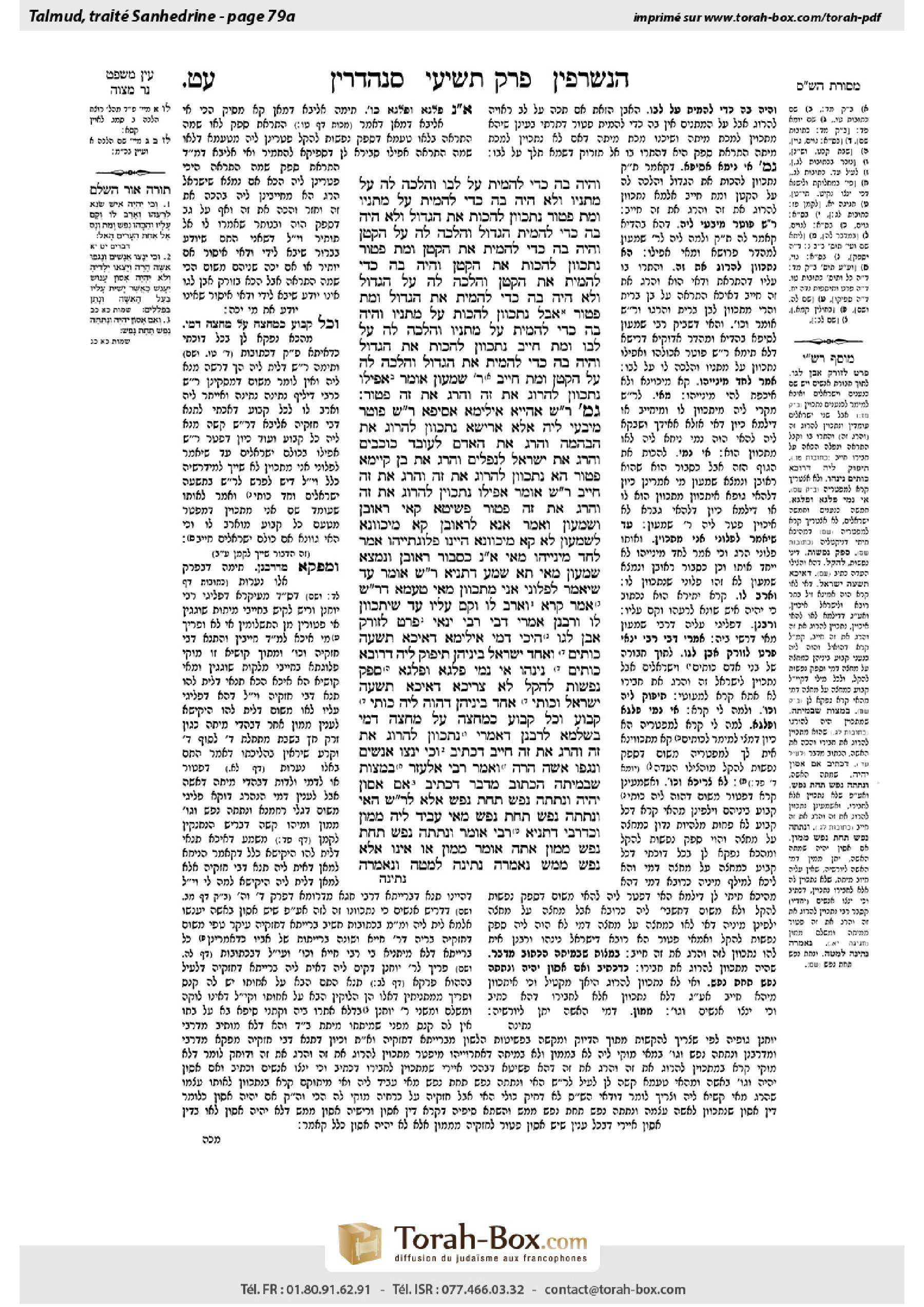
Sanhedrin 79a: Talmud study for Daf Yomi
Daf Yomi is the daily study of one Talmud folio. Explore 37 tractates with scans, Hebrew text, Sefaria English and AI-generated French translations where annotated.
Passage selection and English or AI-generated French translation are available where the scan has annotations. Daf Study is independent of Torah-Box and Sefaria.
Browse Sanhedrin · סנהדרין · All tractatesSanhedrin 79a text and translations
This page of Sanhedrin includes the Aramaic text, an English translation and an AI-generated French translation, alongside the scan above.
סנהדרין ע״ט א · Aramaic and Hebrew text
וְהָיָה בָּהּ כְּדֵי לְהָמִית עַל לִבּוֹ, וְהָלְכָה לָהּ עַל מׇתְנָיו, וְלֹא הָיָה בָּהּ כְּדֵי לְהָמִית עַל מׇתְנָיו, וָמֵת – פָּטוּר.
נִתְכַּוֵּון לְהַכּוֹת אֶת הַגָּדוֹל, וְלֹא הָיָה בָּהּ כְּדֵי לְהָמִית הַגָּדוֹל, וְהָלְכָה לָהּ עַל הַקָּטָן, וְהָיָה בָּהּ כְּדֵי לְהָמִית אֶת הַקָּטָן, וָמֵת – פָּטוּר. נִתְכַּוֵּן לְהַכּוֹת אֶת הַקָּטָן, וְהָיָה בָּהּ כְּדֵי לְהָמִית אֶת הַקָּטָן, וְהָלְכָה לָהּ עַל הַגָּדוֹל, וְלֹא הָיָה בָּהּ כְּדֵי לְהָמִית אֶת הַגָּדוֹל, וָמֵת – פָּטוּר.
אֲבָל נִתְכַּוֵּון לְהַכּוֹת עַל מׇתְנָיו, וְהָיָה בָּהּ כְּדֵי לְהָמִית עַל מׇתְנָיו, וְהָלְכָה לָהּ עַל לִבּוֹ, וָמֵת – חַיָּיב. נִתְכַּוֵּון לְהַכּוֹת אֶת הַגָּדוֹל, וְהָיָה בָּהּ כְּדֵי לְהָמִית אֶת הַגָּדוֹל, וְהָלְכָה לָהּ עַל הַקָּטָן, וָמֵת – חַיָּיב. רַבִּי שִׁמְעוֹן אוֹמֵר: אֲפִילּוּ נִתְכַּוֵּון לַהֲרוֹג אֶת זֶה וְהָרַג אֶת זֶה – פָּטוּר.
גְּמָ׳ רַבִּי שִׁמְעוֹן אַהֵיָיא? אִילֵּימָא אַסֵּיפָא, ״רַבִּי שִׁמְעוֹן פּוֹטֵר״ מִיבְּעֵי לֵיהּ!
אֶלָּא אַרֵישָׁא: נִתְכַּוֵּון לַהֲרוֹג אֶת הַבְּהֵמָה וְהָרַג אֶת הָאָדָם, לַנׇּכְרִי וְהָרַג אֶת יִשְׂרָאֵל, לַנְּפָלִים וְהָרַג אֶת בֶּן קַיָּימָא – פָּטוּר. הָא נִתְכַּוֵּון לַהֲרוֹג אֶת זֶה וְהָרַג אֶת זֶה – חַיָּיב. רַבִּי שִׁמְעוֹן אוֹמֵר: אֲפִילּוּ נִתְכַּוֵּין לַהֲרוֹג אֶת זֶה וְהָרַג אֶת זֶה – פָּטוּר.
פְּשִׁיטָא! קָאֵי רְאוּבֵן וְשִׁמְעוֹן, וְאָמַר: ״אֲנָא לִרְאוּבֵן קָא מִיכַּוַּונָא, לְשִׁמְעוֹן לָא קָא מִיכַּוַּונָא״ – הַיְינוּ פְּלוּגְתַּיְיהוּ. אָמַר: ״לְחַד מִינַּיְיהוּ״ – מַאי? אִי נָמֵי, כְּסָבוּר רְאוּבֵן וְנִמְצָא שִׁמְעוֹן – מַאי? תָּא שְׁמַע, דְּתַנְיָא: רַבִּי שִׁמְעוֹן אוֹמֵר, עַד שֶׁיֹּאמַר ״לִפְלוֹנִי אֲנִי מִתְכַּוֵּון״.
מַאי טַעְמָא דְּרַבִּי שִׁמְעוֹן? אָמַר קְרָא: ״וְאָרַב לוֹ וְקָם עָלָיו״, עַד שֶׁיִּתְכַּוֵּון לוֹ. וְרַבָּנַן, אָמְרִי דְּבֵי רַבִּי יַנַּאי: פְּרָט לְזוֹרֵק אֶבֶן לְגוֹ.
הֵיכִי דָמֵי? אִילֵּימָא דְּאִיכָּא תִּשְׁעָה גּוֹיִם וְאֶחָד יִשְׂרָאֵל בֵּינֵיהֶן, תִּיפּוֹק לֵיהּ דְּרוּבָּא גּוֹיִם נִינְהוּ. אִי נָמֵי פַּלְגָא וּפַלְגָא, סְפֵק נְפָשׁוֹת לְהָקֵל.
לָא צְרִיכָא, דְּאִיכָּא תִּשְׁעָה יִשְׂרָאֵל וְגוֹי אֶחָד בֵּינֵיהֶן, דְּהָוֵה לֵיהּ גּוֹי קָבוּעַ, וְכׇל קָבוּעַ כְּמֶחֱצָה עַל מֶחֱצָה דָּמֵי.
בִּשְׁלָמָא לְרַבָּנַן דְּאָמְרִי: נִתְכַּוֵּון לַהֲרוֹג אֶת זֶה וְהָרַג אֶת זֶה – חַיָּיב, דִּכְתִיב: ״וְכִי יִנָּצוּ אֲנָשִׁים וְנָגְפוּ אִשָּׁה הָרָה״. וְאָמַר רַבִּי אֶלְעָזָר: בְּמַצּוּת שֶׁבְּמִיתָה הַכָּתוּב מְדַבֵּר, דִּכְתִיב: ״אִם אָסוֹן יִהְיֶה וְנָתַתָּה נֶפֶשׁ תַּחַת נָפֶשׁ״.
אֶלָּא לְרַבִּי שִׁמְעוֹן, הַאי ״וְנָתַתָּה נֶפֶשׁ תַּחַת נָפֶשׁ״ מַאי עָבֵיד לֵיהּ? מָמוֹן. וְכִדְרַבִּי, דְּתַנְיָא: רַבִּי אוֹמֵר, ״וְנָתַתָּה נֶפֶשׁ תַּחַת נָפֶשׁ״ – מָמוֹן. אַתָּה אוֹמֵר מָמוֹן, אוֹ אֵינוֹ אֶלָּא נֶפֶשׁ מַמָּשׁ? נֶאֶמְרָה נְתִינָה לְמַטָּה, וְנֶאֶמְרָה
Sanhedrin 79a · English translation
and the blow was powerful enough to kill him were it to land on his chest over his heart, and instead the blow landed on his loins, and it was not powerful enough to kill him when it landed on his loins, and nevertheless the victim died, the assailant is exempt. Although the assailant intended to kill the victim, the blow was not powerful enough to kill. Ostensibly, his death was not a result of the blow.
If one intended to kill an adult and the blow was not powerful enough to kill the adult, and instead the blow landed on a minor, and the blow was powerful enough to kill the minor and the minor died, the assailant is exempt. If one intended to kill a minor and the blow was powerful enough to kill a minor, and the blow landed on an adult and the blow was not powerful enough to kill the adult, and nevertheless, the adult died, the assailant is exempt.
But if one intended to strike another on his loins, and the blow was powerful enough to kill him were it to land on his loins, and instead the blow landed on his chest over his heart, and he died, the assailant is liable, since in any event, his intent was to kill the victim and the blow was powerful enough to kill him wherever it struck him. If one intended to strike an adult and the blow was powerful enough to kill the adult, and the blow landed on a minor and he died, the assailant is liable. Rabbi Shimon says: Even if one intended to kill this one and he killed that one, although he would be liable for killing either, he is exempt, because one is executed only if his action completely corresponded with his intent.
GEMARA: The Gemara asks: With regard to which clause of the mishna does Rabbi Shimon disagree? If we say that he disagrees with the latter clause of the mishna, concerning one who intended to kill an adult and killed a minor, the mishna should have employed the formulation: Rabbi Shimon exempts him, not the extended statement of: Even if one intended to kill this one and he killed that one, he is exempt.
Rather, he disagrees with the first clause of the mishna, which states: If one intended to kill an animal, and he killed a person, or he intended to kill a gentile and he killed a Jew, or he intended to kill non-viable newborns and he killed a viable person, the assailant is exempt from execution; and from which it may be inferred: But if one intended to kill this one and he killed that one, the assailant is liable. Rabbi Shimon disagrees and says: Even if one intended to kill this one and he killed that one, he is exempt.
The Gemara comments: If Reuven and Shimon were standing, and before throwing the stone or shooting the arrow, the assailant said: I intend to kill Reuven, and I do not intend to kill Shimon, it is obvious that this is the dispute between the Rabbis and Rabbi Shimon. If the assailant said: I intend to kill one of them, and he did not specify whether it is Reuven or Shimon, what is the halakha? Alternatively, in a case where he intended to kill one whom he thought was Reuven and he killed him and he was found to be Shimon, what is the ruling? The Gemara suggests: Come and hear a resolution of this matter, as it is taught in a baraita that Rabbi Shimon says: He is not liable until he says: I intend to kill so-and-so, and he then kills him.
The Gemara seeks to clarify the rationale underlying the opinions of the Rabbis and Rabbi Shimon, and asks: What is the reason for the opinion of Rabbi Shimon? The verse states: “But if there will be a man who hates his neighbor, and he lies in wait for him and rises up against him, and strikes him mortally and he dies” (Deuteronomy 19:11). Based on the repeated use of pronouns in the phrase: “And lies in wait for him and rises up against him,” Rabbi Shimon derives: One is not liable to be executed until he intends to kill specifically him, the actual victim. The Gemara asks: And the Rabbis, what do they derive from the repetitive pronouns in that phrase? The Gemara answers: The Sages of the school of Rabbi Yannai say that one derives: This is to the exclusion of one who casts a stone into the midst of a group of people and one of them is killed. Since he did not intend to kill any specific individual, he is not executed.
The Gemara asks: What are the circumstances? If we say that it is a case where there are nine gentiles and one Jew among them, there is no need for a derivation; derive that he is exempt from the fact that they are a majority of gentiles, and based on that majority, the probability is that the stone will strike a gentile. Alternatively, if the group of people comprises half gentiles and half Jews, the principle is that the ruling in a case of uncertainty with regard to cases of capital law is to be lenient, and therefore the one who threw the stone will be exempt from punishment.
The Gemara explains: No, it is necessary to have this derivation only in a case where there are nine Jews and one gentile among them, as this is a case where the gentile is a fixed presence in the group, and the principle is: The legal status of any item fixed in its place is like that of an uncertainty that is equally balanced, and one does not follow the majority. This is what the Rabbis derive from the phrase: “And he lies in wait for him” (Deuteronomy 19:11).
The Gemara asks: Granted, according to the Rabbis, who say that if one intended to kill this individual and he killed that individual he is liable, there is support for their opinion from that which is written: “If men struggle and they hurt a pregnant woman so that her child departs from her, and there is no tragedy, he shall be punished, as the husband of the woman shall impose upon him, and he shall give as the judges determine” (Exodus 21:22). It can be inferred form the verse that if there is a tragedy, i.e., if the woman dies, there is no payment of restitution. And Rabbi Elazar says: It is with regard to a quarrel that involves the intent of each to cause the death of the other that the verse is speaking, as it is written: “But if there shall be a tragedy then you shall give a life for a life” (Exodus 21:23). This is proof that in a case where one intended to kill one individual and he killed a pregnant woman instead, he is liable to be executed, which is why he does not pay restitution.
But according to Rabbi Shimon, this verse: “Then you shall give a life for a life,” what does he do with it? According to his opinion, the party to the quarrel is exempt from the punishment of execution in this case. The Gemara answers: According to Rabbi Shimon, “a life for a life” is not referring to execution; rather, the reference is to monetary restitution. And this understanding is in accordance with the opinion of Rabbi Yehuda HaNasi, as it is taught in a baraita: Rabbi Yehuda HaNasi says that the phrase “then you shall give a life for a life” does not mean execution, but rather monetary restitution for the life that he took. Do you say that it means monetary restitution, or does it mean only the taking of an actual life? Based on the language employed in the verse, it can be determined that the reference is to monetary payment. In these verses, a term of giving is stated below: “And you shall give a life for a life” (Exodus 21:23). And additionally, a term is stated of
Sanhedrin 79a · Traduction française (IA)
et le coup aurait été assez puissant pour le tuer s’il l’avait atteint à la poitrine, au-dessus du cœur ; mais le coup l’atteignit aux reins, où il n’était pas assez puissant pour le tuer. Pourtant, la victime mourut : l’agresseur est exempt. Bien que l’agresseur ait eu l’intention de tuer la victime, le coup n’était pas assez puissant pour la tuer. Apparemment, sa mort ne résultait pas du coup.
Si quelqu’un avait l’intention de tuer un adulte, mais que le coup n’était pas assez puissant pour tuer un adulte, et qu’il atteignit plutôt un mineur, le coup étant assez puissant pour tuer celui-ci, et que le mineur mourut, l’agresseur est exempt. Si quelqu’un avait l’intention de tuer un mineur et que le coup était assez puissant pour tuer un mineur, mais qu’il atteignit un adulte, sans être assez puissant pour le tuer, et que pourtant l’adulte mourut, l’agresseur est exempt.
Mais si quelqu’un avait l’intention de frapper un autre aux reins, et que le coup aurait été assez puissant pour le tuer s’il l’avait atteint aux reins, mais qu’il l’atteignit plutôt à la poitrine, au-dessus du cœur, et que la victime mourut, l’agresseur est passible, puisque, dans tous les cas, son intention était de tuer la victime et que le coup était assez puissant pour la tuer, quel que soit l’endroit où il l’atteignait. Si quelqu’un avait l’intention de frapper un adulte, que le coup était assez puissant pour le tuer, qu’il atteignit un mineur et que celui-ci mourut, l’agresseur est passible. Rabbi Shimon dit : « Même si quelqu’un avait l’intention de tuer celui-ci et qu’il a tué celui-là, bien qu’il eût été passible d’avoir tué l’un comme l’autre, il est exempt, car on n’est exécuté que si son acte correspond exactement à son intention. »
GUEMARA : La Guemara demande : À quelle clause de la Michna Rabbi Shimon s’oppose-t-il ? Si l’on dit qu’il s’oppose à la dernière clause de la Michna, concernant celui qui avait l’intention de tuer un adulte et qui a tué un mineur, la Michna aurait dû employer la formulation : « Rabbi Shimon l’en déclare exempt », et non cette déclaration développée : « Même si quelqu’un avait l’intention de tuer celui-ci et qu’il a tué celui-là, il est exempt. »
Il s’oppose plutôt à la première clause de la Michna, qui énonce : Si quelqu’un avait l’intention de tuer un animal et qu’il a tué une personne, ou s’il avait l’intention de tuer un non-Juif et qu’il a tué un Juif, ou s’il avait l’intention de tuer des nouveau-nés non viables et qu’il a tué une personne viable, l’agresseur est exempt de l’exécution. On peut en déduire que si quelqu’un avait l’intention de tuer celui-ci et qu’il a tué celui-là, l’agresseur est passible. Rabbi Shimon s’y oppose et dit : « Même si quelqu’un avait l’intention de tuer celui-ci et qu’il a tué celui-là, il est exempt. »
La Guemara fait remarquer : Si Réouven et Shimon se tenaient là et que, avant de lancer la pierre ou de tirer la flèche, l’agresseur avait dit : « J’ai l’intention de tuer Réouven, et non Shimon », il est évident que c’est là l’objet du désaccord entre les Rabbins et Rabbi Shimon. Si l’agresseur avait dit : « J’ai l’intention de tuer l’un d’eux », sans préciser s’il s’agissait de Réouven ou de Shimon, quelle est la halakha ? Autre possibilité : il avait l’intention de tuer quelqu’un qu’il croyait être Réouven, il l’a tué, puis on a découvert qu’il s’agissait de Shimon. Quelle est la décision ? La Guemara propose : « Viens et entends » une réponse à cette question, car il est enseigné dans une baraïta que Rabbi Shimon dit : « Il n’est pas passible tant qu’il n’a pas dit : “J’ai l’intention de tuer untel”, puis ne l’a tué. »
La Guemara cherche à préciser le fondement des opinions des Rabbins et de Rabbi Shimon, et demande : Quelle est la raison de l’opinion de Rabbi Shimon ? Le verset dit : « Mais s’il se trouve un homme qui hait son prochain, qu’il lui tende une embuscade, se dresse contre lui, le frappe mortellement et qu’il meure » (Deutéronome 19:11). À partir de la répétition des pronoms dans l’expression « qu’il lui tende une embuscade et se dresse contre lui », Rabbi Shimon déduit que l’on n’est passible d’exécution que si l’on a l’intention de tuer précisément cette personne, la victime effective. La Guemara demande : Et que déduisent les Rabbins de la répétition des pronoms dans cette expression ? La Guemara répond : Les sages de l’école de Rabbi Yannai disent qu’on en déduit ceci : cela exclut celui qui lance une pierre au milieu d’un groupe de personnes et tue l’une d’elles. Puisqu’il n’avait pas l’intention de tuer une personne en particulier, il n’est pas exécuté.
La Guemara demande : Dans quelles circonstances ? Si l’on dit qu’il y a parmi eux neuf non-Juifs et un Juif, il n’est pas nécessaire de procéder à une déduction : on peut établir qu’il est exempt du fait que les non-Juifs sont majoritaires et que, compte tenu de cette majorité, la pierre atteindra probablement un non-Juif. Autre possibilité : le groupe est composé pour moitié de non-Juifs et pour moitié de Juifs. Or, dans un cas d’incertitude relevant du droit pénal où la peine capitale est en jeu, le principe est de statuer avec indulgence ; celui qui a lancé la pierre sera donc exempt de peine.
La Guemara explique : Non, cette déduction n’est nécessaire que dans le cas où le groupe comprend neuf Juifs et un non-Juif, car le non-Juif constitue une présence fixe dans le groupe. Or, le principe est que le statut juridique de tout élément fixe à son emplacement est celui d’un cas d’incertitude à chances égales, et l’on ne suit pas la majorité. Voilà ce que les Rabbins déduisent de l’expression : « Qu’il lui tende une embuscade » (Deutéronome 19:11).
La Guemara demande : Certes, pour les Rabbins, qui disent que si quelqu’un avait l’intention de tuer un individu et qu’il en a tué un autre, il est passible, leur opinion est étayée par ce qui est écrit : « Si des hommes se querellent et heurtent une femme enceinte, de sorte que son enfant sorte d’elle, sans qu’il y ait de malheur, il sera puni, comme le mari de la femme l’imposera, et il paiera selon la décision des juges » (Exode 21:22). On peut déduire du verset que, s’il y a un malheur, c’est-à-dire si la femme meurt, il n’y a pas de paiement de dédommagement. Rabbi Elazar dit que le verset parle d’une querelle où chacun a l’intention de provoquer la mort de l’autre, comme il est écrit : « Mais s’il y a un malheur, tu donneras vie pour vie » (Exode 21:23). Cela prouve que, dans le cas où quelqu’un avait l’intention de tuer un individu mais a tué à sa place une femme enceinte, il est passible d’exécution, raison pour laquelle il ne verse pas de dédommagement.
Mais, selon Rabbi Shimon, que fait-il de ce verset : « Tu donneras vie pour vie » ? Selon son opinion, celui qui prend part à la querelle est exempt de la peine d’exécution dans ce cas. La Guemara répond : Selon Rabbi Shimon, « vie pour vie » ne désigne pas l’exécution ; l’expression se rapporte plutôt à un dédommagement pécuniaire. Cette compréhension correspond à l’opinion de Rabbi Yehouda HaNassi, comme il est enseigné dans une baraïta : Rabbi Yehouda HaNassi dit que l’expression « tu donneras vie pour vie » ne signifie pas l’exécution, mais plutôt un dédommagement pécuniaire pour la vie qu’il a prise. Dis-tu qu’elle signifie un dédommagement pécuniaire, ou signifie-t-elle seulement la prise d’une vie réelle ? La formulation employée dans le verset permet de déterminer qu’il s’agit d’un paiement pécuniaire. Dans ces versets, une expression signifiant « donner » est employée plus loin : « Et tu donneras vie pour vie » (Exode 21:23). Et, de plus, une expression est employée de
Traduction française générée par IA à partir de l’édition anglaise de Sefaria. Vérifie toujours un passage avec le texte source.
Text from Sefaria: William Davidson Edition - Vocalized Aramaic (CC BY NC); William Davidson Edition - English (CC BY NC).