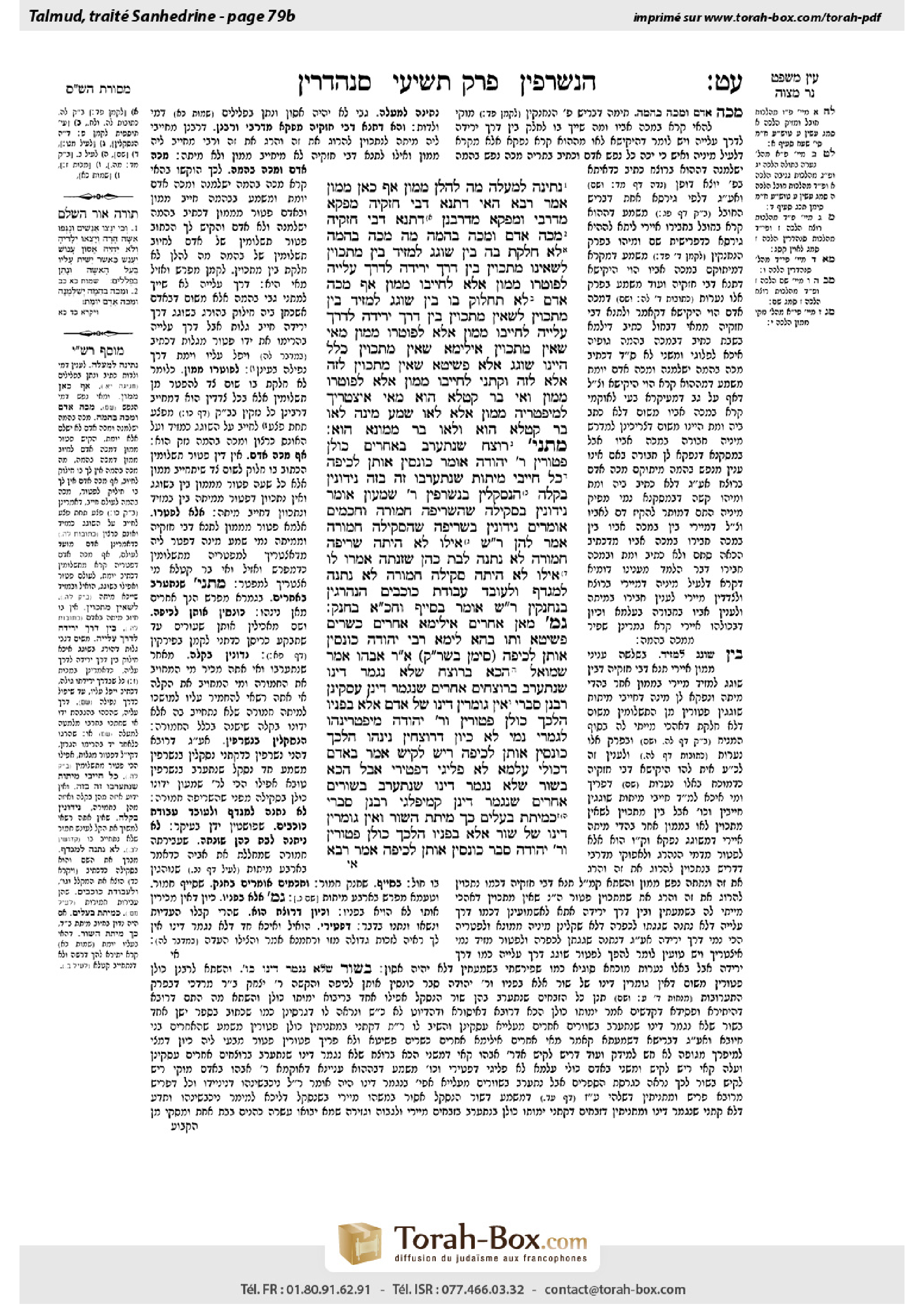
Sanhedrin 79b: Talmud study for Daf Yomi
Daf Yomi is the daily study of one Talmud folio. Explore 37 tractates with scans, Hebrew text, Sefaria English and AI-generated French translations where annotated.
Passage selection and English or AI-generated French translation are available where the scan has annotations. Daf Study is independent of Torah-Box and Sefaria.
Browse Sanhedrin · סנהדרין · All tractatesSanhedrin 79b text and translations
This page of Sanhedrin includes the Aramaic text, an English translation and an AI-generated French translation, alongside the scan above.
סנהדרין ע״ט ב · Aramaic and Hebrew text
נְתִינָה לְמַעְלָה: מָה לְהַלָּן מָמוֹן, אַף כָּאן מָמוֹן.
אָמַר רָבָא: הָאי דְּתָנָא דְּבֵי חִזְקִיָּה מַפְּקָא מִדְּרַבִּי, וּמַפְּקָא מִדְּרַבָּנַן. דְּתָנָא דְּבֵי חִזְקִיָּה: ״מַכֵּה אָדָם״ וּ״מַכֵּה בְּהֵמָה״.
מָה מַכֵּה בְּהֵמָה לֹא חִלַּקְתָּ בָּהּ בֵּין שׁוֹגֵג לְמֵזִיד, בֵּין מִתְכַּוֵּין לְשֶׁאֵינוֹ מִתְכַּוֵּין, בֵּין דֶּרֶךְ יְרִידָה לְדֶרֶךְ עֲלִיָּיה – לְפוֹטְרוֹ מָמוֹן אֶלָּא לְחַיְּיבוֹ מָמוֹן. אַף מַכֵּה אָדָם לֹא תַּחְלוֹק בּוֹ בֵּין שׁוֹגֵג לְמֵזִיד, בֵּין מִתְכַּוֵּין לְשֶׁאֵין מִתְכַּוֵּין, בֵּין דֶּרֶךְ יְרִידָה לְדֶרֶךְ עֲלִיָּיה – לְחַיְּיבוֹ מָמוֹן אֶלָּא לְפוֹטְרוֹ מָמוֹן.
מַאי ״שֶׁאֵין מִתְכַּוֵּין״? אִילֵּימָא שֶׁאֵין מִתְכַּוֵּין כְּלָל – הַיְינוּ שׁוֹגֵג! אֶלָּא פְּשִׁיטָא שֶׁאֵין מִתְכַּוֵּין לָזֶה אֶלָּא לָזֶה, וְקָתָנֵי לְחַיְּיבוֹ מָמוֹן אֶלָּא לְפוֹטְרוֹ מָמוֹן. וְאִי בַּר קְטָלָא הוּא, מַאי אִיצְטְרִיךְ לְמִיפְטְרֵיהּ מָמוֹן?
אֶלָּא, לָאו שְׁמַע מִינַּהּ: לָאו בַּר קְטָלָא הוּא, וְלָאו בַּר מָמוֹנָא הוּא.
מַתְנִי׳ רוֹצֵחַ שֶׁנִּתְעָרֵב בַּאֲחֵרִים – כּוּלָּן פְּטוּרִין. רַבִּי יְהוּדָה אוֹמֵר: כּוֹנְסִין אוֹתָן לַכִּיפָּה.
כׇּל חַיָּיבֵי מִיתוֹת שֶׁנִּתְעָרְבוּ זֶה בָּזֶה – נִידּוֹנִין בַּקַּלָּה. הַנִּסְקָלִין בַּנִּשְׂרָפִין – רַבִּי שִׁמְעוֹן אוֹמֵר: נִידּוֹנִין בִּסְקִילָה, שֶׁהַשְּׂרֵיפָה חֲמוּרָה. וַחֲכָמִים אוֹמְרִים: נִידּוֹנִין בִּשְׂרֵיפָה, שֶׁהַסְּקִילָה חֲמוּרָה.
אָמַר לָהֶן רַבִּי שִׁמְעוֹן: אִילּוּ לֹא הָיְתָה שְׂרֵיפָה חֲמוּרָה, לֹא נִתְּנָה לְבַת כֹּהֵן שֶׁזִּנְּתָה. אָמְרוּ לוֹ: אִילּוּ לֹא הָיְתָה סְקִילָה חֲמוּרָה, לֹא נִתְּנָה לִמְגַדֵּף וּלְעוֹבֵד עֲבוֹדָה זָרָה.
הַנֶּהֱרָגִין בַּנֶּחְנָקִין, רַבִּי שִׁמְעוֹן אוֹמֵר: בְּסַיִיף, וַחֲכָמִים אוֹמְרִים: בְּחֶנֶק.
גְּמָ׳ מַאן אֲחֵרִים? אִילֵּימָא אֲחֵרִים כְּשֵׁרִים, פְּשִׁיטָא! וְתוּ, בְּהָא לֵימָא רַבִּי יְהוּדָה: כּוֹנְסִין אוֹתָן לְכִיפָּה?
(סימן בשק״ר).
אָמַר רַבִּי אֲבָהוּ אָמַר שְׁמוּאֵל: הָכָא בְּרוֹצֵחַ שֶׁלֹּא נִגְמַר דִּינוֹ, שֶׁנִּתְעָרֵב בְּרוֹצְחִים אֲחֵרִים שֶׁנִּגְמַר דִּינָן, עָסְקִינַן. רַבָּנַן סָבְרִי: אֵין גּוֹמְרִין דִּינוֹ שֶׁל אָדָם אֶלָּא בְּפָנָיו, הִלְכָּךְ כּוּלָּן פְּטוּרִין. וְרַבִּי יְהוּדָה: מִיפְטְרִינְהוּ לִגְמָרֵי נָמֵי לָא, כֵּיוָן דְּרוֹצְחִין נִינְהוּ. הִלְכָּךְ כּוֹנְסִין אוֹתָן לַכִּיפָּה.
רֵישׁ לָקִישׁ אָמַר: בְּאָדָם, דְּכוּלֵּי עָלְמָא לָא פְּלִיגִי דִּפְטִירִי. אֲבָל הָכָא, בְּשׁוֹר שֶׁלֹּא נִגְמַר דִּינוֹ שֶׁנִּתְעָרֵב בִּשְׁוָרִים אֲחֵרִים שֶׁנִּגְמַר דִּינָן, קָמִיפַּלְגִי. רַבָּנַן סָבְרִי: כְּמִיתַת בְּעָלִים כָּךְ מִיתַת הַשּׁוֹר, וְאֵין גּוֹמְרִין דִּינוֹ שֶׁל שׁוֹר אֶלָּא בְּפָנָיו, הִלְכָּךְ כּוּלָּן פְּטוּרִין. וְרַבִּי יְהוּדָה סָבַר: כּוֹנְסִין אוֹתָן לַכִּיפָּה.
אָמַר רָבָא:
Sanhedrin 79b · English translation
giving above: “He shall be punished, as the husband of the woman shall impose upon him, and he shall give as the judges determine” (Exodus 21:22). Just as there, in the phrase: “Give as the judges determine,” the reference is to monetary restitution, so too here, in the phrase: “Give a life for a life,” the reference is to monetary restitution.
Rava says: That which the school of Ḥizkiyya taught diverges from the statement of Rabbi Yehuda HaNasi, and diverges from the statement of the Rabbis. The school of Ḥizkiyya holds that in the case where one intended to kill one individual and killed another individual, he is exempt from both liability to be executed, counter to the opinion of the Rabbis, and from the obligation to pay monetary restitution. As the school of Ḥizkiyya taught: The verse states: “And he who kills an animal shall pay for it, and he who kills a man shall be put to death” (Leviticus 24:21), indicating that one who kills a man and one who kills an animal are comparable.
This teaches that just as with regard to one who kills an animal, the Torah did not differentiate between whether he does so unwittingly or intentionally, whether he acts with intent or with no intent, or whether he strikes in the course of a downward motion or in the course of an upward motion, and this is not to exempt him from paying monetary restitution in all these cases but rather to render him liable to pay monetary restitution, as one who kills an animal is liable in any event; similarly, with regard to one who kills a person, do not differentiate concerning him whether he does so unwittingly or unintentionally, whether he acts with intent or with no intent, or whether he strikes in the course of a downward motion or in the course of an upward motion, and this is not to render him liable to pay monetary restitution for the damage he causes in the process of killing him but rather to exempt him from paying monetary restitution in any event.
Accordingly, it is derived from here that one who commits a transgression carrying the death penalty is exempt from paying damages for his action, even if he is not given the death penalty in practice. The Gemara asks: What is the meaning of with no intent? If we say that it means that he had no intent to kill at all and he happened to kill a person, that is unwitting murder that is mentioned explicitly in the baraita. Rather, it is obvious that the reference in the baraita is to one who does not intend to kill this individual, but does intend to kill that individual. And it is taught: This is not to render him liable to pay monetary restitution for the damage he causes in the process of killing him but rather to exempt him from paying monetary restitution. And if according to the school of Ḥizkiyya he is liable to be executed, for what reason was it necessary to exempt him from monetary restitution? Clearly the halakha is that one who is executed is exempt from payment.
Rather, must one not conclude from it that he is neither liable to be executed, nor is he liable to pay monetary restitution. With regard to liability to be executed in a case where one intended to kill one individual and he killed another, the school of Ḥizkiyya holds in accordance with the opinion of Rabbi Shimon that he is exempt from the death penalty, and holds that he is exempt from paying monetary restitution as well.
MISHNA: With regard to a murderer who was intermingled with others and it is not possible to identify the murderer, all of them are exempt from liability to be executed. Rabbi Yehuda says: The court gathers them into the vaulted chamber [lakippa] where they will eventually die.
With regard to all those liable to be executed with different court-imposed death penalties who became intermingled with each other and it cannot be determined which individual was sentenced to which death, they are all sentenced to the most lenient form of execution to which any of them was sentenced. In a case where those who are liable to be stoned were intermingled with those who are liable to be burned, Rabbi Shimon says: They are all sentenced to be executed by stoning, as burning is a more severe form of execution than stoning. And the Rabbis say: They are all sentenced to be executed by burning, as stoning is a more severe form of execution than burning.
Rabbi Shimon said to the Rabbis: If burning were not more severe than stoning, it would not have been administered to a priest’s daughter who committed adultery. A betrothed daughter of an Israelite who committed adultery is executed by stoning. If burning were not a more severe form of execution than stoning, it would not have been administered to the daughter of a priest who committed adultery, who would presumably receive a more severe punishment. The Rabbis said to Rabbi Shimon: If stoning were not more severe than burning it would not have been the death penalty administered to a blasphemer and to an idol worshipper, as their actions violate the very core of the Jewish faith.
There is a parallel dispute: In a case where those who are liable to be killed by beheading were intermingled with those who are liable to be strangled, Rabbi Shimon says: They are all sentenced to be beheaded with a sword, as strangulation is a more severe form of execution than beheading. And the Rabbis say: They are all sentenced to be executed by strangulation, as beheading is a more severe form of execution than strangulation.
GEMARA: The mishna teaches the halakha of a murderer who was intermingled with others. The Gemara asks: Who are the others with whom he was intermingled? If we say that the others are upstanding individuals, it is obvious that they are exempt; why would they all be punished for the transgression of one who happened to be among them? And furthermore, shall Rabbi Yehuda say in that case: The court gathers them into the vaulted chamber where they will eventually die? Can innocent people be left to die in this manner?
The Gemara cites a mnemonic, beit, shin, kuf, reish, for the Sages who address the above question: Rabbi Abbahu citing Shmuel, Reish Lakish, and Rava.
Rabbi Abbahu says that Shmuel says: Here we are dealing with a murderer about whom witnesses testified and the judges deliberated, but his verdict was not yet finalized; and he was incarcerated until the end of his trial, and he was intermingled with other murderers whose verdicts were already finalized. It cannot be determined which of them is the murderer whose verdict was not yet finalized so that he may be brought to court for the verdict. The reason for the dispute is: The Rabbis hold that a court finalizes a person’s verdict only in his presence. Since the identity of the one whose verdict was not finalized is unknown, he cannot be sentenced to death. Since one of them cannot be executed, none of them can be executed; therefore, they are all exempt. And Rabbi Yehuda holds: Completely exempting them is also not possible, since they are murderers. Therefore, the court gathers them into the vaulted chamber.
Reish Lakish says: In the case where a person who was accused of killing another was intermingled with others, everyone agrees that they are all exempt, because one is not punished for a murder committed by others. But here, it is with regard to an ox whose verdict for goring a person to death was not yet finalized, that was intermingled with other oxen whose verdict was already finalized, that they disagree. The Rabbis hold that based on the juxtaposition between them (see Exodus 21:29), the halakha is that like the death of the owner, so is the death of the ox, and just as a court finalizes an individual’s verdict only in his presence, a court finalizes the verdict of an ox only in its presence. Therefore, all the oxen are exempt. And Rabbi Yehuda holds that the court gathers them into the vaulted chamber. Since it is an ox that gored, and the other oxen were sentenced to be stoned, they are incarcerated until they die.
Rava says:
Sanhedrin 79b · Traduction française (IA)
qui précède : « Il sera puni selon ce que le mari de la femme lui imposera, et il paiera selon ce que les juges détermineront » (Exode 21,22). De même que là, dans l’expression « il paiera selon ce que les juges détermineront », il s’agit d’une indemnisation pécuniaire, de même ici, dans l’expression « une vie pour une vie », il s’agit d’une indemnisation pécuniaire.
Rava dit : L’enseignement de l’école de Ḥizkiyya diverge de celui de Rabbi Yehouda HaNassi et de celui des Rabbins. L’école de Ḥizkiyya considère que, dans le cas où quelqu’un avait l’intention de tuer un individu et en a tué un autre, il est exempt à la fois de la peine de mort — contrairement à l’opinion des Rabbins — et de l’obligation de verser une indemnisation pécuniaire. Car l’école de Ḥizkiyya a enseigné : Le verset dit : « Celui qui tue un animal le paiera, et celui qui tue un homme sera mis à mort » (Lévitique 24,21), ce qui indique que celui qui tue un homme et celui qui tue un animal sont comparables.
Cela enseigne que, de même que pour celui qui tue un animal, la Torah ne fait pas de distinction selon qu’il agit par inadvertance ou intentionnellement, avec ou sans intention, ni selon qu’il frappe dans un mouvement descendant ou ascendant — et que cela ne vise pas à l’exempter de l’indemnisation pécuniaire dans tous ces cas, mais au contraire à l’y obliger, puisqu’il est de toute façon tenu de payer lorsqu’il tue un animal —, de même, pour celui qui tue une personne, ne faites pas de distinction selon qu’il agit par inadvertance ou sans intention, avec ou sans intention, ni selon qu’il frappe dans un mouvement descendant ou ascendant ; cela ne vise pas à l’obliger à verser une indemnisation pécuniaire pour le dommage qu’il cause en la tuant, mais au contraire à l’en exempter dans tous les cas.
Il en ressort donc que celui qui commet une transgression passible de la peine de mort est exempt de payer des dommages pour son acte, même si, en pratique, il n’est pas condamné à mort. La Guemara demande : Que signifie « sans intention » ? Si nous disons que cela signifie qu’il n’avait aucune intention de tuer et qu’il a tué une personne par hasard, il s’agit alors d’un homicide involontaire, mentionné explicitement dans la baraïta. Il est donc évident que, dans la baraïta, l’expression désigne celui qui n’a pas l’intention de tuer cet individu, mais a l’intention d’en tuer un autre. Or, il est enseigné : cela ne vise pas à l’obliger à verser une indemnisation pécuniaire pour le dommage qu’il cause en la tuant, mais au contraire à l’en exempter. Et si, selon l’école de Ḥizkiyya, il est passible de la peine de mort, pourquoi aurait-il été nécessaire de l’exempter de l’indemnisation pécuniaire ? Il est clair que la halakha est que celui qui est exécuté est exempt de paiement.
Ne faut-il pas plutôt en conclure qu’il n’est passible ni de la peine de mort ni d’une indemnisation pécuniaire ? Quant à la peine de mort, dans le cas où quelqu’un avait l’intention de tuer un individu et en a tué un autre, l’école de Ḥizkiyya suit l’opinion de Rabbi Shimon, selon laquelle il est exempt de cette peine, et considère également qu’il est exempt d’indemnisation pécuniaire.
MICHNA : À propos d’un meurtrier qui a été mêlé à d’autres et qu’il est impossible d’identifier, tous sont exempts de la peine de mort. Rabbi Yehouda dit : Le tribunal les rassemble dans la chambre voûtée [lakippa], où ils finiront par mourir.
Lorsque des personnes passibles de différentes peines de mort prononcées par le tribunal ont été mêlées les unes aux autres et qu’il est impossible de déterminer laquelle a été condamnée à quelle peine, elles sont toutes condamnées à la forme d’exécution la moins sévère parmi celles auxquelles l’une d’elles a été condamnée. Si des personnes passibles de la lapidation ont été mêlées à des personnes passibles du bûcher, Rabbi Shimon dit : Elles sont toutes condamnées à la lapidation, car le bûcher est une forme d’exécution plus sévère que la lapidation. Les Rabbins disent : Elles sont toutes condamnées au bûcher, car la lapidation est une forme d’exécution plus sévère que le bûcher.
Rabbi Shimon dit aux Rabbins : Si le bûcher n’était pas plus sévère que la lapidation, il n’aurait pas été infligé à la fille d’un prêtre qui a commis un adultère. Une fille fiancée d’un Israélite qui commet un adultère est lapidée. Si le bûcher n’était pas une forme d’exécution plus sévère que la lapidation, il n’aurait pas été infligé à la fille d’un prêtre qui a commis un adultère, laquelle recevrait vraisemblablement une peine plus sévère. Les Rabbins répondirent à Rabbi Shimon : Si la lapidation n’était pas plus sévère que le bûcher, elle n’aurait pas été la peine de mort infligée au blasphémateur et à l’idolâtre, puisque leurs actes portent atteinte au cœur même de la foi juive.
Un désaccord parallèle existe : lorsque des personnes passibles de la décapitation ont été mêlées à des personnes passibles de l’étranglement, Rabbi Shimon dit : Elles sont toutes condamnées à être décapitées à l’épée, car l’étranglement est une forme d’exécution plus sévère que la décapitation. Les Rabbins disent : Elles sont toutes condamnées à l’étranglement, car la décapitation est une forme d’exécution plus sévère que l’étranglement.
GUEMARA : La Michna enseigne la halakha d’un meurtrier qui a été mêlé à d’autres. La Guemara demande : Qui sont ces autres parmi lesquels il a été mêlé ? Si nous disons qu’il s’agit de personnes intègres, il est évident qu’elles sont exemptes ; pourquoi seraient-elles toutes punies pour la transgression d’une personne qui se trouvait là par hasard ? En outre, Rabbi Yehouda pourrait-il dire, dans ce cas, que le tribunal les rassemble dans la chambre voûtée où elles finiront par mourir ? Peut-on laisser ainsi des innocents mourir ?
La Guemara donne un moyen mnémotechnique — beit, shin, kuf, reish — pour les Sages qui répondent à la question ci-dessus : Rabbi Abbahou au nom de Shmouel, Reish Lakish et Rava.
Rabbi Abbahou dit au nom de Shmouel : Il s’agit ici d’un meurtrier au sujet duquel des témoins ont témoigné et les juges ont délibéré, mais dont le verdict n’a pas encore été prononcé définitivement ; il était détenu jusqu’à la fin de son procès et a été mêlé à d’autres meurtriers dont les verdicts avaient déjà été prononcés définitivement. Il est impossible de déterminer lequel d’entre eux est celui dont le verdict n’a pas été prononcé définitivement, afin de le conduire devant le tribunal pour que le verdict soit rendu. La raison du désaccord est la suivante : les Rabbins considèrent que le tribunal ne prononce définitivement le verdict d’une personne qu’en sa présence. Puisqu’on ignore l’identité de celui dont le verdict n’a pas été prononcé définitivement, il ne peut pas être condamné à mort. Comme aucun d’eux ne peut être exécuté, aucun ne peut l’être ; ils sont donc tous exempts. Rabbi Yehouda, lui, considère qu’il n’est pas non plus possible de les exempter complètement, puisqu’ils sont des meurtriers. Le tribunal les rassemble donc dans la chambre voûtée.
Reish Lakish dit : Dans le cas où une personne accusée d’en avoir tué une autre a été mêlée à d’autres, tous conviennent qu’elles sont toutes exemptes, car on ne punit pas quelqu’un pour un meurtre commis par d’autres. Mais leur désaccord porte ici sur un bœuf dont le verdict pour avoir encorné mortellement une personne n’avait pas encore été prononcé définitivement, et qui a été mêlé à d’autres bœufs dont le verdict avait déjà été prononcé définitivement. Les Rabbins considèrent que, sur la base du rapprochement entre eux (voir Exode 21,29), la halakha est que, comme la mort du propriétaire, ainsi est la mort du bœuf ; et de même que le tribunal ne prononce définitivement le verdict d’un individu qu’en sa présence, il ne prononce définitivement celui d’un bœuf qu’en sa présence. Tous les bœufs sont donc exempts. Rabbi Yehouda considère que le tribunal les rassemble dans la chambre voûtée. Puisqu’il s’agit d’un bœuf qui a encorné, et que les autres bœufs ont été condamnés à la lapidation, ils sont détenus jusqu’à leur mort.
Rava dit :
Traduction française générée par IA à partir de l’édition anglaise de Sefaria. Vérifie toujours un passage avec le texte source.
Text from Sefaria: William Davidson Edition - Vocalized Aramaic (CC BY NC); William Davidson Edition - English (CC BY NC).