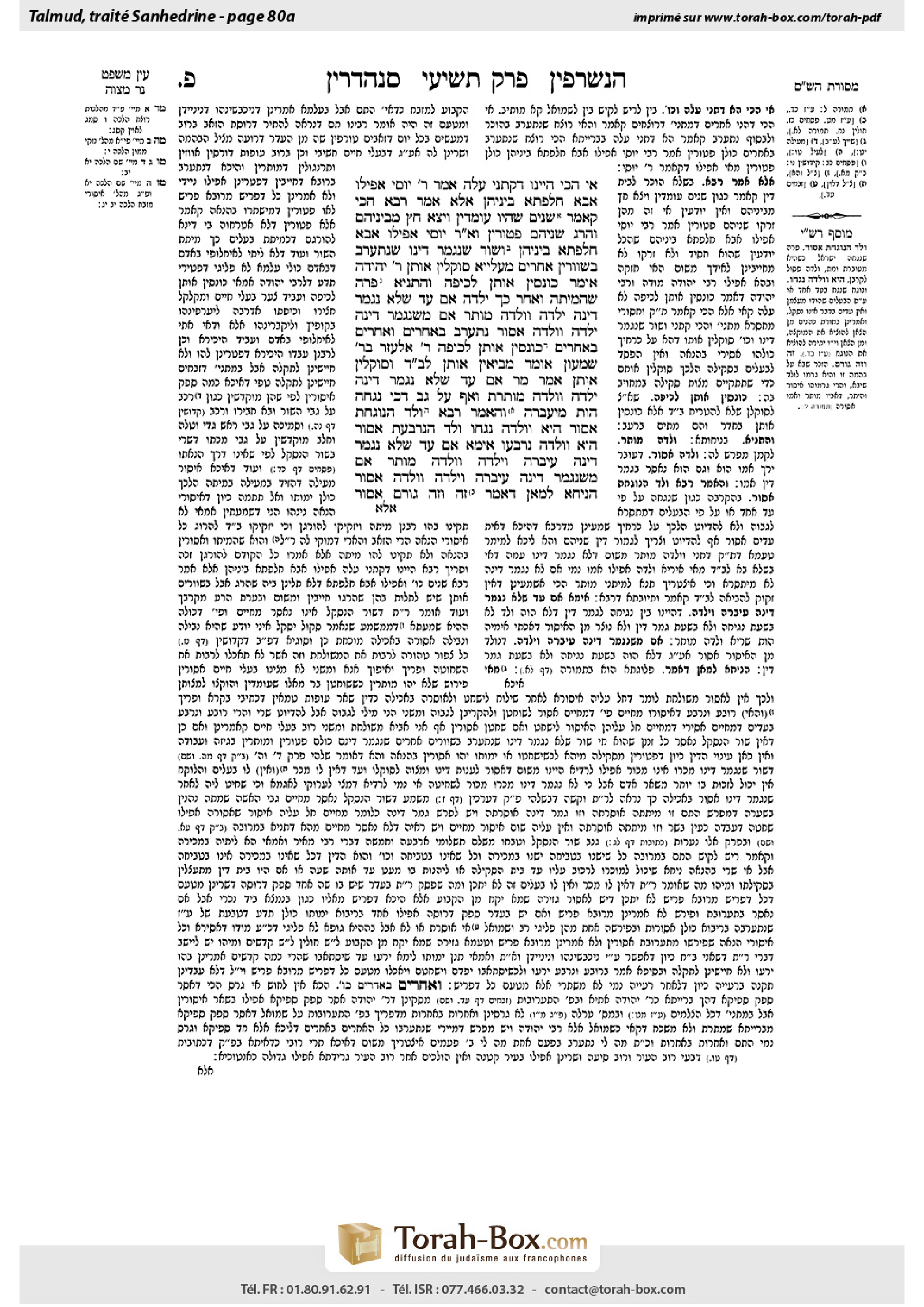
Sanhedrin 80a: Talmud study for Daf Yomi
Daf Yomi is the daily study of one Talmud folio. Explore 37 tractates with scans, Hebrew text, Sefaria English and AI-generated French translations where annotated.
Passage selection and English or AI-generated French translation are available where the scan has annotations. Daf Study is independent of Torah-Box and Sefaria.
Browse Sanhedrin · סנהדרין · All tractatesSanhedrin 80a text and translations
This page of Sanhedrin includes the Aramaic text, an English translation and an AI-generated French translation, alongside the scan above.
סנהדרין פ׳ א · Aramaic and Hebrew text
אִי הָכִי, הַיְינוּ דְּקָתָנֵי עֲלַהּ: אָמַר רַבִּי יוֹסֵי: אֲפִילּוּ אַבָּא חֲלַפְתָּא בֵּינֵיהֶן?
אֶלָּא אָמַר רָבָא: הָכִי קָאָמַר, שְׁנַיִם שֶׁהָיוּ עוֹמְדִין, וְיָצָא חֵץ מִבֵּינֵיהֶם וְהָרַג – שְׁנֵיהֶם פְּטוּרִין. וְאָמַר רַבִּי יוֹסֵי: אֲפִילּוּ אַבָּא חֲלַפְתָּא בֵּינֵיהֶן.
וְשׁוֹר שֶׁנִּגְמַר דִּינוֹ, שֶׁנִּתְעָרֵב בִּשְׁוָורִין אֲחֵרִים מְעַלְּיֵי – סוֹקְלִין אוֹתָן. רַבִּי יְהוּדָה אוֹמֵר: כּוֹנְסִין אוֹתָן לַכִּיפָּה.
וְהָתַנְיָא: פָּרָה שֶׁהֵמִיתָה וְאַחַר כָּךְ יָלְדָה, אִם עַד שֶׁלֹּא נִגְמַר דִּינָה יָלְדָה – וְולָדָהּ מוּתָּר, אִם מִשֶּׁנִּגְמַר דִּינָה יָלְדָה – וְולָדָהּ אָסוּר. נִתְעָרֵב בַּאֲחֵרִים וַאֲחֵרִים בַּאֲחֵרִים – כּוֹנְסִין אוֹתָן לַכִּיפָּה. רַבִּי אֶלְעָזָר בְּרַבִּי שִׁמְעוֹן אוֹמֵר: מְבִיאִין אוֹתָן לְבֵית דִּין וְסוֹקְלִין אוֹתָן.
אָמַר מָר: אִם עַד שֶׁלֹּא נִגְמַר דִּינָה יָלְדָה, וְולָדָהּ מוּתָּר. וְאַף עַל גַּב דְּכִי נְגַחָה הֲוָת מְיעַבְּרָה? וְהָאָמַר רָבָא: וְלַד הַנּוֹגַחַת אָסוּר – הִיא וּוְלָדָהּ נָגְחוּ; וְלַד הַנִּרְבַּעַת אָסוּר – הִיא וּוְלָדָהּ נִרְבְּעוּ!
אֵימָא: אִם עַד שֶׁלֹּא נִגְמַר דִּינָה עִיבְּרָה וְיָלְדָה – וְולָדָהּ מוּתָּר; אִם מִשֶּׁנִּגְמַר דִּינָה עִיבְּרָה וְיָלְדָה – וְולָדָהּ אָסוּר.
הָנִיחָא לְמַאן דְּאָמַר: זֶה וָזֶה גּוֹרֵם – אָסוּר.
Sanhedrin 80a · English translation
If so, according to Shmuel or Reish Lakish, is that compatible with that which is taught in a baraita with regard to the mishna, that Rabbi Yosei says: This is the halakha even if Abba Ḥalafta, i.e., Rabbi Yosei’s father, who himself was a righteous Sage, was among them? This is difficult according to Shmuel, as Rabbi Yosei would certainly not include his father in a group of murderers, and according to Reish Lakish, what is the connection between Rabbi Yosei’s father and a group of oxen?
Rather, Rava says: This is what the mishna is saying: In a case where two people were standing together and an arrow emerged from their midst and killed a person, since it is not known which of them shot the arrow, both of them are exempt. And Rabbi Yosei says: This is the halakha even if Abba Ḥalafta was among them. Even if one of the two people from among whom the arrow emerged was a righteous individual like Abba Ḥalafta, who presumably is not a murderer, since there is no conclusive testimony identifying the shooter, uncertainty remains and both are exempt.
The tanna then proceeds to discuss a different matter. And an ox whose verdict was finalized, that was sentenced to execution by stoning, and that was intermingled with other ordinary oxen, i.e., oxen that did not gore, the court stones all of them. Rabbi Yehuda says: They are placed in a vaulted chamber.
The Gemara notes: And it is taught in a baraita: In the case of a cow that killed a person, and thereafter calved, if it was before its verdict was finalized that the cow calved, its offspring is permitted. If it was after its verdict was finalized that the cow calved, its offspring is prohibited, as it was prohibited together with the cow. If the cow was intermingled with other cows and the identity of the cow that killed cannot be determined, and those other cows were intermingled with yet others, the court gathers them into a vaulted chamber. Rabbi Elazar, son of Rabbi Shimon, says: One brings them to court and the court stones them. The unattributed baraita is in accordance with the opinion of Rabbi Yehuda in the mishna.
The Master says in the baraita: If the cow calved before its verdict was finalized, its offspring is permitted. The Gemara asks: And is that the ruling even though when it gored it was already pregnant? But doesn’t Rava say with regard to the offspring of a cow that gores while pregnant: It is prohibited to bring it as an offering, like any animal that killed a person, as the cow and its unborn offspring gored together. And similarly, with regard to the offspring of a cow that was the object of bestiality while the offspring was in utero: It is prohibited to bring it as an offering, as the cow and its unborn offspring were the object of bestiality together. The baraita poses a difficulty according to Rava.
The Gemara answers: Emend the baraita and say that the reference is not to a case where a cow that was pregnant gored; rather, the reference is to a case where a cow was impregnated after it gored, and this is the distinction: If before its verdict was finalized the cow was impregnated and calved, its offspring is permitted; if after its verdict was finalized the cow was impregnated and calved, its offspring is forbidden together with it.
The Gemara challenges: This works out well according to the one who says that in a case where this permitted factor and that forbidden factor cause an outcome to be produced, that outcome is forbidden. The offspring that was produced from a bull from which deriving benefit is permitted and a cow from which deriving benefit is forbidden is therefore forbidden as well.
Sanhedrin 80a · Traduction française (IA)
S'il en est ainsi, selon Chmouel ou Reish Lakish, cela est-il compatible avec ce qui est enseigné dans une baraïta concernant la Michna, à savoir que Rabbi Yosei dit : « C'est la halakha, même si Abba Ḥalafta, c'est-à-dire le père de Rabbi Yosei, qui était lui-même un sage vertueux, se trouvait parmi eux ? » Cela pose une difficulté selon Chmouel, car Rabbi Yosei n'inclurait certainement pas son père dans un groupe d'assassins ; et selon Reish Lakish, quel est le lien entre le père de Rabbi Yosei et un groupe de bœufs ?
Plutôt, Rava dit : C'est ce que la Michna signifie : Dans un cas où deux personnes se tenaient ensemble et une flèche est sortie de leur milieu pour tuer un homme, comme on ne sait pas laquelle d'entre elles a tiré la flèche, les deux sont exemptes. Et Rabbi Yosei dit : « C'est la halakha, même si Abba Ḥalafta se trouvait parmi eux. » Même si l'une des deux personnes d'entre lesquelles la flèche est sortie était un individu vertueux comme Abba Ḥalafta, qui n'est vraisemblablement pas un assassin, comme il n'y a pas de témoignage concluant identifiant le tireur, l'incertitude demeure et les deux sont exemptes.
Le tanna procède ensuite à discuter une autre affaire. Et un bœuf dont le verdict a été finalisé, c'est-à-dire condamné à la lapidation, et qui s'est mêlé à d'autres bœufs ordinaires, c'est-à-dire des bœufs qui n'ont pas éperonné, le tribunal lapide tous. Rabbi Yehouda dit : Ils sont placés dans une chambre voûtée.
La Guemara note : Il est enseigné dans une baraïta : Dans le cas d'une vache qui a tué un homme, et qui a ensuite vêlé, si elle a vêlé avant que son verdict ne soit définitif, son veau est permis. Si elle a vêlé après que son verdict a été définitif, son veau est interdit, car il a été interdit avec la vache. Si la vache s'est mêlée à d'autres vaches et que l'identité de la vache qui a tué ne peut être déterminée, et que ces autres vaches se sont mêlées à d'autres encore, le tribunal les rassemble dans une chambre voûtée. Rabbi Elazar, fils de Rabbi Chimon, dit : On les amène devant le tribunal et le tribunal les lapide. Cette baraïta anonyme est conforme à l'opinion de Rabbi Yehouda dans la Michna.
Le Maître dit dans la baraïta : Si la vache a vêlé avant que son verdict ne soit définitif, son veau est permis. La Guemara demande : Et est-ce le jugement même si, lorsqu'elle a éperonné, elle était déjà enceinte ? Mais Rava ne dit-il pas au sujet du veau d'une vache qui éperonne alors qu'elle est enceinte : Il est interdit de l'offrir en sacrifice, comme tout animal qui a tué un homme, car la vache et son veau non né ont éperonné ensemble. Et de même, au sujet du veau d'une vache qui a été l'objet d'un acte de bestialité alors que le veau était dans le ventre : Il est interdit de l'offrir en sacrifice, car la vache et son veau non né ont été l'objet de bestialité ensemble. La baraïta pose une difficulté selon Rava.
La Guemara répond : Corrige la baraïta et dis que la référence n'est pas à un cas où une vache enceinte a éperonné ; plutôt, la référence est à un cas où une vache a été fécondée après avoir éperonné, et voici la distinction : Si avant que son verdict ne soit définitif la vache a été fécondée et a vêlé, son veau est permis ; si après que son verdict a été définitif la vache a été fécondée et a vêlé, son veau est interdit avec elle.
La Guemara objecte : Cela se concilie bien avec l'avis de celui qui soutient que lorsqu'un facteur permis et un facteur interdit concourent à produire un résultat, ce résultat est interdit. La descendance issue d'un taureau dont l'exploitation est permise et d'une vache dont l'exploitation est interdite est donc, elle aussi, interdite.
Traduction française générée par IA à partir de l’édition anglaise de Sefaria. Vérifie toujours un passage avec le texte source.
Text from Sefaria: William Davidson Edition - Vocalized Aramaic (CC BY NC); William Davidson Edition - English (CC BY NC).