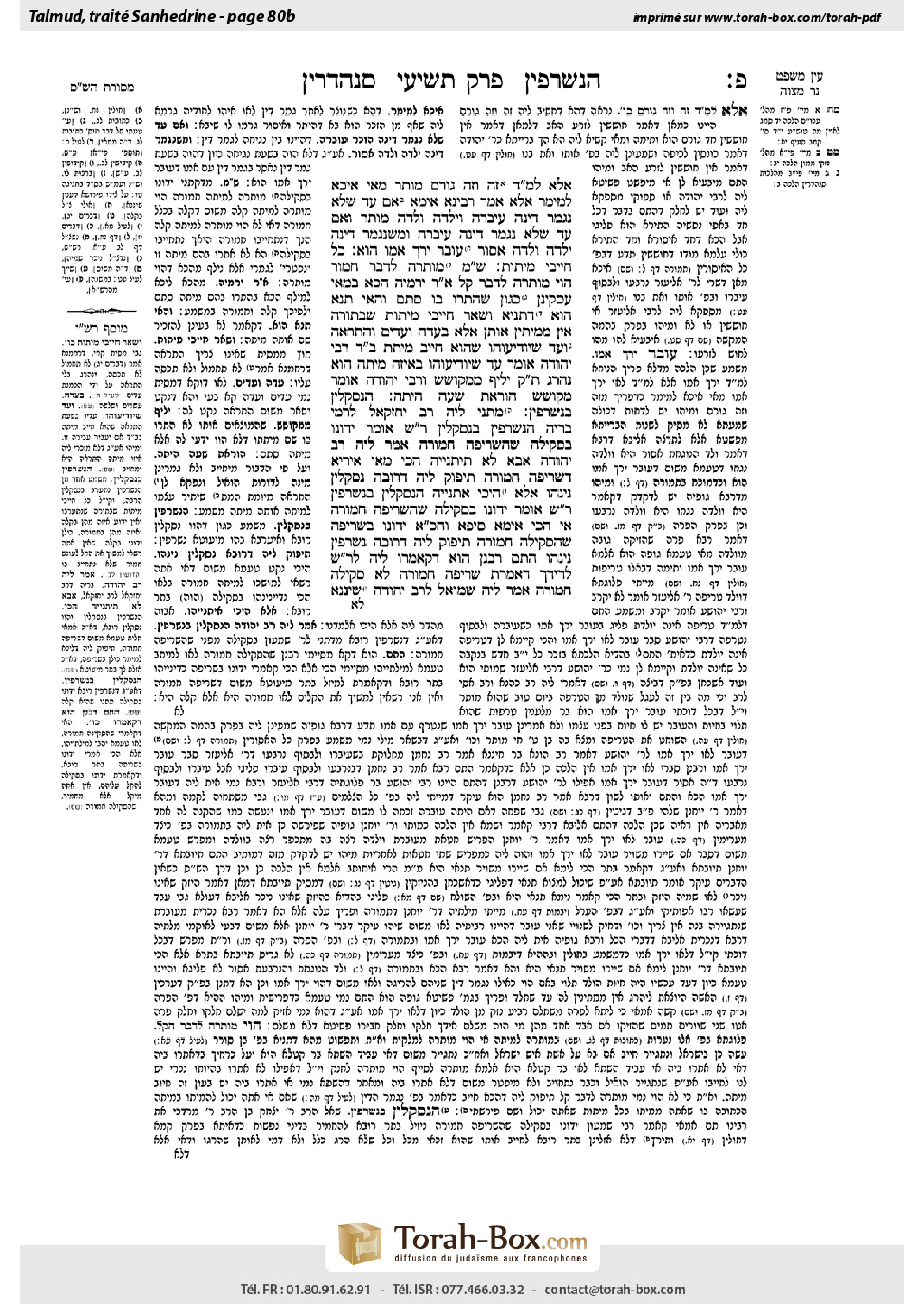
Sanhedrin 80b: Talmud study for Daf Yomi
Daf Yomi is the daily study of one Talmud folio. Explore 37 tractates with scans, Hebrew text, Sefaria English and AI-generated French translations where annotated.
Passage selection and English or AI-generated French translation are available where the scan has annotations. Daf Study is independent of Torah-Box and Sefaria.
Browse Sanhedrin · סנהדרין · All tractatesSanhedrin 80b text and translations
This page of Sanhedrin includes the Aramaic text, an English translation and an AI-generated French translation, alongside the scan above.
סנהדרין פ׳ ב · Aramaic and Hebrew text
אֶלָּא לְמַאן דְּאָמַר: זֶה וָזֶה גּוֹרֵם – מוּתָּר, מַאי אִיכָּא לְמֵימַר?
אֶלָּא אָמַר רָבִינָא: אֵימָא, אִם עַד שֶׁלֹּא נִגְמַר דִּינָה עִיבְּרָה וְיָלְדָה – וְלָדָהּ מוּתָּר, וְאִם עַד שֶׁלֹּא נִגְמַר דִּינָה עִיבְּרָה וּמִשֶּׁנִּגְמַר דִּינָה יָלְדָה – וְלָדָהּ אָסוּר. עוּבָּר יֶרֶךְ אִמּוֹ הוּא.
כׇּל חַיָּיבֵי מִיתוֹת, שְׁמַע מִינַּהּ מוּתְרֶה לְדָבָר חָמוּר – הָוֵי מוּתְרֶה לְדָבָר קַל.
אָמַר רַבִּי יִרְמְיָה: הָכָא בְּמַאי עָסְקִינַן? כְּגוֹן שֶׁהִתְרוּ בּוֹ סְתָם. וְהַאי תַּנָּא הוּא, דְּתַנְיָא: וּשְׁאָר חַיָּיבֵי מִיתוֹת שֶׁבְּתוֹרָה אֵין מְמִיתִין אוֹתָן אֶלָּא בְּעֵדָה וְעֵדִים וְהַתְרָאָה, וְעַד שֶׁיּוֹדִיעוּהוּ שֶׁהוּא חַיָּיב מִיתַת בֵּית דִּין. רַבִּי יְהוּדָה אוֹמֵר: עַד שֶׁיּוֹדִיעוּהוּ בְּאֵיזֶה מִיתָה הוּא נֶהֱרָג.
תַּנָּא קַמָּא יָלֵיף מִמְּקוֹשֵׁשׁ, וְרַבִּי יְהוּדָה אוֹמֵר: מְקוֹשֵׁשׁ הוֹרָאַת שָׁעָה הָיְתָה.
הַנִּסְקָלִין בַּנִּשְׂרָפִין, מַתְנֵי לֵיהּ רַב יְחֶזְקֵאל לְרָמֵי בְּרֵיהּ: הַנִּשְׂרָפִין בַּנִּסְקָלִין, רַבִּי שִׁמְעוֹן אוֹמֵר: יִדּוֹנוּ בִּסְקִילָה, שֶׁהַשְּׂרֵיפָה חֲמוּרָה.
אֲמַר לֵיהּ רַב יְהוּדָה: אַבָּא, לָא תַּיתְנְיֵיהּ הָכִי. מַאי אִירְיָא דִּשְׂרֵיפָה חֲמוּרָה? תִּיפּוֹק לֵיהּ דְּרוּבָּה נִסְקָלִין נִינְהוּ! אֶלָּא: הֵיכִי אַתְנְיֵיהּ?
הַנִּסְקָלִין בַּנִּשְׂרָפִין, רַבִּי שִׁמְעוֹן אוֹמֵר: יִדּוֹנוּ בִּסְקִילָה, שֶׁהַשְּׂרֵיפָה חֲמוּרָה. אִי הָכִי, אֵימָא סֵיפָא: וַחֲכָמִים אוֹמְרִים: יִדּוֹנוּ בִּשְׂרֵיפָה, שֶׁהַסְּקִילָה חֲמוּרָה. תִּיפּוֹק לֵיהּ דְּרוּבָּה נִשְׂרָפִין נִינְהוּ!
הָתָם, רַבָּנַן הוּא דְּקָאָמְרוּ לֵיהּ לְרַבִּי שִׁמְעוֹן: לְדִידָךְ דְּאָמְרַתְּ שְׂרֵיפָה חֲמוּרָה, לָא! סְקִילָה חֲמוּרָה.
אֲמַר לֵיהּ שְׁמוּאֵל לְרַב יְהוּדָה: שִׁינָּנָא,
Sanhedrin 80b · English translation
But according to the one who says that in a case where this permitted factor and that forbidden factor cause an outcome to be produced, that outcome is permitted, what can be said? Since deriving benefit from the bull that sired the offspring is permitted, deriving benefit from the offspring should be permitted as well.
Rather, Ravina says: Emend the baraita and say that the distinction in the baraita is: If before its verdict was finalized, the cow was impregnated and calved, its offspring is permitted. If before its verdict was finalized, the cow was impregnated and after its verdict was finalized it calved, its offspring is forbidden because the legal status of the fetus is not that of an independent entity; rather, its status is like that of its mother’s thigh, i.e., a part of its body. Therefore, when the mother is sentenced to death, the offspring is also forbidden once it is born.
§ The mishna teaches: All those liable to be executed with different court-imposed death penalties who became intermingled are sentenced to the most lenient form of execution. The Gemara notes: Conclude from the mishna that an individual who is forewarned for a severe matter is forewarned for a lesser matter. If one is forewarned that if he violates a certain prohibition then he is liable to be stoned, while in fact, he is liable to be executed with a less severe form of execution, the forewarning is effective and he is executed with the less severe form of execution. That is the reason for the halakha in the mishna that even those liable to be executed with a more severe form of execution are executed with the less severe form of execution.
Rabbi Yirmeya rejects that proof and says: With what are we dealing here? It is a case where the witnesses forewarned the individual that if he violates the prohibition he is liable to be executed, without specification of the mode of execution. And this halakha is in accordance with the opinion of this tanna, as it is taught in a baraita: With regard to all the others, those who are liable for the various death penalties stated in the Torah other than the inciter to idol worship, the court executes them only when the following elements are present: The congregation, represented by the court, and witnesses, and forewarning just before the defendant commits the transgression. And the court does not execute him unless the witnesses informed the defendant that he is liable to receive the death penalty from the court. Rabbi Yehuda says: The defendant is not executed unless the witnesses informed the defendant by which form of death penalty he is to be executed.
Based on the statement of Rabbi Yehuda, it may be inferred that according to the first tanna, although they must inform him that he is liable to be executed, they are not required to inform him of the specific mode of execution. The Gemara explains the basis for the dispute between the first tanna and Rabbi Yehuda: The first tanna derived forewarning from the incident of the wood gatherer (see Numbers 15:32–36), who was executed even though even Moses did not know with which death penalty he was to be executed. Clearly, the mode of execution could not have been included in his forewarning. Rabbi Yehuda says: The execution of the wood gatherer was a provisional edict based on the word of God. The halakha throughout the generations cannot be derived from it.
§ The mishna teaches: In a case where those who are liable to be stoned were intermingled with those who are liable to be burned, Rabbi Shimon says: They are all sentenced to be executed by stoning, and the Rabbis say: They are all sentenced to be executed by burning. Rav Yeḥezkel taught a different version to Rami, his son: In a case where those who are liable to be burned were intermingled with those who are liable to be stoned, Rabbi Shimon says: They shall all be sentenced to execution by stoning, as burning is a more severe form of execution.
Rav Yehuda, son of Rav Yeḥezkel, said to him: Father, do not teach it in that manner, as it is difficult to understand: Why does Rabbi Shimon teach that the reason is specifically that burning is a more severe form of execution than stoning? Derive this halakha, that they are stoned, for a different reason: The principle with regard to a mixture is to follow the majority, and in this case the majority of the intermingled group is liable to be stoned. Rav Yeḥezkel asked Rav Yehuda: Rather, how then shall I teach it?
Rav Yehuda said: You should teach: In a case where those who are liable to be stoned were intermingled with those who are liable to be burned, where the majority is liable to be burned, Rabbi Shimon says: They shall all be sentenced to execution by stoning, as burning is a more severe form of execution. Rav Yeḥezkel, his father, asked: If so, say the latter clause of the mishna: And the Rabbis say: They shall all be sentenced to execution by burning, as stoning is a more severe form of execution. If so, derive this halakha, that they are burned because in this case the majority of the intermingled group is liable to be burned, not because stoning is a more severe form of execution.
Rav Yehuda answered: There, in the latter clause, it is the Rabbis who say to Rabbi Shimon: According to you, who say that burning is a more severe form of execution than stoning, the fact that the majority is liable to be burned does not warrant the execution of the entire group by burning, since the minority was sentenced to stoning, which is more lenient in your opinion. That is not so, as stoning is a more severe form of execution. And that reason is extraneous, as in this case, they are burned because the majority of the group is liable to be burned.
When this narrative was heard, Shmuel said to Rav Yehuda: Long-toothed one:
Sanhedrin 80b · Traduction française (IA)
Mais, selon celui qui dit que, lorsqu’un facteur permis et un facteur interdit produisent un résultat, celui-ci est permis, que peut-on répondre ? Puisqu’il est permis de tirer profit du taureau qui a engendré le petit, il devrait également être permis de tirer profit du petit.
Ravina dit plutôt : corrige la baraïta et enseigne que la distinction qu’elle établit est la suivante : si la vache a été fécondée et a mis bas avant que son verdict ne soit prononcé, son petit est permis. Si la vache a été fécondée avant que son verdict ne soit prononcé, mais qu’elle a mis bas après que celui-ci l’a été, son petit est interdit, car le fœtus n’a pas le statut d’une entité indépendante ; il a plutôt le statut de la cuisse de sa mère, c’est-à-dire qu’il fait partie de son corps. Par conséquent, lorsque la mère est condamnée à mort, le petit est lui aussi interdit dès sa naissance.
§ La Michna enseigne : tous ceux qui sont passibles de différentes peines capitales prononcées par le tribunal et qui se sont retrouvés mêlés sont condamnés à la forme d’exécution la moins sévère. La Guemara relève : concluons de la Michna qu’un individu averti au sujet d’une infraction grave est également averti au sujet d’une infraction moins grave. Si quelqu’un est averti que, s’il transgresse une interdiction donnée, il est passible de lapidation, alors qu’en réalité il est passible d’une forme d’exécution moins sévère, l’avertissement est valable et il est exécuté selon cette forme moins sévère. Telle est la raison de la halakha enseignée dans la Michna : même ceux qui sont passibles d’une forme d’exécution plus sévère sont exécutés selon la forme moins sévère.
Rabbi Yirmeya rejette cette preuve et dit : De quoi s’agit-il ici ? Le cas est celui où les témoins ont averti l’individu qu’en transgressant l’interdiction, il serait passible d’exécution, sans préciser le mode d’exécution. Cette halakha suit l’opinion de ce tanna, comme il est enseigné dans une baraïta : pour tous les autres, c’est-à-dire ceux qui sont passibles des différentes peines capitales énoncées dans la Torah, à l’exception de l’incitateur à l’idolâtrie, le tribunal ne les exécute que si les éléments suivants sont réunis : l’assemblée, représentée par le tribunal, des témoins et un avertissement donné juste avant que l’accusé ne commette la transgression. Le tribunal ne l’exécute que si les témoins l’ont informé qu’il est passible de la peine de mort prononcée par le tribunal. Rabbi Yehuda dit : l’accusé n’est exécuté que si les témoins lui ont indiqué le mode d’exécution auquel il est passible.
On peut déduire de la déclaration de Rabbi Yehuda que, selon le premier tanna, bien que les témoins doivent informer l’accusé qu’il est passible d’exécution, ils ne sont pas tenus de lui préciser le mode d’exécution. La Guemara explique le fondement du désaccord entre le premier tanna et Rabbi Yehuda : le premier tanna déduit les règles de l’avertissement de l’épisode du ramasseur de bois (voir Nombres 15:32–36), qui fut exécuté alors que même Moïse ignorait quelle peine capitale lui serait infligée. Il est donc clair que le mode d’exécution ne pouvait pas avoir été mentionné dans son avertissement. Rabbi Yehuda dit : l’exécution du ramasseur de bois était un décret provisoire fondé sur la parole de Dieu. On ne peut pas en déduire la halakha pour les générations suivantes.
§ La Michna enseigne : dans le cas où ceux qui sont passibles de lapidation se sont retrouvés mêlés à ceux qui sont passibles du bûcher, Rabbi Shimon dit : ils sont tous condamnés à être exécutés par lapidation ; et les Sages disent : ils sont tous condamnés à être exécutés par le bûcher. Rav Yeḥezkel enseigna une autre version à son fils Rami : dans le cas où ceux qui sont passibles du bûcher se sont retrouvés mêlés à ceux qui sont passibles de lapidation, Rabbi Shimon dit : ils sont tous condamnés à être exécutés par lapidation, car le bûcher est une forme d’exécution plus sévère.
Rav Yehuda, fils de Rav Yeḥezkel, lui dit : Père, ne l’enseigne pas de cette manière, car cela est difficile à comprendre : pourquoi Rabbi Shimon précise-t-il que la raison tient au fait que le bûcher est une forme d’exécution plus sévère que la lapidation ? On peut déduire cette halakha, selon laquelle ils sont lapidés, pour une autre raison : dans un mélange, le principe est de suivre la majorité, et, dans ce cas, la majorité du groupe mêlé est passible de lapidation. Rav Yeḥezkel demanda à Rav Yehuda : Comment dois-je donc l’enseigner ?
Rav Yehuda dit : tu dois enseigner : dans le cas où ceux qui sont passibles de lapidation se sont retrouvés mêlés à ceux qui sont passibles du bûcher, et où la majorité est passible du bûcher, Rabbi Shimon dit : ils sont tous condamnés à être exécutés par lapidation, car le bûcher est une forme d’exécution plus sévère. Rav Yeḥezkel, son père, demanda : Dans ce cas, énonce la dernière partie de la Michna : « Et les Sages disent : ils sont tous condamnés à être exécutés par le bûcher, car la lapidation est une forme d’exécution plus sévère. » Il faudrait alors déduire cette halakha — selon laquelle ils sont brûlés — du fait que, dans ce cas, la majorité du groupe mêlé est passible du bûcher, et non du fait que la lapidation est une forme d’exécution plus sévère.
Rav Yehuda répondit : dans la dernière partie, ce sont les Sages qui disent à Rabbi Shimon : selon toi, qui dis que le bûcher est une forme d’exécution plus sévère que la lapidation, le fait que la majorité soit passible du bûcher ne justifie pas que tout le groupe soit exécuté par le bûcher, puisque la minorité a été condamnée à la lapidation, qui est, à ton avis, plus clémente. Ce raisonnement ne tient pas, car la lapidation est une forme d’exécution plus sévère. Cette raison est superflue, puisque, dans ce cas, ils sont exécutés par le bûcher parce que la majorité du groupe est passible du bûcher.
Lorsque ce récit fut rapporté, Shmuel dit à Rav Yehuda : « Toi, aux longues dents ! »
Traduction française générée par IA à partir de l’édition anglaise de Sefaria. Vérifie toujours un passage avec le texte source.
Text from Sefaria: William Davidson Edition - Vocalized Aramaic (CC BY NC); William Davidson Edition - English (CC BY NC).