Sanhedrin 81a: Talmud study for Daf Yomi
Daf Yomi is the daily study of one Talmud folio. Explore 37 tractates with scans, Hebrew text, Sefaria English and AI-generated French translations where annotated.
Passage selection and English or AI-generated French translation are available where the scan has annotations. Daf Study is independent of Torah-Box and Sefaria.
Browse Sanhedrin · סנהדרין · All tractatesSanhedrin 81a text and translations
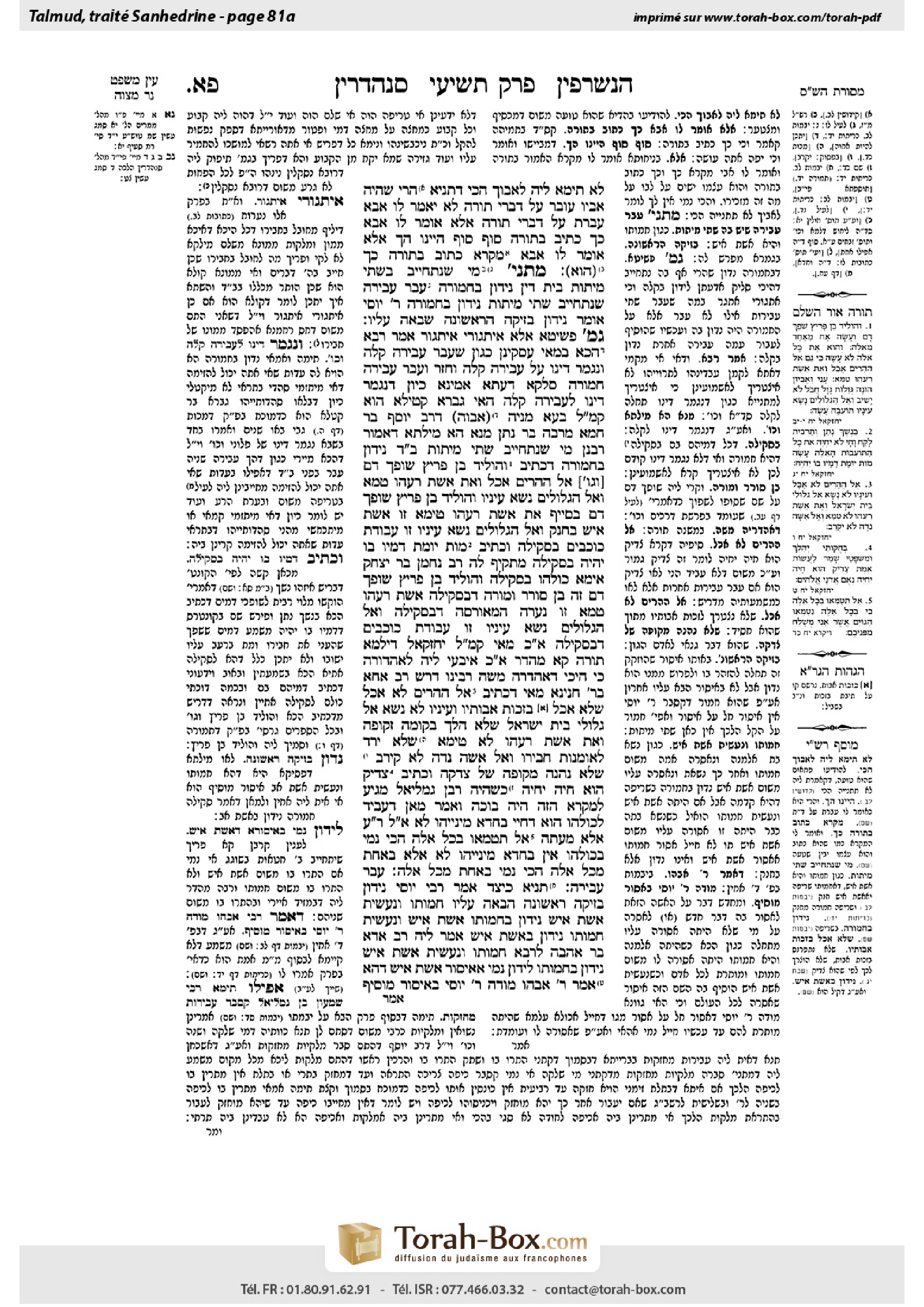
This page of Sanhedrin includes the Aramaic text, an English translation and an AI-generated French translation, alongside the scan above.
סנהדרין פ״א א · Aramaic and Hebrew text
לָא תֵּימָא לֵיהּ לַאֲבוּךְ הָכִי, דְּתַנְיָא: הֲרֵי שֶׁהָיָה אָבִיו עוֹבֵר עַל דִּבְרֵי תוֹרָה, לֹא יֹאמַר לוֹ: ״אַבָּא, עָבַרְתָּ עַל דִּבְרֵי תוֹרָה״, אֶלָּא אוֹמֵר לוֹ: ״אַבָּא, כָּךְ כְּתִיב בַּתּוֹרָה״. סוֹף סוֹף הַיְינוּ הָךְ! אֶלָּא אוֹמֵר לוֹ: ״אַבָּא, מִקְרָא כָּתוּב בַּתּוֹרָה כָּךְ הוּא״.
מַתְנִי׳ מִי שֶׁנִּתְחַיֵּיב בִּשְׁתֵּי מִיתוֹת בֵּית דִּין – נִידּוֹן בַּחֲמוּרָה. עָבַר עֲבֵירָה שֶׁנִּתְחַיֵּיב שְׁתֵּי מִיתוֹת – נִידּוֹן בַּחֲמוּרָה. רַבִּי יוֹסֵי אוֹמֵר: נִידּוֹן בַּזִּיקָּה הָרִאשׁוֹנָה שֶׁבָּאָה עָלָיו.
גְּמָ׳ פְּשִׁיטָא! אֶלָּא, אִיתְּגוֹרֵי אִיתְּגוּר?
אָמַר רָבָא: הָכִי בְּמַאי עָסְקִינַן? כְּגוֹן שֶׁעָבַר עֲבֵירָה קַלָּה, וְנִגְמַר דִּינוֹ עַל עֲבֵירָה קַלָּה, וְחָזַר וְעָבַר עֲבֵירָה חֲמוּרָה. סָלְקָא דַּעְתָּךְ אָמֵינָא: כֵּיוָן דְּנִגְמַר דִּינוֹ לַעֲבֵירָה קַלָּה, הַאי גַּבְרָא קְטִילָא הוּא. קָא מַשְׁמַע לַן.
בְּעָא מִנֵּיהּ אֲבוּהּ דְּרַב יוֹסֵף בַּר חָמָא מֵרַבָּה בַּר נָתָן: מְנַָא הָא מִילְּתָא דַאֲמוּר רַבָּנַן, מִי שֶׁנִּתְחַיֵּיב שְׁתֵּי מִיתוֹת בֵּית דִּין נִידּוֹן בַּחֲמוּרָה? דִּכְתִיב: ״וְהוֹלִיד בֵּן פָּרִיץ שֹׁפֵךְ דָּם [וְגוֹ׳] אֶל הֶהָרִים אָכַל וְאֶת אֵשֶׁת רֵעֵהוּ טִמֵּא וְאֶל הַגִּלּוּלִים נָשָׂא עֵינָיו״.
״וְהוֹלִיד בֵּן פָּרִיץ שֹׁפֵךְ דָּם״ – בְּסַיִיף, ״אֶת אֵשֶׁת רֵעֵהוּ טִמֵּא״ – זוֹ אֵשֶׁת אִישׁ בְּחֶנֶק, ״וְאֶל הַגִּלּוּלִים נָשָׂא עֵינָיו״ – זוֹ עֲבוֹדָה זָרָה בִּסְקִילָה. וּכְתִיב: ״מוֹת יוּמָת דָּמָיו בּוֹ יִהְיֶה״ – בִּסְקִילָה.
מַתְקֵיף לַהּ רַב נַחְמָן בַּר יִצְחָק: אֵימָא כּוּלְּהוּ בִּסְקִילָה. ״וְהוֹלִיד בֵּן פָּרִיץ שֹׁפֵךְ דָּם״ – זֶה בֵּן סוֹרֵר וּמוֹרֶה דְּבִסְקִילָה, ״אֵשֶׁת רֵעֵהוּ טִמֵּא״ – זוֹ נַעֲרָה הַמְאוֹרָסָה דְּבִסְקִילָה, ״וְאֶל הַגִּלּוּלִים נָשָׂא עֵינָיו״ – זוֹ עֲבוֹדָה זָרָה דְּבִסְקִילָה.
אִם כֵּן, מַאי קָא מַשְׁמַע לַן יְחֶזְקֵאל? דִּלְמָא תּוֹרָה קָא מַהְדַּר. אִם כֵּן, אִיבְּעִי לֵיהּ לְאַהְדּוֹרַהּ כִּי הֵיכִי דְּאַהְדְּרַהּ מֹשֶׁה רַבֵּינוּ.
דָּרֵשׁ רַב אַחָא בְּרַבִּי חֲנִינָא: מַאי דִּכְתִיב ״אֶל הֶהָרִים לֹא אָכָל״? שֶׁלֹּא אָכַל בִּזְכוּת אֲבוֹתָיו. ״וְעֵינָיו לֹא נָשָׂא אֶל גִּלּוּלֵי בֵּית יִשְׂרָאֵל״? שֶׁלֹּא הָלַךְ בְּקוֹמָה זְקוּפָה.
״וְאֶת אֵשֶׁת רֵעֵהוּ לֹא טִמֵּא״ – שֶׁלֹּא יָרַד לְאוּמָּנוּת חֲבֵירוֹ, ״וְאֶל אִשָּׁה נִדָּה לֹא יִקְרָב״ – שֶׁלֹּא נֶהֱנָה מִקּוּפָּה שֶׁל צְדָקָה. וּכְתִיב: ״צַדִּיק הוּא חָיֹה יִחְיֶה״. כְּשֶׁהָיָה רַבָּן גַּמְלִיאֵל מַגִּיעַ לְמִקְרָא הַזֶּה, הָיָה בּוֹכֶה. אֲמַר: מַאן דְּעָבֵיד לְכוּלְּהוּ הוּא דְּחָיֵי, בַּחֲדָא מִינַּיְיהוּ – לָא?
אֲמַר לֵיהּ רַבִּי עֲקִיבָא, אֶלָּא מֵעַתָּה: ״אַל תִּטַּמְּאוּ בְּכׇל אֵלֶּה״, הָכִי נָמֵי בְּכוּלְּהוּ – אִין, בַּחֲדָא מִינַּיְיהוּ – לָא? אֶלָּא: בְּאַחַת מִכׇּל אֵלֶּה, הָכִי נָמֵי: בְּאַחַת מִכׇּל אֵלֶּה.
עָבַר עֲבֵירָה. תַּנְיָא: כֵּיצַד אָמַר רַבִּי יוֹסֵי? נִידּוֹן בְּזִיקָּה רִאשׁוֹנָה הַבָּאָה עָלָיו. חֲמוֹתוֹ וְנַעֲשֵׂית אֵשֶׁת אִישׁ – נִידּוֹן בַּחֲמוֹתוֹ. אֵשֶׁת אִישׁ וְנַעֲשֵׂית חֲמוֹתוֹ – נִידּוֹן בְּאֵשֶׁת אִישׁ.
אֲמַר לֵיהּ רַב אַדָּא בַּר אַהֲבָה לְרָבָא: חֲמוֹתוֹ וְנַעֲשֵׂית אֵשֶׁת אִישׁ, נִידּוֹן בַּחֲמוֹתוֹ?
לִידּוֹן נָמֵי אַאִיסּוּר אֵשֶׁת אִישׁ! דְּהָא אָמַר רַבִּי אֲבָהוּ: מוֹדֶה רַבִּי יוֹסֵי בְּאִיסּוּר מוֹסִיף.
Sanhedrin 81a · English translation
Do not speak to your father in that manner, where you tell him directly that he is mistaken. Rather, raise the matter in a circumspect manner, as it is taught in a baraita: In a case where one’s father was violating Torah matters he should not say to him: Father, you violated Torah matters. Rather, he should say to him: Father, it is written so in the Torah. The Gemara asks: Ultimately, isn’t this formulation identical to that previous formulation? In both cases he embarrasses his father. Rather, say to him: Father, there is a verse written in the Torah and this is what it says. Tell him the halakha or the verse in a way in which it is not obvious that it relates to the action that his father performed.
MISHNA: One who is liable to be executed with two different court-imposed death penalties, as he violated two different capital transgressions, is sentenced to the more severe form of execution. If one violated one transgression for which he is liable to receive two death penalties, e.g., if one engaged in intercourse with his mother-in-law, who is also a married woman, he is sentenced to the more severe form of execution. Rabbi Yosei says: He is sentenced to the form of execution that he is liable to receive due to the first relationship that came upon him, i.e., if she was his mother-in-law before she was married, he is executed by burning; if she was married before she was his mother-in-law, he is punished by strangulation.
GEMARA: With regard to the ruling in the mishna that one who is liable to be executed with two different court-imposed death penalties is sentenced to the more severe form of execution the Gemara asks: Isn’t this obvious? Rather, would you say that he would profit from the fact that he violated a second capital transgression and would receive a more lenient punishment?
Rava says: With what are we dealing here? We are dealing with a case where he violated a relatively minor transgression punishable by a less severe form of execution, and his verdict was issued for the minor transgression, and he then violated a major transgression punishable by a more severe form of execution. It could enter your mind to say: Once his verdict was finalized for the minor transgression, the legal status of this individual is that of a dead man, and anything that he does thereafter is insignificant. To counter this, the tanna teaches us that he is liable to be punished for the subsequent transgression, and if it is punishable by a more severe form of execution, he is executed with that form of execution.
The father of Rav Yosef bar Ḥama asked of Rabba bar Natan: From where is this matter that the Sages stated derived: One who is liable to be executed with two different court-imposed death penalties is sentenced to the more severe form of execution? Rabba bar Natan answered: It is derived from a verse, as it is written: “And he begets a violent son, a shedder of blood, who does to a brother any of these. And he had not done any of these, for he has eaten upon the mountains and defiled his neighbor’s wife, has wronged the poor and needy, has taken by robbery, does not return collateral, and has lifted his eyes toward the idols, has committed abomination” (Ezekiel 18:10–12).
This is interpreted: “And he begets a violent son, a shedder of blood,” this is one who is liable to be executed by beheading with a sword; “defiled his neighbor’s wife,” this is engaging in intercourse with a married woman, for which one is liable to be executed by strangulation; “lifted his eyes toward the idols,” this is idol worship, for which one is liable to be executed by stoning. And it is written thereafter: “He shall be put to death, his blood shall be upon himself” (Ezekiel 18:13), which means that he is executed by stoning. It appears that one who violates several capital transgressions is executed with the most severe form of execution for which he is liable.
Rav Naḥman bar Yitzḥak objects to this: Say that all of the transgressions listed in the verse are punishable by stoning. How? “And he begets a violent son, a shedder of blood,” this is a wayward and rebellious son, who is executed by stoning; “defiled his neighbor’s wife,” this is engaging in intercourse with a betrothed young woman, for which one is executed by stoning; “lifted his eyes toward the idols,” this is idol worship, for which one is executed by stoning.
The Gemara answers: If so, according to that understanding of the verse, what is Ezekiel teaching us? According to the first understanding, a new halakha is derived from here; but according to the interpretation of Rav Naḥman bar Yitzḥak there is nothing novel. The Gemara rejects this contention: Perhaps it is the halakhot of the Torah that Ezekiel is reiterating, admonishing the people to fulfill the directives of the Torah. The Gemara answers: If it is so that this was Ezekiel’s intention, it would have been necessary for him to reiterate the halakhot in the manner that Moses our teacher reviewed it, employing the same language. The fact that Ezekiel diverged from Moses’ formulation indicates that he sought to teach a new halakha.
The Gemara cites a homiletic interpretation that Rav Aḥa, son of Rabbi Ḥanina, taught: What is the meaning of that which is written: “He did not eat upon the mountains, nor did he lift his eyes toward the idols of the house of Israel, nor did he defile his neighbor’s wife, nor did he approach a menstruating woman” (Ezekiel 18:6)? This cannot be understood literally, as refraining from performing these transgressions is not sufficient to characterize an individual as righteous. “He did not eat upon the mountains” is an allusion to the fact that he did not eat due to the merit of his fathers; rather, he relies on his own merit and righteousness. “Nor did he lift his eyes toward the idols of the house of Israel” is a reference to one who distances himself from anything similar to idol worship, to the extent that he did not walk with upright stature, typical of a haughty person, as haughtiness is typical of idolaters.
“Nor did he defile his neighbor’s wife” is an allusion to the fact that he did not infringe upon another’s trade, thereby compromising his livelihood. “Nor did he approach a menstruating woman” is an allusion to the fact that he did not benefit from the charity fund even if he was needy. And it is written with regard to one who refrains from these actions: “He is a righteous man, he shall live” (Ezekiel 18:9). The Gemara relates: When Rabban Gamliel would reach this verse: “And has kept all My statutes, and has performed them, he shall live” (Ezekiel 18:19), he would cry and say: It is one who performs all of them, who lives; one who performs one of them, no, he shall not live.
Rabbi Akiva said to Rabban Gamliel in an attempt to console him: If that is so, that the term “all” is understood in that manner, with regard to that which is written concerning the forbidden relatives enumerated in the Torah: “Do not become defiled with all of these” (Leviticus 18:24), would you also say that there too, one who is in violation of all of the prohibitions, yes, he is punished, but one who is in violation of one of them, no, he is not punished? Rather, clearly, “all of these” means in violation of one of all these; therefore, here too, the verse in Ezekiel: “And has kept all My statutes,” means that in fulfillment of one of all these one merits eternal life.
§ The mishna teaches: If one violated one transgression for which he is liable to receive two death penalties, he is sentenced to the more severe form of execution. Rabbi Yosei says: He is sentenced to the form of execution that he is liable to receive due to the first relationship that came upon him. It is taught in a baraita: How, i.e., in what circumstances, does Rabbi Yosei say that he is sentenced to the first relationship that came upon him? If this woman was a widow or a divorcée when she became his mother-in-law, and then she became a married woman and he engaged in intercourse with her, he is sentenced to execution by burning for engaging in intercourse with his mother-in-law. If before he married her daughter she was a married woman, and then she became his mother-in-law, and he engaged in intercourse with her, he is sentenced to execution by strangulation for engaging in intercourse with a married woman.
Rav Adda bar Ahava said to Rava: If this woman was a widow or a divorcée when she became his mother-in-law, and then she became a married woman and he engaged in intercourse with her, is he sentenced to execution by burning for engaging in intercourse with his mother-in-law?
Why is this the halakha? Let him be sentenced for violating the prohibition of a married woman as well, as Rabbi Abbahu says: Rabbi Yosei concedes in the case of an expanded prohibition. Rabbi Yosei holds that generally, a prohibition does not take effect where another prohibition already exists. Nevertheless, when the second transgression is an expanded prohibition, i.e., one that incorporates additional people into the list of those for whom the items or individuals are forbidden, Rabbi Yosei concedes that since the second prohibition applies to others, it takes effect concerning the person included in the first prohibition as well. Here too, the prohibition of intercourse with a married woman is expanded, as it applies to everyone and is therefore more comprehensive than the prohibition of intercourse with his mother-in-law, which applies only to her sons-in-law. Therefore, according to Rabbi Yosei, he should be punished also for violating the prohibition of intercourse with a married woman.
Sanhedrin 81a · Traduction française (IA)
Ne parle pas à ton père de cette manière, en lui disant directement qu’il se trompe. Présente plutôt la question avec circonspection, comme l’enseigne une baraïta : si le père de quelqu’un transgresse les prescriptions de la Torah, il ne doit pas lui dire : « Père, tu as transgressé les prescriptions de la Torah. » Il doit plutôt lui dire : « Père, il est écrit ainsi dans la Torah. » La Guemara demande : au bout du compte, cette formulation n’est-elle pas identique à la précédente ? Dans les deux cas, il fait honte à son père. Il faut plutôt lui dire : « Père, il y a un verset écrit dans la Torah, et voici ce qu’il dit. » Il doit lui exposer la halakha ou le verset d’une manière qui ne rende pas évident que cela concerne l’acte commis par son père.
Michna : Celui qui est passible de deux formes différentes de peine capitale prononcées par le tribunal, parce qu’il a transgressé deux interdits capitaux distincts, est condamné à la forme d’exécution la plus sévère. Si quelqu’un a commis une transgression pour laquelle il est passible de deux peines capitales, par exemple s’il a eu des rapports avec sa belle-mère, qui est également une femme mariée, il est condamné à la forme d’exécution la plus sévère. Rabbi Yossei dit : il est condamné à la forme d’exécution dont il est passible en raison de la première relation qui s’est présentée à lui ; c’est-à-dire que si elle était sa belle-mère avant d’être mariée, il est exécuté par le feu ; si elle était mariée avant de devenir sa belle-mère, il est puni par strangulation.
Guemara : À propos de la règle de la Michna selon laquelle celui qui est passible de deux formes différentes de peine capitale prononcées par le tribunal est condamné à la forme d’exécution la plus sévère, la Guemara demande : cela n’est-il pas évident ? Dirais-tu plutôt qu’il tirerait avantage du fait d’avoir transgressé un deuxième interdit capital, puisqu’il recevrait une peine plus légère ?
Rava dit : De quel cas s’agit-il ici ? D’un cas où il a transgressé un interdit relativement mineur, passible d’une forme d’exécution moins sévère, et où le verdict a été prononcé pour cette transgression mineure ; puis il a transgressé un interdit majeur, passible d’une forme d’exécution plus sévère. On pourrait penser : dès lors que son verdict a été définitivement prononcé pour la transgression mineure, cet individu a le statut d’un homme mort, et tout ce qu’il fait ensuite est sans importance. Pour écarter cette idée, le tanna nous enseigne qu’il est passible d’une peine pour la transgression commise par la suite et que, si celle-ci est passible d’une forme d’exécution plus sévère, il est exécuté de cette manière.
Le père de Rav Yossef bar Ḥama demanda à Rabba bar Natan : d’où les Sages tirent-ils cette règle qu’ils ont énoncée, à savoir que celui qui est passible de deux formes différentes de peine capitale prononcées par le tribunal est condamné à la forme d’exécution la plus sévère ? Rabba bar Natan répondit : on la déduit d’un verset, comme il est écrit : « Il engendre un fils violent, qui répand le sang et fait à son frère l’une de ces choses. Or lui n’a fait aucune de ces choses : il a mangé sur les montagnes, a déshonoré la femme de son prochain, a opprimé le pauvre et le nécessiteux, a commis un vol, ne rend pas le gage, a levé les yeux vers les idoles, a commis une abomination » (Ézéchiel 18:10–12).
Voici comment on interprète ce passage : « Il engendre un fils violent, qui répand le sang » désigne celui qui est passible de décapitation par l’épée ; « a déshonoré la femme de son prochain » désigne les rapports avec une femme mariée, pour lesquels on est passible de strangulation ; « a levé les yeux vers les idoles » désigne le culte des idoles, pour lequel on est passible de lapidation. Et il est écrit ensuite : « Il sera mis à mort, son sang retombera sur lui » (Ézéchiel 18:13), ce qui signifie qu’il est exécuté par lapidation. Il semble donc que celui qui transgresse plusieurs interdits capitaux soit exécuté selon la forme la plus sévère à laquelle il est passible.
Rav Naḥman bar Yitzḥak objecte : dis plutôt que toutes les transgressions énumérées dans le verset sont passibles de lapidation. Comment cela ? « Il engendre un fils violent, qui répand le sang » désigne un fils rebelle et réfractaire, qui est exécuté par lapidation ; « a déshonoré la femme de son prochain » désigne les rapports avec une jeune fille fiancée, pour lesquels on est exécuté par lapidation ; « a levé les yeux vers les idoles » désigne le culte des idoles, pour lequel on est exécuté par lapidation.
La Guemara répond : si tel est le cas, que nous enseigne Ézéchiel selon cette interprétation du verset ? Selon la première interprétation, on en déduit ici une nouvelle halakha ; mais selon l’interprétation de Rav Naḥman bar Yitzḥak, il n’y a rien de nouveau. La Guemara rejette cette objection : peut-être Ézéchiel ne fait-il que rappeler les halakhot de la Torah, exhortant le peuple à respecter les prescriptions de la Torah. La Guemara répond : si telle avait été l’intention d’Ézéchiel, il aurait dû reprendre les halakhot comme Moïse notre maître les avait exposées, en employant les mêmes termes. Le fait qu’Ézéchiel s’écarte de la formulation de Moïse indique qu’il cherchait à enseigner une nouvelle halakha.
La Guemara cite une interprétation homilétique enseignée par Rav Aḥa, fils de Rabbi Ḥanina : quel est le sens de ce qui est écrit : « Il n’a pas mangé sur les montagnes, n’a pas levé les yeux vers les idoles de la maison d’Israël, n’a pas déshonoré la femme de son prochain et ne s’est pas approché d’une femme menstruée » (Ézéchiel 18:6) ? On ne peut pas comprendre cela au sens littéral, car s’abstenir de commettre ces transgressions ne suffit pas à caractériser quelqu’un comme juste. « Il n’a pas mangé sur les montagnes » fait allusion au fait qu’il ne mangeait pas grâce au mérite de ses pères ; il s’appuie plutôt sur son propre mérite et sa propre piété. « N’a pas levé les yeux vers les idoles de la maison d’Israël » fait référence à celui qui s’écarte de tout ce qui ressemble au culte des idoles, au point de ne pas marcher le corps droit, comme le fait l’homme arrogant, car l’arrogance est caractéristique des idolâtres.
« N’a pas déshonoré la femme de son prochain » fait allusion au fait qu’il n’empiétait pas sur le commerce d’autrui, compromettant ainsi ses moyens de subsistance. « Ne s’est pas approché d’une femme menstruée » fait allusion au fait qu’il ne bénéficiait pas de la caisse de charité, même s’il était dans le besoin. Et il est écrit à propos de celui qui s’abstient de ces actes : « C’est un homme juste, il vivra » (Ézéchiel 18:9). La Guemara rapporte : lorsque Rabban Gamliel arrivait à ce verset : « Il a observé toutes Mes lois et les a mises en pratique ; il vivra » (Ézéchiel 18:19), il pleurait et disait : celui qui les accomplit toutes vivra ; celui qui en accomplit une seule, non, il ne vivra pas.
Rabbi Akiva dit à Rabban Gamliel, pour tenter de le consoler : s’il en est ainsi, si le terme « toutes » se comprend de cette manière, à propos de ce qui est écrit concernant les unions interdites énumérées dans la Torah : « Ne vous rendez pas impurs par toutes ces choses » (Lévitique 18:24), dirais-tu aussi que celui qui transgresse toutes les interdictions est puni, mais que celui qui en transgresse une seule ne l’est pas ? Il est clair, au contraire, que « toutes ces choses » signifie : transgresser l’une de toutes ces interdictions. Ici aussi, le verset d’Ézéchiel « Il a observé toutes Mes lois » signifie que l’accomplissement de l’une de toutes ces lois permet de mériter la vie éternelle.
§ La Michna enseigne : si quelqu’un a commis une transgression pour laquelle il est passible de deux peines capitales, il est condamné à la forme d’exécution la plus sévère. Rabbi Yossei dit : il est condamné à la forme d’exécution dont il est passible en raison de la première relation qui s’est présentée à lui. Une baraïta enseigne : dans quelles circonstances Rabbi Yossei dit-il qu’il est condamné en fonction de la première relation qui s’est présentée à lui ? Si cette femme était veuve ou divorcée lorsqu’elle est devenue sa belle-mère, puis qu’elle est devenue une femme mariée et qu’il a eu des rapports avec elle, il est condamné à être brûlé pour avoir eu des rapports avec sa belle-mère. Si, avant qu’il épouse sa fille, elle était une femme mariée, puis qu’elle est devenue sa belle-mère et qu’il a eu des rapports avec elle, il est condamné à la strangulation pour avoir eu des rapports avec une femme mariée.
Rav Adda bar Ahava dit à Rava : si cette femme était veuve ou divorcée lorsqu’elle est devenue sa belle-mère, puis qu’elle est devenue une femme mariée et qu’il a eu des rapports avec elle, est-il condamné à être brûlé pour avoir eu des rapports avec sa belle-mère ?
Pourquoi telle est-elle la halakha ? Qu’il soit également condamné pour avoir transgressé l’interdiction relative à une femme mariée, car Rabbi Abbahu dit : Rabbi Yossei reconnaît le principe d’une interdiction élargie. Rabbi Yossei soutient qu’en règle générale, une interdiction ne s’applique pas lorsqu’une autre interdiction existe déjà. Toutefois, lorsque la seconde transgression relève d’une interdiction élargie, c’est-à-dire d’une interdiction qui ajoute d’autres personnes à la catégorie de celles auxquelles s’applique l’interdiction, Rabbi Yossei reconnaît que, puisque la seconde interdiction s’applique à d’autres personnes, elle s’applique aussi à la personne déjà visée par la première interdiction. Ici aussi, l’interdiction des rapports avec une femme mariée est élargie, puisqu’elle s’applique à tout le monde et est donc plus générale que l’interdiction des rapports avec sa belle-mère, qui s’applique seulement à ses gendres. Par conséquent, selon Rabbi Yossei, il devrait également être puni pour avoir transgressé l’interdiction des rapports avec une femme mariée.
Traduction française générée par IA à partir de l’édition anglaise de Sefaria. Vérifie toujours un passage avec le texte source.
Text from Sefaria: William Davidson Edition - Vocalized Aramaic (CC BY NC); William Davidson Edition - English (CC BY NC).