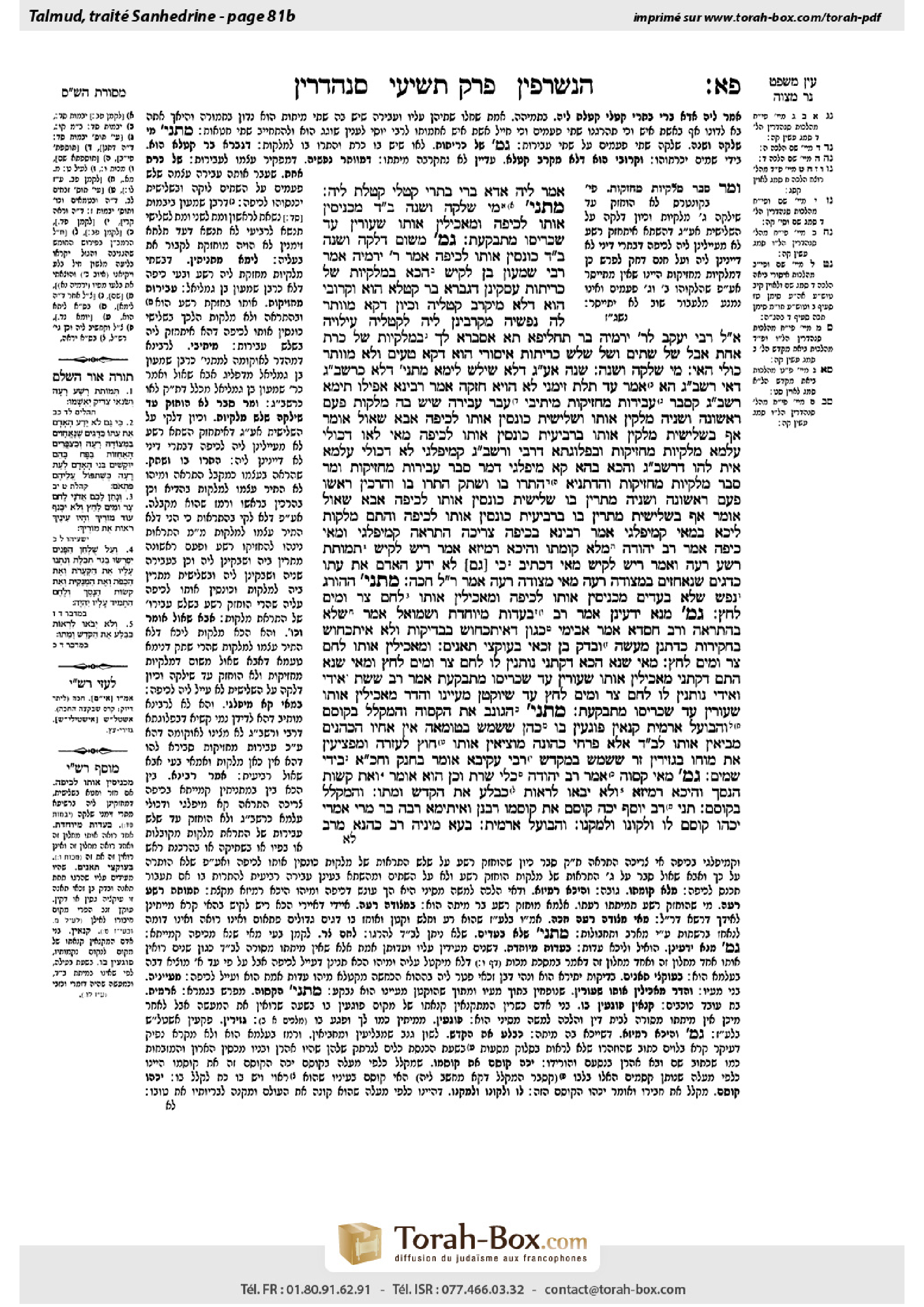
Sanhedrin 81b: Talmud study for Daf Yomi
Daf Yomi is the daily study of one Talmud folio. Explore 37 tractates with scans, Hebrew text, Sefaria English and AI-generated French translations where annotated.
Passage selection and English or AI-generated French translation are available where the scan has annotations. Daf Study is independent of Torah-Box and Sefaria.
Browse Sanhedrin · סנהדרין · All tractatesSanhedrin 81b text and translations
This page of Sanhedrin includes the Aramaic text, an English translation and an AI-generated French translation, alongside the scan above.
סנהדרין פ״א ב · Aramaic and Hebrew text
אֲמַר לֵיהּ: אַדָּא בְּרִי, בִּתְרֵי קְטָלֵי קָטְלַתְּ לֵיהּ?
מַתְנִי׳ מִי שֶׁלָּקָה וְשָׁנָה, בֵּית דִּין מַכְנִיסִין אוֹתוֹ לַכִּיפָּה, וּמַאֲכִילִין אוֹתוֹ שְׂעוֹרִין עַד שֶׁכְּרֵיסוֹ מִתְבַּקַּעַת.
גְּמָ׳ מִשּׁוּם דְּלָקָה וְשָׁנָה, בֵּית דִּין כּוֹנְסִין אוֹתוֹ לַכִּיפָּה? אָמַר רַבִּי יִרְמְיָה אָמַר רַבִּי שִׁמְעוֹן בֶּן לָקִישׁ: הָכָא בְּמַלְקִיּוֹת שֶׁל כָּרֵיתוֹת עָסְקִינַן, דְּגַבְרָא בַּר קְטָלָא הוּא, וְקָרוֹבֵי הוּא דְּלָא מְיקָרַב קְטָלֵיהּ. וְכֵיוָן דְּקָא מְוַותַּר לַהּ לְנַפְשֵׁיהּ, מְקָרְבִינַן לֵיהּ לִקְטָלֵיהּ עִילָּוֵיהּ.
אֲמַר לֵיהּ רַבִּי יַעֲקֹב לְרַבִּי יִרְמְיָה בַּר תַּחְלִיפָא: תָּא אַסְבְּרָא לָךְ, בְּמַלְקִיּוֹת שֶׁל כָּרֵת אַחַת, אֲבָל שֶׁל שְׁתַּיִם וְשֶׁל שָׁלֹשׁ כָּרֵיתוֹת – אִיסּוּרֵי הוּא דְּקָא טָעֵים, וְלָא מְוַותַּר כּוּלֵּי הַאי.
מִי שֶׁלָּקָה וְשָׁנָה. שָׁנָה אַף עַל גַּב דְּלָא שִׁילֵּשׁ. לֵימָא מַתְנִיתִין דְּלָא כְּרַבָּן שִׁמְעוֹן בֶּן גַּמְלִיאֵל? דְּאִי רַבָּן שִׁמְעוֹן בֶּן גַּמְלִיאֵל, הָא אָמַר: עַד תְּלָת זִימְנֵי לָא הָוְיָא חֲזָקָה.
אָמַר רָבִינָא: אֲפִילּוּ תֵּימָא רַבָּן שִׁמְעוֹן בֶּן גַּמְלִיאֵל, קָסָבַר עֲבֵירוֹת מַחֲזִיקוֹת.
מֵיתִיבִי: עָבַר עֲבֵירָה שֶׁיֵּשׁ בָּהּ מַלְקוֹת, פַּעַם רִאשׁוֹנָה וּשְׁנִיָּה מַלְקִין אוֹתוֹ, וּשְׁלִישִׁית כּוֹנְסִין אוֹתוֹ לַכִּיפָּה. אַבָּא שָׁאוּל אוֹמֵר: אַף בַּשְּׁלִישִׁית מַלְקִין אוֹתוֹ, בָּרְבִיעִית כּוֹנְסִין אוֹתוֹ לַכִּיפָּה. מַאי לָאו דְּכוּלֵּי עָלְמָא מַלְקִיּוֹת מַחְזִיקוֹת, וּבִפְלוּגְתָּא דְּרַבִּי וְרַבָּן שִׁמְעוֹן בֶּן גַּמְלִיאֵל קָמִיפַּלְגִי?
לָא, דְּכוּלֵּי עָלְמָא אִית לְהוּ דְּרַבָּן שִׁמְעוֹן בֶּן גַּמְלִיאֵל, וְהָכָא בְּהָא קָא מִיפַּלְגִי: דְּמָר סָבַר עֲבֵירוֹת מַחְזִיקוֹת, וּמָר סָבַר מַלְקִיּוֹת מַחְזִיקוֹת.
וְהָדְתַנְיָא: הִתְרוּ בּוֹ וְשָׁתַק, הִתְרוּ בּוֹ וְהִרְכִּין רֹאשׁוֹ – פַּעַם רִאשׁוֹנָה וּשְׁנִיָּה מַתְרִין בּוֹ, שְׁלִישִׁית – כּוֹנְסִין אוֹתוֹ לַכִּיפָּה. אַבָּא שָׁאוּל אוֹמֵר: אַף בַּשְּׁלִישִׁית מַתְרִין בּוֹ, בִּרְבִיעִית – כּוֹנְסִין אוֹתוֹ לַכִּיפָּה.
וְהָתָם, מַלְקוֹת לֵיכָּא. בְּמַאי קָמִיפַּלְגִי? אָמַר רָבִינָא: בְּכִיפָּה צְרִיכָה הַתְרָאָה קָמִיפַּלְגִי.
וּמַאי כִּיפָּה? אָמַר רַב יְהוּדָה: מְלֹא קוֹמָתוֹ. וְהֵיכָא רְמִיזָא? אָמַר רֵישׁ לָקִישׁ: ״תְּמוֹתֵת רָשָׁע רָעָה״.
וְאָמַר רֵישׁ לָקִישׁ: מַאי דִּכְתִיב ״כִּי [גַּם] לֹא יֵדַע הָאָדָם אֶת עִתּוֹ כַּדָּגִים שֶׁנֶּאֱחָזִים בִּמְצוֹדָה רָעָה״? מַאי ״מְצוֹדָה רָעָה״? אָמַר רֵישׁ לָקִישׁ: חַכָּה.
מַתְנִי׳ הַהוֹרֵג נֶפֶשׁ שֶׁלֹּא בְּעֵדִים, מַכְנִיסִין אוֹתוֹ לַכִּיפָּה וּמַאֲכִילִין אוֹתוֹ לֶחֶם צָר וּמַיִם לָחַץ.
גְּמָ׳ מְנָא יָדְעִינַן? אָמַר רַב: בְּעֵדוּת מְיוּחֶדֶת. וּשְׁמוּאֵל אָמַר: שֶׁלֹּא בְּהַתְרָאָה.
וְרַב חִסְדָּא אָמַר אֲבִימִי: כְּגוֹן דְּאִיתַּכְחוּשׁ בִּבְדִיקוֹת וְלָא אִיתַּכְחוּשׁ בַּחֲקִירוֹת, כְּדִתְנַן: מַעֲשֶׂה וּבָדַק בֶּן זַכַּאי בְּעוּקְצֵי תְאֵנִים.
וּמַאֲכִילִין אוֹתוֹ לֶחֶם צָר וּמַיִם לָחַץ. מַאי שְׁנָא הָכָא דְּקָתָנֵי: נוֹתְנִין לוֹ לֶחֶם צָר וּמַיִם לָחַץ, וּמַאי שְׁנָא הָתָם דְּקָתָנֵי: מַאֲכִילִין אוֹתוֹ שְׂעוֹרִין עַד שֶׁכְּרֵיסוֹ מִתְבַּקַּעַת? אָמַר רַב שֵׁשֶׁת: אִידֵּי וְאִידֵּי נוֹתְנִין לוֹ לֶחֶם צָר וּמַיִם לָחַץ עַד שֶׁיּוּקְטַן מַעְיָינוֹ, וַהֲדַר מַאֲכִילִין אוֹתוֹ שְׂעוֹרִין עַד שֶׁכְּרֵיסוֹ מִתְבַּקַּעַת.
מַתְנִי׳ הַגּוֹנֵב אֶת הַקַּסְוָה, וְהַמְקַלֵּל בְּקוֹסֵם, וְהַבּוֹעֵל אֲרַמִּית – קַנָּאִין פּוֹגְעִין בּוֹ. כֹּהֵן שֶׁשִּׁמֵּשׁ בְּטוּמְאָה – אֵין אֶחָיו הַכֹּהֲנִים מְבִיאִין אוֹתוֹ לְבֵית דִּין, אֶלָּא פִּרְחֵי כְהוּנָּה מוֹצִיאִין אוֹתוֹ חוּץ לָעֲזָרָה וּמְפַצְיעִין אֶת מוֹחוֹ בִּגְזִירִין. זָר שֶׁשִּׁמֵּשׁ בַּמִּקְדָּשׁ – רַבִּי עֲקִיבָא אוֹמֵר: בְּחֶנֶק, וַחֲכָמִים אוֹמְרִים: בִּידֵי שָׁמַיִם.
גְּמָ׳ מַאי קַסְוָה? אָמַר רַב יְהוּדָה: כְּלִי שָׁרֵת. וְכֵן הוּא אוֹמֵר: ״וְאֶת קְשׂוֹת הַנָּסֶךְ״. וְהֵיכָא רְמִיזָא? ״וְלֹא יָבֹאוּ לִרְאוֹת כְּבַלַּע אֶת הַקֹּדֶשׁ וָמֵתוּ״.
וְהַמְקַלֵּל בְּקוֹסֵם. תָּנֵי רַב יוֹסֵף: יַכֶּה קוֹסֵם אֶת קוֹסְמוֹ. רַבָּנַן, וְאִיתֵּימָא רַבָּה בַּר מָרִי, אָמְרִי: יַכֵּהוּ קוֹסֵם לוֹ וּלְקוֹנוֹ וּלְמַקְנוֹ.
וְהַבּוֹעֵל אֲרַמִּית, בְּעָא מִינֵּיהּ רַב כָּהֲנָא מֵרַב:
Sanhedrin 81b · English translation
Rava said to him: Adda my son, will you kill him with two death penalties? Rabbi Yosei concedes that the prohibition of engaging in intercourse with a married woman takes effect in addition to the prohibition of engaging in intercourse with his mother-in-law. If he had violated the transgression unwittingly, he would have been liable to bring two sin-offerings. But if he violated the transgression intentionally, it is impossible to execute him by strangulation after executing him by burning.
MISHNA: One who was flogged for violating a prohibition and then repeated the violation and was flogged again assumes the status of a forewarned transgressor. The court places him into the vaulted chamber [lakippa] and feeds him barley bread until his belly ruptures due to the low-quality food, and he dies.
GEMARA: Due to the fact that he was flogged and repeated the violation does the court place him into the vaulted chamber for the duration of his life and advance his death? Rabbi Yirmeya says that Rabbi Shimon ben Lakish says: Here, we are dealing with lashes administered for violations of prohibitions punishable by excision from the World-to-Come [karet]. As when one violates such a prohibition, the man is essentially liable to be punished with death at the hand of Heaven, but his death is not advanced by the court, as it is administered by the heavenly court. And in this case, since he surrenders his life through his repeated transgressions, we advance his execution upon him by placing him in the vaulted chamber.
Rabbi Ya’akov said to Rabbi Yirmeya bar Taḥlifa: Come and I will explain to you the circumstances of this halakha. It is in a case where he was flogged with lashes for repeatedly violating one prohibition punishable with karet that he is considered to have surrendered his life. But if he received lashes for violating two or for violating three different prohibitions punishable with karet, he is not placed in the vaulted chamber, as he merely is tasting the taste of prohibition and wants to enjoy the different experiences, and he is not thereby surrendering his life to that extent.
§ The mishna teaches: One who was flogged for violating a prohibition and then repeated the violation, the court places him into the vaulted chamber. The Gemara infers: He is placed in the vaulted chamber if he repeated the violation, doing it a second time, even if he did not again repeat the violation, doing it a third time. Let us say that the mishna is not in accordance with the opinion of Rabban Shimon ben Gamliel, as if it is in accordance with the opinion of Rabban Shimon ben Gamliel, doesn’t he say: Presumptive status is not established until the action is performed three times? In his opinion, only after violating the prohibition three times would one assume the status of a forewarned transgressor.
Ravina rejects that proof and says: Even if you say that the mishna is in accordance with the opinion of Rabban Shimon ben Gamliel, the tanna holds that transgressions, not lashes, establish the presumptive status of a transgressor. Therefore, the mishna that teaches: One who was flogged for violating a prohibition and then repeated the violation and was flogged, is placed in the vaulted chamber only after he violated the prohibition a third time, is in accordance with the opinion of Rabban Shimon ben Gamliel.
The Gemara raises an objection from a baraita: If one performed a transgression that has lashes as its punishment, the first and the second time, the court flogs him; and the third time, the court places him in the vaulted chamber. Abba Shaul says: Even the third time the court flogs him; and the fourth time, the court places him in the vaulted chamber. What, is it not that everyone agrees that lashes establish the presumptive status of a transgressor, and it is concerning the dispute of Rabbi Yehuda HaNasi and Rabban Shimon ben Gamliel, whether presumptive status is established after two or three times, that the Rabbis and Abba Shaul disagree?
The Gemara rejects that parallel. No, it can be explained that everyone, the Rabbis and Abba Shaul, agrees with the opinion of Rabban Shimon ben Gamliel that presumptive status is established after three times, and here it is with regard to this matter that they disagree: That one Sage, the Rabbis, holds: Transgressions establish the presumptive status of a transgressor, and after he is flogged twice and performs the transgression a third time, the court places him in the vaulted chamber; and one Sage, Abba Shaul, holds: Lashes establish the presumptive status of a transgressor, and it is only after he performs the third transgression and is flogged for that transgression that he assumes the status of a forewarned transgressor, and when he performs the transgression a fourth time, he is placed in the vaulted chamber.
The Gemara questions that interpretation of the dispute. And that which is taught in a baraita: With regard to a case where witnesses forewarned him that he was about to violate a prohibition punishable by lashes and he was silent and did not acknowledge that he accepted the forewarning, and likewise a case where the witnesses forewarned him and he bowed his head but did not explicitly acknowledge that he accepted the forewarning, the first and second time they forewarn him the court does not flog him, because he did not accept the forewarning. If this scenario occurs a third time, the court places him in the vaulted chamber. Abba Shaul says: Even the third time the witnesses forewarn him the court does not flog him; and the fourth time, the court places him in the vaulted chamber.
And there, in the case in the baraita, there are no lashes, as he did not explicitly acknowledge acceptance of the forewarning. The reference is to a case where one violated the transgression several times, and if their dispute is not with regard to the number of times required to establish presumptive status, with regard to what matter do they disagree? Ravina says: It is with regard to whether placing an individual into a vaulted chamber requires forewarning that they disagree. The Rabbis hold that once he disregarded the forewarning three times, the court places him in a vaulted chamber. Abba Shaul holds that after he is forewarned three times that he will be flogged if he performs the transgression, he requires additional forewarning, before the fourth time, that he will be placed in a vaulted chamber if he performs the transgression again.
The Gemara clarifies: And what is the nature of this vaulted chamber? Rav Yehuda says: It is a small chamber that is the full height of the transgressor, and it does not allow him to move in it. The Gemara asks: And where is this punishment intimated? Reish Lakish said that it is intimated in the verse: “Evil shall kill the wicked” (Psalms 34:22). Ultimately, an evildoer finds his demise through his evil, and the result is this harsh form of death.
The Gemara cites a related statement. And Reish Lakish says: What is the meaning of that which is written: “For man also knows not his time, like fish snared in an evil net” (Ecclesiastes 9:12)? What is the nature of this evil net? Reish Lakish says: It is a hook; although it is small and the fish is much larger, the fish cannot escape it.
MISHNA: With regard to one who kills a person not in the presence of witnesses and it is impossible to judge him in court, the court places him into a vaulted chamber and feeds him sparing bread and scant water (see Isaiah 30:20).
GEMARA: The Gemara asks: If there are no witnesses, from where do we know that he killed a person and is liable to be punished? Rav says: The tanna of the mishna is speaking about a case of disjointed testimony, where the witnesses were not together and they witnessed the murder from different vantage points. The court cannot convict a person for committing a murder based on that type of testimony even though it is clear that the witnesses are telling the truth. And Shmuel says: The tanna of the mishna is speaking about a case where the witnesses testified that they witnessed the murder but there was no forewarning, and therefore the court cannot convict him.
And Rav Ḥisda says that Avimi says: The tanna of the mishna is speaking of a case where the witnesses contradicted each other in the examinations that involve matters peripheral to the murder but did not contradict each other in the interrogations, which are integral to the murder, i.e., time and place. Therefore, it is clear to the court that the accused is guilty and consequently they place him in the vaulted chamber. As we learned in a mishna (40a): There was an incident and ben Zakkai examined the witnesses with regard to the stems of figs on the fig tree beneath which the murder took place. Rabban Yoḥanan ben Zakkai questioned the witnesses about the thickness of the stems in order to determine whether they would contradict each other in this peripheral detail in order to save the accused (see 41a).
The mishna teaches: And feeds him sparing bread and scant water. The Gemara asks: What is different in the mishna here that the tanna teaches that the court gives him sparing bread and scant water in the vaulted chamber, and what is different in the previous mishna there that the tanna teaches that the court feeds him barley bread until his belly ruptures; are these two different punishments? Rav Sheshet says: Both this and that are one punishment; first, the court gives him sparing bread and scant water until his intestines contract due to his starvation diet, and then the court feeds him barley bread that expands in his innards until his belly ruptures.
MISHNA: With regard to one who steals a kasva, and one who curses with a sorcerer, and one who engages in intercourse with an Aramean woman, zealots strike him and kill him. Although the Torah does not say that one who performs one of these actions is liable to be executed, it is permitted for anyone who zealously takes the vengeance of the Lord to do so. In the case of a priest who performed the Temple service in a state of ritual impurity, his priestly brethren do not bring him to court for judgment; rather, the young men of the priesthood remove him from the Temple courtyard and pierce his skull with pieces of wood. In the case of a non-priest who performed the service in the Temple, Rabbi Akiva says: His execution is by strangulation, and the Rabbis say: He is not executed with a court-imposed death penalty; rather, he is liable to receive death at the hand of Heaven.
GEMARA: The Gemara asks: What is the kasva mentioned in the mishna? Rav Yehuda says: It is a term used to describe any service vessel utilized in the Temple. And likewise, it is stated: “And the jars [kesot] with which to pour libations” (Numbers 4:7). The Gemara asks: And where is it intimated that one who steals a service vessel is liable to be killed by zealots? The Gemara answers that it is intimated in the verse: “But they shall not come to see the sacred items as they are being covered [kevala], lest they die” (Numbers 4:20). The Gemara interprets the term kevala as one who ingests, i.e., who takes (see Job 20:15), and the verse thereby teaches that one who steals a service vessel is liable to be killed.
The mishna teaches: And one who curses with a sorcerer is among those liable to be killed by zealots. Rav Yosef teaches that the reference is to one who says: Let the sorcerer strike his sorcerer, meaning one who curses God in the name of idol worship. He does not explicitly say God’s name, but he believes that a sorcerer can curse the sorcerer who provided him with his powers, i.e., the Divine Presence. The Rabbis, and some say that it was Rabba, son of Mari, say that the reference is to one who says: Let the sorcerer strike him, i.e., the individual with whom he is quarreling, and his Creator and his Provider. Since he curses God, it is permitted for zealots to kill him.
The mishna teaches that one who engages in intercourse with an Aramean woman is among those liable to be killed by zealots. Rav Kahana asked of Rav:
Sanhedrin 81b · Traduction française (IA)
Rava lui dit : « Adda, mon fils, veux-tu le tuer en lui infligeant deux peines de mort ? » Rabbi Yosei reconnaît que l’interdit d’avoir des relations avec une femme mariée s’ajoute à celui d’avoir des relations avec sa belle-mère. S’il avait transgressé involontairement, il aurait été tenu d’apporter deux sacrifices expiatoires. Mais s’il avait transgressé intentionnellement, il serait impossible de le mettre à mort par strangulation après l’avoir exécuté par le feu.
Michna : Celui qui a été flagellé pour avoir transgressé un interdit, puis l’a de nouveau transgressé et a été flagellé une seconde fois, acquiert le statut de transgresseur récidiviste. Le tribunal le place dans la chambre voûtée [lakippa] et le nourrit de pain d’orge jusqu’à ce que son ventre éclate sous l’effet de cette nourriture de mauvaise qualité, et qu’il meure.
Guemara : Parce qu’il a été flagellé et qu’il a récidivé, le tribunal le place-t-il dans une chambre voûtée pour le reste de sa vie et hâte-t-il ainsi sa mort ? Rabbi Yirmeya rapporte au nom de Rabbi Shimon ben Lakish : Ici, il s’agit de flagellations infligées pour des transgressions passibles de retranchement du monde à venir [karet]. En effet, celui qui transgresse un tel interdit est en principe passible de mort par la main du Ciel, mais le tribunal ne hâte pas sa mort, car celle-ci est infligée par le tribunal céleste. Dans ce cas, puisqu’il remet sa vie en jeu par ses transgressions répétées, nous hâtons son exécution en le plaçant dans la chambre voûtée.
Rabbi Ya’akov dit à Rabbi Yirmeya bar Taḥlifa : « Viens, je vais t’expliquer les circonstances de cette halakha. » Il s’agit d’un cas où il a été flagellé pour avoir transgressé à plusieurs reprises un seul interdit passible de retranchement : il est alors considéré comme ayant remis sa vie en jeu. Mais s’il a été flagellé pour avoir transgressé deux ou trois interdits différents passibles de retranchement, il n’est pas placé dans la chambre voûtée, car il ne fait que goûter à l’interdit et veut en éprouver différentes expériences ; il ne remet pas sa vie en jeu à ce point.
§ La Michna enseigne : Celui qui a été flagellé pour avoir transgressé un interdit, puis a récidivé, le tribunal le place dans la chambre voûtée. On en déduit qu’il y est placé dès sa récidive, c’est-à-dire la deuxième fois, même s’il ne récidive pas une troisième fois. Faut-il en conclure que la Michna ne suit pas l’opinion de Rabban Shimon ben Gamliel ? Car, si elle suivait son opinion, ne dit-il pas qu’un statut présomptif n’est établi qu’après que l’acte a été accompli trois fois ? Selon lui, ce n’est qu’après avoir transgressé l’interdit trois fois que l’on considère quelqu’un comme un transgresseur récidiviste.
Ravina rejette cette preuve et dit : Même si tu dis que la Michna suit l’opinion de Rabban Shimon ben Gamliel, le tanna considère que ce sont les transgressions, et non les flagellations, qui établissent le statut présomptif du transgresseur. Par conséquent, la Michna enseigne que celui qui a été flagellé pour avoir transgressé un interdit, puis a récidivé et a été flagellé, n’est placé dans la chambre voûtée qu’après avoir transgressé l’interdit une troisième fois ; elle suit donc l’opinion de Rabban Shimon ben Gamliel.
La Guemara soulève une objection à partir d’une baraïta : Si quelqu’un commet une transgression passible de flagellation, le tribunal le flagelle la première et la deuxième fois ; la troisième fois, le tribunal le place dans la chambre voûtée. Abba Shaul dit : Même la troisième fois, le tribunal le flagelle ; la quatrième fois, il le place dans la chambre voûtée. N’est-ce pas que tous s’accordent à dire que ce sont les flagellations qui établissent le statut présomptif du transgresseur, et que les Sages et Abba Shaul sont en désaccord sur le point de savoir si, selon la controverse entre Rabbi Yehuda HaNasi et Rabban Shimon ben Gamliel, le statut présomptif est établi après deux ou trois fois ?
La Guemara écarte cette mise en parallèle. Non, on peut expliquer que tous, les Sages comme Abba Shaul, sont d’accord avec l’opinion de Rabban Shimon ben Gamliel, selon laquelle le statut présomptif est établi après trois fois. Leur désaccord porte sur la question suivante : les Sages considèrent que ce sont les transgressions qui établissent le statut présomptif du transgresseur ; après qu’il a été flagellé deux fois et qu’il a commis la transgression une troisième fois, le tribunal le place dans la chambre voûtée. Abba Shaul, quant à lui, considère que ce sont les flagellations qui établissent ce statut ; ce n’est qu’après avoir commis la troisième transgression et avoir été flagellé pour celle-ci qu’il acquiert le statut de transgresseur récidiviste. Lorsqu’il commet la transgression une quatrième fois, il est placé dans la chambre voûtée.
La Guemara met en question cette interprétation du désaccord. Et que dire de ce qui est enseigné dans une baraïta : si des témoins l’ont averti qu’il allait transgresser un interdit passible de flagellation, mais qu’il est resté silencieux et n’a pas reconnu avoir accepté l’avertissement ; et de même, si les témoins l’ont averti et qu’il a incliné la tête sans reconnaître explicitement avoir accepté l’avertissement, les première et deuxième fois qu’ils l’avertissent, le tribunal ne le flagelle pas, car il n’a pas accepté l’avertissement. Si cela se produit une troisième fois, le tribunal le place dans la chambre voûtée. Abba Shaul dit : Même la troisième fois que les témoins l’avertissent, le tribunal ne le flagelle pas ; la quatrième fois, il le place dans la chambre voûtée.
Or, dans le cas rapporté par la baraïta, il n’y a pas de flagellation, puisqu’il n’a pas explicitement reconnu avoir accepté l’avertissement. Il s’agit d’un cas où quelqu’un a commis la transgression plusieurs fois ; si leur désaccord ne porte pas sur le nombre de fois nécessaire pour établir le statut présomptif, sur quoi porte-t-il ? Ravina dit : Ils sont en désaccord sur la question de savoir si le placement d’un individu dans une chambre voûtée nécessite un avertissement. Les Sages considèrent que dès lors qu’il a ignoré l’avertissement trois fois, le tribunal le place dans une chambre voûtée. Abba Shaul considère qu’après avoir été averti trois fois qu’il serait flagellé s’il commettait la transgression, il doit recevoir un avertissement supplémentaire, avant la quatrième fois, lui indiquant qu’il sera placé dans une chambre voûtée s’il commet de nouveau la transgression.
La Guemara précise : En quoi consiste cette chambre voûtée ? Rav Yehuda dit : C’est une petite chambre dont la hauteur correspond exactement à la taille du transgresseur, où il ne peut pas bouger. La Guemara demande : Où cette peine est-elle suggérée ? Reish Lakish dit qu’elle est suggérée par le verset : « Le mal fera périr les méchants » (Psaumes 34:22). En fin de compte, le méchant trouve la mort à cause de sa méchanceté, d’où cette forme de mort particulièrement pénible.
La Guemara cite une déclaration liée à ce sujet. Reish Lakish dit aussi : Que signifie ce qui est écrit : « Car l’homme non plus ne connaît pas son heure, comme les poissons pris dans un filet funeste » (Ecclésiaste 9:12) ? Quelle est la nature de ce filet funeste ? Reish Lakish dit : C’est un hameçon ; bien qu’il soit petit et que le poisson soit beaucoup plus grand, celui-ci ne peut pas lui échapper.
Michna : Celui qui tue quelqu’un en l’absence de témoins, de sorte qu’il est impossible de le juger au tribunal, est placé par le tribunal dans une chambre voûtée et nourri de peu de pain et de peu d’eau (voir Isaïe 30:20).
Guemara : La Guemara demande : S’il n’y a pas de témoins, comment savons-nous qu’il a tué quelqu’un et qu’il est passible d’une peine ? Rav dit : Le tanna de la Michna parle d’un cas de témoignage disjoint, où les témoins n’étaient pas ensemble et ont vu le meurtre depuis des points de vue différents. Le tribunal ne peut pas condamner quelqu’un pour meurtre sur la base de ce type de témoignage, bien qu’il soit clair que les témoins disent la vérité. Shmuel dit : Le tanna de la Michna parle d’un cas où les témoins ont déclaré avoir vu le meurtre, mais sans qu’il y ait eu d’avertissement préalable ; le tribunal ne peut donc pas le condamner.
Rav Ḥisda rapporte au nom d’Avimi : Le tanna de la Michna parle d’un cas où les témoins se sont contredits lors des examens portant sur des détails périphériques au meurtre, mais ne se sont pas contredits lors des interrogatoires portant sur les éléments essentiels du meurtre, à savoir l’heure et le lieu. Le tribunal est donc certain que l’accusé est coupable et le place par conséquent dans la chambre voûtée. Car nous avons appris dans une Michna (40a) : Il y eut un incident où ben Zakkai interrogea les témoins au sujet des pédoncules des figues sur le figuier sous lequel le meurtre avait eu lieu. Rabban Yoḥanan ben Zakkai les interrogea sur l’épaisseur des pédoncules afin de déterminer s’ils se contrediraient sur ce détail périphérique, ce qui aurait permis de sauver l’accusé (voir 41a).
La Michna enseigne : Et le nourrit de peu de pain et de peu d’eau. La Guemara demande : Pourquoi, ici, le tanna enseigne-t-il que le tribunal lui donne peu de pain et d’eau dans la chambre voûtée, alors que dans la Michna précédente, il enseigne que le tribunal le nourrit de pain d’orge jusqu’à ce que son ventre éclate ? S’agit-il de deux peines différentes ? Rav Sheshet dit : Ces deux descriptions correspondent à une seule et même peine. D’abord, le tribunal lui donne peu de pain et d’eau, jusqu’à ce que ses intestins se contractent sous l’effet de son régime de famine ; ensuite, le tribunal le nourrit de pain d’orge, qui gonfle dans ses entrailles jusqu’à ce que son ventre éclate.
Michna : Celui qui vole un kasva, celui qui maudit avec un sorcier et celui qui a des relations avec une Araméenne : les zélotes le frappent et le tuent. Bien que la Torah ne dise pas que celui qui accomplit l’un de ces actes soit passible d’exécution, il est permis à quiconque prend avec zèle la vengeance du Seigneur d’agir ainsi. Dans le cas d’un prêtre qui a accompli le service du Temple en état d’impureté rituelle, ses frères prêtres ne le conduisent pas au tribunal pour qu’il y soit jugé ; les jeunes prêtres le font sortir de la cour du Temple et lui percent le crâne avec des morceaux de bois. Dans le cas d’un non-prêtre qui a accompli le service dans le Temple, Rabbi Akiva dit : Il est exécuté par strangulation. Les Sages disent : Il ne subit pas une peine de mort imposée par un tribunal ; il est plutôt passible de mort par la main du Ciel.
Guemara : La Guemara demande : Que désigne le kasva mentionné dans la Michna ? Rav Yehuda dit : C’est un terme qui désigne tout ustensile de service utilisé dans le Temple. De même, il est dit : « Et les jarres [kesot] servant à verser les libations » (Nombres 4:7). La Guemara demande : Où est-il suggéré que celui qui vole un ustensile de service peut être tué par les zélotes ? La Guemara répond que cela est suggéré par le verset : « Mais ils ne viendront pas voir les objets sacrés lorsqu’ils sont recouverts [kevala], de peur qu’ils ne meurent » (Nombres 4:20). La Guemara interprète le terme kevala comme désignant quelqu’un qui avale, c’est-à-dire qui prend (voir Job 20:15) ; le verset enseigne ainsi que celui qui vole un ustensile de service peut être tué.
La Michna enseigne que celui qui maudit avec un sorcier fait partie de ceux que les zélotes peuvent tuer. Rav Yosef enseigne qu’il s’agit de quelqu’un qui dit : « Que le sorcier frappe son sorcier », c’est-à-dire quelqu’un qui maudit Dieu au nom de l’idolâtrie. Il ne prononce pas explicitement le nom de Dieu, mais croit qu’un sorcier peut maudire le sorcier qui lui a donné ses pouvoirs, c’est-à-dire la Présence divine. Les Sages — et certains disent que c’était Rabba, fils de Mari — disent qu’il s’agit de quelqu’un qui dit : « Que le sorcier le frappe », c’est-à-dire l’homme avec lequel il se dispute, ainsi que son Créateur et Celui qui le nourrit. Puisqu’il maudit Dieu, les zélotes sont autorisés à le tuer.
La Michna enseigne que celui qui a des relations avec une Araméenne fait partie de ceux que les zélotes peuvent tuer. Rav Kahana demanda à Rav :
Traduction française générée par IA à partir de l’édition anglaise de Sefaria. Vérifie toujours un passage avec le texte source.
Text from Sefaria: William Davidson Edition - Vocalized Aramaic (CC BY NC); William Davidson Edition - English (CC BY NC).