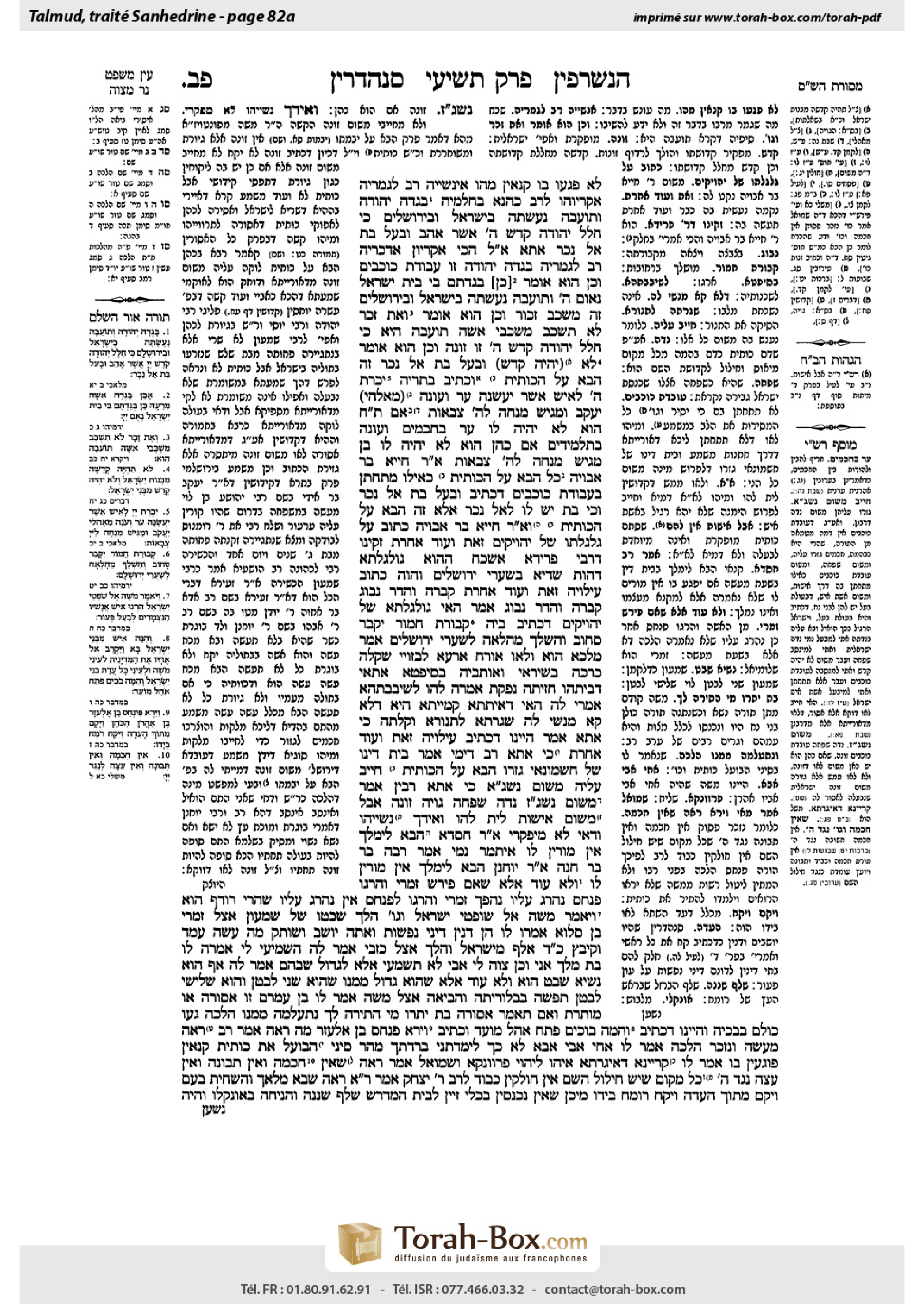
Sanhedrin 82a: Talmud study for Daf Yomi
Daf Yomi is the daily study of one Talmud folio. Explore 37 tractates with scans, Hebrew text, Sefaria English and AI-generated French translations where annotated.
Passage selection and English or AI-generated French translation are available where the scan has annotations. Daf Study is independent of Torah-Box and Sefaria.
Browse Sanhedrin · סנהדרין · All tractatesSanhedrin 82a text and translations
This page of Sanhedrin includes the Aramaic text, an English translation and an AI-generated French translation, alongside the scan above.
סנהדרין פ״ב א · Aramaic and Hebrew text
לֹא פָּגְעוּ בּוֹ קַנָּאִין, מַהוּ? אִינַּשְׁיֵיהּ רַב לִגְמָרֵיהּ. אַקְרְיוּהּ לְרַב כָּהֲנָא בְּחֶלְמֵיהּ: ״בָּגְדָה יְהוּדָה וְתוֹעֵבָה נֶעֶשְׂתָה בְיִשְׂרָאֵל וּבִירוּשָׁלִָים כִּי חִלֵּל יְהוּדָה קֹדֶשׁ ה׳ אֲשֶׁר אָהֵב וּבָעַל בַּת אֵל נֵכָר״. אֲתָא אֲמַר לֵיהּ: הָכִי אַקְרְיוּן.
אִדַּכְרֵיהּ רַב לִגְמָרֵיהּ. ״בָּגְדָה יְהוּדָה״ – זוֹ עֲבוֹדָה זָרָה, וְכֵן הוּא אוֹמֵר: ״כֵּן בְּגַדְתֶּם בִּי בֵּית יִשְׂרָאֵל נְאֻם ה׳״. ״וְתוֹעֵבָה נֶעֶשְׂתָה בְיִשְׂרָאֵל וּבִירוּשָׁלִָים״ – זֶה מִשְׁכַּב זְכוּר, וְכֵן הוּא אוֹמֵר: ״וְאֶת זָכָר לֹא תִשְׁכַּב מִשְׁכְּבֵי אִשָּׁה תּוֹעֵבָה הִיא״. ״כִּי חִלֵּל יְהוּדָה קֹדֶשׁ ה׳״ – זוֹ זוֹנָה, וְכֵן הוּא אוֹמֵר: ״לֹא תִּהְיֶה קְדֵשָׁה מִבְּנוֹת יִשְׂרָאֵל״. ״וּבָעַל בַּת אֵל נֵכָר״ – זֶה הַבָּא עַל הַגּוֹיָה.
וּכְתִיב בָּתְרֵיהּ: ״יַכְרֵת ה׳ לָאִישׁ אֲשֶׁר יַעֲשֶׂנָּה עֵר וְעֹנֶה מֵאׇהֳלֵי יַעֲקֹב וּמַגִּישׁ מִנְחָה לַה׳ צְבָאוֹת״. אִם תַּלְמִיד חָכָם הוּא – לֹא יִהְיֶה לוֹ עֵר בַּחֲכָמִים וְעוֹנֶה בַּתַּלְמִידִים. אִם כֹּהֵן הוּא – לֹא יִהְיֶה לוֹ בֵּן מַגִּישׁ מִנְחָה לַה׳ צְבָאוֹת.
אָמַר רַבִּי חִיָּיא בַּר אֲבוּיָה: כׇּל הַבָּא עַל הַגּוֹיָה, כְּאִילּוּ מִתְחַתֵּן בַּעֲבוֹדָה זָרָה, דִּכְתִיב: ״וּבָעַל בַּת אֵל נֵכָר״. וְכִי בַּת יֵשׁ לוֹ לְאֵל נֵכָר? אֶלָּא זֶה הַבָּא עַל הַגּוֹיָה.
וְאָמַר רַבִּי חִיָּיא בַּר אֲבוּיָה: כָּתוּב עַל גֻּלְגׇּלְתּוֹ שֶׁל יְהוֹיָקִים ״זֹאת וְעוֹד אַחֶרֶת״. זְקֵינוֹ דְּרַבִּי פְּרִידָא אַשְׁכַּח הָהוּא גּוּלְגֻּלְתָּא דַּהֲוָת שַׁדְיָא בְּשַׁעֲרֵי יְרוּשָׁלַיִם, וַהֲוָה כָּתוּב עִילָּוַיהּ ״זֹאת וְעוֹד אַחֶרֶת״. קַבְרַהּ וַהֲדַר נְבוּג, קַבְרַהּ וַהֲדַר נְבוּג. אֲמַר: הַאי גּוּלְגֻּלְתָּא דִּיהוֹיָקִים, דִּכְתִיב בֵּיהּ ״קְבוּרַת חֲמוֹר יִקָּבֵר סָחוֹב וְהַשְׁלֵךְ מֵהָלְאָה לְשַׁעֲרֵי יְרוּשָׁלִָים״.
אֲמַר: מַלְכָּא הוּא, וְלָאו אוֹרַח אַרְעָא לְבַזּוֹיֵי. שַׁקְלַהּ, כַּרְכַהּ בְּשִׁירָאֵי, וְאוֹתְבַיהּ בְּסִיפְטָא. אֲתַאי דְּבֵיתְהוּ, חֲזֵיתַהּ. נְפַקַת, אֲמַרָה לְהוּ לְשִׁיבָבָתַהָא. אָמְרִי לַהּ: הַאי דְּאִיתְּתָא קַמַּיְיתָא הִיא, דְּלָא קָא מִנְּשֵׁי לַהּ. שְׁגַרְתַּא לְתַנּוּרָא וְקַלְתַהּ. כִּי אֲתָא, אֲמַר: הַיְינוּ דִּכְתִיב עִילָּוַיהּ: ״זֹאת וְעוֹד אַחֶרֶת״.
כִּי אֲתָא רַב דִּימִי אָמַר: בֵּית דִּינוֹ שֶׁל חַשְׁמוֹנַאי גָּזְרוּ, הַבָּא עַל הַגּוֹיָה חַיָּיב עָלֶיהָ מִשּׁוּם נִדָּה, שִׁפְחָה, גּוֹיָה, אֵשֶׁת אִישׁ.
כִּי אֲתָא רָבִין אָמַר: מִשּׁוּם נשג״ז – נִדָּה, שִׁפְחָה, גּוֹיָה, זוֹנָה. אֲבָל מִשּׁוּם אִישׁוּת לֵית לְהוּ. וְאִידַּךְ: נְשַׁיְיהוּ וַדַּאי לָא מַפְקְרִי.
אָמַר רַב חִסְדָּא: הַבָּא לִימָּלֵךְ, אֵין מוֹרִין לוֹ. אִיתְּמַר נָמֵי, אָמַר רַבָּה בַּר בַּר חָנָה אָמַר רַבִּי יוֹחָנָן: הַבָּא לִימָּלֵךְ, אֵין מוֹרִין לוֹ.
וְלֹא עוֹד, אֶלָּא שֶׁאִם פֵּירַשׁ זִמְרִי וַהֲרָגוֹ פִּנְחָס – נֶהֱרָג עָלָיו. נֶהְפַּךְ זִמְרִי וַהֲרָגוֹ לְפִנְחָס – אֵין נֶהֱרָג עָלָיו, שֶׁהֲרֵי רוֹדֵף הוּא.
״וַיֹּאמֶר מֹשֶׁה אֶל שֹׁפְטֵי יִשְׂרָאֵל וְגוֹ׳״. הָלַךְ שִׁבְטוֹ שֶׁל שִׁמְעוֹן אֵצֶל זִמְרִי בֶּן סָלוּא, אָמְרוּ לוֹ: הֵן דָּנִין דִּינֵי נְפָשׁוֹת וְאַתָּה יוֹשֵׁב וְשׁוֹתֵק?! מָה עָשָׂה? עָמַד וְקִיבֵּץ עֶשְׂרִים וְאַרְבָּעָה אֶלֶף מִיִּשְׂרָאֵל וְהָלַךְ אֵצֶל כׇּזְבִּי. אֲמַר לַהּ: הִשָּׁמֵיעִי לִי. אָמְרָה לוֹ: בַּת מֶלֶךְ אֲנִי, וְכֵן צִוָּה לִי אָבִי: לֹא תִּשָּׁמְעִי אֶלָּא לַגָּדוֹל שֶׁבָּהֶם. אֲמַר לַהּ: אַף הוּא נְשִׂיא שֵׁבֶט הוּא, וְלָא עוֹד אֶלָּא שֶׁהוּא גָּדוֹל מִמֶּנּוּ, שֶׁהוּא שֵׁנִי לַבֶּטֶן וְהוּא שְׁלִישִׁי לַבֶּטֶן.
תְּפָשָׂהּ בִּבְלוֹרִיתָהּ וֶהֱבִיאָהּ אֵצֶל מֹשֶׁה. אָמַר לוֹ: בֶּן עַמְרָם, זוֹ אֲסוּרָה אוֹ מוּתֶּרֶת? וְאִם תֹּאמַר אֲסוּרָה, בַּת יִתְרוֹ מִי הִתִּירָה לָךְ? נִתְעַלְּמָה מִמֶּנּוּ הֲלָכָה. גָּעוּ כּוּלָּם בִּבְכִיָּה, וְהַיְינוּ דִּכְתִיב: ״וְהֵמָּה בֹכִים פֶּתַח אֹהֶל מוֹעֵד״. וּכְתִיב: ״וַיַּרְא פִּנְחָס בֶּן אֶלְעָזָר״.
מָה רָאָה? אָמַר רַב: רָאָה מַעֲשֶׂה וְנִזְכַּר הֲלָכָה. אָמַר לוֹ: אֲחִי אֲבִי אַבָּא, לֹא כָּךְ לִימַּדְתַּנִי בְּרִדְתְּךָ מֵהַר סִינַי: הַבּוֹעֵל אֲרָמִית קַנָּאִין פּוֹגְעִין בּוֹ? אָמַר לוֹ: קַרְיָינָא דְּאִיגַּרְתָּא אִיהוּ לֶיהֱוֵי פַּרְוָונְקָא.
וּשְׁמוּאֵל אָמַר: רָאָה שֶׁאֵין חׇכְמָה וְאֵין תְּבוּנָה וְאֵין עֵצָה לְנֶגֶד ה׳. כׇּל מָקוֹם שֶׁיֵּשׁ חִילּוּל הַשֵּׁם, אֵין חוֹלְקִין כָּבוֹד לָרַב. רַבִּי יִצְחָק אָמַר רַבִּי אֱלִיעֶזֶר: רָאָה שֶׁבָּא מַלְאָךְ וְהִשְׁחִית בָּעָם.
״וַיָּקׇם מִתּוֹךְ הָעֵדָה וַיִּקַּח רֹמַח בְּיָדוֹ״. מִיכָּן, שֶׁאֵין נִכְנָסִין בִּכְלֵי זַיִין לְבֵית הַמִּדְרָשׁ. שָׁלַף שְׁנָנָהּ וְהִנִּיחָהּ בְּאוּנְקָלוֹ, וְהָיָה
Sanhedrin 82a · English translation
If zealots did not strike him, what is the halakha? Rav forgot that which he learned through tradition concerning this matter. They read this verse to Rav Kahana in his dream: “Judah has dealt treacherously and an abomination is committed in Israel and in Jerusalem, as Judah has profaned the sacred of the Lord, which he loves, and has engaged in intercourse with the daughter of a strange god” (Malachi 2:11). Rav Kahana came and said to Rav: This is what they read to me in my dream.
Rav then remembered that which he learned through tradition and said: “Judah has dealt treacherously,” this is a reference to the sin of idol worship. And likewise it says: But as a wife who treacherously departs her husband, you have dealt treacherously with Me, house of Israel, says the Lord (Jeremiah 3:20). “And an abomination is committed in Israel and in Jerusalem,” this is a reference to male homosexual intercourse, and likewise it says: “You shall not lie with a man as one lies with a woman; it is an abomination” (Leviticus 18:22). “As Judah has profaned the sacred [kodesh] of the Lord,” this is a reference to a prostitute, and likewise it says: “There shall be no harlot [kedesha] of the daughters of Israel” (Deuteronomy 23:18). “And has engaged in intercourse with the daughter of a strange god,” this is a reference to one who engages in intercourse with a gentile woman.
And it is written thereafter with regard to those enumerated in the verse: “May the Lord excise the man who does this, who calls and who answers from the tents of Jacob, and he who sacrifices a meal-offering to the Lord of hosts” (Malachi 2:12). The Gemara interprets the verse: If he is a Torah scholar, he will have neither one among his descendants who calls and initiates discourse among the Sages, nor one who answers among the students, i.e., one who is capable of answering questions posed by the Sages. If he is a priest, he will not have among his descendants a son who sacrifices a meal-offering to the Lord of hosts.
Rabbi Ḥiyya bar Avuya says: With regard to anyone who engages in intercourse with a gentile woman it is as though he married the object of idol worship itself, as it is written: “And has engaged in intercourse with the daughter of a strange god.” Does a strange god have a daughter? Rather, this is a reference to one who engages in intercourse with a gentile woman who is an adherent of a strange god.
§ The Gemara cites another of Rav Ḥiyya bar Avuya’s statements. Rabbi Ḥiyya bar Avuya says: It was written on the skull of Jehoiakim king of Judea: This and yet another, indicating that he will suffer a punishment in addition to the punishment that he already received. The Gemara relates: The grandfather of Rabbi Perida, Rabbi Ḥiyya bar Avuya, found a skull that was cast at the gates of Jerusalem, and upon it was written: This and yet another. He buried it, and it then emerged [navug] from beneath the soil. He buried it and it then emerged from beneath the soil again. He said: This is the skull of Jehoiakim, as it is written in his regard: “With the burial of a donkey he shall be buried, drawn and cast beyond the gates of Jerusalem” (Jeremiah 22:19). He will find no rest in a grave.
Rabbi Ḥiyya bar Avuya said: He is a king and it is not proper conduct to treat him contemptuously. He took the skull, wrapped it in silk [beshira’ei] and placed it in a chest [besifta]. His wife came and saw the skull, went out and told her neighbors and asked them what it was. The neighbors said to her: This is the skull of the first wife to whom he was married, as he has not forgotten her and he keeps her skull in her memory. That angered his wife, and she kindled the oven and burned the skull. When Rabbi Ḥiyya son of Avuya came and learned what she had done, he said: That is the fulfillment of that which is written about him: This and yet another. Having his remains cast beyond the gates of Jerusalem did not complete the punishment of Jehoiakim. He suffered the additional indignity of having his remains burned.
§ When Rav Dimi came from Eretz Yisrael to Babylonia, he said: The court of the Hasmoneans issued a decree that one who engages in intercourse with a gentile woman is liable due to his violation of prohibitions represented by the letters: Nun, shin, gimmel, alef. He is liable for engaging in intercourse with a menstruating woman [nidda] who did not immerse in a ritual bath and remains impure. Although by Torah law there is no impurity of menstruation with regard to gentiles, it has been decreed that one must distance himself from them as he does from a menstruating woman. He is liable for engaging in intercourse with a Canaanite maidservant [shifḥa], as relative to a Jewish woman, the status of a gentile woman is that of a maidservant. He is liable for engaging in intercourse with a gentile woman [goya] and with a married woman [eshet ish].
When Ravin came from Eretz Yisrael to Babylonia, he said: He is liable due to his violation of prohibitions represented by the letters: Nun, shin, gimmel, zayin. Ravin agreed with Rav Dimi that the Hasmoneans decreed that one who engages in intercourse with a gentile woman is liable for engaging in intercourse with a menstruating woman, a maidservant, and a gentile woman. He adds that the individual is liable for engaging in intercourse with a zona. But he disagrees with Rav Dimi and holds that one is not liable due to the violation of the prohibition involving matrimony, i.e., of engaging in intercourse with a married woman, because the halakhic framework of matrimony does not exist among gentiles. Their relationships are fundamentally temporary. And the other amora, Rav Dimi, holds that gentiles certainly do not forsake their wives; therefore, the status of the wife of a gentile is that of a married woman.
Rav Ḥisda says: Concerning one who comes to consult with the court when he sees a Jewish man engaging in intercourse with a gentile woman, the court does not instruct him that it is permitted to kill the transgressor. It was also stated that Rabba bar bar Ḥana says that Rabbi Yoḥanan says: Concerning one who comes to consult with the court, the court does not instruct him that it is permitted to kill the Jewish man engaging in intercourse with a gentile woman.
Moreover, if Zimri son of Salu (see Numbers 25:1–9) had separated himself from the woman and only then Pinehas killed him, Pinehas would have been executed for killing him, because it is permitted for zealots to kill only while the transgressor is engaged in the act of intercourse. Furthermore, if Zimri would have turned and killed Pinehas in self-defense, he would not have been executed for killing him, as Pinehas was a pursuer. One is allowed to kill a pursuer in self-defense, provided that the pursued is not liable to be executed by the court.
It is stated: “And Moses said to the judges of Israel: Each of you shall slay his men who have adhered unto Ba’al-Peor” (Numbers 25:5). The tribe of Simeon went to Zimri, son of Salu, their leader, and said to him: They are judging cases of capital law and executing us and you are sitting and are silent? What did Zimri do? He arose and gathered twenty-four thousand people from the children of Israel, and went to Cozbi, daughter of Zur, princess of Midian, and said to her: Submit to me and engage in intercourse with me. She said to him: I am the daughter of a king, and this is what my father commanded me: Submit only to the greatest of them. Zimri said to her: He, too, referring to himself, is the head of a tribe; moreover, he is greater than Moses, as he is the second of the womb, as he descends from Simeon, the second son of Jacob, and Moses is the third of the womb, as he descends from Levi, the third son of Jacob.
He seized her by her forelock and brought her before Moses. Zimri said to Moses: Son of Amram, is this woman forbidden or permitted? And if you say that she is forbidden, as for the daughter of Yitro to whom you are married, who permitted her to you? The halakha with regard to the proper course of action when encountering a Jewish man engaging in intercourse with a gentile woman eluded Moses. All of the members of the Sanhedrin bawled in their weeping, and that is the meaning of that which is written: “And they are crying at the entrance of the Tent of Meeting” (Numbers 25:6). And it is written thereafter: “And Pinehas, son of Elazar, son of Aaron the priest, saw and arose from the midst of the congregation and took a spear in his hand” (Numbers 25:7).
The Gemara asks: What did Pinehas see that led him to arise and take action? Rav says: He saw the incident taking place before him and he remembered the halakha. He said to Moses: Brother of the father of my father, as Moses was the brother of his grandfather Aaron, did you not teach me this during your descent from Mount Sinai: One who engages in intercourse with a gentile woman, zealots strike him? Moses said to him: Let the one who reads the letter be the agent [parvanka] to fulfill its contents.
And Shmuel says: Pinehas saw and considered the meaning of the verse: “There is neither wisdom nor understanding nor counsel against the Lord” (Proverbs 21:30), which the Sages interpreted to mean: Anywhere that there is desecration of the Lord’s name, one does not show respect to the teacher. In those situations, one need not consult his teacher, but must immediately proceed to right the wrong that is transpiring. Therefore, he took the spear and took immediate action. Rabbi Yitzḥak says that Rabbi Eliezer says: He saw that an angel came and destroyed among the people in punishment for the sin of Zimri, and he realized that he must take immediate action to ameliorate the situation.
It is written with regard to Pinehas: “He arose from amidst the assembly and he took a spear in his hand” (Numbers 25:7). From here, where it is written that he took the spear only after he arose from the assembly, it is derived that one does not enter the study hall with a weapon. The assembly in this context is referring to the seat of the Sanhedrin. Pinehas removed the blade of the spear and placed it in his garment [be’unkalo] and held the shaft of the spear like a walking stick, and he was
Sanhedrin 82a · Traduction française (IA)
Si les zélotes ne l’avaient pas frappé, quelle aurait été la halakha ? Rav avait oublié ce qu’il avait appris par tradition à ce sujet. Dans son rêve, on lut à Rav Kahana ce verset : « Juda a agi avec perfidie, une abomination a été commise en Israël et à Jérusalem, car Juda a profané ce qui est sacré pour le Seigneur, ce qu’il aime, et a eu des relations avec la fille d’un dieu étranger » (Malachie 2,11). Rav Kahana vint trouver Rav et lui dit : « Voici ce qu’on m’a lu dans mon rêve. »
Rav se rappela alors ce qu’il avait appris par tradition et dit : « “Juda a agi avec perfidie” fait référence à la faute de l’idolâtrie. De même, il est dit : “Comme une femme qui trahit son mari, vous m’avez trahi, maison d’Israël, dit le Seigneur” (Jérémie 3,20). “Une abomination a été commise en Israël et à Jérusalem” fait référence aux relations sexuelles entre hommes ; de même, il est dit : “Tu ne coucheras pas avec un homme comme on couche avec une femme ; c’est une abomination” (Lévitique 18,22). “Juda a profané ce qui est sacré [kodesh] pour le Seigneur” fait référence à une prostituée ; de même, il est dit : “Qu’il n’y ait pas de prostituée [kedesha] parmi les filles d’Israël” (Deutéronome 23,18). “Et a eu des relations avec la fille d’un dieu étranger” fait référence à celui qui a des relations avec une non-Juive. »
Et il est écrit ensuite, au sujet de ceux qui sont énumérés dans le verset : « Que le Seigneur retranche l’homme qui fait cela, celui qui appelle et celui qui répond sous les tentes de Jacob, ainsi que celui qui offre une offrande végétale au Seigneur des armées » (Malachie 2,12). La Guemara interprète le verset : s’il s’agit d’un érudit de la Torah, il n’aura parmi ses descendants ni quelqu’un qui prend la parole et engage la discussion parmi les Sages, ni quelqu’un qui répond parmi les étudiants, c’est-à-dire quelqu’un capable de répondre aux questions posées par les Sages. S’il s’agit d’un prêtre, il n’aura parmi ses descendants aucun fils qui offre une offrande végétale au Seigneur des armées.
Rabbi Ḥiyya bar Avuya dit : Quiconque a des relations avec une non-Juive, c’est comme s’il avait épousé l’idole elle-même, comme il est écrit : « Et a eu des relations avec la fille d’un dieu étranger. » Un dieu étranger aurait-il une fille ? Il s’agit plutôt de celui qui a des relations avec une non-Juive adepte d’un dieu étranger.
§ La Guemara cite une autre déclaration de Rav Ḥiyya bar Avuya. Rabbi Ḥiyya bar Avuya dit : Il était écrit sur le crâne de Yehoyakim, roi de Judée : « Ceci, et encore autre chose », ce qui indique qu’il subirait une punition supplémentaire à celle qu’il avait déjà reçue. La Guemara rapporte : Le grand-père de Rabbi Perida, Rabbi Ḥiyya bar Avuya, trouva un crâne jeté aux portes de Jérusalem, sur lequel était écrit : « Ceci, et encore autre chose. » Il l’enterra, mais le crâne ressortit [navug] de terre. Il l’enterra de nouveau, mais le crâne ressortit encore de terre. Il dit : « C’est le crâne de Yehoyakim », car il est écrit à son sujet : « Il sera enterré comme un âne, traîné et jeté au-delà des portes de Jérusalem » (Jérémie 22,19). Il ne trouvera pas le repos dans une tombe.
Rabbi Ḥiyya bar Avuya dit : C’est un roi, et il ne convient pas de le traiter avec mépris. Il prit le crâne, l’enveloppa de soie [beshira’ei] et le plaça dans un coffre [besifta]. Sa femme vit le crâne, sortit, en parla à ses voisines et leur demanda ce que c’était. Les voisines lui dirent : « C’est le crâne de la première épouse qu’il a eue ; il ne l’a pas oubliée et garde son crâne en souvenir d’elle. » Sa femme en fut irritée, alluma le four et brûla le crâne. Lorsque Rabbi Ḥiyya, fils d’Avuya, revint et apprit ce qu’elle avait fait, il dit : « C’est l’accomplissement de ce qui est écrit à son sujet : “Ceci, et encore autre chose.” » Le fait que ses restes aient été jetés au-delà des portes de Jérusalem n’avait pas achevé la punition de Yehoyakim. Il subit l’humiliation supplémentaire de voir ses restes brûlés.
§ Lorsque Rav Dimi vint d’Eretz Israël en Babylonie, il dit : Le tribunal des Hasmonéens décréta que celui qui a des relations avec une non-Juive est passible pour avoir transgressé les interdits représentés par les lettres noun, shin, guimel et alef. Il est passible pour avoir eu des relations avec une femme menstruée [nidda], qui ne s’est pas immergée dans un bain rituel et demeure impure. Bien que, selon la Torah écrite, l’impureté menstruelle ne s’applique pas aux non-Juives, il a été décrété qu’on devait s’en tenir éloigné comme d’une femme menstruée. Il est passible pour avoir eu des relations avec une servante cananéenne [shifḥa], car, par rapport à une femme juive, le statut d’une non-Juive est celui d’une servante. Il est passible pour avoir eu des relations avec une non-Juive [goya] et avec une femme mariée [eshet ish].
Lorsque Ravin vint d’Eretz Israël en Babylonie, il dit : Il est passible pour avoir transgressé les interdits représentés par les lettres noun, shin, guimel et zayin. Ravin partage l’avis de Rav Dimi selon lequel les Hasmonéens décrétèrent que celui qui a des relations avec une non-Juive est passible pour avoir eu des relations avec une femme menstruée, une servante et une non-Juive. Il ajoute que l’individu est passible pour avoir eu des relations avec une prostituée [zona]. Mais il n’est pas d’accord avec Rav Dimi et estime qu’on n’est pas passible au titre de l’interdit lié au mariage, c’est-à-dire pour avoir eu des relations avec une femme mariée, car le cadre halakhique du mariage n’existe pas chez les non-Juifs. Leurs relations sont fondamentalement temporaires. L’autre amora, Rav Dimi, estime au contraire que les non-Juifs ne répudient certainement pas leurs femmes ; par conséquent, l’épouse d’un non-Juif a le statut d’une femme mariée.
Rav Ḥisda dit : Si quelqu’un vient consulter le tribunal après avoir vu un Juif avoir des relations avec une non-Juive, le tribunal ne lui indique pas qu’il est permis de tuer le transgresseur. Il a également été enseigné que Rabba bar bar Ḥana dit au nom de Rabbi Yoḥanan : Si quelqu’un vient consulter le tribunal, celui-ci ne lui indique pas qu’il est permis de tuer le Juif qui a des relations avec une non-Juive.
En outre, si Zimri, fils de Salu (voir Nombres 25,1–9), s’était séparé de la femme et que Pinehas ne l’avait tué qu’ensuite, Pinehas aurait été exécuté pour l’avoir tué, car les zélotes ne sont autorisés à tuer le transgresseur que tant qu’il est en train d’avoir des relations. De plus, si Zimri s’était retourné contre Pinehas et l’avait tué en état de légitime défense, il n’aurait pas été exécuté pour l’avoir tué, car Pinehas était un poursuivant. On peut tuer un poursuivant pour se défendre, à condition que la personne poursuivie ne soit pas passible de la peine capitale devant le tribunal.
Il est dit : « Moïse dit aux juges d’Israël : Que chacun de vous mette à mort ses hommes qui se sont attachés à Baal-Peor » (Nombres 25,5). La tribu de Siméon alla trouver Zimri, fils de Salu, son chef, et lui dit : « Ils jugent des affaires passibles de la peine capitale et nous exécutent, tandis que toi, tu restes assis sans rien dire ? » Que fit Zimri ? Il se leva, rassembla vingt-quatre mille personnes parmi les enfants d’Israël, puis alla trouver Kozbi, fille de Tsur, princesse de Midian, et lui dit : « Soumets-toi à moi et aie des relations avec moi. » Elle lui répondit : « Je suis la fille d’un roi, et voici ce que mon père m’a ordonné : ne te soumets qu’au plus grand d’entre eux. » Zimri lui dit : « Moi aussi, je suis chef d’une tribu ; de plus, je suis plus grand que Moïse, car je suis le deuxième issu du ventre, étant descendant de Siméon, le deuxième fils de Jacob, tandis que Moïse est le troisième issu du ventre, étant descendant de Lévi, le troisième fils de Jacob. »
Il la saisit par les cheveux et l’amena devant Moïse. Zimri dit à Moïse : « Fils d’Amram, cette femme est-elle interdite ou permise ? Et si tu dis qu’elle est interdite, qui t’a permis d’épouser la fille de Yitro ? » La halakha sur la conduite à tenir lorsqu’on rencontre un Juif qui a des relations avec une non-Juive échappa à Moïse. Tous les membres du Sanhédrin éclatèrent en sanglots ; c’est le sens de ce qui est écrit : « Ils pleuraient à l’entrée de la Tente d’assignation » (Nombres 25,6). Et il est écrit ensuite : « Pinehas, fils d’Eléazar, fils du prêtre Aaron, le vit, se leva du milieu de l’assemblée et prit une lance dans sa main » (Nombres 25,7).
La Guemara demande : Qu’est-ce que Pinehas vit qui le poussa à se lever et à agir ? Rav dit : Il vit l’incident se dérouler devant lui et se rappela la halakha. Il dit à Moïse : « Frère du père de mon père — car Moïse était le frère d’Aaron, son grand-père — ne m’as-tu pas enseigné ceci lorsque tu descendis du mont Sinaï : celui qui a des relations avec une non-Juive, les zélotes le frappent ? » Moïse lui dit : « Que celui qui lit la lettre en soit aussi l’agent [parvanka] chargé d’en accomplir le contenu. »
Et Shmuel dit : Pinehas vit l’incident et comprit le sens du verset : « Il n’y a ni sagesse, ni intelligence, ni conseil contre le Seigneur » (Proverbes 21,30), que les Sages interprétèrent ainsi : partout où le nom du Seigneur est profané, on ne témoigne pas de déférence à son maître. Dans une telle situation, il n’est pas nécessaire de consulter son maître ; il faut agir immédiatement pour réparer le tort qui se produit. Pinehas prit donc la lance et intervint sur-le-champ. Rabbi Yitzḥak dit au nom de Rabbi Eliezer : Pinehas vit qu’un ange était venu semer la mort parmi le peuple en punition de la faute de Zimri, et comprit qu’il devait agir immédiatement pour remédier à la situation.
Il est écrit au sujet de Pinehas : « Il se leva du milieu de l’assemblée et prit une lance dans sa main » (Nombres 25,7). De là, puisque le texte dit qu’il ne prit la lance qu’après s’être levé de l’assemblée, on déduit qu’on n’entre pas dans la salle d’étude avec une arme. Ici, l’assemblée désigne le siège du Sanhédrin. Pinehas retira la lame de la lance et la glissa dans son vêtement [be’unkalo] ; il tint le manche de la lance comme une canne, et il était
Traduction française générée par IA à partir de l’édition anglaise de Sefaria. Vérifie toujours un passage avec le texte source.
Text from Sefaria: William Davidson Edition - Vocalized Aramaic (CC BY NC); William Davidson Edition - English (CC BY NC).