Sanhedrin 82b: Talmud study for Daf Yomi
Daf Yomi is the daily study of one Talmud folio. Explore 37 tractates with scans, Hebrew text, Sefaria English and AI-generated French translations where annotated.
Passage selection and English or AI-generated French translation are available where the scan has annotations. Daf Study is independent of Torah-Box and Sefaria.
Browse Sanhedrin · סנהדרין · All tractatesSanhedrin 82b text and translations
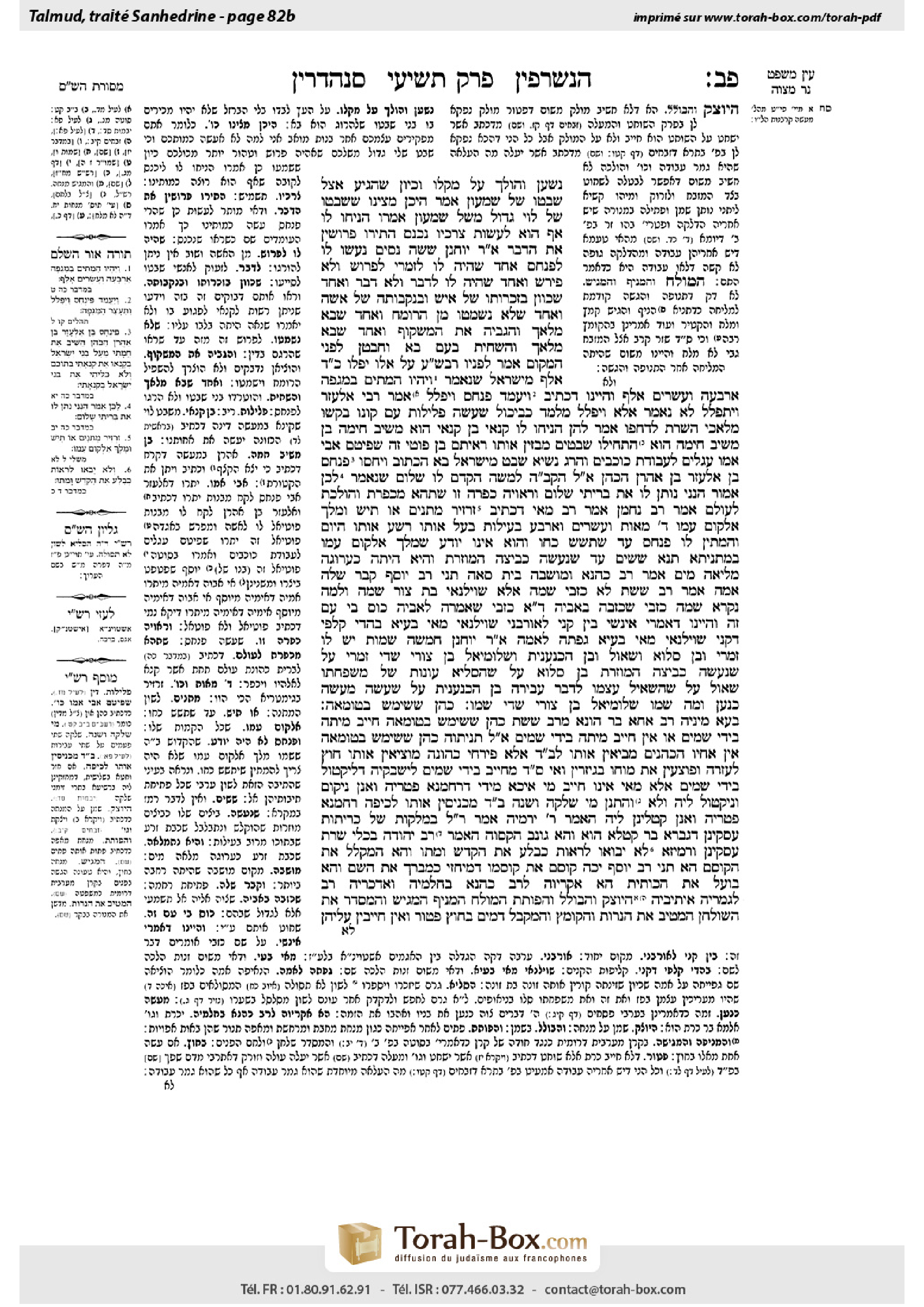
This page of Sanhedrin includes the Aramaic text, an English translation and an AI-generated French translation, alongside the scan above.
סנהדרין פ״ב ב · Aramaic and Hebrew text
נִשְׁעָן וְהוֹלֵךְ עַל מַקְלוֹ, וְכֵיוָן שֶׁהִגִּיעַ אֵצֶל שִׁבְטוֹ שֶׁל שִׁמְעוֹן אָמַר: הֵיכָן מָצִינוּ שֶׁשִּׁבְטוֹ שֶׁל לֵוִי גָּדוֹל מִשֶּׁל שִׁמְעוֹן? אָמְרוּ: הַנִּיחוּ לוֹ, אַף הוּא לַעֲשׂוֹת צְרָכָיו נִכְנַס. הִתִּירוּ פְּרוּשִׁין אֶת הַדָּבָר.
אָמַר רַבִּי יוֹחָנָן: שִׁשָּׁה נִסִּים נַעֲשׂוּ לוֹ לְפִנְחָס. אֶחָד, שֶׁהָיָה לוֹ לְזִמְרִי לִפְרוֹשׁ וְלֹא פֵּירַשׁ. וְאֶחָד, שֶׁהָיָה לוֹ לְדַבֵּר וְלֹא דִּבֵּר. וְאֶחָד, שֶׁכִּוֵּון בְּזַכְרוּתוֹ שֶׁל אִישׁ וּבְנַקְבוּתָהּ שֶׁל אִשָּׁה. וְאֶחָד, שֶׁלֹּא נִשְׁמְטוּ מִן הָרוֹמַח. וְאֶחָד, שֶׁבָּא מַלְאָךְ וְהִגְבִּיהַּ אֶת הַמַּשְׁקוֹף. וְאֶחָד, שֶׁבָּא מַלְאָךְ וְהִשְׁחִית בָּעָם.
בָּא וַחֲבָטָן לִפְנֵי הַמָּקוֹם, אָמַר לְפָנָיו: רִבּוֹנוֹ שֶׁל עוֹלָם, עַל אֵלּוּ יִפְּלוּ עֶשְׂרִים וְאַרְבָּעָה אֶלֶף מִיִּשְׂרָאֵל? שֶׁנֶּאֱמַר ״וַיִּהְיוּ הַמֵּתִים בַּמַּגֵּפָה אַרְבָּעָה וְעֶשְׂרִים אָלֶף״. וְהַיְינוּ דִּכְתִיב: ״וַיַּעֲמֹד פִּינְחָס וַיְפַלֵּל״.
אָמַר רַבִּי אֶלְעָזָר: ״וַיִּתְפַּלֵּל״ לֹא נֶאֱמַר, אֶלָּא ״וַיְפַלֵּל״. מְלַמֵּד כִּבְיָכוֹל, שֶׁעָשָׂה פְּלִילוּת עִם קוֹנוֹ. בִּקְּשׁוּ מַלְאֲכֵי הַשָּׁרֵת לְדׇחֳפוֹ. אָמַר לָהֶן: הַנִּיחוּ לוֹ, קַנַּאי בֶּן קַנַּאי הוּא, מֵשִׁיב חֵימָה בֶּן מֵשִׁיב חֵימָה הוּא.
הִתְחִילוּ שְׁבָטִים מְבַזִּין אוֹתוֹ: רְאִיתֶם בֶּן פּוּטִי זֶה, שֶׁפִּיטֵּם אֲבִי אִמּוֹ עֲגָלִים לַעֲבוֹדָה זָרָה, וְהָרַג נְשִׂיא שֵׁבֶט מִיִּשְׂרָאֵל? בָּא הַכָּתוּב וְיִחֲסוֹ: ״פִּנְחָס בֶּן אֶלְעָזָר בֶּן אַהֲרֹן הַכֹּהֵן״.
אָמַר לוֹ הַקָּדוֹשׁ בָּרוּךְ הוּא לְמֹשֶׁה: הַקְדֵּם לוֹ שָׁלוֹם, שֶׁנֶּאֱמַר: ״לָכֵן אֱמֹר הִנְנִי נוֹתֵן לוֹ אֶת בְּרִיתִי שָׁלוֹם״. וּרְאוּיָה כַּפָּרָה זוֹ שֶׁתְּהֵא מְכַפֶּרֶת וְהוֹלֶכֶת לְעוֹלָם.
אָמַר רַב נַחְמָן אָמַר רַב: מַאי דִּכְתִיב ״זַרְזִיר מׇתְנַיִם אוֹ תָיִשׁ וּמֶלֶךְ אַלְקוּם עִמּוֹ״? אַרְבַּע מֵאוֹת וְעֶשְׂרִים וְאַרְבַּע בְּעִילוֹת בָּעַל אוֹתוֹ רָשָׁע אוֹתוֹ הַיּוֹם, וְהִמְתִּין לוֹ פִּנְחָס עַד שֶׁתָּשַׁשׁ כֹּחוֹ. וְהוּא אֵינוֹ יוֹדֵעַ שֶׁמֶּלֶךְ אַלְקוּם עִמּוֹ.
בְּמַתְנִיתָא תָּנָא: שִׁשִּׁים, עַד שֶׁנַּעֲשָׂה כְּבֵיצָה הַמּוּזֶרֶת, וְהִיא הָיְתָה כַּעֲרוּגָה מְלֵיאָה מַיִם. אָמַר רַב כָּהֲנָא: וּמוֹשָׁבָהּ בֵּית סְאָה. תָּנֵי רַב יוֹסֵף: קֶבֶר שֶׁלָּהּ אַמָּה.
אָמַר רַב שֵׁשֶׁת: לֹא ״כׇּזְבִּי״ שְׁמָהּ, אֶלָּא ״שְׁוִילְנַאי בַּת צוּר״ שְׁמָהּ. וְלָמָּה נִקְרָא שְׁמָהּ ״כׇּזְבִּי״? שֶׁכִּזְּבָה בְּאָבִיהָ. דָּבָר אַחֵר: ״כׇּזְבִּי״ – שֶׁאָמְרָה לְאָבִיהָ: ״כּוֹס בִּי עַם זֶה״.
וְהַיְינוּ דְּאָמְרִי אִינָשֵׁי: ״בֵּין קְנֵי לְאוּרְבָּנֵי, שְׁוִילְנַאי מַאי בָּעֲיָא?״ ״בַּהֲדֵי קְלִפֵּי דִקְנֵי, שְׁוִילְנַאי מַאי בָּעֲיָא?״ גַּפְתָּהּ לְאִמַּהּ.
אָמַר רַבִּי יוֹחָנָן: חֲמִשָּׁה שֵׁמוֹת יֵשׁ לוֹ: זִמְרִי, וּבֶן סָלוּא, וְשָׁאוּל, וּבֶן הַכְּנַעֲנִית, וּשְׁלוּמִיאֵל בֶּן צוּרִי שַׁדָּי. זִמְרִי – עַל שֶׁנַּעֲשָׂה כְּבֵיצָה הַמּוּזֶרֶת, בֶּן סָלוּא – עַל שֶׁהִסְלִיא עֲוֹנוֹת שֶׁל מִשְׁפַּחְתּוֹ, שָׁאוּל – עַל שֶׁהִשְׁאִיל עַצְמוֹ לִדְבַר עֲבֵירָה, בֶּן הַכְּנַעֲנִית – עַל שֶׁעָשָׂה מַעֲשֵׂה כְנַעַן, וּמָה שְׁמוֹ? שְׁלוּמִיאֵל בֶּן צוּרִי שַׁדָּי שְׁמוֹ.
כֹּהֵן שֶׁשִּׁימֵּשׁ בְּטוּמְאָה. בְּעָא מִינֵּיהּ רַב אַחָא בַּר הוּנָא מֵרַב שֵׁשֶׁת: כֹּהֵן שֶׁשִּׁימֵּשׁ בְּטוּמְאָה, חַיָּיב מִיתָה בִּידֵי שָׁמַיִם אוֹ אֵין חַיָּיב מִיתָה בִּידֵי שָׁמַיִם?
אֲמַר לֵיהּ: תְּנֵיתוּהָ, כֹּהֵן שֶׁשִּׁימֵּשׁ בְּטוּמְאָה אֵין אֶחָיו הַכֹּהֲנִים מְבִיאִין אוֹתוֹ לְבֵית דִּין, אֶלָּא פִּירְחֵי כְהוּנָּה מוֹצִיאִין אוֹתוֹ חוּץ לָעֲזָרָה וּפוֹצְעִין אֶת מוֹחוֹ בְּגִיזְרִין. וְאִי סָלְקָא דַעְתָּךְ מְחַיֵּיב בִּידֵי שָׁמַיִם, לִישְׁבְּקֵיהּ דְּלִיקְטוֹל בִּידֵי שָׁמַיִם! אֶלָּא מַאי? אֵינוֹ חַיָּיב.
מִי אִיכָּא מִידֵּי דְּרַחֲמָנָא פַּטְרֵיהּ, וַאֲנַן נֵיקוּם וְנִיקְטוֹל לֵיהּ? וְלָא? וְהָתְנַן: מִי שֶׁלָּקָה וְשָׁנָה – בֵּית דִּין מַכְנִיסִין אוֹתוֹ לַכִּיפָּה. רַחֲמָנָא פַּטְרֵיהּ, וַאֲנַן קָטְלִינַן לֵיהּ! הָאָמַר רַבִּי יִרְמְיָה אָמַר רֵישׁ לָקִישׁ: בְּמַלְקוֹת שֶׁל כָּרֵיתוֹת עָסְקִינַן, דְּגַבְרָא בַּר קְטָלָא הוּא.
וְהָא גּוֹנֵב הַקַּסְוָה? הָאָמַר רַב יְהוּדָה: בִּכְלִי שָׁרֵת עָסְקִינַן, וּרְמִיזָא: ״לֹא יָבֹאוּ לִרְאוֹת כְּבַלַּע אֶת הַקֹּדֶשׁ וָמֵתוּ״.
וְהָא הַמְקַלֵּל אֶת הַקּוֹסֵם? הָא תָּנֵי רַב יוֹסֵף: יַכֶּה קוֹסֵם אֶת קוֹסְמוֹ, דְּמִיחֲזֵי כִּמְבָרֵךְ אֶת הַשֵּׁם.
וְהָא בּוֹעֵל אֲרָמִית? הָא אַקְרְיוּהּ לְרַב כָּהֲנָא בְּחֶלְמֵיהּ, וְאִדַּכְרֵיהּ רַב לִגְמָרֵיהּ.
אֵיתִיבֵיהּ: הַיּוֹצֵק, וְהַבּוֹלֵל, וְהַפּוֹתֵת, הַמּוֹלֵחַ, הַמֵּנִיף, הַמַּגִּישׁ, וְהַמְסַדֵּר אֶת הַשּׁוּלְחָן, הַמֵּטִיב אֶת הַנֵּרוֹת, וְהַקּוֹמֵץ, וְהַמְקַבֵּל דָּמִים בַּחוּץ – פָּטוּר.
וְאֵין חַיָּיבִין עֲלֵיהֶן
Sanhedrin 82b · English translation
walking, leaning on his walking stick, the shaft of the spear. And once he reached the tribe of Simeon he said: Where did we find that the tribe of Levi is greater than that of Simeon? If all the members of your tribe submit to the temptation of the women of Moab, I may do so as well. After hearing that statement, the members of the tribe of Simeon said: Allow him to enter; like us, he too is entering to attend to his needs and engage in intercourse with the Moabite women. They rejoiced and said: Apparently, the pious and God-fearing have permitted this matter, as Pinehas is one of them.
Rabbi Yoḥanan says: Six miracles were performed for Pinehas when he killed Zimri. One is that Zimri should have separated himself from Cozbi, and he did not separate himself. Had he done so, it would have been prohibited for Pinehas to kill him. And one is that Zimri should have spoken and alerted the members of his tribe to come to his assistance, and he did not speak. And one is that Pinehas directed the spear precisely to the male genitals of Zimri and to the female genitals of Cozbi so that the reason that he killed them would be evident. And one is that Zimri and Cozbi did not fall from the spear. And one is that an angel came and raised the lintel of that chamber so that Pinehas could emerge holding them aloft on the spear. And one is that an angel came and caused destruction among the people, distracting them from interfering with the actions of Pinehas.
Pinehas came and slammed them on the ground before the Omnipresent and said before Him: Master of the Universe, will twenty-four thousand of the children of Israel fall due to these sinners? As it is stated: “And those that died in the plague were twenty-four thousand” (Numbers 25:9). And that is the meaning of that which is written: “And Pinehas stood and wrought judgment and the plague was stayed” (Psalms 106:30).
Rabbi Elazar says: It is not stated in the verse: And prayed [vayitpallel]; rather, it is stated vayefalel. This teaches that Pinehas, as it were, wrought judgment [pelilut] with his Creator. The ministering angels sought to push him away because he spoke harshly to God. The Holy One, Blessed be He, said to them: Leave him be; he is a zealot, son of a zealot, from the tribe of Levi, who was zealous in avenging the violation of his sister Dinah; he is an alleviator of wrath, son of an alleviator of wrath, a descendant of Aaron, who alleviated the wrath of God during the plague that followed the assembly of Korah.
The tribes began to demean Pinehas: Did you see this son of Puti, so-called because his mother was one of the daughters of Putiel (see Exodus 6:25), and they interpreted homiletically: As Yitro, the father of his mother, according to one rabbinic tradition, fattened [shepittem] calves for idol worship, and he impudently killed the prince of a tribe of Israel without a trial. In response, the verse comes and provides his lineage as “Pinehas, son of Elazar, son of Aaron the priest” (Numbers 25:11). It is due to that lineage that he zealously executed Zimri.
The Holy One, Blessed be He, said to Moses: Be the first to greet Pinehas with a blessing of peace, to honor him before the people, as it is stated: “Therefore say: I hereby give to him My covenant of peace” (Numbers 25:12), and it is stated: “And it shall be unto him and to his descendants after him a covenant of eternal priesthood, because he was zealous for his God and he atoned for the children of Israel” (Numbers 25:13), and this atonement that he facilitated is worthy of continuing to atone forever.
§ With regard to the same matter, Rav Naḥman says that Rav says: What is the meaning of that which is written: “The thigh-belted greyhound [zarzir], or the he-goat, and the king against whom none can rise” (Proverbs 30:31)? That wicked Zimri engaged in four hundred and twenty-four, the numerical value of the word zarzir, acts of intercourse with Cozbi that day. And Pinehas waited until his strength waned from all that activity. And Pinehas did not know that it was not necessary to wait that long because the king against whom none can rise, a reference to the Holy One, Blessed be He, was with him.
It was taught in a baraita: Zimri engaged in intercourse sixty times until he became like an addled egg whose contents are a muddled and non-differentiated fluid, and Cozbi was like a garden bed full of water. Rav Kahana said to underscore her disgrace resulting from her extensive sexual activity: And her seat was as wide as the area required for sowing one se’a of seed [beit se’a]. Rav Yosef taught: The opening of her womb was a cubit.
Rav Sheshet says: Cozbi was not her given name; rather, Shevilnai, daughter of Zur, was her real name. And why was she called Cozbi? Because through her actions, she distorted [shekizzeva] the instructions of her father. He told her to submit only to the greatest of the children of Israel, and she submitted to the leader of a tribe. Alternatively: She was called Cozbi because she said to her father: Slaughter [kos] this people through me [bi], as I will seduce them to engage in licentiousness.
Her name was Shevilnai; and this is as people say in reference to a famous prostitute: Between reeds and willows, what does Shevilnai seek? Clearly, she seeks licentiousness. There is another adage: Among the peels of the reeds, what does Shevilnai seek? Clearly, she seeks licentiousness. She prostituted her mother. Apparently, Shevilnai became a name popularly used to connote a prostitute. Since everyone refers to her as prostitute, daughter of prostitute, she has implicated her mother with her licentiousness.
Rabbi Yoḥanan says: Zimri has five names: Zimri; and son of Salu; and Saul; and son of the Canaanite woman; and Shelumiel, son of Zuri Shaddai. He was called Zimri because of the fact that he became like an addled [hamuzeret] egg as a result of engaging in multiple acts of intercourse. He was called son of Salu because of the fact that he evoked [shehisli] the sins of his family. He was called Saul [Shaul] because of the fact that he lent [shehishil] himself to sinful matters. He was called son of the Canaanite woman because of the fact that he performed an act of Canaan, as the Canaanites are renowned for their licentiousness. And what is his given name? Shelumiel, son of Zuri Shaddai, is his name, the leader of the tribe of Simeon (Numbers 1:6).
§ The mishna teaches: In the case of a priest who performed the Temple service in a state of ritual impurity, the young of the priesthood kill him. Rav Aḥa bar Huna raised a dilemma before Rav Sheshet: In the case of a priest who performed the Temple service in a state of ritual impurity, is he liable to receive death at the hand of Heaven or is he not liable to receive death at the hand of Heaven?
Rav Sheshet said to him: You learned the resolution of that dilemma from the mishna itself, as we learned: In the case of a priest who performed the Temple service in a state of ritual impurity, his priestly brethren do not bring him to court for judgment; rather, the young of the priesthood remove him from the Temple courtyard and pierce his skull with pieces of wood. And if it enters your mind to say that he is liable to receive death at the hand of Heaven, let the young of the priesthood leave him, so that he will be killed at the hand of Heaven. Rather, what must one say? He is not liable to receive death at the hand of Heaven.
Rav Aḥa bar Huna rejects that proof: Is there any act for which the Torah absolves him of the death penalty and we shall arise and execute him? Rav Sheshet said to him: And are there not cases where one is executed even though the Torah absolves him? But didn’t we learn in a mishna: One who was flogged for violating a prohibition and then repeated the violation, the court places him into the vaulted chamber? There too, the Merciful One absolves him of the death penalty and we execute him. Rav Aḥa bar Huna rejects that proof: Doesn’t Rabbi Yirmeya say that Reish Lakish says: We are dealing with lashes administered for violations of prohibitions punishable by karet? As in that case, the man is essentially liable to be punished with death at the hand of Heaven.
Rav Sheshet said to him: But isn’t there the case of one who steals a kasva, who is exempt from punishment by Torah law, and the mishna says that zealots strike him? Rav Aḥa bar Huna rejects that proof: But doesn’t Rav Yehuda say: We are dealing with a service vessel utilized in the Temple, and the fact that one who steals a service vessel is liable to be killed by zealots is intimated in the verse: “But they shall not come to see the sacred items as they are being covered, lest they die” (Numbers 4:20).
Rav Sheshet said to him: But isn’t there the case of one who curses the sorcerer, who is exempt from punishment by Torah law, and the mishna says that zealots strike him? Rav Aḥa bar Huna rejects that proof: But didn’t Rav Yosef teach that the reference is to a case where one says: Let the sorcerer strike his sorcerer, which appears to be like one who is blessing, a euphemism for cursing, the name of God, and he is liable to be executed for desecration of the name of God.
Rav Sheshet said to him: But isn’t there the case of one who engages in intercourse with an Aramean woman, who is exempt from punishment by Torah law, and the mishna says that zealots strike him? Rav Aḥa bar Huna rejects that proof: Didn’t they read a verse to Rav Kahana in his dream and when he related his dream to Rav, Rav remembered that which he learned through tradition that God will excise the soul of one who engages in intercourse with a gentile woman?
Rav Aḥa bar Huna raises an objection to the opinion of Rav Sheshet that a priest who performs the Temple service in a state of ritual impurity is not liable to receive death at the hand of Heaven. A baraita teaches: With regard to a priest who pours oil onto a meal-offering, and one who mixes the oil into the meal-offering, and one who breaks a baked meal-offering into pieces, and one who salts the meal-offering, and one who waves it toward the altar, and one who brings the meal-offering to the altar, and one who arranges the Table of the shewbread, and one who removes the ashes from the lamps of the Candelabrum, and one who removes the handful from the meal-offering, and one who collects the blood after the slaughter of one of the offerings; if the priest performs any of these sacrificial rites outside the Temple, although there are severe prohibitions with regard to performing the Temple service outside the Temple, he is exempt from karet.
And one is not liable for their performance,
Sanhedrin 82b · Traduction française (IA)
marchant, appuyé sur son bâton de marche, le fût de la lance. Et lorsqu'il atteignit la tribu de Siméon, il dit : Où avons-nous trouvé que la tribu de Lévi est supérieure à celle de Siméon ? Si tous les membres de votre tribu cèdent à la tentation des femmes de Moab, je peux le faire également. Après avoir entendu cette déclaration, les membres de la tribu de Siméon dirent : Laissez-le entrer ; comme nous, il entre également pour satisfaire ses besoins et avoir des rapports avec les femmes moabites. Ils se réjouirent et dirent : Apparemment, les pieux et crainteurs de Dieu ont permis cette affaire, car Pinhas est l'un d'entre eux.
Le Rabbi Yoḥanan dit : Six miracles furent accomplis pour Pinhas lorsqu'il tua Zimri. L'un est que Zimri aurait dû se séparer de Cozbi, et il ne s'est pas séparé. S'il l'avait fait, il aurait été interdit à Pinhas de le tuer. Et l'un est que Zimri aurait dû parler et alerter les membres de sa tribu pour qu'ils viennent à son secours, et il n'a pas parlé. Et l'un est que Pinhas a dirigé la lance précisément vers les organes génitaux mâles de Zimri et vers les organes génitaux féminins de Cozbi, afin que la raison pour laquelle il les a tués soit évidente. Et l'un est que Zimri et Cozbi ne sont pas tombés de la lance. Et l'un est qu'un ange est venu et a soulevé le linteau de cette chambre, afin que Pinhas puisse en sortir en les tenant en l'air sur la lance. Et l'un est qu'un ange est venu et a causé la destruction parmi le peuple, les détournant de s'immiscer dans les actions de Pinhas.
Pinhas vint et les jeta au sol devant l'Omni-present et dit devant Lui : Maître de l'Univers, vingt-quatre mille des enfants d'Israël vont-ils périr à cause de ces pécheurs ? Comme il est écrit : « Et ceux qui moururent de la peste étaient vingt-quatre mille » (Nombres 25:9). Et c'est le sens de ce qui est écrit : « Et Pinhas se leva et exerça le jugement, et la peste s'arrêta » (Psaumes 106:30).
Le Rabbi Elazar dit : Il n'est pas écrit dans le verset : « Et il pria » [vayitpallel] ; plutôt, il est écrit vayefalel. Cela enseigne que Pinhas, en quelque sorte, a exercé le jugement [pelilut] avec son Créateur. Les anges ministériels cherchèrent à le repousser parce qu'il parlait durement à Dieu. Le Saint, béni soit-Il, leur dit : Laissez-le tranquille ; il est un zélé, fils d'un zélé, de la tribu de Lévi, qui fut zélé pour venger la violation de sa sœur Dina ; il est un apaisateur de la colère, fils d'un apaisateur de la colère, descendant d'Aaron, qui apaisa la colère de Dieu lors de la peste qui suivit l'assemblée de Korah.
Les tribus commencèrent à mépriser Pinhas : « Avez-vous vu ce fils de Puti, ainsi nommé parce que sa mère était l'une des filles de Putiel (voir Exode 6:25) ? » Et ils interprétèrent homilétiquement : « Comme Yitro, le père de sa mère, selon une tradition rabbinique, engraisse [shepittem] des veaux pour l'idolâtrie, et il a impudemment tué le prince d'une tribu d'Israël sans procès. » En réponse, le verset vient et fournit sa lignée comme « Pinhas, fils d'Elazar, fils d'Aaron le prêtre » (Nombres 25:11). C'est en raison de cette lignée qu'il a exécuté Zimri avec zèle.
Le Saint, béni soit-Il, dit à Moïse : « Sois le premier à saluer Pinhas d'une bénédiction de paix, pour l'honorer devant le peuple, comme il est écrit : « C'est pourquoi dis : Je lui donne ici mon alliance de paix » (Nombres 25:12), et il est écrit : « Et cela sera pour lui et pour sa descendance après lui une alliance de sacerdoce éternelle, parce qu'il fut zélé pour son Dieu et qu'il expia pour les enfants d'Israël » (Nombres 25:13), et cette expiation qu'il a facilitée est digne de continuer à expier pour toujours. »
§ Concernant la même affaire, Rav Naḥman dit que Rav dit : Quel est le sens de ce qui est écrit : « Le chien de chasse gris, vif [zarzir], ou le bouc, et le roi contre lequel nul ne peut se dresser » (Proverbes 30:31) ? Que le méchant Zimri a eu quatre cent vingt-quatre, la valeur numérique du mot zarzir, rapports sexuels avec Cozbi ce jour-là. Et Pinhas a attendu jusqu'à ce que sa force diminue de toute cette activité. Et Pinhas ne savait pas qu'il n'était pas nécessaire d'attendre si longtemps, car le roi contre lequel nul ne peut se dresser, une référence au Saint, béni soit-Il, était avec lui.
Il a été enseigné dans une baraïta : Zimri a eu des rapports sexuels soixante fois jusqu'à ce qu'il devienne comme un œuf brouillé dont le contenu est un fluide trouble et non différencié, et Cozbi était comme un lit de jardin plein d'eau. Rav Kahana a dit pour souligner son déshonneur résultant de son activité sexuelle extensive : Et son siège était aussi large que la surface nécessaire pour semer un se'a de semence [beit se'a]. Rav Yosef a enseigné : L'ouverture de son utérus était d'une coudée.
Rav Sheshet dit : Cozbi n'était pas son nom donné ; plutôt, Shevilnai, fille de Zur, était son vrai nom. Et pourquoi était-elle appelée Cozbi ? Parce que par ses actions, elle a déformé [shekizzeva] les instructions de son père. Il lui avait dit de ne se soumettre qu'au plus grand des enfants d'Israël, et elle s'est soumise au chef d'une tribu. Ou bien : Elle était appelée Cozbi parce qu'elle a dit à son père : Égorge [kos] ce peuple par moi [bi], car je les séduirai pour qu'ils s'adonnent à la débauche.
Son nom était Shevilnai ; et c'est ainsi que les gens parlent à propos d'une prostituée célèbre : Entre les roseaux et les saules, que cherche Shevilnai ? Évidemment, elle cherche la débauche. Il y a un autre adage : Parmi les écorces des roseaux, que cherche Shevilnai ? Évidemment, elle cherche la débauche. Elle a prostitué sa mère. Apparemment, Shevilnai est devenu un nom utilisé couramment pour désigner une prostituée. Puisque tout le monde la désigne comme prostituée, fille de prostituée, elle a impliqué sa mère dans sa débauche.
Rabbi Yoḥanan dit : Zimri porte cinq noms : Zimri ; et fils de Salu ; et Saül ; et fils de la femme cananéenne ; et Shelumiel, fils de Zuri Shaddai. Il était appelé Zimri en raison du fait qu'il est devenu comme un œuf gâté [hamuzeret] à la suite de la pratique de multiples actes d'intercourse. Il était appelé fils de Salu en raison du fait qu'il a suscité [shehisli] les péchés de sa famille. Il était appelé Saül [Shaul] en raison du fait qu'il s'est livré [shehishil] à des affaires pécheresses. Il était appelé fils de la femme cananéenne en raison du fait qu'il a commis un acte de Canaan, les Cananéens étant renommés pour leur débauche. Et quel est son nom propre ? Shelumiel, fils de Zuri Shaddai, est son nom, le chef de la tribu de Simeon (Nombres 1:6).
§ La Michna enseigne : Dans le cas d'un prêtre qui a accompli le service du Temple dans un état d'impureté rituelle, les jeunes de la prêtrise le mettent à mort. Rav Aḥa bar Huna a soulevé un dilemme devant Rav Sheshet : Dans le cas d'un prêtre qui a accompli le service du Temple dans un état d'impureté rituelle, est-il passible de la mort par la main du Ciel ou n'est-il pas passible de la mort par la main du Ciel ?
Rav Sheshet lui dit : Tu as appris la résolution de ce dilemme de la Michna elle-même, car nous avons appris : Dans le cas d'un prêtre qui a accompli le service du Temple dans un état d'impureté rituelle, ses frères prêtres ne le mènent pas au tribunal pour jugement ; plutôt, les jeunes de la prêtrise le retirent de la cour du Temple et lui percent le crâne avec des morceaux de bois. Et si tu es tenté de dire qu'il est passible de la mort par la main du Ciel, que les jeunes de la prêtrise le laissent, afin qu'il soit mis à mort par la main du Ciel. Plutôt, que doit-on dire ? Il n'est pas passible de la mort par la main du Ciel.
Rav Aḥa bar Huna rejette cette preuve : Existe-t-il un acte pour lequel la Torah l'absout de la peine de mort et nous nous lèverions pour l'exécuter ? Rav Sheshet lui dit : Et n'existe-t-il pas des cas où l'on est exécuté bien que la Torah l'absolve ? Mais n'avons-nous pas appris dans une Michna : Celui qui a été fouetté pour avoir violé une interdiction et qui a ensuite répété la violation, le tribunal le place dans la chambre voûtée ? Là aussi, le Tout-Puissant l'absout de la peine de mort et nous l'exécutons. Rav Aḥa bar Huna rejette cette preuve : Rabbi Yirmeya ne dit-il pas que Reish Lakish dit : Nous avons affaire à des coups de fouet administrés pour des violations d'interdictions punies par la karet ? Car dans ce cas, l'homme est essentiellement passible d'être puni de mort par la main du Ciel.
Rav Sheshet lui dit : Mais n'y a-t-il pas le cas de celui qui vole une kasva, qui est exempt de punition par la loi de la Torah, et la Michna dit que les zélotes le frappent ? Rav Aḥa bar Huna rejette cette preuve : Mais Rav Yehuda ne dit-il pas : Nous avons affaire à un vase de service utilisé dans le Temple, et le fait que celui qui vole un vase de service soit passible d'être mis à mort par les zélotes est suggéré par le verset : « Mais ils ne viendront pas voir les objets sacrés lorsqu'ils sont couverts, de peur qu'ils ne meurent » (Nombres 4:20) ?
Rav Sheshet lui dit : Mais n'y a-t-il pas le cas de celui qui maudit le sorcier, qui est exempt de punition selon la Torah écrite, et la Michna dit que les zélotes le frappent ? Rav Aḥa bar Huna rejette cette preuve : Mais Rav Yosef n'a-t-il pas enseigné que la référence est à un cas où l'on dit : Que le sorcier frappe son sorcier, ce qui semble être comme une bénédiction, un euphémisme pour maudire le Nom de Dieu, et il est passible d'exécution pour la profanation du Nom de Dieu.
Rav Sheshet lui dit : Mais n'y a-t-il pas le cas de celui qui a des rapports avec une femme araméenne, qui est exempt de punition selon la Torah écrite, et la Michna dit que les zélotes le frappent ? Rav Aḥa bar Huna rejette cette preuve : N'a-t-on pas lu un verset à Rav Kahana dans son rêve et lorsqu'il a rapporté son rêve à Rav, Rav s'est souvenu de ce qu'il avait appris par tradition que Dieu excisera l'âme de celui qui a des rapports avec une femme non juive ?
Rav Aḥa bar Huna soulève une objection à l'opinion de Rav Sheshet selon laquelle un prêtre qui accomplit le service du Temple dans un état d'impureté rituelle n'est pas passible de la mort par la main du Ciel. Une baraïta enseigne : En ce qui concerne un prêtre qui verse de l'huile sur une offrande de farine, et celui qui mélange l'huile dans l'offrande de farine, et celui qui brise une offrande de farine cuite en morceaux, et celui qui salée l'offrande de farine, et celui qui la fait osciller vers l'autel, et celui qui apporte l'offrande de farine à l'autel, et celui qui dispose la Table des pains de proposition, et celui qui retire les cendres des lampes du Chandelier, et celui qui retire la poignée de l'offrande de farine, et celui qui recueille le sang après l'abattage de l'une des offrandes ; si le prêtre accomplit l'un de ces rites sacrificiels en dehors du Temple, bien qu'il existe de graves interdictions concernant l'accomplissement du service du Temple en dehors du Temple, il est exempt de la karet.
Et l'on n'est pas tenu de les accomplir,
Traduction française générée par IA à partir de l’édition anglaise de Sefaria. Vérifie toujours un passage avec le texte source.
Text from Sefaria: William Davidson Edition - Vocalized Aramaic (CC BY NC); William Davidson Edition - English (CC BY NC).