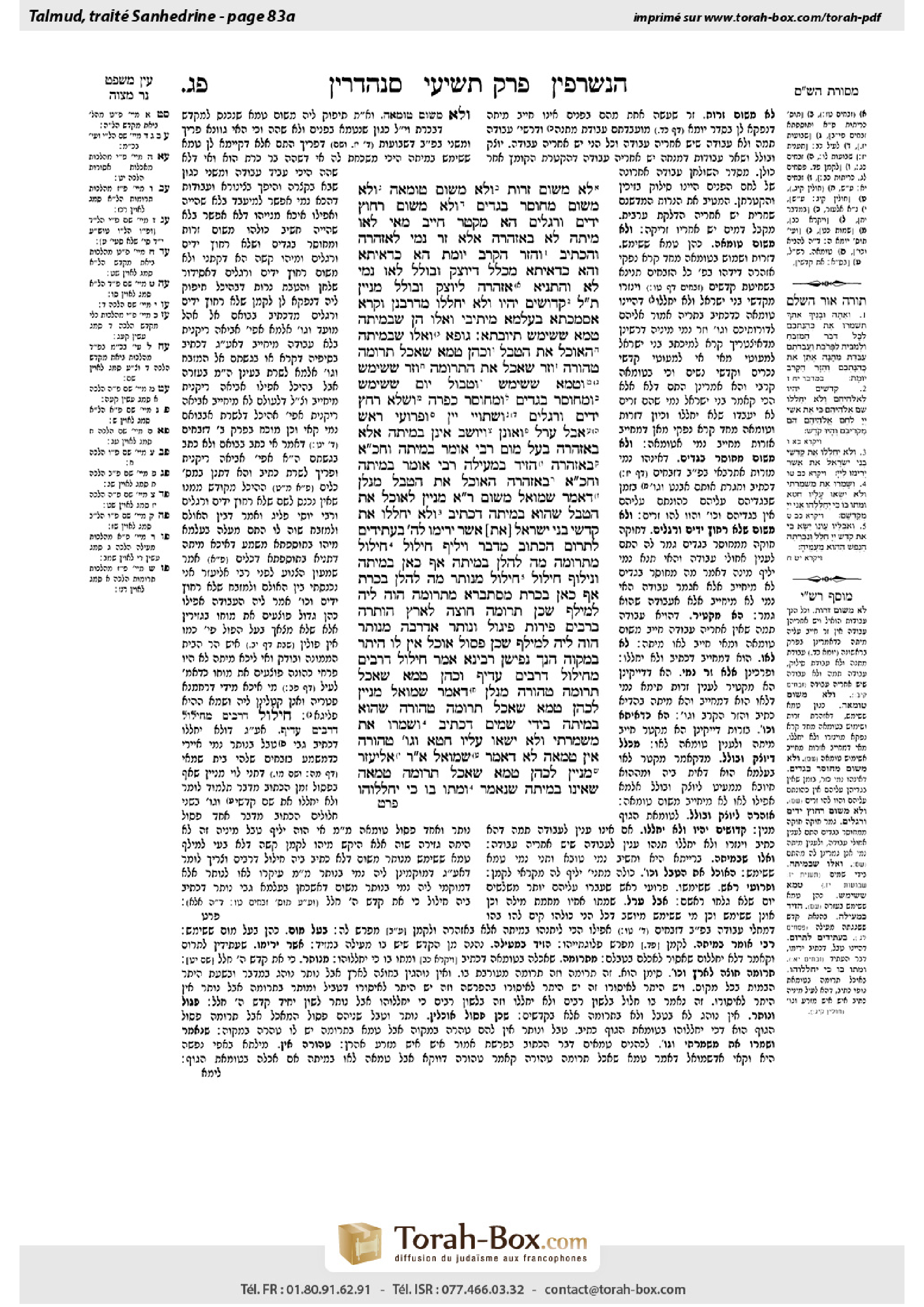
Sanhedrin 83a: Talmud study for Daf Yomi
Daf Yomi is the daily study of one Talmud folio. Explore 37 tractates with scans, Hebrew text, Sefaria English and AI-generated French translations where annotated.
Passage selection and English or AI-generated French translation are available where the scan has annotations. Daf Study is independent of Torah-Box and Sefaria.
Browse Sanhedrin · סנהדרין · All tractatesSanhedrin 83a text and translations
This page of Sanhedrin includes the Aramaic text, an English translation and an AI-generated French translation, alongside the scan above.
סנהדרין פ״ג א · Aramaic and Hebrew text
לֹא מִשּׁוּם זָרוּת, וְלֹא מִשּׁוּם טוּמְאָה, וְלֹא מִשּׁוּם מְחוּסַּר בְּגָדִים, וְלֹא מִשּׁוּם רִחוּץ יָדַיִם וְרַגְלַיִם.
הָא מְקַטֵּר – חַיָּיב. מַאי לָאו, מִיתָה? לָא, בְּאַזְהָרָה.
אֶלָּא זָר נָמֵי לְאַזְהָרָה? וְהָכְתִיב: ״וְהַזָּר הַקָּרֵב יוּמָת״! הָא כִּדְאִיתַאּ וְהָא כִּדְאִיתַאּ.
מִכְּלָל דְּיוֹצֵק וּבוֹלֵל לָאו נָמֵי לָא? וְהָתַנְיָא: אַזְהָרָה לְיוֹצֵק וּבוֹלֵל מִנַּיִין? תַּלְמוּד לוֹמַר: ״קְדֹשִׁים יִהְיוּ וְלֹא יְחַלְּלוּ״. מִדְּרַבָּנַן, וּקְרָא אַסְמַכְתָּא בְּעָלְמָא.
מֵיתִיבִי: וְאֵלּוּ הֵן שֶׁבְּמִיתָה – טָמֵא שֶׁשִּׁימֵּשׁ. תְּיוּבְתָּא!
גּוּפָא: וְאֵלּוּ שֶׁבְּמִיתָה – הָאוֹכֵל אֶת הַטֶּבֶל, וְכֹהֵן טָמֵא שֶׁאָכַל תְּרוּמָה טְהוֹרָה, וְזָר שֶׁאָכַל אֶת הַתְּרוּמָה, וְזָר שֶׁשִּׁימֵּשׁ, וְטָמֵא שֶׁשִּׁימֵּשׁ, וּטְבוּל יוֹם שֶׁשִּׁימֵּשׁ, וּמְחוּסַּר בְּגָדִים, וּמְחוּסַּר כַּפָּרָה, וְשֶׁלֹּא רָחַץ יָדַיִם וְרַגְלַיִם, וּשְׁתוּיֵי יַיִן, וּפְרוּעֵי רֹאשׁ.
אֲבָל עָרֵל, וְאוֹנֵן, וְיוֹשֵׁב – אֵינָן בְּמִיתָה אֶלָּא בְּאַזְהָרָה. בַּעַל מוּם – רַבִּי אוֹמֵר: בְּמִיתָה, וַחֲכָמִים אוֹמְרִים: בָּאַזְהָרָה.
הֵזִיד בִּמְעִילָה, רַבִּי אוֹמֵר: בְּמִיתָה, וַחֲכָמִים אוֹמְרִים: בָּאַזְהָרָה.
הָאוֹכֵל אֶת הַטֶּבֶל, מְנָלַן? דְּאָמַר שְׁמוּאֵל מִשּׁוּם רַבִּי אֱלִיעֶזֶר: מִנַּיִין לְאוֹכֵל אֶת הַטֶּבֶל שֶׁהוּא בְּמִיתָה? דִּכְתִיב: ״וְלֹא יְחַלְּלוּ אֶת קׇדְשֵׁי בְּנֵי יִשְׂרָאֵל [אֵת] אֲשֶׁר יָרִימוּ לַה׳״. בַּעֲתִידִים לִתְרוֹם הַכָּתוּב מְדַבֵּר.
וְיָלֵיף ״חִילּוּל״ ״חִילּוּל״ מִתְּרוּמָה, מָה לְהַלָּן בְּמִיתָה – אַף כָּאן בְּמִיתָה.
וְנֵילַף ״חִילּוּל״ ״חִילּוּל״ מִנּוֹתָר: מָה לְהַלָּן בְּכָרֵת, אַף כָּאן בְּכָרֵת.
מִסְתַּבְּרָא מִתְּרוּמָה הֲוָה לֵיהּ לְמֵילַף, שֶׁכֵּן תְּרוּמָה: חוּצָה לָאָרֶץ, הוּתְּרָה, בְּרַבִּים, פֵּירוֹת, פִּיגּוּל וְנוֹתָר.
אַדְּרַבָּה, מִנּוֹתָר הֲוָה לֵיהּ לְמֵילַף, שֶׁכֵּן פְּסוּל אוֹכֶל, אֵין לוֹ הֶיתֵּר בְּמִקְוֶה. הָנָךְ נְפִישָׁן. רָבִינָא אָמַר: חִילּוּל דְּרַבִּים מֵחִילּוּל דְּרַבִּים עָדִיף.
וְכֹהֵן טָמֵא שֶׁאָכַל תְּרוּמָה טְהוֹרָה מְנָלַן? דְּאָמַר שְׁמוּאֵל: מִנַּיִין לְכֹהֵן טָמֵא שֶׁאָכַל תְּרוּמָה טְהוֹרָה שֶׁהוּא בְּמִיתָה בִּידֵי שָׁמַיִם? דִּכְתִיב: ״וְשָׁמְרוּ אֶת מִשְׁמַרְתִּי וְלֹא יִשְׂאוּ עָלָיו חֵטְא וְגוֹ׳״.
טְהוֹרָה – אִין, טְמֵאָה – לָא. דְּאָמַר שְׁמוּאֵל אָמַר רַבִּי אֱלִיעֶזֶר: מִנַּיִין לְכֹהֵן טָמֵא שֶׁאָכַל תְּרוּמָה טְמֵאָה שֶׁאֵינוֹ בְּמִיתָה? שֶׁנֶּאֱמַר: ״וּמֵתוּ בוֹ כִּי יְחַלְּלֻהוּ״,
Sanhedrin 83a · English translation
neither due to non-priesthood, if a non-priest performs one of those rites in the Temple, he is not liable to receive the death penalty; nor due to the performance of any of these rites in a state of ritual impurity; nor due to the performance of any of these rites as a priest lacking the requisite priestly vestments; nor due to the performance of any of these services without the washing of his hands and feet. The reason for the lack of liability is that in all these cases, additional rites must be performed in order to complete the service. One is liable for performing the service outside the Temple, or performing the service as a non-priest, in a state of ritual impurity, etc., only when performing a ritual that completes the service.
From the baraita, one may infer: But one who burns the offering on the altar in one of these circumstances, including in a state of ritual impurity, is liable. What, is it not teaching that he is liable to receive death at the hand of Heaven, and there is proof from the baraita to resolve Rav Aḥa bar Huna’s dilemma? The Gemara rejects that proof: No, he is liable for violating a prohibition, without the punishment of death.
The Gemara asks: But according to that understanding, as for the non-priest who is mentioned in the baraita together with the priest who performs the Temple service in a state of impurity, is he too liable for violating a prohibition, and not death, if he burns the offering on the altar? But isn’t it written: “And the non-priest who approaches shall be put to death” (Numbers 18:7)? The Gemara answers: Do not extrapolate the liability of a non-priest from the liability of a ritually impure priest, as this case of ritual impurity is as it is, and that case of a non-priest is as it is; each situation is discussed independently.
The Gemara asks: Is that to say, by inference, that a priest who pours oil onto a meal-offering and one who mixes the oil into the meal-offering, in a state of ritual impurity, does not violate even a prohibition? But isn’t it taught in a baraita: From where is a prohibition against pouring oil and against mixing oil in a state of ritual impurity derived? It is derived from a verse, as the verse states: “They shall be sacred to their God and they shall not profane the name of their God; for the fire offerings of the Lord, the bread of their God, they offer” (Leviticus 21:6). The Gemara answers: No proof may be cited from that verse, as the prohibition against performing Temple rites that do not complete the service in a state of impurity is by rabbinic law, and the verse is a mere support, not a Torah prohibition.
The Gemara raises an objection from a baraita (Tosefta, Zevaḥim 12:17): And these are they who are liable to receive death at the hand of Heaven: Among those enumerated is an impure individual who performed the Temple service. The Gemara concludes: This is a conclusive refutation of the opinion of Rav Sheshet, and proof that an impure individual who performs the Temple service is liable to receive death at the hand of Heaven, and young priests and zealots may kill only one who is liable to receive death at the hand of Heaven.
§ In order to discuss the matter itself, the Gemara cites the Tosefta: And these are they who are liable to receive death at the hand of Heaven: One who partakes of untithed produce, and a ritually impure priest who partook of ritually pure teruma, and a non-priest who partook of teruma, and a non-priest who performed the Temple service, and a ritually impure priest who performed the Temple service, and a priest who was ritually impure who immersed that day and is waiting for nightfall for the purification process to be completed, who performed the Temple service, and a priest lacking the requisite priestly vestments, and a priest who has not yet brought an atonement offering to complete his purification process as a leper or zav, and a priest who did not wash his hands and feet before beginning the Temple service; and priests who performed the Temple service while intoxicated with wine, and priests who performed the Temple service with overgrown hair on their heads.
The baraita continues: But a priest who performs the Temple service while uncircumcised or as an acute mourner on the day that one of his close relatives dies, or a priest who performs the Temple service while seated, are not punished with death at the hand of Heaven; rather, they are liable for violating a prohibition. With regard to a blemished priest who performs the Temple service, Rabbi Yehuda HaNasi says: He is punished with death at the hand of Heaven, and the Rabbis say: He is liable only for violating a prohibition.
As the Torah states the halakha only in the case of one who misuses consecrated property unwittingly, there is a dispute with regard to one who intentionally performed an action of misuse of consecrated property. Rabbi Yehuda HaNasi says: He is punished with death at the hand of Heaven, and the Rabbis say: He is liable only for violating a prohibition.
The Gemara elaborates: It was taught in the baraita that one who partakes of untithed produce is liable to receive death at the hand of Heaven. The Gemara asks: From where do we derive this halakha? The Gemara answers: As Shmuel says in the name of Rabbi Eliezer: From where is it derived that one who partakes of untithed produce is punished with death at the hand of Heaven? It is derived from a verse, as it is written: “They shall not desecrate the sacred items of the children of Israel, which they will set apart unto the Lord” (Leviticus 22:15). From the fact that it is formulated in the future tense: “Which they will set apart,” it is clear that the verse is speaking about items that are destined to be separated in the future, i.e. untithed produce from which teruma and tithes will be separated.
And the tanna derives the punishment by means of a verbal analogy: The term of desecration written with regard to untithed produce is derived from the term of desecration written with regard to an impure priest who partakes of teruma (see Leviticus 22:9). Just as there, with regard to teruma, he is punished with death at the hand of Heaven, so too here, with regard to untithed produce, he is punished with death at the hand of Heaven.
The Gemara challenges: And let us derive the punishment by means of a different verbal analogy: Derive the term of desecration written with regard to untithed produce from the term of desecration written with regard to meat leftover from an offering after the time allotted for its consumption [notar] (see Leviticus 19:6, 8). Just as there, with regard to notar, he is punished with karet, so too here, with regard to untithed produce, he is punished with karet.
The Gemara answers: It is reasonable to say that he should have derived the punishment for partaking of untithed produce from teruma, as there are many elements common to teruma and untithed produce. Unlike notar, they are germane to the halakhot of teruma; they are not in effect outside of Eretz Yisrael; both of them can become permitted, as an impure priest can immerse and partake of teruma, and untithed produce can become permitted by taking teruma and tithes; in both cases, the term of desecration is formulated in the plural, while with regard to notar it is formulated in the singular; both apply to produce; and neither the halakha of an offering that was sacrificed with the intent to consume it after its designated time [piggul], nor the halakha of notar, apply in either case.
The Gemara rejects that conclusion: On the contrary, he should have derived the punishment for the partaking of untithed produce from notar, as there are elements common to notar and untithed produce. Both cases relate to the unfitness of the food, while in the case of an impure individual partaking of teruma, it is the person who is unfit; and in both cases there is no permission granted by means of immersion in the ritual bath, while in the case of an impure individual partaking of teruma, immersion is effective. The Gemara answers: Those elements common to teruma and untithed produce are more numerous, therefore that is the preferred derivation. Ravina says: There is no need for a tally of common elements, as deriving desecration in the plural by means of a verbal analogy from desecration in the plural is preferable.
The Gemara continues to analyze the baraita. From where do we derive that an impure priest who partook of pure teruma is liable to receive death at the hand of Heaven? It is derived as Shmuel says: From where is it derived with regard to an impure priest who partakes of pure teruma that he is punished with death at the hand of Heaven? It is derived from a verse, as it is written with regard to a priest who partakes of teruma: “And they shall keep my charge lest they bear a sin for it and die therein if they desecrate it: I am the Lord” (Leviticus 22:9).
The Gemara asks: From where is it derived that for partaking of ritually pure teruma, yes, the impure priest is liable, but for partaking of impure teruma, no, the priest is not liable? It is derived as Shmuel says that Rabbi Eliezer says: From where is it derived that an impure priest who partakes of impure teruma is not punished with death at the hand of Heaven? It is derived from a verse, as it is stated in that verse: “And die therein if they desecrate it,”
Sanhedrin 83a · Traduction française (IA)
ni parce qu’il n’est pas prêtre — si un non-prêtre accomplit l’un de ces rites dans le Temple, il n’est pas passible de la peine de mort —, ni parce que l’un de ces rites est accompli en état d’impureté rituelle, ni parce qu’un prêtre dépourvu des vêtements sacerdotaux requis accomplit l’un de ces rites, ni parce qu’il accomplit l’un de ces services sans s’être lavé les mains et les pieds. L’absence de responsabilité s’explique par le fait que, dans tous ces cas, d’autres rites doivent être accomplis pour achever le service. On n’est passible que si l’on accomplit le service hors du Temple, ou si l’on accomplit le service sans être prêtre, en état d’impureté rituelle, etc., et seulement lorsqu’il s’agit d’un rite qui achève le service.
On peut déduire de la baraïta que celui qui brûle l’offrande sur l’autel dans l’une de ces circonstances, y compris en état d’impureté rituelle, est passible d’une peine. N’enseigne-t-elle pas qu’il est passible de mort par la main du Ciel, ce qui prouverait que la baraïta tranche le dilemme de Rav Aḥa bar Huna ? La Guemara rejette cette preuve : non, il est passible pour avoir enfreint une interdiction, mais non de la peine de mort.
La Guemara demande : Mais, selon cette interprétation, le non-prêtre mentionné dans la baraïta avec le prêtre qui accomplit le service du Temple en état d’impureté est-il lui aussi passible pour avoir enfreint une interdiction, et non de la peine de mort, s’il brûle l’offrande sur l’autel ? Pourtant, n’est-il pas écrit : « Le non-prêtre qui s’approche sera mis à mort » (Nombres 18:7) ? La Guemara répond : Ne déduis pas la responsabilité du non-prêtre de celle du prêtre en état d’impureté rituelle : le cas de l’impureté rituelle est à considérer comme tel, et celui du non-prêtre comme tel ; chaque situation est examinée séparément.
La Guemara demande : Doit-on en déduire qu’un prêtre qui verse de l’huile sur une offrande de farine et celui qui mélange l’huile à l’offrande de farine, en état d’impureté rituelle, n’enfreignent même pas une interdiction ? Pourtant, une baraïta enseigne : D’où déduit-on l’interdiction de verser de l’huile et de la mélanger en état d’impureté rituelle ? Elle se déduit d’un verset, comme il est écrit : « Ils seront saints pour leur Dieu et ne profaneront pas le nom de leur Dieu ; car ils présentent les offrandes consumées par le feu de l’Éternel, le pain de leur Dieu » (Lévitique 21:6). La Guemara répond : On ne peut tirer aucune preuve de ce verset, car l’interdiction d’accomplir en état d’impureté des rites du Temple qui n’achèvent pas le service relève du décret rabbinique ; le verset ne constitue qu’un appui, et non une interdiction de la Torah.
La Guemara soulève une objection à partir d’une baraïta (Tossefta, Zevaḥim 12:17) : Voici ceux qui sont passibles de mort par la main du Ciel : parmi les personnes énumérées figure un individu impur qui a accompli le service du Temple. La Guemara conclut : Cela réfute définitivement l’opinion de Rav Sheshet et prouve qu’un individu impur qui accomplit le service du Temple est passible de mort par la main du Ciel, et que de jeunes prêtres et des zélotes ne peuvent tuer que celui qui est passible de mort par la main du Ciel.
§ Pour examiner la question elle-même, la Guemara cite la Tossefta : Voici ceux qui sont passibles de mort par la main du Ciel : celui qui consomme des produits dont les prélèvements n’ont pas été effectués ; un prêtre en état d’impureté rituelle qui consomme de la terouma rituellement pure ; un non-prêtre qui consomme de la terouma ; un non-prêtre qui accomplit le service du Temple ; un prêtre en état d’impureté rituelle qui accomplit le service du Temple ; un prêtre impur qui s’est immergé ce jour-là, attend la tombée de la nuit pour que le processus de purification s’achève, et accomplit le service du Temple ; un prêtre dépourvu des vêtements sacerdotaux requis ; un prêtre qui n’a pas encore apporté un sacrifice expiatoire pour achever son processus de purification en tant que lépreux ou zav ; un prêtre qui ne s’est pas lavé les mains et les pieds avant de commencer le service du Temple ; des prêtres qui ont accompli le service du Temple alors qu’ils étaient ivres de vin ; et des prêtres qui ont accompli le service du Temple avec une chevelure trop longue.
La baraïta poursuit : Un prêtre qui accomplit le service du Temple alors qu’il est incirconcis ou endeuillé immédiat, le jour du décès d’un de ses proches, ainsi qu’un prêtre qui accomplit le service du Temple assis, ne sont pas passibles de mort par la main du Ciel ; ils sont passibles seulement pour avoir enfreint une interdiction. Quant au prêtre atteint d’un défaut physique qui accomplit le service du Temple, Rabbi Yehouda HaNassi dit : il est passible de mort par la main du Ciel ; les Sages disent : il n’est passible que pour avoir enfreint une interdiction.
Puisque la Torah énonce la halakha uniquement à propos de celui qui détourne involontairement un bien consacré, il existe un désaccord au sujet de celui qui détourne intentionnellement un bien consacré. Rabbi Yehouda HaNassi dit : il est passible de mort par la main du Ciel ; les Sages disent : il n’est passible que pour avoir enfreint une interdiction.
La Guemara développe : la baraïta enseignait que celui qui consomme des produits dont les prélèvements n’ont pas été effectués est passible de mort par la main du Ciel. La Guemara demande : D’où déduit-on cette halakha ? La Guemara répond : Shmuel dit au nom de Rabbi Eliezer : D’où déduit-on que celui qui consomme des produits dont les prélèvements n’ont pas été effectués est passible de mort par la main du Ciel ? On le déduit d’un verset, comme il est écrit : « Ils ne profaneront pas les choses saintes des enfants d’Israël, qu’ils prélèveront pour l’Éternel » (Lévitique 22:15). Le fait que la formulation soit au futur — « qu’ils prélèveront » — montre que le verset parle de choses qui doivent être prélevées ultérieurement, c’est-à-dire de produits dont la terouma et les dîmes n’ont pas encore été prélevées.
Le tanna déduit la peine au moyen d’une analogie verbale : le terme « profaner », employé à propos des produits dont les prélèvements n’ont pas été effectués, est rapproché du terme « profaner », employé à propos d’un prêtre impur qui consomme de la terouma (voir Lévitique 22:9). De même que, dans le cas de la terouma, il est passible de mort par la main du Ciel, de même, dans le cas des produits dont les prélèvements n’ont pas été effectués, il est passible de mort par la main du Ciel.
La Guemara objecte : Pourquoi ne pas déduire la peine au moyen d’une autre analogie verbale ? Rapprochons le terme « profaner », employé à propos des produits dont les prélèvements n’ont pas été effectués, du terme « profaner », employé à propos de la viande restante d’une offrande après le délai imparti à sa consommation [notar] (voir Lévitique 19:6, 8). De même que, dans le cas du notar, il est passible de karet, de même, dans le cas des produits dont les prélèvements n’ont pas été effectués, il est passible de karet.
La Guemara répond : Il est raisonnable de déduire de la terouma la peine encourue pour avoir consommé des produits dont les prélèvements n’ont pas été effectués, car la terouma et ces produits ont de nombreux éléments en commun. Contrairement au notar, ils relèvent des lois de la terouma ; ces lois ne s’appliquent pas hors d’Eretz Israël ; dans les deux cas, l’interdiction peut être levée : un prêtre impur peut s’immerger et consommer de la terouma, et les produits dont les prélèvements n’ont pas été effectués peuvent devenir permis par le prélèvement de la terouma et des dîmes ; dans les deux cas, le terme « profaner » est au pluriel, tandis que, pour le notar, il est au singulier ; les deux concernent des produits végétaux ; enfin, ni la loi de l’offrande sacrifiée avec l’intention d’être consommée après le délai imparti [piggul], ni celle du notar, ne s’appliquent dans l’un ou l’autre de ces cas.
La Guemara rejette cette conclusion : au contraire, il aurait fallu déduire la peine encourue pour avoir consommé des produits dont les prélèvements n’ont pas été effectués à partir du notar, car le notar et ces produits ont des éléments en commun. Dans les deux cas, c’est l’aliment qui est impropre, tandis que, lorsqu’un individu impur consomme de la terouma, c’est la personne qui est impropre ; et, dans les deux cas, l’immersion dans le mikvé ne rend pas la consommation permise, tandis que, dans le cas d’un individu impur qui consomme de la terouma, l’immersion est efficace. La Guemara répond : les éléments communs à la terouma et aux produits dont les prélèvements n’ont pas été effectués sont plus nombreux ; c’est donc la déduction à privilégier. Ravina dit : Il n’est pas nécessaire de compter les éléments communs, car il est préférable de déduire, par analogie verbale, « profaner » au pluriel de « profaner » au pluriel.
La Guemara poursuit son analyse de la baraïta. D’où déduit-on qu’un prêtre impur qui consomme de la terouma pure est passible de mort par la main du Ciel ? On le déduit comme l’enseigne Shmuel : D’où déduit-on qu’un prêtre impur qui consomme de la terouma pure est passible de mort par la main du Ciel ? On le déduit d’un verset écrit à propos d’un prêtre qui consomme de la terouma, comme il est écrit : « Ils observeront ma charge, de peur qu’ils ne portent la faute et ne meurent à cause de cela s’ils la profanent : Je suis l’Éternel » (Lévitique 22:9).
La Guemara demande : D’où déduit-on que le prêtre impur est passible s’il consomme de la terouma rituellement pure, mais qu’il ne l’est pas s’il consomme de la terouma impure ? On le déduit comme l’enseigne Shmuel au nom de Rabbi Eliezer : D’où déduit-on qu’un prêtre impur qui consomme de la terouma impure n’est pas passible de mort par la main du Ciel ? On le déduit d’un verset, comme il est dit dans ce verset : « et meurent à cause de cela s’ils la profanent »,
Traduction française générée par IA à partir de l’édition anglaise de Sefaria. Vérifie toujours un passage avec le texte source.
Text from Sefaria: William Davidson Edition - Vocalized Aramaic (CC BY NC); William Davidson Edition - English (CC BY NC).