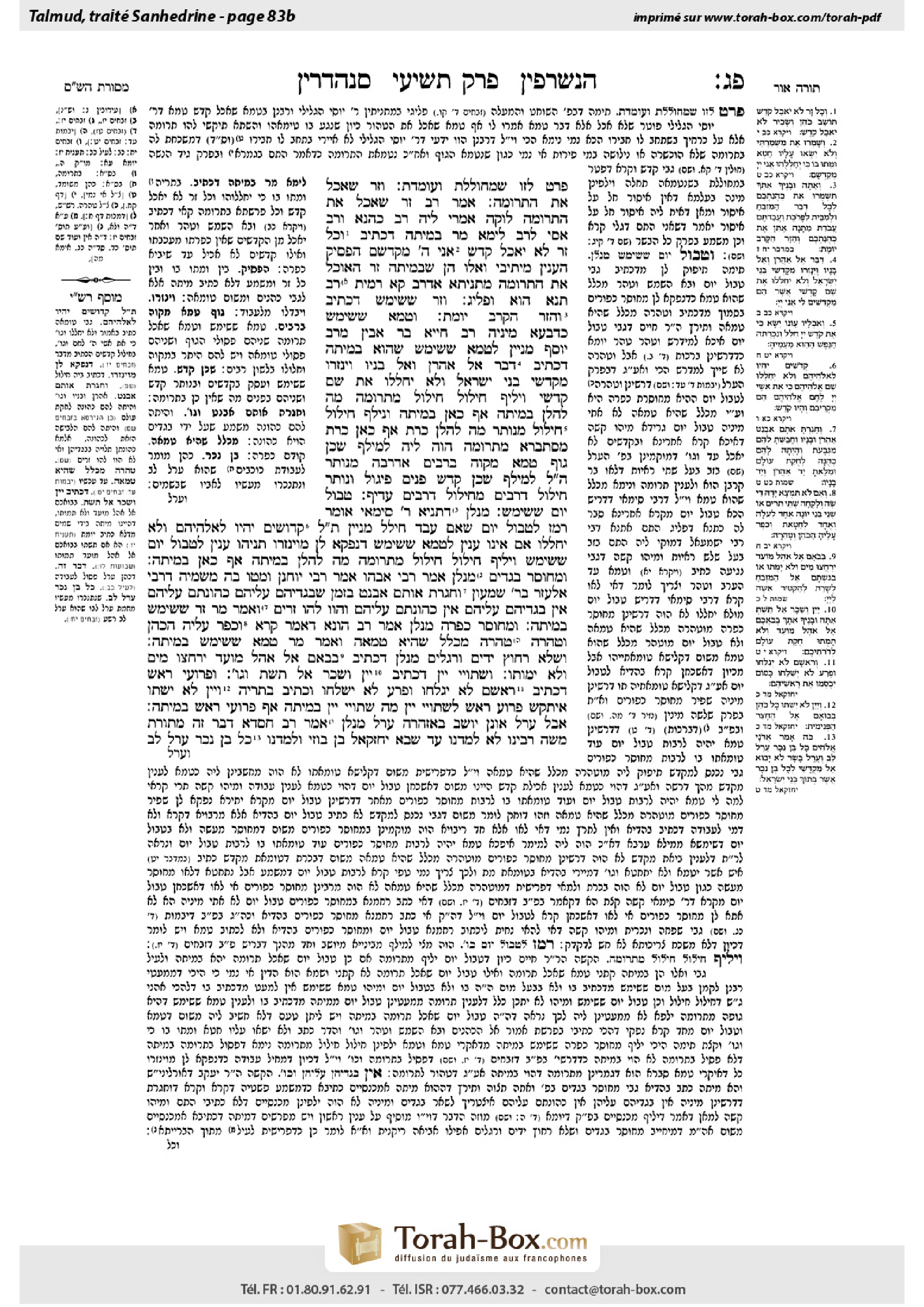
Sanhedrin 83b: Talmud study for Daf Yomi
Daf Yomi is the daily study of one Talmud folio. Explore 37 tractates with scans, Hebrew text, Sefaria English and AI-generated French translations where annotated.
Passage selection and English or AI-generated French translation are available where the scan has annotations. Daf Study is independent of Torah-Box and Sefaria.
Browse Sanhedrin · סנהדרין · All tractatesSanhedrin 83b text and translations
This page of Sanhedrin includes the Aramaic text, an English translation and an AI-generated French translation, alongside the scan above.
סנהדרין פ״ג ב · Aramaic and Hebrew text
פְּרָט לָזוֹ שֶׁמְּחוּלֶּלֶת וְעוֹמֶדֶת.
וְזָר שֶׁאָכַל אֶת הַתְּרוּמָה, אָמַר רַב: זָר שֶׁאָכַל אֶת הַתְּרוּמָה לוֹקֶה. אָמְרִי לֵיהּ רַב כָּהֲנָא וְרַב אַסִּי לְרַב: לֵימָא מָר בְּמִיתָה, דִּכְתִיב ״וְכׇל זָר לֹא יֹאכַל קֹדֶשׁ״?
״אֲנִי ה׳ מְקַדְּשָׁם״ – הִפְסִיק הָעִנְיָן. מֵיתִיבִי: וְאֵלּוּ הֵן שֶׁבְּמִיתָה – זָר הָאוֹכֵל אֶת הַתְּרוּמָה. מַתְנִיתָא אַדְּרַב קָא רָמֵית? רַב תַּנָּא הוּא וּפָלֵיג!
וְזָר שֶׁשִּׁימֵּשׁ, דִּכְתִיב: ״וְהַזָּר הַקָּרֵב יוּמָת״.
וְטָמֵא שֶׁשִּׁימֵּשׁ, כְּדִבְעָא מִינֵּיהּ רַב חִיָּיא בַּר אָבִין מֵרַב יוֹסֵף: מִנַּיִין לְטָמֵא שֶׁשִּׁימֵּשׁ שֶׁהוּא בְּמִיתָה? דִּכְתִיב: ״דַּבֵּר אֶל אַהֲרֹן וְאֶל בָּנָיו וְיִנָּזְרוּ מִקׇּדְשֵׁי בְנֵי יִשְׂרָאֵל וְלֹא יְחַלְּלוּ אֶת שֵׁם קׇדְשִׁי״.
וְיָלֵיף ״חִילּוּל״ ״חִילּוּל״ מִתְּרוּמָה, מָה לְהַלָּן בְּמִיתָה – אַף כָּאן בְּמִיתָה.
וְנֵילַף ״חִילּוּל״ ״חִילּוּל״ מִנּוֹתָר: מָה לְהַלָּן כָּרֵת, אַף כָּאן כָּרֵת?
מִסְתַּבְּרָא מִתְּרוּמָה הֲוָה לֵיהּ לְמֵילַף, שֶׁכֵּן: גּוּף, טָמֵא, מִקְוֶה, בְּרַבִּים.
אַדְּרַבָּה, מִנּוֹתָר הֲוָה לֵיהּ לְמֵילַף, שֶׁכֵּן קֹדֶשׁ, פְּנִים, פִּיגּוּל וְנוֹתָר! חִילּוּל דְּרַבִּים מֵחִילּוּל דְּרַבִּים עֲדִיף.
טְבוּל יוֹם שֶׁשִּׁימֵּשׁ, מְנָלַן? דְּתַנְיָא: רַבִּי סִימַאי אוֹמֵר, רֶמֶז לִטְבוּל יוֹם שֶׁאִם עָבַד חִילֵּל מִנַּיִין? תַּלְמוּד לוֹמַר: ״קְדֹשִׁים יִהְיוּ לֵאלֹהֵיהֶם וְלֹא יְחַלְּלוּ״.
אִם אֵינוֹ עִנְיָן לְטָמֵא שֶׁשִּׁימֵּשׁ, דְּנָפְקָא לַן מִ״וְיִנָּזְרוּ״, תְּנֵיהוּ עִנְיָן לִטְבוּל יוֹם שֶׁשִּׁימֵּשׁ.
וְיָלֵיף חִילּוּל חִילּוּל מִתְּרוּמָה, מָה לְהַלָּן בְּמִיתָה – אַף כָּאן בְּמִיתָה.
וּמְחוּסַּר בְּגָדִים מְנָלַן? אָמַר רַבִּי אֲבָהוּ אָמַר רַבִּי יוֹחָנָן, וּמָטוּ בָּהּ מִשְּׁמֵיהּ דְּרַבִּי אֶלְעָזָר בְּרַבִּי שִׁמְעוֹן: ״וְחָגַרְתָּ אֹתָם אַבְנֵט״.
בִּזְמַן שֶׁבִּגְדֵיהֶם עֲלֵיהֶם – כְּהוּנָּתָם עֲלֵיהֶם; אֵין בִּגְדֵיהֶם עֲלֵיהֶם – אֵין כְּהוּנָּתָם עֲלֵיהֶם. וְהָווּ לְהוּ זָרִים, וְאָמַר מָר: זָר שֶׁשִּׁימֵּשׁ – בְּמִיתָה.
וּמְחוּסַּר כַּפָּרָה מְנָלַן? אָמַר רַב הוּנָא: דְּאָמַר קְרָא ״וְכִפֶּר עָלֶיהָ הַכֹּהֵן וְטָהֵרָה״. טָהֵרָה, מִכְּלָל שֶׁהִיא טְמֵאָה. וְאָמַר מָר: טָמֵא שֶׁשִּׁימֵּשׁ – בְּמִיתָה.
וְשֶׁלֹּא רְחוּץ יָדַיִם וְרַגְלַיִם, מְנָלַן? דִּכְתִיב: ״בְּבֹאָם אֶל אֹהֶל מוֹעֵד יִרְחֲצוּ מַיִם וְלֹא יָמוּתוּ״.
וּשְׁתוּיֵי יַיִן, דִּכְתִיב: ״יַיִן וְשֵׁכָר אַל תֵּשְׁתְּ וְגוֹ׳״.
וּפְרוּעֵי רֹאשׁ, דִּכְתִיב: ״רֹאשָׁם לֹא יְגַלֵּחוּ וּפֶרַע לֹא יְשַׁלֵּחוּ״, וּכְתִיב בָּתְרֵיהּ: ״וְיַיִן לֹא יִשְׁתּוּ״. אִיתַּקַּשׁ פְּרוּעֵי רֹאשׁ לִשְׁתוּיֵי יַיִן: מָה שְׁתוּיֵי יַיִן בְּמִיתָה, אַף פְּרוּעֵי רֹאשׁ בְּמִיתָה.
אֲבָל עָרֵל, אוֹנֵן, יוֹשֵׁב – בְּאַזְהָרָה. עָרֵל מְנָלַן? אָמַר רַב חִסְדָּא: דָּבָר זֶה מִתּוֹרַת מֹשֶׁה רַבֵּינוּ לֹא לָמַדְנוּ, עַד שֶׁבָּא יְחֶזְקֵאל בֶּן בּוּזִי וְלִמְּדָנוּ: ״כׇּל בֶּן נֵכָר עֶרֶל לֵב
Sanhedrin 83b · English translation
to the exclusion of teruma that is impure and already desecrated.
§ The Gemara continues in its analysis of the baraita: A non-priest who partook of teruma is liable to receive death at the hand of Heaven. Rav says: A non-priest who partook of teruma is flogged. Rav Kahana and Rav Asi said to Rav: Let the Master say that he is punished with death at the hand of Heaven, as it is written: “And they shall keep my charge lest they bear a sin for it and die therein if they desecrate it: I am the Lord Who sanctifies them. No non-priest shall eat of the sacred, a tenant of a priest, or a hired servant, shall not eat of the sacred” (Leviticus 22:9–10). Based on the juxtaposition between them, one should say that just as an impure priest who partakes of teruma is punished with death at the hand of Heaven, so too a non-priest who partakes of teruma is punished with death at the hand of Heaven.
Rav responded: The phrase “I am the Lord Who sanctifies them” ends the matter of death, so the matter of a non-priest who partakes of teruma is not juxtaposed to it. The Gemara raises an objection to the opinion of Rav from the baraita: And these are they who are liable to receive death at the hand of Heaven: A non-priest who partakes of teruma. The Gemara explains: Are you raising a contradiction from a baraita to the opinion of Rav? Rav is a tanna, and as such has the authority to dispute the determination of the baraita.
The baraita continues: The punishment for a non-priest who performed the Temple service is death at the hand of Heaven, as it is written: “You and your sons with you shall safeguard your priesthood with regard to every matter of the altar…and any non-priest who approaches shall die” (Numbers 18:7).
The baraita continues: The punishment for an impure priest who performed the Temple service is death at the hand of Heaven. The source for this is explained: As Rav Ḥiyya bar Avin asked of Rav Yosef: From where is it derived that an impure priest who performed the Temple service is punished with death at the hand of Heaven? Rav Yosef answered: It is derived from a verse, as it is written in the context of admonishing priests to avoid impurity: “Speak to Aaron and his sons that they shall separate themselves from the sacred items of the children of Israel that they sanctify to Me, and they shall not desecrate My sacred name: I am the Lord” (Leviticus 22:2).
Rav Yosef continues: And the tanna derives the punishment by means of a verbal analogy. He derives the meaning of the term of desecration written with regard to an impure priest who performs the Temple service from the term of desecration written with regard to an impure priest who partakes of teruma (see Leviticus 22:9). Just as there, with regard to teruma, he is punished with death at the hand of Heaven, so too here, with regard to an impure priest who performs the Temple service, he is punished with death at the hand of Heaven.
The Gemara asks: And let us derive the punishment by means of a different verbal analogy: Derive the term of desecration written with regard to an impure priest who performs the Temple service from the term of desecration written with regard to notar. This would teach that just as there, with regard to notar, he is punished with karet, so too here, with regard to an impure priest who performs the Temple service, he is punished with karet.
The Gemara answers: It is reasonable to say that it is from teruma that he should have derived the punishment for an impure priest who performs the Temple service, as there are many elements common to an impure priest who partakes of teruma and an impure priest who performs the Temple service. In both of these cases, unlike notar, the problem relates to the body of the priest; both relate to impurity; in both, the issue can be resolved through immersion in a ritual bath; and in both, the term of desecration is formulated in the plural, while with regard to notar it is formulated in the singular.
The Gemara rejects that conclusion: On the contrary, it is from notar that he should have derived the punishment for an impure priest who performs the Temple service, as there are elements common to notar and an impure priest who performs the Temple service. Unlike teruma, both are cases involving sacrificial matters; both involve acts performed inside the Temple; and in both cases, the disqualification of piggul and the disqualification of notar are applicable. The Gemara explains: Although the number of elements common to an impure priest who partakes of teruma equals the number of elements common to notar, deriving desecration in the plural by means of a verbal analogy from desecration in the plural is preferable.
The baraita continues: The punishment for a priest who was ritually impure, who immersed that day and is waiting for nightfall for the purification process to be completed, and who performed the Temple service, is death at the hand of Heaven. The Gemara asks: From where do we derive this halakha? The Gemara answers: It is derived as it is taught in a baraita that Rabbi Simai says: From where in the Torah is the allusion with regard to a priest who immersed that day, that if he performed the Temple service he desecrated that service? It is derived from a verse, as the verse states: “They shall be sacred to their God and they shall not desecrate the name of their God” (Leviticus 21:6).
If this verse is not written with regard to the matter of an impure priest who performed the Temple service, as that halakha is derived for us from the verse: “That they shall separate themselves from the sacred items of the children of Israel” (Leviticus 22:2), then apply it to the matter of a priest who immersed that day who performed the Temple service. Although he is no longer impure in every sense, the priest remains impure in terms of the prohibitions of partaking of teruma and sacrificial food, and of entering the Temple.
And the tanna derives the punishment by means of a verbal analogy. He derives the meaning of the term of desecration written with regard to a priest who immersed that day who performed the Temple service from the term of desecration written with regard to an impure priest who partakes of teruma (see Leviticus 22:9). Just as there, with regard to teruma, he is punished with death at the hand of Heaven, so too here, with regard to an impure priest who performs the Temple service, he is punished with death at the hand of Heaven.
The baraita continues: And the punishment for a priest who is lacking the requisite priestly vestments and who performed the Temple service is death at the hand of Heaven. The Gemara asks: From where do we derive that this is his punishment? Rabbi Abbahu says that Rabbi Yoḥanan says, and there are those who determined that this halakha is a tradition that was cited in the name of Rabbi Elazar, son of Rabbi Shimon: It is stated: “You shall gird them with a belt, Aaron and his sons, and you shall wrap the headdresses upon them; and they shall have the priesthood as an eternal statute, and you shall inaugurate Aaron and his sons” (Exodus 29:9).
From that verse it is derived: At a time when their vestments are upon them, their priesthood is upon them; but when their vestments are not upon them, their priesthood is not upon them. Therefore, priests who are lacking the requisite priestly vestments assume the status of non-priests in this respect, and the Master says earlier in the baraita: A non-priest who performs the Temple service is punished with death at the hand of Heaven.
The baraita continues: And the punishment for a priest who has not yet brought an atonement offering to complete the purification process and who performs the Temple service is death at the hand of Heaven. The Gemara asks: From where do we derive that this is his punishment? Rav Huna says: It is derived from a verse, as the verse states with regard to a woman after childbirth who is obligated to bring an atonement offering: “And the priest shall atone for her and she shall become purified” (Leviticus 12:8). He infers: As the verse states “shall become purified,” by inference, one concludes that until the priest sacrifices her atonement offering she is impure to a certain extent. And the Master says earlier in the baraita: An impure priest who performs the Temple service is punished with death at the hand of Heaven.
The baraita continues: And the punishment for a priest whose hands and feet are not washed and who performed the Temple service is death at the hand of Heaven. The Gemara asks: From where do we derive this halakha? The Gemara answers: It is derived from a verse, as it is written: “Whenever they come to the Tent of Meeting, they shall wash with water that they shall not die” (Exodus 30:20).
The baraita continues: And the punishment for priests who performed the Temple service while intoxicated with wine is death at the hand of Heaven, as it is written: “Drink no wine nor strong drink, you and your sons with you, when you come into the Tent of Meeting, that you shall not die” (Leviticus 10:9).
The baraita continues: And the punishment for priests who performed the Temple service with overgrown hair on their heads is death at the hand of Heaven, as it is written: “Neither shall they shave their heads nor allow their hair to grow long” (Ezekiel 44:20), and it is written thereafter: “Neither shall any priest drink wine when they enter the inner courtyard” (Ezekiel 44:21). One with overgrown hair on his head is juxtaposed to priests who are intoxicated with wine. Just as priests who are intoxicated with wine are punished with death at the hand of Heaven, so too priests with overgrown hair on their heads are punished with death at the hand of Heaven.
The baraita continues: But a priest who performs the Temple service while uncircumcised, or as an acute mourner on the day that one of his close relatives dies, or a priest who performs the Temple service while seated, is not punished with death at the hand of Heaven; rather, he is liable for violating a prohibition and his punishment is lashes. The Gemara asks: From where do we derive that it is prohibited for an uncircumcised priest to perform the Temple service? Rav Ḥisda says: This matter we did not learn from the Torah of Moses our teacher. It was not learned until Ezekiel, son of Buzi, the prophet, came and taught it to us, as it is stated: “No foreigner uncircumcised in heart
Sanhedrin 83b · Traduction française (IA)
à l’exclusion de la terouma impure, qui a déjà été profanée.
§ La Guemara poursuit son analyse de la baraïta : un non-prêtre qui consomme de la terouma est passible de mort par décision du Ciel. Rav dit : un non-prêtre qui consomme de la terouma est passible de flagellation. Rav Kahana et Rav Asi dirent à Rav : « Que le maître dise qu’il est passible de mort par décision du Ciel », comme il est écrit : « Ils observeront ma charge, de peur qu’ils ne portent une faute à cause d’elle et n’en meurent s’ils la profanent ; je suis l’Éternel qui les sanctifie. Aucun non-prêtre ne mangera de ce qui est sacré ; le résident d’un prêtre ou son salarié ne mangera pas de ce qui est sacré » (Lévitique 22, 9-10). En s’appuyant sur le rapprochement entre ces versets, on devrait dire que, de même qu’un prêtre impur qui consomme de la terouma est passible de mort par décision du Ciel, de même un non-prêtre qui consomme de la terouma l’est également.
Rav répondit : L’expression « je suis l’Éternel qui les sanctifie » conclut le passage relatif à la mort ; le cas du non-prêtre qui consomme de la terouma n’est donc pas rapproché de ce passage. La Guemara soulève une objection à l’opinion de Rav à partir de la baraïta : « Voici ceux qui sont passibles de mort par décision du Ciel : un non-prêtre qui consomme de la terouma. » La Guemara explique : « Pourquoi soulevez-vous une contradiction entre une baraïta et l’opinion de Rav ? Rav est un tanna et, à ce titre, il est autorisé à contester la conclusion de la baraïta. »
La baraïta poursuit : la peine d’un non-prêtre qui a effectué le service au Temple est la mort par décision du Ciel, comme il est écrit : « Toi et tes fils avec toi, vous garderez votre sacerdoce pour tout ce qui concerne l’autel… et tout non-prêtre qui s’en approchera mourra » (Nombres 18, 7).
La baraïta poursuit : la peine d’un prêtre impur qui a effectué le service au Temple est la mort par décision du Ciel. La source est expliquée ainsi : Rav Ḥiyya bar Avin demanda à Rav Yosef : « D’où apprend-on qu’un prêtre impur qui a effectué le service au Temple est passible de mort par décision du Ciel ? » Rav Yosef répondit : « Cela s’apprend d’un verset », comme il est écrit dans le contexte de l’avertissement adressé aux prêtres afin qu’ils évitent l’impureté : « Parle à Aaron et à ses fils : qu’ils se tiennent à l’écart des choses saintes des enfants d’Israël, qu’ils consacrent pour Moi, et qu’ils ne profanent pas Mon saint nom ; je suis l’Éternel » (Lévitique 22, 2).
Rav Yosef poursuit : le tanna déduit la peine au moyen d’une analogie verbale. Il rapproche le terme de profanation employé à propos d’un prêtre impur qui effectue le service au Temple du terme de profanation employé à propos d’un prêtre impur qui consomme de la terouma (voir Lévitique 22, 9). De même que, dans le cas de la terouma, il est passible de mort par décision du Ciel, de même, dans le cas d’un prêtre impur qui effectue le service au Temple, il est passible de mort par décision du Ciel.
La Guemara demande : « Pourquoi ne pas déduire la peine au moyen d’une autre analogie verbale ? Rapprochons le terme de profanation employé à propos d’un prêtre impur qui effectue le service au Temple du terme de profanation employé à propos du notar. Cela enseignerait que, de même que, dans le cas du notar, il est passible de karet, de même, dans le cas d’un prêtre impur qui effectue le service au Temple, il est passible de karet. »
La Guemara répond : il est logique de déduire de la terouma la peine encourue par un prêtre impur qui effectue le service au Temple, car le cas d’un prêtre impur qui consomme de la terouma et celui d’un prêtre impur qui effectue le service au Temple ont de nombreux éléments en commun. Dans les deux cas, contrairement au notar, le problème concerne le corps du prêtre ; les deux cas ont trait à l’impureté ; dans les deux cas, la situation peut être régularisée par une immersion dans un mikvé ; et, dans les deux cas, le terme de profanation est au pluriel, tandis que, pour le notar, il est au singulier.
La Guemara rejette cette conclusion : au contraire, il aurait dû déduire de celui du notar la peine encourue par un prêtre impur qui effectue le service au Temple, car le notar et le cas d’un prêtre impur qui effectue le service au Temple ont des éléments en commun. Contrairement à la terouma, les deux cas concernent des sacrifices ; ils impliquent tous deux des actes accomplis dans le Temple ; et, dans les deux cas, les invalidations de pigoul et de notar s’appliquent. La Guemara explique : même si le nombre d’éléments communs entre le cas d’un prêtre impur qui consomme de la terouma et celui du notar est égal, il est préférable de rapprocher, au moyen d’une analogie verbale, le terme de profanation au pluriel d’un autre terme de profanation au pluriel.
La baraïta poursuit : la peine d’un prêtre rituellement impur qui s’est immergé ce jour-là, mais attend la tombée de la nuit pour que le processus de purification soit achevé, et qui a effectué le service au Temple, est la mort par décision du Ciel. La Guemara demande : « D’où déduit-on cette halakha ? » La Guemara répond : « Elle se déduit de ce qui est enseigné dans une baraïta, où Rabbi Simai dit : “Où trouve-t-on dans la Torah une allusion au cas d’un prêtre qui s’est immergé ce jour-là, indiquant que s’il a effectué le service au Temple, il a profané ce service ?” » Cela se déduit d’un verset, car il est écrit : « Ils seront saints pour leur Dieu et ils ne profaneront pas le nom de leur Dieu » (Lévitique 21, 6).
Si ce verset n’a pas été écrit au sujet du cas d’un prêtre impur qui a effectué le service au Temple, puisque cette halakha nous est déjà déduite du verset : « Qu’ils se tiennent à l’écart des choses saintes des enfants d’Israël » (Lévitique 22, 2), alors appliquons-le au cas d’un prêtre qui s’est immergé ce jour-là et a effectué le service au Temple. Bien qu’il ne soit plus impur à tous égards, le prêtre reste impur au regard des interdictions de consommer de la terouma et des aliments sacrificiels, ainsi que de celle d’entrer dans le Temple.
Le tanna déduit la peine au moyen d’une analogie verbale. Il rapproche le terme de profanation employé à propos d’un prêtre qui s’est immergé ce jour-là et a effectué le service au Temple du terme de profanation employé à propos d’un prêtre impur qui consomme de la terouma (voir Lévitique 22, 9). De même que, dans le cas de la terouma, il est passible de mort par décision du Ciel, de même, dans le cas d’un prêtre qui s’est immergé ce jour-là et a effectué le service au Temple, il est passible de mort par décision du Ciel.
La baraïta poursuit : la peine d’un prêtre qui ne porte pas les vêtements sacerdotaux requis et qui a effectué le service au Temple est la mort par décision du Ciel. La Guemara demande : « D’où déduit-on que telle est sa peine ? » Rabbi Abbahu dit au nom de Rabbi Yoḥanan — et certains tiennent que cette halakha est une tradition citée au nom de Rabbi Elazar, fils de Rabbi Shimon : « Il est écrit : “Tu les ceindras d’une ceinture, Aaron et ses fils, et tu leur noueras les turbans ; ils auront le sacerdoce comme statut perpétuel, et tu investiras Aaron et ses fils” » (Exode 29, 9).
On déduit de ce verset que, lorsqu’ils portent leurs vêtements, ils ont le statut de prêtres ; mais lorsqu’ils ne les portent pas, ils n’ont pas ce statut. Par conséquent, les prêtres qui ne portent pas les vêtements sacerdotaux requis ont, à cet égard, le statut de non-prêtres, et le maître enseigne plus haut dans la baraïta qu’un non-prêtre qui effectue le service au Temple est passible de mort par décision du Ciel.
La baraïta poursuit : la peine d’un prêtre qui n’a pas encore apporté de sacrifice expiatoire pour achever le processus de purification et qui effectue le service au Temple est la mort par décision du Ciel. La Guemara demande : « D’où déduit-on que telle est sa peine ? » Rav Huna dit : « Cela se déduit d’un verset », comme il est écrit au sujet d’une femme après un accouchement, qui doit apporter un sacrifice expiatoire : « Le prêtre fera expiation pour elle et elle sera purifiée » (Lévitique 12, 8). Il en déduit que, puisque le verset dit « elle sera purifiée », elle reste impure dans une certaine mesure jusqu’à ce que le prêtre offre son sacrifice expiatoire. Et le maître enseigne plus haut dans la baraïta qu’un prêtre impur qui effectue le service au Temple est passible de mort par décision du Ciel.
La baraïta poursuit : la peine d’un prêtre qui n’a pas lavé ses mains et ses pieds et qui a effectué le service au Temple est la mort par décision du Ciel. La Guemara demande : « D’où déduit-on cette halakha ? » La Guemara répond : « Cela se déduit d’un verset », comme il est écrit : « Chaque fois qu’ils entreront dans la Tente d’assignation, ils se laveront avec de l’eau, afin qu’ils ne meurent pas » (Exode 30, 20).
La baraïta poursuit : la peine des prêtres qui ont effectué le service au Temple alors qu’ils étaient ivres de vin est la mort par décision du Ciel, comme il est écrit : « Ne buvez pas de vin ni de boisson forte, toi et tes fils avec toi, lorsque vous entrez dans la Tente d’assignation, afin que vous ne mouriez pas » (Lévitique 10, 9).
La baraïta poursuit : la peine des prêtres qui ont effectué le service au Temple alors qu’ils avaient les cheveux trop longs est la mort par décision du Ciel, comme il est écrit : « Ils ne se raseront pas la tête et ne laisseront pas pousser leurs cheveux » (Ézéchiel 44, 20), puis : « Aucun prêtre ne boira de vin lorsqu’ils entreront dans la cour intérieure » (Ézéchiel 44, 21). Le prêtre aux cheveux trop longs est rapproché des prêtres ivres de vin. De même que les prêtres ivres de vin sont passibles de mort par décision du Ciel, de même les prêtres aux cheveux trop longs sont passibles de mort par décision du Ciel.
La baraïta poursuit : toutefois, un prêtre qui effectue le service au Temple alors qu’il est incirconcis, en deuil aigu le jour où l’un de ses proches décède, ou assis, n’est pas passible de mort par décision du Ciel ; il est plutôt passible de flagellation pour avoir enfreint une interdiction. La Guemara demande : « D’où déduit-on qu’il est interdit à un prêtre incirconcis d’effectuer le service au Temple ? » Rav Ḥisda dit : « Nous n’avons pas appris cette règle dans la Torah de Moïse notre maître. Nous ne l’avons apprise qu’après la venue d’Ézéchiel, fils de Bouzi, le prophète, qui nous l’a enseignée, comme il est écrit : “Aucun étranger incirconcis de cœur
Traduction française générée par IA à partir de l’édition anglaise de Sefaria. Vérifie toujours un passage avec le texte source.
Text from Sefaria: William Davidson Edition - Vocalized Aramaic (CC BY NC); William Davidson Edition - English (CC BY NC).