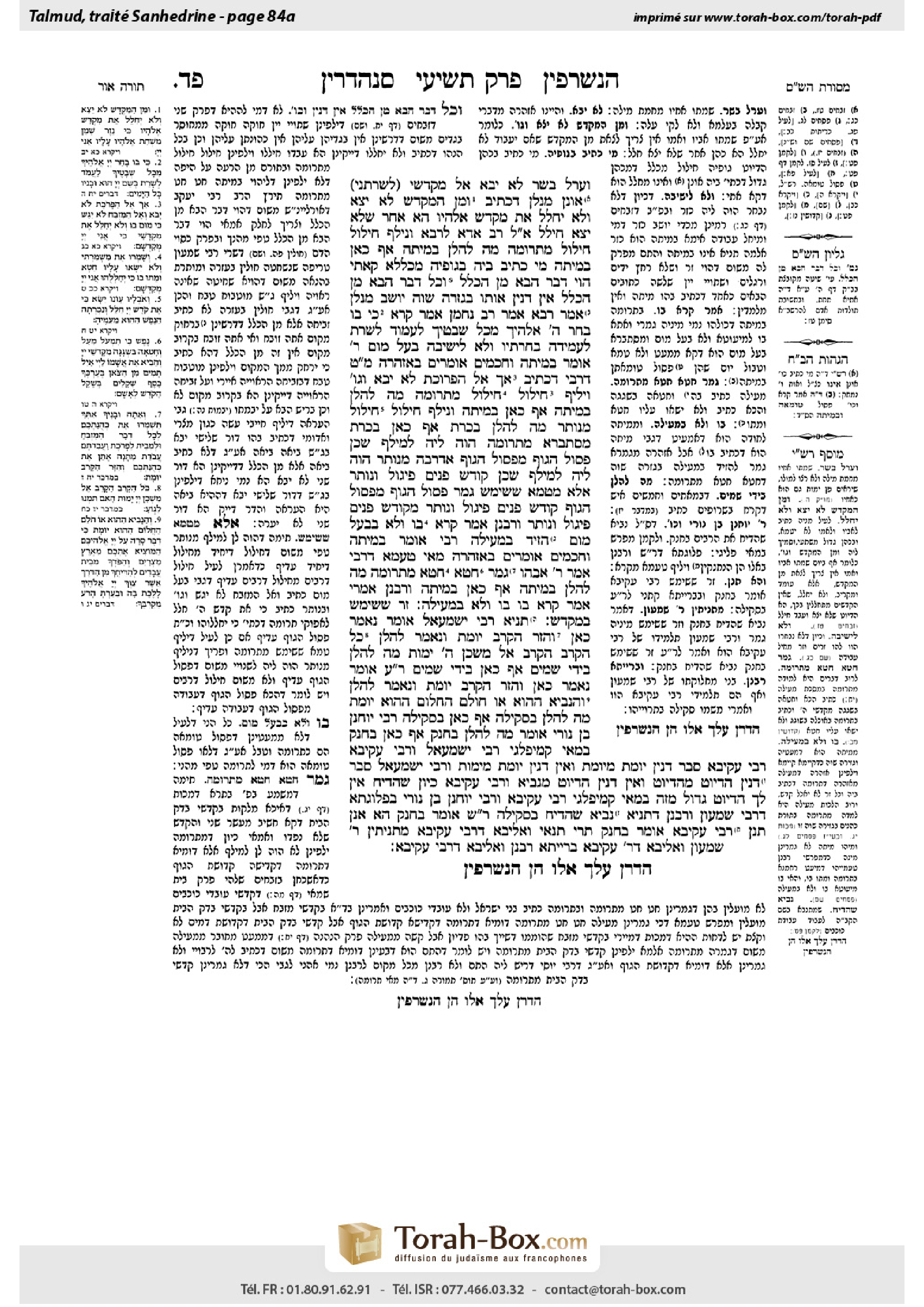
Sanhedrin 84a: Talmud study for Daf Yomi
Daf Yomi is the daily study of one Talmud folio. Explore 37 tractates with scans, Hebrew text, Sefaria English and AI-generated French translations where annotated.
Passage selection and English or AI-generated French translation are available where the scan has annotations. Daf Study is independent of Torah-Box and Sefaria.
Browse Sanhedrin · סנהדרין · All tractatesSanhedrin 84a text and translations
This page of Sanhedrin includes the Aramaic text, an English translation and an AI-generated French translation, alongside the scan above.
סנהדרין פ״ד א · Aramaic and Hebrew text
וְעֶרֶל בָּשָׂר לֹא יָבוֹא אֶל מִקְדָּשִׁי (לְשָׁרְתֵנִי)״.
אוֹנֵן מְנָלַן? דִּכְתִיב: ״וּמִן הַמִּקְדָּשׁ לֹא יֵצֵא וְלֹא יְחַלֵּל אֵת מִקְדַּשׁ אֱלֹהָיו״. הָא אַחֵר שֶׁלֹּא יָצָא, חִילֵּל.
אֲמַר לֵיהּ רַב אַדָּא לְרָבָא: וְנֵילַף ״חִילּוּל״ ״חִילּוּל״ מִתְּרוּמָה, מָה לְהַלָּן בְּמִיתָה – אַף כָּאן בְּמִיתָה.
מִי כְּתִיב בֵּיהּ בְּגוּפֵיהּ? מִכְּלָלָא קָאָתֵי. הָוֵי דָּבָר הַבָּא מִן הַכְּלָל, וְכׇל דָּבָר הַבָּא מִן הַכְּלָל אֵין דָּנִין אוֹתוֹ בִּגְזֵרָה שָׁוָה.
יוֹשֵׁב מְנָלַן? אָמַר רָבָא אָמַר רַב נַחְמָן: אָמַר קְרָא ״כִּי בוֹ בָּחַר ה׳ אֱלֹהֶיךָ מִכׇּל שְׁבָטֶיךָ לַעֲמֹד לְשָׁרֵת״. לַעֲמִידָה בְּחַרְתִּיו, וְלֹא לִישִׁיבָה.
בַּעַל מוּם: רַבִּי אוֹמֵר בְּמִיתָה, וַחֲכָמִים אוֹמְרִים בָּאַזְהָרָה. מַאי טַעְמָא דְּרַבִּי? דִּכְתִיב: ״אַךְ אֶל הַפָּרֹכֶת לֹא יָבֹא וְגוֹ׳״, וְיָלֵיף חִילּוּל חִילּוּל מִתְּרוּמָה. מָה לְהַלָּן בְּמִיתָה, אַף כָּאן בְּמִיתָה.
וְנֵילַף ״חִילּוּל״ ״חִילּוּל״ מִנּוֹתָר: מָה לְהַלָּן בְּכָרֵת, אַף כָּאן בְּכָרֵת?
מִסְתַּבְּרָא מִתְּרוּמָה הֲוָה לֵיהּ לְמֵילַף, שֶׁכֵּן פְּסוּל הַגּוּף מִפְּסוּל הַגּוּף. אַדְּרַבָּה, מִנּוֹתָר הֲוָה לֵיהּ לְמֵילַף, שֶׁכֵּן קוֹדֶשׁ, פְּנִים, פִּיגּוּל וְנוֹתָר.
אֶלָּא, מִטָּמֵא שֶׁשִּׁימֵּשׁ גָּמַר. פְּסוּל הַגּוּף מִפְּסוּל הַגּוּף, קוֹדֶשׁ פְּנִים פִּיגּוּל וְנוֹתָר מִקּוֹדֶשׁ פְּנִים פִּיגּוּל וְנוֹתָר.
וְרַבָּנַן, אָמַר קְרָא: ״בּוֹ״, וְלֹא בְּבַעַל מוּם.
הֵזִיד בִּמְעִילָה: רַבִּי אוֹמֵר בְּמִיתָה, וַחֲכָמִים אוֹמְרִים בָּאַזְהָרָה. מַאי טַעְמָא דְּרַבִּי? אָמַר רַבִּי אֲבָהוּ: גָּמַר חֵטְא חֵטְא מִתְּרוּמָה. מָה לְהַלָּן בְּמִיתָה – אַף כָּאן בְּמִיתָה.
וְרַבָּנַן אָמְרִי: אָמַר קְרָא ״בּוֹ״, ״בּוֹ״ וְלֹא בִּמְעִילָה.
זָר שֶׁשִּׁימֵּשׁ בְּמִקְדָּשׁ: תַּנְיָא, רַבִּי יִשְׁמָעֵאל אוֹמֵר: נֶאֱמַר כָּאן ״וְהַזָּר הַקָּרֵב יוּמָת״, וְנֶאֱמַר לְהַלָּן ״כֹּל הַקָּרֵב הַקָּרֵב אֶל מִשְׁכָּן ה׳ יָמוּת״. מָה לְהַלָּן בִּידֵי שָׁמַיִם, אַף כָּאן בִּידֵי שָׁמַיִם.
רַבִּי עֲקִיבָא אוֹמֵר: נֶאֱמַר כָּאן ״וְהַזָּר הַקָּרֵב יוּמָת״, וְנֶאֱמַר לְהַלָּן ״וְהַנָּבִיא הַהוּא אוֹ חֹלֵם הַחֲלוֹם הַהוּא יוּמָת״. מָה לְהַלָּן בִּסְקִילָה, אַף כָּאן בִּסְקִילָה. רַבִּי יוֹחָנָן בֶּן נוּרִי אוֹמֵר: מָה לְהַלָּן בְּחֶנֶק, אַף כָּאן בְּחֶנֶק.
בְּמַאי קָמִיפַּלְגִי רַבִּי יִשְׁמָעֵאל וְרַבִּי עֲקִיבָא? רַבִּי עֲקִיבָא סָבַר: דָּנִין ״יוּמָת״ מִ״יּוּמָת״, וְאֵין דָּנִין ״יוּמָת״ מִ״יָּמוּת״. וְרַבִּי יִשְׁמָעֵאל סָבַר: דָּנִין הֶדְיוֹט מֵהֶדְיוֹט, וְאֵין דָּנִין הֶדְיוֹט מִנָּבִיא. וְרַבִּי עֲקִיבָא: כֵּיוָן שֶׁהִדִּיחַ – אֵין לְךָ הֶדְיוֹט גָּדוֹל מִזֶּה.
בְּמַאי קָמִיפַּלְגִי רַבִּי עֲקִיבָא וְרַבִּי יוֹחָנָן בֶּן נוּרִי? בִּפְלוּגְתָּא דְּרַבִּי שִׁמְעוֹן וְרַבָּנַן, דְּתַנְיָא: נָבִיא שֶׁהִדִּיחַ – בִּסְקִילָה. רַבִּי שִׁמְעוֹן אוֹמֵר: בְּחֶנֶק. הָא אֲנַן תְּנַן: רַבִּי עֲקִיבָא אוֹמֵר: בְּחֶנֶק.
תְּרֵי תַּנָּאֵי וְאַלִּיבָּא דְּרַבִּי עֲקִיבָא. מַתְנִיתִין – רַבִּי שִׁמְעוֹן וְאַלִּיבָּא דְּרַבִּי עֲקִיבָא. בָּרַיְיתָא – רַבָּנַן וְאַלִּיבָּא דְּרַבִּי עֲקִיבָא.
הֲדַרַן עֲלָךְ אֵלּוּ הֵן הַנִּשְׂרָפִין.
Sanhedrin 84a · English translation
or uncircumcised in flesh may enter My Temple” (Ezekiel 44:9).
The Gemara asks: From where do we derive that it is prohibited for an acute mourner priest to perform the Temple service? It is derived from a verse, as it is written with regard to a High Priest whose mother or father died: “And from the Temple he shall not emerge and he shall not desecrate the Temple of his God” (Leviticus 21:12), from which it may be inferred that another, who is not a High Priest but an ordinary priest, who did not emerge from the Temple and who continued to perform the service, has desecrated the service.
Rav Adda said to Rava: And let us derive it by means of a verbal analogy: Derive the meaning of the term of desecration written with regard to an acute mourner who performs the Temple service from the term of desecration written with regard to an impure priest who partakes of teruma. Just as there, with regard to teruma, he is punished with death at the hand of Heaven, so too here, with regard to an acute mourner who performs the Temple service, he is punished with death at the hand of Heaven.
Rava answers: Is desecration written with regard to the matter of a priest who performs the Temple service as an acute mourner itself? It is derived from that which is written with regard to the High Priest, by inference. Therefore, it is a matter that emerges from an inference, and the principle is: Any matter that emerges from an inference cannot be derived by means of a verbal analogy. A verbal analogy can be derived only when the matter is written explicitly.
The Gemara asks: From where do we derive that it is prohibited for a priest who is seated to perform the Temple service? Rava says that Rav Naḥman says: The verse states: “For him has the Lord chosen from among all your tribes, to stand and minister in the name of the Lord” (Deuteronomy 18:5). God states in the verse that I chose him for service while he is standing, but not for service while seated.
§ The baraita continues: With regard to a blemished priest who performs the Temple service, Rabbi Yehuda HaNasi says: He is punished with death at the hand of Heaven, and the Rabbis say: He is liable only for violating a prohibition. The Gemara elaborates: What is the reason for the opinion of Rabbi Yehuda HaNasi? It is as it is written: “But he shall not come into the curtain and he shall not approach the altar as he has a blemish, that he desecrate not My sacred places” (Leviticus 21:23). And Rabbi Yehuda HaNasi derives the punishment by means of a verbal analogy: The meaning of the term of desecration written with regard to a blemished priest who performs the Temple service is derived from the term of desecration written with regard to an impure priest who partakes of teruma. Just as there, with regard to teruma, he is punished with death at the hand of Heaven, so too here, with regard to a blemished priest who performs the Temple service, he is punished with death at the hand of Heaven.
The Gemara challenges: And let us derive the punishment by means of a different verbal analogy: Derive the meaning of the term of desecration written with regard to a blemished priest who performs the Temple service from the term of desecration written with regard to notar. Just as there, with regard to notar, he is punished with karet, so too here, with regard to a blemished priest who performs the Temple service, he is punished with karet.
The Gemara explains: It is reasonable to say that he should have derived the punishment for a blemished priest who performs the Temple service from teruma, as the tanna derives the bodily disqualification of a blemished priest from the bodily disqualification of the impure priest. The Gemara challenges: On the contrary, he should have derived the punishment for a blemished priest who performs the Temple service from notar, as there are elements common to notar and a blemished priest who performs the Temple service. Unlike teruma, both are cases involving sacrificial matters; both involve matters performed inside the Temple; and in both cases, the disqualification of piggul and the disqualification of notar are applicable.
Rather, Rabbi Yehuda HaNasi derives the halakha of a blemished priest who performed the Temple service from the halakha of an impure priest who performed the Temple service, due to the elements common to both. He derives the bodily disqualification of a blemished priest from the bodily disqualification of an impure priest who performs the Temple service, and he derives the case of a blemished priest, whose case involves sacrificial matters, matters performed inside the Temple, and the relevance of both piggul and notar, from the case of an impure priest, whose case involves sacrificial matters, matters performed inside the Temple, and the relevance of both piggul and notar.
The Gemara asks: And the Rabbis, what is the reason that they hold that he is liable only for violating a prohibition? It is as the verse states: “And die because of it if they desecrate it; I am the Lord Who sanctifies them” (Leviticus 22:9), from which it is derived: “Because of it” they receive death at the hand of Heaven, but not in the case of a blemished priest.
The baraita continues: With regard to one who intentionally performed an action of misuse of consecrated property. Rabbi Yehuda HaNasi says: He is punished with death at the hand of Heaven, and the Rabbis say: He is liable only for violating a prohibition. The Gemara elaborates: What is the reason for the opinion of Rabbi Yehuda HaNasi? Rabbi Abbahu says: He derives a verbal analogy: The meaning of the term of sin written with regard to one who intentionally misuses consecrated property (see Leviticus 5:15) is derived from the term of sin written with regard to an impure priest who partakes of teruma (see Leviticus 22:9). Just as there, with regard to teruma, the priest is punished with death at the hand of Heaven, so too here, one who intentionally misuses consecrated property is punished with death at the hand of Heaven.
The Gemara explains: And the Rabbis say that the verse states with regard to teruma: “Because of it” they receive death at the hand of Heaven, but not in the case of the intentional misuse of consecrated property.
The Gemara cites a dispute between the Sages with regard to the punishment of a non-priest who performed the Temple service. It is taught in a baraita that Rabbi Yishmael says: It is stated here: “You and your sons with you shall keep your priesthood in everything that pertains to the altar…and any non-priest who approaches shall be put to death [yumat]” (Numbers 18:7), and it is stated there: “Anyone who approaches the Tabernacle of the Lord shall die [yamut]” (Numbers 17:28). Just as there, the reference is to death at the hand of Heaven; so too here, in the case of a non-priest who performs the Temple service, the reference is to death at the hand of Heaven.
Rabbi Akiva says that it is stated here: “And any non-priest who approaches shall be put to death [yumat]” and it is stated there: “And that prophet or that dreamer of a dream shall be put to death [yumat]” (Deuteronomy 13:6). Just as there, with regard to the prophet, he is executed by stoning, so too here, a non-priest who performs the Temple service is executed by stoning. Rabbi Yoḥanan ben Nuri says: Just as there, with regard to the prophet, he is executed by strangulation, so too here, a non-priest who performs the Temple service is executed by strangulation.
The Gemara asks: With regard to what principle do Rabbi Yishmael and Rabbi Akiva disagree? The Gemara answers: Rabbi Akiva holds: In the verbal analogy, one derives yumat from yumat and one does not derive yumat from yamut. And Rabbi Yishmael holds: Although the terms are not identical, one derives by means of a verbal analogy the halakha of an ordinary person from the halakha of an ordinary person and one does not derive the halakha of an ordinary person from the halakha of a prophet. The Gemara asks: And what does Rabbi Akiva hold? Once the prophet incited others to idol worship, you have no greater example of an ordinary person than that, i.e., he no longer has the status of a prophet.
The Gemara asks: With regard to what principle do Rabbi Akiva and Rabbi Yoḥanan ben Nuri disagree? The Gemara answers: They disagree with regard to the issue that is the subject of the dispute of Rabbi Shimon and the Rabbis, as it is taught in a baraita: A prophet who incited others to idol worship is executed by stoning. Rabbi Shimon says: He is executed by strangulation. The Gemara asks: Didn’t we learn in a mishna with regard to a prophet who incites others to idol worship that Rabbi Akiva says: He is executed by strangulation, contrary to Rabbi Akiva’s opinion cited in the baraita?
The Gemara answers: These are two tanna’im and they disagree with regard to the opinion of Rabbi Akiva. The mishna, which cites the opinion that Rabbi Akiva holds that a prophet who incited others to idol worship is executed by strangulation, is citing the opinion of Rabbi Shimon in accordance with the opinion of Rabbi Akiva. Rabbi Shimon was his preeminent disciple. The baraita, which cites the opinion that Rabbi Akiva holds that a prophet who incited others to idol worship is executed by stoning, is citing the opinion of the Rabbis, who disagree with Rabbi Shimon, and they too hold in accordance with the opinion of Rabbi Akiva.
Sanhedrin 84a · Traduction française (IA)
ou incirconcis de chair, ne pourra entrer dans Mon Sanctuaire » (Ézéchiel 44:9).
La Guemara demande : D’où déduit-on qu’il est interdit à un prêtre en période d’aninout d’accomplir le service du Temple ? Cela se déduit d’un verset, comme il est écrit au sujet du grand prêtre dont la mère ou le père est mort : « Il ne sortira pas du Sanctuaire et ne profanera pas le Sanctuaire de son Dieu » (Lévitique 21:12). On peut en déduire qu’un autre prêtre, qui n’est pas grand prêtre mais prêtre ordinaire, et qui ne sort pas du Sanctuaire mais continue d’y accomplir le service, a profané le service.
Rav Adda dit à Rava : Déduisons-le au moyen d’une analogie verbale : déduisons le sens du terme « profanation », employé à propos d’un prêtre en période d’aninout qui accomplit le service du Temple, du terme « profanation » employé à propos d’un prêtre impur qui consomme de la terouma. De même que là, à propos de la terouma, il est puni de mort par la main du Ciel, de même ici, à propos d’un prêtre en période d’aninout qui accomplit le service du Temple, il est puni de mort par la main du Ciel.
Rava répond : Le terme « profanation » est-il écrit à propos du prêtre qui accomplit lui-même le service du Temple en période d’aninout ? Cela se déduit par inférence de ce qui est écrit au sujet du grand prêtre. Il s’agit donc d’un cas déduit par inférence, or le principe est le suivant : on ne peut pas établir une analogie verbale à partir d’un cas déduit par inférence. Une analogie verbale ne peut être établie que lorsque le cas est explicitement écrit.
La Guemara demande : D’où déduit-on qu’il est interdit à un prêtre assis d’accomplir le service du Temple ? Rava dit au nom de Rav Naḥman : Le verset dit : « Car c’est lui que le Seigneur a choisi parmi toutes tes tribus, pour se tenir debout et officier au nom du Seigneur » (Deutéronome 18:5). Dieu indique dans ce verset qu’Il l’a choisi pour le service lorsqu’il se tient debout, mais non pour le service lorsqu’il est assis.
§ La baraïta poursuit : Au sujet d’un prêtre présentant un défaut physique qui accomplit le service du Temple, Rabbi Yehouda HaNassi dit : Il est puni de mort par la main du Ciel ; les Sages disent : Il n’est passible que de la peine prévue pour la transgression d’une interdiction. La Guemara développe : Quelle est la raison de l’opinion de Rabbi Yehouda HaNassi ? C’est ce qui est écrit : « Mais il ne viendra pas derrière le rideau et ne s’approchera pas de l’autel, car il a un défaut physique ; ainsi, il ne profanera pas Mes lieux saints » (Lévitique 21:23). Rabbi Yehouda HaNassi déduit la peine au moyen d’une analogie verbale : le sens du terme « profanation », employé à propos d’un prêtre présentant un défaut physique qui accomplit le service du Temple, est déduit du terme « profanation » employé à propos d’un prêtre impur qui consomme de la terouma. De même que là, à propos de la terouma, il est puni de mort par la main du Ciel, de même ici, à propos d’un prêtre présentant un défaut physique qui accomplit le service du Temple, il est puni de mort par la main du Ciel.
La Guemara objecte : Déduisons plutôt la peine au moyen d’une autre analogie verbale : déduisons le sens du terme « profanation », employé à propos d’un prêtre présentant un défaut physique qui accomplit le service du Temple, du terme « profanation » employé à propos du notar. De même que là, à propos du notar, il est puni de retranchement, de même ici, à propos d’un prêtre présentant un défaut physique qui accomplit le service du Temple, il est puni de retranchement.
La Guemara explique : Il est raisonnable de déduire la peine applicable à un prêtre présentant un défaut physique qui accomplit le service du Temple de celle applicable à un prêtre impur qui consomme de la terouma, car le tanna déduit l’inaptitude corporelle du prêtre présentant un défaut physique de celle du prêtre impur. La Guemara objecte : Au contraire, il faudrait déduire la peine applicable à un prêtre présentant un défaut physique qui accomplit le service du Temple de celle applicable au notar, car le notar et le cas du prêtre présentant un défaut physique qui accomplit le service du Temple ont des éléments en commun. Contrairement à la terouma, les deux cas concernent des sacrifices ; tous deux portent sur des actes accomplis à l’intérieur du Temple ; et, dans les deux cas, les règles du piggoul et du notar s’appliquent.
En réalité, Rabbi Yehouda HaNassi déduit la halakha concernant un prêtre présentant un défaut physique qui a accompli le service du Temple de celle concernant un prêtre impur qui a accompli le service du Temple, en raison des éléments qu’ils ont en commun. Il déduit l’inaptitude corporelle du prêtre présentant un défaut physique de celle du prêtre impur qui accomplit le service du Temple ; et il déduit le cas du prêtre présentant un défaut physique — qui concerne des sacrifices, des actes accomplis à l’intérieur du Temple, et auquel s’appliquent les règles du piggoul et du notar — du cas du prêtre impur, qui concerne des sacrifices, des actes accomplis à l’intérieur du Temple, et auquel s’appliquent les règles du piggoul et du notar.
La Guemara demande : Et quelle est la raison pour laquelle les Sages considèrent qu’il n’est passible que de la peine prévue pour la transgression d’une interdiction ? C’est que le verset dit : « Ils mourront à cause de cela s’ils le profanent ; Je suis le Seigneur qui les sanctifie » (Lévitique 22:9). On en déduit qu’ils encourent la mort par la main du Ciel « à cause de cela », mais pas dans le cas d’un prêtre présentant un défaut physique.
La baraïta poursuit : Au sujet de celui qui a intentionnellement détourné des biens consacrés, Rabbi Yehouda HaNassi dit : Il est puni de mort par la main du Ciel ; les Sages disent : Il n’est passible que de la peine prévue pour la transgression d’une interdiction. La Guemara développe : Quelle est la raison de l’opinion de Rabbi Yehouda HaNassi ? Rabbi Abbahou dit : Il établit une analogie verbale : le sens du terme « faute », employé à propos de celui qui détourne intentionnellement des biens consacrés (voir Lévitique 5:15), est déduit du terme « faute » employé à propos d’un prêtre impur qui consomme de la terouma (voir Lévitique 22:9). De même que là, à propos de la terouma, le prêtre est puni de mort par la main du Ciel, de même ici, celui qui détourne intentionnellement des biens consacrés est puni de mort par la main du Ciel.
La Guemara explique : Les Sages disent que le verset indique, au sujet de la terouma, qu’ils encourent la mort par la main du Ciel « à cause de cela », mais pas dans le cas du détournement intentionnel de biens consacrés.
La Guemara rapporte une controverse entre les Sages au sujet de la peine encourue par un non-prêtre qui accomplit le service du Temple. Il est enseigné dans une baraïta que Rabbi Yishmaël dit : Il est écrit ici : « Toi et tes fils avec toi, vous garderez votre sacerdoce pour tout ce qui concerne l’autel… et tout non-prêtre qui s’approche sera mis à mort [yumat] » (Nombres 18:7), et il est écrit là : « Quiconque s’approche de la demeure du Seigneur mourra [yamut] » (Nombres 17:28). De même que là, il s’agit de la mort par la main du Ciel, de même ici, dans le cas d’un non-prêtre qui accomplit le service du Temple, il s’agit de la mort par la main du Ciel.
Rabbi Akiva dit : Il est écrit ici : « Et tout non-prêtre qui s’approche sera mis à mort [yumat] », et il est écrit là : « Ce prophète ou ce rêveur sera mis à mort [yumat] » (Deutéronome 13:6). De même que là, à propos du prophète, il est exécuté par lapidation, de même ici, un non-prêtre qui accomplit le service du Temple est exécuté par lapidation. Rabbi Yoḥanan ben Nouri dit : De même que là, à propos du prophète, il est exécuté par strangulation, de même ici, un non-prêtre qui accomplit le service du Temple est exécuté par strangulation.
La Guemara demande : Sur quel principe Rabbi Yishmaël et Rabbi Akiva sont-ils en désaccord ? La Guemara répond : Rabbi Akiva considère que, dans l’analogie verbale, on déduit yumat de yumat, mais non yumat de yamut. Rabbi Yishmaël considère que, bien que les termes ne soient pas identiques, on déduit par analogie verbale la halakha concernant une personne ordinaire de celle concernant une personne ordinaire, et non la halakha concernant une personne ordinaire de celle concernant un prophète. La Guemara demande : Et que considère Rabbi Akiva ? Dès lors que le prophète a incité d’autres personnes à pratiquer l’idolâtrie, on ne peut trouver meilleur exemple de personne ordinaire que lui, c’est-à-dire qu’il n’a plus le statut de prophète.
La Guemara demande : Sur quel principe Rabbi Akiva et Rabbi Yoḥanan ben Nouri sont-ils en désaccord ? La Guemara répond : Ils sont en désaccord sur la question qui fait l’objet de la controverse entre Rabbi Shimon et les Sages, comme il est enseigné dans une baraïta : Un prophète qui a incité d’autres personnes à pratiquer l’idolâtrie est exécuté par lapidation. Rabbi Shimon dit : Il est exécuté par strangulation. La Guemara demande : N’avons-nous pas appris dans une Michna, à propos d’un prophète qui incite d’autres personnes à pratiquer l’idolâtrie, que Rabbi Akiva dit qu’il est exécuté par strangulation, contrairement à l’opinion de Rabbi Akiva citée dans la baraïta ?
La Guemara répond : Il s’agit de deux tannaïm qui sont en désaccord sur l’opinion de Rabbi Akiva. La Michna, qui rapporte que Rabbi Akiva considère qu’un prophète ayant incité d’autres personnes à pratiquer l’idolâtrie est exécuté par strangulation, cite l’opinion de Rabbi Shimon, conformément à celle de Rabbi Akiva. Rabbi Shimon était son disciple éminent. La baraïta, qui rapporte que Rabbi Akiva considère qu’un prophète ayant incité d’autres personnes à pratiquer l’idolâtrie est exécuté par lapidation, cite l’opinion des Sages, qui sont en désaccord avec Rabbi Shimon et qui, eux aussi, sont d’accord avec Rabbi Akiva.
Traduction française générée par IA à partir de l’édition anglaise de Sefaria. Vérifie toujours un passage avec le texte source.
Text from Sefaria: William Davidson Edition - Vocalized Aramaic (CC BY NC); William Davidson Edition - English (CC BY NC).