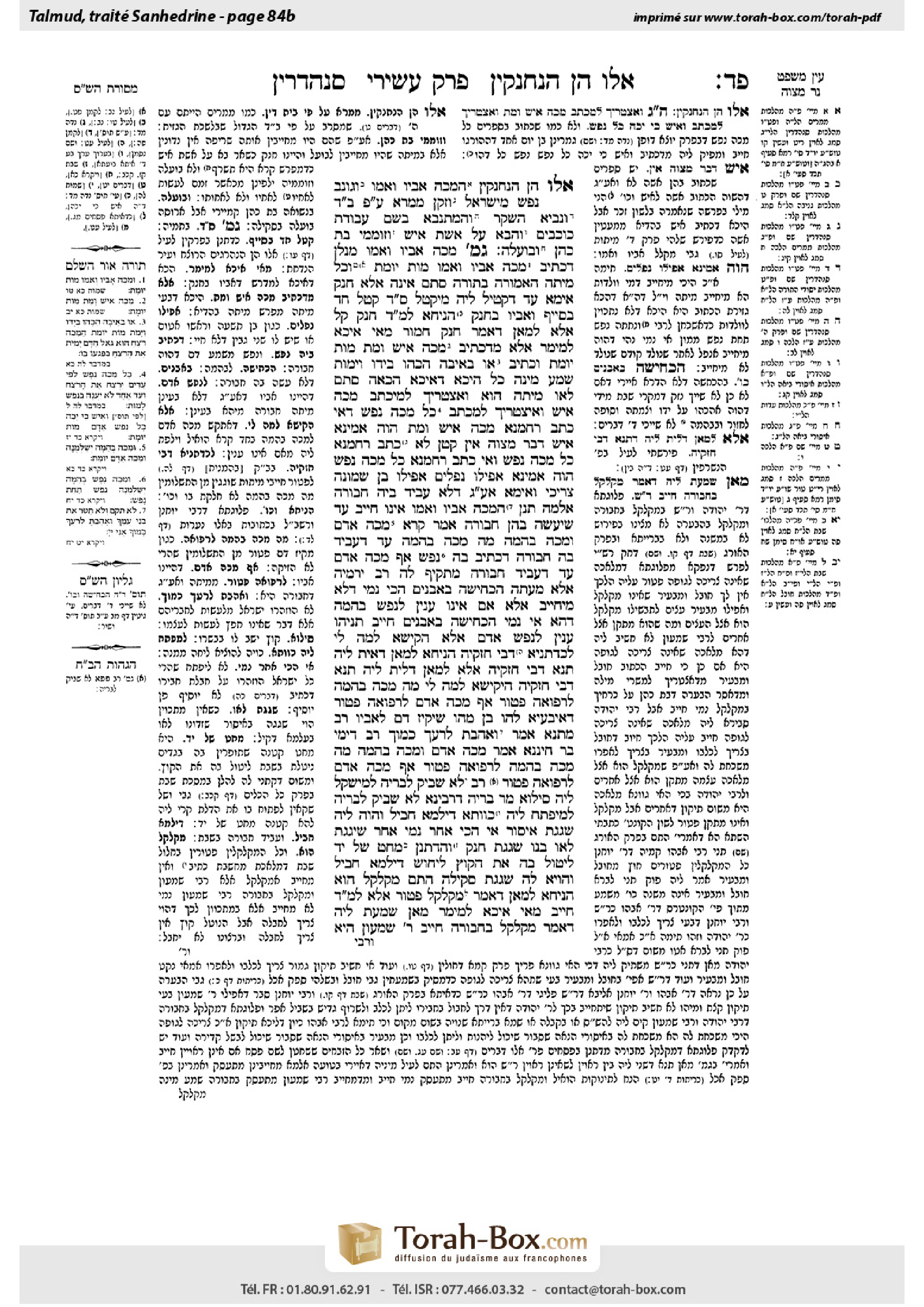
Sanhedrin 84b: Talmud study for Daf Yomi
Daf Yomi is the daily study of one Talmud folio. Explore 37 tractates with scans, Hebrew text, Sefaria English and AI-generated French translations where annotated.
Passage selection and English or AI-generated French translation are available where the scan has annotations. Daf Study is independent of Torah-Box and Sefaria.
Browse Sanhedrin · סנהדרין · All tractatesSanhedrin 84b text and translations
This page of Sanhedrin includes the Aramaic text, an English translation and an AI-generated French translation, alongside the scan above.
סנהדרין פ״ד ב · Aramaic and Hebrew text
מַתְנִי׳ אֵלּוּ הֵן הַנֶּחְנָקִין – הַמַּכֶּה אָבִיו וְאִמּוֹ, וְגוֹנֵב נֶפֶשׁ מִיִּשְׂרָאֵל, וְזָקֵן מַמְרֵא עַל פִּי בֵּית דִּין, וּנְבִיא הַשֶּׁקֶר, וְהַמִּתְנַבֵּא בְּשֵׁם עֲבוֹדָה זָרָה, וְהַבָּא עַל אֵשֶׁת אִישׁ, וְזוֹמְמֵי בַּת כֹּהֵן וּבוֹעֲלָהּ.
גְּמָ׳ מַכֵּה אָבִיו וְאִמּוֹ מְנָלַן? דִּכְתִיב: ״וּמַכֵּה אָבִיו וְאִמּוֹ מוֹת יוּמָת״, וְכׇל מִיתָה הָאֲמוּרָה בַּתּוֹרָה סְתָם – אֵינָהּ אֶלָּא חֶנֶק.
אֵימָא: עַד דְּקָטֵיל לֵיהּ מִיקְטָל! סָלְקָא דַּעְתָּךְ? קְטַל חַד בְּסַיִיף, וְאָבִיו בְּחֶנֶק?
הָנִיחָא לְמַאן דְּאָמַר חֶנֶק קַל, אֶלָּא לְמַאן דְּאָמַר חֶנֶק חָמוּר, מַאי אִיכָּא לְמֵימַר?
אֶלָּא, מִדִּכְתִיב: ״מַכֵּה אִישׁ וָמֵת מוֹת יוּמָת״, וּכְתִיב: ״אוֹ בְאֵיבָה הִכָּהוּ בְיָדוֹ וַיָּמֹת״, שְׁמַע מִינַּהּ: כֹּל הֵיכָא דְּאִיכָּא הַכָּאָה סְתָם – לָאו מִיתָה הוּא.
וְאִיצְטְרִיךְ לְמִיכְתַּב ״מַכֵּה אִישׁ״, וְאִיצְטְרִיךְ לְמִכְתַּב ״כׇּל מַכֵּה נֶפֶשׁ״. דְּאִי כְּתַב רַחֲמָנָא ״מַכֵּה אִישׁ וָמֵת״, הֲוָה אָמֵינָא: אִישׁ דְּבַר מִצְוָה – אִין, קָטָן – לָא. כְּתַב רַחֲמָנָא ״כׇּל מַכֵּה נֶפֶשׁ״. וְאִי כְּתַב רַחֲמָנָא ״כׇּל מַכֵּה נֶפֶשׁ״, הֲוָה אָמֵינָא: אֲפִילּוּ נְפָלִים, אֲפִילּוּ בֶּן שְׁמוֹנָה. צְרִיכִי.
וְאֵימָא: אַף עַל גַּב דְּלָא עָבֵיד בֵּיהּ חַבּוּרָה? אַלְּמָה תְּנַן: הַמַּכֶּה אָבִיו וְאִמּוֹ אֵינוֹ חַיָּיב עַד שֶׁיַּעֲשֶׂה בָּהֶן חַבּוּרָה!
אָמַר קְרָא: ״מַכֵּה אָדָם וּמַכֵּה בְהֵמָה״. מָה מַכֵּה בְהֵמָה – עַד דְּעָבֵיד בַּהּ חַבּוּרָה, דִּכְתִיב בַּהּ ״נֶפֶשׁ״, אַף מַכֵּה אָדָם – עַד דְּעָבֵיד חַבּוּרָה.
מַתְקֵיף לַהּ רַב יִרְמְיָה: אֶלָּא מֵעַתָּה, הִכְחִישָׁהּ בַּאֲבָנִים – הָכִי נָמֵי דְּלָא מִיחַיַּיב? אֶלָּא, אִם אֵינוֹ עִנְיָן לְנֶפֶשׁ בְּהֵמָה – דְּהָא אִי נָמֵי הִכְחִישָׁהּ בַּאֲבָנִים חַיָּיב – תְּנֵיהוּ עִנְיָן לְנֶפֶשׁ אָדָם.
אֶלָּא, הֶקֵּישָׁא לְמָה לִי? לְכִדְתַנְיָא דְּבֵי חִזְקִיָּה.
הָנִיחָא לְמַאן דְּאִית לֵיהּ תַּנָּא דְּבֵי חִזְקִיָּה, אֶלָּא לְמַאן דְּלֵית לֵיהּ תַּנָּא דְּבֵי חִזְקִיָּה, הֶיקֵּישָׁא לְמָה לִי?
מָה מַכֵּה בְהֵמָה לִרְפוּאָה – פָּטוּר, אַף מַכֵּה אָדָם לִרְפוּאָה – פָּטוּר.
דְּאִיבַּעְיָא לְהוּ: בֵּן מַהוּ שֶׁיַּקִּיז דָּם לְאָבִיו? רַב מַתְנָא אָמַר: ״וְאָהַבְתָּ לְרֵעֲךָ כָּמוֹךָ״. רַב דִּימִי בַּר חִינָּנָא אָמַר: מַכֵּה אָדָם וּמַכֵּה בְהֵמָה, מָה מַכֵּה בְהֵמָה לִרְפוּאָה – פָּטוּר, אַף מַכֵּה אָדָם לִרְפוּאָה – פָּטוּר.
רַב לָא שָׁבֵיק לִבְרֵיהּ לְמִישְׁקַל לֵיהּ סִילְוָא. מָר בְּרֵיהּ דְּרָבִינָא לָא שָׁבֵיק לִבְרֵיהּ לְמִיפְתַּח לֵיהּ כְּוָותָא, דִּילְמָא חָבֵיל וְהָוְיָא לֵיהּ שִׁגְגַת אִיסּוּר.
אִי הָכִי, אַחֵר נָמֵי? אַחֵר – שִׁיגְגַת לָאו, בְּנוֹ – שִׁגְגַת חֶנֶק.
וְהָדִתְנַן: מַחַט שֶׁל יָד לִיטּוֹל בָּהּ אֶת הַקּוֹץ, לֵיחוּשׁ דִּילְמָא חָבֵיל וְהָוְיָא לַהּ שִׁגְגַת סְקִילָה?
הָתָם מְקַלְקֵל הוּא.
הָנִיחָא לְמַאן דְּאָמַר: מְקַלְקֵל פָּטוּר, אֶלָּא לְמַאן דְּאָמַר: חַיָּיב, מַאי אִיכָּא לְמֵימַר?
מַאן שָׁמְעַתְּ לֵיהּ דְּאָמַר: מְקַלְקֵל בְּחַבּוּרָה חַיָּיב? רַבִּי שִׁמְעוֹן הִיא.
Sanhedrin 84b · English translation
MISHNA: These are the transgressors who are strangled in the implementation of the court-imposed death penalty: One who strikes his father or his mother, and one who abducts a Jewish person, and a rebellious elder according to the court, and a false prophet, and one who prophesies in the name of idol worship, and one who engages in intercourse with a married woman, and conspiring witnesses who testify that the daughter of a priest committed adultery, even though were she guilty, she would be executed by burning. And her paramour is also executed via strangulation as in any case where a man engages in intercourse with a married woman.
GEMARA: The mishna teaches: One who strikes his father or his mother is executed by strangulation. The Gemara asks: From where do we derive this halakha? The Gemara answers: It is derived from a verse, as it is written: “One who strikes his father or his mother shall be put to death” (Exodus 21:15), and every death stated in the Torah without specification is referring to nothing other than strangulation.
The Gemara suggests: Say that one is not executed for striking his father or mother unless he kills him or her. The Gemara explains: Does it enter your mind to say that if one kills one other person, he is executed by beheading with a sword, but if he kills his father or mother he is executed by strangulation? That is not reasonable.
The Gemara asks: This works out well according to the one who said that strangulation is a more lenient form of execution than decapitation. But according to the one who said that strangulation is a more severe form of execution than decapitation, what is there to say? Perhaps one is liable to receive the death penalty for striking his father or mother only if he kills the parent, and the added severity for killing a parent is in terms of the specific form of death penalty.
The Gemara answers: Rather, prove that one is executed by strangulation for striking his father or mother even if he does not kill them from the fact that it is written: “One who strikes a man and he dies shall be put to death” (Exodus 21:12), and it is written: “Or if in enmity he struck him with his hand and he died he shall be put to death” (Numbers 35:21). Learn from these verses in which it states: Strikes and he dies, that anywhere that there is mention of striking without specifying a resultant death, it is not referring to a case where the blow caused one’s death.
The Gemara notes: And it was necessary for the Torah to write: “One who strikes a man,” and it was necessary for the Torah to write: “Anyone who kills a soul, the murderer shall be slain on the basis of witnesses” (Numbers 35:30), since if the Merciful One wrote only: “One who strikes a man and he dies,” I would say that one who strikes a man, i.e., an adult, who is obligated in the fulfillment of mitzvot, yes, he is executed, but one who kills a minor, no, he is not executed. Therefore, the Merciful One writes: “Anyone who kills a soul.” And if the Merciful One wrote only: “Anyone who kills a soul,” I would say that one is executed even if he killed a non-viable newborn, or even if he killed a child born after a gestation period of eight months, who, in talmudic times, was also considered non-viable. Consequently, both verses are necessary.
The Gemara asks: But if that is the source for the halakha that one is liable for striking his father or mother, why not say that he is liable even though he did not wound him or her and draw blood? Why, then, did we learn in a mishna (85b): One who strikes his father and his mother is not liable unless he wounds them?
The Gemara answers that the verse states: “And one who strikes an animal shall pay for it; and one who strikes a person shall be put to death” (Leviticus 24:21), juxtaposing one who strikes an individual with one who strikes an animal. An earlier verse states: “One who strikes the soul of an animal shall pay for it” (Leviticus 24:18). Based on this it is derived: Just as one who strikes an animal is not liable unless he wounds it and draws blood, as “soul” is written concerning it, and it can be derived from the verse: “For the blood is the soul” (Deuteronomy 12:23), that the term “soul” is a reference to blood, so too, one who strikes a person is not liable unless he causes a wound and draws blood.
Rav Yirmeya objects to this proof: If that is so, then in a case where one weakened the animal by placing a burden of stones upon it and thereby injured or killed it, would one say that so too in that case he is not liable because he did not draw blood? Clearly he is liable to pay for the damage that he caused. Rather, with regard to the term soul in the verse: “One who strikes the soul of an animal,” if it is not a matter that is relevant to the soul of an animal, as even in a case where one weakens the animal by placing a burden of stones upon it, he is liable, apply it to the matter of the soul of a person, and thereby derive that one who strikes his parent is liable to be executed only if he wounds his parent and draws blood.
The Gemara asks: But if the fact that one who strikes his parent is liable only if he draws blood is derived based on the principle: If it is not a matter, why do I need the juxtaposition between the striking of a man and the striking of an animal? The Gemara answers: The juxtaposition is necessary in order to derive the halakha for that which is taught in a baraita in the school of Ḥizkiyya: Just as in the case of one who strikes an animal there is no distinction between one who does so unwittingly and one who does so intentionally, and in both cases he is liable to pay damages, so too, in the case of one who strikes a person there is no distinction between one who does so intentionally and is executed, and one who does so unwittingly and is not executed. In both cases he is exempt from paying damages based on the principle that one receives only the greater punishment.
The Gemara asks: This works out well according to the one who holds in accordance with the opinion of the tanna of the school of Ḥizkiyya, but according to the one who does not hold in accordance with the opinion of the tanna of the school of Ḥizkiyya, why do I need the juxtaposition between the striking of a man and the striking of an animal?
The Gemara answers: He derives that just as one who strikes an animal for medical purposes is exempt from payment of restitution, so too, one who strikes a person for medical purposes is exempt, even if it results in the death of the one that he treated.
The Gemara explains: As a dilemma was raised before the Sages: What is the halakha with regard to whether a son may let blood for his father? Is he liable for wounding his father? Rav Mattana says that it is written: “And you shall love your neighbor as yourself” (Leviticus 19:18); just as one would want others to heal him when the need arises, one must heal others when the need arises. It is prohibited for one to do to others only those actions that he would not want done to him. Therefore, it is permitted for one to heal his father even if the procedure entails wounding him. Rav Dimi bar Ḥinnana says: This is derived from the juxtaposition between one who strikes a person and one who strikes an animal. Just as one who strikes an animal for medical purposes is exempt from paying restitution, so too, one who strikes a person for medical purposes is exempt from liability.
The Gemara relates: Rav did not allow his son to extract a thorn from him, due to the concern that his son would unwittingly wound him. Mar, son of Ravina, did not allow his son to pierce his blister, lest he wound him, which would be an unwitting violation of a prohibition.
The Gemara challenges this: If so, this should be a concern when another who is not his son treats him as well, as it is prohibited for one Jew to injure another. The Gemara explains: There is a distinction, as when another treats him, the concern is that the individual would be in unwitting violation of a prohibition. By contrast, when his son treats him, the concern is that he would be in unwitting violation of a prohibition punishable by strangulation.
The Gemara asks: But with regard to that which we learned in a mishna (Shabbat 122b): It is permitted on Shabbat to move an ordinary hand needle used for sewing garments to extract a thorn with it, why is it permitted to extract a thorn on Shabbat? Let us be concerned lest he wound the individual in the process, which would be an unwitting violation of a prohibition punishable by stoning.
The Gemara answers: There, even if one wounds the individual, he is unwittingly performing a labor for a destructive purpose, i.e., he is causing an injury, and one is liable to be executed only for the performance of a labor for a constructive purpose on Shabbat.
The Gemara asks: This works out well according to the one who said that one who performs a labor on Shabbat for a destructive purpose is exempt. But according to the one who said that even when performing the labor for a destructive purpose, there are cases where one is liable if he benefits from the action, what is there to say?
The Gemara answers: Whom did you hear that said that one who is destructive in causing a wound is liable to be executed if there is a constructive element to his action? It is Rabbi Shimon,
Sanhedrin 84b · Traduction française (IA)
MICHNA : Voici les transgresseurs exécutés par strangulation dans le cadre de la peine capitale prononcée par le tribunal : celui qui frappe son père ou sa mère ; celui qui enlève un Juif ; l’ancien rebelle à l’autorité du tribunal ; le faux prophète ; celui qui prophétise au nom de l’idolâtrie ; celui qui a des relations sexuelles avec une femme mariée ; et les témoins conspirateurs qui déposent que la fille d’un prêtre a commis un adultère, alors que, si elle était coupable, elle serait exécutée par le feu. Son amant est lui aussi exécuté par strangulation, comme dans tout cas où un homme a des relations sexuelles avec une femme mariée.
GUEMARA : La Michna enseigne que celui qui frappe son père ou sa mère est exécuté par strangulation. La Guemara demande : De quelle source déduisons-nous cette halakha ? La Guemara répond : Elle se déduit d’un verset, comme il est écrit : « Celui qui frappe son père ou sa mère sera mis à mort » (Exode 21,15). Or, toute peine de mort mentionnée dans la Torah sans autre précision désigne la strangulation.
La Guemara avance : Disons qu’on n’est exécuté pour avoir frappé son père ou sa mère que si on le tue. La Guemara explique : Peut-on concevoir que, si quelqu’un tue une autre personne, il soit exécuté par décapitation à l’épée, mais que, s’il tue son père ou sa mère, il soit exécuté par strangulation ? Cela n’est pas raisonnable.
La Guemara demande : Cela convient selon celui qui dit que la strangulation est une peine plus légère que la décapitation. Mais, selon celui qui dit que la strangulation est une peine plus sévère que la décapitation, que peut-on répondre ? Peut-être n’est-on passible de la peine de mort pour avoir frappé son père ou sa mère que si l’on tue ce parent, et la gravité supplémentaire du meurtre d’un parent tient à la forme précise de la peine capitale.
La Guemara répond : Il faut plutôt prouver qu’on est exécuté par strangulation pour avoir frappé son père ou sa mère même sans les tuer, du fait qu’il est écrit : « Celui qui frappe un homme et qu’il meurt sera mis à mort » (Exode 21,12), et qu’il est écrit : « Ou s’il le frappe de sa main par inimitié et qu’il meurt, il sera mis à mort » (Nombres 35,21). Déduis de ces versets, où il est dit : « Il frappe et il meurt », que partout où il est question de frapper sans préciser que cela entraîne la mort, il ne s’agit pas d’un cas où le coup a causé la mort.
La Guemara relève qu’il était nécessaire que la Torah écrive : « Celui qui frappe un homme », et qu’elle écrive aussi : « Quiconque tue une personne, le meurtrier sera mis à mort sur la déposition de témoins » (Nombres 35,30). En effet, si le Miséricordieux avait écrit seulement : « Celui qui frappe un homme et qu’il meurt », j’aurais dit que celui qui frappe un homme, c’est-à-dire un adulte tenu d’accomplir les mitsvot, est bien exécuté, mais que celui qui tue un mineur ne l’est pas. C’est pourquoi le Miséricordieux écrit : « Quiconque tue une personne ». Et si le Miséricordieux avait écrit seulement : « Quiconque tue une personne », j’aurais dit qu’on est exécuté même pour avoir tué un nouveau-né non viable, ou un enfant né après une gestation de huit mois, qui, à l’époque talmudique, était lui aussi considéré comme non viable. Par conséquent, les deux versets sont nécessaires.
La Guemara demande : Mais si telle est la source de la halakha selon laquelle on est passible d’une peine pour avoir frappé son père ou sa mère, pourquoi ne pas dire qu’on est passible même sans l’avoir blessé ni lui avoir fait couler le sang ? Pourquoi avons-nous donc appris dans une Michna (85b) : Celui qui frappe son père ou sa mère n’est passible que s’il les blesse ?
La Guemara répond que le verset dit : « Celui qui frappe un animal en paiera le prix ; celui qui frappe un homme sera mis à mort » (Lévitique 24,21), rapprochant celui qui frappe une personne de celui qui frappe un animal. Un verset précédent dit : « Celui qui frappe la vie d’un animal en paiera le prix » (Lévitique 24,18). On en déduit ceci : de même que celui qui frappe un animal n’est passible que s’il le blesse et fait couler son sang, puisque le terme « vie » est écrit à son sujet et qu’on peut déduire du verset « car le sang est la vie » (Deutéronome 12,23) que le terme « vie » désigne le sang, de même, celui qui frappe une personne n’est passible que s’il la blesse et lui fait couler le sang.
Rav Yirmeya conteste cette preuve : si tel est le cas, lorsque quelqu’un affaiblit un animal en lui faisant porter une charge de pierres et le blesse ou le tue ainsi, dira-t-on que, là aussi, il n’est pas passible parce qu’il n’a pas fait couler de sang ? Il est clairement passible de payer les dommages qu’il a causés. Au contraire, concernant le terme « vie » dans le verset « Celui qui frappe la vie d’un animal », s’il ne s’applique pas à la vie d’un animal, puisque même lorsqu’on affaiblit un animal en lui faisant porter une charge de pierres, on est passible, applique-le à la vie d’une personne. On en déduit ainsi que celui qui frappe son parent n’est passible d’exécution que s’il le blesse et lui fait couler le sang.
La Guemara demande : Mais si l’on déduit que celui qui frappe son parent n’est passible que s’il lui fait couler le sang selon le principe « si cela ne s’applique pas ici, à quoi bon ? », pourquoi ai-je besoin du rapprochement entre le fait de frapper un homme et celui de frapper un animal ? La Guemara répond : Ce rapprochement est nécessaire pour déduire la halakha enseignée dans une baraïta de l’école de Ḥizkiyya : de même que, dans le cas de celui qui frappe un animal, il n’y a pas de différence entre celui qui le fait involontairement et celui qui le fait intentionnellement, et que, dans les deux cas, il est passible de payer des dommages, de même, dans le cas de celui qui frappe une personne, il n’y a pas de différence entre celui qui le fait intentionnellement et est exécuté, et celui qui le fait involontairement et n’est pas exécuté. Dans les deux cas, il est dispensé de payer des dommages, selon le principe qu’on ne reçoit que la peine la plus lourde.
La Guemara demande : Cela convient selon celui qui suit l’opinion du tanna de l’école de Ḥizkiyya, mais, selon celui qui ne suit pas l’opinion du tanna de l’école de Ḥizkiyya, pourquoi ai-je besoin du rapprochement entre le fait de frapper un homme et celui de frapper un animal ?
La Guemara répond : Il en déduit que, de même que celui qui frappe un animal à des fins médicales est dispensé de payer des dommages, de même celui qui frappe une personne à des fins médicales est dispensé de payer des dommages, même si cela entraîne la mort de la personne soignée.
La Guemara explique : Une question fut posée aux Sages : quelle est la halakha concernant un fils qui voudrait faire une saignée à son père ? Est-il passible pour l’avoir blessé ? Rav Mattana dit que cela se déduit du verset : « Tu aimeras ton prochain comme toi-même » (Lévitique 19,18) : de même qu’on voudrait que les autres nous soignent lorsque le besoin s’en fait sentir, on doit soigner les autres lorsque le besoin s’en fait sentir. Il est interdit de faire aux autres uniquement ce qu’on ne voudrait pas qu’on nous fasse. Il est donc permis de soigner son père, même si le geste implique de le blesser. Rav Dimi bar Ḥinnana dit : Cela se déduit du rapprochement entre celui qui frappe une personne et celui qui frappe un animal. De même que celui qui frappe un animal à des fins médicales est dispensé de payer des dommages, de même celui qui frappe une personne à des fins médicales est dispensé de toute responsabilité.
La Guemara rapporte : Rav ne laissa pas son fils lui retirer une épine, de crainte que celui-ci ne le blesse involontairement. Mar, fils de Ravina, ne laissa pas son fils percer son ampoule, de peur qu’il ne le blesse, ce qui constituerait une transgression involontaire d’une interdiction.
La Guemara objecte : Si tel est le cas, cette crainte devrait aussi exister lorsqu’une autre personne, qui n’est pas son fils, le soigne, car il est interdit à un Juif d’en blesser un autre. La Guemara explique : Il y a une différence : lorsqu’une autre personne le soigne, on craint que celle-ci ne transgresse involontairement une interdiction. En revanche, lorsque son fils le soigne, on craint qu’il ne transgresse involontairement une interdiction passible de strangulation.
La Guemara demande : Mais au sujet de ce que nous avons appris dans une Michna (Chabbat 122b), à savoir qu’il est permis le Chabbat de déplacer une aiguille à coudre ordinaire pour en extraire une épine, pourquoi est-il permis d’extraire une épine le Chabbat ? Ne craignons-nous pas qu’il blesse la personne en le faisant, ce qui constituerait une transgression involontaire d’une interdiction passible de lapidation ?
La Guemara répond : Dans ce cas, même si l’on blesse la personne, on accomplit involontairement un travail à visée destructrice, c’est-à-dire qu’on lui cause une blessure ; or, on n’est passible d’exécution que pour l’accomplissement, le Chabbat, d’un travail à visée constructive.
La Guemara demande : Cela convient selon celui qui dit que celui qui accomplit le Chabbat un travail à visée destructrice est dispensé. Mais, selon celui qui dit que même lorsqu’on accomplit un travail à visée destructrice, il existe des cas où l’on est passible si l’on tire profit de son acte, que peut-on répondre ?
La Guemara répond : Qui as-tu entendu dire que celui qui cause une blessure à visée destructrice est passible d’exécution si son acte comporte un élément constructif ? C’est Rabbi Shimon,
Traduction française générée par IA à partir de l’édition anglaise de Sefaria. Vérifie toujours un passage avec le texte source.
Text from Sefaria: William Davidson Edition - Vocalized Aramaic (CC BY NC); William Davidson Edition - English (CC BY NC).