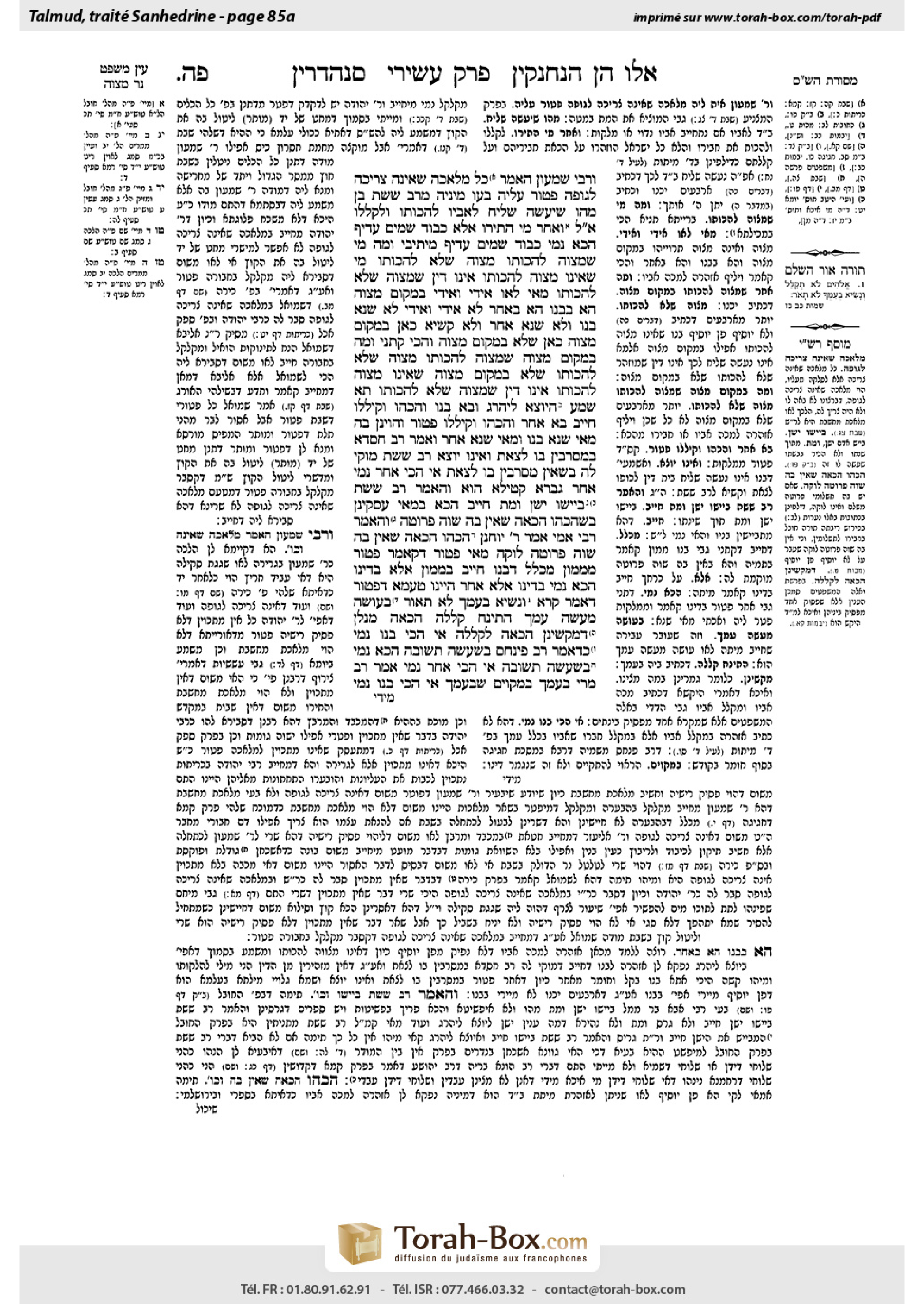
Sanhedrin 85a: Talmud study for Daf Yomi
Daf Yomi is the daily study of one Talmud folio. Explore 37 tractates with scans, Hebrew text, Sefaria English and AI-generated French translations where annotated.
Passage selection and English or AI-generated French translation are available where the scan has annotations. Daf Study is independent of Torah-Box and Sefaria.
Browse Sanhedrin · סנהדרין · All tractatesSanhedrin 85a text and translations
This page of Sanhedrin includes the Aramaic text, an English translation and an AI-generated French translation, alongside the scan above.
סנהדרין פ״ה א · Aramaic and Hebrew text
וְרַבִּי שִׁמְעוֹן הָאָמַר: כׇּל מְלָאכָה שֶׁאֵינָהּ צְרִיכָה לְגוּפָהּ – פָּטוּר עָלֶיהָ.
בְּעוֹ מִינֵּיהּ מֵרַב שֵׁשֶׁת: בֵּן מַהוּ שֶׁיֵּעָשֶׂה שָׁלִיחַ לְאָבִיו, לְהַכּוֹתוֹ וּלְקַלְלוֹ?
אֲמַר לְהוּ: וְאַחֵר מִי הִתִּירוֹ? אֶלָּא, כְּבוֹד שָׁמַיִם עָדִיף. הָכָא נָמֵי, כְּבוֹד שָׁמַיִם עָדִיף.
מֵיתִיבִי: וּמָה מִי שֶׁמִּצְוָה לְהַכּוֹתוֹ, מִצְוָה שֶׁלֹּא לְהַכּוֹתוֹ; מִי שֶׁאֵינוֹ מִצְוָה לְהַכּוֹתוֹ, אֵינוֹ דִּין שֶׁמִּצְוָה שֶׁלֹּא לְהַכּוֹתוֹ?
מַאי לָאו אִידֵּי וְאִידֵּי בִּמְקוֹם מִצְוָה? הָא – בִּבְנוֹ, הָא – בְּאַחֵר.
לָא, אִידֵּי וְאִידִי לָא שְׁנָא בְּנוֹ וְלָא שְׁנָא אַחֵר. וְלָא קַשְׁיָא: כָּאן – בִּמְקוֹם מִצְוָה, כָּאן – שֶׁלֹּא בִּמְקוֹם מִצְוָה.
וְהָכִי קָתָנֵי: וּמָה בִּמְקוֹם מִצְוָה, שֶׁמִּצְוָה לְהַכּוֹתוֹ – מִצְוָה שֶׁלֹּא לְהַכּוֹתוֹ; שֶׁלֹּא בִּמְקוֹם מִצְוָה, שֶׁאֵינוֹ מִצְוָה לְהַכּוֹתוֹ – אֵינוֹ דִּין שֶׁמִּצְוָה שֶׁלֹּא לְהַכּוֹתוֹ?
תָּא שְׁמַע: הַיּוֹצֵא לֵיהָרֵג וּבָא בְּנוֹ וְהִכָּהוּ וְקִילְּלוֹ – חַיָּיב, בָּא אַחֵר וְהִכָּהוּ וְקִילְּלוֹ – פָּטוּר. וְהָוֵינַן בַּהּ: מַאי שְׁנָא בְּנוֹ וּמַאי שְׁנָא אַחֵר? וְאָמַר רַב חִסְדָּא: בִּמְסָרְבִין בּוֹ לָצֵאת וְאֵינוֹ יוֹצֵא.
רַב שֵׁשֶׁת מוֹקֵי לַהּ בְּשֶׁאֵין מְסָרְבִין בּוֹ לָצֵאת.
אִי הָכִי, אַחֵר נָמֵי? אַחֵר – גַּבְרָא קְטִילָא הוּא.
וְהָאָמַר רַב שֵׁשֶׁת: בִּיְּישׁוֹ יָשֵׁן וָמֵת – חַיָּיב? הָכָא בְּמַאי עָסְקִינַן? בְּשֶׁהִכָּהוּ הַכָּאָה שֶׁאֵין בָּהּ שָׁוֶה פְּרוּטָה.
וְהָאָמַר רַבִּי אַמֵּי אָמַר רַבִּי יוֹחָנָן: הִכָּהוּ הַכָּאָה שֶׁאֵין בָּהּ שָׁוֶה פְּרוּטָה – לוֹקֶה? מַאי ״פָּטוּר״ דְּקָאָמַר? פָּטוּר מִמָּמוֹן.
מִכְלָל דִּבְנוֹ חַיָּיב בְּמָמוֹן? אֶלָּא בְּדִינוֹ. הָכָא נָמֵי, בְּדִינוֹ.
אֶלָּא, אַחֵר הַיְינוּ טַעְמָא דְּפָטוּר, דְּאָמַר קְרָא: ״וְנָשִׂיא בְעַמְּךָ לֹא תָאֹר״ – בְּעוֹשֶׂה מַעֲשֵׂה עַמְּךָ.
הָתִינַח קְלָלָה, הַכָּאָה מְנָלַן? דְּמַקְּשִׁינַן הַכָּאָה לִקְלָלָה.
אִי הָכִי, בְּנוֹ נָמֵי? כִּדְאָמַר רַב פִּינְחָס: בְּשֶׁעָשָׂה תְּשׁוּבָה. הָכִי נָמֵי, בְּשֶׁעָשָׂה תְּשׁוּבָה.
אִי הָכִי, אַחֵר נָמֵי? אָמַר רַב מָרִי: ״בְּעַמְּךָ״ – בִּמְקוּיָּם שֶׁבְּעַמְּךָ.
אִי הָכִי, בְּנוֹ נָמֵי?
Sanhedrin 85a · English translation
and doesn’t Rabbi Shimon say: With regard to one who performs any prohibited labor that is not necessary for its own sake, it is labor for which he is exempt? In this case, causing the wound was inadvertent and was not his objective when performing the action.
§ The Sages raised a dilemma before Rav Sheshet: What is the halakha with regard to whether a son may be designated an agent of the court in order to flog his father or to curse him if the court sentenced him to ostracism?
Rav Sheshet said to them: And did the Torah render it permitted to flog or curse another who is not his father? The Torah prohibited such actions. Rather, the reason that an agent of the court may flog or curse the one found liable is that the honor of Heaven takes precedence over the honor due to another. Here too, a son may serve as an agent of the court because the honor of Heaven takes precedence over the honor due to his father.
The Gemara raises an objection from a baraita: And just as with regard to one who is commanded to strike him there is a mitzva not to strike him under other circumstances, with regard to one who is not commanded to strike him is it not right that there is a mitzva not to strike him?
The Gemara explains the baraita: What, is it not that both this first clause of the statement of the baraita and that latter clause of the statement of the baraita are referring to a situation where striking another is a mitzva, e.g., where the other is liable to receive lashes. The distinction between them is that this latter clause, which is referring to one who is not commanded to strike him, is concerning a case where the agent is his son and is therefore prohibited from striking his father even in that capacity, while that first clause, which is referring to one who is commanded to strike him, is concerning a case where the agent is another individual and not his son. This indicates that it is prohibited for a son to flog his father as an agent of the court.
The Gemara answers: No, in both this clause and that clause it is no different if the agent is his son and it is no different if the agent is another. And it is not difficult to distinguish between the clauses: Here, in the first clause, the reference is to a situation where striking another is a mitzva, as he is an agent of the court; there, in the latter clause, the reference is not to a situation where striking another is a mitzva.
And accordingly, this is what the baraita is teaching: And just as in a situation where striking another is a mitzva, where the agent of the court is commanded to strike him, there is a mitzva not to strike him even one lash beyond the number determined by the court, as it is written: “Forty lashes shall he strike him, he shall not exceed, lest if he shall exceed to strike him” (Deuteronomy 25:3), accordingly, in a situation where striking another is not a mitzva, where one is not commanded to strike him, is it not right that there is a mitzva not to strike him? The general prohibition against striking another in any situation is derived from this verse.
The Gemara suggests: Come and hear a proof from a baraita: In the case of one who emerges from the court condemned to be executed and his son came and struck him or cursed him, the son is liable to be executed for striking or cursing his father. If another came and struck him or cursed him, he is exempt. And we discussed it as follows: What is different about the case where his son strikes or curses him that he is liable, and what is different about the case where another strikes or curses him that he is exempt? And Rav Ḥisda says: The baraita is referring to a case where they are imploring the condemned man to emerge from the court to be executed but he is not emerging. Therefore, it is necessary to employ force. Apparently, even under those circumstances, where the use of force is sanctioned by the court, it is prohibited for the son to strike his father.
The Gemara rejects this proof: Rav Sheshet interprets this baraita as referring to a case where they are not imploring him to emerge from the court for his execution. It is referring to a case where the condemned man is proceeding willingly, and it is not an agent of the court but someone else who strikes and curses him at his own initiative.
The Gemara challenges: If so, even another who strikes one who is condemned to death should be liable, as it is prohibited to strike or curse another. The Gemara responds: If another does so he is exempt, since the legal status of the one condemned to death is that of a dead man. Therefore, one is not liable for striking or humiliating him.
The Gemara asks: But doesn’t Rav Sheshet himself say: If one humiliates another who is sleeping and the individual never awakens and dies, the one who humiliated him is liable to compensate his heirs for that humiliation? Apparently, even if the status of the condemned is that of a dead person, the one who cursed him should be liable to compensate his heirs. The Gemara answers: With what are we dealing here in the baraita? We are dealing with a case where he struck him with a blow that does not have sufficient force to cause damage worth one peruta, in which case no compensation is paid.
The Gemara asks: But doesn’t Rabbi Ami say that Rabbi Yoḥanan says: In a case where one struck another with a blow that does not have sufficient force to cause damage worth one peruta, he is flogged for violating the prohibition: “He shall not exceed”? Why does the baraita exempt another entirely? The Gemara explains: What is the meaning of the term exempt that is stated in this baraita? It means that he is exempt from monetary restitution, but he is liable to receive lashes.
The Gemara asks: If the clause of the baraita that discusses a case where another individual strikes or curses him states that he is exempt only from payment of restitution, one may conclude by inference that the clause of the baraita that discusses his son states that he is liable to pay monetary restitution. That is certainly not the case. Rather, the clause of the baraita that discusses his son states that he is liable to be punished in accordance with his appropriate sentence; here too, the clause of the baraita that discusses another individual states that he is exempt from punishment in accordance with his appropriate sentence. The question remains: Why is another exempt from receiving lashes in a case where he struck him with a blow that does not have sufficient force to cause damage worth one peruta?
The Gemara answers: Rather, this is the reason that another is exempt: As the verse states: “Nor curse a ruler of your people” (Exodus 22:27), from which it is inferred that this prohibition applies only with regard to one who performs an action of “your people,” i.e., an action befitting a Jew. There is no prohibition against cursing one whose actions are inconsistent with the conduct appropriate for a Jew.
The Gemara asks: This explanation works out well with regard to cursing, as that is the prohibition mentioned in that verse. From where do we derive that the halakha is the same with regard to striking? The Gemara answers: We derive that the halakha is the same for both, as we liken striking to cursing based on the juxtaposition between the verses that address the cases of one who strikes his father (Exodus 21:15) and one who curses his father (Exodus 21:17).
The Gemara challenges: If so, and the prohibition does not apply to one whose actions are inconsistent with the conduct appropriate for a Jew, his son too should be exempt if he strikes or curses his father whose conduct is inappropriate. The Gemara explains: As Rav Pineḥas says in another context that the reference is to a case where the one in question repented, so too, the baraita is referring to a case where the condemned man repented. Although he is being taken to his execution, because he repented he is considered as one who performs actions “of your people,” and his son is liable for striking or cursing him.
The Gemara challenges: If so, and the baraita is referring to one who repented, another should be rendered liable as well. Rav Mari says: One derives from the expression “of your people” that the prohibition applies only to one enduring among your people, not to one whose execution is imminent.
The Gemara challenges: If so, his son should be exempt as well, since his father’s execution is imminent.
Sanhedrin 85a · Traduction française (IA)
Et Rabbi Shimon ne dit-il pas que celui qui accomplit un travail interdit qui n’est pas nécessaire en soi est exempt de cette faute ? Dans ce cas, la blessure a été causée par inadvertance et ne constituait pas son objectif lorsqu’il a agi.
§ Les Sages posèrent une question à Rav Sheshet : quelle est la halakha quant à la possibilité de désigner un fils comme agent du tribunal pour qu’il frappe son père de coups de fouet ou le maudisse si le tribunal l’a condamné à l’excommunication ?
Rav Sheshet leur dit : La Torah a-t-elle permis de frapper de coups de fouet ou de maudire quelqu’un d’autre que son père ? La Torah a interdit de tels actes. Au contraire, si un agent du tribunal peut frapper ou maudire celui qui a été déclaré passible d’une peine, c’est parce que l’honneur du Ciel prime sur l’honneur dû à autrui. Ici aussi, un fils peut servir d’agent du tribunal, car l’honneur du Ciel prime sur l’honneur dû à son père.
La Guemara soulève une objection à partir d’une baraïta : De même que celui qui a reçu l’ordre de le frapper a l’interdiction de le frapper dans d’autres circonstances, celui qui n’a pas reçu l’ordre de le frapper n’a-t-il pas, à plus forte raison, l’interdiction de le frapper ?
La Guemara explique la baraïta : N’est-il pas question, aussi bien dans la première partie de la déclaration de la baraïta que dans sa dernière partie, d’une situation où frapper autrui constitue une mitsva, par exemple lorsque l’autre est passible de coups de fouet ? La différence entre les deux parties est que la dernière, qui concerne celui qui n’a pas reçu l’ordre de le frapper, traite du cas où l’agent est son fils ; celui-ci a donc l’interdiction de frapper son père, même en cette qualité. La première, en revanche, qui concerne celui qui a reçu l’ordre de le frapper, traite du cas où l’agent est un autre individu, et non son fils. Cela indique qu’il est interdit à un fils de frapper son père de coups de fouet en qualité d’agent du tribunal.
La Guemara répond : Non. Dans les deux parties, peu importe que l’agent soit son fils ou un autre individu. Il n’y a pas de difficulté à distinguer les deux parties : ici, dans la première, il est question d’une situation où frapper autrui constitue une mitsva, puisque l’agent agit au nom du tribunal ; là, dans la dernière, il n’est pas question d’une situation où frapper autrui constitue une mitsva.
Par conséquent, voici ce que la baraïta enseigne : De même que, dans une situation où frapper autrui constitue une mitsva, lorsque l’agent du tribunal a reçu l’ordre de le frapper, il y a une mitsva de ne pas lui donner un seul coup de fouet au-delà du nombre fixé par le tribunal, comme il est écrit : « Il le frappera de quarante coups, il n’en ajoutera pas, de peur que, s’il ajoute, il ne le frappe » (Deutéronome 25:3), de même, dans une situation où frapper autrui ne constitue pas une mitsva, lorsqu’on n’a pas reçu l’ordre de le frapper, n’y a-t-il pas, à plus forte raison, une mitsva de ne pas le frapper ? L’interdiction générale de frapper autrui, quelle que soit la situation, est déduite de ce verset.
La Guemara propose : Viens entendre une preuve tirée d’une baraïta : dans le cas d’un homme qui sort du tribunal après avoir été condamné à mort, si son fils vient le frapper ou le maudire, le fils est passible de la peine de mort pour avoir frappé ou maudit son père. Si un autre vient le frapper ou le maudire, il est exempt. Nous avons alors posé la question suivante : qu’est-ce qui distingue le cas où son fils le frappe ou le maudit, de sorte qu’il est passible d’une peine, du cas où un autre le frappe ou le maudit, de sorte qu’il en est exempt ? Rav Ḥisda dit : La baraïta parle d’un cas où l’on implore le condamné de sortir du tribunal pour être exécuté, mais où il ne sort pas. Il est donc nécessaire d’employer la force. Il apparaît que même dans ces circonstances, où le tribunal autorise l’emploi de la force, il est interdit au fils de frapper son père.
La Guemara rejette cette preuve : Rav Sheshet interprète cette baraïta comme traitant d’un cas où l’on ne l’implore pas de sortir du tribunal pour être exécuté. Elle parle d’un condamné qui avance de son plein gré ; ce n’est pas un agent du tribunal, mais quelqu’un d’autre qui le frappe et le maudit de sa propre initiative.
La Guemara objecte : Dans ce cas, un autre qui frappe un condamné à mort devrait lui aussi être passible d’une peine, car il est interdit de frapper ou de maudire autrui. La Guemara répond : Si un autre agit ainsi, il est exempt, puisque le condamné à mort a le statut d’un mort. Par conséquent, on n’est pas passible d’une peine pour l’avoir frappé ou humilié.
La Guemara demande : Mais Rav Sheshet ne dit-il pas lui-même que si quelqu’un humilie une autre personne qui dort, et que celle-ci ne se réveille jamais et meurt, celui qui l’a humiliée est tenu d’indemniser ses héritiers pour cette humiliation ? Il apparaît que même si le condamné a le statut d’un mort, celui qui l’a maudit devrait être tenu d’indemniser ses héritiers. La Guemara répond : De quel cas s’agit-il ici, dans la baraïta ? D’un cas où il l’a frappé d’un coup dont la force est insuffisante pour causer un dommage d’une valeur d’une perouta ; aucune indemnité n’est alors versée.
La Guemara demande : Mais Rabbi Ami ne dit-il pas au nom de Rabbi Yoḥanan que si quelqu’un frappe une autre personne d’un coup dont la force est insuffisante pour causer un dommage d’une valeur d’une perouta, il reçoit des coups de fouet pour avoir transgressé l’interdiction : « Il n’en ajoutera pas » ? Pourquoi la baraïta exempte-t-elle entièrement un autre individu ? La Guemara explique : Que signifie le terme « exempt » employé dans cette baraïta ? Cela signifie qu’il est exempt de réparation pécuniaire, mais passible de coups de fouet.
La Guemara demande : Si la partie de la baraïta qui traite du cas où un autre individu le frappe ou le maudit indique qu’il est seulement exempt du paiement d’une indemnité, on peut en déduire que la partie qui traite du cas de son fils indique que celui-ci est passible d’une réparation pécuniaire. Ce n’est certainement pas le cas. En réalité, la partie qui traite de son fils indique qu’il est passible de la peine qui lui revient ; de même, la partie qui traite d’un autre individu indique qu’il est exempt de la peine qui lui reviendrait. La question demeure : pourquoi un autre individu est-il exempt de coups de fouet dans le cas où il l’a frappé d’un coup dont la force est insuffisante pour causer un dommage d’une valeur d’une perouta ?
La Guemara répond : En réalité, voici pourquoi un autre individu est exempt : le verset dit : « Tu ne maudiras pas un dirigeant de ton peuple » (Exode 22:27). On en déduit que cette interdiction ne concerne que celui qui agit en membre de « ton peuple », c’est-à-dire qui accomplit un acte digne d’un Juif. Il n’est pas interdit de maudire quelqu’un dont les actes ne sont pas conformes à la conduite qui sied à un Juif.
La Guemara demande : Cette explication convient pour la malédiction, puisque c’est l’interdiction mentionnée dans ce verset. D’où déduisons-nous que la halakha est la même pour les coups ? La Guemara répond : Nous déduisons que la halakha est la même dans les deux cas, car nous assimilons les coups à la malédiction en raison du rapprochement entre les versets qui traitent de celui qui frappe son père (Exode 21:15) et de celui qui maudit son père (Exode 21:17).
La Guemara objecte : Dans ce cas, puisque l’interdiction ne s’applique pas à celui dont les actes ne sont pas conformes à la conduite qui sied à un Juif, son fils aussi devrait être exempt s’il frappe ou maudit son père dont la conduite est inconvenante. La Guemara explique : De même que Rav Pineḥas dit, dans un autre contexte, que le cas visé est celui d’une personne qui s’est repentie, de même la baraïta parle d’un cas où le condamné s’est repenti. Bien qu’on le conduise à son exécution, parce qu’il s’est repenti, il est considéré comme quelqu’un qui accomplit des actes dignes d’un membre de « ton peuple », et son fils est passible d’une peine pour l’avoir frappé ou maudit.
La Guemara objecte : Dans ce cas, puisque la baraïta parle de quelqu’un qui s’est repenti, un autre individu devrait lui aussi être passible d’une peine. Rav Mari dit : On déduit de l’expression « de ton peuple » que l’interdiction ne s’applique qu’à celui qui demeure au sein de ton peuple, et non à celui dont l’exécution est imminente.
La Guemara objecte : Dans ce cas, son fils aussi devrait être exempt, puisque l’exécution de son père est imminente.
Traduction française générée par IA à partir de l’édition anglaise de Sefaria. Vérifie toujours un passage avec le texte source.
Text from Sefaria: William Davidson Edition - Vocalized Aramaic (CC BY NC); William Davidson Edition - English (CC BY NC).