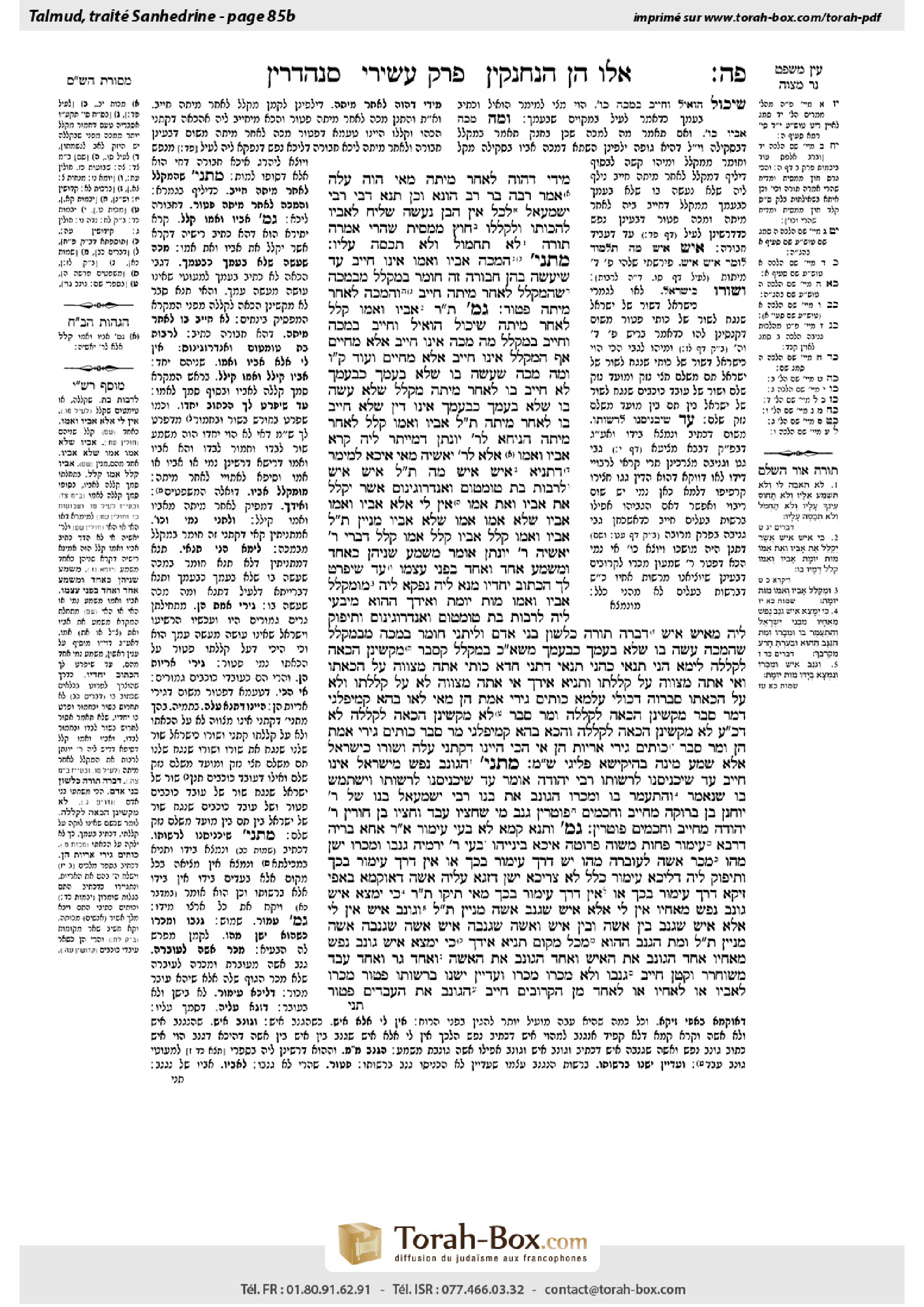
Sanhedrin 85b: Talmud study for Daf Yomi
Daf Yomi is the daily study of one Talmud folio. Explore 37 tractates with scans, Hebrew text, Sefaria English and AI-generated French translations where annotated.
Passage selection and English or AI-generated French translation are available where the scan has annotations. Daf Study is independent of Torah-Box and Sefaria.
Browse Sanhedrin · סנהדרין · All tractatesSanhedrin 85b text and translations
This page of Sanhedrin includes the Aramaic text, an English translation and an AI-generated French translation, alongside the scan above.
סנהדרין פ״ה ב · Aramaic and Hebrew text
מִידֵּי דְּהָוֵה לְאַחַר מִיתָה.
מַאי הֲוָה עֲלַהּ? אָמַר רַבָּה בַּר רַב הוּנָא, וְכֵן תָּנָא דְּבֵי רַבִּי יִשְׁמָעֵאל: לַכֹּל אֵין הַבֵּן נַעֲשֶׂה שָׁלִיחַ לְאָבִיו לְהַכּוֹתוֹ וּלְקַלְלוֹ, חוּץ מִמֵּסִית, שֶׁהֲרֵי אָמְרָה תּוֹרָה: ״וְלֹא תַחְמֹל וְלֹא תְכַסֶּה עָלָיו״.
מַתְנִי׳ הַמַּכֶּה אָבִיו וְאִמּוֹ אֵינוֹ חַיָּיב עַד שֶׁיַּעֲשֶׂה בָּהֶן חַבּוּרָה. זֶה חוֹמֶר בַּמְקַלֵּל מִבַּמַּכֶּה, שֶׁהַמְקַלֵּל לְאַחַר מִיתָה חַיָּיב, וְהַמַּכֶּה לְאַחַר מִיתָה פָּטוּר.
גְּמָ׳ תָּנוּ רַבָּנַן: ״אָבִיו וְאִמּוֹ קִלֵּל״ – לְאַחַר מִיתָה. שֶׁיָּכוֹל, הוֹאִיל וְחִיֵּיב בַּמַּכֶּה וְחִיֵּיב בַּמְקַלֵּל, מָה מַכֶּה אֵינוֹ חַיָּיב אֶלָּא מֵחַיִּים – אַף הַמְקַלֵּל אֵינוֹ חַיָּיב אֶלָּא מֵחַיִּים.
וְעוֹד, קַל וָחוֹמֶר: וּמָה מַכֶּה שֶׁעָשָׂה בּוֹ שֶׁלֹּא ״בְּעַמְּךָ״ כִּ״בְעַמְּךָ״, לֹא חִיֵּיב בּוֹ לְאַחַר מִיתָה – מְקַלֵּל שֶׁלֹּא עָשָׂה בּוֹ שֶׁלֹּא ״בְּעַמְּךָ״ כִּ״בְעַמְּךָ״, אֵינוֹ דִּין שֶׁלֹּא חִיֵּיב בּוֹ לְאַחַר מִיתָה?
תַּלְמוּד לוֹמַר: ״אָבִיו וְאִמּוֹ קִלֵּל״ – לְאַחַר מִיתָה.
הָנִיחָא לְרַבִּי יוֹנָתָן, דִּמְיַיתַּר לֵיהּ קְרָא ״אָבִיו וְאִמּוֹ״. אֶלָּא לְרַבִּי יֹאשִׁיָּה, מַאי אִיכָּא לְמֵימַר?
דְּתַנְיָא: ״אִישׁ אִישׁ״ – מָה תַּלְמוּד לוֹמַר ״אִישׁ אִישׁ״? לְרַבּוֹת בַּת, טוּמְטוּם, וְאַנְדְּרוֹגִינוֹס. ״אֲשֶׁר יְקַלֵּל אֶת אָבִיו וְאֶת אִמּוֹ״ – אֵין לִי אֶלָּא אָבִיו וְאִמּוֹ. אָבִיו שֶׁלֹּא אִמּוֹ, אִמּוֹ שֶׁלֹּא אָבִיו – מִנַּיִין? תַּלְמוּד לוֹמַר: ״אָבִיו וְאִמּוֹ קִלֵּל״ – אָבִיו קִלֵּל, אִמּוֹ קִלֵּל. דִּבְרֵי רַבִּי יֹאשִׁיָּה.
רַבִּי יוֹנָתָן אוֹמֵר: מַשְׁמָע שְׁנֵיהֶן כְּאֶחָד, וּמַשְׁמָע אֶחָד וְאֶחָד בִּפְנֵי עַצְמוֹ, עַד שֶׁיִּפְרֹט לְךָ הַכָּתוּב ״יַחְדָּיו״.
מְנָא לֵיהּ? נָפְקָא לֵיהּ מִ״וּמְקַלֵּל אָבִיו וְאִמּוֹ מוֹת יוּמָת״.
וְאִידַּךְ, הַהוּא מִיבְּעֵי לֵיהּ לְרַבּוֹת בַּת, טוּמְטוּם, וְאַנְדְּרוֹגִינוֹס.
וְתִיפּוֹק לֵיהּ מֵ״אִישׁ אִישׁ״? דִּבְּרָה תוֹרָה כִּלְשׁוֹן בְּנֵי אָדָם.
וְלִיתְנֵי: חוֹמֶר בַּמַּכֶּה מִבַּמְקַלֵּל, שֶׁהַמַּכֶּה עָשָׂה בּוֹ שֶׁלֹּא בְּעַמְּךָ כִּבְעַמְּךָ, מַה שֶּׁאֵין כֵּן בַּמְקַלֵּל. קָסָבַר: מַקְּשִׁינַן הַכָּאָה לִקְלָלָה.
לֵימָא: הָנֵי תַּנָּאֵי כְּהָנֵי תַּנָּאֵי? דְּתָנֵי חֲדָא: כּוּתִי – אַתָּה מְצֻוֶּוה עַל הַכָּאָתוֹ, וְאִי אַתָּה מְצֻוֶּוה עַל קִלְלָתוֹ. וְתַנְיָא אִידַּךְ: אִי אַתָּה מְצֻוֶּוה לֹא עַל קִלְלָתוֹ וְלֹא עַל הַכָּאָתוֹ.
סַבְרוּהָ, דְּכוּלֵּי עָלְמָא כּוּתִים גֵּירֵי אֱמֶת הֵן. מַאי לָאו בְּהָא קָמִיפַּלְגִי? דְּמָר סָבַר: מַקְּשִׁינַן הַכָּאָה לִקְלָלָה, וּמָר סָבַר: לָא מַקְּשִׁינַן הַכָּאָה לִקְלָלָה.
לָא, דְּכוּלֵּי עָלְמָא לָא מַקְּשִׁינַן הַכָּאָה לִקְלָלָה, וְהָכָא בְּהָא קָמִיפַּלְגִי: מָר סָבַר כּוּתִים גֵּירֵי אֱמֶת הֵן, וּמָר סָבַר כּוּתִים גֵּירֵי אֲרָיוֹת הֵן.
אִי הָכִי, הַיְינוּ דְּקָתָנֵי עֲלַהּ: ״וְשׁוֹרוֹ כְּיִשְׂרָאֵל״? אֶלָּא, שְׁמַע מִינַּהּ: בְּהֶיקֵּישָׁא פְּלִיגִי. שְׁמַע מִינַּהּ.
מַתְנִי׳ הַגּוֹנֵב נֶפֶשׁ מִיִּשְׂרָאֵל אֵינוֹ חַיָּיב עַד שֶׁיַּכְנִיסֶנּוּ לִרְשׁוּתוֹ. רַבִּי יְהוּדָה אוֹמֵר: עַד שֶׁיַּכְנִיסֶנּוּ לִרְשׁוּתוֹ וְיִשְׁתַּמֵּשׁ בּוֹ, שֶׁנֶּאֱמַר: ״וְהִתְעַמֵּר בּוֹ וּמְכָרוֹ״. הַגּוֹנֵב אֶת בְּנוֹ, רַבִּי יִשְׁמָעֵאל בְּנוֹ שֶׁל רַבִּי יוֹחָנָן בֶּן בְּרוֹקָה מְחַיֵּיב, וַחֲכָמִים פּוֹטְרִין. גָּנַב מִי שֶׁחֶצְיוֹ עֶבֶד וְחֶצְיוֹ בֶּן חוֹרִין, רַבִּי יְהוּדָה מְחַיֵּיב, וַחֲכָמִים פּוֹטְרִין.
גְּמָ׳ וְתַנָּא קַמָּא לָא בָּעֵי עִימּוּר? אָמַר רַבִּי אַחָא בְּרֵיהּ דְּרָבָא: עִימּוּר פָּחוֹת מִשָּׁוֶה פְּרוּטָה אִיכָּא בֵּינַיְיהוּ.
בָּעֵי רַבִּי יִרְמְיָה: גְּנָבוֹ וּמְכָרוֹ יָשֵׁן, מַהוּ? מָכַר אִשָּׁה לְעוּבָּרָהּ, מַהוּ? יֵשׁ דֶּרֶךְ עִימּוּר בְּכָךְ, אוֹ אֵין דֶּרֶךְ עִימּוּר בְּכָךְ?
וְתִיפּוֹק לֵיהּ דְּלֵיכָּא עִימּוּר כְּלָל? לָא צְרִיכָא: יָשֵׁן – דִּזְגָא עֲלֵיהּ, אִשָּׁה – דְּאוֹקְמַהּ בְּאַפֵּי זִיקָא. דֶּרֶךְ עִימּוּר בְּכָךְ אוֹ אֵין דֶּרֶךְ עִימּוּר בְּכָךְ? מַאי? תֵּיקוּ.
תָּנוּ רַבָּנַן: ״כִּי יִמָּצֵא אִישׁ גֹּנֵב נֶפֶשׁ מֵאֶחָיו״ – אֵין לִי אֶלָּא אִישׁ שֶׁגָּנַב, אִשָּׁה מִנַּיִין? תַּלְמוּד לוֹמַר: ״וְגֹנֵב אִישׁ״.
אֵין לִי אֶלָּא אִישׁ שֶׁגָּנַב, בֵּין אִשָּׁה וּבֵין אִישׁ, וְאִשָּׁה שֶׁגָּנְבָה אִישׁ. אִשָּׁה שֶׁגָּנְבָה אִשָּׁה מִנַּיִין? תַּלְמוּד לוֹמַר: ״וּמֵת הַגַּנָּב הַהוּא״ – מִכׇּל מָקוֹם.
תַּנְיָא אִידַּךְ: ״כִּי יִמָּצֵא אִישׁ גֹּנֵב נֶפֶשׁ מֵאֶחָיו״ – אֶחָד הַגּוֹנֵב אֶת הָאִישׁ, וְאֶחָד הַגּוֹנֵב אֶת הָאִשָּׁה, וְאֶחָד גֵּר, וְאֶחָד עֶבֶד מְשׁוּחְרָר וְקָטָן – חַיָּיב. גְּנָבוֹ וְלֹא מְכָרוֹ, מְכָרוֹ וַעֲדַיִין יֶשְׁנוֹ בִּרְשׁוּתוֹ – פָּטוּר. מְכָרוֹ לְאָבִיו אוֹ לְאָחִיו אוֹ לְאֶחָד מִן הַקְּרוֹבִים – חַיָּיב. הַגּוֹנֵב אֶת הָעֲבָדִים – פָּטוּר.
Sanhedrin 85b · English translation
The Gemara answers: The halakha here is just as it is after the death of his father, and the son is liable for cursing his father even after his death. Therefore, he is also liable when his father’s death is imminent.
Despite several attempts to cite proof contradicting his opinion, there is no conclusive refutation of the statement of Rav Sheshet that a son may serve as an agent of the court to punish his father. The Gemara asks: What halakhic conclusion was reached about this matter? Rabba bar Rav Huna says, and likewise the school of Rabbi Yishmael taught: With regard to all cases a son is not designated as an agent to strike his father or to curse him, except in a case where his father incites others to worship idols, as the Torah states: “Neither shall you spare, nor shall you conceal him” (Deuteronomy 13:9).
MISHNA: One who strikes his father or his mother is not liable to be executed unless he wounds one of them. This is a stringency with regard to one who curses his father that is more severe than the halakha with regard to one who strikes his father, as one who curses his father or his mother after his or her death is liable, but one who strikes one of them after his or her death is exempt, as he did not cause a wound.
GEMARA: The Sages taught in a baraita that it is written: “For any man who curses his father and his mother shall die; he has cursed his father and his mother; his blood shall be upon him” (Leviticus 20:9). This is referring to one who curses his parents even after their death, as one might have thought: Since one is liable for striking and one is liable for cursing, just as one who strikes is liable only when his father or mother are alive, so too, one who curses is liable only when they are alive.
Furthermore, one may draw an a fortiori inference: If, with regard to one who strikes another, where the Torah deemed the status of striking one who performs actions not of your people, i.e., a sinner, like that of striking one who performs actions that are of your people, yet the Torah did not deem him liable for striking another after death, then with regard to one who curses, where the Torah deemed the status of cursing one who performs actions not of your people like that of cursing one who performs actions that are of your people, is it not right that the Torah did not deem him liable for cursing another after their death?
Therefore, the verse states the extraneous phrase: “He has cursed his father and his mother,” to include even one who curses his father or mother after that parent’s death.
The Gemara asks: This works out well according to the opinion of Rabbi Yonatan, for whom the phrase “his father and his mother” is extraneous. But according to the opinion of Rabbi Yoshiya, who disagrees with him, what is there to say?
This is as it is taught in a baraita that it is written: “For any man [ish ish] who curses his father and his mother shall be put to death, he has cursed his father and his mother; his blood shall be upon him.” What is the meaning when the verse states redundantly: “Ish ish”? It serves to include not only a son, but also a daughter, one whose sexual organs are indeterminate [tumtum], and a hermaphrodite who curse their parent. When the verse states: “Who curses his father and his mother,” I have derived only liability for cursing both his father and his mother. From where is liability derived for one who cursed his father but who did not curse his mother, or one who cursed his mother but who did not curse his father? The verse states: “He has cursed his father and his mother,” from which it is derived that the halakha is as if the verse states: He cursed his father or he cursed his mother. This is the statement of Rabbi Yoshiya.
Rabbi Yonatan says: In verses of this kind when two subjects are joined with a prefix of the letter vav, that prefix indicates the conjunction “and,” meaning both subjects together, and it also indicates the conjunction “or,” meaning each one by itself, unless the verse specifies with the word: “Together,” in which case the meaning is both together. Therefore, the phrase “he has cursed his father and his mother” is extraneous.
Since according to the opinion of Rabbi Yoshiya, the phrase is not redundant, from where does he derive that one is liable for cursing his father after his death? The Gemara answers: He derives it from that which is written: “And one who curses his father or his mother shall be put to death” (Exodus 21:17).
The Gemara asks: And the other tanna, Rabbi Yonatan, what does he derive from that verse? The Gemara answers: He requires the other verse to include a daughter, a tumtum, and a hermaphrodite in the prohibition against cursing a parent.
The Gemara challenges: But let him derive that halakha from the redundant use of “ish ish,” as Rabbi Yoshiya does. The Gemara responds: Rabbi Yonatan holds that the Torah spoke in the language of people. The repetition of the term ish is merely a rhetorical flourish commonly employed in speech, and no additional halakhot can be derived from it.
§ The Gemara asks with regard to the mishna: And let the tanna teach a second stringency in the mishna: This is a stringency with regard to one who strikes his father that is more severe than the halakha with regard to one who curses his father, that with regard to one who strikes a parent the Torah deemed the status of striking one who performs actions not of your people to be like that of striking one who performs actions of your people, which is not so with regard to one who curses a parent. The Gemara responds: The tanna of the mishna disagrees and holds that we liken striking to cursing based on the juxtaposition of the verses.
The Gemara suggests: Let us say that the opinions of these following tanna’im are parallel to the opinions of those following tanna’im, as it is taught in one baraita: With regard to a Samaritan, you are commanded to refrain from striking him, but you are not commanded to refrain from cursing him. And it is taught in another baraita: You are commanded neither to refrain from cursing him nor to refrain from striking him.
It is assumed that everyone, i.e., the tanna of each baraita, agrees that Samaritans are true converts. Since their conversion was sincere, their status is that of a Jew who sinned. Based on that assumption, the Gemara suggests: What, is it not that they disagree about this: That one Sage, the tanna of the second baraita, holds that we liken striking to cursing and the halakha is the same with regard to both, and therefore it is neither prohibited to strike a Samaritan, nor is it prohibited to curse him; and one Sage, the tanna of the first baraita, holds that we do not liken striking to cursing, and there is no prohibition against cursing a sinner, but there is a prohibition against striking him?
The Gemara rejects the parallel between the two tannaitic disputes. No, everyone, i.e., the tanna’im in each baraita, agrees that we do not liken striking to cursing, and here they disagree about this: One Sage, the tanna of the first baraita, holds that Samaritans are true converts and their status is that of a Jew who sinned. Therefore, there is no prohibition against cursing him, but there is a prohibition against striking him. And one Sage, the tanna of the second baraita, holds that Samaritans are converts who converted under duress due to the threat of lions (see II Kings, chapter 17) and their conversion was never valid. Therefore, their legal status is that of a gentile and it is neither prohibited to strike a Samaritan nor to curse him.
The Gemara asks: If so, is that consistent with that which is taught with regard to the second baraita: And in terms of damage caused to his ox his status is like that of a Jew? Apparently, even the tanna of the second baraita holds that the conversion of the Samaritans was sincere. Rather, learn from it that the two tanna’im disagree with regard to the juxtaposition of the two prohibitions, as initially suggested; their dispute is not with regard to the status of a Samaritan. The Gemara affirms: Conclude from it that this is the crux of their dispute.
MISHNA: One who abducts a Jewish person is not liable to be executed unless he brings the abductee into his domain. Rabbi Yehuda says: He is not liable unless he brings him into his domain and exploits him, as it is stated: “If a man shall be found abducting a person of his brethren from the children of Israel, and he exploited him and sold him, then that abductor shall die” (Deuteronomy 24:7). The phrase “exploited him” indicates using him for labor. With regard to one who abducts his own son and sells him, Rabbi Yishmael, son of Rabbi Yoḥanan ben Beroka, deems him liable, and the Rabbis deem him exempt. If one abducted one who is a half-slave half-freeman, i.e., a Canaanite slave who belonged to two owners and was emancipated by one of them, Rabbi Yehuda deems him liable, and the Rabbis deem him exempt.
GEMARA: The Gemara asks: And does the first tanna not require exploitation as a condition for liability? The Torah states it explicitly in the verse in Deuteronomy. Rabbi Aḥa, son of Rava, says: The difference between them is in a case of exploitation worth less than the value of one peruta. The first tanna holds that one is liable for any exploitation and there is no minimum value in order to establish liability. Rabbi Yehuda holds that one is liable only if one derives benefit equal to at least one peruta from his exploitation.
Rabbi Yirmeya raises a dilemma: If one abducted another and sold him while he was asleep, what is the halakha? If one abducted and sold a pregnant woman solely for benefit from her fetus, what is the halakha? Is that a manner of exploitation for which one is liable to be executed or is that not a manner of exploitation for which one is liable to be executed?
The Gemara asks with regard to the dilemmas raised by Rabbi Yirmeya: But let him derive that the abductor is not liable, as there is no exploitation at all of a sleeping individual or a fetus. The Gemara answers: No, it is necessary to raise the dilemma only with regard to the sleeping individual in a case where one reclines on him, and with regard to the pregnant woman where one stands her in the face of the wind to protect himself from the wind. In those cases, is that a manner of exploitation for which one is liable to be executed or is that not a manner of exploitation for which one is liable to be executed? What is the halakha? The Gemara concludes: The dilemma shall stand [teiku] unresolved.
The Sages taught in a baraita that it is written: “If a man shall be found abducting a person of his brethren from the children of Israel, and he exploited him and sold him, then that abductor shall die” (Deuteronomy 24:7). I have derived only that a man who abducted another is liable. From where is it derived that a woman who abducts another is liable as well? It is derived from the verse that states: And one who abducts a man, and sells him, if he be found in his hand, he shall be put to death” (Exodus 21:16), where the sex of the abductor is not specified.
I have derived only that a man who abducted another, whether a man or a woman, is liable, as it is written: “If a man shall be found abducting a person”; the abductor is male but the sex of the abductee is not specified. And I derived that a woman who abducted a man is liable, as it is written: “And one who abducts a man”; the sex of the abductor is not specified but the abductee is male. From where is it derived that a woman who abducted a woman is liable as well? It is derived from the verse that states: “Then that abductor shall die” (Deuteronomy 24:7); the abductor shall die in any case, regardless of the sex of the one who was abducted.
It is taught in another baraita that it is written: “If a man is found abducting a person of his brethren,” from which it is derived that whether he abducts a man, or whether he abducts a woman, or whether he abducts a convert, or whether he abducts an emancipated slave or a minor, he is liable. If he abducted another but did not sell him, or if he sold him but he remains in his domain, the abductor is exempt. If he sold him to the father of the abductee, or to his brother, or to one of his other relatives, the abductor is liable. One who abducts slaves is exempt.
Sanhedrin 85b · Traduction française (IA)
La Guemara répond : La halakha est ici la même qu’après la mort de son père : le fils est passible pour avoir maudit son père, même après la mort de celui-ci. Il est donc également passible lorsque la mort de son père est imminente.
Malgré plusieurs tentatives de citer des preuves contredisant son avis, la déclaration de Rav Sheshet selon laquelle un fils peut être désigné par le tribunal comme agent chargé de punir son père n’a pas été réfutée de façon concluante. La Guemara demande : Quelle conclusion halakhique a-t-on tirée à ce sujet ? Rabba bar Rav Huna dit, et l’école de Rabbi Yishmael enseigna de même : Dans tous les cas, un fils n’est pas désigné comme agent pour frapper son père ou le maudire, sauf si son père incite d’autres personnes à pratiquer l’idolâtrie, comme le dit la Torah : « Tu ne l’épargneras pas et tu ne le couvriras pas » (Deutéronome 13:9).
MICHNA : Celui qui frappe son père ou sa mère n’est passible de la peine de mort que s’il blesse l’un d’eux. Voici en quoi la halakha est plus stricte à l’égard de celui qui maudit son père qu’à l’égard de celui qui le frappe : celui qui maudit son père ou sa mère après la mort de celui-ci ou de celle-ci est passible, tandis que celui qui frappe l’un d’eux après sa mort est exempt, car il ne lui a pas infligé de blessure.
GUEMARA : Les Sages enseignent dans une baraïta qu’il est écrit : « Tout homme qui maudit son père et sa mère sera mis à mort ; il a maudit son père et sa mère, son sang retombera sur lui » (Lévitique 20:9). Cela concerne celui qui maudit ses parents même après leur mort. On aurait pu penser que, puisqu’on est passible pour avoir frappé et pour avoir maudit, de même que celui qui frappe n’est passible que lorsque son père ou sa mère est en vie, celui qui maudit n’est lui aussi passible que lorsque ses parents sont en vie.
En outre, on peut déduire une règle a fortiori : si, s’agissant de celui qui frappe autrui, alors que la Torah a assimilé le statut de celui qui frappe une personne dont les actes ne sont pas ceux de ton peuple, c’est-à-dire un pécheur, à celui de celui qui frappe une personne dont les actes sont ceux de ton peuple, la Torah ne l’a pourtant pas rendu passible pour avoir frappé autrui après sa mort, à plus forte raison, s’agissant de celui qui maudit, alors que la Torah a assimilé le statut de celui qui maudit une personne dont les actes ne sont pas ceux de ton peuple à celui de celui qui maudit une personne dont les actes sont ceux de ton peuple, la Torah ne l’a-t-elle pas rendu passible pour avoir maudit autrui après sa mort ?
C’est pourquoi le verset emploie la formule superflue : « Il a maudit son père et sa mère », afin d’inclure également celui qui maudit son père ou sa mère après la mort de ce parent.
La Guemara demande : Cela convient selon l’avis de Rabbi Yonatan, pour qui la formule « son père et sa mère » est superflue. Mais selon l’avis de Rabbi Yoshiya, qui n’est pas d’accord avec lui, que peut-on répondre ?
C’est ce qu’enseigne une baraïta : il est écrit : « Tout homme [ish ish] qui maudit son père et sa mère sera mis à mort ; il a maudit son père et sa mère, son sang retombera sur lui. » Que signifie la répétition « ish ish » dans le verset ? Elle sert à inclure non seulement un fils, mais aussi une fille, une personne dont les organes sexuels sont indéterminés [tumtum] et un androgyne qui maudissent leur parent. Lorsque le verset dit : « Qui maudit son père et sa mère », je n’ai déduit que la responsabilité de celui qui a maudit à la fois son père et sa mère. D’où déduit-on qu’est passible celui qui a maudit son père mais pas sa mère, ou celui qui a maudit sa mère mais pas son père ? Le verset dit : « Il a maudit son père et sa mère », d’où l’on déduit que la halakha est comme si le verset disait : Il a maudit son père ou il a maudit sa mère. Telle est la déclaration de Rabbi Yoshiya.
Rabbi Yonatan dit : Dans ce type de versets, lorsque deux sujets sont reliés par le préfixe de la lettre vav, celui-ci indique la conjonction « et », c’est-à-dire les deux sujets ensemble, mais aussi la conjonction « ou », c’est-à-dire chacun séparément, à moins que le verset ne précise « ensemble », auquel cas il s’agit des deux ensemble. Par conséquent, la formule « il a maudit son père et sa mère » est superflue.
Puisque, selon l’avis de Rabbi Yoshiya, cette formule n’est pas redondante, d’où déduit-il qu’on est passible pour avoir maudit son père après sa mort ? La Guemara répond : Il le déduit de ce qui est écrit : « Celui qui maudit son père ou sa mère sera mis à mort » (Exode 21:17).
La Guemara demande : Et l’autre tanna, Rabbi Yonatan, que déduit-il de ce verset ? La Guemara répond : Il a besoin de cet autre verset pour inclure une fille, un tumtum et un androgyne dans l’interdiction de maudire un parent.
La Guemara objecte : Mais qu’il déduise cette halakha de l’emploi redondant de « ish ish », comme le fait Rabbi Yoshiya. La Guemara répond : Rabbi Yonatan considère que la Torah parle le langage des hommes. La répétition du terme ish n’est qu’une tournure rhétorique couramment employée dans le langage et ne permet pas de déduire de halakhot supplémentaires.
§ La Guemara demande à propos de la Michna : Que le tanna enseigne aussi une seconde rigueur dans la Michna : la halakha est plus stricte à l’égard de celui qui frappe son père qu’à l’égard de celui qui le maudit, car, s’agissant de celui qui frappe un parent, la Torah a assimilé le statut de celui qui frappe une personne dont les actes ne sont pas ceux de ton peuple à celui de celui qui frappe une personne dont les actes sont ceux de ton peuple, ce qui n’est pas le cas de celui qui maudit un parent. La Guemara répond : Le tanna de la Michna n’est pas d’accord et considère que l’on assimile le fait de frapper à celui de maudire en raison du rapprochement des versets.
La Guemara propose : Peut-on dire que les avis des tannaïm suivants correspondent à ceux des tannaïm qui suivent ? Une baraïta enseigne : À l’égard d’un Samaritain, vous avez l’interdiction de le frapper, mais pas celle de le maudire. Une autre baraïta enseigne : Vous n’avez l’interdiction ni de le maudire ni de le frapper.
On suppose que tous, c’est-à-dire le tanna de chacune des baraïtot, conviennent que les Samaritains sont des convertis authentiques. Puisque leur conversion était sincère, leur statut est celui d’un Juif qui a péché. Partant de cette supposition, la Guemara propose : Ne serait-ce pas là leur désaccord ? Un Sage, le tanna de la seconde baraïta, considère que l’on assimile le fait de frapper à celui de maudire et que la halakha est la même pour les deux ; il n’est donc interdit ni de frapper un Samaritain ni de le maudire. L’autre Sage, le tanna de la première baraïta, considère que l’on n’assimile pas le fait de frapper à celui de maudire : il n’est pas interdit de maudire un pécheur, mais il est interdit de le frapper.
La Guemara rejette le rapprochement entre les deux désaccords tannaitiques. Non, tous, c’est-à-dire les tannaïm de chacune des baraïtot, conviennent que l’on n’assimile pas le fait de frapper à celui de maudire ; leur désaccord porte ici sur ce point : un Sage, le tanna de la première baraïta, considère que les Samaritains sont des convertis authentiques et que leur statut est celui d’un Juif qui a péché. Il n’est donc pas interdit de le maudire, mais il est interdit de le frapper. L’autre Sage, le tanna de la seconde baraïta, considère que les Samaritains se sont convertis sous la contrainte, à cause de la menace des lions (voir II Rois, chapitre 17), et que leur conversion n’a jamais été valide. Leur statut juridique est donc celui d’un non-Juif ; il n’est dès lors interdit ni de frapper un Samaritain ni de le maudire.
La Guemara demande : Si c’est le cas, cela concorde-t-il avec ce qui est enseigné à propos de la seconde baraïta : « Et, en ce qui concerne les dommages causés à son bœuf, son statut est celui d’un Juif » ? Apparemment, même le tanna de la seconde baraïta considère que la conversion des Samaritains était sincère. Il faut plutôt en déduire que les deux tannaïm sont en désaccord au sujet du rapprochement des deux interdictions, comme on l’avait d’abord suggéré ; leur désaccord ne porte pas sur le statut d’un Samaritain. La Guemara confirme : Déduis-en que c’est bien là le cœur de leur désaccord.
MICHNA : Celui qui enlève un Juif n’est passible de la peine de mort que s’il fait entrer la personne enlevée dans son domaine. Rabbi Yehuda dit : Il n’est passible que s’il la fait entrer dans son domaine et l’exploite, comme il est dit : « Si l’on trouve un homme qui enlève une personne parmi ses frères, parmi les enfants d’Israël, qui l’exploite et la vend, cet ravisseur mourra » (Deutéronome 24:7). L’expression « qui l’exploite » indique qu’il l’emploie à des travaux. En ce qui concerne celui qui enlève son propre fils et le vend, Rabbi Yishmael, fils de Rabbi Yoḥanan ben Beroka, le déclare passible, tandis que les Sages l’exemptent. Si quelqu’un enlève une personne à moitié esclave et à moitié libre, c’est-à-dire un esclave cananéen appartenant à deux propriétaires et affranchi par l’un d’eux, Rabbi Yehuda le déclare passible, tandis que les Sages l’exemptent.
GUEMARA : La Guemara demande : Le premier tanna n’exige-t-il donc pas l’exploitation comme condition de responsabilité ? La Torah l’énonce explicitement dans le verset du Deutéronome. Rabbi Aḥa, fils de Rava, dit : Leur désaccord porte sur le cas où l’exploitation vaut moins qu’une perouta. Le premier tanna considère qu’on est passible pour toute exploitation, sans valeur minimale requise pour établir la responsabilité. Rabbi Yehuda considère qu’on n’est passible que si l’on tire de l’exploitation un bénéfice d’au moins une perouta.
Rabbi Yirmeya soulève un dilemme : Si quelqu’un a enlevé une autre personne et l’a vendue alors qu’elle dormait, quelle est la halakha ? Si quelqu’un a enlevé et vendu une femme enceinte uniquement pour tirer profit de son fœtus, quelle est la halakha ? Est-ce une forme d’exploitation qui rend passible de la peine de mort, ou non ?
La Guemara interroge au sujet des dilemmes soulevés par Rabbi Yirmeya : Mais qu’il déduise que le ravisseur n’est pas passible, puisqu’il n’y a aucune exploitation d’une personne endormie ou d’un fœtus. La Guemara répond : Non, le dilemme doit être soulevé uniquement au sujet de la personne endormie dans le cas où l’on s’allonge sur elle, et au sujet de la femme enceinte dans le cas où on la place face au vent afin de s’en protéger. Dans ces cas, est-ce une forme d’exploitation qui rend passible de la peine de mort, ou non ? Quelle est la halakha ? La Guemara conclut : Le dilemme reste en suspens [teiku], sans solution.
Les Sages enseignent dans une baraïta qu’il est écrit : « Si l’on trouve un homme qui enlève une personne parmi ses frères, parmi les enfants d’Israël, qui l’exploite et la vend, cet ravisseur mourra » (Deutéronome 24:7). J’ai déduit que l’homme qui enlève une autre personne est passible. D’où déduit-on qu’une femme qui enlève une autre personne est également passible ? On le déduit du verset qui dit : « Celui qui enlève un homme et le vend, s’il est trouvé en sa possession, sera mis à mort » (Exode 21:16), sans préciser le sexe du ravisseur.
J’ai déduit qu’un homme qui enlève une autre personne, homme ou femme, est passible, car il est écrit : « Si l’on trouve un homme qui enlève une personne » ; le ravisseur est un homme, mais le sexe de la personne enlevée n’est pas précisé. J’ai également déduit qu’une femme qui enlève un homme est passible, car il est écrit : « Celui qui enlève un homme » ; le sexe du ravisseur n’est pas précisé, mais la personne enlevée est un homme. D’où déduit-on qu’une femme qui enlève une femme est elle aussi passible ? On le déduit du verset qui dit : « Cet ravisseur mourra » (Deutéronome 24:7) : le ravisseur mourra dans tous les cas, quel que soit le sexe de la personne enlevée.
Une autre baraïta enseigne qu’il est écrit : « Si l’on trouve un homme qui enlève une personne parmi ses frères », d’où l’on déduit que, qu’il enlève un homme, une femme, un converti, un esclave affranchi ou un mineur, il est passible. S’il a enlevé une personne sans la vendre, ou s’il l’a vendue mais qu’elle reste dans son domaine, le ravisseur est exempt. S’il l’a vendue au père de la personne enlevée, à son frère ou à l’un de ses autres proches, le ravisseur est passible. Celui qui enlève des esclaves est exempt.
Traduction française générée par IA à partir de l’édition anglaise de Sefaria. Vérifie toujours un passage avec le texte source.
Text from Sefaria: William Davidson Edition - Vocalized Aramaic (CC BY NC); William Davidson Edition - English (CC BY NC).