Sanhedrin 86a: Talmud study for Daf Yomi
Daf Yomi is the daily study of one Talmud folio. Explore 37 tractates with scans, Hebrew text, Sefaria English and AI-generated French translations where annotated.
Passage selection and English or AI-generated French translation are available where the scan has annotations. Daf Study is independent of Torah-Box and Sefaria.
Browse Sanhedrin · סנהדרין · All tractatesSanhedrin 86a text and translations
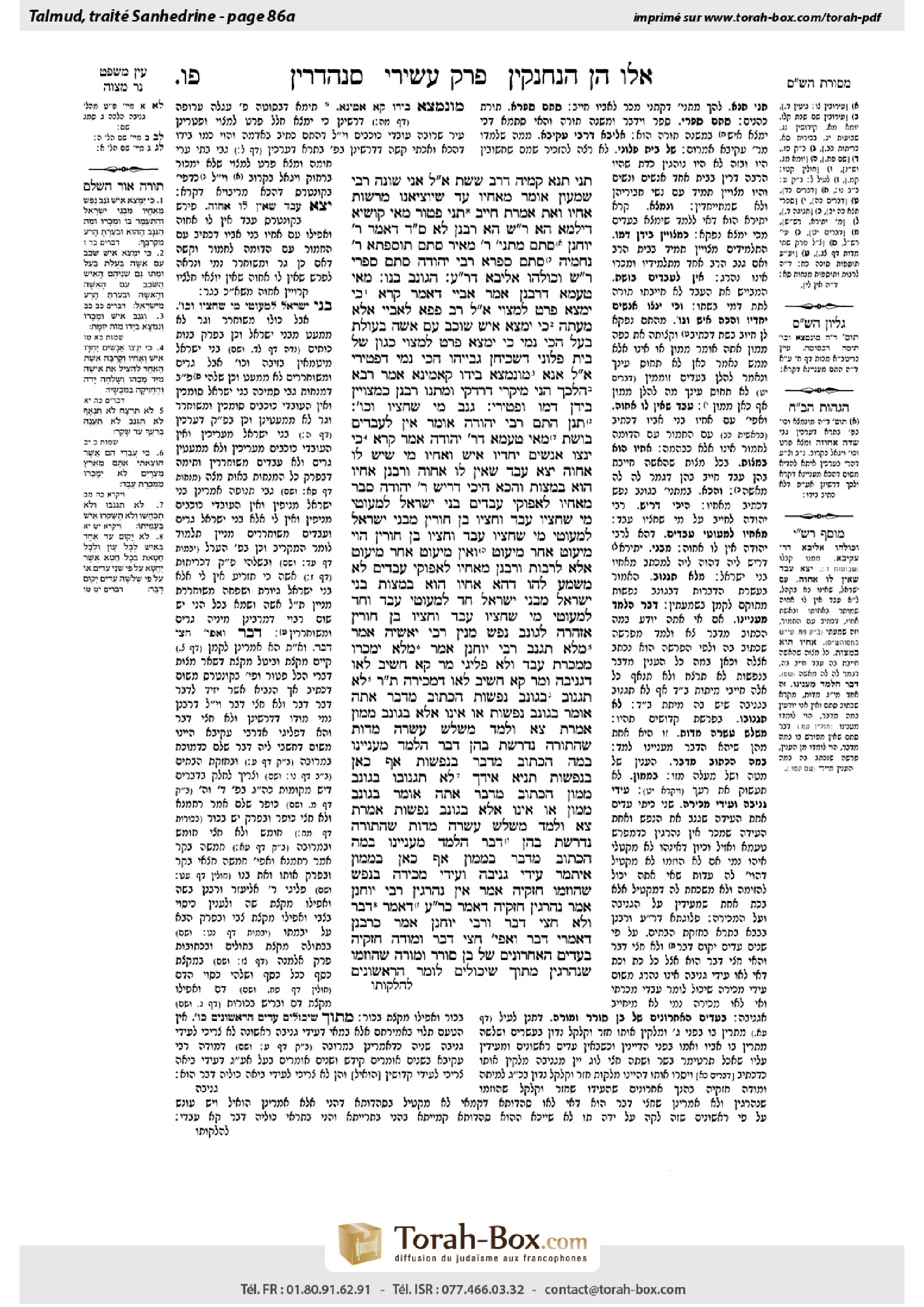
This page of Sanhedrin includes the Aramaic text, an English translation and an AI-generated French translation, alongside the scan above.
סנהדרין פ״ו א · Aramaic and Hebrew text
תָּנֵי תַּנָּא קַמֵּיהּ דְּרַב שֵׁשֶׁת. אֲמַר לֵיהּ: אֲנִי שׁוֹנֶה רַבִּי שִׁמְעוֹן אוֹמֵר ״מֵאֶחָיו״ – עַד שֶׁיּוֹצִיאֶנּוּ מֵרְשׁוּת אֶחָיו, וְאַתְּ אָמְרַתְּ חַיָּיב?! תְּנִי: פָּטוּר.
מַאי קוּשְׁיָא? דִּילְמָא הָא רַבִּי שִׁמְעוֹן, הָא רַבָּנַן.
לָא סָלְקָא דַּעְתָּךְ, דְּאָמַר רַבִּי יוֹחָנָן: סְתָם מַתְנִיתִין – רַבִּי מֵאִיר, סְתַם תּוֹסֶפְתָּא – רַבִּי נְחֶמְיָה, סְתַם סִפְרָא – רַבִּי יְהוּדָה, סְתַם סִפְרֵי – רַבִּי שִׁמְעוֹן, וְכוּלְּהוּ אַלִּיבָּא דְּרַבִּי עֲקִיבָא.
הַגּוֹנֵב בְּנוֹ – מַאי טַעְמָא דְּרַבָּנַן?
אָמַר אַבָּיֵי: דְּאָמַר קְרָא, ״כִּי יִמָּצֵא״ – פְּרָט לְמָצוּי.
אֲמַר לֵיהּ רַב פָּפָּא לְאַבָּיֵי: אֶלָּא מֵעַתָּה, ״כִּי יִמָּצֵא אִישׁ שֹׁכֵב עִם אִשָּׁה בְעֻלַת בַּעַל״, הָכִי נָמֵי ״כִּי יִמָּצֵא״ – פְּרָט לְמָצוּי? כְּגוֹן שֶׁל בֵּית פְּלוֹנִי דִּשְׁכִיחָן גַּבַּיְיהוּ, הָכִי נָמֵי דִּפְטִירִי?
אֲמַר לֵיהּ: ״אֲנָא מִ״וְנִמְצָא בְּיָדוֹ״ קָאָמֵינָא.
אָמַר רָבָא: הִלְכָּךְ, הָנֵי מַקְרֵי דַרְדְּקֵי וּמַתְנוּ רַבָּנַן כִּמְצוּיִין בְּיָדָן דָּמוּ, וּפְטִירִי.
גָּנַב מִי שֶׁחֶצְיוֹ וְכוּ׳. תְּנַן הָתָם, רַבִּי יְהוּדָה אוֹמֵר: אֵין לַעֲבָדִים בּוֹשֶׁת.
מַאי טַעְמָא דְּרַבִּי יְהוּדָה? אָמַר קְרָא: ״כִּי יִנָּצוּ אֲנָשִׁים יַחְדָּו אִישׁ וְאָחִיו״. מִי שֶׁיֵּשׁ לוֹ אַחְוָה – יָצָא עֶבֶד שֶׁאֵין לוֹ אַחְוָה.
וְרַבָּנַן, אָחִיו הוּא בְּמִצְוֹת.
וְהָכָא, הֵיכִי דָּרֵישׁ רַבִּי יְהוּדָה?
סָבַר: ״מֵאֶחָיו״ – לְאַפּוֹקֵי עֲבָדִים, ״בְּנֵי יִשְׂרָאֵל״ – לְמַעוֹטֵי מִי שֶׁחֶצְיוֹ עֶבֶד וְחֶצְיוֹ בֶּן חוֹרִין, ״מִבְּנֵי יִשְׂרָאֵל״ – לְמַעוֹטֵי מִי שֶׁחֶצְיוֹ עֶבֶד וְחֶצְיוֹ בֶּן חוֹרִין. הָוֵי מִיעוּט אַחַר מִיעוּט, וְאֵין מִיעוּט אַחַר מִיעוּט אֶלָּא לְרַבּוֹת.
וְרַבָּנַן, ״מֵאֶחָיו״ לְאַפּוֹקֵי עֲבָדִים לָא מַשְׁמַע לְהוּ, דְּהָא אָחִיו הוּא בְּמִצְוֹת. ״בְּנֵי יִשְׂרָאֵל״ ״מִבְּנֵי יִשְׂרָאֵל״ – חַד לְמַעוֹטֵי עֶבֶד, וְחַד לְמַעוֹטֵי מִי שֶׁחֶצְיוֹ עֶבֶד וְחֶצְיוֹ בֶּן חוֹרִין.
אַזְהָרָה לְגוֹנֵב נֶפֶשׁ מִנַּיִן? רַבִּי יֹאשִׁיָּה אָמַר: מִ״לֹּא תִגְנֹב״. רַבִּי יוֹחָנָן אָמַר: מִ״לֹּא יִמָּכְרוּ מִמְכֶּרֶת עֶבֶד״. וְלָא פְּלִיגִי, מָר קָא חָשֵׁיב לָאו דִּגְנֵיבָה, וּמָר קָא חָשֵׁיב לָאו דִּמְכִירָה.
תָּנוּ רַבָּנַן: ״לֹא תִגְנֹב״ – בְּגוֹנֵב נְפָשׁוֹת הַכָּתוּב מְדַבֵּר. אַתָּה אוֹמֵר בְּגוֹנֵב נְפָשׁוֹת, אוֹ אֵינוֹ אֶלָּא בְּגוֹנֵב מָמוֹן? אָמַרְתָּ: צֵא וּלְמַד מִשְּׁלֹשׁ עֶשְׂרֵה מִדּוֹת שֶׁהַתּוֹרָה נִדְרֶשֶׁת בָּהֶן, דָּבָר הַלָּמֵד מֵעִנְיָינוֹ. בְּמָה הַכָּתוּב מְדַבֵּר? בִּנְפָשׁוֹת. אַף כָּאן בִּנְפָשׁוֹת.
תַּנְיָא אִידַּךְ: ״לֹא תִגְנֹבוּ״ – בְּגוֹנֵב מָמוֹן הַכָּתוּב מְדַבֵּר. אַתָּה אוֹמֵר בְּגוֹנֵב מָמוֹן, אוֹ אֵינוֹ אֶלָּא בְּגוֹנֵב נְפָשׁוֹת? אָמַרְתָּ: צֵא וּלְמַד מִשְּׁלֹשׁ עֶשְׂרֵה מִדּוֹת שֶׁהַתּוֹרָה נִדְרֶשֶׁת בָּהֶן, דָּבָר הַלָּמֵד מֵעִנְיָנוֹ. בְּמָה הַכָּתוּב מְדַבֵּר? בְּמָמוֹן. אַף כָּאן בְּמָמוֹן.
אִיתְּמַר: עֵידֵי גְנֵיבָה וְעֵידֵי מְכִירָה בְּנֶפֶשׁ שֶׁהוּזַּמּוּ, חִזְקִיָּה אָמַר: אֵין נֶהֱרָגִין. רַבִּי יוֹחָנָן אָמַר: נֶהֱרָגִין.
חִזְקִיָּה, דְּאָמַר כְּרַבִּי עֲקִיבָא, דְּאָמַר: ״דָּבָר״ וְלֹא חֲצִי דָּבָר. וְרַבִּי יוֹחָנָן אָמַר: כְּרַבָּנַן, דְּאָמְרִי: ״דָּבָר״, וַאֲפִילּוּ חֲצִי דָּבָר.
וּמוֹדֶה חִזְקִיָּה בְּעֵדִים הָאַחֲרוֹנִים שֶׁל בֶּן סוֹרֵר וּמוֹרֶה שֶׁהוּזַּמּוּ, שֶׁנֶּהֱרָגִין, מִתּוֹךְ שֶׁיְּכוֹלִים לוֹמַר הָרִאשׁוֹנִים:
Sanhedrin 86a · English translation
A tanna who recited mishnayot and baraitot in the study hall recited that baraita, where the tanna holds that one is liable for abducting another and selling him to the abductee’s father, before Rav Sheshet. Rav Sheshet said to him: I teach that Rabbi Shimon says: From the term “of his brethren” it is derived that there is no liability unless he removes the abductee from the domain of his brethren, and you say that one who sells the abductee to his father is liable? Emend the baraita and teach instead: He is exempt.
The Gemara asks: What is the difficulty raised by Rav Sheshet? Perhaps that statement that he cited is the opinion of Rabbi Shimon, while this baraita is the opinion of the Rabbis, who disagree with him.
The Gemara responds: That should not enter your mind, as the unattributed baraita that was cited is a passage from the halakhic midrash on the books of Numbers and Deuteronomy entitled Sifrei, and Rabbi Yoḥanan says: An unattributed mishna is in accordance with the opinion of Rabbi Meir; an unattributed baraita in the Tosefta is in accordance with the opinion of Rabbi Neḥemya; an unattributed baraita in the Sifra, the halakhic midrash on the book of Leviticus, is in accordance with the opinion of Rabbi Yehuda; and an unattributed baraita in the Sifrei is in accordance with the opinion of Rabbi Shimon. And all of these are in accordance with the opinion of Rabbi Akiva, as all the Sages mentioned were his disciples. Therefore, it is unlikely that an unattributed baraita from the Sifrei would run counter to the opinion of Rabbi Shimon.
§ The mishna teaches that there is a dispute between Rabbi Yehuda and the Rabbis with regard to the liability of one who abducts his son. The Gemara asks: What is the reason for the opinion of the Rabbis, who deem him exempt?
Abaye said: It is derived from the verse that states: “If a man shall be found abducting a person of his brethren” (Deuteronomy 24:7), to exclude one who is already found in the custody of the abductor before the abduction. Since the son is already in the custody of his father, the father is not liable for abducting him.
Rav Pappa said to Abaye: If that is so, then the verse: “If a man shall be found lying with a woman married to a husband, then they shall both of them die” (Deuteronomy 22:22), may also be interpreted: “If a man shall be found,” to exclude one who was already found. So too, would one say that adulterers are exempt from liability if they commit adultery in, for example, the house of so-and-so, where married women are commonly found and they have a preexisting reputation for licentiousness?
Abaye said to Rav Pappa: The Rabbis’ opinion is derived from the phrase: “Or if he is found in his possession, he shall be put to death” (Exodus 21:16), from which I am saying my inference, that it is derived: If he is found, to the exclusion of one who was already found.
Rava said: Therefore, with regard to those teachers of children [dardekei] and those who recite mishnayot to Torah scholars, the status of their students is as though they are found in their possession, and the teachers are exempt from liability for abducting them.
§ The mishna teaches that there is a dispute between Rabbi Yehuda and the Rabbis with regard to liability if one abducted one who is half-slave half-freeman. We learned in a mishna there (Bava Kamma 87a) that Rabbi Yehuda says: There is no indemnity for the humiliation of a slave, since he is not a full-fledged Jew.
The Gemara asks: What is the reason for the opinion of Rabbi Yehuda? It is derived from the verse that states: “When men struggle together, a man and his brother, and the wife of the one drew near to deliver her husband from the hand of the one who smites him, and extended her hand, and grabbed his genitals” (Deuteronomy 25:11). This is the source for liability to pay restitution for humiliating another. From the term “his brother” it is derived that one who has brotherhood, i.e., who is halakhically related to his biological family, receives payment for humiliation. A slave is excluded, as he has no brotherhood, i.e., he is not halakhically related to his family.
And what is the reason for the opinion of the Rabbis? They hold that although the slave has no family ties, he is the brother of the assailant with regard to the fulfillment of mitzvot, as a Canaanite slave is obligated to fulfill the same mitzvot that a woman is obligated to fulfill.
The Gemara asks: And here, with regard to abduction, how does Rabbi Yehuda interpret the verses and arrive at the conclusion that one is liable for abducting one who is half-slave half-freeman? Shouldn’t the term “from his brethren” render exempt from liability one who abducts a slave?
The Gemara answers that Rabbi Yehuda holds that the term in the verse: “From his brethren” (Deuteronomy (24:7), serves to exclude from liability one who abducts slaves. Had the verse continued: The children of Israel, that phrase would have been interpreted to exclude from liability one who abducts one who is half-slave half-freeman. Since the verse states: “From the children of Israel,” the prefix letter mem, meaning from, indicates that there are some from the children of Israel for whose abduction one is liable and there are some for whose abduction one is exempt. That prefix also serves to exclude from liability one who abducts one who is half-slave half-freeman. Therefore, this is an example of a restriction following a restriction, and there is a hermeneutical principle that a restriction following a restriction serves only to amplify the halakha and to include in the category of those who are liable one who abducts one who is half-slave half-freeman.
And the Rabbis, who deem one who abducts one who is half-slave half-freeman exempt, how do they interpret the verse? They do not exclude slaves based on the term “from his brethren,” as the slave is the brother of the abductor with regard to the fulfillment of mitzvot. Concerning the expression “children of Israel” and the more expanded expression “from the children of Israel,” one serves to exclude from liability one who abducts slaves, as the slave is not a full-fledged Jew, and one serves to exclude from liability one who abducts one who is half-slave half-freeman.
§ The Gemara asks: From where is a prohibition against abducting a person derived? Rabbi Yoshiya says that it is derived from the verse: “You shall not steal” (Exodus 20:13). Rabbi Yoḥanan says that it is derived from the verse: “They shall not be sold as slaves” (Leviticus 25:42). The Gemara comments: And they do not disagree, as each requires both verses to derive the prohibition. One Sage, Rabbi Yoshiya, enumerates the prohibition against abduction, and one Sage, Rabbi Yoḥanan, enumerates the prohibition against selling the abductee into slavery.
The Sages taught in a baraita: “You shall not steal” (Exodus 20:13), and it is with regard to one who abducts people that the verse is speaking. Do you say that the verse is speaking with regard to one who abducts people, or perhaps the verse is speaking only with regard to one who steals property? You say: Go out and learn from one of the thirteen hermeneutical principles: A matter derived from its context. With regard to what context are the adjacent prohibitions “You shall not kill; you shall not commit adultery” in the verse speaking? They are speaking with regard to capital cases. So too here, the prohibition is speaking with regard to a capital case of abduction.
It is taught in another baraita: “You shall not steal” (Leviticus 19:11), and it is with regard to one who steals property that the verse is speaking. Do you say that the verse is speaking with regard to one who steals property, or perhaps the verse is speaking only with regard to one who abducts people? You say: Go out and learn from one of the thirteen hermeneutical principles: A matter derived from its context. With regard to what context is the subsequent verse: “You shall neither exploit your neighbor nor rob him” (Leviticus 19:13), speaking? It is speaking with regard to property. So too here, the verse is speaking with regard to property.
It was stated: If the witnesses to the abduction and the witnesses to the sale of a person were rendered conspiring witnesses, Ḥizkiyya says: The typical sentence of conspiring witnesses is not implemented and they are not executed. Rabbi Yoḥanan says: They are executed.
The Gemara elaborates: It is Ḥizkiyya who said his statement in accordance with the opinion of Rabbi Akiva, who said one derives from the verse: “On the basis of two witnesses…shall a matter be established” (Deuteronomy 19:15), that the testimony of witnesses is valid only when they attest to an entire matter, but not to half a matter. Since each pair of witnesses provides testimony concerning only half the transgression for which the perpetrator would be liable, i.e., they each testify to only the abduction or the sale, the testimony of each pair is not valid. Therefore, when they are deemed conspiring witnesses, they are not executed. And Rabbi Yoḥanan says his statement in accordance with the opinion of the Rabbis, who said that one derives from the verse that the testimony is valid when they testify with regard to an entire matter, and even when they testify with regard to half a matter. Since the testimony of the two pairs of witnesses together constitutes a complete testimony, if they are rendered conspiring witnesses, they are executed.
The Gemara notes: And Ḥizkiyya concedes with regard to the final witnesses of a stubborn and rebellious son who were rendered conspiring witnesses that they are executed. A stubborn and rebellious son is executed only if witnesses testified that he engaged in gluttonous and drunken conduct and he was flogged, and then a second pair of witnesses testifies that he again engaged in gluttonous and drunken conduct. His death sentence is based solely on the testimony of the second pair, as the first witnesses could say:
Sanhedrin 86a · Traduction française (IA)
Un tanna qui récitait des michnayot et des baraïtot dans la maison d’étude récita cette baraïta devant Rav Sheshet. Selon cette baraïta, on est passible d’une peine pour avoir enlevé une personne et l’avoir vendue au père de celle-ci. Rav Sheshet lui dit : « J’enseigne que Rabbi Shimon dit : Du terme “parmi ses frères”, on déduit qu’il n’est passible d’une peine que s’il fait sortir la personne enlevée du domaine de ses frères ; et toi, tu dis que celui qui vend la personne enlevée à son père est passible d’une peine ? Corrige la baraïta et enseigne plutôt : Il en est exempt. »
La Guemara demande : Quelle difficulté Rav Sheshet soulève-t-il ? Peut-être la déclaration qu’il a citée exprime-t-elle l’opinion de Rabbi Shimon, tandis que cette baraïta exprime celle des Rabbins, qui ne sont pas d’accord avec lui.
La Guemara répond : Il ne faut pas penser ainsi, car la baraïta anonyme qui a été citée est un passage du midrach halakhique sur les livres des Nombres et du Deutéronome, intitulé Sifrei. Or Rabbi Yoḥanan dit : Une Michna anonyme est conforme à l’opinion de Rabbi Meïr ; une baraïta anonyme dans la Tosefta est conforme à l’opinion de Rabbi Neḥemya ; une baraïta anonyme dans le Sifra, le midrach halakhique sur le livre du Lévitique, est conforme à l’opinion de Rabbi Yehuda ; et une baraïta anonyme dans le Sifrei est conforme à l’opinion de Rabbi Shimon. Tous ceux-ci sont conformes à l’opinion de Rabbi Akiva, car les Sages mentionnés étaient ses disciples. Il est donc peu probable qu’une baraïta anonyme du Sifrei aille à l’encontre de l’opinion de Rabbi Shimon.
§ La Michna enseigne qu’il y a une controverse entre Rabbi Yehuda et les Rabbins au sujet de la responsabilité de celui qui enlève son fils. La Guemara demande : Quelle est la raison de l’opinion des Rabbins, qui l’exemptent ?
Abaye dit : Cela se déduit du verset qui énonce : « Si l’on trouve un homme en train d’enlever une personne parmi ses frères » (Deutéronome 24, 7), qui exclut celui qui se trouve déjà sous la garde de l’auteur de l’enlèvement avant que celui-ci ne soit commis. Puisque le fils se trouve déjà sous la garde de son père, celui-ci n’est pas passible d’une peine pour l’avoir enlevé.
Rav Pappa dit à Abaye : S’il en est ainsi, le verset « Si l’on trouve un homme couché avec une femme mariée » (Deutéronome 22, 22) pourrait lui aussi être interprété ainsi : « Si l’on trouve un homme » exclut celui qui a déjà été trouvé. Dirait-on également que les adultères sont exempts de peine s’ils commettent l’adultère, par exemple, dans la maison d’Untel, où se trouvent couramment des femmes mariées et où elles ont déjà la réputation d’être licencieuses ?
Abaye dit à Rav Pappa : L’opinion des Rabbins se déduit de l’expression « ou s’il est trouvé en sa possession, il sera mis à mort » (Exode 21, 16), d’où je tire mon inférence : « s’il est trouvé » exclut celui qui était déjà trouvé.
Rava dit : Par conséquent, les élèves des enseignants d’enfants [dardekei] et de ceux qui récitent des michnayot aux érudits en Torah sont considérés comme étant en leur possession ; ces enseignants sont donc exempts de peine pour les avoir enlevés.
§ La Michna enseigne qu’il y a une controverse entre Rabbi Yehuda et les Rabbins au sujet de la responsabilité de celui qui enlève une personne à moitié esclave et à moitié libre. Nous avons appris dans une Michna, dans le traité Bava Kamma (87a), que Rabbi Yehuda dit : Il n’y a pas d’indemnité pour l’humiliation d’un esclave, puisqu’il n’est pas pleinement juif.
La Guemara demande : Quelle est la raison de l’opinion de Rabbi Yehuda ? Cela se déduit du verset qui énonce : « Lorsque des hommes se querellent, un homme et son frère, et que la femme de l’un s’approche pour délivrer son mari de la main de celui qui le frappe, qu’elle étend la main et saisit ses organes génitaux » (Deutéronome 25, 11). C’est la source de l’obligation de verser une indemnité pour avoir humilié autrui. Du terme « son frère », on déduit que celui qui a des liens de fraternité, c’est-à-dire qui est lié selon la halakha à sa famille biologique, reçoit une indemnité pour humiliation. L’esclave est exclu, car il n’a pas de liens de fraternité, c’est-à-dire qu’il n’est pas lié selon la halakha à sa famille.
Et quelle est la raison de l’opinion des Rabbins ? Ils considèrent que, même si l’esclave n’a pas de liens familiaux, il est le frère de l’agresseur en ce qui concerne l’accomplissement des mitsvot, car un esclave cananéen est tenu d’accomplir les mêmes mitsvot qu’une femme.
La Guemara demande : Et ici, à propos de l’enlèvement, comment Rabbi Yehuda interprète-t-il les versets pour parvenir à la conclusion que l’on est passible d’une peine pour avoir enlevé une personne à moitié esclave et à moitié libre ? Le terme « parmi ses frères » ne devrait-il pas exempter de peine celui qui enlève un esclave ?
La Guemara répond que Rabbi Yehuda considère que l’expression « parmi ses frères » (Deutéronome 24, 7) sert à exclure de la responsabilité celui qui enlève des esclaves. Si le verset avait poursuivi par les mots « les enfants d’Israël », cette expression aurait été interprétée comme excluant de la responsabilité celui qui enlève une personne à moitié esclave et à moitié libre. Mais puisque le verset dit « parmi les enfants d’Israël », la lettre préfixée mem, qui signifie « parmi », indique qu’il y a, parmi les enfants d’Israël, des personnes dont l’enlèvement engage la responsabilité et d’autres dont l’enlèvement ne l’engage pas. Ce préfixe sert également à exclure de la responsabilité celui qui enlève une personne à moitié esclave et à moitié libre. Il s’agit donc d’une restriction qui suit une restriction ; or, selon un principe herméneutique, une restriction qui suit une restriction ne sert qu’à élargir la halakha et à inclure dans la catégorie des personnes dont l’enlèvement engage la responsabilité celui qui enlève une personne à moitié esclave et à moitié libre.
Et les Rabbins, qui exemptent celui qui enlève une personne à moitié esclave et à moitié libre, comment interprètent-ils le verset ? Ils n’excluent pas les esclaves en se fondant sur le terme « parmi ses frères », car l’esclave est le frère de l’auteur de l’enlèvement en ce qui concerne l’accomplissement des mitsvot. Quant aux expressions « enfants d’Israël » et « parmi les enfants d’Israël », l’une sert à exclure de la responsabilité celui qui enlève des esclaves, car l’esclave n’est pas pleinement juif, et l’autre sert à exclure de la responsabilité celui qui enlève une personne à moitié esclave et à moitié libre.
§ La Guemara demande : D’où déduit-on l’interdiction d’enlever une personne ? Rabbi Yoshiya dit qu’elle se déduit du verset « Tu ne voleras pas » (Exode 20, 13). Rabbi Yoḥanan dit qu’elle se déduit du verset « Ils ne seront pas vendus comme esclaves » (Lévitique 25, 42). La Guemara précise : Ils ne sont pas en désaccord, car chacun a besoin des deux versets pour déduire l’interdiction. L’un des Sages, Rabbi Yoshiya, énonce l’interdiction d’enlever une personne, et l’autre, Rabbi Yoḥanan, énonce l’interdiction de vendre la personne enlevée comme esclave.
Les Sages ont enseigné dans une baraïta : « Tu ne voleras pas » (Exode 20, 13) ; le verset parle ici de celui qui enlève des personnes. Dis-tu que le verset parle de celui qui enlève des personnes, ou peut-être parle-t-il uniquement de celui qui vole des biens ? Tu peux le déduire en recourant à l’un des treize principes herméneutiques : une chose s’interprète à partir de son contexte. Dans quel contexte les interdictions voisines « Tu ne tueras pas ; tu ne commettras pas d’adultère » sont-elles énoncées ? Elles portent sur des crimes passibles de la peine capitale. De même ici, l’interdiction porte sur l’enlèvement passible de la peine capitale.
Il est enseigné dans une autre baraïta : « Tu ne voleras pas » (Lévitique 19, 11) ; le verset parle ici de celui qui vole des biens. Dis-tu que le verset parle de celui qui vole des biens, ou peut-être parle-t-il uniquement de celui qui enlève des personnes ? Tu peux le déduire en recourant à l’un des treize principes herméneutiques : une chose s’interprète à partir de son contexte. Dans quel contexte le verset suivant est-il énoncé : « Tu n’exploiteras pas ton prochain et tu ne le dépouilleras pas » (Lévitique 19, 13) ? Il porte sur les biens. De même ici, le verset porte sur les biens.
Il a été dit : Si les témoins de l’enlèvement d’une personne et les témoins de sa vente sont déclarés témoins comploteurs, Ḥizkiya dit que la sanction habituelle des témoins comploteurs ne leur est pas appliquée et qu’ils ne sont pas exécutés. Rabbi Yoḥanan dit qu’ils sont exécutés.
La Guemara développe : Ḥizkiya a énoncé son propos conformément à l’opinion de Rabbi Akiva, qui déduit du verset « sur la déposition de deux témoins… une affaire sera établie » (Deutéronome 19, 15) que le témoignage n’est valable que lorsque les témoins attestent de toute une affaire, et non d’une partie seulement. Puisque chaque paire de témoins ne témoigne que d’une partie de la transgression pour laquelle son auteur serait passible d’une peine — l’une des paires témoigne de l’enlèvement, et l’autre de la vente —, le témoignage de chacune des paires n’est pas valable. Par conséquent, lorsqu’ils sont déclarés témoins comploteurs, ils ne sont pas exécutés. Rabbi Yoḥanan énonce son propos conformément à l’opinion des Rabbins, qui déduisent du verset que le témoignage est valable lorsqu’il porte sur une affaire entière, mais aussi lorsqu’il ne porte que sur une partie de celle-ci. Puisque les témoignages des deux paires constituent ensemble un témoignage complet, si les témoins sont déclarés comploteurs, ils sont exécutés.
La Guemara note que Ḥizkiya reconnaît que les derniers témoins dans le cas d’un fils rebelle, s’ils sont déclarés témoins comploteurs, sont exécutés. Un fils rebelle n’est exécuté que si des témoins attestent qu’il s’est livré à des actes de gloutonnerie et d’ivrognerie et qu’il a été flagellé, puis qu’une seconde paire de témoins atteste qu’il s’est de nouveau livré à des actes de gloutonnerie et d’ivrognerie. Sa condamnation à mort repose uniquement sur le témoignage de la seconde paire, car les premiers témoins pourraient dire :
Traduction française générée par IA à partir de l’édition anglaise de Sefaria. Vérifie toujours un passage avec le texte source.
Text from Sefaria: William Davidson Edition - Vocalized Aramaic (CC BY NC); William Davidson Edition - English (CC BY NC).