Sanhedrin 86b: Talmud study for Daf Yomi
Daf Yomi is the daily study of one Talmud folio. Explore 37 tractates with scans, Hebrew text, Sefaria English and AI-generated French translations where annotated.
Passage selection and English or AI-generated French translation are available where the scan has annotations. Daf Study is independent of Torah-Box and Sefaria.
Browse Sanhedrin · סנהדרין · All tractatesSanhedrin 86b text and translations
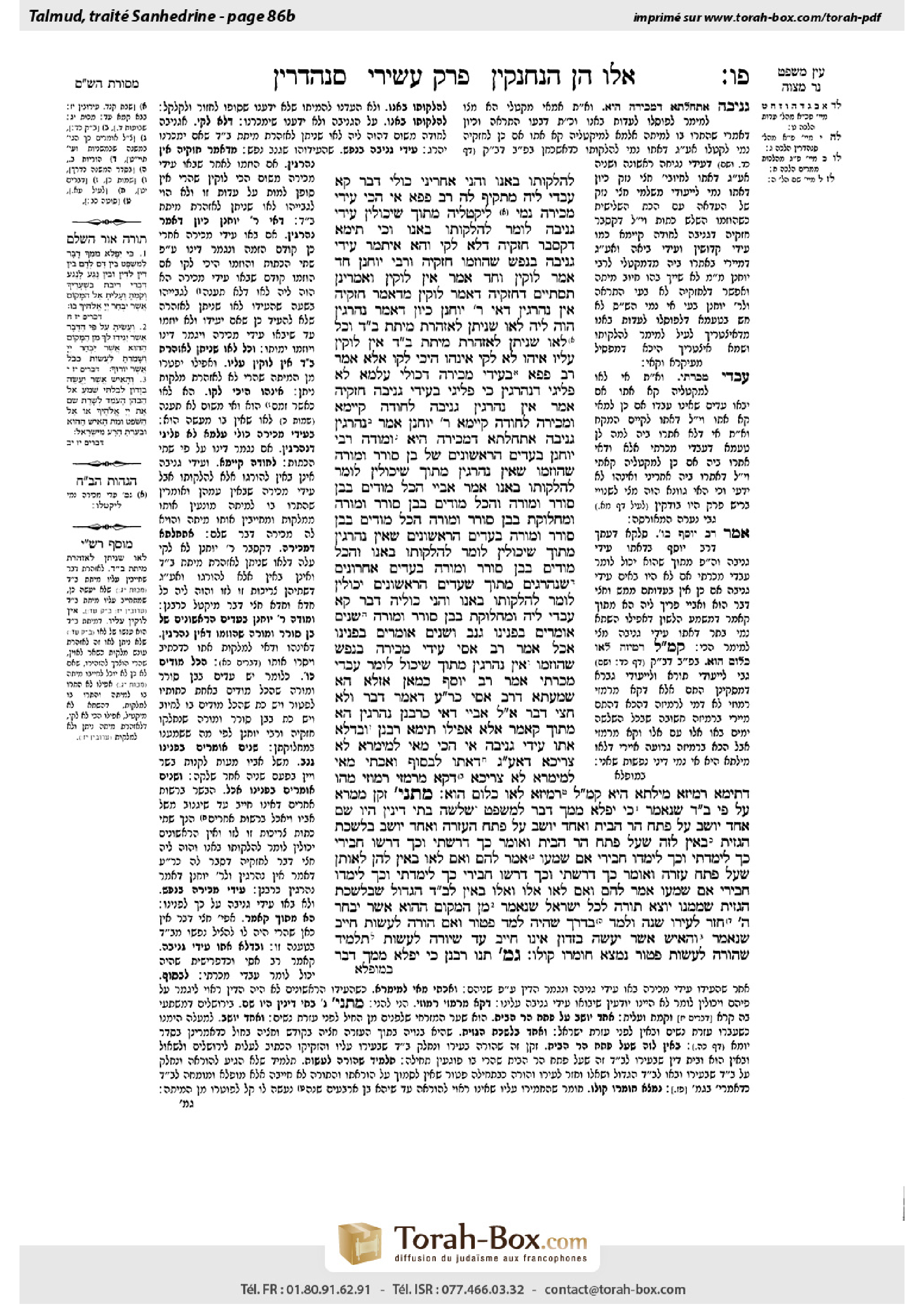
This page of Sanhedrin includes the Aramaic text, an English translation and an AI-generated French translation, alongside the scan above.
סנהדרין פ״ו ב · Aramaic and Hebrew text
לְהַלְקוֹתוֹ בָּאנוּ, וְהָנֵי אַחֲרִינֵי כּוּלֵּיהּ דָּבָר קָא עָבְדִי לֵיהּ.
מַתְקֵיף לַהּ רַב פָּפָּא: אִי הָכִי, עֵידֵי מְכִירָה נָמֵי לִיקְטְלֵיהּ, מִתּוֹךְ שֶׁיְּכוֹלִין עֵידֵי גְנֵיבָה לוֹמַר ״לְהַלְקוֹתוֹ בָּאנוּ״! וְכִי תֵּימָא דְּקָסָבַר חִזְקִיָּה דְּלָא לָקֵי,
וְהָא אִיתְּמַר: עֵידֵי גְּנֵיבָה בְּנֶפֶשׁ שֶׁהוּזַּמּוּ, חִזְקִיָּה וְרַבִּי יוֹחָנָן – חַד אָמַר: לוֹקִין, וְחַד אָמַר: אֵין לוֹקִין. וְאָמְרִינַן: תִּסְתַּיֵּים דְּחִזְקִיָּה דְּאָמַר לוֹקִין, מִדְּאָמַר חִזְקִיָּה: אֵין נֶהֱרָגִין.
דְּאִי רַבִּי יוֹחָנָן, כֵּיוָן דְּאָמַר נֶהֱרָגִין, הָוֵה לֵיהּ לָאו שֶׁנִּיתַּן לְאַזְהָרַת מִיתַת בֵּית דִּין, וְכׇל לָאו שֶׁנִּיתַּן לְאַזְהָרַת מִיתַת בֵּית דִּין אֵין לוֹקִין עָלָיו. אִיהוּ לָא לָקֵי, אִינְהוּ הֵיכִי לָקוּ?
אֶלָּא אָמַר רַב פָּפָּא: בְּעֵידֵי מְכִירָה דְּכוּלֵּי עָלְמָא לָא פְּלִיגִי דְּנֶהֱרָגִין, כִּי פְּלִיגִי בְּעֵידֵי גְנֵיבָה. חִזְקִיָּה אָמַר: אֵין נֶהֱרָגִין, גְּנֵיבָה לְחוֹדַהּ קָיְימָא וּמְכִירָה לְחוּדַהּ קָיְימָא. רַבִּי יוֹחָנָן אָמַר: נֶהֱרָגִין, גְּנֵיבָה אַתְחַלְתָּא דִמְכִירָה הִיא.
וּמוֹדֶה רַבִּי יוֹחָנָן בְּעֵדִים הָרִאשׁוֹנִים שֶׁל בֵּן סוֹרֵר וּמוֹרֶה שֶׁהוּזַּמּוּ, שֶׁאֵין נֶהֱרָגִין, מִתּוֹךְ שֶׁיְּכוֹלִין לוֹמַר: ״לְהַלְקוֹתוֹ בָּאנוּ״.
אָמַר אַבָּיֵי: הַכֹּל מוֹדִים בְּבֵן סוֹרֵר וּמוֹרֶה, וְהַכֹּל מוֹדִים בְּבֵן סוֹרֵר וּמוֹרֶה, וּמַחְלוֹקֶת בְּבֵן סוֹרֵר וּמוֹרֶה.
הַכֹּל מוֹדִים בְּבֵן סוֹרֵר וּמוֹרֶה: בְּעֵדִים הָרִאשׁוֹנִים, שֶׁאֵין נֶהֱרָגִין, מִתּוֹךְ שֶׁיְּכוֹלִין לוֹמַר: ״לְהַלְקוֹתוֹ בָּאנוּ״.
וְהַכֹּל מוֹדִים בְּבֵן סוֹרֵר וּמוֹרֶה: בְּעֵדִים אַחֲרוֹנִים שֶׁנֶּהֱרָגִים, מִתּוֹךְ שֶׁעֵדִים הָרִאשׁוֹנִים יְכוֹלִין לוֹמַר: ״לְהַלְקוֹתוֹ בָּאנוּ״, וְהָנֵי כּוּלֵּיהּ דָּבָר קָא עָבְדִי לֵיהּ.
וּמַחְלוֹקֶת בְּבֵן סוֹרֵר וּמוֹרֶה: שְׁנַיִם אוֹמְרִים ״בְּפָנֵינוּ גָּנַב״, וּשְׁנַיִם אוֹמְרִים: ״בְּפָנֵינוּ אָכַל״.
אָמַר רַב אַסִּי: עֵדֵי מְכִירָה בְּנֶפֶשׁ שֶׁהוּזַּמּוּ אֵין נֶהֱרָגִין, מִתּוֹךְ שֶׁיָּכוֹל לוֹמַר ״עַבְדִּי מָכַרְתִּי״.
אָמַר רַב יוֹסֵף: כְּמַאן אָזְלָא הָא שְׁמַעְתָּא דְּרַב אַסִּי? כְּרַבִּי עֲקִיבָא, דְּאָמַר: ״דָּבָר״, וְלֹא חֲצִי דָבָר. אֲמַר לֵיהּ אַבָּיֵי: דְּאִי כְּרַבָּנַן, נֶהֱרָגִין? הָא ״מִתּוֹךְ״ קָאָמַר!
אֶלָּא, אֲפִילּוּ תֵּימָא רַבָּנַן, וּבִדְלָא אֲתוֹ עֵידֵי גְּנֵיבָה. אִי הָכִי, מַאי לְמֵימְרָא? לָא צְרִיכָא, דְּאַף עַל גַּב דַּאֲתוֹ לְבַסּוֹף.
וְאַכַּתִּי מַאי לְמֵימְרָא? לָא צְרִיכָא, דְּקָא מְרַמְּזִי רַמּוֹזֵי. מַהוּ דְּתֵימָא: רְמִיזָא מִילְּתָא הִיא? קָא מַשְׁמַע לַן: רְמִיזָא לָאו כְּלוּם הוּא.
מַתְנִי׳ זָקֵן מַמְרֵא עַל פִּי בֵּית דִּין, שֶׁנֶּאֱמַר: ״כִּי יִפָּלֵא מִמְּךָ דָבָר לַמִּשְׁפָּט״. שְׁלֹשָׁה בָּתֵּי דִינִין הָיוּ שָׁם: אֶחָד יוֹשֵׁב עַל פֶּתַח הַר הַבַּיִת, וְאֶחָד יוֹשֵׁב עַל פֶּתַח הָעֲזָרָה, וְאֶחָד יוֹשֵׁב בְּלִשְׁכַּת הַגָּזִית.
בָּאִין לָזֶה שֶׁעַל פֶּתַח הַר הַבַּיִת, וְאוֹמֵר: כָּךְ דָּרַשְׁתִּי, וְכָךְ דָּרְשׁוּ חֲבֵירַי. כָּךְ לִימַּדְתִּי, וְכָךְ לִימְּדוּ חֲבֵירַי. אִם שָׁמְעוּ, אָמְרוּ לָהֶם.
וְאִם לָאו, בָּאִין לָהֶן לְאוֹתָן שֶׁעַל פֶּתַח עֲזָרָה, וְאוֹמֵר: כָּךְ דָּרַשְׁתִּי וְכָךְ דָּרְשׁוּ חֲבֵירַי, כָּךְ לִימַּדְתִּי וְכָךְ לִימְּדוּ חֲבֵירַי. אִם שׇׁמְעוּ, אָמְרוּ לָהֶם.
וְאִם לָאו, אֵלּוּ וָאֵלּוּ בָּאִין לְבֵית דִּין הַגָּדוֹל שֶׁבְּלִשְׁכַּת הַגָּזִית, שֶׁמִּמֶּנּוּ יוֹצְאָה תּוֹרָה לְכׇל יִשְׂרָאֵל, שֶׁנֶּאֱמַר: ״מִן הַמָּקוֹם הַהוּא אֲשֶׁר יִבְחַר ה׳״. חָזַר לְעִירוֹ, שָׁנָה וְלִמֵּד בַּדֶּרֶךְ שֶׁהָיָה לָמֵד – פָּטוּר, וְאִם הוֹרָה לַעֲשׂוֹת – חַיָּיב, שֶׁנֶּאֱמַר: ״וְהָאִישׁ אֲשֶׁר יַעֲשֶׂה בְזָדוֹן״. אֵינוֹ חַיָּיב עַד שֶׁיּוֹרֶה לַעֲשׂוֹת.
תַּלְמִיד שֶׁהוֹרָה לַעֲשׂוֹת – פָּטוּר. נִמְצָא חוּמְרוֹ קוּלּוֹ.
גְּמָ׳ תָּנוּ רַבָּנַן: ״כִּי יִפָּלֵא מִמְּךָ דָבָר״ –
Sanhedrin 86b · English translation
It is in order to flog him, not to execute him, that we came to court. And these other witnesses, through their testimony, are the ones who did this to him, i.e., they are responsible for the entire matter of his execution, and are therefore liable to be executed for giving conspiring testimony.
Rav Pappa objects to this: If so, and Ḥizkiyya concedes to Rabbi Yoḥanan in the case of the final testimony of the stubborn and rebellious son, let them also execute the witnesses to the sale of one who was abducted, as the witnesses to the abduction could say: It is in order to flog the abductor, not to execute him, that we came to court. And if you would say that Ḥizkiyya holds that one who abducts another and does not sell him is not flogged, that is difficult.
But wasn’t it stated: With regard to witnesses to the abduction who were rendered conspiring witnesses prior to the testimony of the witnesses to the sale, Ḥizkiyya and Rabbi Yoḥanan disagree. One says: They are flogged, and one says: They are not flogged. And we say: It may be concluded that it is Ḥizkiyya who said that they are flogged, from the fact that Ḥizkiyya said: They are not executed.
Since if one were to suggest that it is Rabbi Yoḥanan who said that they are flogged, that cannot be. Since he says that conspiring witnesses are executed in this case, it is a prohibition that is given as a warning of liability for a court-imposed death penalty, and the principle is: With regard to any prohibition that is given as a warning of liability for a court-imposed death penalty, one is not flogged for its violation, even in a case where the transgressor is not executed. The abductor is not flogged. How then could the conspiring witnesses be flogged for testifying against them, as the punishment for conspiring witnesses is identical to the punishment of the one against whom they testified? Rather, it is certain that Ḥizkiyya holds that the conspiring witnesses to the abduction are flogged, and therefore everyone agrees that the conspiring witnesses to the sale are executed.
Rather, Rav Pappa says: The previous explanation is rejected, and instead the dispute must be explained as follows: With regard to the witnesses to the sale of the abductee, it is clear that everyone agrees that they are executed, as theirs is testimony concerning an entire matter and would have led to his execution. When they disagree, it is with regard to the witnesses to the abduction. Ḥizkiyya says: They are not executed, as he holds that abduction stands discrete as an independent prohibition punishable by lashes, and the sale stands discrete as an independent prohibition punishable by strangulation. Rabbi Yoḥanan says: They are executed, as the abduction is the beginning of the process that culminates with the sale. The witnesses testifying to the abduction are testifying to a transgression that will culminate with the sale of the abductee.
The Gemara notes: And Rabbi Yoḥanan concedes with regard to the initial witnesses concerning a stubborn and rebellious son who testified that he engaged in gluttonous and drunken conduct and who were rendered conspiring witnesses that they are not executed, as they could say: It is in order to flog him for past conduct, not to execute him for actions that he might perform in the future, that we came to court. Therefore, there is no connection between their testimony and punishment for future actions.
Abaye said in summary: All concede in the case of a stubborn and rebellious son, and all concede in the case of a stubborn and rebellious son, and there is a dispute with regard to a stubborn and rebellious son.
The Gemara elaborates: With regard to the initial witnesses, all, even Rabbi Yoḥanan, concede in the case of a stubborn and rebellious son that they are not executed if they are rendered conspiring witnesses, as they could say: It is in order to flog him for past conduct, not to execute him, that we came to court.
And with regard to the final witnesses, all, even Ḥizkiyya, concede in the case of a stubborn and rebellious son that they are executed if they are rendered conspiring witnesses, due to the fact that the initial witnesses could say: It is in order to flog him for past conduct that we came to court, and these final witnesses are the ones who did this to him, i.e., they are responsible for the entire matter of his execution and are therefore liable to be executed.
And there is a dispute with regard to a stubborn and rebellious son in a case where two of the final witnesses, who testify after the son was already flogged for engaging in gluttonous and drunken conduct, say: He stole in our presence, and two other witnesses say: He ate in our presence. The dispute is whether the testimony of these two pairs of witnesses is testimony concerning an entire matter or testimony concerning half a matter.
Rav Asi says: The witnesses to the sale of a person who were rendered conspiring witnesses are not executed, due to the fact that the one against whom they testified could say: Although they testified that I sold an individual, it was my slave that I sold. In that case, the witnesses are not testifying that he violated a capital transgression, as they cannot attest to the fact that the individual he sold was first abducted.
Rav Yosef says: In accordance with whose opinion is that halakha of Rav Asi? It is in accordance with the opinion of Rabbi Akiva, who says: The testimony of witnesses is valid only when they attest to an entire matter and not to half a matter. Abaye said to Rav Yosef: According to your explanation, it is in accordance with the opinion of Rabbi Akiva, as, if it were in accordance with the opinion of the Rabbis, who hold: The testimony is valid when they testify to an entire matter and even when they testify to half a matter, are the conspiring witnesses executed? Doesn’t Rav Asi say that they are not executed due to the fact that the one against whom they testified could say: Although they testified that I sold an individual, it was my slave that I sold? According to that reasoning, even the Rabbis would concede that they are not executed.
Rather, you may even say that Rav Asi’s statement is in accordance with the opinion of the Rabbis, and it is concerning a case where only witnesses to the sale came to testify and witnesses to the abduction did not come to testify. In that case the accused can avoid punishment; therefore, the conspiring witnesses are not executed. The Gemara asks: If so, what is the purpose of stating that halakha? Obviously, in that case they are not executed, as there is no way to determine that the one he sold is not a slave. The Gemara answers: No, it is necessary to teach that they are not executed even if witnesses to the abduction ultimately came after the witnesses to the sale had testified and testified that he sold a freeman, not his slave.
The Gemara asks: But still, what is the purpose of stating that halakha? When the witnesses to the sale testified, their testimony was not sufficient to execute the accused. The Gemara answers: No, it is necessary to teach the halakha in a case where they are not executed even where the first and second pairs of witnesses gesture to one another, ostensibly indicating that the conspiring witnesses to the sale were aware that the witnesses to the abduction would follow and that therefore the initial witnesses are part of the conspiracy to testify and execute the accused. And consequently, it is necessary to teach this halakha lest you say: Gesturing is a significant matter, and the legal status of the two testimonies is that of a single testimony. Therefore, Rav Asi teaches us that gesturing is nothing of significance.
MISHNA: A rebellious elder according to the court, who does not observe the ruling of the court, is executed by strangulation, as it is stated: “If there shall be a matter too hard for you in judgment…and you shall arise and ascend unto the place that the Lord your God shall choose…and you shall do according to the matter that they shall declare unto you…and the man that shall do so intentionally, not to listen…and that man shall die” (Deuteronomy 17:8–12). There were three courts there in Jerusalem. One convenes at the entrance to the Temple Mount, and one convenes at the entrance to the Temple courtyard, and one convenes in the Chamber of Hewn Stone.
An elder who issues a ruling contrary to the ruling of his colleagues, and his colleagues come to that court that is at the entrance to the Temple Mount, and the elder says: This is what I interpreted and that is what my colleagues interpreted; this is what I taught and that is what my colleagues taught. If the members of the court heard a clear halakhic ruling in that case, the court says it to them.
And if not, they come to those judges who are convened at the entrance to the Temple courtyard, which is a more significant tribunal. And the elder says: This is what I interpreted and that is what my colleagues interpreted; this is what I taught and that is what my colleagues taught. If the members of the court heard a clear halakhic ruling in that case, the court says it to them.
And if not, these judges and those judges come to the High Court, the Sanhedrin of seventy-one judges that is in the Chamber of Hewn Stone, from which Torah emerges to the entire Jewish people, as it is stated: “And you shall do according to the matter that they shall declare unto you from that place that the Lord shall choose and you shall observe to perform according to all that they shall teach you” (Deuteronomy 17:10). They are the ultimate arbiters who establish the halakha that is binding. If they ruled contrary to the ruling of the elder and the elder then returned to his city, and nevertheless, he taught in the manner that he was teaching previously, he is exempt from punishment. But if he instructed others to act on the basis of his ruling that stands contrary to the ruling of the Sanhedrin, he is liable to be executed, as it is stated: “And the man that shall do so intentionally not to listen” (Deuteronomy 17:12), meaning that one is not liable unless he instructs others to act.
A student who is not yet an elder, i.e., he has not been ordained, who instructs others to act contrary to the ruling of the Sanhedrin, is exempt, as a ruling given prior to ordination is not a valid ruling. It follows that his stringency is his leniency. The stringency imposed upon the student that he is not sanctioned to issue rulings results in the leniency that if he instructs others to act on the basis of his ruling that is contrary to the ruling of the Sanhedrin, he is exempt.
GEMARA: The Sages taught with regard to that which is stated: “If there shall be a matter too hard for you in judgment, between blood and blood, between plea and plea, and between mark and mark, even matters of controversy within your gates, then you shall arise, and ascend to the place that the Lord your God shall choose” (Deuteronomy 17:8). “If there shall be a matter too hard [yippaleh] for you”;
Sanhedrin 86b · Traduction française (IA)
Nous sommes venus au tribunal pour le faire fouetter, et non pour le faire exécuter. Ce sont ces autres témoins qui, par leur témoignage, lui ont fait cela, c’est-à-dire qu’ils sont responsables de toute son exécution et sont donc passibles d’être exécutés pour avoir témoigné de manière concertée.
Rav Pappa objecte : Si tel est le cas, et si Ḥizkiyya concède à Rabbi Yoḥanan dans le cas du témoignage final concernant le fils rebelle et réfractaire, qu’ils exécutent également les témoins de la vente de la personne enlevée. En effet, les témoins de l’enlèvement pourraient dire : « Nous sommes venus au tribunal pour faire fouetter l’auteur de l’enlèvement, et non pour le faire exécuter. » Et si tu dis que Ḥizkiyya considère que celui qui enlève quelqu’un sans le vendre n’est pas fouetté, cela pose difficulté.
Mais n’a-t-il pas été enseigné que, concernant les témoins de l’enlèvement qui ont été reconnus comme témoins comploteurs avant le témoignage des témoins de la vente, Ḥizkiyya et Rabbi Yoḥanan sont en désaccord ? L’un dit qu’ils sont fouettés, et l’autre qu’ils ne le sont pas. Et nous concluons que c’est Ḥizkiyya qui dit qu’ils sont fouettés, puisque Ḥizkiyya dit qu’ils ne sont pas exécutés.
Car si l’on avançait que c’est Rabbi Yoḥanan qui dit qu’ils sont fouettés, cela ne tiendrait pas. Puisqu’il dit que les témoins comploteurs sont exécutés dans ce cas, l’interdit constitue un avertissement annonçant une peine capitale prononcée par un tribunal. Or, le principe est le suivant : pour toute interdiction constituant un avertissement annonçant une peine capitale prononcée par un tribunal, on ne reçoit pas de coups pour sa transgression, même lorsque le transgresseur n’est pas exécuté. L’auteur de l’enlèvement n’est pas fouetté. Comment les témoins comploteurs pourraient-ils alors être fouettés pour avoir témoigné contre lui, puisque leur peine est identique à celle de la personne contre laquelle ils ont témoigné ? Il est donc certain que Ḥizkiyya considère que les témoins comploteurs de l’enlèvement sont fouettés ; par conséquent, tous conviennent que les témoins comploteurs de la vente sont exécutés.
Rav Pappa dit plutôt : L’explication précédente est rejetée ; le désaccord doit s’expliquer autrement. Concernant les témoins de la vente de la personne enlevée, il est clair que tous conviennent qu’ils sont exécutés, car leur témoignage porte sur une affaire entière et aurait entraîné son exécution. Le désaccord porte sur les témoins de l’enlèvement. Ḥizkiyya dit qu’ils ne sont pas exécutés, car il considère que l’enlèvement constitue un interdit distinct et autonome, passible de coups, tandis que la vente constitue un interdit distinct et autonome, passible de la strangulation. Rabbi Yoḥanan dit qu’ils sont exécutés, car l’enlèvement est le début du processus qui aboutit à la vente. Les témoins de l’enlèvement témoignent d’une transgression qui aboutira à la vente de la personne enlevée.
La Guemara remarque que Rabbi Yoḥanan concède, au sujet des témoins initiaux qui ont témoigné qu’un fils rebelle et réfractaire s’était livré à la gloutonnerie et à l’ivrognerie et qui ont été reconnus comme témoins comploteurs, qu’ils ne sont pas exécutés. En effet, ils pourraient dire : « Nous sommes venus au tribunal pour le faire fouetter pour sa conduite passée, et non pour le faire exécuter en raison d’actes qu’il pourrait commettre à l’avenir. » Leur témoignage n’a donc aucun lien avec la punition d’actes futurs.
Abayé résume : Tous conviennent dans le cas du fils rebelle et réfractaire, tous conviennent dans le cas du fils rebelle et réfractaire, et il existe un désaccord au sujet du fils rebelle et réfractaire.
La Guemara précise : Concernant les témoins initiaux, tous, même Rabbi Yoḥanan, concèdent que, dans le cas d’un fils rebelle et réfractaire, ils ne sont pas exécutés s’ils sont reconnus comme témoins comploteurs, car ils pourraient dire : « Nous sommes venus au tribunal pour le faire fouetter pour sa conduite passée, et non pour le faire exécuter. »
Concernant les témoins finaux, tous, même Ḥizkiyya, concèdent que, dans le cas d’un fils rebelle et réfractaire, ils sont exécutés s’ils sont reconnus comme témoins comploteurs, car les témoins initiaux pourraient dire : « Nous sommes venus au tribunal pour le faire fouetter pour sa conduite passée » ; et ce sont ces témoins finaux qui lui ont fait cela, c’est-à-dire qu’ils sont responsables de toute son exécution et sont donc passibles d’être exécutés.
Il existe un désaccord au sujet d’un fils rebelle et réfractaire dans le cas où deux des témoins finaux, qui témoignent après que le fils a déjà été fouetté pour s’être livré à la gloutonnerie et à l’ivrognerie, disent : « Il a volé sous nos yeux », tandis que deux autres témoins disent : « Il a mangé sous nos yeux. » Le désaccord porte sur la question de savoir si les témoignages de ces deux paires de témoins portent sur une affaire entière ou sur une demi-affaire.
Rav Asi dit : Les témoins de la vente d’une personne qui ont été reconnus comme témoins comploteurs ne sont pas exécutés, car la personne contre laquelle ils ont témoigné pourrait dire : « Bien qu’ils aient témoigné que j’ai vendu un individu, c’est mon esclave que j’ai vendu. » Dans ce cas, les témoins n’attestent pas qu’il a commis une transgression passible de la peine capitale, puisqu’ils ne peuvent attester que la personne qu’il a vendue avait d’abord été enlevée.
Rav Yossef dit : De qui cette halakha de Rav Asi reflète-t-elle l’opinion ? De celle de Rabbi Akiva, qui dit que le témoignage des témoins n’est valable que lorsqu’ils attestent d’une affaire entière, et non d’une demi-affaire. Abayé dit à Rav Yossef : Selon ton explication, cela correspond à l’opinion de Rabbi Akiva. En effet, si cela correspondait à l’opinion des Rabbins, qui considèrent que le témoignage est valable lorsqu’ils attestent d’une affaire entière, mais aussi lorsqu’ils attestent d’une demi-affaire, les témoins comploteurs seraient-ils exécutés ? Rav Asi ne dit-il pas qu’ils ne sont pas exécutés, car la personne contre laquelle ils ont témoigné pourrait dire : « Bien qu’ils aient témoigné que j’ai vendu un individu, c’est mon esclave que j’ai vendu » ? Selon ce raisonnement, même les Rabbins concéderaient qu’ils ne sont pas exécutés.
Tu peux plutôt dire que la déclaration de Rav Asi correspond même à l’opinion des Rabbins et concerne un cas où seuls les témoins de la vente sont venus témoigner, tandis que les témoins de l’enlèvement ne sont pas venus témoigner. Dans ce cas, l’accusé peut échapper à la peine ; les témoins comploteurs ne sont donc pas exécutés. La Guemara demande : Si tel est le cas, pourquoi énoncer cette halakha ? De toute évidence, ils ne sont pas exécutés dans ce cas, puisqu’il est impossible de déterminer que la personne qu’il a vendue n’est pas un esclave. La Guemara répond : Non, il est nécessaire d’enseigner qu’ils ne sont pas exécutés même si les témoins de l’enlèvement sont finalement venus après le témoignage des témoins de la vente et ont attesté qu’il avait vendu un homme libre, et non son esclave.
La Guemara demande : Mais alors, pourquoi énoncer cette halakha ? Lorsque les témoins de la vente ont témoigné, leur témoignage ne suffisait pas à faire exécuter l’accusé. La Guemara répond : Non, il est nécessaire d’enseigner cette halakha dans un cas où ils ne sont pas exécutés même si les deux paires de témoins se font des signes, apparemment pour indiquer que les témoins comploteurs de la vente savaient que les témoins de l’enlèvement viendraient ensuite, et que les premiers témoins font donc partie du complot visant à témoigner et à faire exécuter l’accusé. Il est donc nécessaire d’enseigner cette halakha, de peur que tu ne dises que ces signes sont significatifs et que les deux témoignages ont le statut d’un témoignage unique. Rav Asi nous enseigne donc que ces signes n’ont aucune importance.
MICHNA : Un ancien rebelle à l’égard du tribunal, qui ne se conforme pas à la décision du tribunal, est exécuté par strangulation, comme il est dit : « Si une affaire est trop difficile pour toi en matière de jugement… tu te lèveras et tu monteras au lieu que l’Éternel, ton Dieu, choisira… et tu agiras selon la décision qu’ils t’auront déclarée… et l’homme qui agira intentionnellement, sans écouter… cet homme mourra » (Deutéronome 17, 8–12). Il y avait là, à Jérusalem, trois tribunaux. L’un siégeait à l’entrée du mont du Temple, un autre à l’entrée du parvis du Temple, et le troisième dans la salle de la Pierre taillée.
Un ancien qui rend une décision contraire à celle de ses collègues se présente avec eux devant le tribunal qui siège à l’entrée du mont du Temple. L’ancien dit : « Voici comment j’ai interprété, et voici comment mes collègues ont interprété ; voici ce que j’ai enseigné, et voici ce que mes collègues ont enseigné. » Si les membres du tribunal connaissent une décision halakhique claire sur cette question, le tribunal la leur énonce.
Sinon, ils se présentent devant les juges qui siègent à l’entrée du parvis du Temple, tribunal de plus grande importance. L’ancien dit : « Voici comment j’ai interprété, et voici comment mes collègues ont interprété ; voici ce que j’ai enseigné, et voici ce que mes collègues ont enseigné. » Si les membres du tribunal connaissent une décision halakhique claire sur cette question, le tribunal la leur énonce.
Sinon, ces juges et ceux de l’autre tribunal se présentent devant la Haute Cour, le Sanhédrin de soixante et onze juges qui siège dans la salle de la Pierre taillée, d’où la Torah se répand à tout le peuple juif, comme il est dit : « Et tu agiras selon la décision qu’ils t’auront déclarée depuis ce lieu que l’Éternel choisira, et tu veilleras à agir conformément à tout ce qu’ils t’enseigneront » (Deutéronome 17, 10). Ils sont les arbitres ultimes qui établissent la halakha obligatoire. S’ils statuent contrairement à la décision de l’ancien et que celui-ci retourne ensuite dans sa ville, mais continue à enseigner comme auparavant, il est exempt de peine. Mais s’il ordonne à d’autres d’agir selon sa décision, contraire à celle du Sanhédrin, il est passible d’être exécuté, comme il est dit : « Et l’homme qui agira intentionnellement, sans écouter » (Deutéronome 17, 12), ce qui signifie qu’on n’est passible de peine que si l’on ordonne à d’autres d’agir.
Un élève qui n’est pas encore un ancien, c’est-à-dire qui n’a pas reçu l’ordination, et qui ordonne à d’autres d’agir contrairement à la décision du Sanhédrin, est exempt de peine, car une décision rendue avant l’ordination n’est pas valable. Il s’ensuit que ce qui constitue pour lui une rigueur devient un allègement. La rigueur imposée à l’élève — qui n’est pas autorisé à rendre des décisions — entraîne cet allègement : s’il ordonne à d’autres d’agir selon sa décision, contraire à celle du Sanhédrin, il est exempt.
GUEMARA : Les Sages ont enseigné au sujet de ce qui est dit : « Si une affaire est trop difficile pour toi en matière de jugement, entre sang et sang, entre litige et litige, entre marque et marque, ainsi que dans les affaires de controverse à l’intérieur de tes portes, tu te lèveras et tu monteras au lieu que l’Éternel, ton Dieu, choisira » (Deutéronome 17, 8). « Si une affaire est trop difficile [yippaleh] pour toi »…
Traduction française générée par IA à partir de l’édition anglaise de Sefaria. Vérifie toujours un passage avec le texte source.
Text from Sefaria: William Davidson Edition - Vocalized Aramaic (CC BY NC); William Davidson Edition - English (CC BY NC).