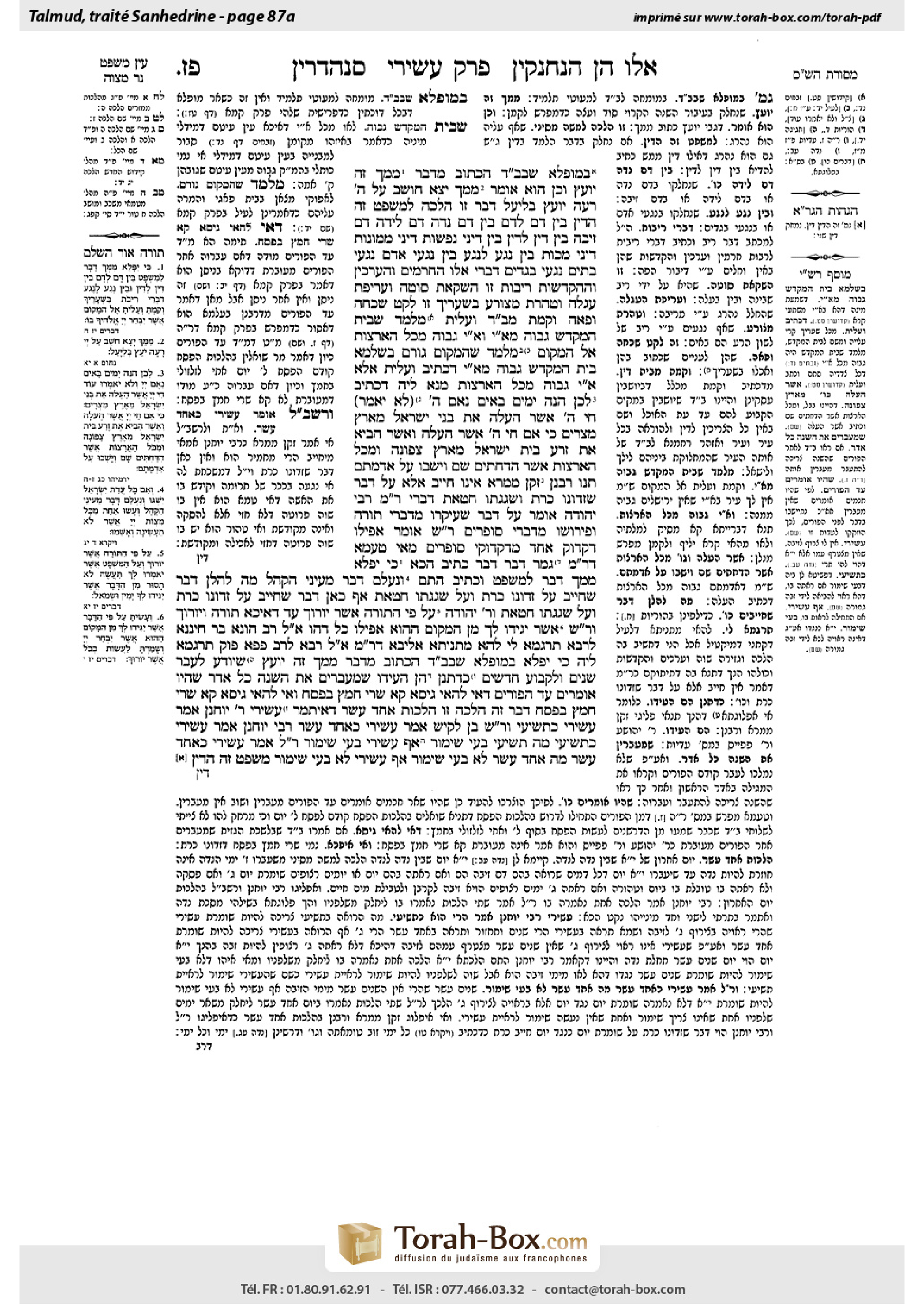
Sanhedrin 87a: Talmud study for Daf Yomi
Daf Yomi is the daily study of one Talmud folio. Explore 37 tractates with scans, Hebrew text, Sefaria English and AI-generated French translations where annotated.
Passage selection and English or AI-generated French translation are available where the scan has annotations. Daf Study is independent of Torah-Box and Sefaria.
Browse Sanhedrin · סנהדרין · All tractatesSanhedrin 87a text and translations
This page of Sanhedrin includes the Aramaic text, an English translation and an AI-generated French translation, alongside the scan above.
סנהדרין פ״ז א · Aramaic and Hebrew text
בְּמוּפְלָא שֶׁבְּבֵית דִּין הַכָּתוּב מְדַבֵּר. ״מִמְּךָ״ – זֶה יוֹעֵץ, וְכֵן הוּא אוֹמֵר: ״מִמֵּךְ יָצָא חֹשֵׁב עַל ה׳ רָעָה יֹעֵץ בְּלִיַּעַל״. ״דָּבָר״ – זוֹ הֲלָכָה. ״לַמִּשְׁפָּט״ – זֶה הַדִּין.
״בֵּין דָּם לְדָם״ – בֵּין דַּם נִדָּה, דַּם לֵידָה, דַּם זִיבָה. ״בֵּין דִּין לְדִין״ – בֵּין דִּינֵי נְפָשׁוֹת, דִּינֵי מָמוֹנוֹת, דִּינֵי מַכּוֹת. ״בֵּין נֶגַע לָנֶגַע״ – בֵּין נִגְעֵי אָדָם, נִגְעֵי בָתִּים, נִגְעֵי בְגָדִים.
״דִּבְרֵי״ – אֵלּוּ הַחֲרָמִים, וְהָעֲרָכִין, וְהַהֶקְדֵּשׁוֹת. ״רִיבֹת״ – זוֹ הַשְׁקָאַת סוֹטָה, וַעֲרִיפַת עֶגְלָה, וְטׇהֳרַת מְצוֹרָע. ״בִּשְׁעָרֶיךָ״ – זוֹ לֶקֶט, שִׁכְחָה, וּפֵאָה.
״וְקַמְתָּ״ – מִבֵּית דִּין. ״וְעָלִיתָ״ – מְלַמֵּד שֶׁבֵּית הַמִּקְדָּשׁ גָּבוֹהַּ מֵאֶרֶץ יִשְׂרָאֵל, וְאֶרֶץ יִשְׂרָאֵל גָּבוֹהַּ מִכׇּל הָאֲרָצוֹת. ״אֶל הַמָּקוֹם״ – מְלַמֵּד שֶׁהַמָּקוֹם גּוֹרֵם.
בִּשְׁלָמָא בֵּית הַמִּקְדָּשׁ גָּבוֹהַּ מֵאֶרֶץ יִשְׂרָאֵל, דִּכְתִיב: ״וְעָלִיתָ״. אֶלָּא אֶרֶץ יִשְׂרָאֵל גָּבוֹהַּ מִכׇּל הָאֲרָצוֹת מְנָא לֵיהּ? דִּכְתִיב: ״לָכֵן הִנֵּה יָמִים בָּאִים נְאֻם ה׳ לֹא יֵאָמֵר חַי ה׳ אֲשֶׁר הֶעֱלָה אֶת בְּנֵי יִשְׂרָאֵל מֵאֶרֶץ מִצְרַיִם. כִּי אִם חַי ה׳ אֲשֶׁר הֶעֱלָה וַאֲשֶׁר הֵבִיא אֶת זֶרַע בֵּית יִשְׂרָאֵל מֵאֶרֶץ צָפֹנָה וּמִכֹּל הָאֲרָצוֹת אֲשֶׁר הִדַּחְתִּים שָׁם וְיָשְׁבוּ עַל אַדְמָתָם״.
תָּנוּ רַבָּנַן: זָקֵן מַמְרֵא אֵינוֹ חַיָּיב אֶלָּא עַל דָּבָר שֶׁזְּדוֹנוֹ כָּרֵת וְשִׁגְגָתוֹ חַטָּאת, דִּבְרֵי רַבִּי מֵאִיר. רַבִּי יְהוּדָה אוֹמֵר: עַל דָּבָר שֶׁעִיקָּרוֹ מִדִּבְרֵי תוֹרָה וּפֵירוּשׁוֹ מִדִּבְרֵי סוֹפְרִים. רַבִּי שִׁמְעוֹן אוֹמֵר: אֲפִילּוּ דִּקְדּוּק אֶחָד מִדִּקְִדּוּקֵי סוֹפְרִים.
מַאי טַעְמָא דְּרַבִּי מֵאִיר? גָּמַר ״דָּבָר״ ״דָּבָר״. כְּתִיב הָכָא: ״כִּי יִפָּלֵא מִמְּךָ דָבָר לַמִּשְׁפָּט״, וּכְתִיב הָתָם: ״וְנֶעְלַם דָּבָר מֵעֵינֵי הַקָּהָל״. מָה לְהַלָּן דָּבָר שֶׁחַיָּיב עַל זְדוֹנוֹ כָּרֵת וְעַל שִׁגְגָתוֹ חַטָּאת, אַף כָּאן דָּבָר שֶׁחַיָּיב עַל זְדוֹנוֹ כָּרֵת וְעַל שִׁגְגָתוֹ חַטָּאת.
וְרַבִּי יְהוּדָה: ״עַל פִּי הַתּוֹרָה אֲשֶׁר יוֹרוּךָ״ – עַד דְּאִיכָּא ״תּוֹרָה״ וְ״יוֹרוּךָ״.
וְרַבִּי שִׁמְעוֹן: ״אֲשֶׁר יַגִּידוּ לְךָ מִן הַמָּקוֹם הַהוּא״ – אֲפִילּוּ כֹּל דְּהוּ.
אֲמַר לֵיהּ רַב הוּנָא בַּר חִינָּנָא לְרָבָא: תַּרְגְּמַהּ לִי לְהָא מַתְנִיתָא אַלִּיבָּא דְּרַבִּי מֵאִיר. אֲמַר לֵיהּ רָבָא לְרַב פָּפָּא: פּוֹק תַּרְגְּמַהּ לֵיהּ.
״כִּי יִפָּלֵא״ – בְּמוּפְלָא שֶׁבְּבֵית דִּין הַכָּתוּב מְדַבֵּר. ״מִמְּךָ״ – זֶה יוֹעֵץ, שֶׁיּוֹדֵעַ לְעַבֵּר שָׁנִים וְלִקְבּוֹעַ חֳדָשִׁים. כְּדִתְנַן: הֵן הֵעִידוּ שֶׁמְּעַבְּרִים אֶת הַשָּׁנָה כׇּל אֲדָר, שֶׁהָיוּ אוֹמְרִים עַד הַפּוּרִים.
דְּאִי לְהַאי גִּיסָא, קָא שָׁרֵי חָמֵץ בְּפֶסַח. וְאִי לְהַאי גִּיסָא, קָא שָׁרֵי חָמֵץ בְּפֶסַח.
דָּבָר זֶה – הֲלָכָה. זוֹ הִלְכַת אַחַד עָשָׂר. דְּאִיתְּמַר: עֲשִׂירִי, רַבִּי יוֹחָנָן אָמַר: עֲשִׂירִי כִּתְשִׁיעִי, וְרַבִּי שִׁמְעוֹן בֶּן לָקִישׁ אָמַר: עֲשִׂירִי כְּאַחַד עָשָׂר.
רַבִּי יוֹחָנָן אָמַר, עֲשִׂירִי כִּתְשִׁיעִי: מָה תְּשִׁיעִי בָּעֵי שִׁימּוּר – אַף עֲשִׂירִי בָּעֵי שִׁימּוּר.
רֵישׁ לָקִישׁ אָמַר, עֲשִׂירִי כְּאַחַד עָשָׂר: מָה אַחַד עָשָׂר לֹא בָּעֵי שִׁימּוּר – אַף עֲשִׂירִי לָא בָּעֵי שִׁימּוּר.
״מִשְׁפָּט״ – זֶה הַדִּין.
Sanhedrin 87a · English translation
it is with regard to the most distinguished [mufla] member of the court, an ordained, expert judge, that the verse is speaking. “For you [mimmekha]”; this is a reference to an adviser, who is consulted with regard to significant matters, e.g., intercalation of the year; and likewise it says: “From you [mimmekh] he emerged, who devised evil against the Lord, an adviser of wickedness” (Nahum 1:11). “A matter”; this halakha transmitted to Moses from Sinai. “In judgment”; this is a logical inference, which is one of the hermeneutical principles.
“Between blood and blood”; this is the ability to discern between the disparate halakhot relevant to the blood of a menstruating woman, the blood of childbirth, and the blood of a gonorrhea-like discharge [ziva]. “Between plea and plea”; this is the ability to discern between cases of capital law and cases of monetary law, with regard to which there are differences in evidence protocols, and laws involving the liability to receive lashes. “Between mark and mark”; this is the ability to discern between the disparate halakhot relevant to leprous marks of a person, leprous marks on houses, and leprous marks on garments (see Leviticus, chapter 14).
“Matters of [divrei]”; these are the dedications to God or to a priest, and the valuations of one’s value to the Temple, and the consecrations, all of which are matters of speech [dibbur]. “Controversy”; this is the giving of the bitter waters to a sota (see Numbers, chapter 5), which results from a dispute between husband and wife; and the heifer whose neck is broken, which results from an unresolved murder (Deuteronomy 21:1–9); and the purification of a leper, who is afflicted due to evil speech. “Within your gates”; this is referring to gleanings, forgotten sheaves, and produce in the corner of the field [pe’a], all of which are given to the poor who eat at the gates of the city.
“Then you shall arise” from the court where he sits as a judge. “And ascend”; this teaches that the Temple is higher than the rest of Eretz Yisrael, and Eretz Yisrael is higher than all the other lands. Therefore, the language of ascent is employed with regard to travel to Eretz Yisrael. “To the place that the Lord, your God, shall choose”; this teaches that the location that God chose for the Sanhedrin to convene causes their rulings to be authoritative, in the sense here in the mishna that the rebellious elder who instructs others to act contrary to a ruling issued there is liable.
The Gemara asks: Granted, the fact that the Temple is higher than the rest of Eretz Yisrael is derived from this verse, as it is written: “And ascend.” But from where does the tanna derive the fact that Eretz Yisrael is higher than all the other lands? The Gemara answers that it is derived from this verse, as it is written: “Therefore, behold, the days come, says the Lord, and they will no longer say: As the Lord lives, Who brought up the children of Israel from the land of Egypt; rather, as the Lord lives, Who brought up and led the descendants of the house of Israel from the north country and from all the countries where I had driven them, and they shall dwell upon their land” (Jeremiah 23:7–8). Apparently, coming from other countries to Eretz Yisrael is also characterized as ascent.
The Sages taught in a baraita: A rebellious elder is liable only for instructing another to perform an action involving a matter for whose intentional violation one is liable to receive karet, and for whose unwitting violation one is liable to bring a sin-offering; this is the statement of Rabbi Meir. Rabbi Yehuda says: One is liable for a matter whose essence is known from the words of the Torah itself and whose explanation is understood from traditional rabbinic interpretations of the Torah. The elder is not liable if the essence of the matter with regard to which he issues his ruling does not appear in the Torah or if the entire matter is written in the Torah. Rabbi Shimon says: Even if he differs with regard to one of the minutiae of the scribes in interpreting the Torah, the elder is liable, irrespective of the severity of the transgression.
The Gemara elaborates: What is the reason for the opinion of Rabbi Meir? He derives a verbal analogy between the term matter written here and the term matter that is written elsewhere. Here, matter is written in the verse: “If there shall be a matter too hard for you in judgment” (Deuteronomy 17:8), and there, it is written: “And the matter shall be concealed from the eyes of the assembly” (Leviticus 4:13). Just as there, in the verse in Leviticus, the sin-offering of the congregation is brought only for a matter for whose intentional violation one is liable to receive karet, and for whose unwitting violation one is liable to bring a sin-offering, so too here, the rebellious elder is liable only for a matter for whose intentional violation one is liable to receive karet, and for whose unwitting violation one is liable to bring a sin-offering.
And what is the reason for the opinion of Rabbi Yehuda? It is as it is written with regard to the rebellious elder: “According to the Torah that they shall instruct you” (Deuteronomy 17:11), indicating that there is no liability until it is a matter that consists of elements of both the Written Torah and in that the Sages shall instruct you in interpretation of the Written Torah.
And what is the reason for the opinion of Rabbi Shimon? It is as it is written with regard to the rebellious elder: “That they shall declare unto you from that place” (Deuteronomy 17:10), from which Rabbi Shimon derives that one is liable even if he deviates from the ruling of the Sanhedrin to any degree whatsoever.
Rav Huna bar Ḥinnana said to Rava: Interpret for me that baraita, in which the liability of the rebellious elder for rulings in different areas of halakha is derived from the verses, in accordance with the opinion of Rabbi Meir, who says that the rebellious elder is liable only for a matter for whose intentional violation one is liable to receive karet, and for whose unwitting violation one is liable to bring a sin-offering. How is such a prohibition found in each of the categories enumerated in the baraita? Rava said to Rav Pappa his student: Go and interpret it for him.
Rav Pappa said to Rav Huna: “If there shall be a matter too hard”; there the verse is speaking with regard to the most distinguished member of the court. “For you”; this is referring to an adviser, who knows how to intercalate years and establish months. How is there liability in this matter for karet or a sin-offering? It is as we learned in a mishna (Eduyyot 7:7): Rabbi Yehoshua and Rabbi Pappeyas testified that the judges may intercalate the year throughout the entire month of Adar, as the other Sages would say that the judges may do so only until the day of Purim.
A ruling contrary to the ruling of the Sanhedrin could result in a matter for which one is liable to receive karet, as, if his disagreement is to this side, e.g., the court intercalated the year and the rebellious elder ruled that the year is not intercalated, his ruling permits consumption of leavened bread on Passover according to the calendar established by the Sanhedrin. And if his disagreement is to that side, e.g., the court did not intercalate the year and the rebellious elder ruled that the year is intercalated, his ruling permits consumption of leavened bread on Passover according to the calendar established by the Sanhedrin. One who intentionally eats leavened bread on Passover is liable to receive karet, and one who does so unwittingly is liable to bring a sin-offering.
“A matter”; this is a halakha transmitted to Moses from Sinai. This is a matter involving karet in the case of the halakhot of eleven days, which is the minimal number of days between one menstrual period and another, when if a woman experiences a flow of blood on three consecutive days during those eleven days, she assumes the status of a greater zava, with regard to whom there are unique halakhot, e.g., the passage of seven clean days before purification by Torah law. When the woman experiences a discharge of blood for one or two days, she is a lesser zava, and if she observes the third day clean from the discharge of blood she may immerse immediately and she is ritually pure. As it was stated that there is an amoraic dispute with regard to a woman who experiences a discharge of blood on the tenth of those eleven days. Rabbi Yoḥanan says: The status of the tenth day is like that of the ninth day, and Rabbi Shimon ben Lakish says: The status of the tenth day is like that of the eleventh day.
The Gemara elaborates: Rabbi Yoḥanan says: The status of the tenth day is like that of the ninth day: Just as a discharge on the ninth day requires the woman to examine herself the following day and requires the observance of a day clean from discharges, so too does a discharge on the tenth day require observance of a day clean from discharges on the eleventh day before immersing in a ritual bath. According to Rabbi Yoḥanan, a woman who experiences a discharge on the tenth day assumes the status of a woman who observes a clean day for one or two days after she experiences a discharge.
And Reish Lakish says: The status of the tenth day is like that of the eleventh day: Just as a discharge on the eleventh day does not require observance of a day clean from discharge before immersing in a ritual bath, so too does a discharge on the tenth day not require observance of a day clean from discharges on the eleventh day. Even if she were to experience a discharge of blood on the days that follow, the eleventh and the twelfth days, she would not assume the status of a greater zava, as in that case the blood that she saw on the twelfth day would be the blood of menstruation and not the discharge of a zava. According to Reish Lakish, she does not assume that status. Therefore, if the Sanhedrin issued a ruling in accordance with Rabbi Yoḥanan’s opinion, one who engages in intercourse with that woman before her purification is liable to receive karet. If the rebellious elder issued a ruling in accordance with the opinion of Reish Lakish, then one who intentionally engaged in intercourse with the woman is liable to receive karet. If he did so unwittingly, he is liable to bring a sin-offering.
“In judgment”; this is a logical inference, which is one of the hermeneutical principles,
Sanhedrin 87a · Traduction française (IA)
C’est du membre le plus éminent [mufla] du tribunal, un juge ordonné et expert, que parle le verset. « De toi [mimmekha »] désigne un conseiller, que l’on consulte pour les questions importantes, par exemple l’intercalation de l’année ; de même, il est dit : « De toi [mimmekh] est sorti celui qui a conçu le mal contre le Seigneur, le conseiller pervers » (Nahum 1, 11). « Une affaire » désigne cette halakha transmise à Moïse au Sinaï. « En matière de jugement » désigne une inférence logique, qui est l’un des principes herméneutiques.
« Entre sang et sang » désigne la capacité de distinguer les différentes halakhot relatives au sang d’une femme menstruée, au sang de l’accouchement et au sang d’un écoulement semblable à la gonorrhée [ziva]. « Entre procès et procès » désigne la capacité de distinguer les affaires de droit pénal passibles de la peine capitale des affaires pécuniaires, qui diffèrent notamment par les règles de preuve, ainsi que les lois relatives aux infractions passibles de flagellation. « Entre marque et marque » désigne la capacité de distinguer les différentes halakhot relatives aux marques de lèpre sur une personne, sur des maisons et sur des vêtements (voir Lévitique, chapitre 14).
« Affaires de [divrei] » désigne les consécrations à Dieu ou à un prêtre, les évaluations de la valeur d’une personne pour le Temple et les consécrations, autant d’affaires qui relèvent de la parole [dibbur]. « Controverse » désigne l’administration des eaux amères à une sota (voir Nombres, chapitre 5), qui résulte d’un différend entre mari et femme ; la génisse dont on brise la nuque, à la suite d’un meurtre non élucidé (Deutéronome 21, 1-9) ; et la purification d’un lépreux, atteint en raison de paroles malveillantes. « Dans tes portes » désigne les glanures, les gerbes oubliées et les produits du coin du champ [pe’a], qui sont tous remis aux pauvres qui mangent aux portes de la ville.
« Alors tu te lèveras » : tu quitteras le tribunal où tu sièges comme juge. « Et tu monteras » enseigne que le Temple se trouve plus haut que le reste d’Eretz Israël, et qu’Eretz Israël se trouve plus haut que tous les autres pays. C’est pourquoi on emploie le langage de la montée pour désigner le voyage vers Eretz Israël. « Vers le lieu que le Seigneur, ton Dieu, choisira » enseigne que le lieu choisi par Dieu pour que le Sanhédrin s’y réunisse confère autorité à ses décisions ; ainsi, comme l’indique ici la Michna, l’ancien rebelle qui enjoint aux autres d’agir à l’encontre d’une décision qui y a été rendue est passible.
La Guemara demande : Certes, le fait que le Temple se trouve plus haut que le reste d’Eretz Israël se déduit de ce verset, puisqu’il est écrit : « Et tu monteras ». Mais d’où le tanna déduit-il qu’Eretz Israël se trouve plus haut que tous les autres pays ? La Guemara répond que cela se déduit de ce verset, puisqu’il est écrit : « C’est pourquoi, voici, les jours viennent, dit le Seigneur, où l’on ne dira plus : “Le Seigneur est vivant, lui qui a fait monter les enfants d’Israël du pays d’Égypte”, mais : “Le Seigneur est vivant, lui qui a fait monter et conduit les descendants de la maison d’Israël du pays du nord et de tous les pays où je les avais dispersés”, et ils habiteront sur leur terre » (Jérémie 23, 7-8). Il apparaît donc que venir d’autres pays en Eretz Israël est également décrit comme une montée.
Les Sages ont enseigné dans une baraïta : Un ancien rebelle n’est passible que s’il ordonne à quelqu’un d’accomplir un acte relevant d’une affaire dont la transgression intentionnelle est passible de karet et la transgression involontaire oblige à apporter un sacrifice expiatoire ; telle est la déclaration de Rabbi Meïr. Rabbi Yehouda dit : Il est passible pour une affaire dont l’essence est connue d’après les paroles mêmes de la Torah, et dont l’explication est comprise grâce aux interprétations traditionnelles de la Torah par les rabbins. L’ancien n’est pas passible si l’essence de l’affaire sur laquelle porte sa décision ne figure pas dans la Torah, ou si l’affaire tout entière est écrite dans la Torah. Rabbi Shimon dit : Même s’il diverge sur l’un des détails transmis par les scribes dans l’interprétation de la Torah, l’ancien est passible, quelle que soit la gravité de la transgression.
La Guemara développe : Quelle est la raison de l’opinion de Rabbi Meïr ? Il établit une analogie verbale entre le terme « affaire », écrit ici, et le terme « affaire », écrit ailleurs. Ici, le terme « affaire » figure dans le verset : « S’il y a pour toi une affaire trop difficile en matière de jugement » (Deutéronome 17, 8) ; et là, il est écrit : « Et l’affaire échappa aux yeux de l’assemblée » (Lévitique 4, 13). De même que là, dans le verset du Lévitique, le sacrifice expiatoire de la communauté n’est apporté que pour une affaire dont la transgression intentionnelle est passible de karet et la transgression involontaire oblige à apporter un sacrifice expiatoire, de même ici, l’ancien rebelle n’est passible que pour une affaire dont la transgression intentionnelle est passible de karet et la transgression involontaire oblige à apporter un sacrifice expiatoire.
Et quelle est la raison de l’opinion de Rabbi Yehouda ? C’est qu’il est écrit au sujet de l’ancien rebelle : « Selon la Torah qu’ils t’enseigneront » (Deutéronome 17, 11), ce qui indique qu’il n’est passible que lorsqu’il s’agit d’une affaire qui comporte à la fois des éléments de la Torah écrite et une interprétation que les Sages t’enseigneront.
Et quelle est la raison de l’opinion de Rabbi Shimon ? C’est qu’il est écrit au sujet de l’ancien rebelle : « Qu’ils te déclareront depuis ce lieu » (Deutéronome 17, 10). Rabbi Shimon en déduit que l’on est passible même si l’on s’écarte, ne serait-ce que dans la moindre mesure, de la décision du Sanhédrin.
Rav Houna bar Ḥinnana dit à Rava : Explique-moi cette baraïta, dans laquelle la responsabilité de l’ancien rebelle pour des décisions relevant de différents domaines de la halakha est déduite des versets, conformément à l’opinion de Rabbi Meïr, qui dit que l’ancien rebelle n’est passible que pour une affaire dont la transgression intentionnelle est passible de karet et la transgression involontaire oblige à apporter un sacrifice expiatoire. Comment une telle interdiction se retrouve-t-elle dans chacune des catégories énumérées dans la baraïta ? Rava dit à Rav Pappa, son élève : Va la lui expliquer.
Rav Pappa dit à Rav Houna : « S’il y a une affaire trop difficile » : le verset parle là du membre le plus éminent du tribunal. « Pour toi » désigne un conseiller, qui sait intercaler les années et fixer les mois. Comment cette affaire peut-elle entraîner une responsabilité passible de karet ou l’obligation d’apporter un sacrifice expiatoire ? C’est comme nous l’avons appris dans une Michna (Eduyyot 7, 7) : Rabbi Yehoshua et Rabbi Pappeyas ont témoigné que les juges peuvent intercaler l’année pendant tout le mois d’Adar, tandis que les autres Sages disaient que les juges ne peuvent le faire que jusqu’au jour de Pourim.
Une décision contraire à celle du Sanhédrin pouvait entraîner une affaire passible de karet. En effet, si l’ancien rebelle diverge dans un sens, par exemple si le tribunal a intercalé l’année et qu’il a décidé que l’année ne devait pas être intercalée, sa décision autorise la consommation de pain levé à Pessa’h, selon le calendrier fixé par le Sanhédrin. Et s’il diverge dans l’autre sens, par exemple si le tribunal n’a pas intercalé l’année et qu’il a décidé que l’année devait être intercalée, sa décision autorise la consommation de pain levé à Pessa’h, selon le calendrier fixé par le Sanhédrin. Celui qui mange intentionnellement du pain levé à Pessa’h est passible de karet, et celui qui en mange involontairement est tenu d’apporter un sacrifice expiatoire.
« Une affaire » désigne cette halakha transmise à Moïse au Sinaï. Il s’agit d’une affaire qui entraîne le karet dans le cas des halakhot des onze jours, c’est-à-dire le nombre minimal de jours séparant une période menstruelle de la suivante. Si une femme a un écoulement de sang pendant trois jours consécutifs au cours de ces onze jours, elle acquiert le statut de grande zava, auquel s’attachent des halakhot particulières, par exemple l’obligation, selon la Torah, d’observer sept jours sans écoulement avant de se purifier. Lorsque la femme a un écoulement de sang pendant un ou deux jours, elle est une petite zava ; si elle observe le troisième jour sans écoulement, elle peut s’immerger immédiatement et devient rituellement pure. Il a été rapporté qu’une discussion entre amoraïm porte sur le cas d’une femme qui a un écoulement de sang le dixième de ces onze jours. Rabbi Yoḥanan dit : Le dixième jour a le même statut que le neuvième ; et Rabbi Shimon ben Lakish dit : Le dixième jour a le même statut que le onzième.
La Guemara développe : Rabbi Yoḥanan dit que le dixième jour a le même statut que le neuvième : de même qu’un écoulement le neuvième jour oblige la femme à s’examiner le lendemain et à observer un jour sans écoulement, de même un écoulement le dixième jour oblige à observer le onzième jour sans écoulement avant de s’immerger dans un bain rituel. Selon Rabbi Yoḥanan, une femme qui a un écoulement le dixième jour acquiert le statut d’une femme qui observe un jour sans écoulement après avoir eu un écoulement pendant un ou deux jours.
Et Reish Lakish dit que le dixième jour a le même statut que le onzième : de même qu’un écoulement le onzième jour n’oblige pas à observer un jour sans écoulement avant de s’immerger dans un bain rituel, de même un écoulement le dixième jour n’oblige pas à observer le onzième jour sans écoulement. Même si elle avait ensuite un écoulement de sang les jours suivants, le onzième et le douzième, elle n’acquerrait pas le statut de grande zava, car, dans ce cas, le sang qu’elle aurait vu le douzième jour serait du sang menstruel et non l’écoulement d’une zava. Selon Reish Lakish, elle n’acquiert pas ce statut. Par conséquent, si le Sanhédrin a rendu une décision conforme à l’opinion de Rabbi Yoḥanan, celui qui a des relations sexuelles avec cette femme avant sa purification est passible de karet. Si l’ancien rebelle a rendu une décision conforme à l’opinion de Reish Lakish, celui qui a intentionnellement des relations sexuelles avec cette femme est passible de karet. S’il le fait involontairement, il est tenu d’apporter un sacrifice expiatoire.
« En matière de jugement » désigne une inférence logique, qui est l’un des principes herméneutiques,
Traduction française générée par IA à partir de l’édition anglaise de Sefaria. Vérifie toujours un passage avec le texte source.
Text from Sefaria: William Davidson Edition - Vocalized Aramaic (CC BY NC); William Davidson Edition - English (CC BY NC).