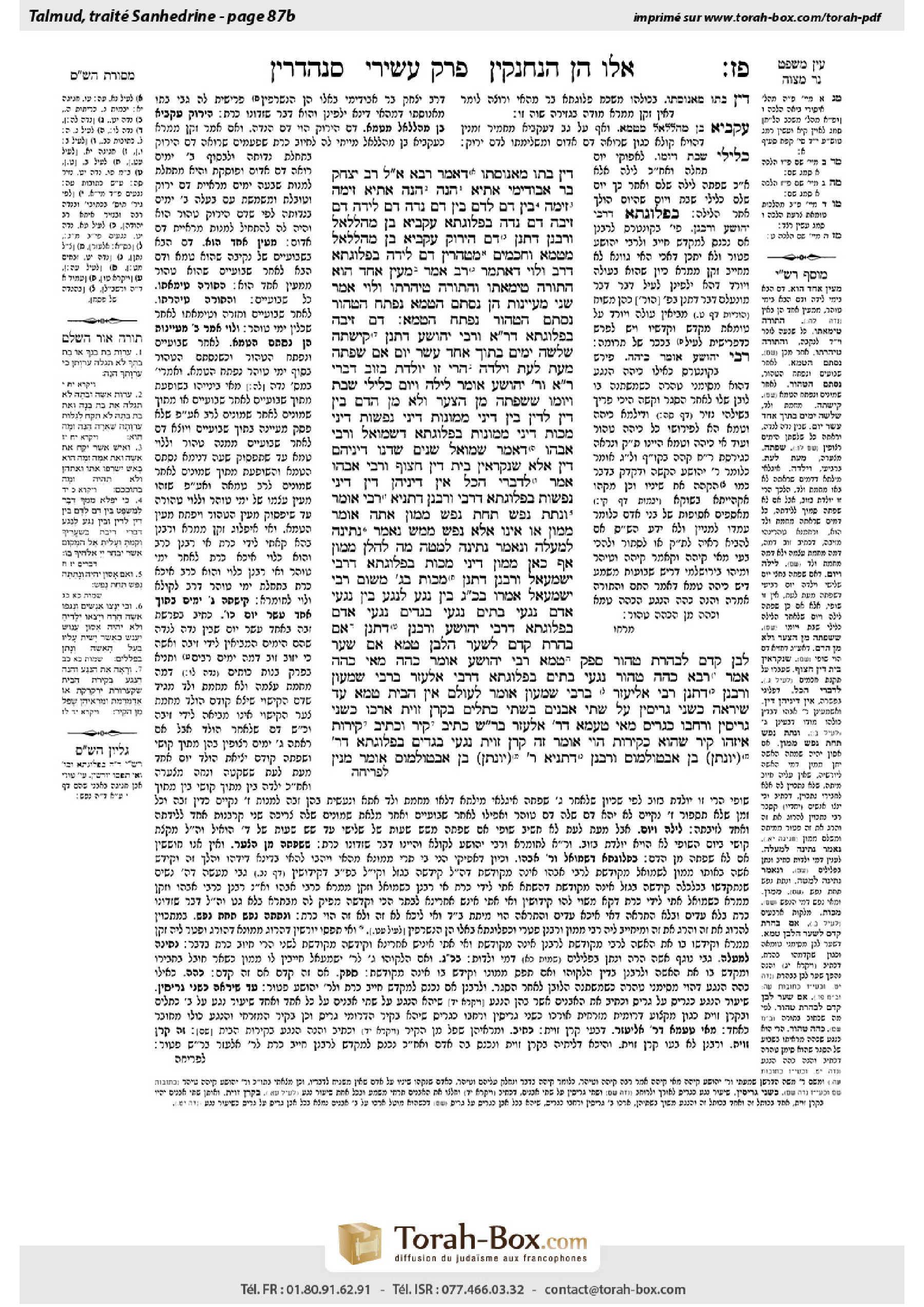
Sanhedrin 87b: Talmud study for Daf Yomi
Daf Yomi is the daily study of one Talmud folio. Explore 37 tractates with scans, Hebrew text, Sefaria English and AI-generated French translations where annotated.
Passage selection and English or AI-generated French translation are available where the scan has annotations. Daf Study is independent of Torah-Box and Sefaria.
Browse Sanhedrin · סנהדרין · All tractatesSanhedrin 87b text and translations
This page of Sanhedrin includes the Aramaic text, an English translation and an AI-generated French translation, alongside the scan above.
סנהדרין פ״ז ב · Aramaic and Hebrew text
דִּין בִּתּוֹ מֵאֲנוּסָתוֹ.
דְּאָמַר רָבָא: אֲמַר לִי רַב יִצְחָק בַּר אֲבוּדִימִי, אָתְיָא ״הֵנָּה״ ״הֵנָּה״,
אָתְיָא ״זִמָּה״ ״זִמָּה״.
״בֵּין דָּם לְדָם״ – בֵּין דַּם נִדָּה, דַּם לֵידָה, דַּם זִיבָה. דַּם נִדָּה – בִּפְלוּגְתָּא עֲקַבְיָא בֶּן מַהֲלַלְאֵל וְרַבָּנַן, דִּתְנַן: דָּם הַיָּרוֹק – עֲקַבְיָא בֶּן מַהֲלַלְאֵל מְטַמֵּא, וַחֲכָמִים מְטַהֲרִין.
דַּם לֵידָה – בִּפְלוּגְתָּא דְּרַב וְלֵוִי, דְּאִתְּמַר, רַב אָמַר: מַעְיָן אֶחָד הוּא, הַתּוֹרָה טִמְּאַתּוּ וְהַתּוֹרָה טִיהֲרַתּוּ.
וְלֵוִי אָמַר: שְׁנֵי מַעֲיָינוֹת הֵן, נִסְתָּם הַטָּמֵא – נִפְתָּח הַטָּהוֹר, נִסְתָּם הַטָּהוֹר – נִפְתָּח הַטָּמֵא.
דַּם זִיבָה – בִּפְלוּגְתָּא דְּרַבִּי אֱלִיעֶזֶר וְרַבִּי יְהוֹשֻׁעַ. דִּתְנַן: קִישְּׁתָה שְׁלֹשָׁה יָמִים בְּתוֹךְ אַחַד עָשָׂר יוֹם, אִם שָׁפְתָה מֵעֵת לְעֵת וְיָלְדָה – הֲרֵי זוֹ יוֹלֶדֶת בְּזוֹב, דִּבְרֵי רַבִּי אֱלִיעֶזֶר.
וְרַבִּי יְהוֹשֻׁעַ אוֹמֵר: לַיְלָה וָיוֹם, כְּלֵילֵי שַׁבָּת וְיוֹמוֹ, שֶׁשָּׁפְתָה מִן הַצַּעַר וְלֹא מִן הַדָּם.
״בֵּין דִּין לְדִין״ – בֵּין דִּינֵי מָמוֹנוֹת, דִּינֵי נְפָשׁוֹת, דִּינֵי מַכּוֹת. דִּינֵי מָמוֹנוֹת – בִּפְלוּגְתָּא דִּשְׁמוּאֵל וְרַבִּי אֲבָהוּ, דְּאָמַר שְׁמוּאֵל: שְׁנַיִם שֶׁדָּנוּ דִּינֵיהֶם דִּין, אֶלָּא שֶׁנִּקְרָאִין בֵּית דִּין חָצוּף. וְרַבִּי אֲבָהוּ אָמַר: לְדִבְרֵי הַכֹּל אֵין דִּינֵיהֶן דִּין.
דִּינֵי נְפָשׁוֹת – בִּפְלוּגְתָּא דְּרַבִּי וְרַבָּנַן. דְּתַנְיָא: רַבִּי אוֹמֵר, ״וְנָתַתָּה נֶפֶשׁ תַּחַת נָפֶשׁ״ – מָמוֹן.
אַתָּה אוֹמֵר מָמוֹן, אוֹ אֵינוֹ אֶלָּא נֶפֶשׁ מַמָּשׁ? נֶאֱמַר ״נְתִינָה״ לְמַעְלָה, וְנֶאֱמַר ״נְתִינָה״ לְמַטָּה. מָה לְהַלָּן מָמוֹן, אַף כָּאן מָמוֹן.
דִּינֵי מַכּוֹת – בִּפְלוּגְתָּא דְּרַבִּי יִשְׁמָעֵאל וְרַבָּנַן, דִּתְנַן: מַכּוֹת בִּשְׁלֹשָׁה. מִשּׁוּם רַבִּי יִשְׁמָעֵאל אָמְרוּ: בְּעֶשְׂרִים וּשְׁלֹשָׁה.
״בֵּין נֶגַע לָנֶגַע״ – בֵּין נִגְעֵי אָדָם, נִגְעֵי בָתִּים, נִגְעֵי בְגָדִים.
נִגְעֵי אָדָם – בִּפְלוּגְתָּא דְּרַבִּי יְהוֹשֻׁעַ וְרַבָּנַן. דִּתְנַן: אִם בַּהֶרֶת קָדַם לַשֵּׂעָר הַלָּבָן – טָמֵא, אִם שֵׂעָר לָבָן קָדַם לַבַּהֶרֶת – טָהוֹר, סָפֵק – טָמֵא. רַבִּי יְהוֹשֻׁעַ אוֹמֵר: כֵּהָה. מַאי כֵּהָה? אָמַר רָבָא: כֵּהָה – טָהוֹר.
נִגְעֵי בָתִּים, בִּפְלוּגְתָּא דְּרַבִּי אֶלְעָזָר בְּרַבִּי שִׁמְעוֹן וְרַבָּנַן. דִּתְנַן: רַבִּי אֶלְעָזָר בְּרַבִּי שִׁמְעוֹן אוֹמֵר, לְעוֹלָם אֵין הַבַּיִת טָמֵא עַד שֶׁיֵּרָאֶה כִּשְׁנֵי גְרִיסִין עַל שְׁתֵּי אֲבָנִים, בִּשְׁנֵי כְתָלִים בְּקֶרֶן זָוִית. אׇרְכּוֹ כִּשְׁנֵי גְרִיסִין, וְרׇחְבּוֹ כִּגְרִיס.
מַאי טַעְמָא דְּרַבִּי אֶלְעָזָר בְּרַבִּי שִׁמְעוֹן? כְּתִיב ״קִיר״ וּכְתִיב ״קִירֹת״. אֵיזֶהוּ קִיר שֶׁהוּא כְּקִירוֹת? הֱוֵי אוֹמֵר: זֶה קֶרֶן זָוִית.
נִגְעֵי בְגָדִים – בִּפְלוּגְתָּא דְּרַבִּי יוֹנָתָן בֶּן אַבְטוּלְמוֹס וְרַבָּנַן. דְּתַנְיָא: רַבִּי יוֹנָתָן בֶּן אַבְטוּלְמוֹס אוֹמֵר, מִנַּיִן
Sanhedrin 87b · English translation
for example, the halakha of the prohibition against engaging in intercourse with one’s daughter born from the victim of his rape.
As Rava says: Rav Yitzḥak bar Avudimi said to me: This prohibition is derived by means of a verbal analogy between the word henna, in the verse: “The nakedness of your son’s daughter, or of your daughter’s daughter, even their nakedness you shall not uncover; for theirs [henna] is your own nakedness” (Leviticus 18:10), and the word henna in a different verse: “You shall not uncover the nakedness of a woman and her daughter; you shall not take her son’s daughter, or her daughter’s daughter, to uncover her nakedness: They [henna] are near kinswomen; it is lewdness” (Leviticus 18:17). This verbal analogy indicates that just as intercourse with one’s granddaughter and with one’s wife’s daughter or granddaughter is forbidden, so too, intercourse with one’s daughter is prohibited.
Furthermore, it is derived from a verbal analogy between the word “lewdness” (Leviticus 18:17) and the word “lewdness” in the verse: “And if a man take with his wife also her mother, it is lewdness; they shall be burned with fire, both he and they, so that there be no lewdness among you” (Leviticus 20:14), that one who engages in sexual intercourse with his daughter or granddaughter is liable to be executed by burning.
“Between blood and blood”; this is the ability to discern between the disparate halakhot relevant to the blood of menstruation, the blood of childbirth, and the blood of a gonorrhea-like discharge [ziva]. In each of these cases, there is a dispute between the Sages with regard to a matter for whose intentional violation one is liable to receive karet. In the case of the blood of menstruation, it is with regard to the issue that is the subject of the dispute between Akavya ben Mahalalel and the Rabbis, as we learned in a mishna (Nidda 19a): With regard to blood that is green that is discharged by a woman, Akavya ben Mahalalel deems it blood of menstruation and impure, and the Rabbis deem it pure. According to Akavya ben Mahalalel, one who engages in intercourse with a woman who discharged green blood is liable to receive karet, while according to the Rabbis, he is exempt.
In the case of the blood of childbirth, the dispute concerning such a prohibition is with regard to the issue that is the subject of the dispute between Rav and Levi. This is as it was stated that Rav says: Blood that a woman discharges after childbirth is all from one source; the Torah deemed ritually impure the blood discharged for one week after the birth of a male and two weeks after the birth of a female, and the Torah deemed ritually pure the blood that is discharged for the subsequent thirty-three days for a male and sixty-six days for a female. Even if the blood flows continuously, the status of the blood changes after the conclusion of the period of impurity.
And Levi says: It is from two sources; the impure source is sealed after one week for a male and two weeks for a female, and then the pure source is opened, and at the conclusion of the period of the discharge of pure blood, the pure source is sealed and the impure source is opened. Only if the flow of impure blood ceases is a subsequent discharge deemed pure. Therefore, if one engaged in intercourse with a woman who experienced a continuous flow of blood beyond the time of the conclusion of the period of the flow of pure blood, according to Levi, he is liable to receive karet, and according to Rav, he is exempt.
In the case of the blood of ziva, the dispute concerning such a prohibition is with regard to the issue that is the subject of the dispute between Rabbi Eliezer and Rabbi Yehoshua. As we learned in a mishna (Nidda 36b): In a case where a woman experienced labor pain accompanied by an emission of blood lasting three consecutive days within the eleven days between the periods when her emissions render her a menstruating woman, during which the emission of blood renders the woman a zava, if she ceased experiencing labor for a twenty-four-hour period, indicating that the blood was not the result of imminent birth, and then she gave birth, that woman gives birth as a zava and is liable to bring the purification offerings of both a woman after childbirth and a zava; this is the statement of Rabbi Eliezer.
The mishna continues: And Rabbi Yehoshua says: That is her status only if she ceased experiencing labor for a twenty-four-hour period that is a night and the day that follows, like Shabbat evening and the day that follows it. When the mishna says that she ceased, it is referring to a case where she ceased from having labor pains and not from having the flow of blood. The dispute is whether the woman who gave birth has the status of a zava, who is required to count seven clean days before immersing in flowing water, or whether she has the status of a woman after childbirth. If the two weeks of the blood of impurity after childbirth elapsed and she did not immerse in flowing water, according to Rabbi Eliezer, she remains a zava, and one who engages in intercourse with her is liable to receive karet. According to Rabbi Yehoshua, at that point the blood becomes the blood of purity, and one who engages in intercourse with her is not liable to receive karet.
“Between plea and plea”; this is the ability to discern between cases of capital law, cases of monetary law, and cases of laws involving lashes. The Gemara elaborates: In cases of monetary law, the dispute concerning such a prohibition is with regard to the issue that is the subject of the dispute between Shmuel and Rabbi Abbahu, as Shmuel says: With regard to two judges who sat in judgment and issued a ruling in cases of monetary law, their ruling is a valid ruling, but they are characterized as an impudent court. And Rabbi Abbahu says: Everyone agrees that their ruling is not a valid ruling. If a tribunal of two judges rules that one of the litigants must pay the other money, and that litigant uses the money to betroth a woman, according to Shmuel she is betrothed, and one who intentionally engages in intercourse with her is liable to receive karet. According to Rabbi Abbahu she is not betrothed, and one who engages in intercourse with her is not liable.
In cases of capital law, the dispute concerning such a prohibition is with regard to the issue that is the subject of the dispute between Rabbi Yehuda HaNasi and the Rabbis, as it is taught in a baraita that Rabbi Yehuda HaNasi says with regard to that which is written: “If men struggle and they hurt a pregnant woman…and if there shall be a tragedy you shall give a life for a life” (Exodus 21:22–23), the reference is to a monetary payment for the life that he took. The tragedy referenced is the unintentional killing of the mother.
The tanna deliberates: Do you say that the reference is to a monetary payment, or perhaps the reference is only to giving his actual life? Based on the language employed in the verse, it can be determined that the reference is to monetary payment. In these verses, giving is stated above: “And you shall give a life for a life,” and giving is stated below: “He shall be punished, as the husband of the woman shall impose upon him, and he shall give as the judges determine” (Exodus 21:23). Just as there, in the phrase “Give as the judges determine,” the reference is to monetary payment, so too here, in the phrase “Give a life for a life,” the reference is to monetary payment. The Rabbis hold that the reference is to giving his actual life. If an heir of the victim betrothed a woman with money seized from the assailant, according to Rabbi Yehuda HaNasi the woman is betrothed, while according to the Rabbis she is not betrothed.
In cases of laws involving lashes, the dispute concerning such a prohibition is with regard to the issue that is the subject of the dispute between Rabbi Yishmael and the Rabbis, as we learned in a mishna (2a): Cases concerning the violation of prohibitions that render one liable to receive lashes are adjudicated by three judges. The Sages stated in the name of Rabbi Yishmael: Cases concerning lashes are adjudicated by twenty-three judges. According to Rabbi Yishmael, if a tribunal of three sentences an individual to lashes, that individual can claim damages for any injury caused as a result of the lashes, and if he betroths a woman with that money the betrothal is valid. According to the Rabbis, he cannot claim damages, as the court is authorized to sentence him to receive lashes.
“Between mark and mark”; this is the ability to discern between the disparate halakhot relevant to leprous marks of a person, leprous marks on houses, and leprous marks on garments.
In the case of leprous marks of a person, the dispute concerning such a prohibition is with regard to the issue that is the subject of the dispute between Rabbi Yehoshua and the Rabbis, as we learned in a mishna (Nega’im 4:11): If the snow-white leprous mark [baheret] preceded the white hair, the individual is impure with leprosy, as that is the order of events that appears in the Torah, and if the white hair preceded the baheret, the individual is pure. If there is uncertainty concerning which appeared first, the Rabbis say: He is impure, and Rabbi Yehoshua says: It has darkened. The Gemara asks: What is the meaning of: It has darkened? Rava says: Its status is like that of a baheret that darkened, with regard to which the Torah says that he is pure. If one with a baheret and a white hair entered the Temple, and there is uncertainty concerning which appeared first, according to the Rabbis he is liable to receive karet, and according to Rabbi Yehoshua he is not liable.
In the case of leprous marks of houses, the dispute concerning such a prohibition is with regard to the issue that is the subject of the dispute between Rabbi Elazar, son of Rabbi Shimon, and the Rabbis, as we learned in a mishna (Nega’im 12:3): Rabbi Elazar, son of Rabbi Shimon, says: A house is never deemed impure with leprosy unless the leprous mark will be seen to be the size of two Cilician beans, on two stones, on two walls, in a corner between two walls. The length of the mark is that of two Cilician beans and its width is that of one Cilician bean.
The Gemara asks: What is the reason for the opinion of Rabbi Elazar, son of Rabbi Shimon? The Gemara answers: The word wall is written in the verse and the word walls is written in the same verse: And he shall see the leprous mark…in the walls of the house with hollow streaks, greenish or reddish, and their appearance is lower than the wall” (Leviticus 14:37). Which is one wall that is like multiple walls? You must say: This is a corner between two walls. The Rabbis hold that it is a leprous house even if the mark appears on one wall. Therefore, one who entered a house with a leprous mark on one wall and then entered the Temple is liable to receive karet according to the Rabbis; according to Rabbi Elazar, son of Rabbi Shimon, he is not liable.
In the case of leprous marks on garments, the dispute concerning such a prohibition is with regard to the issue that is the subject of the dispute between Rabbi Yonatan ben Avtolemos and the Rabbis, as it is taught in a baraita that Rabbi Yonatan ben Avtolemos says: From where is it derived
Sanhedrin 87b · Traduction française (IA)
par exemple, la halakha interdisant les relations sexuelles avec sa fille née de la victime de son viol.
Comme le dit Rava : Rav Yitzḥak bar Avudimi m'a dit : Cette interdiction est déduite par une analogie verbale entre le mot henna, dans le verset : « La nudité de la fille de ton fils ou de la fille de ta fille, tu ne la révéleras pas ; car leur nudité [henna] est ta propre nudité » (Lévitique 18:10), et le mot henna dans un autre verset : « Tu ne révéleras pas la nudité d'une femme et de sa fille ; tu ne prendras pas la fille de son fils ou la fille de sa fille pour révéler sa nudité : Elles [henna] sont des parentes proches ; c'est une turpitude » (Lévitique 18:17). Cette analogie verbale indique que de même que les relations avec sa petite-fille et avec la fille ou la petite-fille de sa femme sont interdites, de même les relations avec sa fille sont prohibées.
De plus, cela est déduit d'une analogie verbale entre le mot « turpitude » (Lévitique 18:17) et le mot « turpitude » dans le verset : « Et si un homme prend avec sa femme aussi sa mère, c'est une turpitude ; tous deux seront brûlés par le feu, lui et elles, afin qu'il n'y ait pas de turpitude parmi vous » (Lévitique 20:14), selon laquelle celui qui a des relations sexuelles avec sa fille ou sa petite-fille est passible de la peine de mort par le feu.
« Entre le sang et le sang » ; il s'agit de la capacité de distinguer entre les différentes halakhot applicables au sang des règles, au sang de l'accouchement et au sang d'un écoulement de type gonorrhée [ziva]. Dans chacun de ces cas, il y a un désaccord entre les Sages concernant une question pour laquelle la violation intentionnelle entraîne la peine de karet. Dans le cas du sang des règles, il s'agit de la question qui fait l'objet du désaccord entre Akavya ben Mahalalel et les Rabbins, comme nous l'avons appris dans une Michna (Nidda 19a) : Concernant le sang vert qui est émis par une femme, Akavya ben Mahalalel le considère comme du sang des règles et impur, tandis que les Rabbins le considèrent comme pur. Selon Akavya ben Mahalalel, celui qui a des relations avec une femme qui a émis du sang vert est passible de la peine de karet, tandis que selon les Rabbins, il est exempt.
Dans le cas du sang de l'accouchement, le désaccord concernant une telle interdiction porte sur la question qui fait l'objet du désaccord entre Rav et Levi. C'est ainsi qu'il a été dit que Rav dit : Le sang qu'une femme émet après l'accouchement provient toutes d'une même source ; la Torah a déclaré rituellement impur le sang émis pendant une semaine après la naissance d'un garçon et deux semaines après la naissance d'une fille, et la Torah a déclaré rituellement pur le sang qui est émis pendant les trente-trois jours suivants pour un garçon et les soixante-six jours pour une fille. Même si le sang coule en continu, le statut du sang change après la fin de la période d'impureté.
Et Levi dit : Il provient de deux sources ; la source impure est scellée après une semaine pour un homme et deux semaines pour une femme, puis la source pure s'ouvre, et à la fin de la période d'écoulement de sang pur, la source pure est scellée et la source impure s'ouvre. Ce n'est que si l'écoulement de sang impur cesse qu'un écoulement ultérieur est considéré comme pur. Par conséquent, si un homme a eu des relations avec une femme qui a eu un écoulement de sang continu au-delà du terme de la période d'écoulement de sang pur, selon Levi, il est passible de la peine de karet, et selon Rav, il est exempt.
Dans le cas du sang de ziva, le désaccord concernant une telle interdiction porte sur la question qui fait l'objet du désaccord entre Rabbi Eliezer et Rabbi Yehoshua. Comme nous l'avons appris dans une Michna (Nidda 36b) : Dans un cas où une femme a ressenti des douleurs d'accouchement accompagnées d'un écoulement de sang pendant trois jours consécutifs au sein des onze jours entre les périodes où ses écoulements la rendent menstruée, pendant lesquels l'écoulement de sang rend la femme zava, si elle a cessé de ressentir des douleurs pendant une période de vingt-quatre heures, indiquant que le sang n'était pas le résultat d'une naissance imminente, et qu'elle a ensuite accouché, cette femme accouche en tant que zava et est tenue d'apporter les offrandes de purification d'une femme après l'accouchement et d'une zava ; c'est l'avis de Rabbi Eliezer.
La Michna continue : Et Rabbi Yehoshua dit : C'est son statut seulement si elle a cessé de ressentir des douleurs pendant une période de vingt-quatre heures, soit une nuit et le jour qui suit, comme le soir du Shabbat et le jour qui suit. Lorsque la Michna dit qu'elle a cessé, cela fait référence à un cas où elle a cessé d'avoir des douleurs d'accouchement et non d'avoir l'écoulement de sang. Le désaccord porte sur le fait de savoir si la femme qui a accouché a le statut de zava, qui est tenue de compter sept jours de pureté avant de s'immerger dans l'eau courante, ou si elle a le statut d'une femme après l'accouchement. Si les deux semaines de sang d'impureté après l'accouchement sont écoulées et qu'elle ne s'est pas immergée dans l'eau courante, selon Rabbi Eliezer, elle reste zava, et celui qui a des relations avec elle est passible de la peine de karet. Selon Rabbi Yehoshua, à ce moment-là, le sang devient du sang de pureté, et celui qui a des relations avec elle n'est pas passible de la peine de karet.
« Entre la plainte et la plainte » ; c'est la capacité de distinguer entre les cas relevant du droit pénal, les cas relevant du droit monétaire et les cas relevant des lois impliquant des coups de fouet. La Guemara développe : Dans les cas relevant du droit monétaire, le désaccord concernant une telle interdiction porte sur la question qui fait l'objet du désaccord entre Shmuel et Rabbi Abbahu, car Shmuel dit : Concernant deux juges qui se sont assis pour juger et ont émis un jugement dans des cas relevant du droit monétaire, leur jugement est un jugement valide, mais ils sont caractérisés comme un tribunal impudent. Et Rabbi Abbahu dit : Tout le monde est d'accord que leur jugement n'est pas un jugement valide. Si un tribunal de deux juges décide que l'une des parties doit payer de l'argent à l'autre, et que cette partie utilise l'argent pour épouser une femme, selon Shmuel, elle est épousée, et celui qui a intentionnellement des relations avec elle est passible de la peine de karet. Selon Rabbi Abbahu, elle n'est pas épousée, et celui qui a des relations avec elle n'est pas passible.
En matière de droit pénal, la controverse concernant une telle interdiction porte sur la question qui fait l'objet du différend entre Rabbi Yehuda HaNasi et les Sages, comme l'enseigne une baraïta : Rabbi Yehuda HaNasi déclare, au sujet de ce qui est écrit : « Si des hommes se disputent et blessent une femme enceinte… et s'il y a un malheur, tu donneras vie pour vie » (Exode 21:22-23), que la référence est à une indemnité monétaire pour la vie qu'il a prise. Le malheur mentionné est le meurtre involontaire de la mère.
Le tanna délibère : Dit-on que la référence est à une indemnité monétaire, ou peut-être la référence est-elle uniquement à la remise de sa propre vie ? Sur la base du langage employé dans le verset, il peut être déterminé que la référence est à une indemnité monétaire. Dans ces versets, le verbe « donner » est énoncé plus haut : « Et tu donneras vie pour vie », et le verbe « donner » est énoncé plus bas : « Il sera puni, comme l'époux de la femme l'imposera sur lui, et il donnera ce que les juges détermineront » (Exode 21:23). De même que là, dans l'expression « Donner ce que les juges détermineront », la référence est à une indemnité monétaire, de même ici, dans l'expression « Donner vie pour vie », la référence est à une indemnité monétaire. Les Sages soutiennent que la référence est à la remise de sa propre vie. Si un héritier de la victime a fiancé une femme avec de l'argent saisi sur l'agresseur, selon Rabbi Yehuda HaNasi la femme est fiancée, tandis que selon les Sages elle ne l'est pas.
En matière de lois impliquant des coups de fouet, la controverse concernant une telle interdiction porte sur la question qui fait l'objet du différend entre Rabbi Yishmael et les Sages, comme nous l'avons appris dans une Michna (2a) : Les cas concernant la violation d'interdictions qui rendent l'individu passible de coups de fouet sont jugés par trois juges. Les Sages ont déclaré au nom de Rabbi Yishmael : Les cas concernant les coups de fouet sont jugés par vingt-trois juges. Selon Rabbi Yishmael, si un tribunal de trois condamne un individu aux coups de fouet, cet individu peut réclamer des dommages et intérêts pour toute blessure causée par les coups de fouet, et s'il fiance une femme avec cet argent, les fiançailles sont valides. Selon les Sages, il ne peut pas réclamer de dommages et intérêts, car le tribunal est autorisé à le condamner aux coups de fouet.
« Entre marque et marque » ; cela désigne la capacité de distinguer entre les différentes halakhot applicables aux marques de lèpre sur une personne, aux marques de lèpre sur les maisons et aux marques de lèpre sur les vêtements.
Dans le cas des marques de lèpre sur une personne, la controverse concernant une telle interdiction porte sur la question qui fait l'objet du différend entre Rabbi Yehoshua et les Sages, comme nous l'avons appris dans une Michna (Nega'im 4:11) : Si la marque blanche de lèpre [baheret] a précédé le poil blanc, l'individu est impur de lèpre, car c'est l'ordre des événements qui apparaît dans la Torah, et si le poil blanc a précédé la baheret, l'individu est pur. S'il y a incertitude quant à celle qui est apparue en premier, les Sages disent : Il est impur, et Rabbi Yehoshua dit : Elle a foncé. La Guemara demande : Quelle est la signification de : Elle a foncé ? Rava dit : Son statut est celui d'une baheret qui a foncé, au sujet de laquelle la Torah dit qu'il est pur. Si une personne ayant une baheret et un poil blanc est entrée dans le Temple, et s'il y a incertitude quant à celle qui est apparue en premier, selon les Sages il est passible de karet, et selon Rabbi Yehoshua il n'est pas passible.
Dans le cas des marques de lèpre sur les maisons, la controverse concernant une telle interdiction porte sur la question qui fait l'objet du différend entre Rabbi Elazar, fils de Rabbi Shimon, et les Sages, comme nous l'avons appris dans une Michna (Nega'im 12:3) : Rabbi Elazar, fils de Rabbi Shimon, dit : Une maison n'est jamais considérée impure de lèpre à moins que la marque de lèpre ne soit vue de la taille de deux fèves ciliciennes, sur deux pierres, sur deux murs, dans un angle entre deux murs. La longueur de la marque est celle de deux fèves ciliciennes et sa largeur est celle d'une fève cilicienne.
La Guemara demande : Quelle est la raison de l'opinion de Rabbi Elazar, fils de Rabbi Shimon ? La Guemara répond : Le mot « mur » est écrit dans le verset et le mot « murs » est écrit dans le même verset : « Et il verra la marque de lèpre… dans les murs de la maison, avec des stries creuses, verdâtres ou rougeâtres, et leur apparence est plus basse que le mur » (Lévitique 14:37). Lequel est un mur qui est comme plusieurs murs ? Tu dois dire : C'est un angle entre deux murs. Les Sages soutiennent que c'est une maison lépreuse même si la marque apparaît sur un seul mur. Par conséquent, celui qui est entré dans une maison ayant une marque de lèpre sur un seul mur et qui est ensuite entré dans le Temple est passible de karet selon les Sages ; selon Rabbi Elazar, fils de Rabbi Shimon, il n'est pas passible.
Dans le cas des marques de lèpre sur les vêtements, la controverse concernant une telle interdiction porte sur la question qui fait l'objet du différend entre Rabbi Yonatan ben Avtolemos et les Sages, comme l'enseigne une baraïta que Rabbi Yonatan ben Avtolemos dit : D'où est-il dérivé
Traduction française générée par IA à partir de l’édition anglaise de Sefaria. Vérifie toujours un passage avec le texte source.
Text from Sefaria: William Davidson Edition - Vocalized Aramaic (CC BY NC); William Davidson Edition - English (CC BY NC).