Sanhedrin 88a: Talmud study for Daf Yomi
Daf Yomi is the daily study of one Talmud folio. Explore 37 tractates with scans, Hebrew text, Sefaria English and AI-generated French translations where annotated.
Passage selection and English or AI-generated French translation are available where the scan has annotations. Daf Study is independent of Torah-Box and Sefaria.
Browse Sanhedrin · סנהדרין · All tractatesSanhedrin 88a text and translations
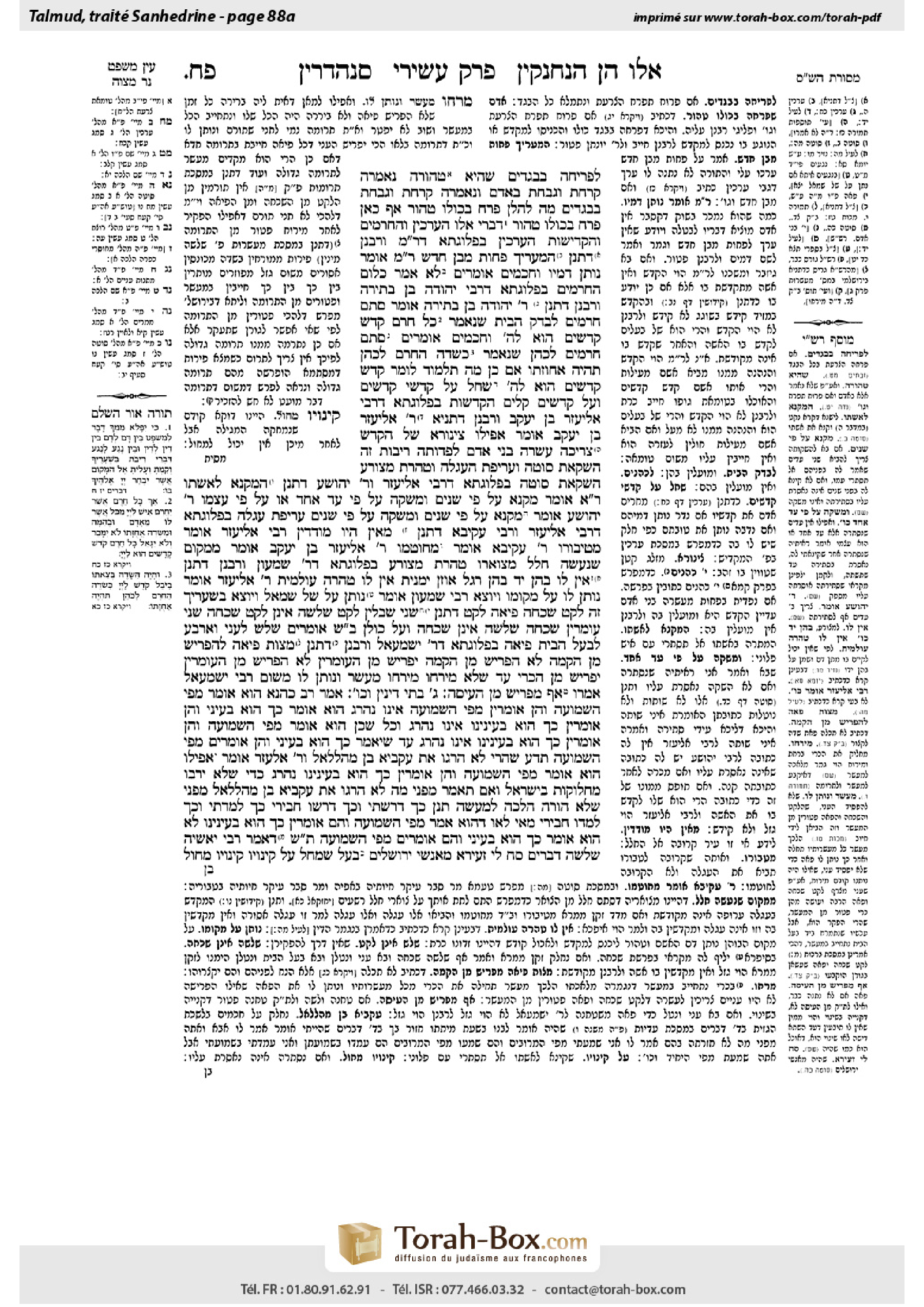
This page of Sanhedrin includes the Aramaic text, an English translation and an AI-generated French translation, alongside the scan above.
סנהדרין פ״ח א · Aramaic and Hebrew text
לִפְרִיחָה בִּבְגָדִים, שֶׁהִיא טְהוֹרָה?
נֶאֶמְרָה קָרַחַת וְגַבַּחַת בָּאָדָם, וְנֶאֶמְרָה קָרַחַת וְגַבַּחַת בִּבְגָדִים. מָה לְהַלָּן – פָּרַח בְּכוּלּוֹ טָהוֹר, אַף כָּאן – פָּרַח בְּכוּלּוֹ טָהוֹר.
״דִּבְרֵי״ – אֵלּוּ הָעֲרָכִין, וְהַחֲרָמִים, וְהַהֶקְדֵּישׁוֹת. הָעֲרָכִין – בִּפְלוּגְתָּא דְּרַבִּי מֵאִיר וְרַבָּנַן, דִּתְנַן: הַמַּעֲרִיךְ פָּחוֹת מִבֶּן חֹדֶשׁ, רַבִּי מֵאִיר אוֹמֵר: נוֹתֵן דָּמָיו, וַחֲכָמִים אוֹמְרִים: לֹא אָמַר כְּלוּם.
הַחֲרָמִים – בִּפְלוּגְתָּא דְּרַבִּי יְהוּדָה בֶּן בְּתִירָה וְרַבָּנַן. דִּתְנַן, רַבִּי יְהוּדָה בֶּן בְּתִירָה אוֹמֵר: סְתַם חֲרָמִים לְבֶדֶק הַבַּיִת, שֶׁנֶּאֱמַר: ״כׇּל חֵרֶם קֹדֶשׁ קֳדָשִׁים הוּא לַה׳״.
וַחֲכָמִים אוֹמְרִים: סְתַם חֲרָמִים לַכֹּהֵן, שֶׁנֶּאֱמַר: ״כִּשְׂדֵה הַחֵרֶם לַכֹּהֵן תִּהְיֶה אֲחֻזָּתוֹ״. אִם כֵּן, מָה תַּלְמוּד לוֹמַר: ״קֹדֶשׁ קָדָשִׁים הוּא לַה׳״? שֶׁחָל עַל קׇדְשֵׁי קָדָשִׁים וְעַל קָדָשִׁים קַלִּים.
הֶקְדֵּשׁוֹת, בִּפְלוּגְתָּא דְּרַבִּי אֱלִיעֶזֶר בֶּן יַעֲקֹב וְרַבָּנַן. דְּתַנְיָא, רַבִּי אֱלִיעֶזֶר בֶּן יַעֲקֹב אוֹמֵר: אֲפִילּוּ צִינּוֹרָא שֶׁל הֶקְדֵּשׁ צְרִיכָה עֲשָׂרָה בְּנֵי אָדָם לִפְדּוֹתָהּ.
״רִיבֹת״ – זֶה הַשְׁקָאַת סוֹטָה, וַעֲרִיפַת הָעֶגְלָה, וְטׇהֳרַת מְצוֹרָע. הַשְׁקָאַת סוֹטָה – בִּפְלוּגְתָּא דְּרַבִּי אֱלִיעֶזֶר וְרַבִּי יְהוֹשֻׁעַ, דִּתְנַן: הַמְקַנֵּא לְאִשְׁתּוֹ, רַבִּי אֱלִיעֶזֶר אוֹמֵר: מְקַנֵּא עַל פִּי שְׁנַיִם, וּמַשְׁקֶה עַל פִּי עֵד אֶחָד אוֹ עַל פִּי עַצְמוֹ.
רַבִּי יְהוֹשֻׁעַ אוֹמֵר: מְקַנֵּא עַל פִּי שְׁנַיִם, וּמַשְׁקֶה עַל פִּי שְׁנַיִם.
עֲרִיפַת עֶגְלָה – בִּפְלוּגְתָּא דְּרַבִּי אֱלִיעֶזֶר וְרַבִּי עֲקִיבָא. דִּתְנַן: מֵאַיִן הָיוּ מוֹדְדִין? רַבִּי אֱלִיעֶזֶר אוֹמֵר: מִטִּיבּוּרוֹ, רַבִּי עֲקִיבָא אוֹמֵר: מֵחוֹטְמוֹ, רַבִּי אֱלִיעֶזֶר בֶּן יַעֲקֹב אוֹמֵר: מִמָּקוֹם שֶׁנַּעֲשֶׂה חָלָל – מִצַּוָּארוֹ.
טׇהֳרַת מְצוֹרָע – בִּפְלוּגְתָּא דְּרַבִּי שִׁמְעוֹן וְרַבָּנַן. דִּתְנַן: אֵין לוֹ בֹּהֶן יָד, בֹּהֶן רֶגֶל, אוֹזֶן יְמָנִית – אֵין לוֹ טׇהֳרָה עוֹלָמִית. רַבִּי אֱלִיעֶזֶר אוֹמֵר: נוֹתֵן לוֹ עַל מְקוֹמוֹ וְיוֹצֵא. רַבִּי שִׁמְעוֹן אוֹמֵר: נוֹתֵן עַל שֶׁל שְׂמֹאל וְיוֹצֵא.
״בִּשְׁעָרֶיךָ״ – זֶה לֶקֶט, שִׁכְחָה, פֵּיאָה. לֶקֶט – דִּתְנַן: שְׁנֵי שִׁבֳּלִין – לֶקֶט, שְׁלֹשָׁה – אֵינָן לֶקֶט. שִׁכְחָה – שְׁנֵי עֳמָרִין – שִׁכְחָה, שְׁלֹשָׁה – אֵינָן שִׁכְחָה.
וְעַל כּוּלָּן בֵּית שַׁמַּאי אוֹמְרִים: שָׁלֹשׁ לְעָנִי, וְאַרְבַּע לְבַעַל הַבַּיִת.
פֵּיאָה – בִּפְלוּגְתָּא דְּרַבִּי יִשְׁמָעֵאל וְרַבָּנַן. דִּתְנַן: מִצְוַת פֵּיאָה לְהַפְרִישׁ מִן הַקָּמָה. לֹא הִפְרִישׁ מִן הַקָּמָה – יַפְרִישׁ מִן הָעֳמָרִין. לֹא הִפְרִישׁ מִן הָעֳמָרִין – יַפְרִישׁ מִן הַכְּרִי עַד שֶׁלֹּא מֵירְחוֹ. מֵירְחוֹ – מְעַשֵּׂר וְנוֹתֵן לוֹ.
מִשּׁוּם רַבִּי יִשְׁמָעֵאל אָמְרוּ: אַף מַפְרִישׁ מִן הָעִיסָּה.
שְׁלֹשָׁה בָּתֵּי דִינִין וְכוּ׳. אָמַר רַב כָּהֲנָא: הוּא אוֹמֵר מִפִּי הַשְּׁמוּעָה, וְהֵן אוֹמְרִין מִפִּי הַשְּׁמוּעָה – אֵינוֹ נֶהֱרָג.
הוּא אוֹמֵר: ״כָּךְ הוּא בְּעֵינַי״, וְהֵן אוֹמְרִין: ״כָּךְ הוּא בְּעֵינֵינוּ״ – אֵינוֹ נֶהֱרָג. וְכׇל שֶׁכֵּן הוּא אוֹמֵר: ״מִפִּי הַשְּׁמוּעָה״, וְהֵן אוֹמְרִין: ״כָּךְ הוּא בְּעֵינֵינוּ״ – אֵינוֹ נֶהֱרָג. עַד שֶׁיֹּאמַר: ״כָּךְ הוּא בְּעֵינַי״, וְהֵן אוֹמְרִים: ״מִפִּי הַשְּׁמוּעָה״. תֵּדַע, שֶׁהֲרֵי לֹא הָרְגוּ אֶת עֲקַבְיָא בֶּן מַהֲלַלְאֵל.
וְרַבִּי אֶלְעָזָר אוֹמֵר: אֲפִילּוּ הוּא אוֹמֵר ״מִפִּי הַשְּׁמוּעָה״, וְהֵן אוֹמְרִין ״כָּךְ הוּא בְּעֵינֵינוּ״ – נֶהֱרָג, כְּדֵי שֶׁלֹּא יִרְבּוּ מַחְלוֹקוֹת בְּיִשְׂרָאֵל. וְאִם תֹּאמַר: מִפְּנֵי מָה לֹא הָרְגוּ אֶת עֲקַבְיָא בֶּן מַהֲלַלְאֵל? מִפְּנֵי שֶׁלֹּא הוֹרָה הֲלָכָה לְמַעֲשֶׂה.
תְּנַן: כָּךְ דָּרַשְׁתִּי, וְכָךְ דָּרְשׁוּ חֲבֵירַי; כָּךְ לִמַּדְתִּי, וְכָךְ לִמְּדוּ חֲבֵירַי. מַאי לָאו? דְּהוּא אָמַר ״מִפִּי הַשְּׁמוּעָה״, וְהֵם אוֹמְרִין: ״כָּךְ הוּא בְּעֵינֵינוּ״? לָא, הוּא אוֹמֵר: ״כָּךְ הוּא בְּעֵינַי״, וְהֵם אוֹמְרִים מִפִּי הַשְּׁמוּעָה.
תָּא שְׁמַע, דְּאָמַר רַבִּי יֹאשִׁיָּה: שְׁלֹשָׁה דְּבָרִים סָח לִי זְעֵירָא מֵאַנְשֵׁי יְרוּשָׁלַיִם: בַּעַל שֶׁמָּחַל עַל קִינּוּיוֹ – קִינּוּיוֹ מָחוּל.
Sanhedrin 88a · English translation
with regard to a case where there is a spread of leprosy in garments that culminates with the garment’s being completely covered with leprous marks that the garment is pure, just as it is with regard to leprosy of a person?
Karaḥat and gabbaḥat are stated with regard to leprosy of a person (see Leviticus 13:42), in the sense of baldness on the back of one’s head and forehead, and karaḥat and gabbaḥat are stated with regard to leprosy of garments (see Leviticus 13:55), in the sense of the newer and the older sections of the garment. Just as there, with regard to leprosy of a person, if the leprosy spread to his entire body he is pure, so too here, with regard to leprosy of garments, if the leprosy spread to the entire garment it is pure. The Rabbis disagree and hold that even if the leprosy spreads, the garment remains impure. Therefore, if one touches the garment throughout which the leprosy spread and enters the Temple, according to the Rabbis, he is liable to receive karet, while according to Rabbi Yonatan ben Avtolemos, he is not liable.
“Matters of”; these are the valuations, and the dedications, and the consecrations. The Gemara elaborates: In the case of valuations, the dispute concerning such a prohibition is with regard to the issue that is the subject of the dispute between Rabbi Meir and the Rabbis, as we learned in a baraita: In the case of one who valuates a child less than one month old, for whom the Torah does not specify a value, Rabbi Meir says: He gives the monetary value of the child, as it is apparent that his intent was to give a donation, not a valuation. And the Rabbis say: He did not say anything. If the money is consecrated and one betrothed a woman with it, she is not betrothed, and one who engages in intercourse with her is liable to receive karet.
In the case of dedications, the dispute concerning such a prohibition is with regard to the issue that is the subject of the dispute between Rabbi Yehuda ben Beteira and the Rabbis, as we learned in a mishna (Arakhin 28b): Rabbi Yehuda ben Beteira says: Dedications dedicated without specification of their purpose are designated for Temple maintenance, as it is stated: “Every dedicated item is most sacred unto the Lord” (Leviticus 27:28).
And the Rabbis say: Dedications dedicated without specification of their purpose are designated for the priest, as it is stated with regard to one who consecrated a field and did not redeem it: “As a field dedicated; to the priest shall be its possession” (Leviticus 27:21). If so, why must the verse state: “Every dedicated item is most sacred unto the Lord”? It is to teach that dedication takes effect on offerings of the most sacred order and offerings of lesser sanctity. According to the Rabbis, the property is not consecrated, and if a woman is betrothed with that property, the betrothal takes effect, and one who engages in intercourse with her is liable to receive karet. According to Rabbi Yehuda ben Beteira, the property is consecrated and he is not liable.
In the case of consecrations, the dispute concerning such a prohibition is with regard to the issue that is the subject of the dispute between Rabbi Eliezer ben Ya’akov and the Rabbis, as it is taught in a baraita: Rabbi Eliezer ben Ya’akov says: Even a small fork that is consecrated property requires a court consisting of ten people in order to redeem it. The Rabbis say: A court of three judges is sufficient. According to Rabbi Eliezer ben Ya’akov, if it is redeemed before a court of three, the property remains consecrated. According to the Rabbis, the property is not consecrated, and if a woman is betrothed with that property, the betrothal takes effect, and one who engages in intercourse with her is liable to receive karet. According to Rabbi Eliezer ben Ya’akov, the property is consecrated and he is not liable.
“Disputes”; this is the giving of the bitter waters to a sota to drink, and the heifer whose neck is broken, and the purification of a leper. In the case of giving the bitter waters to a sota to drink, the dispute concerning such a prohibition is with regard to the issue that is the subject of the dispute between Rabbi Eliezer and Rabbi Yehoshua, as we learned in a mishna (Sota 2a): With regard to one who issues a warning to his wife not to seclude herself with a particular man, Rabbi Eliezer says: He issues a warning to her based on the presence of two witnesses; only then is the warning effective. And the husband gives her the bitter waters based on the testimony of one witness who saw the seclusion, or even based on his own testimony.
Rabbi Yehoshua says: He both issues a warning to her based on the presence of two witnesses and gives her the bitter waters to drink based on the testimony of two witnesses to the seclusion. If the seclusion took place in the presence of one witness, according to Rabbi Eliezer, she is a sota and not entitled to receive payment of her marriage contract. According to Rabbi Yehoshua, she is not a sota and she is entitled to receive payment of her marriage contract. The difference is whether the money of her marriage contract is hers. According to Rabbi Eliezer, if she gave that money to another who betrothed a woman with it, it is a betrothal with stolen property and the woman is not betrothed. According to Rabbi Yehoshua, the betrothal would not take effect.
In the case of the heifer whose neck is broken, the dispute concerning such a prohibition is with regard to the issue that is the subject of the dispute between Rabbi Eliezer and Rabbi Akiva, as we learned in a mishna (Sota 45b): From where on the body of the murder victim would they measure the distance to determine which city is closest? Rabbi Eliezer says: From his navel. Rabbi Akiva says: From his nose. Rabbi Eliezer ben Ya’akov says: From the place where he became a slain person, which is from his neck. According to all of these tanna’im, if the corpse was measured from a place on the body other than the place prescribed, the heifer is not consecrated for its purpose. According to Rabbi Akiva, if the measurement was taken from his navel, the heifer is not consecrated for its purpose, while according to Rabbi Eliezer, it is consecrated for its purpose. This has clear ramifications with regard to a situation in which one attempts to betroth a woman with that heifer.
In the case of the purification of a leper, the dispute concerning such a prohibition is with regard to the issue that is the subject of the dispute between Rabbi Shimon and the Rabbis, as we learned in a mishna (Nega’im 14:9): If a leper does not have a thumb, or a big toe, or a right ear upon which the Torah says that blood and oil must be placed as part of the purification process for a leper, he has no possibility of purification forever. Rabbi Eliezer says: The priest places the blood and oil for him on its place, i.e., where those body parts would have been if they were intact, and he fulfills his obligation. Rabbi Shimon says: The priest places the blood and oil on his left thumb, toe, and ear, and he fulfills his obligation. Both Rabbi Eliezer and Rabbi Shimon maintain that it is possible to purify such a leper, who would then not be liable to be punished with karet if he were to enter the Temple. The Rabbis, who maintain that such a leper has no possibility of purification, hold that if he enters the Temple he is liable to be punished with karet.
“In your gates”; this is gleanings, forgotten sheaves, and produce in the corner of the field [pe’a]. In the case of gleanings, the dispute concerning such a prohibition is as we learned in a mishna (Pe’a 6:5): Two stalks that were not cut with the sheaves and are then found in a field by a poor person are gleanings and belong to the poor person. Three stalks are not gleanings and the owner of the field can take them, if he chooses. In the case of forgotten sheaves, the same mishna teaches that if he forgot two sheaves, they are forgotten sheaves and belong to the poor, whereas three or more bundles are not forgotten sheaves and belong to the owner of the field.
And with regard to all of them, Beit Shammai say: If there are three, it belongs to the poor person, and if there are four, it belongs to the owner. According to Beit Hillel, if a poor person took three stalks or sheaves, they do not belong to him, and if he betrothed a woman with them, the betrothal does not take effect. According to Beit Shammai, she is betrothed.
In the case of pe’a, the dispute concerning such a prohibition is with regard to the issue that is the subject of the dispute between Rabbi Yishmael and the Rabbis, as we learned in a baraita: The mitzva of pe’a is to designate it from the standing grain still growing from the ground. If he did not designate it from the standing grain, but reaped the entire field, he designates a portion from the sheaves as pe’a. If he did not designate it from the sheaves, he designates it from the pile where one places the kernels after threshing, before he smooths the pile, at which point the produce is considered grain from which one is obligated to take terumot and tithes. If he already smoothed the pile before designating the pe’a, he tithes the grain in the pile and then gives the pe’a to the poor. If he ground the kernels into flour, he no longer designates pe’a.
In the name of Rabbi Yishmael they said: One designates pe’a even from the dough. If a poor person takes pe’a from the dough and betroths a woman with the dough, according to the Rabbis the betrothal does not take effect, while according to Rabbi Yishmael, she is betrothed.
§ The mishna teaches: There were three courts there in Jerusalem. The mishna then details the procedure followed when a rebellious elder appeared before these courts. Rav Kahana says: If the rebellious elder says his ruling on the basis of the tradition he received from his teacher, and the members of the court say their ruling on the basis of the tradition they received from their teachers, the rebellious elder is not executed, because there is a legitimate basis for his ruling.
If the rebellious elder says: This is the correct understanding in my eyes, and does not claim that his ruling is based on tradition, and the members of the court say: This is the correct understanding in our eyes, he is not executed. And all the more so if he says his ruling on the basis of the tradition, and the members of the court say: This is the correct understanding in our eyes, he is not executed. He is not executed unless he flouts tradition on the basis of his understanding and says: This is the correct understanding in my eyes, and the members of the court say their ruling on the basis of the tradition. Know that this is so, as Akavya ben Mahalalel was not executed despite the fact that he ruled contrary to the consensus ruling of his contemporaries, because he based his ruling on a tradition that he received.
And Rabbi Elazar says: Even if the rebellious elder says his ruling on the basis of the tradition, and the members of the court say: This is the correct understanding in our eyes, he is executed, so that discord will not proliferate among Israel and to ensure that there will be a standard halakhic ruling. And if you say: For what reason was Akavya ben Mahalalel not executed? It is due to the fact that he did not issue his ruling as practical halakha; he merely claimed that his understanding was correct in theory, which is always permitted.
We learned in the mishna that the rebellious elder says: This is what I interpreted and that is what my colleagues interpreted; this is what I taught and that is what my colleagues taught. The Gemara asks: What, is it not including a case where he says his ruling on the basis of the tradition, and the members of the court say: This is the correct understanding in our eyes? The Gemara rejects this: No, the reference is to a case where he says: This is the correct understanding in my eyes, and the members of the court say their ruling on the basis of the tradition.
Come and hear proof from that which Rabbi Yoshiya says: There are three matters that Zeira, one of the residents of Jerusalem, said to me: The first is that in the case of a husband who, after warning his wife not to enter into seclusion with a certain man, retracted his warning, his warning is retracted, and if she enters into seclusion with that man, she is not rendered forbidden to her husband.
Sanhedrin 88a · Traduction française (IA)
dans le cas où la lèpre se propage sur un vêtement jusqu’à le couvrir entièrement de marques lépreuses, le vêtement est-il pur, comme c’est le cas pour la lèpre d’une personne ?
Les termes karaḥat et gabbaḥat sont employés à propos de la lèpre d’une personne (voir Lévitique 13:42), au sens de calvitie à l’arrière de la tête et sur le front ; ces mêmes termes sont employés à propos de la lèpre des vêtements (voir Lévitique 13:55), au sens des parties plus récentes et plus anciennes du vêtement. De même que, dans le cas de la lèpre d’une personne, si la lèpre s’étend à tout son corps, elle est pure, de même, dans le cas de la lèpre des vêtements, si la lèpre s’étend à tout le vêtement, celui-ci est pur. Les Sages sont en désaccord et estiment que même si la lèpre se propage, le vêtement reste impur. Par conséquent, si quelqu’un touche le vêtement sur toute l’étendue duquel la lèpre s’est propagée puis entre dans le Temple, selon les Sages, il est passible de karet, tandis que selon Rabbi Yonatan ben Avtolemos, il n’en est pas passible.
« Des affaires » : il s’agit des évaluations, des biens voués et des consécrations. La Guemara précise : en matière d’évaluations, le désaccord concernant une telle interdiction porte sur la question qui fait l’objet du différend entre Rabbi Meïr et les Sages, comme nous l’avons appris dans une baraïta : celui qui évalue un enfant âgé de moins d’un mois, pour lequel la Torah ne fixe pas de valeur, Rabbi Meïr dit : il donne la valeur monétaire de l’enfant, car il est évident qu’il avait l’intention de faire un don, et non une évaluation. Les Sages disent : il n’a rien dit. Si l’argent est consacré et qu’un homme s’en sert pour épouser une femme, elle n’est pas épousée, et celui qui a des relations avec elle est passible de karet.
En matière de biens voués, le désaccord concernant une telle interdiction porte sur la question qui fait l’objet du différend entre Rabbi Yehuda ben Beteira et les Sages, comme nous l’avons appris dans une Michna (Arakhin 28b) : Rabbi Yehuda ben Beteira dit : les biens voués sans indication de leur destination sont affectés à l’entretien du Temple, comme il est dit : « Tout ce qui est voué est très saint pour l’Éternel » (Lévitique 27:28).
Les Sages disent : les biens voués sans indication de leur destination sont attribués au prêtre, comme il est dit à propos de celui qui a consacré un champ sans le racheter : « Comme un champ voué ; sa possession reviendra au prêtre » (Lévitique 27:21). Si tel est le cas, pourquoi le verset précise-t-il : « Tout ce qui est voué est très saint pour l’Éternel » ? C’est pour enseigner que la consécration s’applique aux offrandes de sainteté suprême comme aux offrandes de moindre sainteté. Selon les Sages, le bien n’est pas consacré ; si une femme est épousée au moyen de ce bien, le mariage prend effet, et celui qui a des relations avec elle est passible de karet. Selon Rabbi Yehuda ben Beteira, le bien est consacré et il n’est pas passible de cette peine.
En matière de consécrations, le désaccord concernant une telle interdiction porte sur la question qui fait l’objet du différend entre Rabbi Eliezer ben Ya’akov et les Sages, comme l’enseigne une baraïta : Rabbi Eliezer ben Ya’akov dit : même une petite fourchette appartenant aux biens consacrés doit être rachetée devant un tribunal composé de dix personnes. Les Sages disent : un tribunal de trois juges suffit. Selon Rabbi Eliezer ben Ya’akov, si elle est rachetée devant un tribunal de trois personnes, le bien reste consacré. Selon les Sages, le bien n’est pas consacré ; si une femme est épousée au moyen de ce bien, le mariage prend effet, et celui qui a des relations avec elle est passible de karet. Selon Rabbi Eliezer ben Ya’akov, le bien est consacré et il n’est pas passible de cette peine.
« Des différends » : il s’agit de faire boire les eaux amères à une sota, de la génisse dont on brise la nuque et de la purification d’un lépreux. En matière de mise à l’épreuve d’une sota par les eaux amères, le désaccord concernant une telle interdiction porte sur la question qui fait l’objet du différend entre Rabbi Eliezer et Rabbi Yehoshua, comme nous l’avons appris dans une Michna (Sota 2a) : celui qui met sa femme en garde contre le fait de s’isoler avec un homme donné, Rabbi Eliezer dit, la met en garde en présence de deux témoins ; alors seulement la mise en garde est valable. Le mari lui fait boire les eaux amères sur le témoignage d’un seul témoin qui a vu l’isolement, voire sur son propre témoignage.
Rabbi Yehoshua dit : il la met en garde en présence de deux témoins et lui fait boire les eaux amères sur le témoignage de deux témoins de l’isolement. Si l’isolement a eu lieu en présence d’un seul témoin, selon Rabbi Eliezer, elle est une sota et n’a pas droit au versement de sa ketouba. Selon Rabbi Yehoshua, elle n’est pas une sota et a droit au versement de sa ketouba. La différence porte sur la question de savoir si l’argent de sa ketouba lui appartient. Selon Rabbi Eliezer, si elle remet cet argent à quelqu’un d’autre, qui s’en sert pour épouser une femme, le mariage est conclu au moyen d’un bien volé et la femme n’est pas épousée. Selon Rabbi Yehoshua, le mariage ne prendrait pas effet.
En matière de génisse dont on brise la nuque, le désaccord concernant une telle interdiction porte sur la question qui fait l’objet du différend entre Rabbi Eliezer et Rabbi Akiva, comme nous l’avons appris dans une Michna (Sota 45b) : à partir de quel endroit du corps de la victime du meurtre mesurait-on la distance afin de déterminer quelle ville était la plus proche ? Rabbi Eliezer dit : à partir de son nombril. Rabbi Akiva dit : à partir de son nez. Rabbi Eliezer ben Ya’akov dit : à partir de l’endroit où il a été tué, c’est-à-dire son cou. Selon tous ces tannaïm, si le cadavre a été mesuré à partir d’un endroit autre que celui prescrit, la génisse n’est pas consacrée à cette fin. Selon Rabbi Akiva, si la mesure a été prise à partir de son nombril, la génisse n’est pas consacrée à cette fin, tandis que selon Rabbi Eliezer, elle l’est. Cela a des conséquences évidentes dans le cas où quelqu’un tente d’épouser une femme au moyen de cette génisse.
En matière de purification d’un lépreux, le désaccord concernant une telle interdiction porte sur la question qui fait l’objet du différend entre Rabbi Shimon et les Sages, comme nous l’avons appris dans une Michna (Nega’im 14:9) : si un lépreux n’a pas de pouce, de gros orteil ou d’oreille droite — parties du corps sur lesquelles la Torah prescrit de placer du sang et de l’huile dans le cadre de sa purification —, il n’a aucune possibilité d’être purifié, à jamais. Rabbi Eliezer dit : le prêtre place pour lui le sang et l’huile à l’endroit correspondant, c’est-à-dire là où ces parties du corps se seraient trouvées si elles étaient intactes, et il s’acquitte ainsi de son obligation. Rabbi Shimon dit : le prêtre place le sang et l’huile sur son pouce, son orteil et son oreille gauches, et il s’acquitte ainsi de son obligation. Rabbi Eliezer et Rabbi Shimon estiment tous deux qu’il est possible de purifier un tel lépreux ; celui-ci ne serait donc pas passible de karet s’il entrait dans le Temple. Les Sages, qui estiment qu’un tel lépreux ne peut pas être purifié, considèrent que s’il entre dans le Temple, il est passible de karet.
« Dans tes portes » : il s’agit des glanures, des gerbes oubliées et des produits du coin du champ [pe’a]. En matière de glanures, le désaccord concernant une telle interdiction est celui que nous avons appris dans une Michna (Pe’a 6:5) : deux épis qui n’ont pas été coupés avec les gerbes et qu’un pauvre trouve ensuite dans un champ sont des glanures et appartiennent au pauvre. Trois épis ne sont pas des glanures et le propriétaire du champ peut les prendre s’il le souhaite. En matière de gerbes oubliées, la même Michna enseigne que si quelqu’un a oublié deux gerbes, elles sont des gerbes oubliées et appartiennent aux pauvres, tandis que trois gerbes ou davantage ne sont pas des gerbes oubliées et appartiennent au propriétaire du champ.
Et, dans tous ces cas, Beit Shammaï disent : s’il y en a trois, cela appartient au pauvre, et s’il y en a quatre, cela appartient au propriétaire. Selon Beit Hillel, si un pauvre a pris trois épis ou trois gerbes, ils ne lui appartiennent pas ; s’il s’en sert pour épouser une femme, le mariage ne prend pas effet. Selon Beit Shammaï, elle est épousée.
En matière de pe’a, le désaccord concernant une telle interdiction porte sur la question qui fait l’objet du différend entre Rabbi Yishmael et les Sages, comme nous l’avons appris dans une baraïta : la mitsva de pe’a consiste à la réserver dans la récolte encore sur pied. S’il ne l’a pas réservée dans la récolte sur pied, mais a moissonné tout le champ, il réserve une part des gerbes pour la pe’a. S’il ne l’a pas réservée dans les gerbes, il la prélève sur le tas où l’on met les grains après le battage, avant d’aplanir le tas, moment auquel la récolte est considérée comme du grain soumis au prélèvement des teroumot et des dîmes. S’il a déjà aplani le tas avant de réserver la pe’a, il prélève les dîmes sur le grain du tas, puis donne la pe’a aux pauvres. S’il a moulu les grains pour en faire de la farine, il ne réserve plus de pe’a.
Au nom de Rabbi Yishmael, on a enseigné : on réserve de la pe’a même à partir de la pâte. Si un pauvre prend de la pe’a dans la pâte et s’en sert pour épouser une femme, selon les Sages, le mariage ne prend pas effet, tandis que selon Rabbi Yishmael, elle est épousée.
§ La Michna enseigne : il y avait là trois tribunaux à Jérusalem. La Michna détaille ensuite la procédure suivie lorsqu’un ancien rebelle comparaissait devant ces tribunaux. Rav Kahana dit : si l’ancien rebelle énonce sa décision sur la base de la tradition reçue de son maître, et que les membres du tribunal énoncent la leur sur la base de la tradition reçue de leurs maîtres, l’ancien rebelle n’est pas exécuté, car sa décision repose sur un fondement légitime.
Si l’ancien rebelle dit : « C’est ainsi que je comprends les choses », sans prétendre que sa décision repose sur une tradition, et que les membres du tribunal disent : « C’est ainsi que nous comprenons les choses », il n’est pas exécuté. À plus forte raison ne l’est-il pas s’il énonce sa décision sur la base de la tradition et que les membres du tribunal disent : « C’est ainsi que nous comprenons les choses. » Il n’est exécuté que s’il s’oppose à la tradition en se fondant sur sa propre compréhension et dit : « C’est ainsi que je comprends les choses », tandis que les membres du tribunal énoncent leur décision sur la base de la tradition. Sache que c’est bien ainsi, car Akavya ben Mahalalel n’a pas été exécuté, bien qu’il ait statué contre la décision faisant consensus parmi ses contemporains, puisqu’il fondait sa décision sur une tradition qu’il avait reçue.
Et Rabbi Elazar dit : même si l’ancien rebelle énonce sa décision sur la base de la tradition et que les membres du tribunal disent : « C’est ainsi que nous comprenons les choses », il est exécuté, afin que la discorde ne se répande pas parmi Israël et qu’une décision halakhique uniforme soit établie. Et si tu demandes pour quelle raison Akavya ben Mahalalel n’a pas été exécuté, c’est parce qu’il n’a pas énoncé sa décision comme une halakha pratique ; il s’est borné à affirmer que sa compréhension était théoriquement correcte, ce qui est toujours permis.
Nous avons appris dans la Michna que l’ancien rebelle dit : « Voici comment j’ai interprété, et voici comment mes collègues ont interprété ; voici ce que j’ai enseigné, et voici ce que mes collègues ont enseigné. » La Guemara demande : cela inclut-il le cas où il énonce sa décision sur la base de la tradition et où les membres du tribunal disent : « C’est ainsi que nous comprenons les choses » ? La Guemara rejette cette interprétation : non, il s’agit du cas où il dit : « C’est ainsi que je comprends les choses », tandis que les membres du tribunal énoncent leur décision sur la base de la tradition.
Viens entendre une preuve de ce que dit Rabbi Yoshiya : Zeira, l’un des habitants de Jérusalem, m’a dit trois choses. La première est que, dans le cas d’un mari qui, après avoir averti sa femme de ne pas s’isoler avec un homme donné, retire son avertissement, celui-ci est annulé ; si elle s’isole avec cet homme, elle ne devient pas interdite à son mari.
Traduction française générée par IA à partir de l’édition anglaise de Sefaria. Vérifie toujours un passage avec le texte source.
Text from Sefaria: William Davidson Edition - Vocalized Aramaic (CC BY NC); William Davidson Edition - English (CC BY NC).