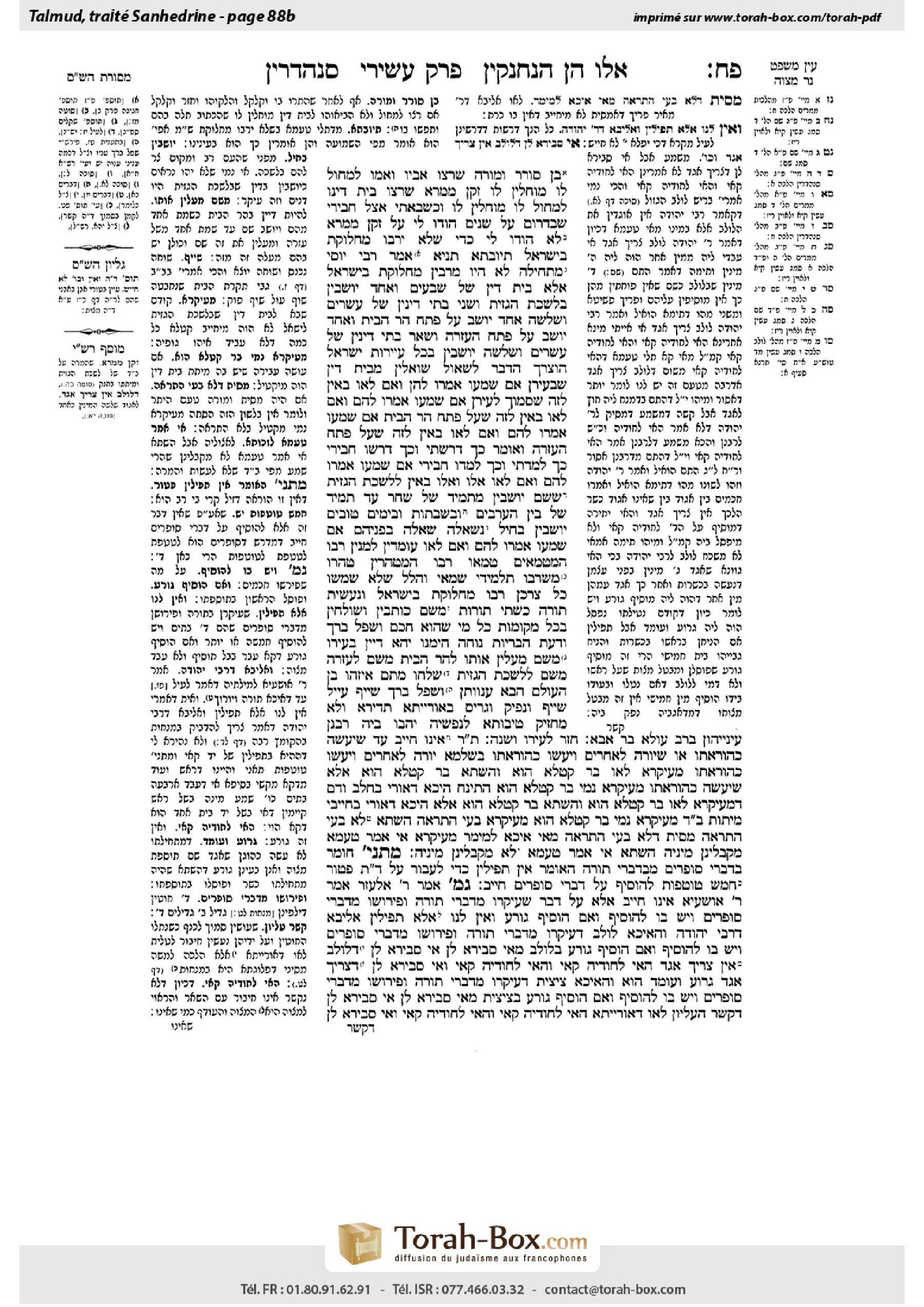
Sanhedrin 88b: Talmud study for Daf Yomi
Daf Yomi is the daily study of one Talmud folio. Explore 37 tractates with scans, Hebrew text, Sefaria English and AI-generated French translations where annotated.
Passage selection and English or AI-generated French translation are available where the scan has annotations. Daf Study is independent of Torah-Box and Sefaria.
Browse Sanhedrin · סנהדרין · All tractatesSanhedrin 88b text and translations
This page of Sanhedrin includes the Aramaic text, an English translation and an AI-generated French translation, alongside the scan above.
סנהדרין פ״ח ב · Aramaic and Hebrew text
בֵּן סוֹרֵר וּמוֹרֶה, שֶׁרָצוּ אָבִיו וְאִמּוֹ לִמְחוֹל לוֹ – מוֹחֲלִין לוֹ.
זָקֵן מַמְרֵא שֶׁרָצוּ בֵּית דִּינוֹ לִמְחוֹל לוֹ – מוֹחֲלִין לוֹ. וּכְשֶׁבָּאתִי אֵצֶל חֲבֵירַי שֶׁבַּדָּרוֹם, עַל שְׁנַיִם הוֹדוּ לִי, עַל זָקֵן מַמְרֵא לֹא הוֹדוּ לִי, כְּדֵי שֶׁלֹּא יִרְבּוּ מַחְלוֹקוֹת בְּיִשְׂרָאֵל. תְּיוּבְתָּא.
תַּנְיָא, אָמַר רַבִּי יוֹסֵי: מִתְּחִילָּה לֹא הָיוּ (מַרְבִּין) מַחְלוֹקוֹת בְּיִשְׂרָאֵל, אֶלָּא בֵּית דִּין שֶׁל שִׁבְעִים וְאֶחָד יוֹשְׁבִין בְּלִשְׁכַּת הַגָּזִית, וּשְׁנֵי בָּתֵּי דִינִין שֶׁל עֶשְׂרִים וּשְׁלֹשָׁה, אֶחָד יוֹשֵׁב עַל פֶּתַח הַר הַבַּיִת וְאֶחָד יוֹשֵׁב עַל פֶּתַח הָעֲזָרָה, וּשְׁאָר בָּתֵּי דִינִין שֶׁל עֶשְׂרִים וּשְׁלֹשָׁה יוֹשְׁבִין בְּכׇל עַיְירוֹת יִשְׂרָאֵל.
הוּצְרַךְ הַדָּבָר לִשְׁאוֹל, שׁוֹאֲלִין מִבֵּית דִּין שֶׁבְּעִירָן. אִם שָׁמְעוּ, אָמְרוּ לָהֶן. וְאִם לָאו, בָּאִין לָזֶה שֶׁסָּמוּךְ לְעִירָן. אִם שָׁמְעוּ, אָמְרוּ לָהֶם. וְאִם לָאו, בָּאִין לָזֶה שֶׁעַל פֶּתַח הַר הַבַּיִת. אִם שָׁמְעוּ, אָמְרוּ לָהֶם. וְאִם לָאו, בָּאִין לָזֶה שֶׁעַל פֶּתַח הָעֲזָרָה.
וְאוֹמֵר: כָּךְ דָּרַשְׁתִּי וְכָךְ דָּרְשׁוּ חֲבֵירַי, כָּךְ לִמַּדְתִּי וְכָךְ לִמְּדוּ חֲבֵירַי. אִם שָׁמְעוּ, אָמְרוּ לָהֶם. וְאִם לָאו, אֵלּוּ וָאֵלּוּ בָּאִין לְלִשְׁכַּת הַגָּזִית, שֶׁשָּׁם יוֹשְׁבִין מִתָּמִיד שֶׁל שַׁחַר עַד תָּמִיד שֶׁל בֵּין הָעַרְבַּיִם.
וּבְשַׁבָּתוֹת וּבְיָמִים טוֹבִים, יוֹשְׁבִין בַּחֵיל. נִשְׁאֲלָה שְׁאֵלָה בִּפְנֵיהֶם, אִם שָׁמְעוּ – אָמְרוּ לָהֶם, וְאִם לָאו – עוֹמְדִין לַמִּנְיָן. רַבּוּ הַמְטַמְּאִים – טִמְּאוּ, רַבּוּ הַמְּטַהֲרִין – טִהֲרוּ.
מִשֶּׁרַבּוּ תַּלְמִידֵי שַׁמַּאי וְהִלֵּל שֶׁלֹּא שִׁמְּשׁוּ כׇּל צָרְכָּן, רַבּוּ מַחְלוֹקוֹת בְּיִשְׂרָאֵל וְנַעֲשֵׂית תּוֹרָה כִּשְׁתֵּי תוֹרוֹת.
מִשָּׁם כּוֹתְבִין וְשׁוֹלְחִין בְּכׇל מְקוֹמוֹת: כׇּל מִי שֶׁהוּא חָכָם, וּשְׁפַל בֶּרֶךְ, וְדַעַת הַבְּרִיּוֹת נוֹחָה הֵימֶנּוּ – יְהֵא דַּיָּין בְּעִירוֹ. מִשָּׁם מַעֲלִין אוֹתוֹ לְהַר הַבַּיִת, מִשָּׁם לָעֲזָרָה, מִשָּׁם לְלִשְׁכַּת הַגָּזִית.
שְׁלַחוּ מִתָּם: אֵיזֶהוּ בֶּן הָעוֹלָם הַבָּא? עַנְוְותָן וּשְׁפַל בֶּרֶךְ, שָׁיֵיף עָיֵיל שָׁיֵיף וְנָפֵיק, וְגָרֵיס בְּאוֹרָיְיתָא תְּדִירָא, וְלָא מַחְזֵיק טֵיבוּתָא לְנַפְשֵׁיהּ. יְהַבוּ בֵּיהּ רַבָּנַן עֵינַיְיהוּ בְּרַב עוּלָּא בַּר אַבָּא.
חָזַר לְעִירוֹ וְשָׁנָה. תָּנוּ רַבָּנַן: אֵינוֹ חַיָּיב עַד שֶׁיַּעֲשֶׂה כְּהוֹרָאָתוֹ, אוֹ שֶׁיּוֹרֶה לַאֲחֵרִים וְיַעֲשׂוּ כְּהוֹרָאָתוֹ.
בִּשְׁלָמָא יוֹרֶה לַאֲחֵרִים וְיַעֲשׂוּ כְּהוֹרָאָתוֹ – מֵעִיקָּרָא לָאו בַּר קְטָלָא הוּא, וְהַשְׁתָּא בַּר קְטָלָא הוּא. אֶלָּא שֶׁיַּעֲשֶׂה כְּהוֹרָאָתוֹ? מֵעִיקָּרָא נָמֵי בַּר קְטָלָא הוּא! הָתִינַח הֵיכָא דְּאוֹרִי בְּחֵלֶב וָדָם, דְּמֵעִיקָּרָא לָאו בַּר קְטָלָא הוּא וְהַשְׁתָּא בַּר קְטָלָא הוּא. אֶלָּא הֵיכָא דְּאוֹרִי בְּחַיָּיבֵי מִיתוֹת בֵּית דִּין, מֵעִיקָּרָא נָמֵי בַּר קְטָלָא הוּא!
מֵעִיקָּרָא – בָּעֵי הַתְרָאָה, הַשְׁתָּא – לָא בָּעֵי הַתְרָאָה.
מֵסִית, דְּלָא בָּעֵי הַתְרָאָה, מַאי אִיכָּא לְמֵימַר? מֵעִיקָּרָא, אִי אָמַר טַעְמָא – מְקַבְּלִינַן מִינֵּיהּ. הַשְׁתָּא, אִי אָמַר טַעְמָא – לָא מְקַבְּלִינַן מִינֵּיהּ.
מַתְנִי׳ חוֹמֶר בְּדִבְרֵי סוֹפְרִים מִבְּדִבְרֵי תוֹרָה. הָאוֹמֵר: ״אֵין תְּפִילִּין״, כְּדֵי לַעֲבוֹר עַל דִּבְרֵי תוֹרָה – פָּטוּר. ״חָמֵשׁ טוֹטָפוֹת״, לְהוֹסִיף עַל דִּבְרֵי סוֹפְרִים – חַיָּיב.
גְּמָ׳ אָמַר רַבִּי אֶלְעָזָר אָמַר רַבִּי אוֹשַׁעְיָא: אֵינוֹ חַיָּיב אֶלָּא עַל דָּבָר שֶׁעִיקָּרוֹ מִדִּבְרֵי תוֹרָה וּפֵירוּשׁוֹ מִדִּבְרֵי סוֹפְרִים, וְיֵשׁ בּוֹ לְהוֹסִיף, וְאִם הוֹסִיף גּוֹרֵעַ. וְאֵין לָנוּ אֶלָּא תְּפִילִּין, אַלִּיבָּא דְּרַבִּי יְהוּדָה.
וְהָאִיכָּא לוּלָב, דְּעִיקָּרוֹ מִדִּבְרֵי תוֹרָה וּפֵירוּשׁוֹ מִדִּבְרֵי סוֹפְרִים, וְיֵשׁ בּוֹ לְהוֹסִיף, וְאִם הוֹסִיף – גּוֹרֵעַ?
בְּלוּלָב, מַאי סְבִירָא לַן? אִי סְבִירָא לַן דְּלוּלָב אֵין צָרִיךְ אֶגֶד, הַאי לְחוֹדֵיהּ קָאֵי וְהַאי לְחוֹדֵיהּ קָאֵי. וְאִי סְבִירָא לַן דְּצָרִיךְ אֶגֶד, גָּרוּעַ וְעוֹמֵד הוּא.
וְהָאִיכָּא צִיצִית, דְּעִיקָּרוֹ מִדִּבְרֵי תוֹרָה וּפֵירוּשׁוֹ מִדִּבְרֵי סוֹפְרִים, וְיֵשׁ בּוֹ לְהוֹסִיף, וְאִם הוֹסִיף – גּוֹרֵעַ?
בְּצִיצִית, מַאי סְבִירָא לַן? אִי סְבִירָא לַן דְּקֶשֶׁר הָעֶלְיוֹן לָאו דְּאוֹרָיְיתָא, הַאי לְחוֹדֵיהּ קָאֵי וְהַאי לְחוֹדֵיהּ קָאֵי. וְאִי סְבִירָא לַן
Sanhedrin 88b · English translation
The second matter is that in the case of a stubborn and rebellious son whose father and mother sought to forgive him for his gluttonous and drunken conduct and decided not to bring him to court, they can forgive him.
The third is that in the case of a rebellious elder whom his court sought to forgive for his deviation from their ruling, they can forgive him. And when I came to my colleagues in the South, with regard to two of the cases they agreed with me, but with regard to a rebellious elder they did not agree with me, so that discord would not proliferate in Israel. This supports the opinion of Rabbi Elazar and is a conclusive refutation of the opinion of Rav Kahana.
It is taught in a baraita that Rabbi Yosei said: Initially, discord would not proliferate among Israel. Rather, the court of seventy-one judges would sit in the Chamber of Hewn Stone. And there were two additional courts each consisting of twenty-three judges; one would convene at the entrance to the Temple Mount, and one would convene at the entrance to the Temple courtyard. And all the other courts consisting of twenty-three judges would convene in all cities inhabited by the Jewish people.
If the matter was unclear and it was necessary to ask and clarify it, those uncertain of the halakha would ask the court that is in their city. If the members of the court heard a clear halakhic ruling with regard to that matter, they said it to them, and if not, they would come to a court that is adjacent to their city. If the members of the court heard a clear halakhic ruling with regard to that matter, they said it to them, and if not, they would come to the court at the entrance to the Temple Mount. If the members of the court heard a clear halakhic ruling with regard to that matter, they said it to them, and if not, they would come to the court at the entrance to the Temple courtyard.
And the elder whose ruling deviated from the ruling of his colleagues says: This is what I interpreted and that is what my colleagues interpreted; this is what I taught and that is what my colleagues taught. If the members of the court heard a clear halakhic ruling with regard to that matter, they said it to them, and if not, these judges and those judges would come to the Chamber of Hewn Stone, where the Sanhedrin would be convened from the time that the daily morning offering is sacrificed until the time that the daily afternoon offering is sacrificed.
And on Shabbatot and Festivals, when court is not in session, the members of the court would sit at the rampart. When a question was asked before them, if the members of the court heard a clear halakhic ruling with regard to that matter, they would say it to them, and if not they would stand for a vote on the matter. If the judges who deemed the item in question ritually impure outnumbered those who deemed it pure, the court would deem the item impure. If the judges who deemed the item in question ritually pure outnumbered those who deemed it impure, the court would deem the item pure.
From the time that the disciples of Shammai and Hillel grew in number, and they were disciples who did not attend to their masters to the requisite degree, dispute proliferated among the Jewish people and the Torah became like two Torahs. Two disparate systems of halakha developed, and there was no longer a halakhic consensus with regard to every matter.
The baraita continues its discussion of the workings of the Sanhedrin: From there, the Sanhedrin writes and dispatches the following statement to all places: Anyone who is wise and humble and the minds of people are at ease with him shall be a judge in his city. If he is successful in his city, from there, they promote him to the court at the entrance to the Temple Mount if there is a vacant seat on the court, and from there they promote him to the court at the entrance to the Temple courtyard, and from there to the court in the Chamber of Hewn Stone.
Apropos the appointment of judges, the Gemara relates that they sent the following statement from there, i.e., Eretz Yisrael: Who is the one destined to receive a place in the World-to-Come? It is one who is modest and humble, who bows and enters and bows and exits, and who studies Torah regularly, and who does not take credit for himself. The Sages cast their eyes on Rav Ulla bar Abba, as they perceived him as the embodiment of all these characteristics.
The mishna teaches: If the rebellious elder returned to his city and he taught in the manner that he was teaching previously, he is exempt from punishment, unless he instructs others to act on the basis of his ruling. The Sages taught: He is not liable unless he acts in accordance with his ruling, or he instructs others and they act in accordance with his ruling.
The Gemara challenges: Granted, if he instructs others and they act in accordance with his ruling there is a novel element in the fact that he is liable to be executed, as initially, before he was deemed a rebellious elder, he is not liable to receive the death penalty for instructing others to perform the transgression, and now, he is to receive the death penalty. But if he acts in accordance with his ruling, initially, before he was deemed a rebellious elder, he is also liable to receive the death penalty for performing that action. The Gemara clarifies the difficulty: This works out well in a case where he ruled with regard to forbidden fat and blood, as initially he would not have been liable to receive the death penalty; rather, he would have been liable to receive karet, and now he is liable to receive the death penalty. But in a case where he ruled with regard to a transgression for which one is liable to receive a court-imposed death penalty, initially, he is also liable to receive the death penalty.
The Gemara explains: There is a novel element even in a case where he acts in accordance with his ruling, as initially, before he is deemed a rebellious elder, he requires forewarning in order to be executed; now, he does not require forewarning in order to be executed.
The Gemara asks: If the rebellious elder’s ruling was with regard to one who instigates others to engage in idol worship, who does not require forewarning, what is there to say? Both before and after he is deemed a rebellious elder he is executed without forewarning. The Gemara answers: Initially, before the rebellious elder ruled that instigating others to engage in idol worship is permitted, if after he instigated others, he stated a reason why he thought that it is permitted, we accept his explanation from him and exempt him. Now, after he issued the divergent ruling, if he stated a reason, we do not accept the explanation from him, since he already indicated that he holds that instigating others to engage in idol worship incitement is permitted and that is the reason that he engaged in instigation.
MISHNA: With regard to the rulings of the rebellious elder the mishna states: There is greater stringency with regard to traditional rabbinic interpretations of the Torah than with regard to matters of Torah. If one states: There is no mitzva to don phylacteries, and his intention is in order to have others violate matters of Torah, he is exempt from punishment as a rebellious elder. One who disputes matters written explicitly in the Torah is not considered an elder and a Torah scholar, and therefore does not assume the status of a rebellious elder. If, however, he disputed a matter based on rabbinic tradition, e.g., he stated that there should be five compartments in the phylacteries of the head, in order to add an extra compartment to the four established according to traditional rabbinic interpretations of the Torah, he is liable.
GEMARA: Rabbi Elazar says that Rabbi Oshaya says: One is liable only for issuing a ruling with regard to a matter whose essence, whose basic obligation, is from matters of Torah and whose explanation is from traditional rabbinic interpretations of the Torah and which includes the possibility to add to it, and if one added to it, one compromises his fulfillment of the mitzva and does not satisfy his obligation. And we have only the mitzva to don phylacteries that meets those criteria. And Rabbi Oshaya’s statement is in accordance with the opinion of Rabbi Yehuda, who says: A rebellious elder is liable only for a matter whose essence is from matters of Torah and whose explanation is from traditional rabbinic interpretations of the Torah.
The Gemara asks: But isn’t there the mitzva of lulav and the other species that one takes on the festival of Sukkot, whose essence is from matters of Torah, and whose explanation is from traditional rabbinic interpretations that establish the identity and the number of the four species enumerated in the Torah, and which includes the possibility to add other species to it, and if one added to it, one compromises his fulfillment of the mitzva and does not satisfy his obligation?
The Gemara rejects this possibility: That is not the case, as with regard to the mitzva of lulav, what do we hold? If we hold that fundamentally a lulav does not require binding of the species together in order to fulfill the mitzva, then adding an additional species is inconsequential, as these species with which he fulfills the mitzva stand alone and that additional species stands alone. It is as though he were holding the species of the mitzva and an additional unrelated item that does not affect fulfillment of the mitzva. And if we hold that a lulav requires binding of the four species together in order to fulfill the mitzva, fulfillment of the mitzva is already compromised from the outset. The rebellious elder is liable only when the object of the mitzva was as it should be and the addition compromised that object and disqualifies it. In this case, the object was never as it should be.
The Gemara asks: But isn’t there the mitzva of ritual fringes, whose essence is from matters of Torah, and whose explanation is from traditional rabbinic interpretations that establish the number of fringes enumerated in the Torah and the number of threads in each fringe, and which includes the possibility to add fringes or threads to it, and if one added to it, one compromises his fulfillment of the mitzva and does not satisfy his obligation?
The Gemara rejects this possibility: That is not the case, as with regard to ritual fringes, what do we hold? If we hold that the upper knot is not mandated by Torah law, and one fulfills his obligation by placing the threads on the corner of the garment, these threads with which he fulfills the mitzva are independent and that additional thread is independent and does not compromise fulfillment of the mitzva. The additional string is not considered as joined to the required strings. And if we hold
Sanhedrin 88b · Traduction française (IA)
La deuxième affaire concerne le fils rebelle et récalcitrant dont le père et la mère ont voulu pardonner la conduite gloutonne et l’ivrognerie, et ont décidé de ne pas le traduire en justice : ils peuvent lui pardonner.
La troisième concerne l’ancien rebelle dont le tribunal a voulu pardonner l’écart par rapport à sa décision : il peut lui pardonner. Lorsque je suis allé auprès de mes collègues du Sud, ils m’ont donné raison dans deux des cas, mais pas dans celui de l’ancien rebelle, afin que la discorde ne se répande pas en Israël. Cela appuie l’opinion de Rabbi Elazar et réfute de manière décisive celle de Rav Kahana.
Il est enseigné dans une baraïta que Rabbi Yosei a dit : Au début, la discorde ne se répandait pas parmi Israël. Le tribunal des soixante et onze juges siégeait dans la Chambre de pierre de taille. Il y avait en outre deux tribunaux, chacun composé de vingt-trois juges : l’un siégeait à l’entrée du mont du Temple et l’autre à l’entrée de la cour du Temple. Tous les autres tribunaux de vingt-trois juges siégeaient dans chacune des villes habitées par le peuple juif.
Si la question n’était pas claire et qu’il fallait la poser et l’élucider, ceux qui doutaient de la halakha interrogeaient le tribunal de leur ville. Si ses membres connaissaient une décision halakhique claire à ce sujet, ils la leur communiquaient ; sinon, ils se rendaient auprès d’un tribunal d’une ville voisine. Si les membres de ce tribunal connaissaient une décision halakhique claire à ce sujet, ils la leur communiquaient ; sinon, ils se rendaient auprès du tribunal situé à l’entrée du mont du Temple. Si ses membres connaissaient une décision halakhique claire à ce sujet, ils la leur communiquaient ; sinon, ils se rendaient auprès du tribunal situé à l’entrée de la cour du Temple.
Et l’ancien dont la décision s’écartait de celle de ses collègues disait : « Voici comment j’ai interprété la loi et voici comment mes collègues l’ont interprétée ; voici ce que j’ai enseigné et voici ce que mes collègues ont enseigné. » Si les membres du tribunal connaissaient une décision halakhique claire à ce sujet, ils la leur communiquaient ; sinon, les uns et les autres se rendaient dans la Chambre de pierre de taille, où le Sanhédrin siégeait depuis le moment où l’on offrait l’holocauste quotidien du matin jusqu’à celui où l’on offrait l’holocauste quotidien de l’après-midi.
Le Chabbat et les jours de fête, lorsque le tribunal ne siégeait pas, ses membres s’installaient sur le rempart. Lorsqu’une question leur était posée, si les membres du tribunal connaissaient une décision halakhique claire à ce sujet, ils la communiquaient ; sinon, ils procédaient à un vote. Si les juges qui déclaraient l’objet rituellement impur étaient plus nombreux que ceux qui le déclaraient pur, le tribunal le déclarait impur. Si les juges qui le déclaraient rituellement pur étaient plus nombreux que ceux qui le déclaraient impur, le tribunal le déclarait pur.
À partir du moment où les disciples de Chammaï et de Hillel se multiplièrent — des disciples qui ne servaient pas leurs maîtres autant qu’ils l’auraient dû —, les controverses se répandirent parmi le peuple juif et la Torah devint comme deux Torah. Deux systèmes halakhiques divergents se développèrent, et il n’y eut plus de consensus halakhique sur chaque question.
La baraïta poursuit son exposé sur le fonctionnement du Sanhédrin : de là, le Sanhédrin rédige et envoie le message suivant dans tous les lieux : « Toute personne sage et humble, auprès de qui les gens se sentent à l’aise, sera juge dans sa ville. S’il réussit dans sa ville, on le promeut de là au tribunal situé à l’entrée du mont du Temple, s’il y a un siège vacant ; de là, on le promeut au tribunal situé à l’entrée de la cour du Temple, puis au tribunal de la Chambre de pierre de taille. »
À propos de la nomination des juges, la Guemara rapporte qu’on envoya de là, c’est-à-dire de la terre d’Israël, le message suivant : Qui est destiné à recevoir une part dans le monde à venir ? Celui qui est discret et humble, qui s’incline en entrant et en sortant, qui étudie régulièrement la Torah et ne s’attribue pas de mérite. Les Sages fixèrent leur regard sur Rav Ulla bar Abba, car ils voyaient en lui l’incarnation de toutes ces qualités.
La Michna enseigne : Si l’ancien rebelle retourne dans sa ville et enseigne comme auparavant, il est exempt de peine, à moins qu’il n’ordonne à d’autres d’agir conformément à sa décision. Les Sages ont enseigné : Il n’est passible que s’il agit conformément à sa décision, ou s’il donne des instructions à d’autres et qu’ils agissent conformément à sa décision.
La Guemara objecte : Certes, s’il donne des instructions à d’autres et qu’ils agissent conformément à sa décision, il y a un élément nouveau dans le fait qu’il soit passible de la peine de mort : auparavant, avant d’être considéré comme un ancien rebelle, il n’était pas passible de la peine de mort pour avoir ordonné à d’autres de commettre la transgression, tandis que maintenant, il l’est. Mais s’il agit conformément à sa décision, auparavant, avant d’être considéré comme un ancien rebelle, il était lui aussi passible de la peine de mort pour avoir accompli cet acte. La Guemara précise la difficulté : cela s’explique dans le cas où il a statué au sujet de la graisse interdite et du sang, car auparavant, il n’aurait pas été passible de la peine de mort, mais du karet, tandis que maintenant, il est passible de la peine de mort. Mais dans le cas où il a statué au sujet d’une transgression passible de la peine de mort prononcée par un tribunal, auparavant, il était lui aussi passible de la peine de mort.
La Guemara explique : Il y a un élément nouveau même dans le cas où il agit conformément à sa décision, car auparavant, avant d’être considéré comme un ancien rebelle, il fallait le mettre en garde pour pouvoir le condamner à mort ; maintenant, il n’est pas nécessaire de le mettre en garde pour pouvoir le condamner à mort.
La Guemara demande : Que peut-on dire si la décision de l’ancien rebelle portait sur celui qui incite d’autres à pratiquer l’idolâtrie, pour lequel une mise en garde n’est pas nécessaire ? Avant comme après avoir été considéré comme un ancien rebelle, il est exécuté sans mise en garde. La Guemara répond : Auparavant, avant que l’ancien rebelle ne statue que l’incitation d’autrui à pratiquer l’idolâtrie est permise, si, après avoir incité les autres, il expliquait pourquoi il pensait que cela était permis, nous acceptions son explication et l’exemptions. Maintenant, après qu’il a rendu une décision divergente, s’il avance une explication, nous ne l’acceptons pas, puisqu’il a déjà indiqué qu’à ses yeux, inciter d’autres à pratiquer l’idolâtrie est permis et que c’est pour cette raison qu’il les a incités.
MICHNA : À propos des décisions de l’ancien rebelle, la Michna enseigne : La rigueur est plus grande pour les interprétations traditionnelles rabbiniques de la Torah que pour les questions relevant de la Torah. Si quelqu’un déclare : « Il n’y a pas de mitsva de mettre les téfilines », dans l’intention d’amener d’autres à transgresser des prescriptions de la Torah, il est exempt de peine en tant qu’ancien rebelle. Celui qui conteste des prescriptions explicitement écrites dans la Torah n’est considéré ni comme un ancien ni comme un sage de la Torah et n’acquiert donc pas le statut d’ancien rebelle. En revanche, s’il conteste une question fondée sur la tradition rabbinique, par exemple s’il affirme que les téfilines de la tête doivent comporter cinq compartiments, ajoutant ainsi un compartiment aux quatre établis par les interprétations traditionnelles rabbiniques de la Torah, il est passible de peine.
GUEMARA : Rabbi Elazar dit au nom de Rabbi Oshaya : On n’est passible que pour avoir rendu une décision sur une question dont le principe, c’est-à-dire l’obligation fondamentale, relève des prescriptions de la Torah, dont l’explication relève des interprétations traditionnelles rabbiniques de la Torah, et à laquelle on peut ajouter un élément tel que cet ajout compromet l’accomplissement de la mitsva et empêche de s’acquitter de son obligation. Nous ne connaissons que la mitsva de mettre les téfilines qui répond à ces critères. La déclaration de Rabbi Oshaya est conforme à l’opinion de Rabbi Yehuda, qui dit : Un ancien rebelle n’est passible que pour une question dont le principe relève des prescriptions de la Torah et dont l’explication relève des interprétations traditionnelles rabbiniques de la Torah.
La Guemara demande : Mais n’y a-t-il pas la mitsva du loulav et des autres espèces que l’on prend à la fête de Souccot, dont le principe relève des prescriptions de la Torah, dont l’explication relève des interprétations traditionnelles rabbiniques qui établissent l’identité et le nombre des quatre espèces énumérées dans la Torah, et auxquelles on peut ajouter d’autres espèces, alors que cet ajout compromet l’accomplissement de la mitsva et empêche de s’acquitter de son obligation ?
La Guemara rejette cette possibilité : ce n’est pas le cas. En effet, concernant la mitsva du loulav, quelle est notre position ? Si nous considérons qu’en principe, il n’est pas nécessaire de lier ensemble les espèces pour accomplir la mitsva, l’ajout d’une espèce supplémentaire est sans conséquence : les espèces avec lesquelles il accomplit la mitsva restent indépendantes, tout comme l’espèce ajoutée. C’est comme s’il tenait les espèces requises pour la mitsva ainsi qu’un objet supplémentaire sans rapport avec elles, qui n’affecte pas l’accomplissement de la mitsva. Et si nous considérons qu’il faut lier ensemble les quatre espèces pour accomplir la mitsva, alors celle-ci est déjà compromise dès le départ. L’ancien rebelle n’est passible que lorsque l’objet de la mitsva est conforme à ce qu’il doit être et que l’ajout le compromet et l’invalide. Dans ce cas, l’objet n’a jamais été conforme à ce qu’il devait être.
La Guemara demande : Mais n’y a-t-il pas la mitsva des franges rituelles, dont le principe relève des prescriptions de la Torah, dont l’explication relève des interprétations traditionnelles rabbiniques qui établissent le nombre de franges mentionné dans la Torah et le nombre de fils de chaque frange, et auxquelles on peut ajouter des franges ou des fils, alors que cet ajout compromet l’accomplissement de la mitsva et empêche de s’acquitter de son obligation ?
La Guemara rejette cette possibilité : ce n’est pas le cas. En effet, concernant les franges rituelles, quelle est notre position ? Si nous considérons que le nœud supérieur n’est pas prescrit par la Torah, et que l’on s’acquitte de son obligation en plaçant les fils au coin du vêtement, les fils avec lesquels on accomplit la mitsva sont indépendants, tout comme le fil supplémentaire, qui ne compromet donc pas l’accomplissement de la mitsva. Le fil supplémentaire n’est pas considéré comme joint aux fils requis. Et si nous considérons
Traduction française générée par IA à partir de l’édition anglaise de Sefaria. Vérifie toujours un passage avec le texte source.
Text from Sefaria: William Davidson Edition - Vocalized Aramaic (CC BY NC); William Davidson Edition - English (CC BY NC).