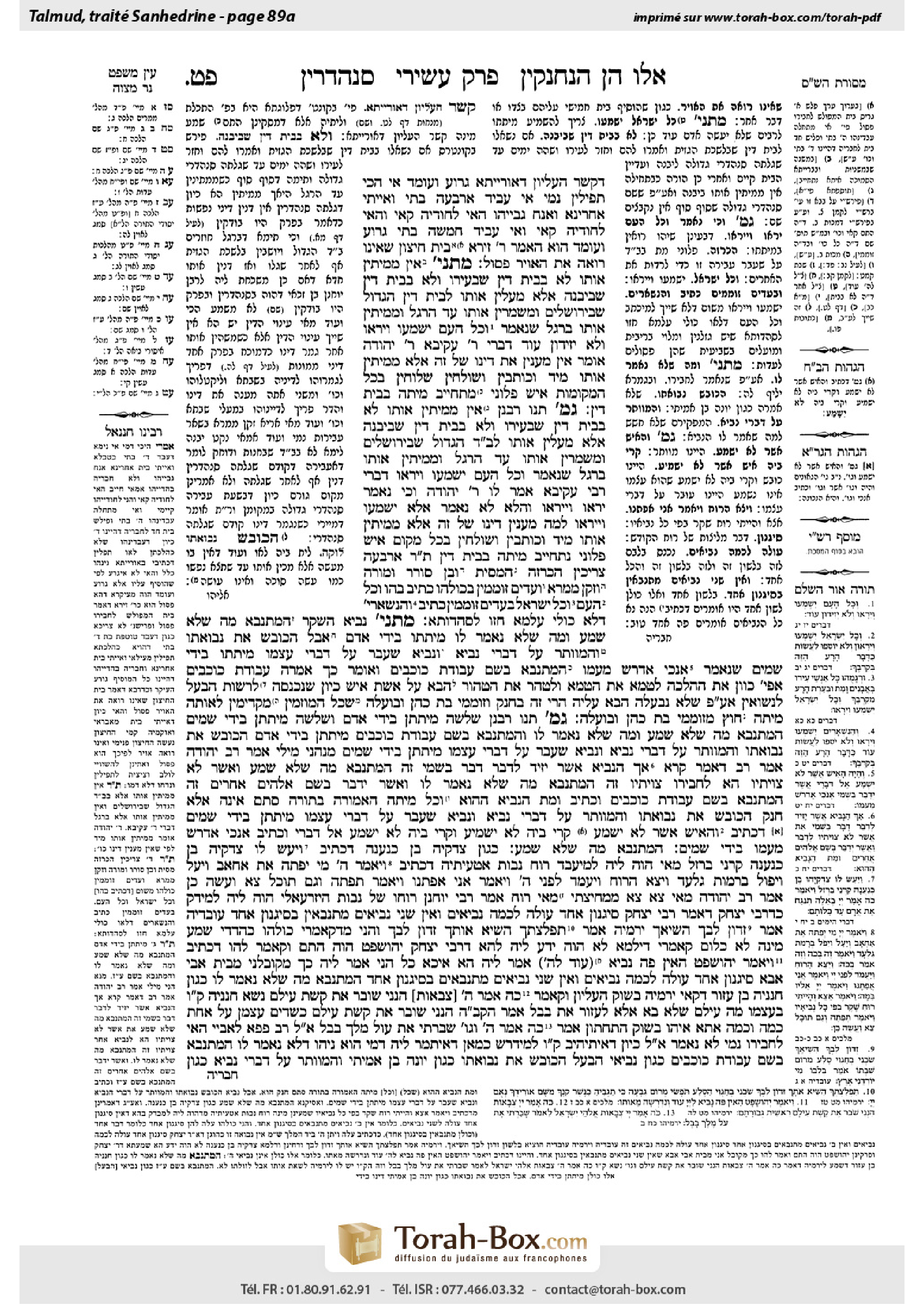
Sanhedrin 89a: Talmud study for Daf Yomi
Daf Yomi is the daily study of one Talmud folio. Explore 37 tractates with scans, Hebrew text, Sefaria English and AI-generated French translations where annotated.
Passage selection and English or AI-generated French translation are available where the scan has annotations. Daf Study is independent of Torah-Box and Sefaria.
Browse Sanhedrin · סנהדרין · All tractatesSanhedrin 89a text and translations
This page of Sanhedrin includes the Aramaic text, an English translation and an AI-generated French translation, alongside the scan above.
סנהדרין פ״ט א · Aramaic and Hebrew text
דְּקֶשֶׁר הָעֶלְיוֹן דְּאוֹרָיְיתָא, גָּרוּעַ וְעוֹמֵד.
אִי הָכִי, תְּפִילִּין נָמֵי? אִי עֲבַד אַרְבְּעָה בָּתֵּי, וְאַיְיתִי אַחֲרִינָא וְאַנַּח גַּבַּיְיהוּ – הַאי לְחוֹדֵיהּ קָאֵי וְהַאי לְחוֹדֵיהּ קָאֵי. וְאִי עֲבַד חַמְשָׁה בָּתֵּי – גָּרוּעַ וְעוֹמֵד הוּא! הָאָמַר רַבִּי זֵירָא: בַּיִת חִיצוֹן שֶׁאֵינוֹ רוֹאֶה אֶת הָאֲוִיר – פָּסוּל.
מַתְנִי׳ אֵין מְמִיתִין אוֹתוֹ לֹא בְּבֵית דִּין שֶׁבְּעִירוֹ, וְלֹא בְּבֵית דִּין שֶׁבְּיַבְנֶה, אֶלָּא מַעֲלִין אוֹתוֹ לְבֵית דִּין הַגָּדוֹל שֶׁבִּירוּשָׁלַיִם. וּמְשַׁמְּרִין אוֹתוֹ עַד הָרֶגֶל, וּמְמִיתִין אוֹתוֹ בָּרֶגֶל, שֶׁנֶּאֱמַר: ״וְכׇל הָעָם יִשְׁמְעוּ וְיִרָאוּ וְלֹא יְזִידוּן עוֹד״. דִּבְרֵי רַבִּי עֲקִיבָא. רַבִּי יְהוּדָה אוֹמֵר: אֵין מְעַנִּין אֶת דִּינוֹ שֶׁל זֶה, אֶלָּא מְמִיתִין אוֹתוֹ מִיָּד, וְכוֹתְבִין וְשׁוֹלְחִין שְׁלוּחִין בְּכׇל הַמְּקוֹמוֹת: ״אִישׁ פְּלוֹנִי מִתְחַיֵּיב מִיתָה בְּבֵית דִּין״.
גְּמָ׳ תָּנוּ רַבָּנַן: אֵין מְמִיתִין אוֹתוֹ לֹא בְּבֵית דִּין שֶׁבְּעִירוֹ וְלֹא בְּבֵית דִּין שֶׁבְּיַבְנֶה, אֶלָּא מַעֲלִין אוֹתוֹ לְבֵית דִּין הַגָּדוֹל שֶׁבִּירוּשָׁלַיִם וּמְשַׁמְּרִין אוֹתוֹ עַד הָרֶגֶל, וּמְמִיתִין אוֹתוֹ בָּרֶגֶל, שֶׁנֶּאֱמַר: ״וְכׇל הָעָם יִשְׁמְעוּ וְיִרָאוּ״. דִּבְרֵי רַבִּי עֲקִיבָא.
אָמַר לוֹ רַבִּי יְהוּדָה: וְכִי נֶאֱמַר ״יִרְאוּ וְיִירָאוּ״? וַהֲלֹא לֹא נֶאֱמַר אֶלָּא ״יִשְׁמְעוּ וְיִירָאוּ״! לָמָּה מְעַנִּין דִּינוֹ שֶׁל זֶה? אֶלָּא, מְמִיתִין אוֹתוֹ מִיָּד, וְכוֹתְבִין וְשׁוֹלְחִין בְּכׇל מָקוֹם: ״אִישׁ פְּלוֹנִי נִתְחַיֵּיב מִיתָה בְּבֵית דִּין״.
תָּנוּ רַבָּנַן: אַרְבָּעָה צְרִיכִין הַכְרָזָה – הַמֵּסִית, וּבֵן סוֹרֵר וּמוֹרֶה, וְזָקֵן מַמְרֵא, וְעֵדִים זוֹמְמִין. בְּכוּלְּהוּ כְּתִיב בְּהוּ ״וְכׇל הָעָם״ וְ״כׇל יִשְׂרָאֵל״. בְּעֵדִים זוֹמְמִין כְּתִיב ״וְהַנִּשְׁאָרִים״? דְּלָא כּוּלֵּי עָלְמָא חֲזוּ לְסָהֲדוּתָא.
מַתְנִי׳ נְבִיא הַשֶּׁקֶר הַמִּתְנַבֵּא מַה שֶּׁלֹּא שָׁמַע, וּמַה שֶּׁלֹּא נֶאֱמַר לוֹ – מִיתָתוֹ בִּידֵי אָדָם.
אֲבָל הַכּוֹבֵשׁ אֶת נְבוּאָתוֹ, וְהַמְוַותֵּר עַל דִּבְרֵי נָבִיא, וְנָבִיא שֶׁעָבַר עַל דִּבְרֵי עַצְמוֹ – מִיתָתוֹ בִּידֵי שָׁמַיִם, שֶׁנֶּאֱמַר: ״אָנֹכִי אֶדְרֹשׁ מֵעִמּוֹ״.
הַמִּתְנַבֵּא בְּשֵׁם עֲבוֹדָה זָרָה, וְאוֹמֵר: ״כָּךְ אָמְרָה עֲבוֹדָה זָרָה״, אֲפִילּוּ כִּוֵּון אֶת הַהֲלָכָה לְטַמֵּא אֶת הַטָּמֵא וּלְטַהֵר אֶת הַטָּהוֹר.
הַבָּא עַל אֵשֶׁת אִישׁ, כֵּיוָן שֶׁנִּכְנְסָה לִרְשׁוּת הַבַּעַל לְנִשּׂוּאִין, אַף עַל פִּי שֶׁלֹּא נִבְעֲלָה, הַבָּא עָלֶיהָ הֲרֵי זֶה בְּחֶנֶק.
וְזוֹמְמֵי בַּת כֹּהֵן וּבוֹעֲלָהּ, שֶׁכׇּל הַמּוּזַמִּין מַקְדִּימִין לְאוֹתָהּ מִיתָה, חוּץ מִזּוֹמְמֵי בַּת כֹּהֵן וּבוֹעֲלָהּ.
גְּמָ׳ תָּנוּ רַבָּנַן: שְׁלֹשָׁה מִיתָתָן בִּידֵי אָדָם, וּשְׁלֹשָׁה מִיתָתָן בִּידֵי שָׁמַיִם. הַמִּתְנַבֵּא מַה שֶּׁלֹּא שָׁמַע, וּמַה שֶּׁלֹּא נֶאֱמַר לוֹ, וְהַמִּתְנַבֵּא בְּשֵׁם עֲבוֹדָה זָרָה – מִיתָתָן בִּידֵי אָדָם. הַכּוֹבֵשׁ אֶת נְבוּאָתוֹ, וְהַמְוַותֵּר עַל דִּבְרֵי נָבִיא, וְנָבִיא שֶׁעָבַר עַל דִּבְרֵי עַצְמוֹ – מִיתָתָן בִּידֵי שָׁמַיִם.
מְנָהָנֵי מִילֵּי? אָמַר רַב יְהוּדָה אָמַר רַב, דְּאָמַר קְרָא: ״אַךְ הַנָּבִיא אֲשֶׁר יָזִיד לְדַבֵּר דָּבָר בִּשְׁמִי״. זֶה הַמִּתְנַבֵּא מַה שֶּׁלֹּא שָׁמַע. ״וַאֲשֶׁר לֹא צִוִּיתִיו״ – הָא לַחֲבֵירוֹ צִוִּיתִיו, זֶה הַמִּתְנַבֵּא מַה שֶּׁלֹּא נֶאֱמַר לוֹ. ״וַאֲשֶׁר יְדַבֵּר בְּשֵׁם אֱלֹהִים אֲחֵרִים״ – זֶה הַמִּתְנַבֵּא בְּשֵׁם עֲבוֹדָה זָרָה. וּכְתִיב: ״וּמֵת הַנָּבִיא הַהוּא״. וְכׇל מִיתָה הָאֲמוּרָה בְּתוֹרָה סְתָם – אֵינָהּ אֶלָּא חֶנֶק.
הַכּוֹבֵשׁ אֶת נְבוּאָתוֹ, וְהַמְוַותֵּר עַל דִּבְרֵי נָבִיא, וְנָבִיא שֶׁעָבַר עַל דִּבְרֵי עַצְמוֹ – מִיתָתָן בִּידֵי שָׁמַיִם. דִּכְתִיב: ״וְהָאִישׁ אֲשֶׁר לֹא יִשְׁמַע״. קְרִי בֵּיהּ: ״לֹא יַשְׁמִיעַ״, וּקְרִי בֵּיהּ: ״לֹא יִשְׁמַע אֶל דְּבָרַי״. וּכְתִיב: ״אָנֹכִי אֶדְרֹשׁ מֵעִמּוֹ״ – בִּידֵי שָׁמַיִם.
הַמִּתְנַבֵּא מַה שֶּׁלֹּא שָׁמַע, כְּגוֹן צִדְקִיָּה בֶן כְּנַעֲנָה, דִּכְתִיב: ״וַיַּעַשׂ לוֹ צִדְקִיָּהוּ בֶן כְּנַעֲנָה קַרְנֵי בַרְזֶל״. מַאי הֲוָה לֵיהּ לְמֶעְבַּד? רוּחַ נָבוֹת אַטְעִיתֵיהּ, דִּכְתִיב: ״וַיֹּאמֶר ה׳ מִי יְפַתֶּה אֶת אַחְאָב וְיַעַל וְיִפֹּל בְּרָמֹת גִּלְעָד״. ״וַיֵּצֵא הָרוּחַ וַיַּעֲמֹד לִפְנֵי ה׳ וַיֹּאמֶר אֲנִי אֲפַתֶּנּוּ״. ״וַיֹּאמֶר תְּפַתֶּה וְגַם תּוּכָל צֵא וַעֲשֵׂה כֵן״.
אָמַר רַב יְהוּדָה: מַאי ״צֵא״? צֵא מִמְּחִיצָתִי. מַאי רוּחַ? אָמַר רַבִּי יוֹחָנָן: רוּחוֹ שֶׁל נָבוֹת הַיִּזְרְעֵאלִי.
הֲוָה לֵיהּ לְמֵידַק, כִּדְרַבִּי יִצְחָק, דְּאָמַר רַבִּי יִצְחָק: סִיגְנוֹן אֶחָד עוֹלֶה לְכַמָּה נְבִיאִים, וְאֵין שְׁנֵי נְבִיאִים מִתְנַבְּאִין בְּסִיגְנוֹן אֶחָד.
עוֹבַדְיָה אָמַר: ״זְדוֹן לִבְּךָ הִשִּׁיאֶךָ״. יִרְמְיָה אָמַר: ״תִּפְלַצְתְּךָ הִשִּׁיא אֹתָךְ זְדוֹן לִבֶּךָ״. וְהָנֵי, מִדְּקָאָמְרִי כּוּלְּהוּ כַּהֲדָדֵי, שְׁמַע מִינַּהּ לָא כְּלוּם קָאָמְרִי.
דִּילְמָא לָא הֲוָה יָדַע לֵיהּ לְהָא דְּרַבִּי יִצְחָק? יְהוֹשָׁפָט הֲוָה הָתָם, וְקָאָמַר לְהוּ. דִּכְתִיב: ״וַיֹּאמֶר יְהוֹשָׁפָט הַאֵין פֹּה נָבִיא עוֹד לַה׳״. אֲמַר לֵיהּ: הָא אִיכָּא כֹּל הָנֵי. אֲמַר לֵיהּ: כָּךְ מְקוּבְּלַנִי מִבֵּית אֲבִי אַבָּא: סִיגְנוֹן אֶחָד עוֹלֶה לְכַמָּה נְבִיאִים, וְאֵין שְׁנֵי נְבִיאִים מִתְנַבְּאִים בְּסִיגְנוֹן אֶחָד.
הַמִּתְנַבֵּא מַה שֶּׁלֹּא נֶאֱמַר לוֹ: כְּגוֹן חֲנַנְיָה בֶּן עַזּוּר, דְּקָאֵי יִרְמְיָה בְּשׁוּק הָעֶלְיוֹן וְקָאָמַר: ״כֹּה אָמַר ה׳ [צְבָאוֹת] הִנְנִי שֹׁבֵר אֶת קֶשֶׁת עֵילָם״. נָשָׂא חֲנַנְיָה קַל וָחוֹמֶר בְּעַצְמוֹ: מָה עֵילָם שֶׁלֹּא בָּא אֶלָּא לַעֲזוֹר אֶת בָּבֶל אָמַר הַקָּדוֹשׁ בָּרוּךְ הוּא ״הִנְנִי שֹׁבֵר אֶת קֶשֶׁת עֵילָם״, כַּשְׂדִּים עַצְמָן עַל אַחַת כַּמָּה וְכַמָּה. אֲתָא אִיהוּ בְּשׁוּק הַתַּחְתּוֹן אֲמַר: ״כֹּה אָמַר ה׳ וְגוֹ׳ שָׁבַרְתִּי אֶת עֹל מֶלֶךְ בָּבֶל״.
אֲמַר לֵיהּ רַב פָּפָּא לְאַבָּיֵי: הַאי לַחֲבֵירוֹ נָמֵי לֹא נֶאֱמַר! אֲמַר לֵיהּ: כֵּיוָן דְּאִיתְיְהִיב קַל וָחוֹמֶר לְמִידְרַשׁ, כְּמַאן דְּאִיתְּמַר לֵיהּ דָּמֵי. הוּא נִיהוּ דְּלֹא נֶאֱמַר לוֹ.
הַמִּתְנַבֵּא בְּשֵׁם עֲבוֹדָה זָרָה: כְּגוֹן נְבִיאֵי הַבַּעַל.
הַכּוֹבֵשׁ אֶת נְבוּאָתוֹ: כְּגוֹן יוֹנָה בֶּן אֲמִיתַּי. וְהַמְוַותֵּר עַל דִּבְרֵי נָבִיא: כְּגוֹן
Sanhedrin 89a · English translation
that the upper knot is mandated by Torah law, then fulfillment of the mitzva is already compromised from the outset when the additional string is tied together with the other threads.
The Gemara challenges: If so, the status of phylacteries is also the same. If one crafts phylacteries of the head with four compartments, and he then brings another compartment and places it alongside them, these compartments with which he fulfills the mitzva stand alone and that additional compartment stands alone and does not compromise the fulfillment of the mitzva. And if one crafts phylacteries of the head with five compartments, the fulfillment of the mitzva is already compromised from the outset. The Gemara answers: But doesn’t Rabbi Zeira say: If there is an obstruction which creates an outer compartment of the phylacteries of the head that is not exposed to the air, the phylacteries of the head are unfit for use in the fulfillment of the mitzva? Therefore, adding a fifth compartment to the four compartments of the phylacteries of the head always compromises the fulfillment of the mitzva.
MISHNA: One does not execute the rebellious elder, neither in the court that is in his city, nor in the court that is in Yavne, although that was the seat of the Sanhedrin after the destruction of the Second Temple. Rather, one takes him up to the High Court in Jerusalem. And they guard him in incarceration until the pilgrimage Festival, and the court executes him during the pilgrimage Festival, as it is stated: “And all the nation shall hear, and fear, and no longer sin intentionally” (Deuteronomy 17:13); this is the statement of Rabbi Akiva. Rabbi Yehuda says: One does not delay administering justice to this individual. Rather, the court executes him immediately, and the judges write reports and dispatch agents to all the places, informing them: So-and-so is liable to be punished with the court-imposed death penalty for disobeying the court.
GEMARA: The Sages taught in a baraita (Tosefta 11:3): One does not execute the rebellious elder, neither in the court that is in his city, nor in the court that is in Yavne. Rather, one takes him up to the High Court that is in Jerusalem. And they guard him in incarceration until the pilgrimage Festival, and the court executes him during the pilgrimage Festival, as it is stated: “And all the nation shall hear, and fear” (Deuteronomy 17:13); this is the statement of Rabbi Akiva.
Rabbi Yehuda said to Rabbi Akiva: Is it stated: And all the nation shall see and fear, which would indicate that the entire nation must actually witness his execution? But isn’t it stated only: “And all the nation shall hear and fear,” indicating that merely informing the people of the execution is sufficient? Why delay administering justice to this individual? Rather, the court executes him immediately, and the judges write reports and dispatch agents to all the places informing them: So-and-so was sentenced and found liable to be punished with execution in court.
The Sages taught: There are four transgressors condemned to be executed whose verdicts require a proclamation to inform the public: One who instigates others to engage in idol worship, and the stubborn and rebellious son, and the rebellious elder, and conspiring witnesses. In all of these cases, it is written concerning them: “And all the nation” (Deuteronomy 17:13), or: “And all Israel” (Deuteronomy 13:12, 21:21), except with regard to conspiring witnesses, where it is written: “And those who remain shall hear and fear” (Deuteronomy 19:20), as not everyone is fit for providing testimony. Therefore, rather than saying that all of the nation or all of Israel must be informed, only those remaining who are not disqualified from providing testimony are those who must heed the verse: “Hear and fear and shall henceforth commit no more such evil in the midst of you” (Deuteronomy 19:20).
MISHNA: The false prophet mentioned in the Torah includes one who prophesies that which he did not hear from God and one who prophesies that which was not said to him, even if it was said to another prophet. In those cases, his execution is at the hand of man, through strangulation imposed by the court.
But with regard to one who suppresses his prophecy because he does not want to share it with the public, and one who contemptuously forgoes the statement of a prophet and refuses to heed it, and a prophet who violated his own statement and failed to perform that which he was commanded to do, his death is at the hand of Heaven, as it is stated: “And it shall come to pass, that whosoever shall not hearken unto My words that he shall speak in My name, I will exact it of him” (Deuteronomy 18:19).
One who prophesies in the name of idol worship and says: This is what the idol said, even if he approximated the correct halakha in the name of the idol to deem ritually impure that which is ritually impure and to deem ritually pure that which is ritually pure, is executed by strangulation.
In the case of one who engages in intercourse with a married woman once she entered her husband’s domain for the purposes of marriage, even if the marriage was not yet consummated, as she did not yet engage in intercourse with him, one who engages in intercourse with her is executed by strangulation. Before marriage, one who engages in intercourse with her is liable to be executed by stoning.
And conspiring witnesses who testified that the daughter of a priest committed adultery are executed by strangulation, even though were she guilty, she would be executed by burning. And her paramour is also executed by strangulation, as in any case where one engages in intercourse with a married woman. As all those who are rendered conspiring witnesses are led to their deaths via the same mode of execution with which they conspired to have their victim executed, except for conspiring witnesses who testified that the daughter of a priest and her paramour committed adultery. In that case, although the priest’s daughter who commits adultery is executed by burning, the conspiring witnesses who sought to have her executed are executed by strangulation, as is the paramour whom they also conspired to have executed.
GEMARA: The Sages taught in a baraita about the punishment of those who sin concerning prophecy: With regard to three of them, their execution is at the hand of man, and with regard to three of them, their execution is at the hand of Heaven. In the case of one who prophesies that which he did not hear from God, and one who prophesies that which was not stated to him, and one who prophesies in the name of idol worship, their execution is at the hand of man. In the case of one who suppresses his prophecy, and one who contemptuously forgoes the statement of a prophet, and a prophet who violated his own statement, their execution is at the hand of Heaven.
The Gemara asks: From where are these matters derived? Rav Yehuda says that Rav says that it is derived from a verse, as the verse states: “But the prophet who shall sin intentionally to speak a word in My name that I have not commanded him to speak, or who shall speak in the name of other gods, that prophet shall die” (Deuteronomy 18:20). The Gemara analyzes the verse: “But the prophet who shall sin intentionally to speak a word in My name”; this is a reference to one who prophesies that which he did not hear. The verse then states: “That I have not commanded him,” from which it is inferred: But I did command another. This is a reference to one who prophesies that which was not stated to him. “Or who shall speak in the name of other gods”; this is a reference to one who prophesies in the name of idol worship. And it is written with regard to all of these: “That prophet shall die.” And every death stated in the Torah without specification is referring to nothing other than strangulation.
One who suppresses his prophecy, and one who contemptuously forgoes the statement of a prophet, and a prophet who violated his own statement, their execution is at the hand of Heaven, as it is written: “And it shall come to pass, that whosoever shall not hearken [yishma] unto My words that he shall speak in My name, I will exact from him” (Deuteronomy 18:19). The reference is to one who forgoes the statement of a prophet. Read into the verse: Who shall not voice [yashmia]; the reference is to one who suppresses the prophecy. And read into the verse: Shall not heed [yishama]; the reference is to one who violated his own statement. And it is written with regard to all of these: “I will exact from him,” meaning he is liable to receive death at the hand of Heaven.
§ The mishna lists among those liable to be executed as a false prophet one who prophesies that which he did not hear. The Gemara comments: For example, Zedekiah, son of Chenaanah, who prophesied that Ahab should wage war against the kingdom of Aram and would be successful, as it is written: “And Zedekiah, son of Chenaanah, made for him horns of iron, and said: So says the Lord: With these shall you gore the Arameans, until they are consumed” (II Chronicles 18:10). The Gemara asks: What was Zedekiah, son of Chenaanah, to do? Why was he held responsible? After all, the spirit of Naboth misled him, as it is written: “And the Lord said: Who shall entice Ahab, that he may go up and fall at Ramoth Gilead…and there came forth the spirit, and stood before the Lord, and said: I will entice him. And He said…You shall entice him, and shall prevail also; go forth, and do so” (I Kings 22:20–22).
Rav Yehuda says: What is the meaning of the apparently unnecessary term: “Go forth”? Could the Lord not have sufficed with telling the spirit: Do so? The term means: Go forth from My proximity. Since the spirit volunteered to engage in deceit, it was no longer fit to stand in proximity to God. What is the identity of the spirit that undertook to entice Ahab? Rabbi Yoḥanan says: It was the spirit of Naboth the Jezreelite, who was eager to take revenge upon Ahab.
The Gemara comments: It was incumbent upon Zedekiah to discern between actual prophecies and false prophecies, in accordance with the statement of Rabbi Yitzḥak, as Rabbi Yitzḥak says: A prophetic vision relating to one and the same subject matter [sigenon] may appear to several prophets, but two prophets do not prophesy employing one and the same style of expression.
An example of identical content expressed in different styles is the prophecy where Obadiah said: “The pride of your heart has beguiled you” (Obadiah 1:3), and Jeremiah said a similar message employing slightly different language: “Your terribleness has deceived you, even the pride of your heart” (Jeremiah 49:16). And with regard to these false prophets, from the fact that in their case all the prophets are saying their prophecies like each other, i.e., employing an identical style, conclude from it that they are saying nothing of substance and that it is a false prophecy.
The Gemara asks: Perhaps Zedekiah, son of Chenaanah, did not know this statement of Rabbi Yitzḥak, and therefore should not have been held responsible? The Gemara answers: Jehoshaphat, king of Judea, was there, and he said to them that they were false prophets, as it is written: “But Jehoshaphat said: Is there not here besides a prophet of the Lord, that we might inquire of him?” (I Kings 22:7). Ahab said to him: But aren’t there all these prophets here? Why seek others? Jehoshaphat said to Ahab: This is the tradition that I received from the house of the father of my father, the house of David: A prophetic vision relating to one and the same subject matter may appear to several prophets, but two prophets do not prophesy employing one and the same style of expression. They are false prophets, as they employed the same language when stating their prophecy.
§ The mishna lists among those liable to be executed as false prophets one who prophesies that which was not stated to him. The Gemara comments: For example, Hananiah, son of Azzur, as Jeremiah was standing in the upper market in Jerusalem and saying: “So says the Lord of hosts: Behold, I will break the bow of Elam, the chief of their might” (Jeremiah 49:35). Hananiah raised an a fortiori inference himself: If, with regard to Elam, which came only to assist Babylonia, the Holy One, Blessed be He, said: “Behold, I will break the bow of Elam,” all the more so are the Chaldeans, i.e., the Babylonians, themselves, destined to fall. Hananiah came to the lower market and said: “So speaks the Lord of hosts, the God of Israel, saying: I have broken the yoke of the king of Babylon” (Jeremiah 28:2). As a result, Hananiah, son of Azzur, was killed at the hand of Heaven (Jeremiah 28:16).
Rav Pappa said to Abaye: Referring to this case as one who prophesies that which was not said to him is not precise, as not only was it not said to Hananiah, neither was this prophecy stated to another prophet. Abaye said to him: Since this matter can be inferred by means of an a fortiori inference, it is like a prophecy that was said to Jeremiah, as inferring matters a fortiori is a legitimate manner of derivation. It is Hananiah who misrepresented the prophecy, as it was not stated to him, i.e., to Hananiah, and then he presented the prophecy as though he heard it from God.
The mishna lists among those liable to be executed as false prophets one who prophesies in the name of idol worship. The Gemara comments: For example, the prophets of the Baal (see I Kings, chapter 18).
The mishna lists among those liable to receive death at the hand of Heaven one who suppresses his prophecy. The Gemara comments: For example, Jonah, son of Amittai (Jonah 1:1–3). The mishna also lists: And one who forgoes the statement of a prophet. The Gemara comments: For example,
Sanhedrin 89a · Traduction française (IA)
si le nœud supérieur est prescrit par la Torah, l’accomplissement de la mitsva est déjà compromis dès le départ lorsque le fil supplémentaire est noué avec les autres fils.
La Guemara objecte : dans ce cas, il en va de même pour les tefillin. Si quelqu’un confectionne des tefillin de la tête avec quatre compartiments, puis prend un compartiment supplémentaire et le place à côté, les compartiments avec lesquels il accomplit la mitsva restent séparés, et le compartiment supplémentaire reste séparé, sans compromettre l’accomplissement de la mitsva. En revanche, s’il confectionne des tefillin de la tête avec cinq compartiments, l’accomplissement de la mitsva est compromis dès le départ. La Guemara répond : Mais Rabbi Zeira ne dit-il pas que si un obstacle forme un compartiment extérieur des tefillin de la tête qui n’est pas exposé à l’air, les tefillin de la tête sont impropres à l’accomplissement de la mitsva ? Par conséquent, l’ajout d’un cinquième compartiment aux quatre compartiments des tefillin de la tête compromet toujours l’accomplissement de la mitsva.
MICHNA : On ne met pas à mort l’ancien rebelle, ni devant le tribunal de sa ville ni devant celui de Yavné, bien que ce dernier ait été le siège du Sanhédrin après la destruction du Second Temple. On le fait plutôt monter devant la Haute Cour de Jérusalem. On le garde en détention jusqu’à la fête de pèlerinage, et le tribunal le met à mort pendant cette fête, comme il est dit : « Tout le peuple entendra, sera saisi de crainte et ne commettra plus de faute délibérée » (Deutéronome 17:13). Telle est la position de Rabbi Akiva. Rabbi Yehouda dit : On ne tarde pas à rendre la justice dans son cas. Le tribunal le met plutôt à mort immédiatement, et les juges rédigent des rapports et envoient des messagers partout pour informer les gens : Untel est passible de la peine capitale prononcée par le tribunal pour avoir désobéi au tribunal.
GUEMARA : Les Sages ont enseigné dans une baraïta (Tosefta 11:3) : On ne met pas à mort l’ancien rebelle, ni devant le tribunal de sa ville ni devant celui de Yavné. On le fait plutôt monter devant la Haute Cour de Jérusalem. On le garde en détention jusqu’à la fête de pèlerinage, et le tribunal le met à mort pendant cette fête, comme il est dit : « Tout le peuple entendra et sera saisi de crainte » (Deutéronome 17:13). Telle est la position de Rabbi Akiva.
Rabbi Yehouda dit à Rabbi Akiva : Est-il écrit : « Tout le peuple verra et sera saisi de crainte », ce qui indiquerait que tout le peuple doit assister à son exécution ? Or, n’est-il pas écrit seulement : « Tout le peuple entendra et sera saisi de crainte », ce qui indique qu’il suffit d’informer le peuple de l’exécution ? Pourquoi tarder à rendre la justice dans son cas ? Le tribunal le met plutôt à mort immédiatement, et les juges rédigent des rapports et envoient des messagers partout pour informer les gens : Untel a été condamné et reconnu passible de la peine capitale prononcée par le tribunal.
Les Sages ont enseigné : Quatre transgresseurs condamnés à mort doivent faire l’objet d’une proclamation afin d’informer le public : celui qui incite les autres à pratiquer le culte des idoles, le fils obstiné et rebelle, l’ancien rebelle et les témoins comploteurs. Dans tous ces cas, il est écrit à leur sujet : « Tout le peuple » (Deutéronome 17:13), ou « Tout Israël » (Deutéronome 13:12 ; 21:21), à l’exception des témoins comploteurs, au sujet desquels il est écrit : « Ceux qui resteront l’entendront et seront saisis de crainte » (Deutéronome 19:20), car tout le monde n’est pas apte à témoigner. Ainsi, au lieu de dire que tout le peuple ou tout Israël doit être informé, seuls ceux qui restent et ne sont pas disqualifiés comme témoins sont concernés par le verset : « Ils entendront, seront saisis de crainte et ne commettront plus désormais de tels méfaits parmi vous » (Deutéronome 19:20).
MICHNA : Parmi les faux prophètes mentionnés dans la Torah figure celui qui prophétise ce qu’il n’a pas entendu de Dieu, ainsi que celui qui prophétise ce qui ne lui a pas été dit, même si cela a été dit à un autre prophète. Dans ces cas, il est mis à mort par les hommes, par strangulation, sur décision du tribunal.
En revanche, celui qui tait sa prophétie parce qu’il ne veut pas la communiquer au public, celui qui méprise la parole d’un prophète et refuse d’y prêter attention, ainsi que le prophète qui transgresse sa propre parole et n’accomplit pas ce qui lui a été ordonné, meurent de la main du Ciel, comme il est dit : « Et il arrivera que quiconque n’écoutera pas les paroles qu’il prononcera en Mon nom, Je lui en demanderai compte » (Deutéronome 18:19).
Celui qui prophétise au nom du culte des idoles et dit : « Voici ce que l’idole a dit », même s’il énonce correctement la halakha au nom de l’idole, déclarant impur ce qui est impur et pur ce qui est pur, est mis à mort par strangulation.
Celui qui a des relations avec une femme mariée après qu’elle est entrée dans le domaine de son mari en vue du mariage, même si le mariage n’a pas encore été consommé puisqu’elle n’a pas encore eu de relations avec lui, est mis à mort par strangulation. Avant le mariage, celui qui a des relations avec elle est passible de lapidation.
Les témoins comploteurs qui ont témoigné que la fille d’un prêtre avait commis un adultère sont mis à mort par strangulation, alors que, si elle avait été coupable, elle aurait été mise à mort par le feu. Son amant est lui aussi mis à mort par strangulation, comme dans tout cas de relation avec une femme mariée. En effet, tous ceux qui sont déclarés témoins comploteurs sont conduits à la mort selon le même mode d’exécution que celui auquel ils avaient conspiré à faire condamner leur victime, à l’exception des témoins comploteurs qui ont témoigné que la fille d’un prêtre et son amant avaient commis un adultère. Dans ce cas, bien que la fille du prêtre qui commet un adultère soit mise à mort par le feu, les témoins comploteurs qui ont cherché à la faire exécuter sont mis à mort par strangulation, tout comme l’amant qu’ils avaient également conspiré à faire exécuter.
GUEMARA : Les Sages ont enseigné dans une baraïta au sujet de la punition de ceux qui pèchent en matière de prophétie : trois d’entre eux sont mis à mort par les hommes et trois par le Ciel. Celui qui prophétise ce qu’il n’a pas entendu de Dieu, celui qui prophétise ce qui ne lui a pas été dit et celui qui prophétise au nom du culte des idoles sont mis à mort par les hommes. Celui qui tait sa prophétie, celui qui méprise la parole d’un prophète et refuse d’y prêter attention, ainsi que le prophète qui transgresse sa propre parole sont mis à mort par le Ciel.
La Guemara demande : D’où déduit-on ces principes ? Rav Yehouda dit au nom de Rav qu’ils sont déduits d’un verset, car il est dit : « Mais le prophète qui aura l’audace de prononcer en Mon nom une parole que Je ne lui ai pas ordonné de prononcer, ou qui parlera au nom d’autres dieux, ce prophète mourra » (Deutéronome 18:20). La Guemara analyse le verset : « Mais le prophète qui aura l’audace de prononcer en Mon nom une parole » désigne celui qui prophétise ce qu’il n’a pas entendu. Le verset poursuit : « Que Je ne lui ai pas ordonné », d’où l’on déduit : mais Je l’ai ordonné à un autre. Cela désigne celui qui prophétise ce qui ne lui a pas été dit. « Ou qui parlera au nom d’autres dieux » désigne celui qui prophétise au nom du culte des idoles. Et il est écrit au sujet de tous ceux-là : « Ce prophète mourra. » Or toute mise à mort mentionnée sans précision dans la Torah désigne la strangulation.
Celui qui tait sa prophétie, celui qui méprise la parole d’un prophète et refuse d’y prêter attention, ainsi que le prophète qui transgresse sa propre parole meurent de la main du Ciel, comme il est écrit : « Et il arrivera que quiconque n’écoutera pas [yishma] les paroles qu’il prononcera en Mon nom, Je lui en demanderai compte » (Deutéronome 18:19). Cela désigne celui qui méprise la parole d’un prophète et refuse d’y prêter attention. On peut lire dans le verset : « Qui ne fera pas entendre [yashmia] » ; cela désigne celui qui tait la prophétie. On peut aussi lire : « Ne sera pas écouté [yishama] » ; cela désigne celui qui transgresse sa propre parole. Et il est écrit au sujet de tous ceux-là : « Je lui en demanderai compte », ce qui signifie qu’il est passible de la mort de la main du Ciel.
§ La Michna énumère parmi ceux qui sont passibles d’être mis à mort comme faux prophètes celui qui prophétise ce qu’il n’a pas entendu. La Guemara commente : c’est, par exemple, Tsidkiyahou, fils de Kenaana, qui prophétisa qu’Achav devait faire la guerre au royaume d’Aram et qu’il l’emporterait, comme il est écrit : « Tsidkiyahou, fils de Kenaana, se fit des cornes de fer et dit : Ainsi parle le Seigneur : Avec elles, tu frapperas les Araméens jusqu’à leur extermination » (II Chroniques 18:10). La Guemara demande : Que devait faire Tsidkiyahou, fils de Kenaana ? Pourquoi a-t-il été tenu pour responsable ? Après tout, l’esprit de Naboth l’a induit en erreur, comme il est écrit : « Et le Seigneur dit : Qui séduira Achav, afin qu’il monte et tombe à Ramot-Guiléad ? […] Et l’esprit s’avança, se tint devant le Seigneur et dit : Je le séduirai. Et Il dit […] : Tu le séduiras, et tu réussiras aussi ; va et fais-le » (I Rois 22:20–22).
Rav Yehouda dit : Que signifie le terme apparemment superflu « va » ? Le Seigneur n’aurait-Il pas pu se contenter de dire à l’esprit : « Fais-le » ? Ce terme signifie : « Éloigne-toi de Ma proximité. » Puisque l’esprit s’est proposé de tromper, il ne convenait plus qu’il se tienne près de Dieu. Quelle était l’identité de l’esprit qui s’était chargé de séduire Achav ? Rabbi Yoḥanan dit : c’était l’esprit de Naboth le Yizréélite, qui brûlait du désir de se venger d’Achav.
La Guemara commente : Tsidkiyahou aurait dû discerner les prophéties véritables des fausses, conformément à l’enseignement de Rabbi Yitzḥak. En effet, Rabbi Yitzḥak dit : Une vision prophétique portant sur un même sujet [sigenon] peut apparaître à plusieurs prophètes, mais deux prophètes ne prophétisent pas en employant exactement le même style d’expression.
Un exemple de contenu identique exprimé dans des styles différents est la prophétie dans laquelle Obadia dit : « L’orgueil de ton cœur t’a trompé » (Obadia 1:3), tandis que Jérémie exprime un message similaire en des termes légèrement différents : « Ta terreur t’a trompé, l’orgueil de ton cœur » (Jérémie 49:16). Quant à ces faux prophètes, puisque tous prophétisent de la même manière, c’est-à-dire dans un style identique, conclus qu’ils ne disent rien de substantiel et que leur prophétie est fausse.
La Guemara demande : Peut-être Tsidkiyahou, fils de Kenaana, ne connaissait-il pas cet enseignement de Rabbi Yitzḥak, et ne devait-il donc pas être tenu pour responsable ? La Guemara répond : Yéhochafat, roi de Judée, était présent et leur dit qu’ils étaient de faux prophètes, comme il est écrit : « Mais Yéhochafat dit : N’y a-t-il pas ici un prophète du Seigneur que nous pourrions consulter ? » (I Rois 22:7). Achav lui dit : « Mais tous ces prophètes ne sont-ils pas ici ? Pourquoi en chercher d’autres ? » Yéhochafat dit à Achav : « Voici la tradition que j’ai reçue de la maison de mon père, la maison de David : une vision prophétique portant sur un même sujet peut apparaître à plusieurs prophètes, mais deux prophètes ne prophétisent pas dans un seul et même style d’expression. Ils sont de faux prophètes, puisqu’ils ont employé les mêmes termes en énonçant leur prophétie. »
§ La Michna énumère parmi ceux qui sont passibles d’être mis à mort comme faux prophètes celui qui prophétise ce qui ne lui a pas été dit. La Guemara commente : c’est, par exemple, Hanania, fils d’Azzour. Jérémie se tenait sur la place supérieure de Jérusalem et disait : « Ainsi parle le Seigneur des armées : Voici, Je briserai l’arc d’Élam, la source de leur puissance » (Jérémie 49:35). Hanania tira lui-même une déduction a fortiori : si, au sujet d’Élam, qui n’était venu qu’aider la Babylonie, le Saint, béni soit-Il, a dit : « Voici, Je briserai l’arc d’Élam », à plus forte raison les Chaldéens, c’est-à-dire les Babyloniens eux-mêmes, sont-ils destinés à tomber. Hanania se rendit sur la place inférieure et dit : « Ainsi parle le Seigneur des armées, le Dieu d’Israël : J’ai brisé le joug du Royaume des Cieux du roi de Babylone » (Jérémie 28:2). Hanania, fils d’Azzour, fut par conséquent mis à mort par le Ciel (Jérémie 28:16).
Rav Pappa dit à Abayé : Il n’est pas exact de qualifier ce cas de prophétie de ce qui ne lui a pas été dit, car non seulement cela n’a pas été dit à Hanania, mais cette prophétie n’a pas non plus été dite à un autre prophète. Abayé lui dit : Puisque cette idée peut être déduite au moyen d’une déduction a fortiori, c’est comme une prophétie qui aurait été dite à Jérémie, car tirer une conclusion a fortiori est une méthode de déduction légitime. C’est Hanania qui a déformé la prophétie : elle ne lui avait pas été dite, à lui, Hanania, mais il l’a présentée comme s’il l’avait entendue de Dieu.
La Michna énumère parmi ceux qui sont passibles d’être mis à mort comme faux prophètes celui qui prophétise au nom du culte des idoles. La Guemara commente : c’est, par exemple, le cas des prophètes de Baal (voir I Rois, chapitre 18).
La Michna énumère parmi ceux qui sont passibles de mourir de la main du Ciel celui qui tait sa prophétie. La Guemara commente : c’est, par exemple, Yonah, fils d’Amittaï (Jonas 1:1–3). La Michna énumère également celui qui méprise la parole d’un prophète et refuse d’y prêter attention. La Guemara commente : c’est, par exemple,
Traduction française générée par IA à partir de l’édition anglaise de Sefaria. Vérifie toujours un passage avec le texte source.
Text from Sefaria: William Davidson Edition - Vocalized Aramaic (CC BY NC); William Davidson Edition - English (CC BY NC).