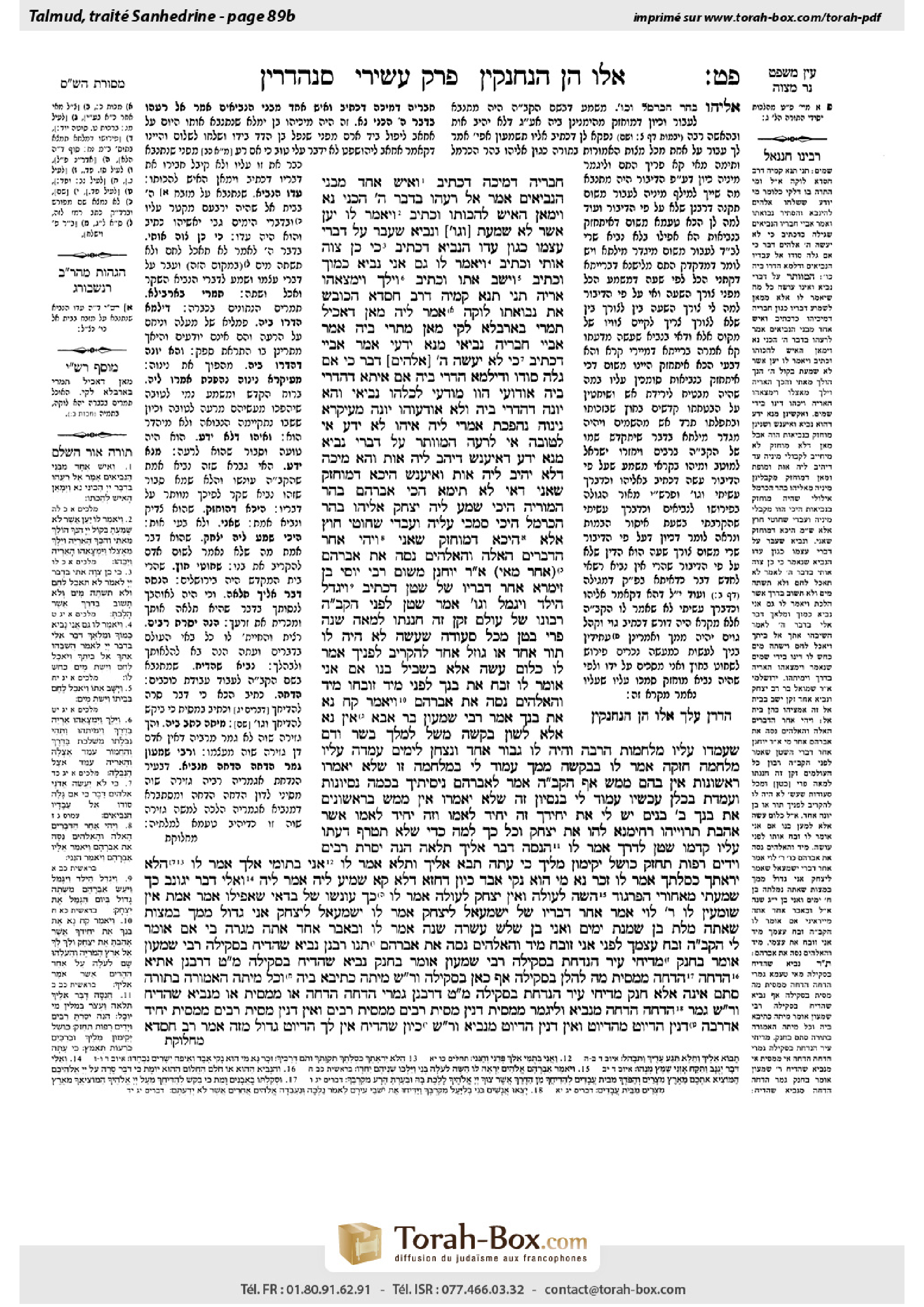
Sanhedrin 89b: Talmud study for Daf Yomi
Daf Yomi is the daily study of one Talmud folio. Explore 37 tractates with scans, Hebrew text, Sefaria English and AI-generated French translations where annotated.
Passage selection and English or AI-generated French translation are available where the scan has annotations. Daf Study is independent of Torah-Box and Sefaria.
Browse Sanhedrin · סנהדרין · All tractatesSanhedrin 89b text and translations
This page of Sanhedrin includes the Aramaic text, an English translation and an AI-generated French translation, alongside the scan above.
סנהדרין פ״ט ב · Aramaic and Hebrew text
חַבְרֵיהּ דְּמִיכָה, דִּכְתִיב: ״וְאִישׁ אֶחָד מִבְּנֵי הַנְּבִיאִים אָמַר אֶל רֵעֵהוּ בִּדְבַר ה׳ הַכֵּינִי נָא, וַיְמָאֵן הָאִישׁ לְהַכּוֹתוֹ״, וּכְתִיב: ״וַיֹּאמֶר לוֹ יַעַן אֲשֶׁר לֹא שָׁמַעְתָּ [וְגוֹ׳]״.
וְנָבִיא שֶׁעָבַר עַל דִּבְרֵי עַצְמוֹ: כְּגוֹן עִדּוֹ הַנָּבִיא, דִּכְתִיב: ״כִּי כֵן צִוָּה אֹתִי״, וּכְתִיב: ״וַיֹּאמֶר לוֹ גַּם אֲנִי נָבִיא כָּמוֹךָ״, וּכְתִיב: ״וַיָּשׇׁב אִתּוֹ״, וּכְתִיב: ״וַיֵּלֶךְ וַיִּמְצָאֵהוּ אַרְיֵה״.
תָּנֵי תַּנָּא קַמֵּיהּ דְּרַב חִסְדָּא: הַכּוֹבֵשׁ אֶת נְבוּאָתוֹ לוֹקֶה. אָמַר לֵיהּ: ״מַאן דְּאָכֵיל תַּמְרֵי בְּאַרְבְּלָא לָקֵי? מַאן מַתְרֵי בֵּיהּ? אָמַר אַבָּיֵי: חַבְרֵיהּ נְבִיאֵי.
מְנָא יָדְעִי? אָמַר אַבָּיֵי: דִּכְתִיב ״כִּי לֹא יַעֲשֶׂה ה׳ [אֱלֹהִים] דָּבָר כִּי אִם גָּלָה סוֹדוֹ״. וְדִילְמָא הֲדַרוּ בֵּיהּ? אִם אִיתָא דְּהָדְרִי בֵּיהּ, אוֹדוֹעֵי הֲווֹ מוֹדְעִי לְכֻלְּהוּ נְבִיאֵי.
וְהָא יוֹנָה, דַּהֲדַרוּ בֵּיהּ וְלָא אוֹדְעוּהּ? יוֹנָה מֵעִיקָּרָא ״נִינְוֵה נֶהְפָּכֶת״ אֲמַרוּ לֵיהּ. אִיהוּ לָא יְדַע אִי לְטוֹבָה אִי לְרָעָה.
הַמְוַותֵּר עַל דִּבְרֵי נָבִיא, מְנָא יָדַע דְּאִיעֲנַשׁ? דִּיהַב לֵיהּ אוֹת. וְהָא מִיכָה, דְּלָא יְהַב לֵיהּ אוֹת, וְאִיעֲנַשׁ? הֵיכָא דְּמוּחְזָק שָׁאנֵי.
דְּאִי לָא תֵּימָא הָכִי, אַבְרָהָם בְּהַר הַמּוֹרִיָּה, הֵיכִי שְׁמַע לֵיהּ יִצְחָק? אֵלִיָּהוּ בְּהַר הַכַּרְמֶל, הֵיכִי סָמְכִי עֲלֵיהּ וְעָבְדִי שְׁחוּטֵי חוּץ? אֶלָּא הֵיכָא דְּמוּחְזָק שָׁאנֵי.
״וַיְהִי אַחַר הַדְּבָרִים הָאֵלֶּה וְהָאֱלֹהִים נִסָּה אֶת אַבְרָהָם״, אַחַר מַאי?
אָמַר רַבִּי יוֹחָנָן מִשּׁוּם רַבִּי יוֹסֵי בֶּן זִימְרָא: אַחַר דְּבָרָיו שֶׁל שָׂטָן, דִּכְתִיב ״וַיִּגְדַּל הַיֶּלֶד וַיִּגָּמַל וְגוֹ׳״. אָמַר שָׂטָן לִפְנֵי הַקָּדוֹשׁ בָּרוּךְ הוּא: רִבּוֹנוֹ שֶׁל עוֹלָם, זָקֵן זֶה חֲנַנְתּוֹ לְמֵאָה שָׁנָה פְּרִי בֶטֶן, מִכׇּל סְעוּדָה שֶׁעָשָׂה לֹא הָיָה לוֹ תּוֹר אֶחָד אוֹ גּוֹזָל אֶחָד לְהַקְרִיב לְפָנֶיךָ? אָמַר לוֹ: כְּלוּם עָשָׂה אֶלָּא בִּשְׁבִיל בְּנוֹ? אִם אֲנִי אוֹמֵר לוֹ ״זְבַח אֶת בִּנְךָ לְפָנַי״ מִיָּד זוֹבְחוֹ. מִיָּד ״וְהָאֱלֹהִים נִסָּה אֶת אַבְרָהָם״.
״וַיֹּאמֶר קַח נָא אֶת בִּנְךָ״. אָמַר רַבִּי שִׁמְעוֹן בַּר אַבָּא: אֵין ״נָא״ אֶלָּא לְשׁוֹן בַּקָּשָׁה. מָשָׁל לְמֶלֶךְ בָּשָׂר וָדָם שֶׁעָמְדוּ עָלָיו מִלְחָמוֹת הַרְבֵּה, וְהָיָה לוֹ גִּבּוֹר אֶחָד וְנִצְּחָן. לְיָמִים עָמְדָה עָלָיו מִלְחָמָה חֲזָקָה. אָמַר לוֹ: בְּבַקָּשָׁה מִמְּךָ, עֲמוֹד לִי בְּמִלְחָמָה זוֹ, שֶׁלֹּא יֹאמְרוּ רִאשׁוֹנוֹת אֵין בָּהֶם מַמָּשׁ. אַף הַקָּדוֹשׁ בָּרוּךְ הוּא אָמַר לְאַבְרָהָם: נִיסֵּיתִיךָ בְּכַמָּה נִסְיוֹנוֹת וְעָמַדְתָּ בְּכֻלָּן. עַכְשָׁיו עֲמוֹד לִי בְּנִסָּיוֹן זֶה, שֶׁלֹּא יֹאמְרוּ אֵין מַמָּשׁ בָּרִאשׁוֹנִים.
״אֶת בִּנְךָ״. שְׁנֵי בָּנִים יֵשׁ לִי. ״אֶת יְחִידְךָ״. זֶה יָחִיד לְאִמּוֹ וְזֶה יָחִיד לְאִמּוֹ. ״אֲשֶׁר אָהַבְתָּ״. תַּרְוַיְיהוּ רָחֵימְנָא לְהוּ. ״אֶת יִצְחָק״. וְכׇל כָּךְ לָמָּה? כְּדֵי שֶׁלֹּא תִּטָּרֵף דַּעְתּוֹ עָלָיו.
קְדָמוֹ שָׂטָן לַדֶּרֶךְ. אָמַר לוֹ: ״הֲנִסָּה דָבָר אֵלֶיךָ תִּלְאֶה... הִנֵּה יִסַּרְתָּ רַבִּים וְיָדַיִם רָפוֹת תְּחַזֵּק. כּוֹשֵׁל יְקִימוּן מִלֶּיךָ... כִּי עַתָּה תָּבוֹא אֵלֶיךָ וַתֵּלֶא״. אָמַר לוֹ: ״אֲנִי בְּתֻמִּי אֵלֵךְ״.
אָמַר לוֹ: ״הֲלֹא יִרְאָתְךָ כִּסְלָתֶךָ״. אָמַר לוֹ: ״זְכׇר נָא מִי הוּא נָקִי אָבָד״. כֵּיוָן דַּחֲזָא דְּלָא קָא שָׁמַיע לֵיהּ, אֲמַר לֵיהּ: ״וְאֵלַי דָּבָר יְגֻנָּב״. כָּךְ שָׁמַעְתִּי מֵאֲחוֹרֵי הַפַּרְגּוֹד: ״הַשֶּׂה לְעוֹלָה״ וְאֵין יִצְחָק לְעוֹלָה. אָמַר לוֹ: כָּךְ עוֹנְשׁוֹ שֶׁל בַּדַּאי, שֶׁאֲפִילּוּ אָמַר אֱמֶת אֵין שׁוֹמְעִין לוֹ.
רַבִּי לֵוִי אָמַר: אַחַר דְּבָרָיו שֶׁל יִשְׁמָעֵאל לְיִצְחָק. אָמַר לוֹ יִשְׁמָעֵאל לְיִצְחָק: אֲנִי גָּדוֹל מִמְּךָ בְּמִצְוֹת, שֶׁאַתָּה מַלְתָּ בֶּן שְׁמֹנַת יָמִים, וַאֲנִי בֶּן שְׁלֹשׁ עֶשְׂרֵה שָׁנָה. אָמַר לוֹ: וּבְאֵבֶר אֶחָד אַתָּה מְגָרֶה בִּי? אִם אוֹמֵר לִי הַקָּדוֹשׁ בָּרוּךְ הוּא ״זְבַח עַצְמְךָ לְפָנַי״, אֲנִי זוֹבֵחַ. מִיָּד: ״וְהָאֱלֹהִים נִסָּה אֶת אַבְרָהָם״.
תָּנוּ רַבָּנַן: נָבִיא שֶׁהִדִּיחַ – בִּסְקִילָה. רַבִּי שִׁמְעוֹן אוֹמֵר: בְּחֶנֶק. מַדִּיחֵי עִיר הַנִּדַּחַת – בִּסְקִילָה. רַבִּי שִׁמְעוֹן אוֹמֵר: בְּחֶנֶק.
נָבִיא שֶׁהִדִּיחַ – בִּסְקִילָה. מַאי טַעְמָא דְּרַבָּנַן? אָתְיָא ״הַדָּחָה״ ״הַדָּחָה״ מִמֵּסִית: מָה לְהַלָּן בִּסְקִילָה, אַף כָּאן בִּסְקִילָה.
וְרַבִּי שִׁמְעוֹן: מִיתָה כְּתִיבָא בֵּיהּ, וְכׇל מִיתָה הָאֲמוּרָה בְּתוֹרָה סְתָם – אֵינָהּ אֶלָּא חֶנֶק.
מַדִּיחֵי עִיר הַנִּדַּחַת בִּסְקִילָה, מַאי טַעְמָא דְּרַבָּנַן? גְּמִירִי ״הַדָּחָה״ ״הַדָּחָה״, אוֹ מִמֵּסִית, אוֹ מִנָּבִיא שֶׁהִדִּיחַ.
וְרַבִּי שִׁמְעוֹן גָּמַר ״הַדָּחָה״ ״הַדָּחָה״ מִנָּבִיא.
וְלִיגְמַר מִמֵּסִית! דָּנִין מֵסִית רַבִּים מִמֵּסִית רַבִּים, וְאֵין דָּנִין מֵסִית רַבִּים מִמֵּסִית יָחִיד. אַדְּרַבָּה, דָּנִין הֶדְיוֹט מֵהֶדְיוֹט, וְאֵין דָּנִין הֶדְיוֹט מִנָּבִיא!
וְרַבִּי שִׁמְעוֹן, כֵּיוָן שֶׁהִדִּיחַ – אֵין לְךָ הֶדְיוֹט גָּדוֹל מִזֶּה.
אָמַר רַב חִסְדָּא:
Sanhedrin 89b · English translation
the colleague of the prophet Micah, son of Imla (see II Chronicles 18:7–8), as it is written: “And a certain man of the sons of the prophets said unto his colleague by the word of the Lord: Strike me, please. And the man refused to strike him” (I Kings 20:35). And it is written: “Then he said to him: Because you have not listened to the voice of the Lord, behold, as soon as you leave me, a lion shall slay you. And as soon as he left from him, a lion found him; and slew him” (I Kings 20:36).
The mishna lists among those liable to receive death at the hand of Heaven: And a prophet who violated his own statement. The Gemara comments: For example, Iddo the prophet, who, according to tradition, prophesied the punishment of Jeroboam in Bethel, as it is written: “I will neither eat bread nor drink water in this place, for it so was commanded me by the word of the Lord” (I Kings 13:8–9). And it is written: “And he said to him: I too am a prophet like you; and an angel spoke unto me by the word of the Lord, saying: Bring him back with you into your house, that he may eat bread and drink water” (I Kings 13:18). And it is written: “And he went back with him, and ate bread in his house, and drank water” (I Kings 13:19). And it is written that he died at the hand of Heaven: “And he went, and a lion met him by the way, and killed him” (I Kings 13:24).
§ A tanna taught a baraita before Rav Ḥisda: One who suppresses his prophecy is flogged. Rav Ḥisda said a parable to him: Is one who eats dates in a sieve flogged? How can he be flogged? Who forewarns him if he eats dates infested with worms that no one sees? Likewise, as no one knows whether the prophet received a prophecy, how can he be forewarned? Abaye said: His fellow prophets forewarn him.
The Gemara asks: From where do they know that he received a prophecy? Abaye says: They know, as it is written: “For the Lord God will do nothing, unless He reveals His counsel to His servants the prophets” (Amos 3:7). The Gemara challenges: And perhaps the heavenly court reconsidered with regard to the prophecy, and the prophet is no longer commanded to disseminate the prophecy. The Gemara answers: If it is so that they reconsidered with regard to the prophecy, the heavenly court would have informed all the prophets.
The Gemara challenges: But in the case of Jonah, they reconsidered it and did not inform them that the people of Nineveh had repented for their sins and were therefore spared the foretold destruction. The Gemara explains: In the case of Jonah, from the outset, the heavenly court told him to say: “Nineveh will be overturned” (Jonah 3:4). Still, he did not know if the sentence would be for the good, as their corruption would be overturned through repentance, or if it would be for the bad, as the city would be overturned through destruction. Therefore, the prophecy was never revoked, but simply fulfilled in accordance with one of its possible interpretations.
The Gemara asks: In the case of one who forgoes the statement of a prophet, from where does he know that the one prophesying is actually a prophet and that he will be punished for failing to comply with the prophecy? The Gemara answers: It is referring to a case where the prophet provides him with a sign indicating that he is a prophet. The Gemara asks: But in the case of Micah, who did not provide him with a sign, and yet he was punished, how could he have known that Micah was a prophet? A case where he has already assumed the presumptive status of a prophet is different, and no sign is necessary.
The Gemara continues: Since if you do not say so, and claim that even the prophecy of one established as a prophet requires a sign, then in the case of Abraham at Mount Moriah, how did Isaac listen to him and submit to being slaughtered as an offering? Likewise, in the case of Elijah at Mount Carmel, how did the people rely upon him and enable him to engage in the sacrifice of animals slaughtered outside the Temple, which is prohibited? Rather, perforce, a case where he has already assumed the presumptive status of a prophet is different.
§ Apropos the binding of Isaac, the Gemara elaborates: It is written: “And it came to pass after these matters [hadevarim] that God tried Abraham” (Genesis 22:1). The Gemara asks: After what matters? How does the binding of Isaac relate to the preceding events?
Rabbi Yoḥanan said in the name of Rabbi Yosei ben Zimra: This means after the statement [devarav] of Satan, as it is written: “And the child grew, and was weaned, and Abraham prepared a great feast on the day that Isaac was weaned” (Genesis 21:8). Satan said before the Holy One, Blessed be He: Master of the Universe, this old man, you favored him with a product of the womb, i.e., a child, at one hundred years of age. From the entire feast that he prepared, did he not have even one dove or one pigeon to sacrifice before You as a thanks-offering? God said to Satan: Did Abraham prepare the feast for any reason but for his son? If I say to him: Sacrifice your son before Me, he would immediately slaughter him. Immediately, after these matters, the verse states: “And God tried Abraham.”
The Torah continues: “And He said: Take, please [na], your son” (Genesis 22:2). Rabbi Shimon bar Abba says: The word na is nothing other than an expression of entreaty. Why did God request rather than command that Abraham take his son? The Gemara cites a parable of a flesh-and-blood king who confronted many wars. And he had one warrior fighting for him, and he overcame his enemies. Over time, there was a fierce war confronting him. The king said to his warrior: I entreat you, stand firm for me in this war, so that others will not say: There is no substance in the first victories, and you are not a true warrior. Likewise, the Holy One, Blessed be He, also said to Abraham: I have tried you with several ordeals, and you have withstood them all. Now, stand firm in this ordeal for Me, so that others will not say: There is no substance in the first ordeals.
God said to Abraham: “Please take your son, your only, whom you love, Isaac” (Genesis 22:2). When God said: “Your son,” Abraham said: I have two sons. When God said: “Your only,” Abraham said: This son is an only son to his mother, and that son is an only son to his mother. When God said: “Whom you love,” Abraham said: I love both of them. Then God said: “Isaac.” And why did God prolong His command to that extent? Why did He not say Isaac’s name from the outset? God did so, so that Abraham’s mind would not be confused by the trauma.
Satan preceded Abraham to the path that he took to bind his son and said to him: “If one ventures a word to you, will you be weary…you have instructed many, and you have strengthened the weak hands. Your words have upheld him that was falling…but now it comes upon you, and you are weary” (Job 4:2–5). Do you now regret what you are doing? Abraham said to him in response: “And I will walk with my integrity” (Psalms 26:11).
Satan said to Abraham: “Is not your fear of God your foolishness?” (Job 4:6). In other words, your fear will culminate in the slaughter of your son. Abraham said to him: “Remember, please, whoever perished, being innocent” (Job 4:7). God is righteous and His pronouncements are just. Once Satan saw that Abraham was not heeding him, he said to him: “Now a word was secretly brought to me, and my ear received a whisper thereof” (Job 4:12). This is what I heard from behind the heavenly curtain [pargod], which demarcates between God and the ministering angels: The sheep is to be sacrificed as a burnt-offering, and Isaac is not to be sacrificed as a burnt-offering. Abraham said to him: Perhaps that is so. However, this is the punishment of the liar, that even if he speaks the truth, others do not listen to him. Therefore, I do not believe you and will fulfill that which I was commanded to perform.
The Gemara cites an alternative explanation of the verse: “And it came to pass after these matters that God tried Abraham” (Genesis 22:1). Rabbi Levi says: This means after the statement of Ishmael to Isaac, during an exchange between them described in the verse: “And Sarah saw the son of Hagar…mocking” (Genesis 21:9). Ishmael said to Isaac: I am greater than you in the fulfillment of mitzvot, as you were circumcised at the age of eight days, without your knowledge and without your consent, and I was circumcised at the age of thirteen years, with both my knowledge and my consent. Isaac said to Ishmael: And do you provoke me with one organ? If the Holy One, Blessed be He, were to say to me: Sacrifice yourself before Me, I would sacrifice myself. Immediately, God tried Abraham, to confirm that Isaac was sincere in his offer to give his life.
§ The Sages taught: A prophet who incites others to worship idols is executed by stoning. Rabbi Shimon says: He is executed by strangulation. Those who incite residents of a city to worship idols, leading the city to be declared an idolatrous city, are executed by stoning. Rabbi Shimon says: They are executed by strangulation.
The Gemara elaborates: A prophet who incites others to worship idols is executed by stoning. What is the reason for the opinion of the Rabbis? They derive a verbal analogy to clarify the meaning of the word incitement written with regard to a prophet who incites others to worship idols from the word incitement written with regard to a layman who instigates others to worship idols. Just as there, the layman who incites others to worship idols is executed by stoning, so too here, the prophet who incites others to worship idols is executed by stoning.
And Rabbi Shimon says: With regard to a prophet, the term death is written concerning him. And every death stated in the Torah without specification is referring to nothing other than strangulation.
The Gemara continues: Those who incite residents of a city to worship idols, leading the city to be declared an idolatrous city, are executed by stoning. What is the reason for the opinion of the Rabbis? They derive a verbal analogy to clarify the meaning of the word incitement written with regard to those who incite residents of a city to worship idols, leading the city to be declared an idolatrous city, from the word incitement written either with regard to a layman who instigates others to worship idols or from the word incitement written with regard to a prophet who incites others to worship idols. Just as there, the layman who incites others to worship idols is executed by stoning, so too here, the prophet who incites others to worship idols is executed by stoning.
And Rabbi Shimon derives a verbal analogy to clarify the meaning of the word incitement written with regard to those who incite residents of a city to worship idols, leading the city to be declared an idolatrous city, from the word incitement written with regard to a prophet who incites others to worship idols, who, in his opinion, is executed by strangulation.
The Gemara challenges: Let him derive the punishment from the punishment of one who is not a prophet who instigates others to worship idols, as those cases are similar. The Gemara answers: Rabbi Shimon derives the punishment for one who instigates the multitudes from the punishment of one who instigates the multitudes, and does not derive the punishment for one who instigates the multitudes from the punishment of one who instigates an individual. The Gemara asks: On the contrary, one derives the punishment for an ordinary person, i.e., one who is not a prophet, who instigates others from the punishment of an ordinary person who incites an idolatrous city, and one does not derive the punishment for an ordinary person who instigates others from the punishment of a prophet who instigates others.
And Rabbi Shimon holds that in this case there is no distinction between prophet and layman; once the prophet has incited others to idol worship, you have no greater example of an ordinary person than that.
Rav Ḥisda says:
Sanhedrin 89b · Traduction française (IA)
le collègue du prophète Michée, fils d’Imla (voir II Chroniques 18:7–8), comme il est écrit : « Un homme des fils des prophètes dit à son collègue, sur l’ordre du Seigneur : Frappe-moi, je te prie. Mais l’homme refusa de le frapper » (I Rois 20:35). Et il est écrit : « Alors il lui dit : Parce que tu n’as pas écouté la voix du Seigneur, voici qu’aussitôt que tu m’auras quitté, un lion te tuera. Dès qu’il le quitta, un lion le rencontra et le tua » (I Rois 20:36).
La Michna énumère parmi ceux qui sont passibles de mort par le Ciel le prophète qui transgresse sa propre parole. La Guemara commente : C’est le cas, par exemple, du prophète Iddo, qui, selon la tradition, prophétisa le châtiment de Jéroboam à Béthel, comme il est écrit : « Je ne mangerai pas de pain et ne boirai pas d’eau en ce lieu, car ainsi me l’a ordonné la parole du Seigneur » (I Rois 13:8–9). Et il est écrit : « Il lui dit : Moi aussi, je suis prophète comme toi ; un ange m’a parlé sur l’ordre du Seigneur, en disant : Ramène-le avec toi dans ta maison, afin qu’il mange du pain et boive de l’eau » (I Rois 13:18). Et il est écrit : « Il retourna avec lui, mangea du pain dans sa maison et but de l’eau » (I Rois 13:19). Et il est écrit qu’il mourut par le Ciel : « Il partit, un lion le rencontra sur le chemin et le tua » (I Rois 13:24).
§ Un tanna enseigna une baraïta devant Rav Ḥisda : Celui qui étouffe sa prophétie est passible de flagellation. Rav Ḥisda lui proposa une parabole : Celui qui mange des dattes dans une passoire est-il passible de flagellation ? Comment pourrait-il être flagellé ? Qui peut l’avertir s’il mange des dattes infestées de vers que personne ne voit ? De même, puisque personne ne sait si le prophète a reçu une prophétie, comment peut-il être averti ? Abaye dit : Ses collègues prophètes l’avertissent.
La Guemara demande : Comment savent-ils qu’il a reçu une prophétie ? Abaye répond : Ils le savent, comme il est écrit : « Car le Seigneur Dieu ne fait rien sans révéler son dessein à ses serviteurs les prophètes » (Amos 3:7). La Guemara objecte : Mais peut-être le tribunal céleste a-t-il révisé la prophétie, de sorte que le prophète n’est plus tenu de la diffuser. La Guemara répond : Si le tribunal céleste avait révisé la prophétie, il en aurait informé tous les prophètes.
La Guemara objecte : Mais, dans le cas de Jonas, le tribunal céleste a révisé la prophétie sans informer les autres que les habitants de Ninive s’étaient repentis de leurs péchés et avaient donc été épargnés de la destruction annoncée. La Guemara explique : Dans le cas de Jonas, dès le départ, le tribunal céleste lui avait dit d’annoncer : « Ninive sera renversée » (Jonas 3:4). Toutefois, il ne savait pas si la sentence serait favorable, la corruption de la ville étant renversée par le repentir, ou défavorable, la ville étant renversée par la destruction. La prophétie ne fut donc jamais révoquée, mais simplement accomplie conformément à l’une de ses interprétations possibles.
La Guemara demande : Dans le cas de celui qui méprise la parole d’un prophète, comment sait-il que celui qui prophétise est véritablement un prophète et qu’il sera puni s’il ne se conforme pas à la prophétie ? La Guemara répond : Il s’agit d’un cas où le prophète lui fournit un signe indiquant qu’il est prophète. La Guemara demande : Mais, dans le cas de Michée, qui ne lui a pas fourni de signe et qui fut pourtant puni, comment pouvait-il savoir que Michée était prophète ? Le cas d’un homme qui a déjà acquis le statut présumé de prophète est différent : aucun signe n’est nécessaire.
La Guemara poursuit : Car, si tu ne dis pas cela et affirmes que même la prophétie de celui qui est établi comme prophète exige un signe, alors, dans le cas d’Abraham au mont Moriah, comment Isaac a-t-il pu lui obéir et se soumettre à être offert en sacrifice ? De même, dans le cas d’Élie au mont Carmel, comment le peuple a-t-il pu se fier à lui et lui permettre d’offrir des animaux en sacrifice hors du Temple, ce qui est interdit ? Il faut donc conclure que le cas de celui qui a déjà acquis le statut présumé de prophète est différent.
§ À propos de la ligature d’Isaac, la Guemara développe : Il est écrit : « Et il arriva, après ces événements [hadevarim], que Dieu éprouva Abraham » (Genèse 22:1). La Guemara demande : Après quels événements ? Quel rapport la ligature d’Isaac a-t-elle avec les événements précédents ?
Rabbi Yoḥanan dit au nom de Rabbi Yosei ben Zimra : Cela signifie après la parole [devarav] de Satan, comme il est écrit : « L’enfant grandit et fut sevré ; Abraham donna un grand festin le jour où Isaac fut sevré » (Genèse 21:8). Satan dit devant le Saint, béni soit-Il : Maître de l’Univers, tu as favorisé ce vieillard en lui accordant un fruit de ses entrailles, c’est-à-dire un enfant, à l’âge de cent ans. De tout le festin qu’il a préparé, n’avait-il donc pas une seule tourterelle ou un seul pigeon à t’offrir en sacrifice pour te remercier ? Dieu dit à Satan : Abraham a-t-il préparé ce festin pour une autre raison que la naissance de son fils ? Si je lui dis : « Sacrifie ton fils devant moi », il l’égorgera aussitôt. Aussitôt après ces événements, le verset dit : « Et Dieu éprouva Abraham. »
La Torah poursuit : « Et Il dit : Prends, je te prie [na], ton fils » (Genèse 22:2). Rabbi Shimon bar Abba dit : Le mot na n’est rien d’autre qu’une expression de supplication. Pourquoi Dieu demanda-t-Il à Abraham de prendre son fils au lieu de le lui ordonner ? La Guemara cite la parabole d’un roi mortel qui livra de nombreuses guerres. Un guerrier combattait pour lui et vainquit ses ennemis. Avec le temps, une guerre acharnée se présenta à lui. Le roi dit à son guerrier : Je t’en prie, tiens bon pour moi dans cette guerre, afin que les autres ne disent pas : Les premières victoires ne signifient rien et tu n’es pas un véritable guerrier. De même, le Saint, béni soit-Il, dit aussi à Abraham : Je t’ai éprouvé par plusieurs épreuves et tu les as toutes surmontées. Maintenant, tiens bon pour moi dans cette épreuve, afin que les autres ne disent pas : Les premières épreuves ne signifient rien.
Dieu dit à Abraham : « Prends, je te prie, ton fils, ton unique, celui que tu aimes, Isaac » (Genèse 22:2). Lorsque Dieu dit : « Ton fils », Abraham répondit : J’ai deux fils. Lorsque Dieu dit : « Ton unique », Abraham répondit : Ce fils est le fils unique de sa mère, et cet autre fils est le fils unique de sa mère. Lorsque Dieu dit : « Celui que tu aimes », Abraham répondit : Je les aime tous les deux. Alors Dieu dit : « Isaac. » Pourquoi Dieu prolongea-t-Il ainsi Son commandement ? Pourquoi ne prononça-t-Il pas le nom d’Isaac dès le début ? Il agit ainsi afin que le choc ne trouble pas l’esprit d’Abraham.
Satan devança Abraham sur le chemin qu’il avait pris pour lier son fils et lui dit : « Si l’on tente de t’adresser une parole, te lasseras-tu… Tu en as instruit beaucoup et tu as fortifié les mains défaillantes. Tes paroles ont soutenu celui qui tombait… mais maintenant, cela t’arrive et tu te lasses » (Job 4:2–5). Regrettes-tu maintenant ce que tu fais ? Abraham lui répondit : « Je marcherai dans mon intégrité » (Psaumes 26:11).
Satan dit à Abraham : « Ta crainte de Dieu n’est-elle pas ta folie ? » (Job 4:6). Autrement dit, ta crainte aboutira à l’égorgement de ton fils. Abraham lui répondit : « Souviens-toi, je te prie : quel innocent a jamais péri ? » (Job 4:7). Dieu est juste et Ses décrets sont équitables. Quand Satan vit qu’Abraham ne l’écoutait pas, il lui dit : « Une parole m’a été furtivement apportée, et mon oreille en a reçu un murmure » (Job 4:12). Voici ce que j’ai entendu de derrière le rideau céleste [pargod], qui sépare Dieu des anges du service : Le bélier doit être offert en holocauste, et Isaac ne doit pas être offert en holocauste. Abraham lui répondit : Peut-être en est-il ainsi. Mais tel est le châtiment du menteur : même s’il dit la vérité, les autres ne l’écoutent pas. C’est pourquoi je ne te crois pas et j’accomplirai ce qui m’a été ordonné.
La Guemara cite une autre explication du verset : « Et il arriva, après ces événements, que Dieu éprouva Abraham » (Genèse 22:1). Rabbi Levi dit : Cela signifie après les paroles d’Ismaël à Isaac, au cours d’un échange entre eux décrit dans le verset : « Sara vit le fils d’Agar… qui se moquait » (Genèse 21:9). Ismaël dit à Isaac : Je te surpasse dans l’accomplissement des mitsvot, car tu as été circoncis à l’âge de huit jours, sans le savoir ni y consentir, tandis que j’ai été circoncis à l’âge de treize ans, en connaissance de cause et avec mon consentement. Isaac répondit à Ismaël : Et tu me provoques au sujet d’un seul organe ? Si le Saint, béni soit-Il, me disait : « Offre-toi en sacrifice devant moi », je m’offrirais. Aussitôt, Dieu éprouva Abraham, afin de confirmer qu’Isaac était sincère lorsqu’il proposait de donner sa vie.
§ Les Sages enseignèrent : Un prophète qui incite d’autres personnes à servir des idoles est exécuté par lapidation. Rabbi Shimon dit : Il est exécuté par strangulation. Ceux qui incitent les habitants d’une ville à servir des idoles, entraînant ainsi la déclaration de la ville comme ville idolâtre, sont exécutés par lapidation. Rabbi Shimon dit : Ils sont exécutés par strangulation.
La Guemara développe : Un prophète qui incite d’autres personnes à servir des idoles est exécuté par lapidation. Quelle est la raison de l’opinion des rabbins ? Ils établissent une analogie verbale afin de préciser le sens du terme « incitation », employé à propos du prophète qui incite d’autres personnes à servir des idoles, avec le terme « incitation », employé à propos d’un particulier qui pousse d’autres personnes à servir des idoles. De même que, dans ce cas, le particulier qui incite d’autres personnes à servir des idoles est exécuté par lapidation, de même, ici, le prophète qui incite d’autres personnes à servir des idoles est exécuté par lapidation.
Et Rabbi Shimon dit : À propos du prophète, le terme « mort » est employé. Or, chaque fois que la Torah mentionne une mort sans en préciser le mode, il s’agit uniquement de la strangulation.
La Guemara poursuit : Ceux qui incitent les habitants d’une ville à servir des idoles, entraînant ainsi la déclaration de la ville comme ville idolâtre, sont exécutés par lapidation. Quelle est la raison de l’opinion des rabbins ? Ils établissent une analogie verbale afin de préciser le sens du terme « incitation », employé à propos de ceux qui incitent les habitants d’une ville à servir des idoles, entraînant ainsi la déclaration de la ville comme ville idolâtre, avec le terme « incitation », employé soit à propos d’un particulier qui pousse d’autres personnes à servir des idoles, soit à propos d’un prophète qui incite d’autres personnes à servir des idoles. De même que, dans ce cas, le particulier qui incite d’autres personnes à servir des idoles est exécuté par lapidation, de même, ici, le prophète qui incite d’autres personnes à servir des idoles est exécuté par lapidation.
Et Rabbi Shimon établit une analogie verbale afin de préciser le sens du terme « incitation », employé à propos de ceux qui incitent les habitants d’une ville à servir des idoles, entraînant ainsi la déclaration de la ville comme ville idolâtre, avec le terme « incitation », employé à propos d’un prophète qui incite d’autres personnes à servir des idoles et qui, selon son opinion, est exécuté par strangulation.
La Guemara objecte : Qu’il déduise la peine de celle infligée à un non-prophète qui pousse d’autres personnes à servir des idoles, puisque ces cas sont similaires. La Guemara répond : Rabbi Shimon déduit la peine de celui qui incite les multitudes de celle infligée à celui qui incite les multitudes ; il ne déduit pas la peine de celui qui incite les multitudes de celle infligée à celui qui incite un particulier. La Guemara demande : Au contraire, on déduit la peine d’un homme ordinaire, c’est-à-dire d’un non-prophète qui incite d’autres personnes, de celle infligée à un homme ordinaire qui incite une ville idolâtre ; on ne déduit pas la peine d’un homme ordinaire qui incite d’autres personnes de celle infligée à un prophète qui incite d’autres personnes.
Et Rabbi Shimon estime que, dans ce cas, il n’y a pas de distinction entre prophète et particulier : dès lors que le prophète a incité d’autres personnes à l’idolâtrie, on ne peut trouver meilleur exemple de particulier que lui.
Rav Ḥisda dit :
Traduction française générée par IA à partir de l’édition anglaise de Sefaria. Vérifie toujours un passage avec le texte source.
Text from Sefaria: William Davidson Edition - Vocalized Aramaic (CC BY NC); William Davidson Edition - English (CC BY NC).