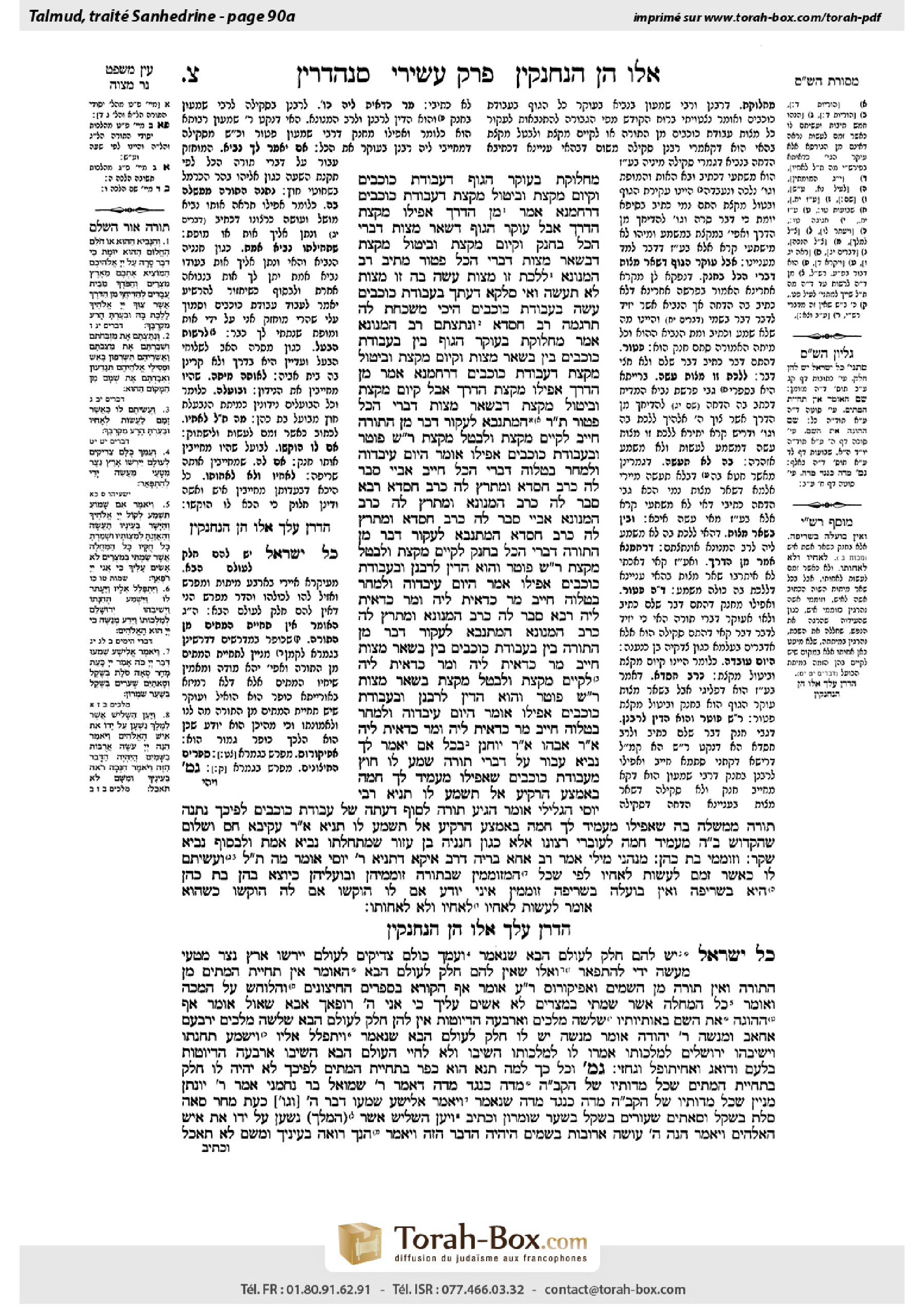
Sanhedrin 90a: Talmud study for Daf Yomi
Daf Yomi is the daily study of one Talmud folio. Explore 37 tractates with scans, Hebrew text, Sefaria English and AI-generated French translations where annotated.
Passage selection and English or AI-generated French translation are available where the scan has annotations. Daf Study is independent of Torah-Box and Sefaria.
Browse Sanhedrin · סנהדרין · All tractatesSanhedrin 90a text and translations
This page of Sanhedrin includes the Aramaic text, an English translation and an AI-generated French translation, alongside the scan above.
סנהדרין צ׳ א · Aramaic and Hebrew text
מַחְלוֹקֶת בְּעוֹקֵר הַגּוּף דַּעֲבוֹדָה זָרָה, וְקִיּוּם מִקְצָת וּבִיטּוּל מִקְצָת דַּעֲבוֹדָה זָרָה, דְּרַחֲמָנָא אָמַר: ״מִן הַדֶּרֶךְ״ – אֲפִילּוּ מִקְצָת הַדֶּרֶךְ.
אֲבָל עוֹקֵר הַגּוּף דִּשְׁאָר מִצְוֹת, דִּבְרֵי הַכֹּל בְּחֶנֶק. וְקִיּוּם מִקְצָת וּבִיטּוּל מִקְצָת דְּבִשְׁאָר מִצְוֹת, דִּבְרֵי הַכֹּל פָּטוּר.
מֵתִיב רַב הַמְנוּנָא: ״לָלֶכֶת״ – זוֹ מִצְוַת עֲשֵׂה, ״בָּהּ״ – זוֹ מִצְוַת לֹא תַעֲשֶׂה. וְאִי סָלְקָא דַעְתָּךְ בַּעֲבוֹדָה זָרָה, עֲשֵׂה בַּעֲבוֹדָה זָרָה הֵיכִי מַשְׁכַּחַתְּ לַהּ? תַּרְגְּמַהּ רַב חִסְדָּא: ״וְנִתַּצְתֶּם״.
רַב הַמְנוּנָא אָמַר: מַחֲלוֹקֶת בְּעוֹקֵר הַגּוּף, בֵּין בַּעֲבוֹדָה זָרָה בֵּין בִּשְׁאָר מִצְוֹת, וְקִיּוּם מִקְצָת וּבִיטּוּל מִקְצָת דַּעֲבוֹדָה זָרָה. דְּרַחֲמָנָא אָמַר: ״מִן הַדֶּרֶךְ״, אֲפִילּוּ מִקְצָת הַדֶּרֶךְ.
אֲבָל קִיּוּם מִקְצָת וּבִיטּוּל מִקְצָת, דְּבִשְׁאָר מִצְוֹת – דִּבְרֵי הַכֹּל פָּטוּר.
תָּנוּ רַבָּנַן: הַמִּתְנַבֵּא לַעֲקוֹר דָּבָר מִן הַתּוֹרָה – חַיָּיב. לְקַיֵּים מִקְצָת וּלְבַטֵּל מִקְצָת – רַבִּי שִׁמְעוֹן פּוֹטֵר. וּבַעֲבוֹדָה זָרָה, אֲפִילּוּ אוֹמֵר: ״הַיּוֹם עִיבְדוּהָ וּלְמָחָר בַּטְּלוּהָ״ – דִּבְרֵי הַכֹּל חַיָּיב.
אַבָּיֵי סָבַר לַהּ כְּרַב חִסְדָּא, וּמְתָרֵץ לַהּ כְּרַב חִסְדָּא. רָבָא סָבַר לַהּ כְּרַב הַמְנוּנָא, וּמְתָרֵץ לַהּ כְּרַב הַמְנוּנָא.
אַבָּיֵי סָבַר לַהּ כְּרַב חִסְדָּא, וּמְתָרֵץ לַהּ כְּרַב חִסְדָּא: הַמִּתְנַבֵּא לַעֲקוֹר דָּבָר מִן הַתּוֹרָה – דִּבְרֵי הַכֹּל בְּחֶנֶק. לְקַיֵּים מִקְצָת וּלְבַטֵּל מִקְצָת – רַבִּי שִׁמְעוֹן פּוֹטֵר, וְהוּא הַדִּין לְרַבָּנַן. וּבַעֲבוֹדָה זָרָה, אֲפִילּוּ אָמַר ״הַיּוֹם עִיבְדוּהָ וּלְמָחָר בַּטְּלוּהָ״ – חַיָּיב. מָר כִּדְאִית לֵיהּ, וּמַר כִּדְאִית לֵיהּ.
רָבָא סָבַר לַהּ כְּרַב הַמְנוּנָא, וּמְתָרֵץ לַהּ כְּרַב הַמְנוּנָא: הַמִּתְנַבֵּא לַעֲקוֹר דָּבָר מִן הַתּוֹרָה, בֵּין בַּעֲבוֹדָה זָרָה בֵּין בִּשְׁאָר מִצְוֹת – חַיָּיב, מָר כִּדְאִית לֵיהּ וּמַר כִּדְאִית לֵיהּ. לְקַיֵּים מִקְצָת וּלְבַטֵּל מִקְצָת בִּשְׁאָר מִצְוֹת – רַבִּי שִׁמְעוֹן פּוֹטֵר, וְהוּא הַדִּין לְרַבָּנַן. וּבַעֲבוֹדָה זָרָה, אֲפִילּוּ אוֹמֵר ״הַיּוֹם עִיבְדוּהָ וּלְמָחָר בַּטְּלוּהָ״ – חַיָּיב, מָר כִּדְאִית לֵיהּ וּמַר כִּדְאִית לֵיהּ.
אָמַר רַבִּי אֲבָהוּ אָמַר רַבִּי יוֹחָנָן: בַּכֹּל, אִם יֹאמַר לְךָ נָבִיא ״עֲבוֹר עַל דִּבְרֵי תוֹרָה״ – שְׁמַע לוֹ, חוּץ מֵעֲבוֹדָה זָרָה, שֶׁאֲפִילּוּ מַעֲמִיד לְךָ חַמָּה בְּאֶמְצַע הָרָקִיעַ – אַל תִּשְׁמַע לוֹ. תַּנְיָא, רַבִּי יוֹסֵי הַגְּלִילִי אוֹמֵר: הִגִּיעָה תּוֹרָה לְסוֹף דַּעְתָּהּ שֶׁל עֲבוֹדָה זָרָה, לְפִיכָךְ נָתְנָה תּוֹרָה מֶמְשָׁלָה בָּהּ, שֶׁאֲפִילּוּ מַעֲמִיד לְךָ חַמָּה בְּאֶמְצַע הָרָקִיעַ – אַל תִּשְׁמַע לוֹ.
תַּנְיָא, אָמַר רַבִּי עֲקִיבָא: חַס וְשָׁלוֹם שֶׁהַקָּדוֹשׁ בָּרוּךְ הוּא מַעֲמִיד חַמָּה לְעוֹבְרֵי רְצוֹנוֹ! אֶלָּא כְּגוֹן חֲנַנְיָה בֶּן עַזּוּר, שֶׁמִּתְּחִלָּתוֹ נְבִיא אֱמֶת, וּלְבַסּוֹף נְבִיא שֶׁקֶר.
וְזוֹמְמֵי בַּת כֹּהֵן – מְנָהָנֵי מִילֵּי? אָמַר רַב אַחָא בְּרֵיהּ דְּרַב אִיקָא: דְּתַנְיָא, רַבִּי יוֹסֵי אוֹמֵר: מָה תַּלְמוּד לוֹמַר ״וַעֲשִׂיתֶם לוֹ כַּאֲשֶׁר זָמַם לַעֲשׂוֹת לְאָחִיו״? לְפִי שֶׁכׇּל הַמְזוּמָּמִין שֶׁבַּתּוֹרָה, זוֹמְמֵיהֶן וּבוֹעֲלֵיהֶן כַּיּוֹצֵא בָּהֶן.
בַּת כֹּהֵן הִיא בִּשְׂרֵיפָה, וְאֵין בּוֹעֲלָהּ בִּשְׂרֵיפָה. זוֹמְמִין – אֵינִי יוֹדֵעַ אִם לוֹ הוּקְשׁוּ, אִם לָהּ הוּקְשׁוּ. כְּשֶׁהוּא אוֹמֵר ״לַעֲשׂוֹת לְאָחִיו״ – לְאָחִיו וְלֹא לַאֲחוֹתוֹ.
הֲדַרַן עֲלָךְ אֵלּוּ הֵן הַנֶּחְנָקִין
מַתְנִי׳ כׇּל יִשְׂרָאֵל יֵשׁ לָהֶם חֵלֶק לָעוֹלָם הַבָּא, שֶׁנֶּאֱמַר: ״וְעַמֵּךְ כֻּלָּם צַדִּיקִים לְעוֹלָם יִירְשׁוּ אָרֶץ נֵצֶר מַטָּעַי מַעֲשֵׂה יָדַי לְהִתְפָּאֵר״. וְאֵלּוּ שֶׁאֵין לָהֶם חֵלֶק לָעוֹלָם הַבָּא: הָאוֹמֵר אֵין תְּחִיַּית הַמֵּתִים מִן הַתּוֹרָה, וְאֵין תּוֹרָה מִן הַשָּׁמַיִם, וְאֶפִּיקוֹרוֹס.
רַבִּי עֲקִיבָא אוֹמֵר: אַף הַקּוֹרֵא בַּסְּפָרִים הַחִיצוֹנִים, וְהַלּוֹחֵשׁ עַל הַמַּכָּה וְאוֹמֵר ״כׇּל הַמַּחֲלָה אֲשֶׁר שַׂמְתִּי בְמִצְרַיִם לֹא אָשִׂים עָלֶיךָ כִּי אֲנִי ה׳ רֹפְאֶךָ״. אַבָּא שָׁאוּל אוֹמֵר: אַף הַהוֹגֶה אֶת הַשֵּׁם בְּאוֹתִיּוֹתָיו.
שְׁלֹשָׁה מְלָכִים וְאַרְבָּעָה הֶדְיוֹטוֹת אֵין לָהֶן חֵלֶק לָעוֹלָם הַבָּא. שְׁלֹשָׁה מְלָכִים: יָרׇבְעָם, אַחְאָב, וּמְנַשֶּׁה. רַבִּי יְהוּדָה אוֹמֵר: מְנַשֶּׁה יֵשׁ לוֹ חֵלֶק לָעוֹלָם הַבָּא, שֶׁנֶּאֱמַר ״וַיִּתְפַּלֵּל אֵלָיו וַיִּשְׁמַע תְּחִנָּתוֹ וַיְשִׁיבֵהוּ יְרוּשָׁלִַים לְמַלְכוּתוֹ״. אָמְרוּ לוֹ: לְמַלְכוּתוֹ הֱשִׁיבוֹ וְלֹא לְחַיֵּי הָעוֹלָם הַבָּא הֱשִׁיבוֹ. אַרְבָּעָה הֶדְיוֹטוֹת: בִּלְעָם, וְדוֹאֵג, וַאֲחִיתוֹפֶל, וְגֵחֲזִי.
גְּמָ׳ וְכׇל כָּךְ לָמָּה? תָּנָא: הוּא כָּפַר בִּתְחִיַּית הַמֵּתִים, לְפִיכָךְ לֹא יִהְיֶה לוֹ חֵלֶק בִּתְחִיַּית הַמֵּתִים, שֶׁכׇּל מִדּוֹתָיו שֶׁל הַקָּדוֹשׁ בָּרוּךְ הוּא מִדָּה כְּנֶגֶד מִדָּה.
דְּאָמַר רַבִּי שְׁמוּאֵל בַּר נַחְמָנִי אָמַר רַבִּי יוֹנָתָן: מִנַּיִין שֶׁכׇּל מִדּוֹתָיו שֶׁל הַקָּדוֹשׁ בָּרוּךְ הוּא מִדָּה כְּנֶגֶד מִדָּה? שֶׁנֶּאֱמַר: ״וַיֹּאמֶר אֱלִישָׁע שִׁמְעוּ דְּבַר ה׳ [וְגוֹ׳] כָּעֵת מָחָר סְאָה סֹלֶת בְּשֶׁקֶל וְסָאתַיִם שְׂעֹרִים בְּשֶׁקֶל בְּשַׁעַר שֹׁמְרוֹן״. וּכְתִיב: ״וַיַּעַן הַשָּׁלִישׁ אֲשֶׁר הַמֶּלֶךְ נִשְׁעָן עַל יָדוֹ אֶת אִישׁ הָאֱלֹהִים וַיֹּאמַר הִנֵּה ה׳ עוֹשֶׂה אֲרֻבּוֹת בַּשָּׁמַיִם הֲיִהְיֶה הַדָּבָר הַזֶּה וַיֹּאמֶר הִנְּךָ רֹאֶה בְּעֵינֶיךָ וּמִשָּׁם לֹא תֹאכֵל״.
Sanhedrin 90a · English translation
The dispute is with regard to a prophet who prophesies to abolish the essence of the prohibition of idol worship, or a prophet who espouses fulfillment of part of the prohibition and nullification of part of the prohibition of idol worship, asserting that idol worship is permitted in certain circumstances, as the Merciful One says: “And that prophet…shall be put to death; because he has spoken perversion against the Lord…to divert you from the way on which the Lord your God commanded you to walk” (Deuteronomy 13:6). It may be inferred from this verse: If he diverts you even from part of the way. In these cases, Rabbi Shimon holds that he is executed by strangulation, and the Rabbis hold that he is executed by stoning.
But if a prophet abolishes the essence of the rest of the mitzvot, everyone agrees that he is executed by strangulation. And if the prophet espouses fulfillment of part and nullification of part of other mitzvot, everyone agrees that he is exempt from punishment. If a true prophet espouses temporary nullification of a specific mitzva, one must heed his words.
Rav Hamnuna raises an objection from a baraita that interprets the phrase in the verse “to divert you from the way on which the Lord your God commanded you to walk.” “To walk”; this is a reference to a positive mitzva. “On which”; this is a reference to a prohibition. And if it enters your mind that the verse is stated with regard to idol worship, how can you find a positive mitzva relating to idol worship? The Gemara answers: Rav Ḥisda interpreted that the positive mitzva referred to in the verse is: “And you shall smash their altars, and break their pillars, and burn their asherim in fire; and you shall hew down the graven images of their gods; and you shall destroy their name from that place” (Deuteronomy 12:3). A prophet is liable to receive the death penalty if he abolishes this mitzva.
Although his objection was resolved, Rav Hamnuna suggests an alternative explanation of the dispute and says: The dispute is with regard to a prophet who prophesies to abolish the essence of a mitzva, whether it is with regard to idol worship or with regard to the rest of the mitzvot; or a prophet who espouses fulfillment of part of the prohibition and nullification of part of the prohibition of idol worship. This is as the Merciful One says: “From the way,” from which it may be inferred: If he diverts you from even part of the way. In these cases, Rabbi Shimon holds that he is executed by strangulation, and the Rabbis hold that he is executed by stoning.
But if the prophet espouses fulfillment of part and nullification of part of other mitzvot, everyone agrees that he is exempt from punishment, as that is within the prophet’s mandate.
The Sages taught: In the case of one who prophesies to abolish a matter from the Torah, he is deemed a false prophet and is liable to be executed by strangulation. If he prophesies to fulfill part or to nullify part of a matter in the Torah, Rabbi Shimon deems him exempt from execution. And with regard to idol worship, even if he says: Worship it today and tomorrow nullify it, everyone agrees that he is liable.
The Gemara comments: Abaye holds in accordance with the opinion of Rav Ḥisda and explains the baraita in accordance with the opinion of Rav Ḥisda. Rava holds in accordance with the opinion of Rav Hamnuna and explains the baraita in accordance with the opinion of Rav Hamnuna.
The Gemara elaborates: Abaye holds in accordance with the opinion of Rav Ḥisda and explains the baraita in accordance with the opinion of Rav Ḥisda. In the case of one who prophesies to abolish a matter from the Torah, everyone agrees that he is executed by strangulation. If he prophesies to fulfill part or to nullify part of a Torah law, Rabbi Shimon deems him exempt from execution, and the same is true of the Rabbis, who also hold that he is exempt. And with regard to idol worship, even if he says: Worship it today and nullify it tomorrow, everyone agrees that he is liable to be executed. What form of death penalty is imposed? One Sage, the Rabbis, rules in accordance with what he holds, i.e., stoning, and one Sage, Rabbi Shimon, rules in accordance with what he holds, i.e., strangulation.
Rava holds in accordance with the opinion of Rav Hamnuna and explains the baraita in accordance with the opinion of Rav Hamnuna. In the case of one who prophesies to abolish a matter from the Torah, whether it is with regard to idol worship or with regard to the rest of the mitzvot, he is liable to be executed. What form of death penalty is imposed? One Sage, the Rabbis, rules in accordance with what he holds, i.e., stoning, and one Sage, Rabbi Shimon, rules in accordance with what he holds, i.e., strangulation. If he prophesies to fulfill part or to nullify part of a Torah law other than idol worship, Rabbi Shimon deems him exempt from execution, and the same is true of the Rabbis, who also hold that he is exempt. And with regard to idol worship, even if he says: Worship it today and nullify it tomorrow, everyone agrees that he is liable to be executed. What form of death penalty is imposed? One Sage, the Rabbis, rules in accordance with what he holds, i.e., stoning, and one Sage, Rabbi Shimon, rules in accordance with what he holds, i.e., strangulation.
Rabbi Abbahu says that Rabbi Yoḥanan says, in summary: With regard to all mitzvot, if a prophet will say to you: Violate matters of Torah on a provisional basis, heed him, except for idol worship, as even if he establishes that he is a bona fide prophet and stops the sun for you in the middle of the sky, do not heed him. It is taught in a baraita that Rabbi Yosei HaGelili says: The Torah ascertained the depth of the mentality of idol worship, the danger that it presents, and the lure of its ideology. Therefore, the Torah ascribed the false prophet with dominion in its regard, recognizing that a false prophet could perform wonders on the basis of idol worship. Therefore, even if the false prophet stops the sun for you in the middle of the sky, do not heed him.
It is taught in a baraita that Rabbi Akiva says: Heaven forfend that the Holy One, Blessed be He, would stop the sun for those who violate His will. A false prophet could never perform an actual miracle. Rather, this warning is relevant only in the case of a prophet, for example, Hananiah, son of Azzur, whose origin was as a true prophet, at which point he could perform miracles; and ultimately, he was a false prophet. Therefore, although he had already been established as a true prophet, once he espouses idol worship, it is clear that he is a false prophet.
§ The mishna teaches: And conspiring witnesses who testified that the daughter of a priest and her paramour committed adultery are executed by strangulation. The Gemara asks: From where are these matters derived? Rav Aḥa, son of Rav Ika, says: It is derived as it is taught in a baraita that Rabbi Yosei says: What is the meaning when the verse states with regard to conspiring witnesses: “And you shall do to him as he conspired to do to his brother” (Deuteronomy 19:19)? The verse is formulated in this manner due to the fact that in all cases involving those rendered conspiring witnesses who are mentioned in the Torah, e.g., forbidden relatives, the sentences of their conspiring witnesses and their paramours are similar to their own sentences, and the witnesses are executed by strangulation.
The baraita continues: The daughter of a priest is an exception, as she is executed by burning if she commits adultery, and her paramour is not executed by burning. With regard to conspiring witnesses who testified that they committed adultery, I do not know if the witnesses are likened to the paramour or if they are likened to the daughter of the priest, in terms of punishment. When the verse states with regard to conspiring witnesses: “As he conspired to do to his brother,” one infers: As he conspired to do to his brother, but not as he conspired to do to his sister. The execution of the conspiring witnesses is likened to the execution of the paramour, who is executed by strangulation, and is not likened to the execution of the daughter of the priest, who is executed by burning.
MISHNA: All of the Jewish people, even sinners and those who are liable to be executed with a court-imposed death penalty, have a share in the World-to-Come, as it is stated: “And your people also shall be all righteous, they shall inherit the land forever; the branch of My planting, the work of My hands, for My name to be glorified” (Isaiah 60:21). And these are the exceptions, the people who have no share in the World-to-Come, even when they fulfilled many mitzvot: One who says: There is no resurrection of the dead derived from the Torah, and one who says: The Torah did not originate from Heaven, and an epikoros, who treats Torah scholars and the Torah that they teach with contempt.
Rabbi Akiva says: Also included in the exceptions are one who reads external literature, and one who whispers invocations over a wound and says as an invocation for healing: “Every illness that I placed upon Egypt I will not place upon you, for I am the Lord, your Healer” (Exodus 15:26). By doing so, he shows contempt for the sanctity of the name of God and therefore has no share in the World-to-Come. Abba Shaul says: Also included in the exceptions is one who pronounces the ineffable name of God as it is written, with its letters.
Three prominent kings mentioned in the Bible and four prominent commoners who are described in the Bible as men of great wisdom have no share in the World-to-Come. The three kings are: Jeroboam, son of Nebat, and Ahab, both of whom were kings of Israel, and Manasseh, king of Judea. Rabbi Yehuda says: Manasseh has a share in the World-to-Come, as it is stated concerning Manasseh: “And he prayed to Him, and He received his entreaty, and heard his supplication and brought him back to Jerusalem unto his kingdom” (II Chronicles 33:13), indicating that he repented wholeheartedly and effectively. The Rabbis said to Rabbi Yehuda: He regretted his actions, and his repentance was effective to the extent that God restored him to his kingdom, but God did not restore him to his share in life in the World-to-Come. The four commoners are: Balaam, son of Beor; Doeg the Edomite; Ahithophel; and Gehazi.
GEMARA: And why is one punished to that extent for saying that there is no resurrection of the dead derived from the Torah? The Sages taught in a baraita: He denied the resurrection of the dead; therefore he will not have a share in the resurrection of the dead, as all measures dispensed by the Holy One, Blessed be He, to His people are dispensed measure for measure, i.e., the response is commensurate with the action.
This is based on that which Rabbi Shmuel bar Naḥmani says that Rabbi Yonatan says: From where is it derived that all measures dispensed by the Holy One, Blessed be He, are dispensed measure for measure? It is derived from a verse, as it is stated concerning the siege of Jerusalem: “And Elisha said: Hear the word of the Lord; so said the Lord: Tomorrow at this time one se’a of fine flour will be sold for one shekel and two se’a of barley for one shekel in the gate of Samaria” (II Kings 7:1). And it is written: “And the officer on whose hand the king leaned answered the man of God and said: Will the Lord make windows in heaven? Might this thing be? And he said: You shall see it with your eyes, but you shall not eat from there” (II Kings 7:2).
Sanhedrin 90a · Traduction française (IA)
La controverse concerne un prophète qui prophétise l’abolition de l’interdit fondamental de l’idolâtrie, ou un prophète qui préconise d’observer une partie de cet interdit et d’en annuler une autre, affirmant que l’idolâtrie est permise dans certaines circonstances. En effet, le Miséricordieux dit : « Et ce prophète […] sera mis à mort, car il a parlé de perversion contre le Seigneur […] pour te détourner de la voie que le Seigneur ton Dieu t’a ordonné de suivre » (Deutéronome 13, 6). On peut déduire de ce verset : s’il te détourne même d’une partie de la voie. Dans ces cas, Rabbi Shimon estime qu’il est exécuté par strangulation, tandis que les Sages estiment qu’il est exécuté par lapidation.
Mais si un prophète abolit l’essence des autres mitsvot, tous s’accordent à dire qu’il est exécuté par strangulation. Et si le prophète préconise d’observer une partie et d’en annuler une autre parmi les autres mitsvot, tous s’accordent à dire qu’il est exempt de peine. Si un véritable prophète préconise l’annulation temporaire d’une mitsva précise, il faut suivre ses paroles.
Rav Hamnuna soulève une objection à partir d’une baraïta qui interprète l’expression du verset : « Pour te détourner de la voie que le Seigneur ton Dieu t’a ordonné de suivre. » « Suivre » fait référence à une mitsva positive. « De la voie » fait référence à un interdit. Or, si l’on considère que le verset concerne l’idolâtrie, comment peut-on y trouver une mitsva positive qui s’y rapporte ? La Guemara répond : Rav Ḥisda interprète la mitsva positive visée par le verset comme étant celle-ci : « Vous démolirez leurs autels, vous briserez leurs stèles, vous brûlerez au feu leurs asherim, vous abattrez les statues de leurs dieux et vous effacerez leur nom de ce lieu » (Deutéronome 12, 3). Un prophète encourt la peine de mort s’il abolit cette mitsva.
Bien que son objection ait été résolue, Rav Hamnuna propose une autre explication de la controverse et dit : Elle concerne un prophète qui prophétise l’abolition de l’essence d’une mitsva, qu’il s’agisse de l’idolâtrie ou des autres mitsvot, ou un prophète qui préconise d’observer une partie de l’interdit et d’en annuler une autre en matière d’idolâtrie. Cela correspond aux mots du Miséricordieux : « De la voie », dont on peut déduire : s’il te détourne même d’une partie de la voie. Dans ces cas, Rabbi Shimon estime qu’il est exécuté par strangulation, tandis que les Sages estiment qu’il est exécuté par lapidation.
Mais si le prophète préconise d’observer une partie et d’en annuler une autre parmi les autres mitsvot, tous s’accordent à dire qu’il est exempt de peine, car cela relève de la mission du prophète.
Les Sages ont enseigné : Celui qui prophétise l’abolition d’une règle de la Torah est considéré comme un faux prophète et encourt la peine de mort par strangulation. S’il prophétise l’observance d’une partie ou l’annulation d’une partie d’une règle de la Torah, Rabbi Shimon l’estime exempt de la peine de mort. En matière d’idolâtrie, en revanche, même s’il dit : « Adorez-la aujourd’hui et renoncez-y demain », tous s’accordent à dire qu’il est passible de la peine de mort.
La Guemara fait remarquer : Abaye suit l’opinion de Rav Ḥisda et explique la baraïta conformément à celle-ci. Rava suit l’opinion de Rav Hamnuna et explique la baraïta conformément à celle-ci.
La Guemara développe : Abaye suit l’opinion de Rav Ḥisda et explique la baraïta conformément à celle-ci. Dans le cas de celui qui prophétise l’abolition d’une règle de la Torah, tous s’accordent à dire qu’il est exécuté par strangulation. S’il prophétise l’observance d’une partie ou l’annulation d’une partie d’une loi de la Torah, Rabbi Shimon l’estime exempt de la peine de mort, et il en va de même pour les Sages, qui l’estiment eux aussi exempt. En matière d’idolâtrie, en revanche, même s’il dit : « Adorez-la aujourd’hui et renoncez-y demain », tous s’accordent à dire qu’il encourt la peine de mort. Quel est le mode d’exécution ? Un Sage, les Sages, statue selon son opinion, c’est-à-dire la lapidation, et un Sage, Rabbi Shimon, statue selon la sienne, c’est-à-dire la strangulation.
Rava suit l’opinion de Rav Hamnuna et explique la baraïta conformément à celle-ci. Celui qui prophétise l’abolition d’une règle de la Torah, qu’il s’agisse de l’idolâtrie ou des autres mitsvot, encourt la peine de mort. Quel est le mode d’exécution ? Un Sage, les Sages, statue selon son opinion, c’est-à-dire la lapidation, et un Sage, Rabbi Shimon, statue selon la sienne, c’est-à-dire la strangulation. S’il prophétise l’observance d’une partie ou l’annulation d’une partie d’une loi de la Torah autre que celle relative à l’idolâtrie, Rabbi Shimon l’estime exempt de la peine de mort, et il en va de même pour les Sages, qui l’estiment eux aussi exempt. En matière d’idolâtrie, en revanche, même s’il dit : « Adorez-la aujourd’hui et renoncez-y demain », tous s’accordent à dire qu’il encourt la peine de mort. Quel est le mode d’exécution ? Un Sage, les Sages, statue selon son opinion, c’est-à-dire la lapidation, et un Sage, Rabbi Shimon, statue selon la sienne, c’est-à-dire la strangulation.
Rabbi Abbahu dit au nom de Rabbi Yoḥanan, en résumé : Pour toutes les mitsvot, si un prophète te dit : « Transgresse les lois de la Torah à titre provisoire », suis-le, à l’exception de l’idolâtrie. Même s’il établit qu’il est un véritable prophète et arrête le soleil pour toi au milieu du ciel, ne le suis pas. Une baraïta enseigne que Rabbi Yosei HaGelili dit : La Torah a sondé la profondeur de l’état d’esprit propre à l’idolâtrie, le danger qu’elle représente et l’attrait de son idéologie. C’est pourquoi la Torah a attribué au faux prophète autorité en la matière, reconnaissant qu’un faux prophète pouvait accomplir des prodiges au nom de l’idolâtrie. Par conséquent, même si le faux prophète arrête le soleil pour toi au milieu du ciel, ne le suis pas.
Une baraïta enseigne que Rabbi Akiva dit : À Dieu ne plaise que le Saint, béni soit-Il, arrête le soleil pour ceux qui transgressent Sa volonté. Un faux prophète ne pourrait jamais accomplir un véritable miracle. Cet avertissement ne concerne que le cas d’un prophète tel que Hanania, fils d’Azzur, qui était à l’origine un véritable prophète et pouvait alors accomplir des miracles, mais qui devint finalement un faux prophète. Par conséquent, bien qu’il ait déjà été reconnu comme un véritable prophète, dès lors qu’il préconise l’idolâtrie, il est clair qu’il est un faux prophète.
§ La Michna enseigne : Les témoins comploteurs qui ont témoigné que la fille d’un prêtre et son amant avaient commis l’adultère sont exécutés par strangulation. La Guemara demande : De quelle source déduit-on ces règles ? Rav Aḥa, fils de Rav Ika, dit : Elles sont déduites de ce qui est enseigné dans une baraïta. Rabbi Yosei dit : Que signifie la formulation du verset concernant les témoins comploteurs : « Vous lui ferez ce qu’il avait comploté de faire à son frère » (Deutéronome 19, 19) ? Le verset est formulé ainsi parce que, dans tous les cas de témoins déclarés comploteurs mentionnés dans la Torah, par exemple ceux qui concernent des proches avec lesquels les relations sont interdites, la peine infligée aux témoins comploteurs et à leurs amants est semblable à celle qui aurait été infligée aux personnes visées par leur témoignage, et les témoins sont exécutés par strangulation.
La baraïta poursuit : La fille d’un prêtre fait exception, car elle est exécutée par le feu si elle commet l’adultère, tandis que son amant n’est pas exécuté par le feu. Pour ce qui est des témoins comploteurs qui ont témoigné qu’ils avaient commis l’adultère, je ne sais pas si les témoins sont assimilés à l’amant ou à la fille du prêtre quant à la peine. Lorsque le verset dit au sujet des témoins comploteurs : « Ce qu’il avait comploté de faire à son frère », on en déduit : ce qu’il avait comploté de faire à son frère, mais non ce qu’il avait comploté de faire à sa sœur. L’exécution des témoins comploteurs est assimilée à celle de l’amant, qui est exécuté par strangulation, et non à celle de la fille du prêtre, qui est exécutée par le feu.
MICHNA : Tout le peuple juif, même les pécheurs et ceux qui sont passibles de la peine de mort prononcée par un tribunal, a une part dans le Monde futur, comme il est dit : « Ton peuple tout entier sera juste, il héritera du pays pour toujours ; il est le rejeton que J’ai planté, l’œuvre de Mes mains, afin que Je sois glorifié » (Isaïe 60, 21). Voici les exceptions, ceux qui n’ont pas de part dans le Monde futur, même s’ils ont accompli de nombreuses mitsvot : celui qui dit que la résurrection des morts n’est pas enseignée dans la Torah, celui qui dit que la Torah ne vient pas du Ciel, et l’épikors, qui traite avec mépris les érudits de la Torah ainsi que la Torah qu’ils enseignent.
Rabbi Akiva dit : Sont également compris parmi les exceptions celui qui lit des ouvrages extérieurs et celui qui prononce des incantations sur une plaie en disant, comme formule de guérison : « Je ne mettrai sur toi aucune des maladies que J’ai infligées à l’Égypte, car Je suis le Seigneur, ton guérisseur » (Exode 15, 26). En agissant ainsi, il témoigne du mépris pour la sainteté du nom de Dieu et n’a donc pas de part dans le Monde futur. Abba Shaul dit : Est également compris parmi les exceptions celui qui prononce le nom ineffable de Dieu tel qu’il est écrit, avec ses lettres.
Trois rois éminents mentionnés dans la Bible et quatre hommes du peuple éminents, décrits dans la Bible comme des hommes d’une grande sagesse, n’ont pas de part dans le Monde futur. Les trois rois sont Jéroboam, fils de Nebat, et Ahab, tous deux rois d’Israël, ainsi que Manassé, roi de Juda. Rabbi Yehuda dit : Manassé a une part dans le Monde futur, comme il est dit à son sujet : « Il le pria, et Il accueillit sa supplication ; Il entendit son appel et le ramena à Jérusalem, dans son royaume » (II Chroniques 33, 13), ce qui indique qu’il s’est repenti de tout son cœur et que son repentir a été effectif. Les Sages dirent à Rabbi Yehuda : Il regretta ses actes, et son repentir fut efficace au point que Dieu le rétablit dans son royaume, mais Dieu ne lui rendit pas sa part dans la vie du Monde futur. Les quatre hommes du peuple sont Balaam, fils de Beor, Doëg l’Édomite, Ahitophel et Guéhazi.
GUEMARA : Pourquoi punit-on aussi sévèrement celui qui dit que la résurrection des morts n’est pas enseignée dans la Torah ? Les Sages ont enseigné dans une baraïta : Il a nié la résurrection des morts ; il n’aura donc pas de part à la résurrection des morts, car toutes les mesures appliquées par le Saint, béni soit-Il, à Son peuple le sont mesure pour mesure, c’est-à-dire que la réponse est à la mesure de l’acte.
Cela s’appuie sur ce que Rabbi Shmuel bar Naḥmani dit au nom de Rabbi Yonatan : De quelle source déduit-on que toutes les mesures appliquées par le Saint, béni soit-Il, le sont mesure pour mesure ? On le déduit d’un verset concernant le siège de Jérusalem, comme il est dit : « Élisée dit : Écoutez la parole du Seigneur ! Ainsi parle le Seigneur : Demain, à cette heure-ci, une mesure de farine fine coûtera un sicle et deux mesures d’orge coûteront un sicle à la porte de Samarie » (II Rois 7, 1). Et il est écrit : « L’officier sur le bras duquel le roi s’appuyait répondit à l’homme de Dieu et dit : Même si le Seigneur ouvrait des fenêtres dans le ciel, cela pourrait-il arriver ? Et il dit : Tu le verras de tes yeux, mais tu n’en mangeras pas » (II Rois 7, 2).
Traduction française générée par IA à partir de l’édition anglaise de Sefaria. Vérifie toujours un passage avec le texte source.
Text from Sefaria: William Davidson Edition - Vocalized Aramaic (CC BY NC); William Davidson Edition - English (CC BY NC).