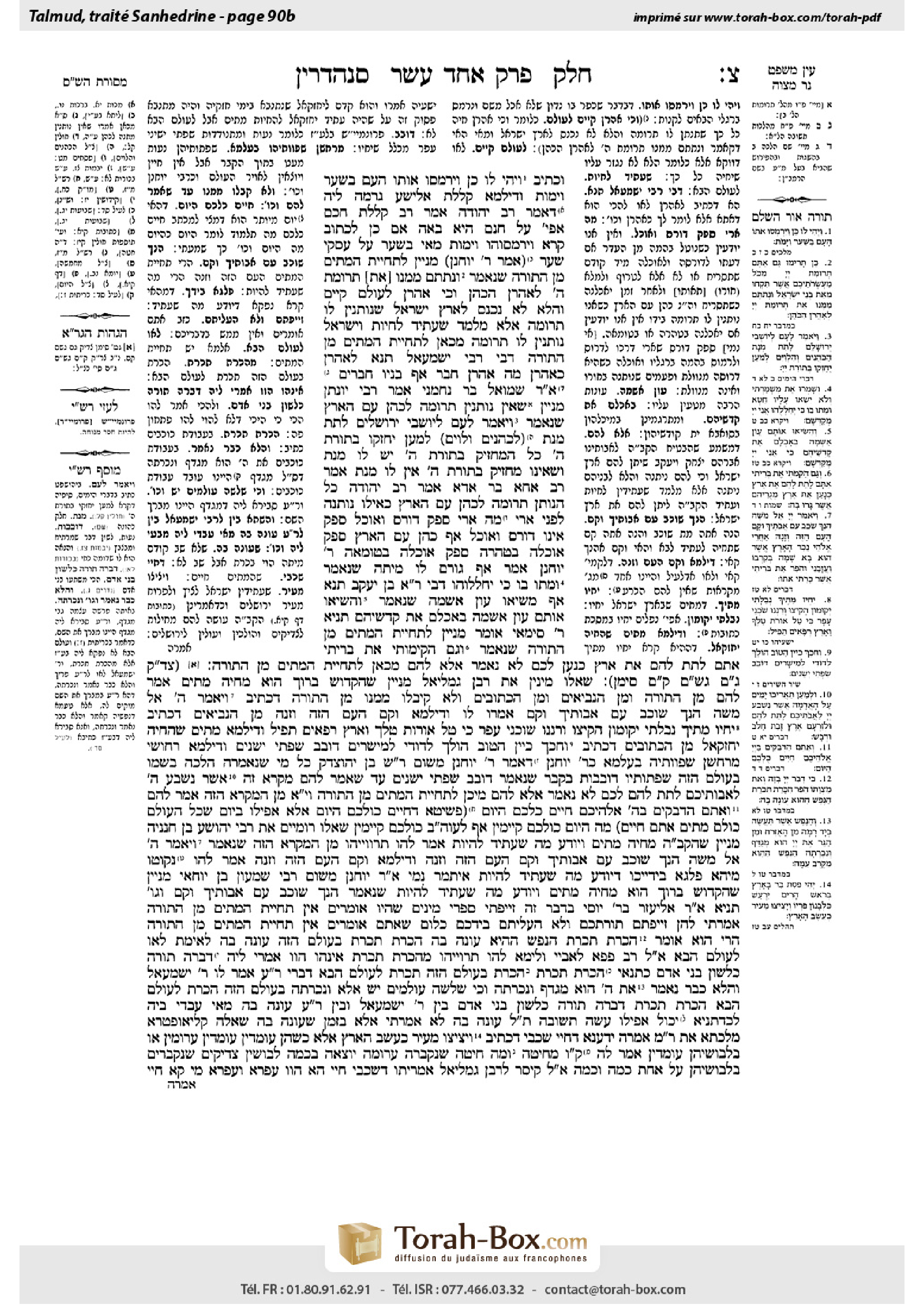
Sanhedrin 90b: Talmud study for Daf Yomi
Daf Yomi is the daily study of one Talmud folio. Explore 37 tractates with scans, Hebrew text, Sefaria English and AI-generated French translations where annotated.
Passage selection and English or AI-generated French translation are available where the scan has annotations. Daf Study is independent of Torah-Box and Sefaria.
Browse Sanhedrin · סנהדרין · All tractatesSanhedrin 90b text and translations
This page of Sanhedrin includes the Aramaic text, an English translation and an AI-generated French translation, alongside the scan above.
סנהדרין צ׳ ב · Aramaic and Hebrew text
וּכְתִיב: ״וַיְהִי לוֹ כֵּן וַיִּרְמְסוּ אֹתוֹ הָעָם בַּשַּׁעַר וַיָּמֹת״. וְדִילְמָא קִלְלַת אֱלִישָׁע גְּרַמָה לֵיהּ? דְּאָמַר רַב יְהוּדָה אָמַר רַב: קִלְלַת חָכָם, אֲפִילּוּ עַל חִנָּם הִיא בָּאָה. אִם כֵּן, לִכְתּוֹב קְרָא: ״וַיִּרְמְסוּהוּ וַיָּמֹת״. מַאי ״בַּשַּׁעַר״? עַל עִסְקֵי שַׁעַר.
אָמַר רַבִּי יוֹחָנָן: מִנַּיִין לִתְחִיַּית הַמֵּתִים מִן הַתּוֹרָה? שֶׁנֶּאֱמַר: ״וּנְתַתֶּם מִמֶּנּוּ [אֶת] תְּרוּמַת ה׳ לְאַהֲרֹן הַכֹּהֵן״. וְכִי אַהֲרֹן לְעוֹלָם קַיָּים? וַהֲלֹא לֹא נִכְנַס לְאֶרֶץ יִשְׂרָאֵל שֶׁנּוֹתְנִין לוֹ תְּרוּמָה! אֶלָּא מְלַמֵּד שֶׁעָתִיד לִחְיוֹת, וְיִשְׂרָאֵל נוֹתְנִין לוֹ תְּרוּמָה. מִכָּאן לִתְחִיַּית הַמֵּתִים מִן הַתּוֹרָה.
דְּבֵי רַבִּי יִשְׁמָעֵאל תָּנָא: ״לְאַהֲרֹן״ – כְּאַהֲרֹן, מָה אַהֲרֹן חָבֵר – אַף בָּנָיו חֲבֵרִים.
אָמַר רַבִּי שְׁמוּאֵל בַּר נַחְמָנִי אָמַר רַבִּי יוֹנָתָן: מִנַּיִין שֶׁאֵין נוֹתְנִין תְּרוּמָה לְכֹהֵן עַם הָאָרֶץ? שֶׁנֶּאֱמַר: ״וַיֹּאמֶר לָעָם לְיוֹשְׁבֵי יְרוּשָׁלִַים לָתֵת מְנָת הַכֹּהֲנִים וְהַלְוִיִּם לְמַעַן יֶחֶזְקוּ בְּתוֹרַת ה׳״. כׇּל הַמַּחְזִיק בְּתוֹרַת ה׳ – יֵשׁ לוֹ מְנָת, וְשֶׁאֵינוֹ מַחְזִיק בְּתוֹרַת ה׳ – אֵין לוֹ מְנָת.
אָמַר רַב אַחָא בַּר אַדָּא אָמַר רַב יְהוּדָה: כׇּל הַנּוֹתֵן תְּרוּמָה לְכֹהֵן עַם הָאָרֶץ, כְּאִילּוּ נוֹתְנָהּ לִפְנֵי אֲרִי. מָה אֲרִי - סָפֵק דּוֹרֵס וְאוֹכֵל, סָפֵק אֵינוֹ דּוֹרֵס וְאוֹכֵל, אַף כֹּהֵן עַם הָאָרֶץ - סָפֵק אוֹכְלָהּ בְּטׇהֳרָה, סָפֵק אוֹכְלָהּ בְּטוּמְאָה.
רַבִּי יוֹחָנָן אָמַר: אַף גּוֹרֵם לוֹ מִיתָה, שֶׁנֶּאֱמַר ״וּמֵתוּ בוֹ כִּי יְחַלְּלֻהוּ״. דְּבֵי רַבִּי אֱלִיעֶזֶר בֶּן יַעֲקֹב תָּנָא: אַף מַשִּׂיאוֹ עֲוֹן אַשְׁמָה, שֶׁנֶּאֱמַר ״וְהִשִּׂיאוּ אוֹתָם עֲוֹן אַשְׁמָה בְּאׇכְלָם אֶת קׇדְשֵׁיהֶם״.
תַּנְיָא, רַבִּי סִימַאי אוֹמֵר: מִנַּיִין לִתְחִיַּית הַמֵּתִים מִן הַתּוֹרָה? שֶׁנֶּאֱמַר: ״וְגַם הֲקִמֹתִי אֶת בְּרִיתִי אִתָּם לָתֵת לָהֶם אֶת אֶרֶץ כְּנַעַן״. ״לָכֶם״ לֹא נֶאֱמַר, אֶלָּא ״לָהֶם״. מִכָּאן לִתְחִיַּית הַמֵּתִים מִן הַתּוֹרָה.
(צֶדֶ״ק גַּ״ם גֶּשֶׁ״ם קָ״ם סִימָן) שָׁאֲלוּ צַדּוּקִים אֶת רַבָּן גַּמְלִיאֵל: מִנַּיִין שֶׁהַקָּדוֹשׁ בָּרוּךְ הוּא מְחַיֶּיה מֵתִים? אָמַר לָהֶם: מִן הַתּוֹרָה, וּמִן הַנְּבִיאִים, וּמִן הַכְּתוּבִים. וְלֹא קִיבְּלוּ מִמֶּנּוּ.
מִן הַתּוֹרָה, דִּכְתִיב: ״וַיֹּאמֶר ה׳ אֶל מֹשֶׁה הִנְּךָ שֹׁכֵב עִם אֲבֹתֶיךָ וְקָם״. אָמְרוּ לוֹ: וְדִילְמָא ״וְקָם הָעָם הַזֶּה וְזָנָה״?
מִן הַנְּבִיאִים, דִּכְתִיב: ״יִחְיוּ מֵתֶיךָ נְבֵלָתִי יְקוּמוּן הָקִיצוּ וְרַנְּנוּ שֹׁכְנֵי עָפָר כִּי טַל אוֹרֹת טַלֶּךָ וָאָרֶץ רְפָאִים תַּפִּיל״. וְדִילְמָא מֵתִים שֶׁהֶחְיָה יְחֶזְקֵאל?
מִן הַכְּתוּבִים, דִּכְתִיב: ״וְחִכֵּךְ כְּיֵין הַטּוֹב הוֹלֵךְ לְדוֹדִי לְמֵישָׁרִים דּוֹבֵב שִׂפְתֵי יְשֵׁנִים״. וְדִילְמָא רַחוֹשֵׁי מְרַחֲשָׁן שִׂפְוָותֵיהּ בְּעָלְמָא? כְּרַבִּי יוֹחָנָן, דְּאָמַר רַבִּי יוֹחָנָן מִשּׁוּם רַבִּי שִׁמְעוֹן בֶּן יְהוֹצָדָק: כׇּל מִי שֶׁנֶּאֶמְרָה הֲלָכָה בִּשְׁמוֹ בְּעוֹלָם הַזֶּה, שִׂפְתוֹתָיו דּוֹבְבוֹת בַּקֶּבֶר, שֶׁנֶּאֱמַר: ״דּוֹבֵב שִׂפְתֵי יְשֵׁנִים״.
עַד שֶׁאָמַר לָהֶם מִקְרָא זֶה: ״אֲשֶׁר נִשְׁבַּע ה׳ לַאֲבֹתֵיכֶם לָתֵת לָהֶם״. ״לָכֶם״ לֹא נֶאֱמַר, אֶלָּא ״לָהֶם״. מִיכָּן לִתְחִיַּית הַמֵּתִים מִן הַתּוֹרָה.
וְיֵשׁ אוֹמְרִים: מִן הַמִּקְרָא הַזֶּה אָמַר לָהֶם, ״וְאַתֶּם הַדְּבֵקִים בַּה׳ אֱלֹהֵיכֶם חַיִּים כֻּלְּכֶם הַיּוֹם״. פְּשִׁיטָא דְּחַיִּים כֻּלְּכֶם הַיּוֹם! אֶלָּא, אֲפִילּוּ בְּיוֹם שֶׁכׇּל הָעוֹלָם כּוּלָּם מֵתִים – אַתֶּם חַיִּים. מָה הַיּוֹם כּוּלְּכֶם קַיָּימִין, אַף לָעוֹלָם הַבָּא כּוּלְּכֶם קַיָּימִין.
שָׁאֲלוּ רוֹמִיִּים אֶת רַבִּי יְהוֹשֻׁעַ בֶּן חֲנַנְיָה: מִנַּיִין שֶׁהַקָּדוֹשׁ בָּרוּךְ הוּא מְחַיֵּה מֵתִים, וְיוֹדֵעַ מַה שֶּׁעָתִיד לִהְיוֹת? אֲמַר לְהוּ: תַּרְוַויְיהוּ מִן הַמִּקְרָא הַזֶּה, שֶׁנֶּאֱמַר: ״וַיֹּאמֶר ה׳ אֶל מֹשֶׁה הִנְּךָ שֹׁכֵב עִם אֲבֹתֶיךָ וְקָם הָעָם הַזֶּה וְזָנָה״.
וְדִילְמָא ״וְקָם הָעָם הַזֶּה וְזָנָה״? אֲמַר לְהוּ: נְקוּטוּ מִיהָא פַּלְגָא בִּידַיְיכוּ, דְּיוֹדֵעַ מַה שֶּׁעָתִיד לִהְיוֹת. אִיתְּמַר נָמֵי, אָמַר רַבִּי יוֹחָנָן מִשּׁוּם רַבִּי שִׁמְעוֹן בֶּן יוֹחַאי: מִנַּיִין שֶׁהַקָּדוֹשׁ בָּרוּךְ הוּא מְחַיֵּה מֵתִים וְיוֹדֵעַ מַה שֶּׁעָתִיד לִהְיוֹת? שֶׁנֶּאֱמַר ״הִנְּךָ שֹׁכֵב עִם אֲבֹתֶיךָ וְקָם וְגוֹ׳״.
תַּנְיָא: אָמַר רַבִּי אֱלִיעֶזֶר בְּרַבִּי יוֹסֵי: בְּדָבָר זֶה זִיַּיפְתִּי סִפְרֵי כוּתִים, שֶׁהָיוּ אוֹמְרִים אֵין תְּחִיַּית הַמֵּתִים מִן הַתּוֹרָה. אָמַרְתִּי לָהֶן: זִיַּיפְתֶּם תּוֹרַתְכֶם וְלֹא הֶעֱלִיתֶם בְּיֶדְכֶם כְּלוּם, שֶׁאַתֶּם אוֹמְרִים אֵין תְּחִיַּית הַמֵּתִים מִן הַתּוֹרָה. הֲרֵי הוּא אוֹמֵר ״הִכָּרֵת תִּכָּרֵת הַנֶּפֶשׁ הַהִיא עֲוֹנָהּ בָּהּ״. ״הִכָּרֵת תִּכָּרֵת״ – בָּעוֹלָם הַזֶּה, ״עֲוֹנָהּ בָּהּ״ – לְאֵימַת? לָאו לָעוֹלָם הַבָּא?
אֲמַר לֵיהּ רַב פָּפָּא לְאַבָּיֵי: וְלֵימָא לְהוּ תַּרְוַיְיהוּ מֵ״הִכָּרֵת תִּכָּרֵת״! אִינְהוּ הֲווֹ אָמְרִי לֵיהּ: דִּבְּרָה תּוֹרָה כִּלְשׁוֹן בְּנֵי אָדָם.
כְּתַנָּאֵי: ״הִכָּרֵת תִּכָּרֵת״ – ״הִכָּרֵת״ בָּעוֹלָם הַזֶּה, ״תִּכָּרֵת״ לָעוֹלָם הַבָּא, דִּבְרֵי רַבִּי עֲקִיבָא. אָמַר לוֹ רַבִּי יִשְׁמָעֵאל: וַהֲלֹא כְּבָר נֶאֱמַר ״אֶת ה׳ הוּא מְגַדֵּף וְנִכְרְתָה״, וְכִי שְׁלֹשָׁה עוֹלָמִים יֵשׁ? אֶלָּא ״וְנִכְרְתָה״ בָּעוֹלָם הַזֶּה, ״הִכָּרֵת״ לָעוֹלָם הַבָּא, ״הִכָּרֵת תִּכָּרֵת״ – דִּבְּרָה תוֹרָה כִלְשׁוֹן בְּנֵי אָדָם.
בֵּין רַבִּי יִשְׁמָעֵאל וּבֵין רַבִּי עֲקִיבָא, ״עֲוֹנָהּ בָּהּ״ מַאי עָבְדִי בֵּיהּ? לְכִדְתַנְיָא: יָכוֹל אֲפִילּוּ עָשָׂה תְּשׁוּבָה? תַּלְמוּד לוֹמַר: ״עֲוֹנָהּ בָּהּ״. לֹא אָמַרְתִּי אֶלָּא בִּזְמַן שֶׁעֲוֹנָהּ בָּהּ.
שָׁאֲלָה קְלֵיאוֹפַּטְרָא מַלְכְּתָא אֶת רַבִּי מֵאִיר. אָמְרָה: יָדַעְנָא דְּחָיִי שָׁכְבֵי, דִּכְתִיב ״וְיָצִיצוּ מֵעִיר כְּעֵשֶׂב הָאָרֶץ״. אֶלָּא כְּשֶׁהֵן עוֹמְדִין, עוֹמְדִין עֲרוּמִין אוֹ בִּלְבוּשֵׁיהֶן עוֹמְדִין? אֲמַר לַהּ: קַל וָחוֹמֶר מֵחִיטָּה. וּמָה חִיטָּה שֶׁנִּקְבְּרָה עֲרוּמָּה יוֹצְאָה בְּכַמָּה לְבוּשִׁין, צַדִּיקִים שֶׁנִּקְבָּרִים בִּלְבוּשֵׁיהֶן – עַל אַחַת כַּמָּה וְכַמָּה.
אֲמַר לֵיהּ קֵיסָר לְרַבָּן גַּמְלִיאֵל: אָמְרִיתוּ דְּשָׁכְבֵי חָיִי. הָא הָווּ עַפְרָא, וְעַפְרָא מִי קָא חָיֵי?!
Sanhedrin 90b · English translation
And it is written: “And it was for him so, and the people trampled him in the gate, and he died” (II Kings 7:20). The Gemara challenges: Perhaps it was the curse of Elisha that caused the officer to die in that manner, not the principle of punishment measure for measure for his lack of belief, as Rav Yehuda says that Rav says: The curse of a Sage, even if baseless, comes to be fulfilled? This is all the more so true concerning the curse of Elisha, which was warranted. The Gemara answers: If so, let the verse write: And they trampled him and he died. What does the term “in the gate” serve to teach? It teaches that he died over matters relating to the gate [sha’ar]. It was for the cynical dismissal of the prophecy of Elisha that the officer voiced at the city gate that he was punished measure for measure and was trampled at the city gate.
§ Rabbi Yoḥanan says: From where is the resurrection of the dead derived from the Torah? It is derived from this verse, as it is stated with regard to teruma of the tithe: “And you shall give the teruma of the Lord to Aaron the priest” (Numbers 18:28). And does Aaron exist forever so that one can fulfill the mitzva by giving him the teruma of the tithe? But is it not so that Aaron did not enter Eretz Yisrael, the only place where the people would give him teruma? Rather, the verse teaches that Aaron is destined to live in the future and the Jewish people will give him teruma. From here it is derived that the resurrection of the dead is from the Torah.
The school of Rabbi Yishmael taught a different derivation from this verse. From the term “to Aaron” one derives that teruma must be given to a priest like Aaron; just as Aaron is one devoted to the meticulous observance of mitzvot, particularly those relating to ritual purity, teruma, and tithes [ḥaver], so too one gives teruma to his descendants who are ḥaverim.
Rabbi Shmuel bar Naḥmani says that Rabbi Yonatan says: From where is it derived that one does not give teruma to a priest who is an am ha’aretz? It is derived from a verse, as it is stated: “And he commanded the people who dwelled in Jerusalem to give the portion of the priests and of the Levites, so that they may firmly adhere to the Torah of the Lord” (II Chronicles 31:4). Everyone who firmly adheres to the Torah of the Lord has a portion, and anyone who does not firmly adhere to the Torah of the Lord does not have a portion.
Rav Aḥa bar Adda says that Rav Yehuda says: With regard to anyone who gives teruma to a priest who is an am ha’aretz, it is as though he placed the teruma before a lion. Just as with regard to a lion, there is uncertainty whether it will maul its prey and eat it, and uncertainty whether it will not maul its prey and instead eat it alive, so too, with regard to a priest who is an am ha’aretz to whom one gives teruma, there is uncertainty whether he will eat it in purity, and there is uncertainty whether he will eat it in impurity, thereby violating a prohibition by Torah law.
Rabbi Yoḥanan says: One who gives teruma to a priest who is an am ha’aretz even causes the priest’s death, as it is stated with regard to teruma: “And die therefore if they profane it” (Leviticus 22:9). Priests who partake of teruma in a state of ritual impurity profane it and are liable to be punished with death at the hand of Heaven. The school of Rabbi Eliezer ben Ya’akov taught: By giving teruma to a priest who is an am ha’aretz, one also brings upon him a sin of guilt, i.e., a sin that will lead to additional sins, as it is stated: “And so bring upon them a sin of guilt when they eat their sacred items” (Leviticus 22:16).
§ It is taught in a baraita that Rabbi Simai says: From where is resurrection of the dead derived from the Torah? It is derived from a verse, as it is stated with regard to the Patriarchs: “I have also established My covenant with them to give to them the land of Canaan” (Exodus 6:4). The phrase: To give to you the land of Canaan, is not stated, as the meaning of the verse is not that God fulfilled the covenant with the Patriarchs when he gave the land of Canaan to the children of Israel; rather, it is stated: “To give to them the land of Canaan,” meaning to the Patriarchs themselves. From here is it derived that the resurrection of the dead is from the Torah, as in the future the Patriarchs will come to life and inherit the land.
The Gemara records a mnemonic for those cited in the upcoming discussion: Tzadi, dalet, kuf; gimmel, mem; gimmel, shin, mem; kuf, mem. Heretics asked Rabban Gamliel: From where is it derived that the Holy One, Blessed be He, revives the dead? Rabban Gamliel said to them that this matter can be proven from the Torah, from the Prophets, and from Writings, but they did not accept the proofs from him.
The proof from the Torah is as it is written: “And the Lord said to Moses, behold, you shall lie with your fathers and arise” (Deuteronomy 31:16). The heretics said to him: But perhaps the verse should be divided in a different manner, and it should be read: “Behold, you shall lie with your fathers, and this people will arise and stray after the foreign gods of the land.”
The proof from the Prophets is as it is written: “Your dead shall live, my corpse shall arise. Awake and sing, you that dwell in the dust, for your dew is as the dew of vegetation, and the land shall cast out the dead” (Isaiah 26:19). The heretics said to him: But perhaps the prophecy was fulfilled with the dead that Ezekiel revived. No proof may be cited from that verse with regard to any future resurrection.
The proof from Writings is as it is written: “And your palate is like the best wine that glides down smoothly for my beloved, moving gently the lips of those that sleep” (Song of Songs 7:10), indicating that the dead will ultimately rise and speak. The heretics said to him: But perhaps merely their lips will move, in accordance with the opinion of Rabbi Yoḥanan, as Rabbi Yoḥanan says in the name of Rabbi Shimon ben Yehotzadak: Anyone in whose name a halakha is stated in this world, his lips move in the grave as if repeating the statement cited in his name, as it is stated: “Moving gently the lips of those that sleep.” No proof may be cited from that verse, as it is unrelated to resurrection.
This exchange continued until Rabban Gamliel stated to them this verse: “That your days may be multiplied, and the days of your children, upon the land that the Lord took an oath to your forefathers to give them” (Deuteronomy 11:21). The phrase: To give you, is not stated; rather, it is stated: “To give them,” to the Patriarchs themselves, as in the future the Patriarchs will come to life and inherit the land. From here resurrection of the dead is derived from the Torah.
And there are those who say that it is from this following verse that he said to them his ultimate proof: “But you who cleave to the Lord your God every one of you is alive this day” (Deuteronomy 4:4). Wasn’t it obvious with regard to the children of Israel whom God was addressing, that “every one of you is alive this day”? Rather, the meaning of the verse is: Even on the day when everyone is dead you will live; just as today every one of you is alive, so too, in the World-to-Come every one of you will be alive.
The Romans asked Rabbi Yehoshua ben Ḥananya: From where is it derived that the Holy One, Blessed be He, revives the dead, and from where is it derived that He knows what is destined to be? Rabbi Yehoshua ben Ḥananya said to them: Both of those matters are derived from this verse, as it is stated: “And the Lord said to Moses, Behold, you shall lie with your fathers and arise; this people will go astray” (Deuteronomy 31:16). This indicates that Moses will die and then arise from the dead and that the Holy One, Blessed be He, knows what the children of Israel are destined to do.
The Romans asked: But perhaps the verse should be divided in a different manner, and it should be read: “Behold, you shall lie with your fathers and this people will arise and go astray after the foreign gods of the land.” Rabbi Yehoshua ben Ḥananya said to them: Take at least a response to half of your question in your hands from that verse, that God knows what is destined to be. The Gemara comments: It was also stated on a similar note by an amora citing a tanna, as Rabbi Yoḥanan says in the name of Rabbi Shimon ben Yoḥai: From where is it derived that the Holy One, Blessed be He, revives the dead, and from where is it derived that He knows what is destined to be? It is derived from a verse, as it is stated: “Behold, you shall lie with your fathers and arise.”
It is taught in a baraita that Rabbi Eliezer, son of Rabbi Yosei, says: With this following matter, I refuted the books of the Samaritans, as they would say that there is no source for the resurrection of the dead from the Torah. I said to them: You falsified your torah and you accomplished nothing, as you say there is no source for the resurrection of the dead from the Torah, and the Torah states: “That soul shall be excised; his iniquity shall be upon him” (Numbers 15:31). You interpret the phrase “that soul shall be excised” to mean that a sinner will be punished with death in this world. If so, with regard to the phrase “his iniquity shall be upon him,” for when is that destined to be? Is it not for the World-to-Come, i.e., the world as it will exist after the resurrection of the dead? Apparently, there is a World-to-Come and there is an allusion to it in the Torah.
Rav Pappa said to Abaye: And let Rabbi Eliezer, son of Rabbi Yosei, say to the Samaritans that both of those matters can be derived from the phrase “shall be excised [hikkaret tikkaret].” “Hikkaret” indicates that the sinner is excised from this world, and “tikkaret” indicates that the sinner is excised from the World-to-Come. Abaye answered: Rabbi Eliezer, son of Rabbi Yosei, preferred not to cite proof from the compound verb, because the Samaritans would say: The Torah spoke in the language of people, and the compound verb is merely a stylistic flourish.
The Gemara notes: These derivations of Rabbi Eliezer and Rav Pappa are parallel to a dispute between tanna’im with regard to “hikkaret tikkaret,” as follows: “Hikkaret” indicates that the sinner is excised in this world, and “tikkaret” indicates that the sinner is excised in the World-to-Come; this is the statement of Rabbi Akiva. Rabbi Yishmael said to him: Isn’t it already stated in the previous verse: “That person that blasphemes the Lord, that soul shall be excised [venikhreta]” (Numbers 15:30), and are there three worlds from which the sinner is excised? Rather, from the term “venikhreta” it is derived that the sinner is excised in this world, from “hikkaret” it is derived that the sinner is excised in the World-to-Come, and from the compound verb “hikkaret tikkaret” nothing is derived, as the Torah spoke in the language of people.
The Gemara asks: According to both Rabbi Yishmael and Rabbi Akiva, what do they do with, i.e., what do they derive from, the phrase “His iniquity shall be upon him”? The Gemara answers: That phrase is necessary for that derivation which is taught in a baraita: One might have thought that the sinner is excised even after he repented. Therefore, the verse states: “His iniquity shall be upon him.” God states: I said that the sinner will be excised only when his iniquity remains upon him.
§ The Gemara relates: Queen Cleopatra asked Rabbi Meir a question. She said: I know that the dead will live, as it is written: “And may they blossom out of the city like grass of the earth” (Psalms 72:16). Just as grass grows, so too, the dead will come to life. But when they arise, will they arise naked or will they arise with their garments? Rabbi Meir said to her: It is derived a fortiori from wheat. If wheat, which is buried naked, meaning that the kernel is sown without the chaff, emerges with several garments of chaff, all the more so will the righteous, who are buried with their garments, arise with their garments.
The Roman emperor said to Rabban Gamliel: You say that the dead will live. Aren’t they dust? And does dust come to life?
Sanhedrin 90b · Traduction française (IA)
Et il est écrit : « Et il en fut ainsi pour lui : le peuple le piétina à la porte, et il mourut » (II Rois 7:20). La Guemara objecte : Peut-être est-ce la malédiction d’Élisée qui causa la mort de l’officier de cette manière, et non le principe d’une punition mesure pour mesure pour son manque de foi, puisque Rav Yehouda dit au nom de Rav : « La malédiction d’un Sage, même sans fondement, finit par se réaliser. » Cela est d’autant plus vrai de la malédiction d’Élisée, qui était justifiée. La Guemara répond : Si tel était le cas, que le verset dise : « Ils le piétinèrent et il mourut. » À quoi sert l’expression « à la porte » ? Elle enseigne qu’il mourut pour des affaires liées à la porte [sha’ar]. L’officier fut puni mesure pour mesure pour avoir raillé la prophétie d’Élisée à la porte de la ville : il fut piétiné à la porte de la ville.
§ Rabbi Yoḥanan dit : D’où déduit-on de la Torah la résurrection des morts ? On la déduit de ce verset, comme il est dit au sujet de la terouma de la dîme : « Et vous donnerez la terouma du Seigneur à Aaron le prêtre » (Nombres 18:28). Aaron existe-t-il éternellement, pour qu’on puisse accomplir la mitsva en lui donnant la terouma de la dîme ? Or, Aaron n’est-il pas vrai qu’il n’est pas entré en Eretz Israël, le seul endroit où le peuple pouvait lui donner la terouma ? Le verset enseigne plutôt qu’Aaron est destiné à vivre dans l’avenir et que le peuple juif lui donnera la terouma. On en déduit que la résurrection des morts est enseignée dans la Torah.
L’école de Rabbi Yishmaël enseigne une autre déduction à partir de ce verset. De l’expression « à Aaron », on déduit que la terouma doit être donnée à un prêtre semblable à Aaron : de même qu’Aaron était attaché à l’observance scrupuleuse des mitsvot, en particulier celles qui concernent la pureté rituelle, la terouma et les dîmes [ḥaver], de même on donne la terouma à ses descendants qui sont des ḥaverim.
Rabbi Shmuel bar Naḥmani dit au nom de Rabbi Yonatan : D’où déduit-on qu’on ne donne pas la terouma à un prêtre qui est un am ha’aretz ? On le déduit d’un verset, comme il est dit : « Et il ordonna au peuple qui habitait à Jérusalem de donner la part des prêtres et des Lévites, afin qu’ils s’attachent fermement à la Torah du Seigneur » (II Chroniques 31:4). Quiconque s’attache fermement à la Torah du Seigneur a une part, et quiconque ne s’y attache pas fermement n’en a pas.
Rav Aḥa bar Adda dit au nom de Rav Yehouda : Quiconque donne la terouma à un prêtre qui est un am ha’aretz, c’est comme s’il avait déposé la terouma devant un lion. De même que, dans le cas d’un lion, on ne sait pas s’il déchirera sa proie et la mangera, ou s’il ne la déchirera pas et la mangera vivante, de même, dans le cas d’un prêtre qui est un am ha’aretz et à qui l’on donne la terouma, on ne sait pas s’il la mangera en état de pureté ou s’il la mangera en état d’impureté, transgressant ainsi une interdiction de la Torah.
Rabbi Yoḥanan dit : Celui qui donne la terouma à un prêtre qui est un am ha’aretz cause même la mort du prêtre, comme il est dit à propos de la terouma : « Ils mourront donc s’ils la profanent » (Lévitique 22:9). Les prêtres qui consomment la terouma en état d’impureté la profanent et encourent la peine de mort par la main du Ciel. L’école de Rabbi Eliezer ben Ya’akov enseigne : En donnant la terouma à un prêtre qui est un am ha’aretz, on fait aussi naître en lui une faute de culpabilité, c’est-à-dire une faute qui entraînera d’autres fautes, comme il est dit : « Et ils feront ainsi peser sur eux une faute de culpabilité lorsqu’ils mangeront leurs choses saintes » (Lévitique 22:16).
§ Il est enseigné dans une baraïta que Rabbi Simai dit : D’où déduit-on de la Torah la résurrection des morts ? On la déduit d’un verset, comme il est dit au sujet des Patriarches : « J’ai aussi établi mon alliance avec eux, pour leur donner le pays de Canaan » (Exode 6:4). Il n’est pas dit : « Pour vous donner le pays de Canaan », car le sens du verset n’est pas que Dieu a accompli son alliance avec les Patriarches en donnant le pays de Canaan aux enfants d’Israël ; il est dit plutôt : « Pour leur donner le pays de Canaan », c’est-à-dire aux Patriarches eux-mêmes. On en déduit que la résurrection des morts est enseignée dans la Torah, car à l’avenir les Patriarches reviendront à la vie et hériteront du pays.
La Guemara donne un moyen mnémotechnique pour ceux qui sont cités dans la discussion à venir : tsadi, dalet, qof ; guimel, mem ; guimel, shin, mem ; qof, mem. Des hérétiques demandèrent à Rabban Gamliel : « D’où déduit-on que le Saint, béni soit-Il, ressuscite les morts ? » Rabban Gamliel leur répondit que cela pouvait être prouvé à partir de la Torah, des Prophètes et des Écrits, mais ils n’acceptèrent pas ses preuves.
La preuve tirée de la Torah est celle-ci, comme il est écrit : « Et le Seigneur dit à Moïse : Voici, tu vas te coucher avec tes pères et te relever » (Deutéronome 31:16). Les hérétiques lui dirent : « Mais peut-être faut-il diviser le verset autrement et le lire ainsi : “Voici, tu vas te coucher avec tes pères, et ce peuple se lèvera et se prostituera aux dieux étrangers du pays.” »
La preuve tirée des Prophètes est celle-ci, comme il est écrit : « Tes morts revivront, mon cadavre se relèvera. Réveillez-vous et chantez, vous qui habitez la poussière, car ta rosée est comme la rosée des plantes, et la terre rejettera les morts » (Isaïe 26:19). Les hérétiques lui dirent : « Mais peut-être cette prophétie s’est-elle accomplie lorsque Ézéchiel a ressuscité les morts. » On ne peut citer ce verset comme preuve d’une résurrection future.
La preuve tirée des Écrits est celle-ci, comme il est écrit : « Et ton palais est comme le meilleur vin, qui coule doucement pour mon bien-aimé, faisant remuer les lèvres de ceux qui dorment » (Cantique des Cantiques 7:10), ce qui indique que les morts finiront par se relever et parler. Les hérétiques lui dirent : « Mais peut-être que seules leurs lèvres remueront », conformément à l’opinion de Rabbi Yoḥanan. En effet, Rabbi Yoḥanan dit au nom de Rabbi Shimon ben Yehotzadak : « Quiconque est cité par son nom dans l’énoncé d’une halakha en ce monde voit ses lèvres remuer dans la tombe comme s’il répétait l’enseignement cité en son nom », comme il est dit : « Faisant remuer les lèvres de ceux qui dorment. » On ne peut citer ce verset comme preuve, car il n’a aucun rapport avec la résurrection.
La discussion se poursuivit jusqu’à ce que Rabban Gamliel leur cite ce verset : « Afin que vos jours et les jours de vos enfants se multiplient sur la terre que le Seigneur a juré à vos ancêtres de leur donner » (Deutéronome 11:21). Il n’est pas dit : « De vous donner », mais plutôt : « De leur donner », aux Patriarches eux-mêmes, car à l’avenir les Patriarches reviendront à la vie et hériteront du pays. On en déduit que la résurrection des morts est enseignée dans la Torah.
Et certains disent que c’est à partir du verset suivant qu’il leur donna sa preuve décisive : « Mais vous qui êtes attachés au Seigneur votre Dieu, vous êtes tous vivants aujourd’hui » (Deutéronome 4:4). N’était-il pas évident que les enfants d’Israël auxquels Dieu s’adressait étaient « tous vivants aujourd’hui » ? Le sens du verset est plutôt le suivant : même le jour où tous seront morts, vous vivrez ; de même qu’aujourd’hui vous êtes tous vivants, de même, dans le Monde à venir, vous serez tous vivants.
Les Romains demandèrent à Rabbi Yehoshua ben Ḥananya : « D’où déduit-on que le Saint, béni soit-Il, ressuscite les morts, et d’où déduit-on qu’Il sait ce qui est destiné à arriver ? » Rabbi Yehoshua ben Ḥananya leur dit : « Ces deux choses se déduisent du même verset », comme il est dit : « Et le Seigneur dit à Moïse : Voici, tu vas te coucher avec tes pères et te relever ; ce peuple s’égarera » (Deutéronome 31:16). Cela indique que Moïse mourra puis se relèvera d’entre les morts, et que le Saint, béni soit-Il, sait ce que les enfants d’Israël sont destinés à faire.
Les Romains demandèrent : « Mais peut-être faut-il diviser le verset autrement et le lire ainsi : “Voici, tu vas te coucher avec tes pères, et ce peuple se lèvera et se prostituera aux dieux étrangers du pays.” » Rabbi Yehoshua ben Ḥananya leur dit : « Retenez au moins de ce verset une réponse à la moitié de votre question : Dieu sait ce qui est destiné à arriver. » La Guemara fait remarquer qu’un amora citant un tanna a également formulé une affirmation similaire, car Rabbi Yoḥanan dit au nom de Rabbi Shimon ben Yoḥai : « D’où déduit-on que le Saint, béni soit-Il, ressuscite les morts, et d’où déduit-on qu’Il sait ce qui est destiné à arriver ? » On le déduit d’un verset, comme il est dit : « Voici, tu vas te coucher avec tes pères et te relever. »
Il est enseigné dans une baraïta que Rabbi Eliezer, fils de Rabbi Yosei, dit : « C’est par l’argument suivant que j’ai réfuté les livres des Samaritains, car ils disaient qu’il n’existe aucune source dans la Torah pour la résurrection des morts. Je leur ai dit : Vous avez falsifié votre Torah et n’avez rien obtenu, puisque vous dites qu’il n’existe aucune source dans la Torah pour la résurrection des morts, alors que la Torah dit : “Cette personne sera retranchée ; sa faute restera sur elle” » (Nombres 15:31). Vous interprétez l’expression « cette personne sera retranchée » comme signifiant qu’un pécheur sera puni de mort en ce monde. Dans ce cas, quand l’expression « sa faute restera sur elle » est-elle destinée à s’appliquer ? N’est-ce pas dans le Monde à venir, c’est-à-dire dans le monde tel qu’il existera après la résurrection des morts ? Il apparaît donc qu’il existe un Monde à venir et que la Torah y fait allusion.
Rav Pappa dit à Abaye : Rabbi Eliezer, fils de Rabbi Yosei, aurait aussi pu dire aux Samaritains que ces deux choses se déduisent de l’expression « sera retranché [hikkaret tikkaret] ». « Hikkaret » indique que le pécheur est retranché de ce monde, et « tikkaret » indique qu’il est retranché du Monde à venir. Abaye répondit : Rabbi Eliezer, fils de Rabbi Yosei, préféra ne pas citer de preuve tirée du verbe redoublé, car les Samaritains auraient dit : « La Torah parle le langage des hommes, et le redoublement n’est qu’un effet de style. »
La Guemara note : Ces déductions de Rabbi Eliezer et de Rav Pappa correspondent à une controverse entre tannaïm au sujet de « hikkaret tikkaret », comme suit : « Hikkaret » indique que le pécheur est retranché de ce monde, et « tikkaret » indique qu’il est retranché du Monde à venir ; telle est l’opinion de Rabbi Akiva. Rabbi Yishmaël lui dit : « Le verset précédent ne dit-il pas déjà : “Cette personne qui blasphème le Seigneur, cette âme sera retranchée [venikhreta]” » (Nombres 15:30) ? Le pécheur serait-il retranché de trois mondes ? On déduit plutôt de l’expression « venikhreta » que le pécheur est retranché de ce monde, de « hikkaret » qu’il est retranché du Monde à venir, et on ne déduit rien de l’expression redoublée « hikkaret tikkaret », car la Torah parle le langage des hommes.
La Guemara demande : Selon Rabbi Yishmaël comme selon Rabbi Akiva, que déduisent-ils de l’expression « Sa faute restera sur lui » ? La Guemara répond : Cette expression est nécessaire à la déduction enseignée dans une baraïta : On aurait pu penser que le pécheur est retranché même après s’être repenti. Le verset dit donc : « Sa faute restera sur lui. » Dieu déclare : « J’ai dit que le pécheur serait retranché uniquement tant que sa faute reste sur lui. »
§ La Guemara rapporte : La reine Cléopâtre posa une question à Rabbi Meir. Elle dit : « Je sais que les morts revivront, comme il est écrit : “Qu’ils fleurissent hors de la ville comme l’herbe de la terre” » (Psaumes 72:16). De même que l’herbe pousse, de même les morts reviendront à la vie. Mais lorsqu’ils se relèveront, le feront-ils nus ou vêtus ? Rabbi Meir lui répondit : « On peut le déduire a fortiori du blé. Si le blé, qui est enterré nu, c’est-à-dire que le grain est semé sans sa balle, ressort avec plusieurs enveloppes de balle, à plus forte raison les justes, qui sont enterrés avec leurs vêtements, se relèveront-ils avec leurs vêtements. »
L’empereur romain dit à Rabban Gamliel : « Vous dites que les morts vivront. Ne sont-ils pas poussière ? Et la poussière revient-elle à la vie ? »
Traduction française générée par IA à partir de l’édition anglaise de Sefaria. Vérifie toujours un passage avec le texte source.
Text from Sefaria: William Davidson Edition - Vocalized Aramaic (CC BY NC); William Davidson Edition - English (CC BY NC).