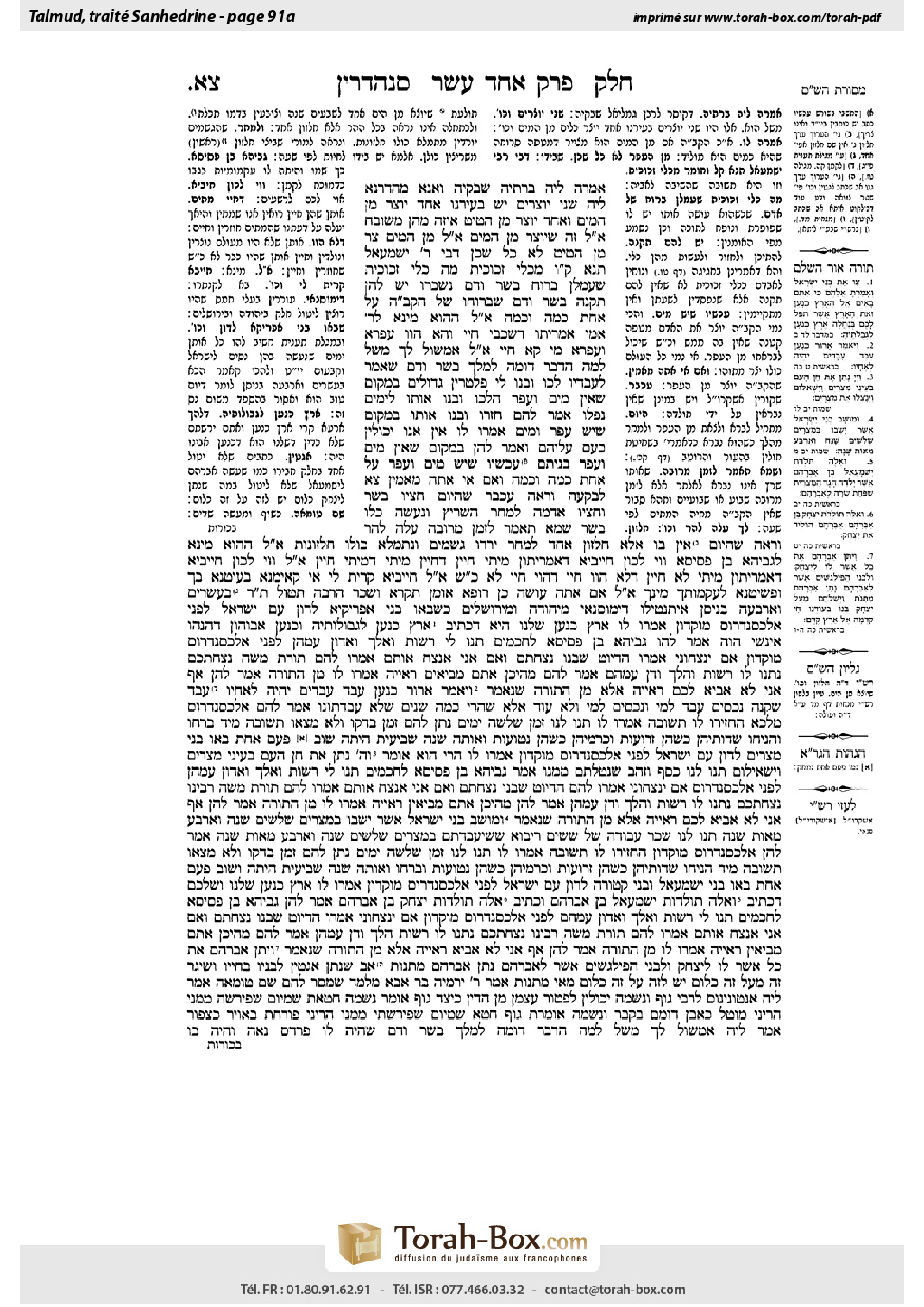
Sanhedrin 91a: Talmud study for Daf Yomi
Daf Yomi is the daily study of one Talmud folio. Explore 37 tractates with scans, Hebrew text, Sefaria English and AI-generated French translations where annotated.
Passage selection and English or AI-generated French translation are available where the scan has annotations. Daf Study is independent of Torah-Box and Sefaria.
Browse Sanhedrin · סנהדרין · All tractatesSanhedrin 91a text and translations
This page of Sanhedrin includes the Aramaic text, an English translation and an AI-generated French translation, alongside the scan above.
סנהדרין צ״א א · Aramaic and Hebrew text
אֲמַרָה לֵיהּ בְּרַתֵּיה: שִׁבְקֵיהּ, וַאֲנָא מַהְדַּרְנָא לֵיהּ. שְׁנֵי יוֹצְרִים יֵשׁ בְּעִירֵנוּ: אֶחָד יוֹצֵר מִן הַמַּיִם, וְאֶחָד יוֹצֵר מִן הַטִּיט. אֵיזֶה מֵהֶן מְשׁוּבָּח? אָמַר לָהּ: זֶה שֶׁיּוֹצֵר מִן הַמַּיִם. אָמְרָה לוֹ: מִן הַמַּיִם צָר, מִן הַטִּיט לֹא כׇּל שֶׁכֵּן?
דְּבֵי רַבִּי יִשְׁמָעֵאל תָּנָא: קַל וָחוֹמֶר מִכְּלֵי זְכוּכִית, מָה כְּלֵי זְכוּכִית שֶׁעֲמָלָן בְּרוּחַ בָּשָׂר וָדָם - נִשְׁבְּרוּ יֵשׁ לָהֶן תַּקָּנָה, בָּשָׂר וָדָם שֶׁבְּרוּחוֹ שֶׁל הַקָּדוֹשׁ בָּרוּךְ הוּא – עַל אַחַת כַּמָּה וְכַמָּה.
אֲמַר לֵיהּ הָהוּא מִינָא לְרַבִּי אַמֵּי: אָמְרִיתוּ דְּשָׁכְבֵי חָיִי. וְהָא הָווּ עַפְרָא, וְעַפְרָא מִי קָא חָיֵי?! אֲמַר לֵיהּ: אֶמְשׁוֹל לְךָ מָשָׁל. לְמָה הַדָּבָר דּוֹמֶה? לְמֶלֶךְ בָּשָׂר וָדָם שֶׁאָמַר לַעֲבָדָיו: לְכוּ וּבְנוּ לִי פַּלְטֵרִין גְּדוֹלִים בִּמְקוֹם שֶׁאֵין מַיִם וְעָפָר. הָלְכוּ וּבָנוּ אוֹתָן. לְיָמִים נָפְלוּ. אָמַר לָהֶם: חִזְרוּ וּבְנוּ אוֹתָן בִּמְקוֹם שֶׁיֵּשׁ עָפָר וָמַיִם. אָמְרוּ לוֹ: אֵין אָנוּ יְכוֹלִין.
כָּעַס עֲלֵיהֶם, וְאָמַר לָהֶן: בִּמְקוֹם שֶׁאֵין מַיִם וְעָפָר בְּנִיתֶם, עַכְשָׁיו שֶׁיֵּשׁ מַיִם וְעָפָר – עַל אַחַת כַּמָּה וְכַמָּה! וְאִם אִי אַתָּה מַאֲמִין, צֵא לַבִּקְעָה וּרְאֵה עַכְבָּר שֶׁהַיּוֹם חֶצְיוֹ בָּשָׂר וְחֶצְיוֹ אֲדָמָה, לְמָחָר הִשְׁרִיץ וְנַעֲשָׂה כֻּלּוֹ בָּשָׂר. שֶׁמָּא תֹּאמַר לִזְמַן מְרוּבֶּה? עֲלֵה לָהָר וּרְאֵה שֶׁהַיּוֹם אֵין בּוֹ אֶלָּא חִלָּזוֹן אֶחָד, לְמָחָר יָרְדוּ גְּשָׁמִים וְנִתְמַלֵּא כּוּלּוֹ חֶלְזוֹנוֹת.
אֲמַר לֵיהּ הָהוּא מִינָא לִגְבִיהָא בֶּן פְּסִיסָא: וַוי לְכוֹן חַיָּיבַיָּא, דְּאָמְרִיתוּן מִיתֵי חָיִין! דְּחָיִין מָיְתִי, דְּמִיתֵי חָיִין? אֲמַר לֵיהּ: וַוי לְכוֹן חַיָּיבַיָּא, דְּאָמְרִיתוּן מִיתֵי לָא חָיִין! דְּלָא הֲווֹ חָיִי, דַּהֲווֹ חַיֵּי – לֹא כׇּל שֶׁכֵּן? אֲמַר לֵיהּ: חַיָּיבַיָּא קָרֵית לִי? אִי קָאֵימְנָא, בָּעֵיטְנָא בָּךְ וּפָשֵׁיטְנָא לְעַקְמוּתָךְ מִינָּךְ! אֲמַר לֵיהּ: אִם אַתָּה עוֹשֶׂה כֵּן, רוֹפֵא אוּמָּן תִּקָּרֵא, וְשָׂכָר הַרְבֵּה תִּטּוֹל.
תָּנוּ רַבָּנַן: בְּעֶשְׂרִים וְאַרְבָּעָה בְּנִיסָן אִיתְנְטִילוּ דֵּימוֹסְנָאֵי מִיהוּדָה וּמִירוּשָׁלַיִם. כְּשֶׁבָּאוּ בְּנֵי אַפְרִיקִיָּא לָדוּן עִם יִשְׂרָאֵל לִפְנֵי אֲלֶכְּסַנְדְּרוֹס מוֹקְדוֹן, אָמְרוּ לוֹ: אֶרֶץ כְּנַעַן שֶׁלָּנוּ הִיא, דִּכְתִיב ״אֶרֶץ כְּנַעַן לִגְבֻלֹתֶיהָ״, וּכְנַעַן אֲבוּהוֹן דְּהָנְהוּ אִינָשֵׁי הֲוָה.
אֲמַר לְהוּ גְּבִיהָא בֶּן פְּסִיסָא לַחֲכָמִים: תְּנוּ לִי רְשׁוּת וְאֵלֵךְ וְאָדוּן עִמָּהֶן לִפְנֵי אֲלֶכְּסַנְדְּרוֹס מוֹקְדוֹן. אִם יְנַצְּחוּנִי, אִמְרוּ: הֶדְיוֹט שֶׁבָּנוּ נִצַּחְתֶּם, וְאִם אֲנִי אֲנַצֵּחַ אוֹתָם, אִמְרוּ לָהֶם: תּוֹרַת מֹשֶׁה נִצְּחַתְכֶם. נָתְנוּ לוֹ רְשׁוּת, וְהָלַךְ וְדָן עִמָּהֶם.
אָמַר לָהֶם: מֵהֵיכָן אַתֶּם מְבִיאִים רְאָיָיה? אָמְרוּ לוֹ: מִן הַתּוֹרָה. אָמַר לָהֶן: אַף אֲנִי לֹא אָבִיא לָכֶם רְאָיָיה אֶלָּא מִן הַתּוֹרָה, שֶׁנֶּאֱמַר: ״וַיֹּאמֶר אָרוּר כְּנָעַן עֶבֶד עֲבָדִים יִהְיֶה לְאֶחָיו״. עֶבֶד שֶׁקָּנָה נְכָסִים – עֶבֶד לְמִי וּנְכָסִים לְמִי? וְלֹא עוֹד, אֶלָּא שֶׁהֲרֵי כַּמָּה שָׁנִים שֶׁלֹּא עֲבַדְתּוּנוּ!
אָמַר לָהֶם אֲלֶכְּסַנְדְּרוֹס מַלְכָּא: הַחְזִירוּ לוֹ תְּשׁוּבָה! אָמְרוּ לוֹ: תְּנוּ לָנוּ זְמַן שְׁלֹשָׁה יָמִים. נָתַן לָהֶם זְמַן. בָּדְקוּ וְלֹא מָצְאוּ תְּשׁוּבָה. מִיָּד בָּרְחוּ, וְהִנִּיחוּ שְׂדוֹתֵיהֶן כְּשֶׁהֵן זְרוּעוֹת, וְכַרְמֵיהֶן כְּשֶׁהֵן נְטוּעוֹת. וְאוֹתָהּ שָׁנָה שְׁבִיעִית הָיְתָה.
שׁוּב פַּעַם אַחַת בָּאוּ בְּנֵי מִצְרַיִם לָדוּן עִם יִשְׂרָאֵל לִפְנֵי אֲלֶכְּסַנְדְּרוֹס מוֹקְדוֹן. אָמְרוּ לוֹ: הֲרֵי הוּא אוֹמֵר ״וַה׳ נָתַן אֶת חֵן הָעָם בְּעֵינֵי מִצְרַיִם וַיַּשְׁאִלוּם״. תְּנוּ לָנוּ כֶּסֶף וְזָהָב שֶׁנְּטַלְתֶּם מִמֶּנּוּ.
אָמַר גְּבִיהָא בֶּן פְּסִיסָא לַחֲכָמִים: תְּנוּ לִי רְשׁוּת וְאֵלֵךְ וְאָדוּן עִמָּהֶן לִפְנֵי אֲלֶכְּסַנְדְּרוֹס. אִם יְנַצְּחוּנִי, אִמְרוּ לָהֶם: הֶדְיוֹט שֶׁבָּנוּ נִצַּחְתֶּם, וְאִם אֲנִי אֲנַצֵּחַ אוֹתָם, אִמְרוּ לָהֶם: תּוֹרַת מֹשֶׁה רַבֵּינוּ נִצְּחַתְכֶם. נָתְנוּ לוֹ רְשׁוּת וְהָלַךְ וְדָן עִמָּהֶן.
אָמַר לָהֶן: מֵהֵיכָן אַתֶּם מְבִיאִין רְאָיָיה? אָמְרוּ לוֹ: מִן הַתּוֹרָה. אָמַר לָהֶן: אַף אֲנִי לֹא אָבִיא לָכֶם רְאָיָיה אֶלָּא מִן הַתּוֹרָה, שֶׁנֶּאֱמַר: ״וּמוֹשַׁב בְּנֵי יִשְׂרָאֵל אֲשֶׁר יָשְׁבוּ בְּמִצְרָיִם שְׁלֹשִׁים שָׁנָה וְאַרְבַּע מֵאוֹת שָׁנָה״. תְּנוּ לָנוּ שְׂכַר עֲבוֹדָה שֶׁל שִׁשִּׁים רִיבּוֹא שֶׁשִּׁיעְבַּדְתֶּם בְּמִצְרַיִם שְׁלֹשִׁים שָׁנָה וְאַרְבַּע מֵאוֹת שָׁנָה.
אָמַר לָהֶן אֲלֶכְּסַנְדְּרוֹס מוֹקְדוֹן: הַחְזִירוּ לוֹ תְּשׁוּבָה! אָמְרוּ לוֹ: תְּנוּ לָנוּ זְמַן שְׁלֹשָׁה יָמִים. נָתַן לָהֶם זְמַן. בָּדְקוּ וְלֹא מָצְאוּ תְּשׁוּבָה. מִיָּד הִנִּיחוּ שְׂדוֹתֵיהֶן כְּשֶׁהֵן זְרוּעוֹת, וְכַרְמֵיהֶן כְּשֶׁהֵן נְטוּעוֹת, וּבָרְחוּ. וְאוֹתָהּ שָׁנָה שְׁבִיעִית הָיְתָה.
וְשׁוּב פַּעַם אַחַת בָּאוּ בְּנֵי יִשְׁמָעֵאל וּבְנֵי קְטוּרָה לָדוּן עִם יִשְׂרָאֵל לִפְנֵי אֲלֶכְּסַנְדְּרוֹס מוֹקְדוֹן. אָמְרוּ לוֹ: אֶרֶץ כְּנַעַן שֶׁלָּנוּ וְשֶׁלָּכֶם, דִּכְתִיב ״וְאֵלֶּה תֹּלְדֹת יִשְׁמָעֵאל בֶּן אַבְרָהָם״ וּכְתִיב ״אֵלֶּה תּוֹלְדֹת יִצְחָק בֶּן אַבְרָהָם״.
אָמַר לָהֶן גְּבִיהָא בֶּן פְּסִיסָא לַחֲכָמִים: תְּנוּ לִי רְשׁוּת וְאֵלֵךְ וְאָדוּן עִמָּהֶם לִפְנֵי אֲלֶכְּסַנְדְּרוֹס מוֹקְדוֹן. אִם יְנַצְּחוּנִי אִמְרוּ: הֶדְיוֹט שֶׁבָּנוּ נִצַּחְתֶּם, וְאִם אֲנִי אֲנַצֵּחַ אוֹתָם אִמְרוּ לָהֶם: תּוֹרַת מֹשֶׁה רַבֵּינוּ נִצְּחַתְכֶם. נָתְנוּ לוֹ רְשׁוּת, הָלַךְ וְדָן עִמָּהֶן.
אָמַר לָהֶם: מֵהֵיכָן אַתֶּם מְבִיאִין רְאָיָיה? אָמְרוּ לוֹ: מִן הַתּוֹרָה. אָמַר לָהֶן: אַף אֲנִי לֹא אָבִיא רְאָיָיה אֶלָּא מִן הַתּוֹרָה, שֶׁנֶּאֱמַר: ״וַיִּתֵּן אַבְרָהָם אֶת כׇּל אֲשֶׁר לוֹ לְיִצְחָק. וְלִבְנֵי הַפִּילַגְשִׁים אֲשֶׁר לְאַבְרָהָם נָתַן אַבְרָהָם מַתָּנֹת״. אָב שֶׁנָּתַן אֲגִטִּין לְבָנָיו בְּחַיָּיו וְשִׁיגֵּר זֶה מֵעַל זֶה, כְּלוּם יֵשׁ לָזֶה עַל זֶה כְּלוּם? מַאי מַתָּנוֹת? אָמַר רַבִּי יִרְמְיָה בַּר אַבָּא: מְלַמֵּד שֶׁמָּסַר לָהֶם שֵׁם טוּמְאָה.
אֲמַר לֵיהּ אַנְטוֹנִינוּס לְרַבִּי: גּוּף וּנְשָׁמָה יְכוֹלִין לִפְטוֹר עַצְמָן מִן הַדִּין. כֵּיצַד? גּוּף אוֹמֵר: נְשָׁמָה חָטָאת, שֶׁמִּיּוֹם שֶׁפֵּירְשָׁה מִמֶּנִּי הֲרֵינִי מוּטָּל כְּאֶבֶן דּוּמָם בַּקֶּבֶר. וּנְשָׁמָה אוֹמֶרֶת: גּוּף חָטָא, שֶׁמִּיּוֹם שֶׁפֵּירַשְׁתִּי מִמֶּנּוּ הֲרֵינִי פּוֹרַחַת בָּאֲוִיר כְּצִפּוֹר. אֲמַר לֵיהּ: אֶמְשׁוֹל לְךָ מָשָׁל. לְמָה הַדָּבָר דּוֹמֶה? לְמֶלֶךְ בָּשָׂר וָדָם שֶׁהָיָה לוֹ פַּרְדֵּס נָאֶה, וְהָיָה בּוֹ
Sanhedrin 91a · English translation
The daughter of the emperor said to Rabban Gamliel: Leave him, and I will respond to him with a parable. She said: There are two craftsmen in our city; one fashions vessels from water, and one fashions vessels from mortar. Which is more noteworthy? The emperor said to her: It is that craftsman that fashions vessels from water. His daughter said to him: If he fashions a vessel from the water, all the more so is it not clear that he can fashion vessels from mortar? By the same token, if God was able to create the world from water, He is certainly able to resurrect people from dust.
The school of Rabbi Yishmael taught that resurrection of the dead a fortiori from glass vessels: If concerning glass vessels, which are fashioned by the breath of those of flesh and blood, who blow and form the vessels, and yet if they break they can be repaired, as they can be melted and subsequently blown again, then with regard to those of flesh and blood, whose souls are a product of the breath of the Holy One, Blessed be He, all the more so can God restore them to life.
The Gemara relates that a certain heretic said to Rabbi Ami: You say that the dead will live. Aren’t they dust? And does dust come to life? Rabbi Ami said to him: I will tell you a parable. To what is this matter comparable? It is comparable to a flesh-and-blood king who said to his servants: Go and construct for me a great palace [palterin] in a place where there is no water and earth available. They went and constructed it. Sometime later, the palace collapsed. The king said to them: Return to your labor and construct the palace in a place where there is earth and water available. They said to him: We are unable to do so.
The king became angry at them and said to them: If in a place where there is no water and earth available you constructed a palace, now that there is water and earth available all the more so should you be able to do so. Similarly, concerning man, whom God created ex nihilo, all the more so will God be able to resurrect him from dust. And if you do not believe that a being can be created from dust, go out to the valley and see an akhbar, a creature that today is half flesh and half earth, and tomorrow the being will develop and all of it will become flesh. Lest you say that creation of living creatures is a matter that develops over an extended period, ascend a mountain and see that today there is only one snail there; then ascend tomorrow, after rain will have fallen, and see that it will be entirely filled with snails.
The Gemara relates that a certain heretic said to Geviha ben Pesisa: Woe unto you, the wicked, as you say: The dead will come to life. The way of the world is that those who are alive die. How can you say that the dead will come to life? Geviha ben Pesisa said to him: Woe unto you, the wicked, as you say: The dead will not come to life. If those who were not in existence come to life, is it not reasonable all the more so that those who were once alive will come to life again? The heretic said to Geviha ben Pesisa angrily: You called me wicked? If I stand, I will kick you and flatten your hump, as Geviha ben Pesisa was a hunchback. Geviha ben Pesisa said to him jocularly: If you do so, you will be called an expert doctor and will take high wages for your services.
§ Apropos Geviha ben Pesisa and his cleverness in debate, the Gemara cites additional incidents where he represented the Jewish people in debates. The Sages taught in Megillat Ta’anit: On the twenty-fourth day in Nisan it is a joyous day, since the usurpers [dimusana’ei] were expelled from Judea and Jerusalem. When the people of Afrikiya came to judgment with the Jewish people before the emperor, Alexander of Macedon, they said to him: The land of Canaan is ours, as it is written: “This is the land that shall fall to you as an inheritance, the land of Canaan according to its borders” (Numbers 34:2). And the people of Afrikiya said, referring to themselves: Canaan is the forefather of these people.
Geviha ben Pesisa said to the Sages: Give me permission and I will go and deliberate with them before Alexander of Macedon. If they will defeat me, say to them: You have defeated an ordinary person from among us, and until you overcome our Sages, it is no victory. And if I will defeat them, say to them: The Torah of Moses defeated you, and attribute no significance to me. The Sages gave him permission, and he went and deliberated with them.
Geviha ben Pesisa said to them: From where are you citing proof that the land of Canaan is yours? They said to him: From the Torah. Geviha ben Pesisa said to them: I too will cite proof to you only from the Torah, as it is stated: “And he said: Cursed will be Canaan; a slave of slaves shall he be to his brethren” (Genesis 9:25). And with regard to a slave who acquired property, the slave belongs to whom and the property belongs to whom? The slave and his property belong to the master. And moreover, it is several years now that you have not served us. Therefore, not only are you not entitled to the land, there are additional debts that must be repaid, as well as a return to enslavement.
Alexander the king said to the people of Afrikiya: Provide Geviha ben Pesisa with a response to his claims. They said to Alexander: Give us time; give us three days to consider the matter. The emperor gave them the requested time and they examined the matter and did not find a response to the claims. Immediately, they fled and abandoned their fields when they were sown and their vineyards when they were planted. The Gemara adds: And since that year was a Sabbatical Year, with the accompanying restrictions on agricultural activity, this benefited the Jewish people, as they were able to consume the produce of those fields and vineyards.
The Gemara relates: On another occasion, the people of Egypt came to judgment with the Jewish people before Alexander of Macedon. The Egyptian people said to Alexander: It says in the Torah: “And the Lord gave the people favor in the eyes of Egypt, and they lent them” (Exodus 12:36). Give us the silver and gold that you took from us; you claimed that you were borrowing it and you never returned it.
Geviha ben Pesisa said to the Sages: Give me permission and I will go and deliberate with them before Alexander of Macedon. If they will defeat me, say to them: You have defeated an ordinary person from among us, and until you overcome our Sages, it is no victory. And if I will defeat them, say to them: The Torah of Moses, our teacher, defeated you, and attribute no significance to me. The Sages gave him permission, and he went and deliberated with them.
Geviha ben Pesisa said to them: From where are you citing proof that you are entitled to the silver and gold? They said to him: From the Torah. Geviha ben Pesisa said to them: I too will cite proof to you only from the Torah, as it is stated: “And the sojourning of the children of Israel, who dwelt in Egypt, was four hundred and thirty years” (Exodus 12:40), during which they were enslaved to Egypt, engaged in hard manual labor. Give us the wages for the work performed by the 600,000 men above the age of twenty (see Exodus 12:37) whom you enslaved in Egypt for four hundred and thirty years.
Alexander of Macedon said to the people of Egypt: Provide Geviha ben Pesisa with a response to his claims. They said to him: Give us time; give us three days to consider the matter. The emperor gave them the requested time and they examined the matter and did not find a response to the claims. Immediately, they abandoned their fields when they were sown and their vineyards when they were planted, and fled. The Gemara adds: And that year was a Sabbatical Year.
The Gemara relates: And on another occasion, the descendants of Ishmael and the descendants of Keturah came to judgment with the Jewish people before Alexander of Macedon. They said to the Jewish people before Alexander: The land of Canaan is both ours and yours, as it is written: “And these are the generations of Ishmael, son of Abraham, whom Hagar the Egyptian, Sarah’s maidservant, bore unto Abraham” (Genesis 25:12), and it is written: “And these are the generations of Isaac, son of Abraham” (Genesis 25:19). Therefore, the land should be divided between Abraham’s heirs.
Geviha ben Pesisa said to the Sages: Give me permission and I will go and deliberate with them before Alexander of Macedon. If they will defeat me, say to them: You have defeated an ordinary person from among us, and until you overcome our Sages, it is no victory. And if I will defeat them, say to them: The Torah of Moses, our teacher, defeated you, and attribute no significance to me. The Sages gave him permission, and he went and deliberated with them.
Geviha ben Pesisa said to the descendants of Ishmael: From where are you citing proof that the land of Canaan belongs to both you and the Jewish people? They said to him: From the Torah. Geviha ben Pesisa said to them: I too will cite proof to you only from the Torah, as it is stated: “And Abraham gave all that he had to Isaac. But to the sons of the concubines that Abraham had, Abraham gave gifts, and he sent them away from his son, while he yet lived, eastward, to the east country” (Genesis 25:5–6). In the case of a father who gave a document of bequest [agatin] to his sons during his lifetime and sent one of the sons away from the other, does the one who was sent away have any claim against the other? The father himself divided his property. The Gemara asks: What were these gifts that Abraham gave to the sons of the concubines? Rabbi Yirmeya bar Abba says: This teaches that Abraham provided them with the name of the supernatural spirit of impurity, enabling them to perform witchcraft.
§ Apropos exchanges with prominent gentile leaders, the Gemara cites an exchange where Antoninos, the Roman emperor, said to Rabbi Yehuda HaNasi: The body and the soul are able to exempt themselves from judgment for their sins. How so? The body says: The soul sinned, as from the day of my death when it departed from me, I am cast like a silent stone in the grave, and do not sin. And the soul says: The body sinned, as from the day that I departed from it, I am flying in the air like a bird, incapable of sin. Rabbi Yehuda HaNasi said to him: I will tell you a parable. To what is this matter comparable? It is comparable to a king of flesh and blood who had a fine orchard, and in it there were
Sanhedrin 91a · Traduction française (IA)
La fille de l’empereur dit à Rabban Gamliel : « Laisse-le, je vais lui répondre par une parabole. » Elle poursuivit : « Il y a dans notre ville deux artisans : l’un façonne des récipients à partir d’eau, l’autre à partir de mortier. Lequel est le plus remarquable ? » L’empereur lui répondit : « Celui qui façonne des récipients à partir d’eau. » Sa fille lui dit : « S’il façonne un récipient à partir d’eau, n’est-il pas d’autant plus évident qu’il peut en façonner à partir de mortier ? De même, si Dieu a pu créer le monde à partir d’eau, il est assurément capable de ressusciter les gens à partir de la poussière. »
L’école de Rabbi Yishmael enseignait qu’on peut déduire a fortiori la résurrection des morts des récipients de verre : si des récipients de verre, façonnés par le souffle d’êtres de chair et de sang qui soufflent pour leur donner forme, peuvent être réparés lorsqu’ils se brisent — puisqu’on peut les faire fondre, puis souffler à nouveau pour les façonner —, alors, à plus forte raison, Dieu peut-il rendre à la vie des êtres de chair et de sang, dont les âmes sont le produit du souffle du Saint, béni soit-Il.
La Guemara rapporte qu’un certain hérétique dit à Rabbi Ami : « Vous dites que les morts revivront. Ne sont-ils pas poussière ? Et la poussière revient-elle à la vie ? » Rabbi Ami lui dit : « Je vais te raconter une parabole. À quoi cela ressemble-t-il ? À un roi de chair et de sang qui dit à ses serviteurs : “Allez me construire un grand palais [palterin] dans un endroit où il n’y a ni eau ni terre.” Ils y allèrent et le construisirent. Quelque temps plus tard, le palais s’effondra. Le roi leur dit : “Retournez à votre travail et construisez le palais dans un endroit où il y a de la terre et de l’eau.” Ils lui répondirent : “Nous n’en sommes pas capables.” »
Le roi se mit en colère contre eux et leur dit : « Si vous avez construit un palais dans un endroit où il n’y avait ni eau ni terre, maintenant qu’il y a de l’eau et de la terre, vous devriez d’autant plus en être capables. » De même, en ce qui concerne l’homme, que Dieu a créé ex nihilo, Dieu pourra d’autant plus le ressusciter à partir de la poussière. Et si tu ne crois pas qu’un être puisse être créé à partir de poussière, va dans la vallée et observe un akhbar, une créature qui est aujourd’hui à moitié chair et à moitié terre, mais qui, demain, se développera et sera entièrement faite de chair. De peur que tu ne dises que la création des êtres vivants est un processus qui s’étend sur une longue période, monte sur une montagne et observe : aujourd’hui, il n’y a là qu’un seul escargot ; puis remonte demain, après la pluie, et tu verras que l’endroit sera entièrement rempli d’escargots.
La Guemara rapporte qu’un certain hérétique dit à Geviha ben Pesisa : « Malheur à vous, les méchants, puisque vous dites que les morts revivront. L’ordre naturel est que les vivants meurent. Comment pouvez-vous dire que les morts revivront ? » Geviha ben Pesisa lui dit : « Malheur à vous, les méchants, puisque vous dites que les morts ne revivront pas. Si ceux qui n’existaient pas viennent à l’existence, n’est-il pas d’autant plus raisonnable que ceux qui ont été vivants reviennent à la vie ? » Le hérétique dit avec colère à Geviha ben Pesisa : « Tu m’as traité de méchant ? Si je me lève, je te donnerai un coup de pied et t’aplatirai la bosse », car Geviha ben Pesisa était bossu. Geviha ben Pesisa lui répondit sur le ton de la plaisanterie : « Si tu fais cela, on te considérera comme un médecin expert et tu recevras des honoraires élevés pour tes services. »
§ À propos de Geviha ben Pesisa et de son habileté dans les débats, la Guemara cite d’autres épisodes où il représenta le peuple juif dans des controverses. Les Sages enseignèrent dans la Meguilat Ta’anit : le vingt-quatre Nissan est un jour de réjouissance, car les usurpateurs [dimusana’ei] furent expulsés de Judée et de Jérusalem. Lorsque les habitants d’Afrikiya vinrent plaider leur cause contre le peuple juif devant l’empereur Alexandre de Macédoine, ils lui dirent : « Le pays de Canaan nous appartient, comme il est écrit : “Voici le pays qui vous échoira en héritage, le pays de Canaan selon ses frontières” (Nombres 34:2). » Les habitants d’Afrikiya dirent, en parlant d’eux-mêmes : « Canaan est l’ancêtre de ce peuple. »
Geviha ben Pesisa dit aux Sages : « Donnez-moi la permission, et j’irai débattre avec eux devant Alexandre de Macédoine. S’ils l’emportent sur moi, dites-leur : “Vous avez vaincu un homme ordinaire parmi nous ; tant que vous n’aurez pas vaincu nos Sages, ce n’est pas une victoire.” Et si je l’emporte sur eux, dites-leur : “C’est la Torah de Moïse qui vous a vaincus”, et n’attachez aucune importance à ma personne. » Les Sages lui en donnèrent la permission, et il alla débattre avec eux.
Geviha ben Pesisa leur dit : « Sur quoi fondez-vous votre preuve que le pays de Canaan vous appartient ? » Ils lui répondirent : « Sur la Torah. » Geviha ben Pesisa leur dit : « Moi aussi, je ne vous apporterai de preuve que de la Torah, comme il est dit : “Il dit : Maudit soit Canaan ; il sera l’esclave des esclaves de ses frères” (Genèse 9:25). Or, lorsqu’un esclave acquiert des biens, à qui appartiennent l’esclave et ses biens ? L’esclave et ses biens appartiennent au maître. De plus, voilà plusieurs années que vous ne nous servez plus. Vous n’avez donc non seulement aucun droit sur le pays, mais vous avez aussi des dettes à rembourser et devez redevenir esclaves. »
Le roi Alexandre dit aux habitants d’Afrikiya : « Répondez aux arguments de Geviha ben Pesisa. » Ils dirent à Alexandre : « Accordez-nous du temps ; donnez-nous trois jours pour examiner la question. » L’empereur leur accorda le délai demandé. Ils examinèrent la question, mais ne trouvèrent aucune réponse à ses arguments. Aussitôt, ils s’enfuirent, abandonnant leurs champs déjà ensemencés et leurs vignes déjà plantées. La Guemara ajoute que, cette année-là étant une année sabbatique, avec les restrictions agricoles qui l’accompagnent, cela fut bénéfique au peuple juif, qui put consommer les produits de ces champs et de ces vignes.
La Guemara rapporte qu’une autre fois, les habitants d’Égypte vinrent plaider leur cause contre le peuple juif devant Alexandre de Macédoine. Les Égyptiens dirent à Alexandre : « Il est écrit dans la Torah : “L’Éternel rendit le peuple bien disposé à l’égard des Égyptiens, et ils leur prêtèrent” (Exode 12:36). Rendez-nous l’argent et l’or que vous nous avez pris : vous avez prétendu nous les emprunter et ne nous les avez jamais rendus. »
Geviha ben Pesisa dit aux Sages : « Donnez-moi la permission, et j’irai débattre avec eux devant Alexandre de Macédoine. S’ils l’emportent sur moi, dites-leur : “Vous avez vaincu un homme ordinaire parmi nous ; tant que vous n’aurez pas vaincu nos Sages, ce n’est pas une victoire.” Et si je l’emporte sur eux, dites-leur : “C’est la Torah de Moïse, notre maître, qui vous a vaincus”, et n’attachez aucune importance à ma personne. » Les Sages lui en donnèrent la permission, et il alla débattre avec eux.
Geviha ben Pesisa leur dit : « Sur quoi fondez-vous votre preuve que l’argent et l’or vous reviennent ? » Ils lui répondirent : « Sur la Torah. » Geviha ben Pesisa leur dit : « Moi aussi, je ne vous apporterai de preuve que de la Torah, comme il est dit : “Le séjour des enfants d’Israël, qui demeurèrent en Égypte, fut de quatre cent trente ans” (Exode 12:40), durant lesquels ils furent asservis à l’Égypte et soumis à de durs travaux manuels. Payez-nous le salaire du travail effectué par les 600 000 hommes âgés de plus de vingt ans (voir Exode 12:37), que vous avez asservis en Égypte pendant quatre cent trente ans. »
Alexandre de Macédoine dit aux habitants d’Égypte : « Répondez aux arguments de Geviha ben Pesisa. » Ils lui dirent : « Accordez-nous du temps ; donnez-nous trois jours pour examiner la question. » L’empereur leur accorda le délai demandé. Ils examinèrent la question, mais ne trouvèrent aucune réponse à ses arguments. Aussitôt, ils abandonnèrent leurs champs déjà ensemencés et leurs vignes déjà plantées, puis s’enfuirent. La Guemara ajoute que cette année-là était une année sabbatique.
La Guemara rapporte qu’une autre fois, les descendants d’Ismaël et les descendants de Ketoura vinrent plaider leur cause contre le peuple juif devant Alexandre de Macédoine. Ils dirent au peuple juif, devant Alexandre : « Le pays de Canaan nous appartient autant qu’à vous, comme il est écrit : “Voici la descendance d’Ismaël, fils d’Abraham, que Hagar l’Égyptienne, servante de Sarah, enfanta à Abraham” (Genèse 25:12), et il est écrit : “Voici la descendance d’Isaac, fils d’Abraham” (Genèse 25:19). Le pays doit donc être partagé entre les héritiers d’Abraham. »
Geviha ben Pesisa dit aux Sages : « Donnez-moi la permission, et j’irai débattre avec eux devant Alexandre de Macédoine. S’ils l’emportent sur moi, dites-leur : “Vous avez vaincu un homme ordinaire parmi nous ; tant que vous n’aurez pas vaincu nos Sages, ce n’est pas une victoire.” Et si je l’emporte sur eux, dites-leur : “C’est la Torah de Moïse, notre maître, qui vous a vaincus”, et n’attachez aucune importance à ma personne. » Les Sages lui en donnèrent la permission, et il alla débattre avec eux.
Geviha ben Pesisa dit aux descendants d’Ismaël : « Sur quoi fondez-vous votre preuve que le pays de Canaan appartient à la fois à vous et au peuple juif ? » Ils lui répondirent : « Sur la Torah. » Geviha ben Pesisa leur dit : « Moi aussi, je ne vous apporterai de preuve que de la Torah, comme il est dit : “Abraham donna tout ce qu’il possédait à Isaac. Mais aux fils de ses concubines, Abraham fit des dons ; puis, de son vivant, il les éloigna de son fils et les envoya vers l’est, dans le pays de l’Orient” (Genèse 25:5–6). Lorsqu’un père remet à ses fils, de son vivant, un acte de legs [agatin] et éloigne l’un d’eux des autres, celui qui a été éloigné peut-il revendiquer quoi que ce soit contre les autres ? Le père lui-même a partagé ses biens. » La Guemara demande : quels étaient ces dons qu’Abraham fit aux fils de ses concubines ? Rabbi Yirmeya bar Abba dit : cela enseigne qu’Abraham leur révéla le nom de l’esprit surnaturel d’impureté, ce qui leur permettait de pratiquer la sorcellerie.
§ À propos des échanges avec des dirigeants non juifs éminents, la Guemara cite une conversation au cours de laquelle Antoninus, l’empereur romain, dit à Rabbi Yehuda HaNasi : « Le corps et l’âme peuvent se soustraire au jugement pour leurs péchés. Comment cela ? Le corps dit : “C’est l’âme qui a péché, car depuis le jour de ma mort, lorsqu’elle m’a quitté, je suis étendu dans la tombe comme une pierre silencieuse et je ne pèche pas.” Et l’âme dit : “C’est le corps qui a péché, car depuis le jour où je l’ai quitté, je vole dans les airs comme un oiseau, incapable de pécher.” » Rabbi Yehuda HaNasi lui dit : « Je vais te raconter une parabole. À quoi cela ressemble-t-il ? À un roi de chair et de sang qui avait un beau verger, dans lequel se trouvaient… »
Traduction française générée par IA à partir de l’édition anglaise de Sefaria. Vérifie toujours un passage avec le texte source.
Text from Sefaria: William Davidson Edition - Vocalized Aramaic (CC BY NC); William Davidson Edition - English (CC BY NC).