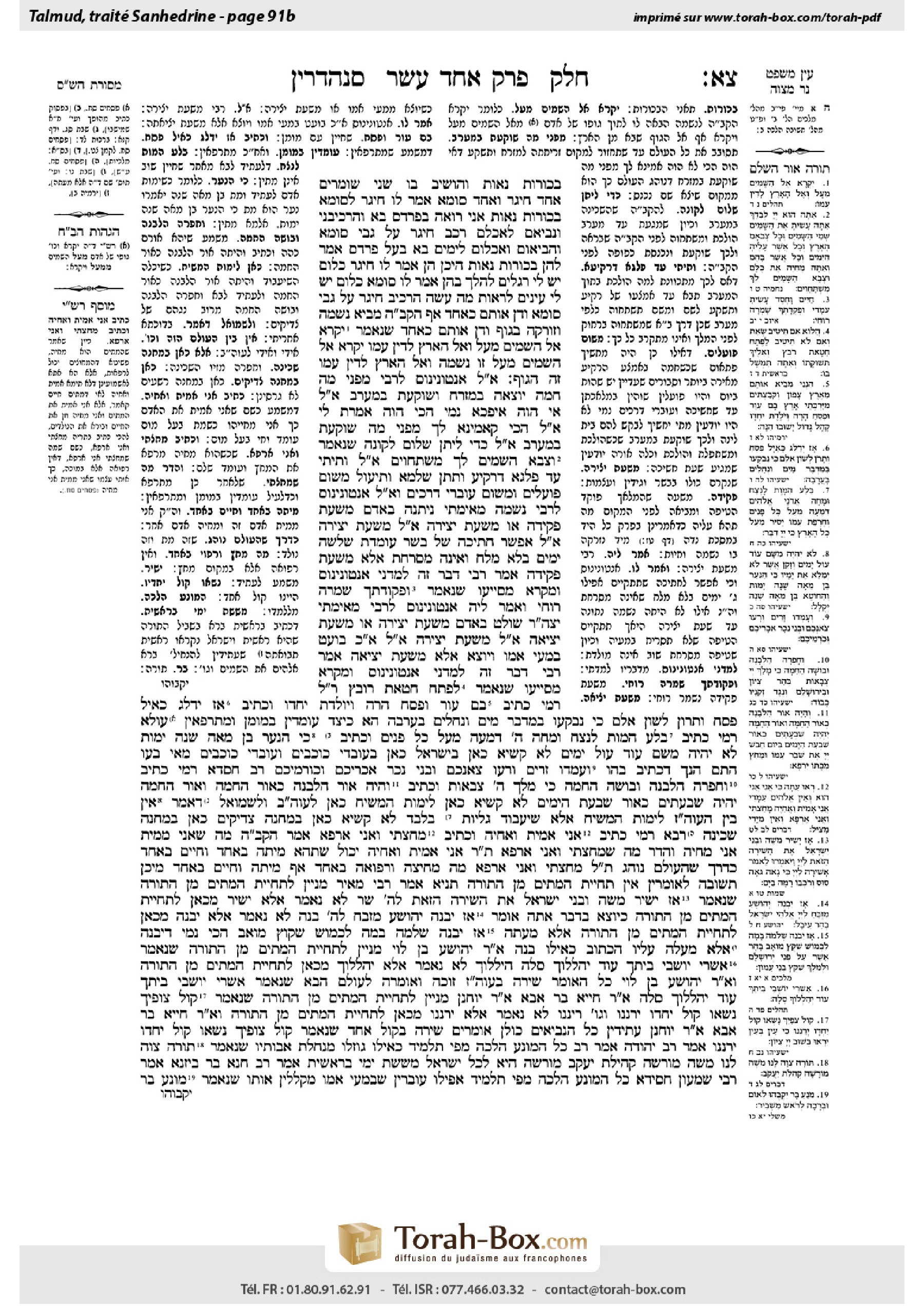
Sanhedrin 91b: Talmud study for Daf Yomi
Daf Yomi is the daily study of one Talmud folio. Explore 37 tractates with scans, Hebrew text, Sefaria English and AI-generated French translations where annotated.
Passage selection and English or AI-generated French translation are available where the scan has annotations. Daf Study is independent of Torah-Box and Sefaria.
Browse Sanhedrin · סנהדרין · All tractatesSanhedrin 91b text and translations
This page of Sanhedrin includes the Aramaic text, an English translation and an AI-generated French translation, alongside the scan above.
סנהדרין צ״א ב · Aramaic and Hebrew text
בַּכּוּרוֹת נָאוֹת, וְהוֹשִׁיב בּוֹ שְׁנֵי שׁוֹמְרִים: אֶחָד חִיגֵּר וְאֶחָד סוֹמֵא. אָמַר לוֹ חִיגֵּר לַסּוֹמֵא: בַּכּוּרוֹת נָאוֹת אֲנִי רוֹאֶה בַּפַּרְדֵּס. בֹּא וְהַרְכִּיבֵנִי וּנְבִיאֵם לְאׇכְלָם. רָכַב חִיגֵּר עַל גַּבֵּי סוֹמֵא, וֶהֱבִיאוּם וַאֲכָלוּם.
לְיָמִים בָּא בַּעַל פַּרְדֵּס. אָמַר לָהֶן: בַּכּוּרוֹת נָאוֹת הֵיכָן הֵן? אָמַר לוֹ חִיגֵּר: כְּלוּם יֵשׁ לִי רַגְלַיִם לְהַלֵּךְ בָּהֶן? אָמַר לוֹ סוֹמֵא: כְּלוּם יֵשׁ לִי עֵינַיִם לִרְאוֹת? מָה עָשָׂה? הִרְכִּיב חִיגֵּר עַל גַּבֵּי סוֹמֵא, וְדָן אוֹתָם כְּאֶחָד.
אַף הַקָּדוֹשׁ בָּרוּךְ הוּא מֵבִיא נְשָׁמָה וְזוֹרְקָהּ בַּגּוּף, וְדָן אוֹתָם כְּאֶחָד, שֶׁנֶּאֱמַר: ״יִקְרָא אֶל הַשָּׁמַיִם מֵעָל וְאֶל הָאָרֶץ לָדִין עַמּוֹ״. ״יִקְרָא אֶל הַשָּׁמַיִם מֵעָל״ – זוֹ נְשָׁמָה, ״וְאֶל הָאָרֶץ לָדִין עַמּוֹ״ – זֶה הַגּוּף.
אֲמַר לֵיהּ אַנְטוֹנִינוּס לְרַבִּי: מִפְּנֵי מָה חַמָּה יוֹצְאָה בַּמִּזְרָח וְשׁוֹקַעַת בְּמַעֲרָב? אֲמַר לֵיהּ: אִי הֲוָה אִיפְּכָא נָמֵי הָכִי הֲוָה אָמְרַתְּ לִי. אֲמַר לֵיהּ, הָכִי קָאָמֵינָא לָךְ: מִפְּנֵי מָה שׁוֹקַעַת בַּמַּעֲרָב?
אֲמַר לֵיהּ: כְּדֵי לִיתֵּן שָׁלוֹם לְקוֹנָהּ, שֶׁנֶּאֱמַר ״וּצְבָא הַשָּׁמַיִם לְךָ מִשְׁתַּחֲוִים״. אֲמַר לֵיהּ: וְתֵיתֵי עַד פַּלְגָא דְרָקִיעַ, וְתִתֵּן שְׁלָמָא, וְתֵיעוֹל! מִשּׁוּם פּוֹעֲלִים וּמִשּׁוּם עוֹבְרֵי דְרָכִים.
וְאָמַר לוֹ אַנְטוֹנִינוּס לְרַבִּי: נְשָׁמָה מֵאֵימָתַי נִיתְּנָה בָּאָדָם, מִשְּׁעַת פְּקִידָה אוֹ מִשְּׁעַת יְצִירָה? אָמַר לוֹ: מִשְּׁעַת יְצִירָה. אָמַר לוֹ: אֶפְשָׁר חֲתִיכָה שֶׁל בָּשָׂר עוֹמֶדֶת שְׁלֹשָׁה יָמִים בְּלֹא מֶלַח וְאֵינָהּ מַסְרַחַת? אֶלָּא מִשְּׁעַת פְּקִידָה. אָמַר רַבִּי: דָּבָר זֶה לִמְּדַנִי אַנְטוֹנִינוּס, וּמִקְרָא מְסַיְּיעוֹ שֶׁנֶּאֱמַר ״וּפְקֻדָּתְךָ שָׁמְרָה רוּחִי״.
וְאָמַר לוֹ אַנְטוֹנִינוּס לְרַבִּי: מֵאֵימָתַי יֵצֶר הָרָע שׁוֹלֵט בָּאָדָם, מִשְּׁעַת יְצִירָה אוֹ מִשְּׁעַת יְצִיאָה? אָמַר לוֹ: מִשְּׁעַת יְצִירָה. אָמַר לוֹ: אִם כֵּן, בּוֹעֵט בִּמְעֵי אִמּוֹ וְיוֹצֵא! אֶלָּא מִשְּׁעַת יְצִיאָה. אָמַר רַבִּי: דָּבָר זֶה לִמְּדַנִי אַנְטוֹנִינוּס, וּמִקְרָא מְסַיְּיעוֹ, שֶׁנֶּאֱמַר: ״לַפֶּתַח חַטָּאת רֹבֵץ״.
רֵישׁ לָקִישׁ רָמֵי: כְּתִיב ״בָּם עִוֵּר וּפִסֵּחַ הָרָה וְיֹלֶדֶת יַחְדָּיו״, וּכְתִיב ״אָז יְדַלֵּג כָּאַיָּל פִּסֵּחַ וְתָרֹן לְשׁוֹן אִלֵּם כִּי נִבְקְעוּ בַמִּדְבָּר מַיִם וּנְחָלִים בָּעֲרָבָה״. הָא כֵּיצַד? עוֹמְדִין בְּמוּמָן וּמִתְרַפְּאִין.
עוּלָּא רָמֵי: כְּתִיב ״בִּלַּע הַמָּוֶת לָנֶצַח וּמָחָה ה׳ דִּמְעָה מֵעַל כׇּל פָּנִים״, וּכְתִיב ״כִּי הַנַּעַר בֶּן מֵאָה שָׁנָה יָמוּת לֹא יִהְיֶה מִשָּׁם עוֹד עוּל יָמִים״. לָא קַשְׁיָא: כָּאן – בְּיִשְׂרָאֵל, כָּאן – בְּאוּמּוֹת הָעוֹלָם. וְאוּמּוֹת הָעוֹלָם מַאי בָּעוּ הָתָם? הָנָךְ דִּכְתִיב בְּהוּ ״וְעָמְדוּ זָרִים וְרָעוּ צֹאנְכֶם וּבְנֵי נֵכָר אִכָּרֵיכֶם וְכֹרְמֵיכֶם״.
רַב חִסְדָּא רָמֵי: כְּתִיב ״וְחָפְרָה הַלְּבָנָה וּבוֹשָׁה הַחַמָּה כִּי מָלַךְ ה׳ צְבָאוֹת״, וּכְתִיב ״וְהָיָה אוֹר הַלְּבָנָה כְּאוֹר הַחַמָּה וְאוֹר הַחַמָּה יִהְיֶה שִׁבְעָתַיִם כְּאוֹר שִׁבְעַת הַיָּמִים״. לָא קַשְׁיָא: כָּאן לִימוֹת הַמָּשִׁיחַ, כָּאן לָעוֹלָם הַבָּא.
וְלִשְׁמוּאֵל, דְּאָמַר: אֵין בֵּין הָעוֹלָם הַזֶּה לִימוֹת הַמָּשִׁיחַ אֶלָּא שִׁיעְבּוּד גָּלִיּוֹת בִּלְבַד, לָא קַשְׁיָא: כָּאן בְּמַחֲנֵה צַדִּיקִים, כָּאן בְּמַחֲנֵה שְׁכִינָה.
רָבָא רָמֵי: כְּתִיב ״אֲנִי אָמִית וַאֲחַיֶּה״, וּכְתִיב ״מָחַצְתִּי וַאֲנִי אֶרְפָּא״. אָמַר הַקָּדוֹשׁ בָּרוּךְ הוּא: מַה שֶּׁאֲנִי מֵמִית – אֲנִי מְחַיֶּה, וַהֲדַר מַה שֶּׁמָּחַצְתִּי – וַאֲנִי אֶרְפָּא.
תָּנוּ רַבָּנַן: ״אֲנִי אָמִית וַאֲחַיֶּה״ – יָכוֹל שֶׁתְּהֵא מִיתָה בְּאֶחָד וְחַיִּים בְּאֶחָד, כְּדֶרֶךְ שֶׁהָעוֹלָם נוֹהֵג? תַּלְמוּד לוֹמַר: ״מָחַצְתִּי וַאֲנִי אֶרְפָּא״ – מָה מְחִיצָה וּרְפוּאָה בְּאֶחָד, אַף מִיתָה וְחַיִּים בְּאֶחָד. מִיכָּן תְּשׁוּבָה לָאוֹמְרִין אֵין תְּחִיַּית הַמֵּתִים מִן הַתּוֹרָה.
תַּנְיָא, אָמַר רַבִּי מֵאִיר: מִנַּיִין לִתְחִיַּית הַמֵּתִים מִן הַתּוֹרָה? שֶׁנֶּאֱמַר: ״אָז יָשִׁיר מֹשֶׁה וּבְנֵי יִשְׂרָאֵל אֶת הַשִּׁירָה הַזֹּאת לַה׳״. ״שָׁר״ לֹא נֶאֱמַר, אֶלָּא ״יָשִׁיר״ – מִכָּאן לִתְחִיַּית הַמֵּתִים מִן הַתּוֹרָה. כַּיּוֹצֵא בַּדָּבָר, אַתָּה אוֹמֵר: ״אָז יִבְנֶה יְהוֹשֻׁעַ מִזְבֵּחַ לַה׳״. ״בָּנָה״ לֹא נֶאֱמַר, אֶלָּא ״יִבְנֶה״ – מִכָּאן לִתְחִיַּית הַמֵּתִים מִן הַתּוֹרָה.
אֶלָּא מֵעַתָּה, ״אָז יִבְנֶה שְׁלֹמֹה בָּמָה לִכְמוֹשׁ שִׁקֻּץ מוֹאָב״, הָכִי נָמֵי דְּיִבְנֶה? אֶלָּא מַעֲלֶה עָלָיו הַכָּתוּב כְּאִילּוּ בָּנָה.
אָמַר רַבִּי יְהוֹשֻׁעַ בֶּן לֵוִי: מִנַּיִין לִתְחִיַּית הַמֵּתִים מִן הַתּוֹרָה? שֶׁנֶּאֱמַר: ״אַשְׁרֵי יוֹשְׁבֵי בֵיתֶךָ עוֹד יְהַלְלוּךָ סֶּלָה״. ״הִילְּלוּךְ״ לֹא נֶאֱמַר, אֶלָּא ״יְהַלְלוּךָ״ – מִכָּאן לִתְחִיַּית הַמֵּתִים מִן הַתּוֹרָה. וְאָמַר רַבִּי יְהוֹשֻׁעַ בֶּן לֵוִי: כׇּל הָאוֹמֵר שִׁירָה בְּעוֹלָם הַזֶּה זוֹכֶה וְאוֹמְרָהּ לָעוֹלָם הַבָּא, שֶׁנֶּאֱמַר: ״אַשְׁרֵי יוֹשְׁבֵי בֵיתֶךָ עוֹד יְהַלְלוּךָ סֶּלָה״.
אָמַר רַבִּי חִיָּיא בַּר אַבָּא אָמַר רַבִּי יוֹחָנָן: מִנַּיִין לִתְחִיַּית הַמֵּתִים מִן הַתּוֹרָה? שֶׁנֶּאֱמַר: ״קוֹל צֹפַיִךְ נָשְׂאוּ קוֹל יַחְדָּו יְרַנֵּנוּ וְגוֹ״. ״רִינְּנוּ״ לֹא נֶאֱמַר, אֶלָּא ״יְרַנֵּנוּ״ – מִכָּאן לִתְחִיַּית הַמֵּתִים מִן הַתּוֹרָה. וְאָמַר רַבִּי חִיָּיא בַּר אַבָּא אָמַר רַבִּי יוֹחָנָן: עֲתִידִין כׇּל הַנְּבִיאִים כּוּלָּן אוֹמְרִים שִׁירָה בְּקוֹל אֶחָד, שֶׁנֶּאֱמַר: ״קוֹל צֹפַיִךְ נָשְׂאוּ קוֹל יַחְדָּו יְרַנֵּנוּ״.
אָמַר רַב יְהוּדָה אָמַר רַב: כׇּל הַמּוֹנֵעַ הֲלָכָה מִפִּי תַלְמִיד, כְּאִילּוּ גּוֹזְלוֹ מִנַּחֲלַת אֲבוֹתָיו, שֶׁנֶּאֱמַר: ״תּוֹרָה צִוָּה לָנוּ מֹשֶׁה מוֹרָשָׁה קְהִלַּת יַעֲקֹב״. מוֹרָשָׁה הִיא לְכׇל יִשְׂרָאֵל מִשֵּׁשֶׁת יְמֵי בְּרֵאשִׁית. אָמַר רַב חָנָא בַּר בִּיזְנָא אָמַר רַבִּי שִׁמְעוֹן חֲסִידָא: כׇּל הַמּוֹנֵעַ הֲלָכָה מִפִּי תַּלְמִיד, אֲפִילּוּ עוּבָּרִין שֶׁבִּמְעֵי אִמָּן מְקַלְּלִין אוֹתוֹ, שֶׁנֶּאֱמַר: ״מֹנֵעַ בָּר
Sanhedrin 91b · English translation
fine first fruits of a fig tree, and he stationed two guards in the orchard, one lame, who was unable to walk, and one blind. Neither was capable of reaching the fruit on the trees in the orchard without the assistance of the other. The lame person said to the blind person: I see fine first fruits of a fig tree in the orchard; come and place me upon your shoulders. I will guide you to the tree, and we will bring the figs to eat them. The lame person rode upon the shoulders of the blind person and they brought the figs and ate them.
Sometime later the owner of the orchard came to the orchard. He said to the guards: The fine first fruits of a fig tree that were in the orchard, where are they? The lame person said: Do I have any legs with which I would be able to walk and take the figs? The blind person said: Do I have any eyes with which I would be able to see the way to the figs? What did the owner of the orchard do? He placed the lame person upon the shoulders of the blind person just as they did when they stole the figs, and he judged them as one.
So too, the Holy One, Blessed be He, brings the soul on the day of judgment and casts it back into the body, as they were when they sinned, and He judges them as one, as it is stated: “He calls to the heavens above and to the earth that He may judge His people” (Psalms 50:4). “He calls to the heavens above”; this is the soul, which is heavenly. “And to the earth that He may judge His people”; this is the body, which is earthly.
The Gemara relates another exchange. Antoninos said to Rabbi Yehuda HaNasi: For what reason does the sun emerge in the east and set in the west? Rabbi Yehuda HaNasi said to him: If it were the reverse, you would have also said that to me, as the sun must emerge from one direction and set in the other. Antoninos said to him: This is what I am saying to you: For what reason does the sun set in the west and not occasionally deviate and set elsewhere?
Rabbi Yehuda HaNasi said to him: The sun always sets in the west in order to greet its Creator, as it is stated: “And the hosts of heaven worship You” (Nehemiah 9:6). Setting is a form of worship; it is as though the sun is bowing to God. The Divine Presence rests in the west, as is evident from the fact that the Holy of Holies in the Temple, in which the Ark, the resting place of the Divine Presence, is located in the west. Antoninos said to him: If so, let the sun come until the midpoint of the sky, set slightly and greet its Creator, and return and enter its place of origin in the east and set there. Rabbi Yehuda HaNasi answered him: The sun sets in the west due to workers and due to travelers, as, if the sun did not proceed from east to west with the light of day gradually waning, they would not know that it is time to return home or to find an inn.
And Antoninos said to Rabbi Yehuda HaNasi: From when is the soul placed in a person? Is it from the moment of conception or from the moment of the formation of the embryo, forty days after conception? Rabbi Yehuda HaNasi said to him: It is from the moment of the formation of the embryo. Antoninos said to him: That is inconceivable. Is it possible that a piece of meat could stand for even three days without salt as a preservative and would not rot? The embryo could not exist for forty days without a soul. Rather, the soul is placed in man from the moment of conception. Rabbi Yehuda HaNasi said: Antoninos taught me this matter, and there is a verse that supports him, as it is stated: “And Your Providence [pekudatekha] has preserved my spirit” (Job 10:12) indicating that it is from the moment of conception [pekida] that the soul is preserved within a person.
And Antoninos said to Rabbi Yehuda HaNasi: From when does the evil inclination dominate a person? Is it from the moment of the formation of the embryo or from the moment of emergence from the womb? Rabbi Yehuda HaNasi said to him: It is from the moment of the formation of the embryo. Antoninos said to him: If so, the evil inclination would cause the fetus to kick his mother’s innards and emerge from the womb. Rather, the evil inclination dominates a person from the moment of emergence from the womb. Rabbi Yehuda HaNasi said: Antoninos taught me this matter, and there is a verse that supports him, as it is stated: “Sin crouches at the entrance” (Genesis 4:7), indicating that it is from the moment of birth, when the newborn emerges from the entrance of his mother’s womb, that the evil inclination lurks.
§ Reish Lakish raises a contradiction between two verses written with regard to the resurrection of the dead. It is written: “I will bring them from the north country and gather them from the ends of the earth, and with them the blind and the lame, the woman with child and the woman giving birth together” (Jeremiah 31:7), indicating that at the end of days there will still be people with physical defects. And it is written: “Then shall the lame man leap as a deer and the tongue of the mute sing; for in the wilderness shall waters break out, and streams in the desert” (Isaiah 35:6), indicating that at the end of days there will be no people with physical defects. How so? When resurrected, the dead will arise still afflicted with their defects, and they will then be healed.
Ulla raises a contradiction. It is written: “He will swallow death forever; and the Lord God will wipe tears from all faces” (Isaiah 25:8), indicating that death will no longer exist at the end of days. And it is written: “There shall be no more an infant a few days old then…for the youngest shall die one hundred years old” (Isaiah 65:20). The Gemara answers that this contradiction is not difficult. The verse here, in Isaiah chapter 25, is written with regard to the Jewish people, who will live forever after resurrection; the verse there, in Isaiah chapter 65, is written with regard to gentiles, who will ultimately die after an extremely long life. The Gemara asks: And what do gentiles seek, i.e., why will they merit to live, in that era? The Gemara answers that the verse is referring to those gentiles about whom it is written: “And strangers shall stand and feed your flocks, and aliens shall be your plowmen and vinedressers” (Isaiah 61:5).
Rav Ḥisda raises a contradiction. It is written: “Then the moon shall be confounded and the sun ashamed, when the Lord of hosts will reign in Mount Zion and in Jerusalem, and before His elders shall be His glory” (Isaiah 24:23), indicating that the sun and the moon will no longer shine at the end of days. And it is written: “And the light of the moon shall be as the light of the sun, and the light of the sun shall be sevenfold, as the light of seven days” (Isaiah 30:26), indicating that the sun and the moon will exist then and they will shine more brightly. The Gemara answers that this is not difficult. The verse here, in Isaiah chapter 30, is written with regard to the days of the Messiah, when the sun and moon will shine more brightly; the verse there, in Isaiah chapter 24, is written with regard to the World-to-Come, when the only light will be the light of God.
The Gemara asks: And according to Shmuel, who says: The difference between this world and the messianic era is only subjugation of the exiles, as during that era the Jewish people will be freed from that subjugation, how is the contradiction resolved? The Gemara answers that even according to Shmuel this contradiction is not difficult. The verse here, in Isaiah chapter 30, is written with regard to the light in the camp of the righteous; the verse there, in Isaiah chapter 24, the verse is written with regard to the camp of the Divine Presence, when the only light will be the light of God.
Rava raises a contradiction. It is written: “I will kill and I will bring to life” (Deuteronomy 32:39), indicating that God is capable of reviving the dead. And it is written immediately afterward: “I wounded and I will heal,” which indicates that God will only heal the wounded. Rather, it should be understood: The Holy One, Blessed be He, is saying: What I kill, I bring to life, indicating that God revives the dead. And then what I wounded, I will heal.
§ The Sages taught in a baraita with regard to the verse: “I will kill and I will bring to life.” One might have thought that it means that there will be death for one person and life for one other person, in the typical manner that the world operates. Therefore, the verse states: “I wounded and I will heal.” Just as wounding and healing take place in one person, so too, death and bringing back to life take place in one person. From here there is a response to those who say that there is no resurrection of the dead derived from the Torah.
It is taught in a baraita that Rabbi Meir said: From where is resurrection of the dead derived from the Torah? It is derived from a verse, as it is stated: “Then Moses and the children of Israel will sing this song to the Lord” (Exodus 15:1). It is not stated: Sang, in the verse; rather, the term “they will sing” is stated, indicating that Moses will come back to life and sing the song in the future. From here it is proved that resurrection of the dead is derived from the Torah. On a similar note, you can say: “Then Joshua will build an altar to the Lord God of Israel on Mount Ebal” (Joshua 8:30). It is not stated: Built, in the verse; rather, the term “will build” is stated. From here, resurrection of the dead is derived from the Torah.
The Gemara challenges: If that is so, then in the verse: “Then Solomon will build an altar for Chemosh the abomination of Moab” (I Kings 11:7), does this also mean that Solomon will build in the future? Rather, the use of the future tense here should be understood differently. Solomon did not build an altar to the idol; rather, the use of the future tense teaches that the verse ascribes him blame as though he built it, since he did not prevent his wives from doing so. Therefore, no proof for the resurrection of the dead may be cited from this verse.
Rabbi Yehoshua ben Levi says: From where is resurrection of the dead derived from the Torah? It is derived from a verse, as it is stated: “Happy are they who dwell in Your house; they will yet praise You, Selah” (Psalms 84:5). It is not stated: They praised you, in the verse; rather, the term “they will praise you” is stated. From here, resurrection of the dead is derived from the Torah. And Rabbi Yehoshua ben Levi says: Anyone who recites song to God in this world is privileged and recites it in the World-to-Come, as it is stated: “Happy are they who dwell in Your house; they will yet praise You, Selah.”
Rabbi Ḥiyya bar Abba says that Rabbi Yoḥanan says: From where is resurrection of the dead derived from the Torah? It is derived from a verse, as it is stated: “Your watchmen, they raise the voice; together shall they sing, for they shall see eye to eye the Lord returning to Zion” (Isaiah 52:8). It is not stated: They sang, in the verse; rather, the term “together shall they sing” is stated. From here resurrection of the dead is derived from the Torah. And Rabbi Ḥiyya bar Abba says that Rabbi Yoḥanan says: All the prophets are all destined to recite song in one voice, as it is stated: “Your watchmen, they raise the voice; together shall they sing.”
Rav Yehuda says that Rav says: With regard to anyone who withholds halakha from being studied by the mouth of a student who seeks to study Torah, it is as though he robs him of the inheritance of his ancestors, as it is stated: “Moses commanded us the Torah, an inheritance of the congregation of Jacob” (Deuteronomy 33:4), indicating that the Torah is an inheritance for all of the Jewish people from the six days of Creation. Rav Ḥana bar Bizna says that Rabbi Shimon Ḥasida says: With regard to anyone who withholds halakha from being studied by the mouth of a student who seeks to study Torah, even fetuses in their mother’s womb curse him, as it is stated: “He who withholds bar,
Sanhedrin 91b · Traduction française (IA)
de belles prémices d’un figuier, et il plaça deux gardiens dans le verger : l’un était boiteux et ne pouvait pas marcher, l’autre était aveugle. Aucun des deux ne pouvait atteindre les fruits des arbres du verger sans l’aide de l’autre. Le boiteux dit à l’aveugle : « Je vois de belles prémices d’un figuier dans le verger ; viens me prendre sur tes épaules. Je te guiderai jusqu’à l’arbre, et nous prendrons les figues pour les manger. » Le boiteux monta sur les épaules de l’aveugle, et ils prirent les figues et les mangèrent.
Quelque temps plus tard, le propriétaire du verger arriva. Il demanda aux gardiens : « Où sont les belles prémices du figuier qui se trouvaient dans le verger ? » Le boiteux répondit : « Ai-je des jambes qui me permettraient de marcher et de prendre les figues ? » L’aveugle répondit : « Ai-je des yeux qui me permettraient de voir le chemin jusqu’aux figues ? » Que fit le propriétaire du verger ? Il plaça le boiteux sur les épaules de l’aveugle, comme ils l’avaient fait lorsqu’ils avaient volé les figues, et les jugea ensemble.
De même, le Saint, béni soit-Il, ramène l’âme le jour du jugement et la réintroduit dans le corps, tels qu’ils étaient lorsqu’ils ont péché, puis les juge ensemble, comme il est dit : « Il appelle les cieux d’en haut et la terre, afin de juger Son peuple » (Psaumes 50:4). « Il appelle les cieux d’en haut » : il s’agit de l’âme, qui est céleste. « Et la terre, afin de juger Son peuple » : il s’agit du corps, qui est terrestre.
La Guemara rapporte un autre échange. Antoninos dit à Rabbi Yehouda HaNassi : « Pourquoi le soleil se lève-t-il à l’est et se couche-t-il à l’ouest ? » Rabbi Yehouda HaNassi lui répondit : « Si c’était l’inverse, tu m’aurais aussi posé cette question, car le soleil doit se lever dans une direction et se coucher dans une autre. » Antoninos lui dit : « Voici ce que je te demande : pourquoi le soleil se couche-t-il à l’ouest, et ne dévie-t-il pas parfois pour se coucher ailleurs ? »
Rabbi Yehouda HaNassi lui répondit : « Le soleil se couche toujours à l’ouest afin de saluer son Créateur, comme il est dit : “Les armées des cieux se prosternent devant Toi” » (Néhémie 9:6). Se coucher est une forme de prosternation ; c’est comme si le soleil s’inclinait devant Dieu. La Présence divine réside à l’ouest, comme le montre le fait que le Saint des Saints du Temple, où se trouve l’Arche, lieu de résidence de la Présence divine, est situé à l’ouest. Antoninos lui dit : « Dans ce cas, que le soleil avance jusqu’au milieu du ciel, se couche un peu et salue son Créateur, puis retourne à son point de départ, à l’est, et s’y couche. » Rabbi Yehouda HaNassi lui répondit : « Le soleil se couche à l’ouest à cause des travailleurs et des voyageurs : si le soleil ne progressait pas d’est en ouest tandis que la lumière du jour diminuait peu à peu, ils ne sauraient pas qu’il est temps de rentrer chez eux ou de trouver une auberge. »
Antoninos dit aussi à Rabbi Yehouda HaNassi : « À partir de quand l’âme est-elle placée dans une personne ? Dès la conception ou à partir de la formation de l’embryon, quarante jours après la conception ? » Rabbi Yehouda HaNassi lui répondit : « À partir de la formation de l’embryon. » Antoninos lui dit : « Cela est inconcevable. Un morceau de viande peut-il rester, ne serait-ce que trois jours, sans sel pour le conserver, sans pourrir ? L’embryon ne pourrait pas exister quarante jours sans âme. L’âme est donc placée dans l’homme dès la conception. » Rabbi Yehouda HaNassi dit : « Antoninos m’a enseigné cette idée, et un verset la confirme, comme il est dit : “Ta sollicitude [pekudatekha] a gardé mon esprit” » (Job 10:12), ce qui indique que c’est dès la conception [pekida] que l’âme est préservée dans la personne.
Antoninos dit à Rabbi Yehouda HaNassi : « À partir de quand le mauvais penchant domine-t-il une personne ? Dès la formation de l’embryon ou à partir de sa sortie du ventre maternel ? » Rabbi Yehouda HaNassi lui répondit : « Dès la formation de l’embryon. » Antoninos lui dit : « Dans ce cas, le mauvais penchant pousserait le fœtus à donner des coups dans les entrailles de sa mère et à sortir de son ventre. Le mauvais penchant ne domine donc une personne qu’à partir de sa sortie du ventre maternel. » Rabbi Yehouda HaNassi dit : « Antoninos m’a enseigné cette idée, et un verset la confirme, comme il est dit : “Le péché est tapi à l’entrée” » (Genèse 4:7), ce qui indique que le mauvais penchant guette dès la naissance, lorsque le nouveau-né sort par l’ouverture du ventre de sa mère.
§ Reish Lakish soulève une contradiction entre deux versets relatifs à la résurrection des morts. Il est écrit : « Je les ramènerai du pays du nord et les rassemblerai des extrémités de la terre, avec eux l’aveugle et le boiteux, la femme enceinte et celle qui accouche, tous ensemble » (Jérémie 31:7), ce qui indique qu’à la fin des temps, il y aura encore des personnes atteintes de défauts physiques. Or, il est écrit : « Alors le boiteux bondira comme un cerf et la langue du muet chantera ; car des eaux jailliront dans le désert, et des torrents dans la steppe » (Isaïe 35:6), ce qui indique qu’à la fin des temps, il n’y aura plus de personnes atteintes de défauts physiques. Comment cela s’explique-t-il ? À la résurrection, les morts se relèveront encore affligés de leurs défauts, puis ils seront guéris.
Oulla soulève une contradiction. Il est écrit : « Il engloutira la mort à jamais ; le Seigneur Dieu essuiera les larmes de tous les visages » (Isaïe 25:8), ce qui indique qu’à la fin des temps, la mort n’existera plus. Or, il est écrit : « Il n’y aura plus là de nourrisson qui ne vive que quelques jours […] car le plus jeune mourra à cent ans » (Isaïe 65:20). La Guemara répond que cette contradiction n’est pas difficile à résoudre. Le verset ici, au chapitre 25 d’Isaïe, concerne le peuple juif, qui vivra éternellement après la résurrection ; le verset là, au chapitre 65 d’Isaïe, concerne les non-Juifs, qui finiront par mourir après une vie extrêmement longue. La Guemara demande : Que viennent chercher les non-Juifs, c’est-à-dire pourquoi mériteront-ils de vivre à cette époque ? La Guemara répond que le verset parle des non-Juifs à propos desquels il est écrit : « Des étrangers se tiendront là et feront paître vos troupeaux, et des étrangers seront vos laboureurs et vos vignerons » (Isaïe 61:5).
Rav Hisda soulève une contradiction. Il est écrit : « Alors la lune sera confuse et le soleil honteux, quand le Seigneur des armées régnera sur le mont Sion et à Jérusalem, et que Sa gloire sera devant Ses anciens » (Isaïe 24:23), ce qui indique que le soleil et la lune ne brilleront plus à la fin des temps. Or, il est écrit : « La lumière de la lune sera comme la lumière du soleil, et la lumière du soleil sera sept fois plus intense, comme la lumière de sept jours » (Isaïe 30:26), ce qui indique que le soleil et la lune existeront alors et brilleront davantage. La Guemara répond que cette contradiction n’est pas difficile à résoudre. Le verset ici, au chapitre 30 d’Isaïe, concerne les jours du Messie, où le soleil et la lune brilleront davantage ; le verset là, au chapitre 24 d’Isaïe, concerne le Monde futur, où la seule lumière sera celle de Dieu.
La Guemara demande : Et selon Shmouel, qui dit que la seule différence entre ce monde-ci et l’ère messianique est l’asservissement des exilés, puisque durant cette ère le peuple juif en sera libéré, comment résout-on la contradiction ? La Guemara répond que, même selon Shmouel, cette contradiction n’est pas difficile à résoudre. Le verset ici, au chapitre 30 d’Isaïe, concerne la lumière dans le camp des justes ; le verset là, au chapitre 24 d’Isaïe, concerne le camp de la Présence divine, où la seule lumière sera celle de Dieu.
Rava soulève une contradiction. Il est écrit : « Je fais mourir et je fais vivre » (Deutéronome 32:39), ce qui indique que Dieu est capable de ressusciter les morts. Or, il est écrit immédiatement après : « J’ai blessé et je guérirai », ce qui indique que Dieu ne fera que guérir les blessés. Il faut plutôt comprendre ainsi : le Saint, béni soit-Il, dit : « Ce que Je fais mourir, Je le fais vivre », ce qui indique que Dieu ressuscite les morts. « Et ce que J’ai blessé, Je le guérirai. »
§ Les Sages ont enseigné dans une baraïta au sujet du verset : « Je fais mourir et je fais vivre. » On aurait pu penser qu’il signifie qu’une personne mourra et qu’une autre vivra, selon le cours habituel du monde. C’est pourquoi le verset précise : « J’ai blessé et je guérirai. » De même que blesser et guérir se produisent chez une seule et même personne, de même la mort et le retour à la vie se produisent chez une seule et même personne. On tire de là une réponse à ceux qui affirment que la résurrection des morts n’est pas dérivée de la Torah.
Il est enseigné dans une baraïta que Rabbi Meïr a dit : « D’où tire-t-on de la Torah la résurrection des morts ? » On la tire d’un verset, comme il est dit : « Alors Moïse et les enfants d’Israël chanteront ce cantique à l’Éternel » (Exode 15:1). Le verset ne dit pas « chantèrent », mais emploie le terme « chanteront », ce qui indique que Moïse reviendra à la vie et chantera le cantique à l’avenir. On prouve de là que la résurrection des morts se tire de la Torah. Dans le même ordre d’idées, on peut dire : « Alors Josué bâtira un autel à l’Éternel, Dieu d’Israël, sur le mont Ébal » (Josué 8:30). Le verset ne dit pas « bâtit », mais emploie le terme « bâtira ». On tire de là la résurrection des morts de la Torah.
La Guemara objecte : si tel est le cas, dans le verset « Alors Salomon bâtira un autel à Kemosh, l’abomination de Moab » (I Rois 11:7), cela signifie-t-il également que Salomon bâtira à l’avenir ? Il faut plutôt comprendre autrement l’emploi du futur dans ce verset. Salomon n’a pas bâti d’autel à l’idole ; l’emploi du futur enseigne que le verset lui impute la faute comme s’il l’avait bâti, puisqu’il n’a pas empêché ses femmes de le faire. On ne peut donc pas tirer de ce verset une preuve de la résurrection des morts.
Rabbi Yehoshoua ben Lévi dit : « D’où tire-t-on de la Torah la résurrection des morts ? » On la tire d’un verset, comme il est dit : « Heureux ceux qui résident dans Ta maison ; ils Te loueront encore, Séla » (Psaumes 84:5). Le verset ne dit pas « ils T’ont loué », mais emploie le terme « ils Te loueront ». On tire de là la résurrection des morts de la Torah. Rabbi Yehoshoua ben Lévi dit aussi : quiconque chante des louanges à Dieu dans ce monde-ci aura le mérite de les chanter dans le Monde futur, comme il est dit : « Heureux ceux qui résident dans Ta maison ; ils Te loueront encore, Séla. »
Rabbi Hiyya bar Abba dit au nom de Rabbi Yohanan : « D’où tire-t-on de la Torah la résurrection des morts ? » On la tire d’un verset, comme il est dit : « Tes sentinelles élèvent la voix ; ensemble elles chanteront, car elles verront de leurs propres yeux l’Éternel revenir à Sion » (Isaïe 52:8). Le verset ne dit pas « elles chantèrent », mais emploie le terme « ensemble elles chanteront ». On tire de là la résurrection des morts de la Torah. Rabbi Hiyya bar Abba dit aussi au nom de Rabbi Yohanan : tous les prophètes sont destinés à chanter ensemble d’une seule voix, comme il est dit : « Tes sentinelles élèvent la voix ; ensemble elles chanteront. »
Rav Yehouda dit au nom de Rav : quiconque empêche qu’une halakha soit étudiée par un élève désireux d’étudier la Torah, c’est comme s’il le privait de l’héritage de ses ancêtres, comme il est dit : « Moïse nous a ordonné la Torah, héritage de l’assemblée de Jacob » (Deutéronome 33:4), ce qui indique que la Torah est un héritage pour tout le peuple juif depuis les six jours de la Création. Rav Hana bar Bizna dit au nom de Rabbi Shimon Hasida : quiconque empêche qu’une halakha soit étudiée par un élève désireux d’étudier la Torah, même les fœtus dans le ventre de leur mère le maudissent, comme il est dit : « Celui qui retient le blé,
Traduction française générée par IA à partir de l’édition anglaise de Sefaria. Vérifie toujours un passage avec le texte source.
Text from Sefaria: William Davidson Edition - Vocalized Aramaic (CC BY NC); William Davidson Edition - English (CC BY NC).