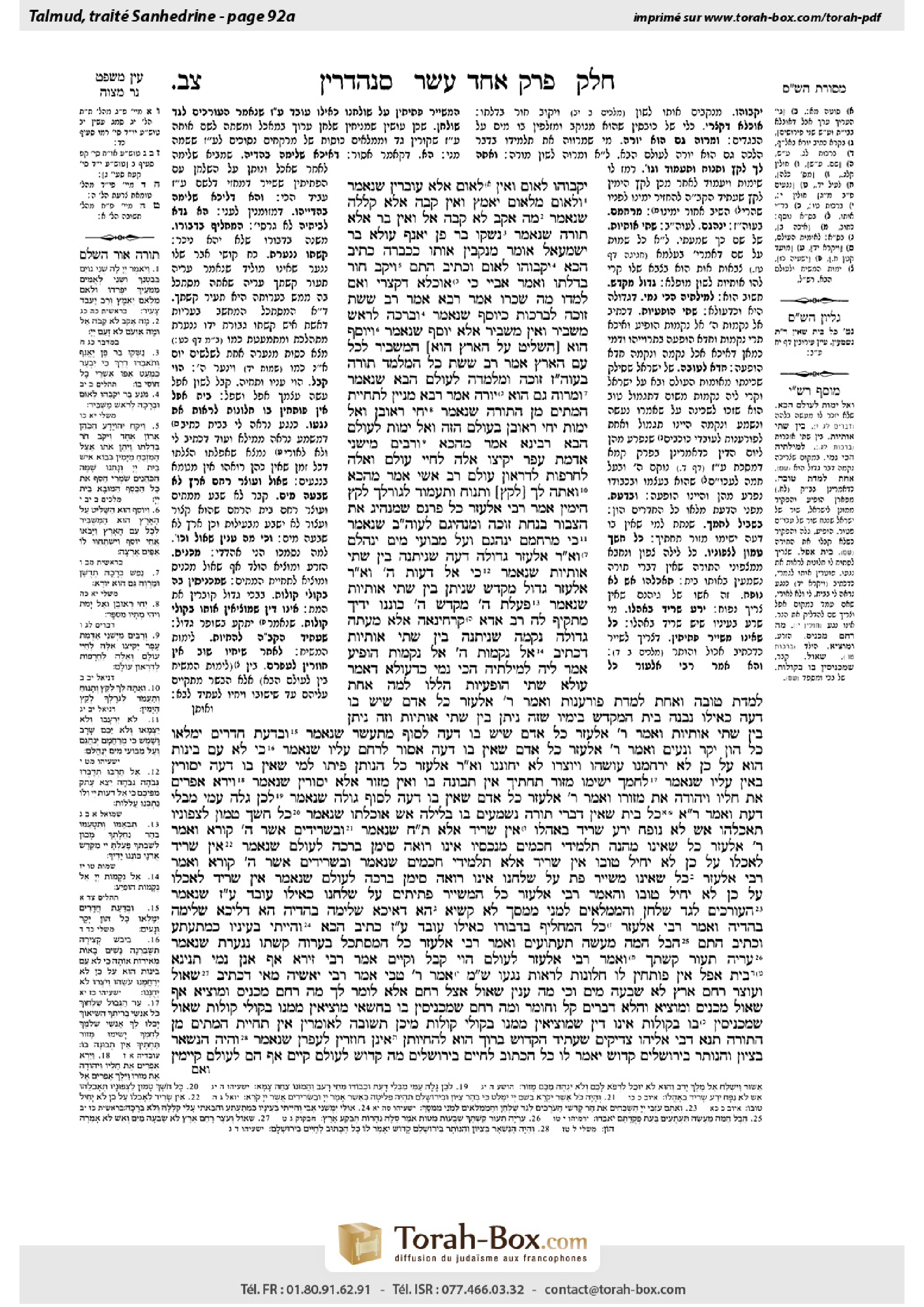
Sanhedrin 92a: Talmud study for Daf Yomi
Daf Yomi is the daily study of one Talmud folio. Explore 37 tractates with scans, Hebrew text, Sefaria English and AI-generated French translations where annotated.
Passage selection and English or AI-generated French translation are available where the scan has annotations. Daf Study is independent of Torah-Box and Sefaria.
Browse Sanhedrin · סנהדרין · All tractatesSanhedrin 92a text and translations
This page of Sanhedrin includes the Aramaic text, an English translation and an AI-generated French translation, alongside the scan above.
סנהדרין צ״ב א · Aramaic and Hebrew text
יִקְּבֻהוּ לְאוֹם״, וְאֵין לְאוֹם אֶלָּא עוּבָּרִין, שֶׁנֶּאֱמַר: ״וּלְאֹם מִלְּאֹם יֶאֱמָץ״. וְאֵין קַבֹּה אֶלָּא קְלָלָה, שֶׁנֶּאֱמַר: ״מָה אֶקֹּב לֹא קַבֹּה אֵל״. וְאֵין בַּר אֶלָּא תּוֹרָה, שֶׁנֶּאֱמַר: ״נַשְּׁקוּ בַר פֶּן יֶאֱנַף״.
עוּלָּא בַּר יִשְׁמָעֵאל אוֹמֵר: מְנַקְּבִין אוֹתוֹ כִּכְבָרָה. כְּתִיב הָכָא: ״יִקְּבֻהוּ לְאוֹם״, וּכְתִיב הָתָם: ״וַיִּקֹּב חֹר בְּדַלְתּוֹ״. וַאֲמַר אַבָּיֵי: כִּי אוּכְלָא דְקַצָּרֵי.
וְאִם לִמְּדוֹ, מָה שְׂכָרוֹ? אָמַר רָבָא אָמַר רַב שֵׁשֶׁת: זוֹכֶה לִבְרָכוֹת כְּיוֹסֵף, שֶׁנֶּאֱמַר: ״וּבְרָכָה לְרֹאשׁ מַשְׁבִּיר״. וְאֵין מַשְׁבִּיר אֶלָּא יוֹסֵף, שֶׁנֶּאֱמַר: ״וְיוֹסֵף הוּא [הַשַּׁלִּיט עַל הָאָרֶץ הוּא] הַמַּשְׁבִּיר לְכׇל עַם הָאָרֶץ״.
אָמַר רַב שֵׁשֶׁת: כׇּל הַמְלַמֵּד תּוֹרָה בְּעוֹלָם הַזֶּה, זוֹכֶה וּמְלַמְּדָהּ לָעוֹלָם הַבָּא, שֶׁנֶּאֱמַר: ״וּמַרְוֶה גַּם הוּא יוֹרֶה״.
אָמַר רָבָא: מִנַּיִין לִתְחִיַּית הַמֵּתִים מִן הַתּוֹרָה? שֶׁנֶּאֱמַר: ״יְחִי רְאוּבֵן וְאַל יָמֹת״. ״יְחִי רְאוּבֵן״ – בָּעוֹלָם הַזֶּה, ״וְאַל יָמֹת״ – לָעוֹלָם הַבָּא. רָבִינָא אָמַר מֵהָכָא: ״וְרַבִּים מִיְּשֵׁנֵי אַדְמַת עָפָר יָקִיצוּ אֵלֶּה לְחַיֵּי עוֹלָם וְאֵלֶּה לַחֲרָפוֹת לְדִרְאוֹן עוֹלָם״. רַב אָשֵׁי אָמַר מֵהָכָא: ״וְאַתָּה לֵךְ [לַקֵּץ] וְתָנוּחַ וְתַעֲמֹד לְגֹרָלְךָ לְקֵץ הַיָּמִין״.
אָמַר רַבִּי אֶלְעָזָר: כׇּל פַּרְנָס שֶׁמַּנְהִיג אֶת הַצִּבּוּר בְּנַחַת, זוֹכֶה וּמַנְהִיגָם לָעוֹלָם הַבָּא, שֶׁנֶּאֱמַר: ״כִּי מְרַחֲמָם יְנַהֲגֵם וְעַל מַבּוּעֵי מַיִם יְנַהֲלֵם״.
וְאָמַר רַבִּי אֶלְעָזָר: גְּדוֹלָה דֵּעָה, שֶׁנִּיתְּנָה בֵּין שְׁתֵּי אוֹתִיּוֹת, שֶׁנֶּאֱמַר ״כִּי אֵל דֵּעוֹת ה׳״.
וְאָמַר רַבִּי אֶלְעָזָר: גָּדוֹל מִקְדָּשׁ שֶׁנִּיתַּן בֵּין שְׁתֵּי אוֹתִיּוֹת, שֶׁנֶּאֱמַר: ״פָּעַלְתָּ ה׳ מִקְּדָשׁ ה׳ כּוֹנְנוּ יָדֶיךָ״. מַתְקֵיף לַהּ רַב אַדָּא קַרְחִינָאָה: אֶלָּא מֵעַתָּה, גְּדוֹלָה נְקָמָה שֶׁנִּיתְּנָה בֵּין שְׁתֵּי אוֹתִיּוֹת, דִּכְתִיב: ״אֵל נְקָמוֹת ה׳ אֵל נְקָמוֹת הוֹפִיַע״!
אֲמַר לֵיהּ: לְמִילְּתֵיהּ הָכִי נָמֵי, כִּדְעוּלָּא. דְּאָמַר עוּלָּא: שְׁתֵּי הוֹפָעָיוֹת הַלָּלוּ לָמָּה? אַחַת לְמִידָּה טוֹבָה, וְאַחַת לְמִדַּת פּוּרְעָנוּת.
וְאָמַר רַבִּי אֶלְעָזָר: כׇּל אָדָם שֶׁיֵּשׁ בּוֹ דֵּעָה, כְּאִילּוּ נִבְנָה בֵּית הַמִּקְדָּשׁ בְּיָמָיו, שֶׁזֶּה נִיתַּן בֵּין שְׁתֵּי אוֹתִיּוֹת, וְזֶה נִיתַּן בֵּין שְׁתֵּי אוֹתִיּוֹת.
וְאָמַר רַבִּי אֶלְעָזָר: כׇּל אָדָם שֶׁיֵּשׁ בּוֹ דֵּעָה, לְסוֹף מִתְעַשֵּׁר, שֶׁנֶּאֱמַר: ״וּבְדַעַת חֲדָרִים יִמָּלְאוּ כׇּל הוֹן יָקָר וְנָעִים״.
וְאָמַר רַבִּי אֶלְעָזָר: כׇּל אָדָם שֶׁאֵין בּוֹ דֵּעָה אָסוּר לְרַחֵם עָלָיו, שֶׁנֶּאֱמַר: ״כִּי לֹא עַם בִּינוֹת הוּא עַל כֵּן לֹא יְרַחֲמֶנּוּ עֹשֵׂהוּ וְיֹצְרוֹ לֹא יְחֻנֶּנּוּ״.
וְאָמַר רַבִּי אֶלְעָזָר: כׇּל הַנּוֹתֵן פִּיתּוֹ לְמִי שֶׁאֵין בּוֹ דֵּעָה, יִסּוּרִין בָּאִין עָלָיו, שֶׁנֶּאֱמַר: ״לַחְמְךָ יָשִׂימוּ מָזוֹר תַּחְתֶּיךָ אֵין תְּבוּנָה בּוֹ״. וְאֵין מָזוֹר אֶלָּא יִסּוּרִין, שֶׁנֶּאֱמַר: ״וַיַּרְא אֶפְרַיִם אֶת חׇלְיוֹ וִיהוּדָה אֶת מְזֹרוֹ״.
וְאָמַר רַבִּי אֶלְעָזָר: כׇּל אָדָם שֶׁאֵין בּוֹ דֵּעָה, לְסוֹף גּוֹלֶה, שֶׁנֶּאֱמַר: ״לָכֵן גָּלָה עַמִּי מִבְּלִי דָעַת״.
וְאָמַר רַבִּי אֶלְעָזָר: כׇּל בַּיִת שֶׁאֵין דִּבְרֵי תוֹרָה נִשְׁמָעִים בּוֹ בַּלַּיְלָה, אֵשׁ אוֹכַלְתּוֹ, שֶׁנֶּאֱמַר: ״כׇּל חֹשֶׁךְ טָמוּן לִצְפּוּנָיו תְּאׇכְלֵהוּ אֵשׁ לֹא נֻפָּח יֵרַע שָׂרִיד בְּאׇהֳלוֹ״. אֵין שָׂרִיד אֶלָּא תַּלְמִיד חָכָם, שֶׁנֶּאֱמַר: ״וּבַשְּׂרִידִים אֲשֶׁר ה׳ קֹרֵא״.
וְאָמַר רַבִּי אֶלְעָזָר: כׇּל שֶׁאֵינוֹ מְהַנֶּה תַּלְמִידֵי חֲכָמִים מִנְּכָסָיו, אֵינוֹ רוֹאֶה סִימַן בְּרָכָה לְעוֹלָם, שֶׁנֶּאֱמַר: ״אֵין שָׂרִיד לְאׇכְלוֹ עַל כֵּן לֹא יָחִיל טוּבוֹ״. אֵין ״שָׂרִיד״ אֶלָּא תַּלְמִידֵי חֲכָמִים, שֶׁנֶּאֱמַר: ״וּבַשְּׂרִידִים אֲשֶׁר ה׳ קֹרֵא״.
וְאָמַר רַבִּי אֶלְעָזָר: כׇּל שֶׁאֵינוֹ מְשַׁיֵּיר פַּת עַל שֻׁלְחָנוֹ, אֵינוֹ רוֹאֶה סִימַן בְּרָכָה לְעוֹלָם, שֶׁנֶּאֱמַר: ״אֵין שָׂרִיד לְאׇכְלוֹ עַל כֵּן לֹא יָחִיל טוּבוֹ״.
וְהָאָמַר רַבִּי אֶלְעָזָר: כׇּל הַמְשַׁיַּיר פְּתִיתִים עַל שֻׁלְחָנוֹ כְּאִילּוּ עוֹבֵד עֲבוֹדָה זָרָה, שֶׁנֶּאֱמַר: ״הָעֹרְכִים לַגַּד שֻׁלְחָן וְהַמְמַלְאִים לַמְנִי מִמְסָךְ״! לָא קַשְׁיָא: הָא דְּאִיכָּא שְׁלֵימָה בַּהֲדֵיהּ, הָא דְּלֵיכָּא שְׁלֵימָה בַּהֲדֵיהּ.
וְאָמַר רַבִּי אֶלְעָזָר: כׇּל הַמַּחְלִיף בְּדִיבּוּרוֹ כְּאִילּוּ עוֹבֵד עֲבוֹדָה זָרָה. כְּתִיב הָכָא: ״וְהָיִיתִי בְעֵינָיו כִּמְתַעְתֵּעַ״, וּכְתִיב הָתָם: ״הֶבֶל הֵמָּה מַעֲשֵׂה תַּעְתֻּעִים״.
וְאָמַר רַבִּי אֶלְעָזָר: כׇּל הַמִּסְתַּכֵּל בְּעֶרְוָה, קַשְׁתּוֹ נִנְעֶרֶת, שֶׁנֶּאֱמַר: ״עֶרְיָה תֵעוֹר קַשְׁתֶּךָ״.
וְאָמַר רַבִּי אֶלְעָזָר: לְעוֹלָם הָוֵי קָבֵל וְקַיָּים. אָמַר רַבִּי זֵירָא: אַף אֲנַן נָמֵי תְּנֵינָא, בַּיִת אָפֵל אֵין פּוֹתְחִין לוֹ חַלּוֹנוֹת לִרְאוֹת נִגְעוֹ. שְׁמַע מִינַּהּ.
אָמַר רַבִּי טָבִי אָמַר רַבִּי יֹאשִׁיָּה: מַאי דִּכְתִיב ״שְׁאוֹל וְעֹצֶר רָחַם אֶרֶץ לֹא שָׂבְעָה מַּיִם״? וְכִי מָה עִנְיַן שְׁאוֹל אֵצֶל רֶחֶם? אֶלָּא לוֹמַר לְךָ: מָה רֶחֶם מַכְנִיס וּמוֹצִיא, אַף שְׁאוֹל מַכְנִיס וּמוֹצִיא.
וַהֲלֹא דְּבָרִים קַל וְחוֹמֶר: וּמָה רֶחֶם שֶׁמַּכְנִיסִין בּוֹ בַּחֲשַׁאי, מוֹצִיאִין מִמֶּנּוּ בְּקוֹלֵי קוֹלוֹת; שְׁאוֹל שֶׁמַּכְנִיסִין בּוֹ בְּקוֹלוֹת, אֵינוֹ דִּין שֶׁמּוֹצִיאִין מִמֶּנּוּ בְּקוֹלֵי קוֹלוֹת? מִיכָּן תְּשׁוּבָה לָאוֹמְרִין: אֵין תְּחִיַּית הַמֵּתִים מִן הַתּוֹרָה.
תָּנָא דְּבֵי אֵלִיָּהוּ: צַדִּיקִים שֶׁעָתִיד הַקָּדוֹשׁ בָּרוּךְ הוּא לְהַחְיוֹתָן אֵינָן חוֹזְרִין לַעֲפָרָן, שֶׁנֶּאֱמַר: ״וְהָיָה הַנִּשְׁאָר בְּצִיּוֹן וְהַנּוֹתָר בִּירוּשָׁלִַים קָדוֹשׁ יֵאָמֶר לוֹ כׇּל הַכָּתוּב לַחַיִּים בִּירוּשָׁלָיִם״. מָה קָדוֹשׁ לְעוֹלָם קַיָּים – אַף הֵם לְעוֹלָם קַיָּימִין.
Sanhedrin 92a · English translation
the people [leom] shall curse him [yikkevuhu], but blessing shall be upon the head of one who provides” (Proverbs 11:26). And the term leom is referring to nothing other than fetuses, as it is stated: “Two nations are in your womb, and two peoples shall be separated from your bowels; and the one leom shall overcome the other leom” (Genesis 25:23). And kabbo is referring to nothing other than curse, as it is stated in the statement of Balaam: “How can I curse one who is not cursed [kabbo] by God?” (Numbers 23:8). And bar is referring to nothing other than Torah, as it is stated: “Pay homage to bar lest He be angry” (Psalms 2:12), i.e., observe the Torah to avoid God’s wrath.
Ulla bar Yishmael says: One perforates like a sieve a person who withholds halakha from a student. It is written here: “He who withholds bar, the people yikkevuhu” (Proverbs 11:26), and it is written there: “And he bored [vayyikkov] a hole in its lid of it” (II Kings 12:10). And Abaye says: One perforates him like a launderers’ utensil used for sprinkling water on garments.
And if one teaches the student halakha rather than withholding it, what is his reward? Rava says that Rav Sheshet says: He is privileged to receive blessings like Joseph, as it is stated at the end of that verse: “But blessing shall be upon the head of one who provides [mashbir]” (Proverbs 11:26). And mashbir is referring to no one other than Joseph, as it is stated: “And Joseph was the governor of the land, and he was the provider [hamashbir] to all the people of the land” (Genesis 42:6).
Rav Sheshet says: Anyone who teaches Torah in this world is privileged and teaches it in the World-to-Come, as it is stated: “And he who satisfies abundantly [umarveh] shall be satisfied himself [yoreh]” (Proverbs 11:25). Rav Sheshet interprets the verse homiletically: By transposing the letters of the word marveh: Mem, reish, vav, heh, one arrives at the word moreh, meaning teaches. The verse means that one who teaches [moreh] will teach [yoreh] in the future as well.
The Gemara returns to the topic of the source for resurrection in the Torah. Rava says: From where is resurrection of the dead derived from the Torah? It is derived from a verse, as it is stated: “Let Reuben live and not die, in that his men become few” (Deuteronomy 33:6). This is interpreted: “Let Reuben live” in this world “and not die” in the World-to-Come. Ravina says that resurrection is derived from here: “And many of those who sleep in the dust of the earth shall awaken, some to everlasting life, and some to reproaches and everlasting disgrace” (Daniel 12:2). Rav Ashi says proof is derived from here: “But go you your way until the end be; and you shall rest, and arise to your lot at the end of days” (Daniel 12:13).
§ Rabbi Elazar says: Any communal leader who leads the community calmly, without anger and honestly, is privileged and leads them in the World-to-Come, as it is stated: “For he that has compassion upon them will lead them, even by the springs of water shall he guide them” (Isaiah 49:10). Just as he led them in this world, so too will he guide them in the World-to-Come.
The Gemara proceeds to cite additional statements of Rabbi Elazar relating to recommended conduct. And Rabbi Elazar says: Great is knowledge, as it was placed between two letters, two names of God, as it is stated: “For a God of knowledge is the Lord” (I Samuel 2:3).
And Rabbi Elazar says: Great is the Holy Temple, as it too was placed between two letters, two names of God, as it is stated: “The place in which to dwell that You have made, Lord, the Temple, Lord, which Your hands have prepared” (Exodus 15:17). Rav Adda Karḥina’a objects to the explanation that being placed between two names of God accords significance. If that is so, the same should hold true for vengeance. Shall one say: Great is vengeance, as it was placed between two letters, as it is written: “God of vengeance, Lord, God of vengeance shine forth” (Psalms 94:1)?
Rabbi Elazar said to him: In its context, indeed, vengeance is great, in accordance with the statement of Ulla. As Ulla says with regard to these two appearances: “O Lord, God to Whom vengeance belongs; God to Whom vengeance belongs, appear” (Psalms 94:1), and: “He appeared from Mount Paran” (Deuteronomy 33:2), why are both necessary? One, the second verse, is necessary for the attribute of divine good, with which God gave the Torah at Sinai, and one, the first verse, is necessary for the attribute of divine punishment, with which God exacts vengeance against the enemies and oppressors of the Jewish people.
And Rabbi Elazar says: With regard to any person in whom there is knowledge, it is as though the Temple was built in his days, as this, knowledge, was placed between two letters and that, the Temple, was placed between two letters.
And Rabbi Elazar says: Any person in whom there is knowledge ultimately becomes wealthy, as it is stated: “And by knowledge are the chambers filled with all precious and pleasant riches” (Proverbs 24:4).
And Rabbi Elazar says: With regard to any person in whom there is no knowledge, it is prohibited to have mercy upon him, as it is stated: “For it is a people of no understanding; therefore its Maker will have no mercy on them, and its Creator will show them no favor” (Isaiah 27:11). If God has no mercy upon them, all the more so should people not show them mercy.
And Rabbi Elazar says: With regard to anyone who gives his bread to one without knowledge, afflictions befall him, as it is stated: “They who eat your bread will place mazor under you, in whom there is no discernment” (Obadiah 1:7). And mazor means nothing other than afflictions, based on the parallel with another verse, as it is stated: “And Ephraim saw his sickness and Judah his wound [mezoro]” (Hosea 5:13). This indicates that one who gives his bread to one without discernment will ultimately fall ill.
And Rabbi Elazar says: Any person in whom there is no knowledge is ultimately exiled, as it is stated: “Therefore my people are exiled, for lack of knowledge” (Isaiah 5:13).
And Rabbi Elazar says: With regard to any house in which there are no matters of Torah heard at night, the fire of Gehenna consumes it, as it is stated: “All darkness is laid up for his treasures, a fire not fanned shall consume him; it shall go ill with a sarid in his tent” (Job 20:26). Sarid is referring to no one but a Torah scholar, as it is stated: “And among the seridim, those whom the Lord shall call” (Joel 3:5). A house that is dark at night and in which no Torah is heard will be consumed by a fire that does not require fanning with a bellows, the fire of Gehenna.
And Rabbi Elazar says: Anyone who does not benefit Torah scholars from his property never sees a sign of blessing, as it is stated: “None of his food shall remain [sarid]; therefore his prosperity shall not endure” (Job 20:21). Sarid is referring to no one but Torah scholars, as it is stated: “And among the seridim, those whom the Lord shall call.” No prosperity will come to one who does not share his food with a Torah scholar.
And Rabbi Elazar says: Anyone who does not leave bread on his table at the end of his meal indicating his gratitude to God for providing him more than enough never sees a sign of blessing, as it is stated: “None of his food shall remain; therefore his prosperity shall not endure.”
The Gemara asks: But doesn’t Rabbi Elazar say: With regard to anyone who leaves pieces of bread on his table, it is as if he worships idols, as it is stated: “Who prepare a table for Fortune [Gad] and offer blended wine for Destiny” (Isaiah 65:11). The people would leave pieces of bread on the table as an offering to the constellation Gad, which they believed influences the fortune of the home. This practice was a form of idol worship. The Gemara answers: This apparent contradiction is not difficult: This case, where leaving pieces of bread is a form of idol worship, applies when there is a whole loaf together with the pieces, as the addition of the pieces is clearly for idol worship; that case, where failure to leave bread on the table is criticized, applies when there is no whole loaf together with the pieces.
And Rabbi Elazar says: With regard to anyone who amends the truth in his speech, it is as though he worships idols. As, it is written here, in the verse where Jacob sought to resist taking his father’s blessing from Esau: “And I shall seem to him a deceiver [metate’a]” (Genesis 27:12), and it is written there with regard to idol worship: “They are vanity, the work of deception [tatuim]” (Jeremiah 10:15).
And Rabbi Elazar says: With regard to anyone who looks at nakedness [erva], his bow is emptied, i.e., he will be robbed of his potency, as it is stated: “Your bow is stripped bare [erya]” (Habakkuk 3:9).
And Rabbi Elazar says: Forever be in the dark, i.e., anonymous, and you will continue to exist. Rabbi Zeira says: We learn a similar idea in a mishna as well (Nega’im 2:3): In a dark house, one does not open windows to illuminate it in order to see whether or not its blemish is leprosy, and the house retains the presumptive status of ritual purity. Those matters that are obscured are allowed to continue. The Gemara affirms: Conclude from that mishna that this is so.
§ The Gemara returns to the topic of the source for resurrection in the Torah. Rabbi Tavi says that Rabbi Yoshiya says: What is the meaning of that which is written: “There are three that are never satisfied…the grave, and the barren womb, and earth that does not receive sufficient water” (Proverbs 30:15–16)? And what does a grave have to do with a womb? Rather, they are juxtaposed to say to you: Just as a womb takes in and gives forth, so too a grave takes in and also gives forth, with the resurrection of the dead.
And are these matters not inferred a fortiori: If with regard to a womb, into which one introduces the embryo in secret, one removes the baby from it accompanied by the loud sounds of the woman crying out during childbirth, then with regard to the grave, into which one introduces the corpse with sounds of wailing and mourning the dead, is it not right that one removes from it the resurrected dead accompanied by the loud sounds of the resurrected multitudes? From here there is a response to those who say: There is no resurrection of the dead derived from the Torah.
The school of Eliyahu taught: The righteous whom the Holy One, Blessed be He, is destined to resurrect do not return to their dust, as it is stated: “And it shall come to pass, that he who remains in Zion and he who remains in Jerusalem shall be called holy, anyone who is written unto life in Jerusalem” (Isaiah 4:3). Just as the Holy One exists forever, so too will they exist forever.
Sanhedrin 92a · Traduction française (IA)
« Le peuple [leom] le maudira [yikkevuhu], mais la bénédiction sera sur la tête de celui qui approvisionne » (Proverbes 11, 26). Le terme leom ne désigne rien d’autre que les fœtus, comme il est dit : « Deux nations sont dans ton ventre, et deux peuples seront séparés de tes entrailles ; l’un des peuples [leom] sera plus fort que l’autre [leom] » (Genèse 25, 23). Et kabbo ne désigne rien d’autre qu’une malédiction, comme il est dit dans la déclaration de Balaam : « Comment maudirais-je celui que Dieu n’a pas maudit [kabbo] ? » (Nombres 23, 8). Et bar ne désigne rien d’autre que la Torah, comme il est dit : « Rendez hommage à bar, de peur qu’Il ne se mette en colère » (Psaumes 2, 12), c’est-à-dire : observez la Torah afin d’éviter la colère de Dieu.
Oulla bar Yishmaël dit : On perce comme un tamis celui qui retient une halakha à un élève. Il est écrit ici : « Celui qui retient bar, le peuple le maudira » (Proverbes 11, 26), et il est écrit là : « Il perça [vayyikkov] un trou dans son couvercle » (II Rois 12, 10). Abayé dit : On le perce comme un ustensile de blanchisseur servant à asperger les vêtements.
Et si l’on enseigne la halakha à l’élève au lieu de la lui retenir, quelle est la récompense ? Rava dit au nom de Rav Chéchet : Il mérite de recevoir des bénédictions comme Joseph, ainsi qu’il est dit à la fin de ce verset : « Mais la bénédiction sera sur la tête de celui qui approvisionne [mashbir] » (Proverbes 11, 26). Or mashbir ne désigne personne d’autre que Joseph, comme il est dit : « Joseph était le gouverneur du pays, et c’était lui qui approvisionnait [hamashbir] tout le peuple du pays » (Genèse 42, 6).
Rav Chéchet dit : Quiconque enseigne la Torah en ce monde mérite de l’enseigner dans le Monde à venir, comme il est dit : « Celui qui abreuve abondamment [umarveh] sera lui-même abreuvé [yoreh] » (Proverbes 11, 25). Rav Chéchet interprète ce verset de façon homilétique : en transposant les lettres du mot marveh — mem, rech, vav, hé —, on obtient le mot moreh, qui signifie « enseigne ». Le verset signifie que celui qui enseigne [moreh] enseignera aussi [yoreh] à l’avenir.
La Guemara revient à la question de la source de la résurrection dans la Torah. Rava dit : De quel verset de la Torah déduit-on la résurrection des morts ? On la déduit d’un verset, comme il est dit : « Que Ruben vive et ne meure pas, bien que ses hommes soient peu nombreux » (Deutéronome 33, 6). Cela s’interprète ainsi : « Que Ruben vive » en ce monde « et ne meure pas » dans le Monde à venir. Ravina dit que la résurrection se déduit de ce verset : « Beaucoup de ceux qui dorment dans la poussière de la terre se réveilleront, les uns pour la vie éternelle, les autres pour l’opprobre et la honte éternelle » (Daniel 12, 2). Rav Achi dit que la preuve se déduit de ce verset : « Mais toi, va jusqu’à la fin ; tu te reposeras, puis tu te lèveras pour recevoir ton lot à la fin des jours » (Daniel 12, 13).
§ Rabbi Elazar dit : Tout dirigeant communautaire qui dirige la communauté avec calme, sans colère et avec honnêteté, mérite de la diriger dans le Monde à venir, comme il est dit : « Car celui qui a compassion d’eux les conduira et les guidera vers des sources d’eau » (Isaïe 49, 10). De même qu’il les a dirigés en ce monde, de même les guidera-t-il dans le Monde à venir.
La Guemara rapporte ensuite d’autres déclarations de Rabbi Elazar concernant la conduite recommandée. Rabbi Elazar dit : Le savoir est grand, puisqu’il est placé entre deux lettres, c’est-à-dire entre deux noms de Dieu, comme il est dit : « Car le Seigneur est un Dieu de connaissance » (I Samuel 2, 3).
Rabbi Elazar dit aussi : Le Temple est grand, puisqu’il est lui aussi placé entre deux lettres, c’est-à-dire entre deux noms de Dieu, comme il est dit : « Le lieu que Tu as préparé pour y résider, Seigneur, le sanctuaire, Seigneur, que Tes mains ont établi » (Exode 15, 17). Rav Adda Karḥina’a objecte à l’explication selon laquelle le fait d’être placé entre deux noms de Dieu confère de l’importance. Si tel était le cas, il faudrait en dire autant de la vengeance. Devrait-on dire que la vengeance est grande, puisqu’elle est placée entre deux lettres, comme il est écrit : « Dieu des vengeances, Seigneur, Dieu des vengeances, manifeste-Toi » (Psaumes 94, 1) ?
Rabbi Elazar lui répondit : Dans son contexte, la vengeance est effectivement grande, conformément à la déclaration d’Oulla. En effet, à propos de ces deux occurrences — « Seigneur, Dieu auquel appartient la vengeance ; Dieu auquel appartient la vengeance, manifeste-Toi » (Psaumes 94, 1) et « Il apparut depuis le mont Paran » (Deutéronome 33, 2) —, pourquoi faut-il les deux ? Le second verset est nécessaire pour l’attribut de bonté divine, avec lequel Dieu donna la Torah au Sinaï ; le premier est nécessaire pour l’attribut de châtiment divin, avec lequel Dieu se venge des ennemis et des oppresseurs du peuple juif.
Rabbi Elazar dit aussi : Toute personne qui possède du savoir, c’est comme si le Temple avait été construit de son vivant, car le savoir était placé entre deux lettres et le Temple, lui aussi, était placé entre deux lettres.
Rabbi Elazar dit aussi : Toute personne qui possède du savoir finit par s’enrichir, comme il est dit : « Par le savoir, les chambres se remplissent de toutes sortes de richesses précieuses et agréables » (Proverbes 24, 4).
Rabbi Elazar dit aussi : Il est interdit d’avoir pitié de toute personne qui ne possède pas de savoir, comme il est dit : « Car c’est un peuple dépourvu de discernement ; c’est pourquoi Celui qui l’a fait n’aura pas pitié de lui, et Celui qui l’a créé ne lui fera pas grâce » (Isaïe 27, 11). Si Dieu n’a pas pitié d’eux, à plus forte raison les hommes ne doivent-ils pas avoir pitié d’eux.
Rabbi Elazar dit aussi : Des afflictions frappent quiconque donne son pain à une personne dépourvue de discernement, comme il est dit : « Ceux qui mangent ton pain mettront mazor sous toi, car il n’y a pas de discernement en eux » (Obadia 1, 7). Or mazor ne désigne rien d’autre que des afflictions, par rapprochement avec un autre verset, comme il est dit : « Éphraïm vit sa maladie et Juda sa blessure [mezoro] » (Osée 5, 13). Cela indique que celui qui donne son pain à une personne dépourvue de discernement finira par tomber malade.
Rabbi Elazar dit aussi : Toute personne dépourvue de savoir finit par être exilée, comme il est dit : « C’est pourquoi mon peuple est exilé, faute de savoir » (Isaïe 5, 13).
Rabbi Elazar dit aussi : Dans toute maison où l’on n’entend pas de paroles de Torah la nuit, le feu de la Géhenne dévore la maison, comme il est dit : « Toutes les ténèbres sont réservées à ses trésors ; un feu qu’on n’attise pas le dévorera ; il ira mal pour un sarid dans sa tente » (Job 20, 26). Sarid ne désigne personne d’autre qu’un érudit en Torah, comme il est dit : « Parmi les seridim, ceux que le Seigneur appellera » (Joël 3, 5). Une maison qui demeure dans l’obscurité la nuit et où l’on n’entend pas de Torah sera dévorée par un feu qu’il n’est pas nécessaire d’attiser avec un soufflet : le feu de la Géhenne.
Rabbi Elazar dit aussi : Quiconque ne fait pas bénéficier les érudits en Torah de ses biens ne voit jamais le moindre signe de bénédiction, comme il est dit : « Rien de sa nourriture ne restera [sarid] ; aussi sa prospérité ne durera pas » (Job 20, 21). Sarid ne désigne personne d’autre que les érudits en Torah, comme il est dit : « Parmi les seridim, ceux que le Seigneur appellera. » Aucune prospérité ne viendra à celui qui ne partage pas sa nourriture avec un érudit en Torah.
Rabbi Elazar dit aussi : Quiconque ne laisse pas de pain sur sa table à la fin de son repas, en signe de gratitude envers Dieu qui lui a donné plus qu’il ne lui en fallait, ne voit jamais le moindre signe de bénédiction, comme il est dit : « Rien de sa nourriture ne restera ; aussi sa prospérité ne durera pas. »
La Guemara demande : Pourtant, Rabbi Elazar ne dit-il pas que quiconque laisse des morceaux de pain sur sa table, c’est comme s’il adorait des idoles, comme il est dit : « Ceux qui dressent une table pour la Fortune [Gad] et remplissent des coupes de vin mélangé pour le Destin » (Isaïe 65, 11) ? Les gens laissaient des morceaux de pain sur la table en offrande à la constellation Gad, qu’ils croyaient influer sur la fortune du foyer. Cette pratique constituait une forme d’idolâtrie. La Guemara répond : Cette contradiction apparente ne pose pas de difficulté : le cas où laisser des morceaux de pain constitue une forme d’idolâtrie s’applique lorsqu’il y a un pain entier avec les morceaux, car la présence de ces morceaux est alors clairement destinée à l’idolâtrie ; le cas où l’on reproche de ne pas laisser de pain sur la table s’applique lorsqu’il n’y a pas de pain entier avec les morceaux.
Rabbi Elazar dit aussi : Quiconque déforme la vérité dans ses paroles, c’est comme s’il adorait des idoles. En effet, il est écrit ici, dans le verset où Jacob cherchait à éviter de prendre à Ésaü la bénédiction de leur père : « Je passerai à ses yeux pour un trompeur [metate’a] » (Genèse 27, 12), et il est écrit là, à propos de l’idolâtrie : « Elles sont vanité, œuvres de tromperie [tatuim] » (Jérémie 10, 15).
Rabbi Elazar dit aussi : Quiconque regarde la nudité [erva] verra son arc dépouillé, c’est-à-dire qu’il sera privé de sa virilité, comme il est dit : « Ton arc est mis à nu [erya] » (Habacuc 3, 9).
Rabbi Elazar dit aussi : Reste toujours dans l’ombre, c’est-à-dire demeure anonyme, et tu continueras d’exister. Rabbi Zeira dit : Nous apprenons aussi une idée semblable dans une Michna (Negaïm 2, 3) : dans une maison sombre, on n’ouvre pas de fenêtres pour l’éclairer afin de voir si sa tache est ou non une lèpre, et la maison conserve son statut présumé de pureté rituelle. Ce qui reste dans l’obscurité peut continuer d’exister. La Guemara conclut : Déduis de cette Michna qu’il en est bien ainsi.
§ La Guemara revient à la question de la source de la résurrection dans la Torah. Rabbi Tavi dit au nom de Rabbi Yoshiya : Quel est le sens de ce qui est écrit : « Il y en a trois qui ne sont jamais rassasiés… la tombe, le ventre stérile et la terre qui ne reçoit pas assez d’eau » (Proverbes 30, 15-16) ? Quel rapport y a-t-il entre une tombe et un ventre ? Ils sont plutôt rapprochés pour t’enseigner ceci : de même qu’un ventre reçoit et donne naissance, de même une tombe reçoit et rend aussi, avec la résurrection des morts.
Et ne déduit-on pas ces choses a fortiori ? Si, pour un ventre dans lequel on introduit l’embryon en secret, on en fait sortir le bébé au milieu des cris retentissants de la femme qui crie pendant l’accouchement, alors, pour la tombe dans laquelle on introduit le cadavre au milieu des lamentations et du deuil des morts, n’est-il pas d’autant plus juste qu’on en fasse sortir les morts ressuscités au milieu des cris retentissants des multitudes ressuscitées ? Nous avons ici une réponse à ceux qui disent que la résurrection des morts ne se déduit pas de la Torah.
L’école d’Éliyahou enseigna : Les justes que le Saint, béni soit-Il, est destiné à ressusciter ne retourneront pas à la poussière, comme il est dit : « Et il arrivera que celui qui restera à Sion et celui qui sera demeuré à Jérusalem sera appelé saint, quiconque sera inscrit pour la vie à Jérusalem » (Isaïe 4, 3). De même que le Saint existe éternellement, eux aussi existeront éternellement.
Traduction française générée par IA à partir de l’édition anglaise de Sefaria. Vérifie toujours un passage avec le texte source.
Text from Sefaria: William Davidson Edition - Vocalized Aramaic (CC BY NC); William Davidson Edition - English (CC BY NC).