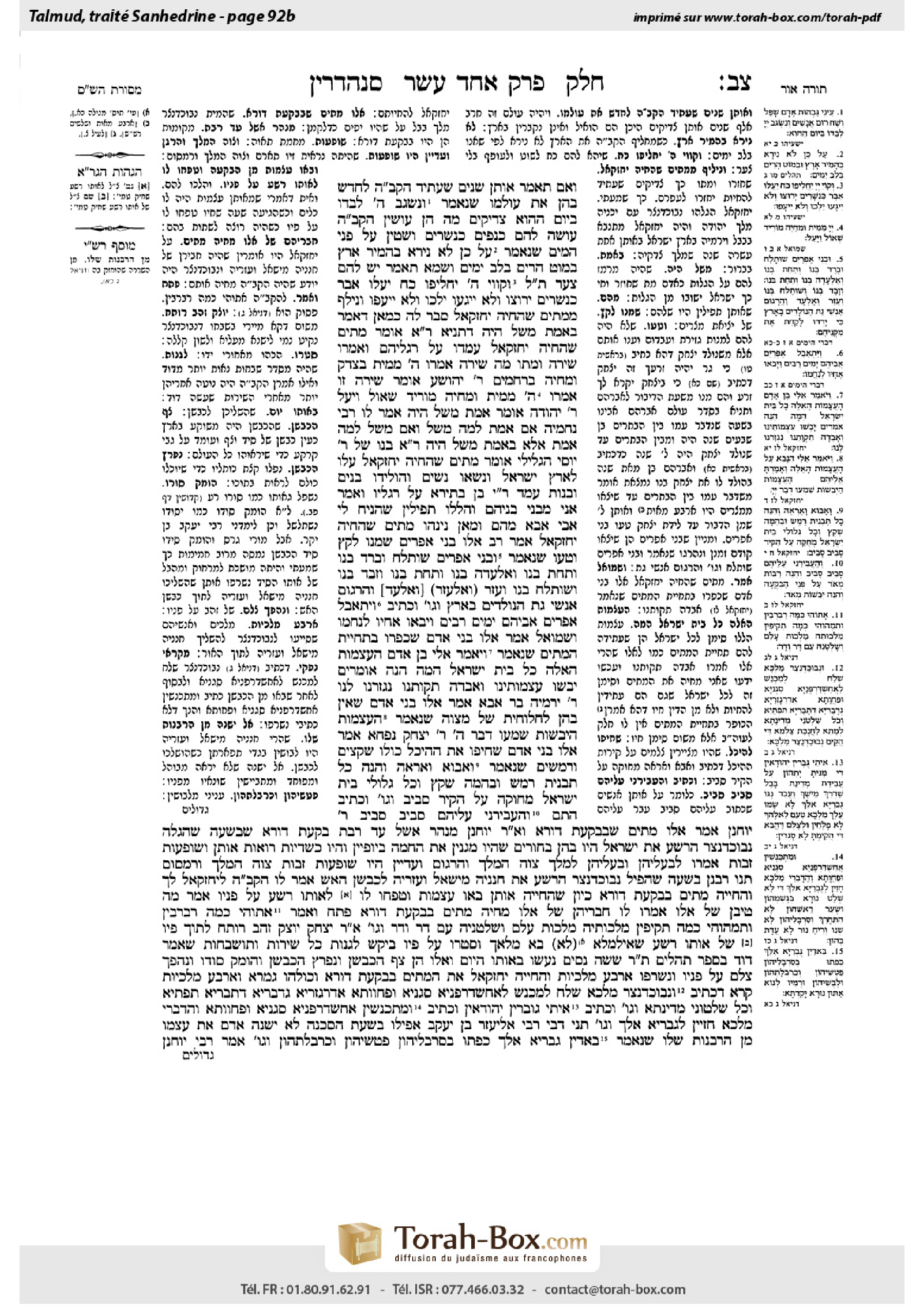
Sanhedrin 92b: Talmud study for Daf Yomi
Daf Yomi is the daily study of one Talmud folio. Explore 37 tractates with scans, Hebrew text, Sefaria English and AI-generated French translations where annotated.
Passage selection and English or AI-generated French translation are available where the scan has annotations. Daf Study is independent of Torah-Box and Sefaria.
Browse Sanhedrin · סנהדרין · All tractatesSanhedrin 92b text and translations
This page of Sanhedrin includes the Aramaic text, an English translation and an AI-generated French translation, alongside the scan above.
סנהדרין צ״ב ב · Aramaic and Hebrew text
וְאִם תֹּאמַר: אוֹתָן שָׁנִים שֶׁעָתִיד הַקָּדוֹשׁ בָּרוּךְ הוּא לְחַדֵּשׁ בָּהֶן אֶת עוֹלָמוֹ, שֶׁנֶּאֱמַר: ״וְנִשְׂגַּב ה׳ לְבַדּוֹ בַּיּוֹם הַהוּא״, צַדִּיקִים מָה הֵן עוֹשִׂין? הַקָּדוֹשׁ בָּרוּךְ הוּא עוֹשֶׂה לָהֶם כְּנָפַיִם כִּנְשָׁרִים, וְשָׁטִין עַל פְּנֵי הַמָּיִם, שֶׁנֶּאֱמַר: ״עַל כֵּן לֹא נִירָא בְּהָמִיר אָרֶץ וּבְמוֹט הָרִים בְּלֵב יַמִּים״. וְשֶׁמָּא תֹּאמַר: יֵשׁ לָהֶם צַעַר? תַּלְמוּד לוֹמַר: ״וְקוֹיֵ ה׳ יַחֲלִיפוּ כֹחַ יַעֲלוּ אֵבֶר כַּנְּשָׁרִים יָרוּצוּ וְלֹא יִיגָעוּ יֵלְכוּ וְלֹא יִיעָפוּ״.
וְנֵילַף מִמֵּתִים שֶׁהֶחְיָה יְחֶזְקֵאל? סָבַר לַהּ כְּמַאן דְּאָמַר: בֶּאֱמֶת מָשָׁל הָיָה.
דְּתַנְיָא, רַבִּי אֱלִיעֶזֶר אוֹמֵר: מֵתִים שֶׁהֶחְיָה יְחֶזְקֵאל עָמְדוּ עַל רַגְלֵיהֶם וְאָמְרוּ שִׁירָה וָמֵתוּ. מָה שִׁירָה אָמְרוּ? ״ה׳ מֵמִית בְּצֶדֶק וּמְחַיֶּה בְּרַחֲמִים״. רַבִּי יְהוֹשֻׁעַ אוֹמֵר: שִׁירָה זוֹ אָמְרוּ ״ה׳ מֵמִית וּמְחַיֶּה מוֹרִיד שְׁאוֹל וַיָּעַל״. רַבִּי יְהוּדָה אוֹמֵר, אֱמֶת מָשָׁל הָיָה.
אָמַר לוֹ רַבִּי נְחֶמְיָה: אִם אֱמֶת, לָמָּה מָשָׁל? וְאִם מָשָׁל, לָמָּה אֱמֶת? אֶלָּא, בֶּאֱמֶת מָשָׁל הָיָה. רַבִּי אֱלִיעֶזֶר בְּנוֹ שֶׁל רַבִּי יוֹסֵי הַגְּלִילִי אוֹמֵר: מֵתִים שֶׁהֶחְיָה יְחֶזְקֵאל עָלוּ לְאֶרֶץ יִשְׂרָאֵל, וְנָשְׂאוּ נָשִׁים וְהוֹלִידוּ בָּנִים וּבָנוֹת. עָמַד רַבִּי יְהוּדָה בֶּן בְּתֵירָא עַל רַגְלָיו וְאָמַר: אֲנִי מִבְּנֵי בְנֵיהֶם, וְהַלָּלוּ תְּפִילִּין שֶׁהִנִּיחַ לִי אֲבִי אַבָּא מֵהֶם.
וּמַאן נִינְהוּ מֵתִים שֶׁהֶחְיָה יְחֶזְקֵאל?
אָמַר רַב: אֵלּוּ בְּנֵי אֶפְרַיִם שֶׁמָּנוּ לַקֵּץ וְטָעוּ, שֶׁנֶּאֱמַר: ״וּבְנֵי אֶפְרַיִם שׁוּתָלַח וּבֶרֶד בְּנוֹ וְתַחַת בְּנוֹ וְאֶלְעָדָה בְנוֹ וְתַחַת בְּנוֹ וְזָבָד בְּנוֹ וְשׁוּתֶלַח בְּנוֹ וְעֵזֶר וְאֶלְעָד וַהֲרָגוּם אַנְשֵׁי גַת הַנּוֹלָדִים בָּאָרֶץ וְגוֹ׳״, וּכְתִיב: ״וַיִּתְאַבֵּל אֶפְרַיִם אֲבִיהֶם יָמִים רַבִּים וַיָּבֹאוּ אֶחָיו לְנַחֲמוֹ״.
וּשְׁמוּאֵל אָמַר: אֵלּוּ בְּנֵי אָדָם שֶׁכָּפְרוּ בִּתְחִיַּית הַמֵּתִים, שֶׁנֶּאֱמַר: ״וַיֹּאמֶר אֵלַי בֶּן אָדָם הָעֲצָמוֹת הָאֵלֶּה כׇּל בֵּית יִשְׂרָאֵל הֵמָּה הִנֵּה אֹמְרִים יָבְשׁוּ עַצְמוֹתֵינוּ וְאָבְדָה תִקְוָתֵנוּ נִגְזַרְנוּ לָנוּ״.
רַבִּי יִרְמְיָה בַּר אַבָּא אָמַר: אֵלּוּ בְּנֵי אָדָם שֶׁאֵין בָּהֶן לַחְלוּחִית שֶׁל מִצְוָה, שֶׁנֶּאֱמַר ״הָעֲצָמוֹת הַיְבֵשׁוֹת שִׁמְעוּ דְּבַר ה׳״.
רַבִּי יִצְחָק נַפָּחָא אָמַר: אֵלּוּ בְּנֵי אָדָם שֶׁחִיפּוּ אֶת הַהֵיכָל כּוּלּוֹ שְׁקָצִים וּרְמָשִׂים, שֶׁנֶּאֱמַר: ״וָאָבוֹא וָאֶרְאֶה וְהִנֵּה כׇל תַּבְנִית רֶמֶשׂ וּבְהֵמָה שֶׁקֶץ וְכׇל גִּלּוּלֵי בֵּית יִשְׂרָאֵל מְחֻקֶּה עַל הַקִּיר סָבִיב וְגוֹ׳״, וּכְתִיב הָתָם: ״וְהֶעֱבִירַנִי עֲלֵיהֶם סָבִיב סָבִיב״.
רַבִּי יוֹחָנָן אָמַר: אֵלּוּ מֵתִים שֶׁבְּבִקְעַת דּוּרָא. וְאָמַר רַבִּי יוֹחָנָן: מִנְּהַר אֵשֶׁל עַד רַבַּת בִּקְעַת דּוּרָא, שֶׁבְּשָׁעָה שֶׁהִגְלָה נְבוּכַדְנֶצַּר הָרָשָׁע אֶת יִשְׂרָאֵל הָיוּ בָּהֶן בַּחוּרִים שֶׁהָיוּ מְגַנִּין אֶת הַחַמָּה בְּיוֹפְיָין, וְהָיוּ כַּשְׂדִּיּוֹת רוֹאוֹת אוֹתָן וְשׁוֹפְעוֹת זָבוּת. אָמְרוּ לְבַעֲלֵיהֶן, וּבַעֲלֵיהֶן לַמֶּלֶךְ. צִוָּה הַמֶּלֶךְ וַהֲרָגוּם, וַעֲדַיִין הָיוּ שׁוֹפְעוֹת זָבוּת. צִוָּה הַמֶּלֶךְ וּרְמָסוּם.
תָּנוּ רַבָּנַן: בְּשָׁעָה שֶׁהִפִּיל נְבוּכַדְנֶצַּר הָרָשָׁע אֶת חֲנַנְיָה מִישָׁאֵל וַעֲזַרְיָה לְכִבְשַׁן הָאֵשׁ, אָמַר לוֹ הַקָּדוֹשׁ בָּרוּךְ הוּא לִיחֶזְקֵאל: לֵךְ וְהַחְיֵיה מֵתִים בְּבִקְעַת דּוּרָא. כֵּיוָן שֶׁהֶחְיָיה אוֹתָן, בָּאוּ עֲצָמוֹת וְטָפְחוּ לוֹ לְאוֹתוֹ רָשָׁע עַל פָּנָיו. אָמַר: מָה טִיבָן שֶׁל אֵלּוּ? אָמְרוּ לוֹ: חַבְרֵיהֶן שֶׁל אֵלּוּ מְחַיֶּיה מֵתִים בְּבִקְעַת דּוּרָא. פָּתַח וְאָמַר: ״אָתוֹהִי כְּמָה רַבְרְבִין וְתִמְהוֹהִי כְּמָה תַקִּיפִין מַלְכוּתֵיהּ מַלְכוּת עָלַם וְשׇׁלְטָנֵהּ עִם דָּר וְדָר וְגוֹ׳״.
אָמַר רַבִּי יִצְחָק: יוּצַק זָהָב רוֹתֵחַ לְתוֹךְ פִּיו שֶׁל אוֹתוֹ רָשָׁע, שֶׁאִילְמָלֵא (לֹא) בָּא מַלְאָךְ וּסְטָרוֹ עַל פִּיו, בִּיקֵּשׁ לְגַנּוֹת כׇּל שִׁירוֹת וְתִשְׁבָּחוֹת שֶׁאָמַר דָּוִד בְּסֵפֶר תְּהִלִּים.
תָּנוּ רַבָּנַן: שִׁשָּׁה נִסִּים נַעֲשׂוּ בְּאוֹתוֹ הַיּוֹם, וְאֵלּוּ הֵן: צָף הַכִּבְשָׁן, וְנִפְרַץ הַכִּבְשָׁן, וְהוּמַק סוֹדוֹ, וְנֶהְפַּךְ צֶלֶם עַל פָּנָיו, וְנִשְׂרְפוּ אַרְבַּע מַלְכִיּוֹת, וְהֶחְיָה יְחֶזְקֵאל אֶת הַמֵּתִים בְּבִקְעַת דּוּרָא.
וְכוּלְּהוּ גְּמָרָא, וְאַרְבַּע מַלְכִיּוֹת קְרָא. דִּכְתִיב: ״וּנְבוּכַדְנֶצַּר מַלְכָּא שְׁלַח לְמִכְנַשׁ לַאֲחַשְׁדַּרְפְּנַיָּא סִגְנַיָּא וּפַחֲוָתָא אֲדַרְגָּזְרַיָּא גְדָבְרַיָּא דְּתָבְרַיָּא תִּפְתָּיֵא וְכֹל שִׁלְטֹנֵי מְדִינָתָא וְגוֹ׳״, וּכְתִיב: ״אִיתַי גֻּבְרִין יְהוּדָאִין״, וּכְתִיב: ״וּמִתְכַּנְּשִׁין אֲחַשְׁדַּרְפְּנַיָּא סִגְנַיָּא וּפַחֲוָתָא וְהַדָּבְרֵי מַלְכָּא חָזַיִן לְגֻבְרַיָּא אִלֵּךְ וְגוֹ׳״.
תָּנֵי דְּבֵי רַבִּי אֱלִיעֶזֶר בֶּן יַעֲקֹב: אֲפִילּוּ בִּשְׁעַת הַסַּכָּנָה לֹא יְשַׁנֶּה אָדָם אֶת עַצְמוֹ מִן הָרַבָּנוּת (שֶׁלּוֹ), שֶׁנֶּאֱמַר: ״בֵּאדַיִן גֻּבְרַיָּא אִלֵּךְ כְּפִתוּ בְּסַרְבָּלֵיהוֹן פַּטְּשֵׁיהוֹן וְכַרְבְּלָתְהוֹן וְגוֹ׳״.
אָמַר רַבִּי יוֹחָנָן:
Sanhedrin 92b · English translation
And if you say: During those years when the Holy One, Blessed be He, is destined to renew His world, as it is stated: “And the Lord alone shall be exalted on that day” (Isaiah 2:11), what are the righteous to do? How will they survive? The Holy One, Blessed be He, will make wings like eagles for them and they will fly over the surface of the water, as it is stated: “Therefore, we will not fear when God changes the land, and when the mountains are moved in the midst of the sea” (Psalms 46:3). Although God will renew the land, they will not fear, because they will be in the sky over the sea at that time. And lest you say that they will endure suffering from flying uninterrupted for an extended period, the verse states: “But they who wait for the Lord shall renew their strength; they shall mount up with wings as eagles; they shall run, and not be weary; they shall walk, and not tire” (Isaiah 40:31).
The Gemara suggests: And let us derive from the dead that Ezekiel revived (see Ezekiel, chapter 37) that the resurrected dead will not live forever, but will die at some point. The Gemara explains: The school of Eliyahu holds in accordance with the opinion of the one who says: In truth, Ezekiel’s depiction of the dry bones that came to life was a parable, from which nothing can be derived with regard to the nature of resurrection.
This is as it is taught in a baraita, that Rabbi Eliezer says: The dead that Ezekiel revived stood on their feet and recited song to God and died. And what song did they recite? The Lord kills with justice and gives life with mercy. Rabbi Yehoshua says that it was this song that they recited: “The Lord kills, and gives life; He lowers to the grave and elevates” (I Samuel 2:6). Rabbi Yehuda says: Ezekiel’s depiction of the dry bones that came to life was truth and it was a parable.
Rabbi Neḥemya said to Rabbi Yehuda: If it was truth, why do you refer to it as a parable, and if it was a parable, why do you refer to it as truth? Rather, it means: In truth, it was a parable. Rabbi Eliezer, son of Rabbi Yosei HaGelili, says: Not only was it not a parable, the dead that Ezekiel revived ascended to Eretz Yisrael and married wives and fathered sons and daughters. Rabbi Yehuda ben Beteira stood on his feet and said: I am a descendant of their sons, and these are phylacteries that my father’s father left me from them.
The Gemara asks: And who are the dead that Ezekiel revived?
Rav says: These were the descendants of Ephraim who calculated the time of the end of the enslavement and the redemption from Egypt and erred in their calculation. They left before the appointed time and were killed, as it is stated: “And the sons of Ephraim; Shuthelah, and Bered his son, and Tahath his son, and Eleadah his son, and Tahath his son. And Zabad his son, and Shuthelah his son, and Ezer and Elead whom the men of Gath that were born in the land slew, because they came down to take their cattle” (I Chronicles 7:20–21), and it is written: “And Ephraim their father mourned many days, and his brothers came to comfort him” (I Chronicles 7:22).
And Shmuel says: These dead that Ezekiel revived were people who denied the resurrection of the dead, as it is stated: “Then He said to me: Son of man, these bones are the whole house of Israel; behold, they say: Our bones are dried and our hope is lost; we are cut off” (Ezekiel 37:11). God tells Ezekiel that these were people who had lost hope for resurrection.
Rabbi Yirmeya bar Abba says: These were people in whom there was not even the moist residue of a mitzva, as it is stated: “The dry bones, hear the word of the Lord” (Ezekiel 37:4). Even during their lifetime they were comparable to dry bones.
Rabbi Yitzḥak Nappaḥa says: These are the people who covered the Sanctuary with repugnant creatures and creeping animals, as it is stated: “So I entered and saw and behold, every form of creeping animal and repugnant animal, and all the idols of the house of Israel, etched upon the wall around” (Ezekiel 8:10), and it is written there with regard to the prophecy of the dry bones: “And he passed me over them around and around” (Ezekiel 37:2). By means of a verbal analogy between: Around, in one verse and the identical term in the other it is derived that the two verses are referring to the same people.
Rabbi Yoḥanan says: These are the dead from the Dura Valley (see Daniel, chapter 3). And Rabbi Yoḥanan says: These corpses filled the area from the Eshel River to Rabat, which constitutes the Dura Valley. As, at the time that Nebuchadnezzar the wicked exiled the Jewish people to Babylonia, there were among them youths who overshadowed the sun with their beauty, and the Chaldean women would see them, and desire them, and discharge the flow of a zava. These women told their husbands, and their husbands told the king. The king ordered the youths executed, and his servants executed them. And their execution did not resolve the problem, as the women were still discharging the flow of a zava. Even after death, the youths’ beauty remained intact. The king ordered that their corpses be taken to the valley, and his servants trampled them so that their form would no longer be visible.
§ The Sages taught in a baraita: At the moment that Nebuchadnezzar the wicked cast Hananiah, Mishael, and Azariah into the fiery furnace, the Holy One, Blessed be He, said to Ezekiel: Go and revive the dead in the Dura Valley. Once Ezekiel revived them, the bones came and struck Nebuchadnezzar, that wicked man, in his face. Nebuchadnezzar said: What is the nature of these? His servants said to him: The friend of these three, Hananiah, Mishael, and Azariah, is reviving the dead in the Dura Valley. Nebuchadnezzar began and said: “How great are His signs and how mighty are His wonders; His kingdom is an everlasting kingdom and His dominion is from generation to generation” (Daniel 3:33).
Rabbi Yitzḥak says: Molten gold should be poured into the mouth of that wicked person. His mouth should be sealed in the course of an extraordinary death; in deference to royalty, Rabbi Yitzḥak suggested that gold would be used to accomplish that task. The reason is that if an angel had not come and struck him on his mouth to prevent him from continuing his praise, he would have sought to overshadow all the songs and praises that David recited in the book of Psalms.
The Sages taught in a baraita: Six miracles were performed on that day that Hananiah, Mishael, and Azarya were delivered from the furnace, and they are: The furnace rose from where it was sunken to ground level; and the furnace was breached; and its limestone dissipated; and the graven image that Nebuchadnezzar established, which he commanded his subjects to worship (see Daniel 3:5–6), fell on its face; and four ranks of officials from monarchies, who stood around the furnace, were burned; and Ezekiel revived the dead in the Dura Valley.
And the knowledge that all of the miracles were performed is based on tradition. And the four ranks of officials from monarchies that were burned is related in a verse, as it is written: “Then Nebuchadnezzar the king sent to gather together the satraps, the prefects and the governors, the counselors, the treasurers, the justices, the magistrates and all the rulers of the provinces” (Daniel 3:2). And it is written: “There are certain Jews…they do not serve your gods, nor worship the golden image you have erected” (Daniel 3:12). And it is written in the verse after Hananiah, Mishael, and Azariah left the fiery furnace: “And the satraps, the prefects, the governors, and the king’s counselors gathered and saw these men” (Daniel 3:27) who emerged from the fire unscathed. Nebuchadnezzar sent to gather eight ranks of officials, and only four ranks witnessed Hananiah, Mishael, and Azariah emerge from the furnace. Apparently, the other four ranks were burned in the fire.
The school of Rabbi Eliezer ben Ya’akov teaches: Even during a period of danger, a person should not deviate from his prominence and demean himself, as it is stated: “Then these men were bound in their mantles, their tunics, and their hats, and their other garments, and they were cast into the blazing fiery furnace” (Daniel 3:21). Even when cast into the furnace, they donned garments befitting their station.
Rabbi Yoḥanan says:
Sanhedrin 92b · Traduction française (IA)
Et si tu dis : Que feront les justes durant ces années où le Saint, béni soit-Il, est destiné à renouveler Son monde, comme il est dit : « Le Seigneur seul sera exalté en ce jour-là » (Isaïe 2,11) ? Comment survivront-ils ? Le Saint, béni soit-Il, leur fera des ailes comme celles des aigles, et ils voleront au-dessus de la surface de l’eau, comme il est dit : « Aussi, nous ne craindrons pas lorsque Dieu transformera la terre et que les montagnes seront déplacées au cœur de la mer » (Psaumes 46,3). Bien que Dieu renouvelle la terre, ils ne craindront pas, car ils seront alors dans le ciel, au-dessus de la mer. Et de peur que tu ne dises qu’ils subiront les souffrances d’un vol ininterrompu pendant une longue période, le verset dit : « Mais ceux qui espèrent en le Seigneur renouvelleront leur force ; ils s’élèveront avec des ailes comme les aigles ; ils courront sans se lasser, ils marcheront sans se fatiguer » (Isaïe 40,31).
La Guemara suggère : déduisons des morts qu’Ézéchiel a fait revivre (voir Ézéchiel, chapitre 37) que les morts ressuscités ne vivront pas éternellement, mais mourront à un moment donné. La Guemara explique : l’école d’Éliyahou suit l’opinion de celui qui dit qu’en vérité, la vision d’Ézéchiel des ossements desséchés revenus à la vie était une parabole, dont on ne peut rien déduire quant à la nature de la résurrection.
C’est ce qui est enseigné dans une baraïta : Rabbi Eliezer dit que les morts qu’Ézéchiel a fait revivre se tinrent debout, chantèrent un cantique à Dieu, puis moururent. Et quel cantique chantèrent-ils ? « Le Seigneur fait mourir avec justice et donne la vie avec miséricorde. » Rabbi Yehoshua dit qu’ils chantèrent ce cantique : « Le Seigneur fait mourir et donne la vie ; Il fait descendre au tombeau et en fait remonter » (I Samuel 2,6). Rabbi Yehuda dit : la vision d’Ézéchiel des ossements desséchés revenus à la vie était à la fois une réalité et une parabole.
Rabbi Neḥemya dit à Rabbi Yehuda : si c’était une réalité, pourquoi la qualifier de parabole, et si c’était une parabole, pourquoi la qualifier de réalité ? Il faut plutôt comprendre : en vérité, c’était une parabole. Rabbi Eliezer, fils de Rabbi Yosei HaGelili, dit : non seulement ce n’était pas une parabole, mais les morts qu’Ézéchiel a fait revivre montèrent en Eretz Israël, épousèrent des femmes et engendrèrent des fils et des filles. Rabbi Yehuda ben Beteira se leva et dit : je descends de leurs fils, et voici les tefillin que le père de mon père m’a laissés, provenant d’eux.
La Guemara demande : qui sont les morts qu’Ézéchiel a fait revivre ?
Rav dit : c’étaient les descendants d’Éphraïm, qui avaient calculé la date de la fin de l’asservissement et de la délivrance d’Égypte, mais s’étaient trompés dans leur calcul. Ils partirent avant le moment fixé et furent tués, comme il est dit : « Les fils d’Éphraïm : Shoutéla, son fils Bérèd, son fils Taḥat, son fils Éléada, son fils Taḥat, son fils Zabad, son fils Shoutéla, ainsi qu’Ézer et Éléad, que les hommes de Gath, nés dans le pays, tuèrent, parce qu’ils étaient descendus pour prendre leur bétail » (I Chroniques 7,20-21). Et il est écrit : « Éphraïm, leur père, porta le deuil pendant de nombreux jours, et ses frères vinrent le consoler » (I Chroniques 7,22).
Et Shmuel dit : ces morts qu’Ézéchiel a fait revivre étaient des gens qui niaient la résurrection des morts, comme il est dit : « Il me dit alors : Fils de l’homme, ces ossements sont toute la maison d’Israël ; voici, ils disent : Nos ossements sont desséchés, notre espoir est perdu, nous sommes retranchés » (Ézéchiel 37,11). Dieu dit à Ézéchiel qu’il s’agissait de gens qui avaient perdu tout espoir en la résurrection.
Rabbi Yirmeya bar Abba dit : c’étaient des gens en qui il ne subsistait même pas le moindre résidu humide d’une mitsva, comme il est dit : « Ossements desséchés, écoutez la parole du Seigneur » (Ézéchiel 37,4). Même de leur vivant, ils étaient comparables à des ossements desséchés.
Rabbi Yitzḥak Nappaḥa dit : ce sont les gens qui avaient couvert le Sanctuaire de créatures répugnantes et d’animaux rampants, comme il est dit : « J’entrai et je regardai, et voici que toute sorte d’animal rampant et de créature répugnante, ainsi que toutes les idoles de la maison d’Israël, étaient gravées sur le mur tout autour » (Ézéchiel 8,10). Et il est écrit là, à propos de la prophétie des ossements desséchés : « Il me fit passer parmi eux tout autour » (Ézéchiel 37,2). Par une analogie verbale entre le terme « tout autour », dans un verset, et le même terme dans l’autre, on déduit que les deux versets parlent des mêmes personnes.
Rabbi Yoḥanan dit : ce sont les morts de la vallée de Doura (voir Daniel, chapitre 3). Et Rabbi Yoḥanan dit : ces cadavres occupaient l’espace entre le fleuve Eshel et Rabat, qui constitue la vallée de Doura. En effet, lorsque le méchant Nabuchodonosor exila le peuple juif en Babylonie, il y avait parmi eux des jeunes gens dont la beauté éclipsait le soleil. Les femmes chaldéennes les voyaient, les désiraient et avaient un écoulement de zavah. Elles en parlèrent à leurs maris, et leurs maris en parlèrent au roi. Le roi ordonna que les jeunes gens soient exécutés, et ses serviteurs les exécutèrent. Mais leur exécution ne résolut pas le problème, car les femmes avaient toujours un écoulement de zavah. Même après leur mort, la beauté des jeunes gens demeurait intacte. Le roi ordonna que leurs cadavres soient transportés dans la vallée, et ses serviteurs les piétinèrent afin que leur apparence ne soit plus visible.
§ Les Sages ont enseigné dans une baraïta : au moment où le méchant Nabuchodonosor jeta Hanania, Mishaël et Azaria dans la fournaise ardente, le Saint, béni soit-Il, dit à Ézéchiel : « Va faire revivre les morts de la vallée de Doura. » Une fois qu’Ézéchiel les eut fait revivre, les ossements vinrent frapper au visage Nabuchodonosor, cet homme méchant. Nabuchodonosor dit : « Que signifie cela ? » Ses serviteurs lui dirent : « L’ami de ces trois hommes, Hanania, Mishaël et Azaria, fait revivre les morts dans la vallée de Doura. » Nabuchodonosor se mit alors à dire : « Que Ses signes sont grands et que Ses prodiges sont puissants ! Son royaume est un royaume éternel, et Sa domination s’étend de génération en génération » (Daniel 3,33).
Rabbi Yitzḥak dit : il faudrait verser de l’or en fusion dans la bouche de cet homme méchant. Sa bouche devrait être scellée au moyen d’une mort extraordinaire ; par égard pour la royauté, Rabbi Yitzḥak suggéra d’utiliser de l’or à cette fin. Car si un ange n’était pas venu le frapper à la bouche pour l’empêcher de poursuivre ses louanges, il aurait cherché à éclipser tous les chants et toutes les louanges que David a récités dans le livre des Psaumes.
Les Sages ont enseigné dans une baraïta : six miracles furent accomplis ce jour-là, lorsque Hanania, Mishaël et Azaria furent délivrés de la fournaise. Les voici : la fournaise remonta de son emplacement, où elle était enfoncée, jusqu’au niveau du sol ; la fournaise fut éventrée ; son revêtement de chaux se désagrégea ; la statue sculptée que Nabuchodonosor avait fait ériger et qu’il avait ordonné à ses sujets d’adorer (voir Daniel 3,5-6) tomba face contre terre ; quatre rangs de dignitaires de royaumes, qui se tenaient autour de la fournaise, furent brûlés ; et Ézéchiel fit revivre les morts de la vallée de Doura.
Le fait que tous ces miracles furent accomplis est connu par tradition. Quant aux quatre rangs de dignitaires de royaumes qui furent brûlés, cela est rapporté dans un verset, comme il est écrit : « Alors le roi Nabuchodonosor envoya rassembler les satrapes, les préfets et les gouverneurs, les conseillers, les trésoriers, les juges, les magistrats et tous les chefs des provinces » (Daniel 3,2). Et il est écrit : « Il y a certains Juifs… qui ne servent pas tes dieux et n’adorent pas la statue d’or que tu as érigée » (Daniel 3,12). Et le verset qui suit la sortie de Hanania, Mishaël et Azaria de la fournaise ardente dit : « Les satrapes, les préfets, les gouverneurs et les conseillers du roi se rassemblèrent et virent ces hommes » (Daniel 3,27), qui étaient sortis du feu sans dommage. Nabuchodonosor avait envoyé convoquer huit rangs de dignitaires, mais seuls quatre rangs assistèrent à la sortie de Hanania, Mishaël et Azaria de la fournaise. Il apparaît donc que les quatre autres rangs furent brûlés dans le feu.
L’école de Rabbi Eliezer ben Ya’akov enseigne : même en période de danger, une personne ne doit pas renoncer à sa dignité ni s’abaisser, comme il est dit : « Alors ces hommes furent liés avec leurs manteaux, leurs tuniques, leurs coiffes et leurs autres vêtements, puis jetés dans la fournaise ardente » (Daniel 3,21). Même lorsqu’ils furent jetés dans la fournaise, ils portaient des vêtements dignes de leur rang.
Rabbi Yoḥanan dit :
Traduction française générée par IA à partir de l’édition anglaise de Sefaria. Vérifie toujours un passage avec le texte source.
Text from Sefaria: William Davidson Edition - Vocalized Aramaic (CC BY NC); William Davidson Edition - English (CC BY NC).