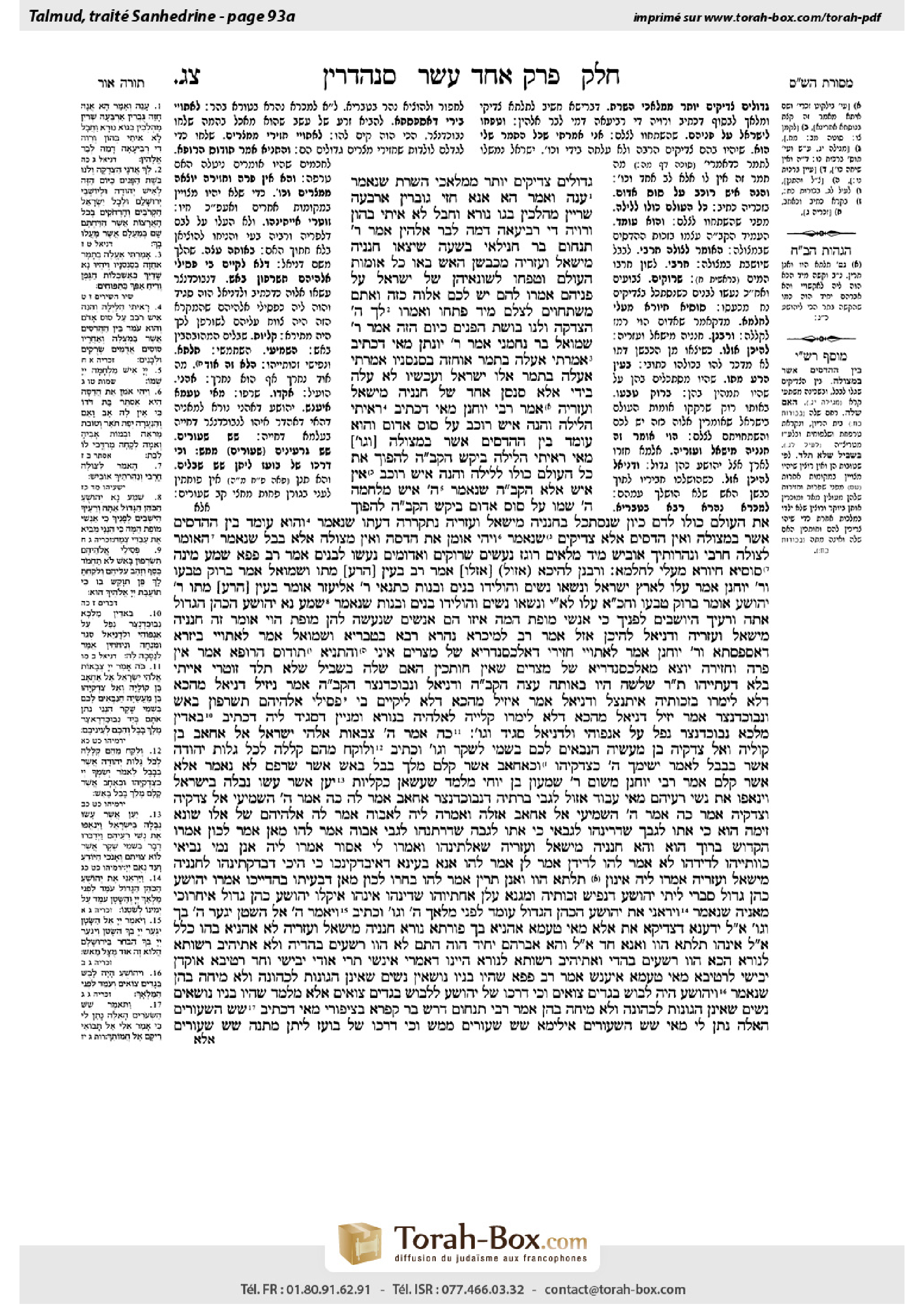
Sanhedrin 93a: Talmud study for Daf Yomi
Daf Yomi is the daily study of one Talmud folio. Explore 37 tractates with scans, Hebrew text, Sefaria English and AI-generated French translations where annotated.
Passage selection and English or AI-generated French translation are available where the scan has annotations. Daf Study is independent of Torah-Box and Sefaria.
Browse Sanhedrin · סנהדרין · All tractatesSanhedrin 93a text and translations
This page of Sanhedrin includes the Aramaic text, an English translation and an AI-generated French translation, alongside the scan above.
סנהדרין צ״ג א · Aramaic and Hebrew text
גְּדוֹלִים צַדִּיקִים יוֹתֵר מִמַּלְאֲכֵי הַשָּׁרֵת, שֶׁנֶּאֱמַר: ״עָנֵה וְאָמַר הָא אֲנָא חָזֵי גֻּבְרִין אַרְבְּעָה שְׁרַיִן מַהְלְכִין בְּגוֹ נוּרָא וַחֲבָל לָא אִיתַי בְּהוֹן וְרֵוֵהּ דִּי רְבִיעָאָה דָּמֵה לְבַר אֱלָהִין״.
אָמַר רַבִּי תַּנְחוּם בַּר חֲנִילַאי: בְּשָׁעָה שֶׁיָּצְאוּ חֲנַנְיָה מִישָׁאֵל וַעֲזַרְיָה מִכִּבְשַׁן הָאֵשׁ, בָּאוּ כׇּל אוּמּוֹת הָעוֹלָם וְטָפְחוּ לְשׂוֹנְאֵיהֶן שֶׁל יִשְׂרָאֵל עַל פְּנֵיהֶם. אָמְרוּ לָהֶם: יֵשׁ לָכֶם אֱלוֹהַּ כָּזֶה, וְאַתֶּם מִשְׁתַּחֲוִים לַצֶּלֶם?! מִיָּד פָּתְחוּ וְאָמְרוּ: ״לְךָ ה׳ הַצְּדָקָה וְלָנוּ בֹּשֶׁת הַפָּנִים כַּיּוֹם הַזֶּה״.
אָמַר רַבִּי שְׁמוּאֵל בַּר נַחְמָנִי אָמַר רַבִּי יוֹנָתָן: מַאי דִּכְתִיב ״אָמַרְתִּי אֶעֱלֶה בְתָמָר אֹחֲזָה בְּסַנְסִנָּיו״? ״אָמַרְתִּי אֶעֱלֶה בְתָמָר״ – אֵלּוּ יִשְׂרָאֵל, וְעַכְשָׁיו לֹא עָלָה בְּיָדִי אֶלָּא סַנְסַן אֶחָד שֶׁל חֲנַנְיָה מִישָׁאֵל וַעֲזַרְיָה.
אָמַר רַבִּי יוֹחָנָן: מַאי דִּכְתִיב ״רָאִיתִי הַלַּיְלָה וְהִנֵּה אִישׁ רֹכֵב עַל סוּס אָדֹם וְהוּא עֹמֵד בֵּין הַהֲדַסִּים אֲשֶׁר בַּמְּצֻלָה [וְגוֹ׳]״? מַאי ״רָאִיתִי הַלַּיְלָה״? בִּיקֵּשׁ הַקָּדוֹשׁ בָּרוּךְ הוּא לַהֲפוֹךְ אֶת כָּל הָעוֹלָם כּוּלּוֹ לְלַיְלָה. ״וְהִנֵּה אִישׁ רֹכֵב״ – אֵין ״אִישׁ״ אֶלָּא הַקָּדוֹשׁ בָּרוּךְ הוּא, שֶׁנֶּאֱמַר ״ה׳ אִישׁ מִלְחָמָה ה׳ שְׁמוֹ״. ״עַל סוּס אָדֹם״ – בִּיקֵּשׁ הַקָּדוֹשׁ בָּרוּךְ הוּא לַהֲפוֹךְ אֶת הָעוֹלָם כּוּלּוֹ לְדָם.
כֵּיוָן שֶׁנִּסְתַּכֵּל בַּחֲנַנְיָה מִישָׁאֵל וַעֲזַרְיָה, נִתְקָרְרָה דַּעְתּוֹ, שֶׁנֶּאֱמַר: ״וְהוּא עֹמֵד בֵּין הַהֲדַסִּים אֲשֶׁר בַּמְּצֻלָה״. וְאֵין ״הֲדַסִּים״ אֶלָּא צַדִּיקִים, שֶׁנֶּאֱמַר: ״וַיְהִי אֹמֵן אֶת הֲדַסָּה״. וְאֵין ״מְצוּלָה״ אֶלָּא בָּבֶל, שֶׁנֶּאֱמַר: ״הָאֹמֵר לַצּוּלָה חֳרָבִי וְנַהֲרֹתַיִךְ אוֹבִישׁ״. מִיָּד, מְלֵאִים רוֹגֶז נַעֲשִׂים שְׂרוּקִּים, וַאֲדוּמִּים נַעֲשׂוּ לְבָנִים. אָמַר רַב פָּפָּא: שְׁמַע מִינַּהּ סוּסְיָא חִיוָּרָא מְעַלֵּי לְחֶלְמָא.
וְרַבָּנַן, לְהֵיכָא אֲזַלוּ? אָמַר רַב: בְּעַיִן [הָרָע] מֵתוּ. וּשְׁמוּאֵל אָמַר: בְּרוֹק טָבְעוּ. וְרַבִּי יוֹחָנָן אָמַר: עָלוּ לְאֶרֶץ יִשְׂרָאֵל, וְנָשְׂאוּ נָשִׁים וְהוֹלִידוּ בָּנִים וּבָנוֹת.
כְּתַנָּאֵי, רַבִּי אֱלִיעֶזֶר אוֹמֵר: בְּעַיִן [הָרָע] מֵתוּ. רַבִּי יְהוֹשֻׁעַ אוֹמֵר: בְּרוֹק טָבְעוּ. וַחֲכָמִים אוֹמְרִים: עָלוּ לְאֶרֶץ יִשְׂרָאֵל וְנָשְׂאוּ נָשִׁים וְהוֹלִידוּ בָּנִים וּבָנוֹת, שֶׁנֶּאֱמַר: ״שְׁמַע נָא יְהוֹשֻׁעַ הַכֹּהֵן הַגָּדוֹל אַתָּה וְרֵעֶיךָ הַיֹּשְׁבִים לְפָנֶיךָ כִּי אַנְשֵׁי מוֹפֵת הֵמָּה״. אֵיזוֹ הֵם אֲנָשִׁים שֶׁנַּעֲשָׂה לָהֶן מוֹפֵת? הֱוֵי אוֹמֵר: זֶה חֲנַנְיָה מִישָׁאֵל וַעֲזַרְיָה.
וְדָנִיֵּאל לְהֵיכָן אֲזַל? אֲמַר רַב: לְמִיכְרֵא נַהֲרָא רַבָּא בִּטְבֶרְיָא. וּשְׁמוּאֵל אָמַר: לְאֵתוֹיֵי בִּיזְרָא דְאַסְפַּסְתָּא. וְרַבִּי יוֹחָנָן אָמַר: לְאֵתוֹיֵי חֲזִירֵי דַּאֲלֶכְּסַנְדְּרִיָּא שֶׁל מִצְרַיִם. אִינִי? וְהָתַנְיָא: תּוֹדוֹס הָרוֹפֵא אָמַר, אֵין פָּרָה וַחֲזִירָה יוֹצֵא מֵאֲלֶכְּסַנְדְּרִיָּא שֶׁל מִצְרַיִם שֶׁאֵין חוֹתְכִין הָאֵם שֶׁלָּהּ בִּשְׁבִיל שֶׁלֹּא תֵּלֵד! זוּטְרֵי אַיְיתִי בְּלָא דַּעְתַּיְיהוּ.
תָּנוּ רַבָּנַן: שְׁלֹשָׁה הָיוּ בְּאוֹתָהּ עֵצָה – הַקָּדוֹשׁ בָּרוּךְ הוּא, וְדָנִיֵּאל, וּנְבוּכַדְנֶצַּר. הַקָּדוֹשׁ בָּרוּךְ הוּא אֲמַר: נֵיזִיל דָּנִיֵּאל מֵהָכָא, דְּלָא לֵימְרוּ בִּזְכוּתֵיהּ אִיתַּנְצוּל.
וְדָנִיֵּאל אֲמַר: אֵיזִיל מֵהָכָא, דְּלָא לִיקַיַּים בִּי ״פְּסִילֵי אֱלֹהֵיהֶם תִּשְׂרְפוּן בָּאֵשׁ״.
וּנְבוּכַדְנֶצַּר אֲמַר: יֵזִיל דָּנִיאֵל מֵהָכָא, דְּלָא לֵימְרוּ ״קַלְיֵיהּ לֶאֱלָהֵיהּ בְּנוּרָא״. וּמִנַּיִין דִּסְגִיד לֵיהּ? דִּכְתִיב: ״בֵּאדַיִן מַלְכָּא נְבוּכַדְנֶצַּר נְפַל עַל אַנְפּוֹהִי וּלְדָנִיֵּאל סְגִד וְגוֹ׳״.
״כֹּה אָמַר ה׳ צְבָאוֹת אֱלֹהֵי יִשְׂרָאֵל אֶל אַחְאָב בֶּן קוֹלָיָה וְאֶל צִדְקִיָּהוּ בֶן מַעֲשֵׂיָה הַנִּבְּאִים לָכֶם בִּשְׁמִי לַשָּׁקֶר וְגוֹ׳״. וּכְתִיב: ״וְלֻקַּח מֵהֶם קְלָלָה לְכֹל גָּלוּת יְהוּדָה אֲשֶׁר בְּבָבֶל לֵאמֹר יְשִׂימְךָ ה׳ כְּצִדְקִיָּהוּ וּכְאֶחָאב אֲשֶׁר קָלָם מֶלֶךְ בָּבֶל בָּאֵשׁ״. ״אֲשֶׁר שְׂרָפָם״ לֹא נֶאֱמַר, אֶלָּא ״אֲשֶׁר קָלָם״. אָמַר רַבִּי יוֹחָנָן מִשּׁוּם רַבִּי שִׁמְעוֹן בֶּן יוֹחַי: מְלַמֵּד שֶׁעֲשָׂאָן כִּקְלָיוֹת.
״יַעַן אֲשֶׁר עָשׂוּ נְבָלָה בְּיִשְׂרָאֵל וַיְנַאֲפוּ אֶת נְשֵׁי רֵעֵיהֶם״. מַאי עֲבוּד? אֲזוּל לְגַבֵּי בְּרַתֵּיה דִּנְבוּכַדְנֶצַּר. אַחְאָב אֲמַר לַהּ: ״כֹּה אָמַר ה׳ הִשָּׁמֵיעִי אֶל צִדְקִיָּה״. וְצִדְקִיָּה אֲמַר: ״כֹּה אָמַר ה׳ הִשָּׁמֵיעִי אֶל אַחְאָב״. אֲזַלָה וַאֲמַרָה לֵיהּ לַאֲבוּהּ. אֲמַר לַהּ: אֱלֹהֵיהֶם שֶׁל אֵלּוּ שׂוֹנֵא זִימָּה הוּא. כִּי אָתוּ לְגַבָּךְ, שַׁדְּרִינְהוּ לְגַבַּאי.
כִּי אֲתוֹ לְגַבַּהּ, שַׁדַּרְתַּנְהוּ לְגַבֵּי אֲבוּהָ. אֲמַר לְהוּ: מַאן אֲמַר לְכוֹן? אֲמַרוּ: הַקָּדוֹשׁ בָּרוּךְ הוּא. וְהָא חֲנַנְיָה מִישָׁאֵל וַעֲזַרְיָה שְׁאֵלְתִּינְהוּ, וַאֲמַרוּ לִי: אָסוּר! אֲמַרוּ לֵיהּ: אֲנַן נָמֵי נְבִיאֵי כְּוָותַיְיהוּ. לְדִידְהוּ לָא אֲמַר לְהוּ, לְדִידַן אֲמַר לַן. אֲמַר לְהוּ: אֲנָא בָּעֵינָא דְּאֶיבְדְּקִינְכוּ, כִּי הֵיכִי דִּבְדַקְתִּינְהוּ לַחֲנַנְיָה מִישָׁאֵל וַעֲזַרְיָה.
אֲמַרוּ לֵיהּ: אִינּוּן תְּלָתָא הֲווֹ, וַאֲנַן תְּרֵין. אֲמַר לְהוּ: בְּחַרוּ לְכוֹן מַאן דְּבָעֵיתוּ בַּהֲדַיְיכוּ. אֲמַרוּ: יְהוֹשֻׁעַ כֹּהֵן גָּדוֹל. סָבְרִי: לֵיתֵי יְהוֹשֻׁעַ דִּנְפִישׁ זְכוּתֵיהּ וּמַגְּנָא עֲלַן.
אַחְתְיוּהּ, שְׁדִינְהוּ. אִינְהוּ אִיקְּלוֹ, יְהוֹשֻׁעַ כֹּהֵן גָּדוֹל אִיחֲרֻךְ אִיחֲרוֹכֵי מָאנֵיהּ, שֶׁנֶּאֱמַר: ״וַיַּרְאֵנִי אֶת יְהוֹשֻׁעַ הַכֹּהֵן הַגָּדוֹל עֹמֵד לִפְנֵי מַלְאַךְ ה׳ וְגוֹ׳״, וּכְתִיב: ״וַיֹּאמֶר ה׳ אֶל הַשָּׂטָן יִגְעַר ה׳ בְּךָ וְגוֹ׳״.
אֲמַר לֵיהּ: יָדַעְנָא דְּצַדִּיקָא אַתְּ, אֶלָּא מַאי טַעְמָא אַהְנְיָא בָּךְ פּוּרְתָּא נוּרָא? חֲנַנְיָה מִישָׁאֵל וַעֲזַרְיָה לָא אַהְנְיָא בְּהוּ כְּלָל! אֲמַר לֵיהּ: אִינְהוּ תְּלָתָא הֲווֹ, וַאֲנָא חַד. אָמַר לֵיהּ: וְהָא אַבְרָהָם יָחִיד הֲוָה? הָתָם לָא הֲווֹ רְשָׁעִים בַּהֲדֵיהּ, וְלָא אִתְיְהִיב רְשׁוּתָא לְנוּרָא. הָכָא הֲווֹ רְשָׁעִים בַּהֲדַי, וְאִתְיְהִיב רְשׁוּתָא לְנוּרָא. הַיְינוּ דְּאָמְרִי אִינָשֵׁי: תְּרֵי אוּדֵי יַבִּישֵׁי וְחַד רַטִּיבָא, אוֹקְדוּהּ יַבִּישֵׁי לְרַטִּיבָא.
מַאי טַעְמָא אִיעֲנַשׁ? אָמַר רַב פָּפָּא: שֶׁהָיוּ בָּנָיו נוֹשְׂאִין נָשִׁים שֶׁאֵינָן הֲגוּנוֹת לִכְהוּנָּה וְלֹא מִיחָה בָּהֶן. שֶׁנֶּאֱמַר: ״וִיהוֹשֻׁעַ הָיָה לָבֻשׁ בְּגָדִים צוֹאִים״. וְכִי דַרְכּוֹ שֶׁל יְהוֹשֻׁעַ לִלְבּוֹשׁ בְּגָדִים צוֹאִים? אֶלָּא מְלַמֵּד שֶׁהָיוּ בָּנָיו נוֹשְׂאִים נָשִׁים שֶׁאֵינָן הֲגוּנוֹת לִכְהוּנָּה, וְלֹא מִיחָה בָּהֶן.
אָמַר רַבִּי תַּנְחוּם: דָּרַשׁ בַּר קַפָּרָא בְּצִיפּוֹרִי, מַאי דִּכְתִיב ״שֵׁשׁ הַשְּׂעֹרִים הָאֵלֶּה נָתַן לִי״? מַאי ״שֵׁשׁ הַשְּׂעֹרִים״? אִילֵּימָא שֵׁשׁ שְׂעוֹרִים מַמָּשׁ, וְכִי דַרְכּוֹ שֶׁל בּוֹעַז לִיתֵּן מַתָּנָה שֵׁשׁ שְׂעוֹרִים?
Sanhedrin 93a · English translation
The righteous are greater than the ministering angels, as it is stated: “He answered and said: I see four men unbound, walking in the midst of the fire, and they have no hurt; and the appearance of the fourth is like a son of the gods” (Daniel 3:25). Nebuchadnezzar saw three righteous people and an angel in the fire of the furnace and noted the presence of the righteous people before noting the presence of the angel.
§ Rabbi Tanḥum bar Ḥanilai says: At the moment that Hananiah, Mishael, and Azariah emerged from the fiery furnace, all the nations of the world came and struck the enemies of Israel, a euphemism for the Jewish people, in the face and said to them: You have a God with capabilities like that and you bow to the graven image? Immediately Hananiah, Mishael, and Azariah began and said: “Lord, righteousness is Yours, but we are shamefaced, as of this day” (Daniel 9:7).
Rabbi Shmuel bar Naḥmani says that Rabbi Yonatan says on a similar note: What is the meaning of that which is written: “I said: I will climb into the palm tree; I will grasp its boughs” (Song of Songs 7:9)? “I said: I will climb into the palm tree”; this is a reference to the Jewish people, who are likened to a palm tree, as they are upright and have one heart directed toward their Father in Heaven. God continues: And now that I have tested them by means of the decrees of Nebuchadnezzar, I have succeeded in grasping in My hand only the one bough of Hananiah, Mishael, and Azariah, as only they were willing to give their lives.
Rabbi Yoḥanan says: What is the meaning of that which is written: “I saw the night, and behold, a man riding upon a red horse, and he stood among the myrtle bushes that were in the depths” (Zechariah 1:8)? What is the meaning of the phrase “I saw the night”? The Holy One, Blessed be He, sought to transform the entire world into night and destroy it, as there were no righteous people. “And behold, a man riding”; the word “man” is referring to no one but the Holy One, Blessed be He, as it is stated: “The Lord is a man of war, The Lord is His name” (Exodus 15:3). “Upon a red horse” alludes to the fact that the Holy One, Blessed be He, sought to transform the whole world into blood.
Once He looked at Hananiah, Mishael, and Azariah He was placated, as it is stated: “And he stood among the myrtle bushes [hadassim] that were in the depths [bametzula].” And hadassim is referring to no one but the righteous, as it is stated: “And he raised Hadassah, that is Esther, his uncle’s daughter” (Esther 2:7). Hadassah is an appellation for the righteous Esther. And metzula is referring to no place but Babylonia, as it is stated with regard to the downfall of Babylonia: “That says to the deep [latzula]: Be dry, and I will dry up your rivers” (Isaiah 44:27). Immediately those messengers, in the form of horses, filled with anger and became gray, and those who were red became white. Rav Pappa says: Conclude from it that seeing a white horse in a dream is a good portent for that dream, as it presages peace and quiet.
The Gemara asks: And with regard to the Sages, Hananiah, Mishael, and Azariah, where did they go after their miraculous deliverance, as there is no further mention of them? Rav says: They died as the result of the evil eye, as everyone was jealous of their deliverance. And Shmuel says: They drowned in the spittle of the nations of the world who held the Jewish people in contempt due to their failure to serve God in the appropriate manner. And Rabbi Yoḥanan says: They ascended to Eretz Yisrael and married women and fathered sons and daughters.
The Gemara comments: This amoraic dispute is parallel to a dispute between tanna’im. Rabbi Eliezer says: They died as the result of the evil eye. Rabbi Yehoshua says: They drowned in the spittle. And the Rabbis say: They ascended to Eretz Yisrael and married women and fathered sons and daughters, as it is stated: “Hear now, Joshua the High Priest, you and your fellows who sit before you, for they are men of wonder” (Zechariah 3:8). Who are the people who had a wonder performed for them in that generation? You must say that it is Hananiah, Mishael, and Azariah.
The Gemara asks: And where did Daniel go? He certainly did not bow to the graven image, and he was not cast into the furnace. Apparently, he was elsewhere. Rav says: He went to dig the great river in Tiberias. And Shmuel says: Daniel went to bring choice alfalfa seed from a distance, and therefore he was not in Babylonia. And Rabbi Yoḥanan says: He went to bring the high-quality pigs of Alexandria of Egypt. The Gemara asks: Is that so that he went to bring the pigs? But isn’t it taught in a baraita that Theodosius the doctor says: No cow or sow emerges from Alexandria of Egypt whose womb is not severed so that it will not give birth? The Gemara answers: They were small pigs that he brought without the knowledge of the people of Alexandria.
The Sages taught: Three were partners in that plan to ensure that Daniel would not be in Babylonia when the decree of persecution was in effect: The Holy One, Blessed be He; Daniel; and Nebuchadnezzar. The Holy One, Blessed be He, said: Let Daniel go from here, so that people would not say that Hananiah, Mishael, and Azariah were delivered from the fiery furnace due to the virtue of Daniel, rather than due to their own righteousness.
And Daniel said to himself: I will go away from here so that this verse will not be fulfilled in my regard: “The graven images of their gods shall you burn with fire” (Deuteronomy 7:25). Daniel was concerned that because Nebuchadnezzar worshipped him like a deity, his legal status was that of an idol, and he would be burned.
And Nebuchadnezzar said: Daniel should go away from here so that the people will not say: Nebuchadnezzar burned his god in fire. And from where is it derived that Nebuchadnezzar worshipped Daniel? It is derived from a verse, as it is written: “Then the king Nebuchadnezzar fell upon his face and worshipped Daniel and commanded that they should offer an offering and pleasing aromas to him” (Daniel 2:46).
§ Apropos the deliverance of Hananiah, Mishael, and Azariah, the Gemara cites the verses: “So says the Lord of hosts, the God of Israel, concerning Ahab, son of Kolaiah, and of Zedekiah, son of Maaseiah, who prophesy to you a lie in My name: Behold, I will deliver them into the hand of Nebuchadrezzar, king of Babylonia; and he shall slay them before your eyes” (Jeremiah 29:21). And it is written: “And of them shall be taken a curse by all the captivity of Judea, who are in Babylonia, saying: May the Lord make you like Zedekiah and like Ahab, whom the king of Babylonia toasted in the fire” (Jeremiah 29:22). It is not stated: Whom the king of Babylonia burned, but “whom the king of Babylonia toasted.” Rabbi Yoḥanan said in the name of Rabbi Shimon ben Yoḥai: This teaches that he rendered them like toasted wheat, which is toasted on all sides.
The verse states: “Because they have committed baseness in Israel, and have committed adultery with the wives of their neighbors” (Jeremiah 29:23). What did they do? The Gemara relates: They went to the daughter of Nebuchadnezzar. Ahab said to her: So says the Lord: Submit to Zedekiah and engage in intercourse with him. And Zedekiah said to her: So says the Lord: Submit to Ahab and engage in intercourse with him. She went and said to her father what they said to her. Nebuchadnezzar said to her: The God of these people abhors lewdness, so this is likely a false prophecy. When they come to you, send them to me.
When they came to her, she sent them to her father. Nebuchadnezzar said to them: Who told you to do this? They said: It was the Holy One, Blessed be He. Nebuchadnezzar said: But haven't I asked Hananiah, Mishael, and Azariah about this and they said to me: It is prohibited? They said to him: We too are prophets like they are. God did not say this prophecy to them; He said it to us. Nebuchadnezzar said to them: If so, I wish to put you to the test to determine if you are righteous, just as I put Hananiah, Mishael, and Azariah to the test.
Ahab and Zedekiah said to Nebuchadnezzar: They were three and we are only two, and our merit is not great enough to save us from the fire. Nebuchadnezzar said to them: Choose for yourselves a third person, whomever you wish, to be put to the test with you. They said to him: We choose Joshua the High Priest. They chose him because they thought: Let Joshua the High Priest come with us, since his merit is great and it will protect us.
They took the three of them down and cast them into the furnace. They were burned, and as for Joshua the High Priest, his garments were singed, as it is stated: “And He showed me Joshua the High Priest, standing before the angel of the Lord, and Satan was standing at his right to thwart him” (Zechariah 3:1). And it is written: “And the Lord said to Satan, the Lord shall rebuke you, Satan, the Lord Who has chosen Jerusalem shall rebuke you; is this man not a firebrand plucked from fire?” (Zechariah 3:2). This is an allusion to the fact that he was delivered from the fiery furnace, although he was slightly singed.
Nebuchadnezzar said to Joshua the High Priest: I know you are righteous because you were delivered from the fire, but what is the reason that the fire was slightly effective concerning you, and for Hananiah, Mishael, and Azariah the fire was not effective concerning them at all, and their garments were not singed? Joshua the High Priest said to him: They were three righteous people, and I am one. Nebuchadnezzar said to him: But wasn’t Abraham one person, and when he was cast into the furnace the fire had no effect? Joshua answered him: There, in the case of Abraham, there were no wicked people with him, and license to cause damage was not given to the fire. Here, in this case, there were wicked people with me, and license to cause damage was given to the fire. The Gemara adds that this explains the adage that people say: If there are two dry firebrands and one moist one in a fire, the dry firebrands burn the moist one.
The Gemara asks: What is the reason that Joshua the High Priest was punished and was cast into the furnace? Rav Pappa says: It was due to the fact that his sons would marry women who were not fit for marriage into the priesthood, and he did not reprimand them, as it is stated: “And Joshua was clothed in filthy garments, and he stood before the angel” (Zechariah 3:3). And was it the typical manner of Joshua to wear filthy garments? Rather this verse teaches an allusion that his sons would marry women who were not fit for marriage into the priesthood, and he did not reprimand them. That is why he appeared with soiled garments in the vision of the prophet Zechariah.
§ Apropos Hananiah, Mishael, and Azariah, the Gemara cites that which Rabbi Tanḥum says that bar Kappara taught in Tzippori: What is the meaning of that which is written with regard to the statement of Ruth to Naomi concerning Boaz: “These six grains of barley he gave me” (Ruth 3:17). What is the meaning of the phrase “six grains of barley”? If we say that the reference is to six actual grains of barley, is it the typical manner of Boaz to give a minimal gift of six grains of barley?
Sanhedrin 93a · Traduction française (IA)
Les justes sont supérieurs aux anges officiants, comme il est dit : « Il répondit et dit : “Je vois quatre hommes libres de leurs liens, qui marchent au milieu du feu sans subir aucun dommage ; et l’aspect du quatrième est semblable à celui d’un fils des dieux” » (Daniel 3:25). Nabuchodonosor vit trois justes et un ange dans le feu de la fournaise, et remarqua la présence des justes avant celle de l’ange.
§ Rabbi Tanḥum bar Ḥanilai dit : Au moment où Hanania, Mishaël et Azaria sortirent de la fournaise ardente, toutes les nations du monde vinrent frapper au visage les ennemis d’Israël — expression euphémique désignant le peuple juif — et leur dirent : « Vous avez un Dieu doté de tels pouvoirs, et vous vous prosternez devant une idole ? » Aussitôt, Hanania, Mishaël et Azaria se mirent à dire : « Seigneur, à toi la justice, et à nous la honte au visage, comme en ce jour » (Daniel 9:7).
Rabbi Shmuel bar Naḥmani dit au nom de Rabbi Yonatan, dans le même ordre d’idées : Quel est le sens de ce qui est écrit : « J’ai dit : “Je monterai sur le palmier, je saisirai ses branches” » (Cantique des Cantiques 7:9) ? « Je monterai sur le palmier » fait référence au peuple juif, qui est comparé à un palmier, car il se tient droit et n’a qu’un seul cœur tourné vers son Père dans les Cieux. Dieu poursuit : Et maintenant que je l’ai mis à l’épreuve au moyen des décrets de Nabuchodonosor, je n’ai réussi à saisir de ma main qu’une seule branche, celle de Hanania, Mishaël et Azaria, car eux seuls étaient prêts à donner leur vie.
Rabbi Yoḥanan dit : Quel est le sens de ce qui est écrit : « Je vis la nuit, et voici un homme monté sur un cheval rouge ; il se tenait parmi les myrtes qui étaient dans les profondeurs » (Zacharie 1:8) ? Quel est le sens de l’expression « Je vis la nuit » ? Le Saint, béni soit-Il, avait cherché à transformer le monde entier en nuit et à le détruire, car il n’y avait pas de justes. « Et voici un homme monté » : le mot « homme » ne désigne personne d’autre que le Saint, béni soit-Il, comme il est dit : « L’Éternel est un homme de guerre, l’Éternel est son nom » (Exode 15:3). « Sur un cheval rouge » indique que le Saint, béni soit-Il, avait cherché à transformer le monde entier en sang.
Dès qu’Il aperçut Hanania, Mishaël et Azaria, Il fut apaisé, comme il est dit : « Et il se tenait parmi les myrtes [hadassim] qui étaient dans les profondeurs [bametzula]. » Or, hadassim ne désigne personne d’autre que les justes, comme il est dit : « Il éleva Hadassah, c’est-à-dire Esther, fille de son oncle » (Esther 2:7). Hadassah est une appellation désignant Esther la juste. Et metzula ne désigne aucun lieu autre que la Babylonie, comme il est dit au sujet de la chute de la Babylonie : « Qui dit aux profondeurs [latzula] : “Sois desséchée, et je dessécherai tes fleuves” » (Isaïe 44:27). Aussitôt, ces messagers, sous la forme de chevaux, se remplirent de colère et devinrent gris, tandis que ceux qui étaient rouges devinrent blancs. Rav Pappa dit : Déduis-en que voir un cheval blanc en rêve est un bon présage, car il annonce la paix et la tranquillité.
La Guemara demande : Et les Sages, Hanania, Mishaël et Azaria, où allèrent-ils après leur délivrance miraculeuse, puisqu’on ne les mentionne plus par la suite ? Rav dit : Ils moururent à cause du mauvais œil, car tout le monde était jaloux de leur délivrance. Shmuel dit : Ils se noyèrent dans les crachats des nations du monde, qui méprisaient le peuple juif parce qu’il ne servait pas Dieu comme il convenait. Rabbi Yoḥanan dit : Ils montèrent en Eretz Israël, se marièrent et eurent des fils et des filles.
La Guemara remarque : Cette controverse entre amoraïm correspond à une controverse entre tannaïm. Rabbi Eliezer dit : Ils moururent à cause du mauvais œil. Rabbi Yehoshua dit : Ils se noyèrent dans les crachats. Et les Sages disent : Ils montèrent en Eretz Israël, se marièrent et eurent des fils et des filles, comme il est dit : « Écoute donc, Josué, grand prêtre, toi et tes compagnons qui siègent devant toi, car ils sont des hommes de présage » (Zacharie 3:8). Qui sont ceux pour qui un miracle fut accompli en cette génération ? Il faut dire qu’il s’agit de Hanania, Mishaël et Azaria.
La Guemara demande : Et où Daniel était-il allé ? Il ne s’était certainement pas prosterné devant l’idole, et il n’avait pas été jeté dans la fournaise. Il se trouvait donc ailleurs. Rav dit : Il était allé creuser le grand fleuve de Tibériade. Shmuel dit : Daniel était parti chercher au loin des semences de luzerne de choix, et ne se trouvait donc pas en Babylonie. Rabbi Yoḥanan dit : Il était parti chercher les porcs de qualité supérieure d’Alexandrie, en Égypte. La Guemara demande : Était-il donc parti chercher des porcs ? Mais n’est-il pas enseigné dans une baraïta que Théodose le médecin dit : « Aucune vache ni truie ne sort d’Alexandrie, en Égypte, sans qu’on lui ait sectionné l’utérus afin qu’elle ne puisse pas mettre bas » ? La Guemara répond : Il avait apporté de petits porcs à l’insu des habitants d’Alexandrie.
Les Sages ont enseigné : Trois personnes participèrent au plan visant à faire en sorte que Daniel ne se trouve pas en Babylonie pendant que le décret de persécution était en vigueur : le Saint, béni soit-Il ; Daniel ; et Nabuchodonosor. Le Saint, béni soit-Il, dit : « Que Daniel parte d’ici, afin que les gens ne disent pas que Hanania, Mishaël et Azaria ont été délivrés de la fournaise ardente grâce au mérite de Daniel plutôt qu’à leur propre mérite. »
Et Daniel se dit : « Je vais partir d’ici afin que ce verset ne s’accomplisse pas à mon sujet : “Vous brûlerez au feu les idoles de leurs dieux” » (Deutéronome 7:25). Daniel craignait que, puisque Nabuchodonosor le vénérait comme une divinité, il ait le statut juridique d’une idole et soit brûlé.
Et Nabuchodonosor dit : « Daniel doit partir d’ici, afin que les gens ne disent pas : “Nabuchodonosor a brûlé son dieu dans le feu.” » Et d’où déduit-on que Nabuchodonosor vénérait Daniel ? On le déduit d’un verset, comme il est écrit : « Alors le roi Nabuchodonosor se jeta face contre terre, se prosterna devant Daniel et ordonna qu’on lui présente une offrande et des parfums agréables » (Daniel 2:46).
§ À propos de la délivrance de Hanania, Mishaël et Azaria, la Guemara cite les versets : « Ainsi parle l’Éternel des armées, le Dieu d’Israël, au sujet d’Achab, fils de Kolaïa, et de Sédécias, fils de Maaseïa, qui vous prophétisent mensongèrement en mon nom : Voici, je les livre entre les mains de Nabuchodonosor, roi de Babylonie, et il les fera mourir sous vos yeux » (Jérémie 29:21). Et il est écrit : « Tous les exilés de Juda qui sont en Babylonie feront d’eux une malédiction, en disant : “Que l’Éternel te rende semblable à Sédécias et à Achab, que le roi de Babylonie a fait rôtir au feu” » (Jérémie 29:22). Il n’est pas écrit : « que le roi de Babylonie a brûlés », mais « que le roi de Babylonie a fait rôtir ». Rabbi Yoḥanan dit au nom de Rabbi Shimon ben Yoḥai : Cela enseigne qu’il les rendit semblables à des épis de blé grillés, rôtis de tous les côtés.
Le verset dit : « Parce qu’ils ont commis des actes honteux en Israël et ont commis l’adultère avec les femmes de leurs voisins » (Jérémie 29:23). Qu’ont-ils fait ? La Guemara raconte : Ils allèrent trouver la fille de Nabuchodonosor. Achab lui dit : « Ainsi parle l’Éternel : Soumets-toi à Sédécias et aie des relations sexuelles avec lui. » Et Sédécias lui dit : « Ainsi parle l’Éternel : Soumets-toi à Achab et aie des relations sexuelles avec lui. » Elle alla rapporter à son père ce qu’ils lui avaient dit. Nabuchodonosor lui dit : « Le Dieu de ces gens abhorre la débauche ; cette prophétie est donc probablement mensongère. Quand ils viendront te voir, envoie-les-moi. »
Quand ils vinrent la voir, elle les envoya chez son père. Nabuchodonosor leur dit : « Qui vous a dit de faire cela ? » Ils répondirent : « Le Saint, béni soit-Il. » Nabuchodonosor dit : « Mais n’ai-je pas interrogé Hanania, Mishaël et Azaria à ce sujet, et ne m’ont-ils pas dit que c’était interdit ? » Ils lui répondirent : « Nous aussi, nous sommes des prophètes comme eux. Dieu ne leur a pas communiqué cette prophétie ; Il nous l’a communiquée à nous. » Nabuchodonosor leur dit : « Dans ce cas, je veux vous mettre à l’épreuve pour déterminer si vous êtes justes, comme j’ai mis Hanania, Mishaël et Azaria à l’épreuve. »
Achab et Sédécias dirent à Nabuchodonosor : « Ils étaient trois, et nous ne sommes que deux ; notre mérite n’est pas assez grand pour nous sauver du feu. » Nabuchodonosor leur dit : « Choisissez-vous une troisième personne, qui vous voudrez, pour être mise à l’épreuve avec vous. » Ils lui dirent : « Nous choisissons Josué, le grand prêtre. » Ils le choisirent parce qu’ils pensaient : « Que Josué, le grand prêtre, nous accompagne, car son grand mérite nous protégera. »
Ils firent descendre les trois hommes et les jetèrent dans la fournaise. Ils furent brûlés, tandis que les vêtements de Josué, le grand prêtre, furent roussis, comme il est dit : « Il me montra Josué, le grand prêtre, debout devant l’ange de l’Éternel, et Satan se tenait à sa droite pour l’accuser » (Zacharie 3:1). Et il est écrit : « L’Éternel dit à Satan : “Que l’Éternel te réprimande, Satan ! Que l’Éternel, qui a choisi Jérusalem, te réprimande ! Cet homme n’est-il pas un tison arraché au feu ?” » (Zacharie 3:2). Cela fait allusion au fait qu’il fut délivré de la fournaise ardente, bien qu’il eût été légèrement roussi.
Nabuchodonosor dit à Josué, le grand prêtre : « Je sais que tu es juste, puisque tu as été délivré du feu ; mais pourquoi le feu a-t-il eu un léger effet sur toi, alors qu’il n’a eu aucun effet sur Hanania, Mishaël et Azaria, dont les vêtements n’ont pas été roussis ? » Josué, le grand prêtre, lui répondit : « Ils étaient trois justes, tandis que moi, je suis seul. » Nabuchodonosor lui dit : « Mais Abraham n’était-il pas seul, et le feu n’eut-il aucun effet sur lui lorsqu’il fut jeté dans la fournaise ? » Josué lui répondit : « Dans le cas d’Abraham, il n’y avait pas de méchants avec lui, et le feu n’avait pas reçu la permission de causer des dégâts. Ici, en revanche, il y avait des méchants avec moi, et le feu avait reçu la permission de causer des dégâts. » La Guemara ajoute que cela explique le proverbe : « Si, dans un feu, il y a deux tisons secs et un tison humide, les tisons secs brûlent le tison humide. »
La Guemara demande : Pourquoi Josué, le grand prêtre, fut-il puni et jeté dans la fournaise ? Rav Pappa dit : C’est parce que ses fils épousaient des femmes qui ne convenaient pas au mariage avec un prêtre, et qu’il ne les réprimandait pas, comme il est dit : « Josué était vêtu de vêtements souillés et se tenait devant l’ange » (Zacharie 3:3). Était-il dans les habitudes de Josué de porter des vêtements souillés ? Ce verset enseigne plutôt, par allusion, que ses fils épousaient des femmes qui ne convenaient pas au mariage avec un prêtre, et qu’il ne les réprimandait pas. C’est pourquoi il apparut avec des vêtements souillés dans la vision du prophète Zacharie.
§ À propos de Hanania, Mishaël et Azaria, la Guemara cite ce que Rabbi Tanḥum dit au sujet de l’enseignement que bar Kappara donna à Tsippori : Quel est le sens de ce qui est écrit au sujet des paroles de Ruth à Naomi concernant Boaz : « Ces six grains d’orge, il me les a donnés » (Ruth 3:17) ? Quel est le sens de l’expression « six grains d’orge » ? Si l’on dit qu’il s’agit de six grains d’orge au sens propre, était-ce dans les habitudes de Boaz d’offrir un cadeau aussi dérisoire que six grains d’orge ?
Traduction française générée par IA à partir de l’édition anglaise de Sefaria. Vérifie toujours un passage avec le texte source.
Text from Sefaria: William Davidson Edition - Vocalized Aramaic (CC BY NC); William Davidson Edition - English (CC BY NC).