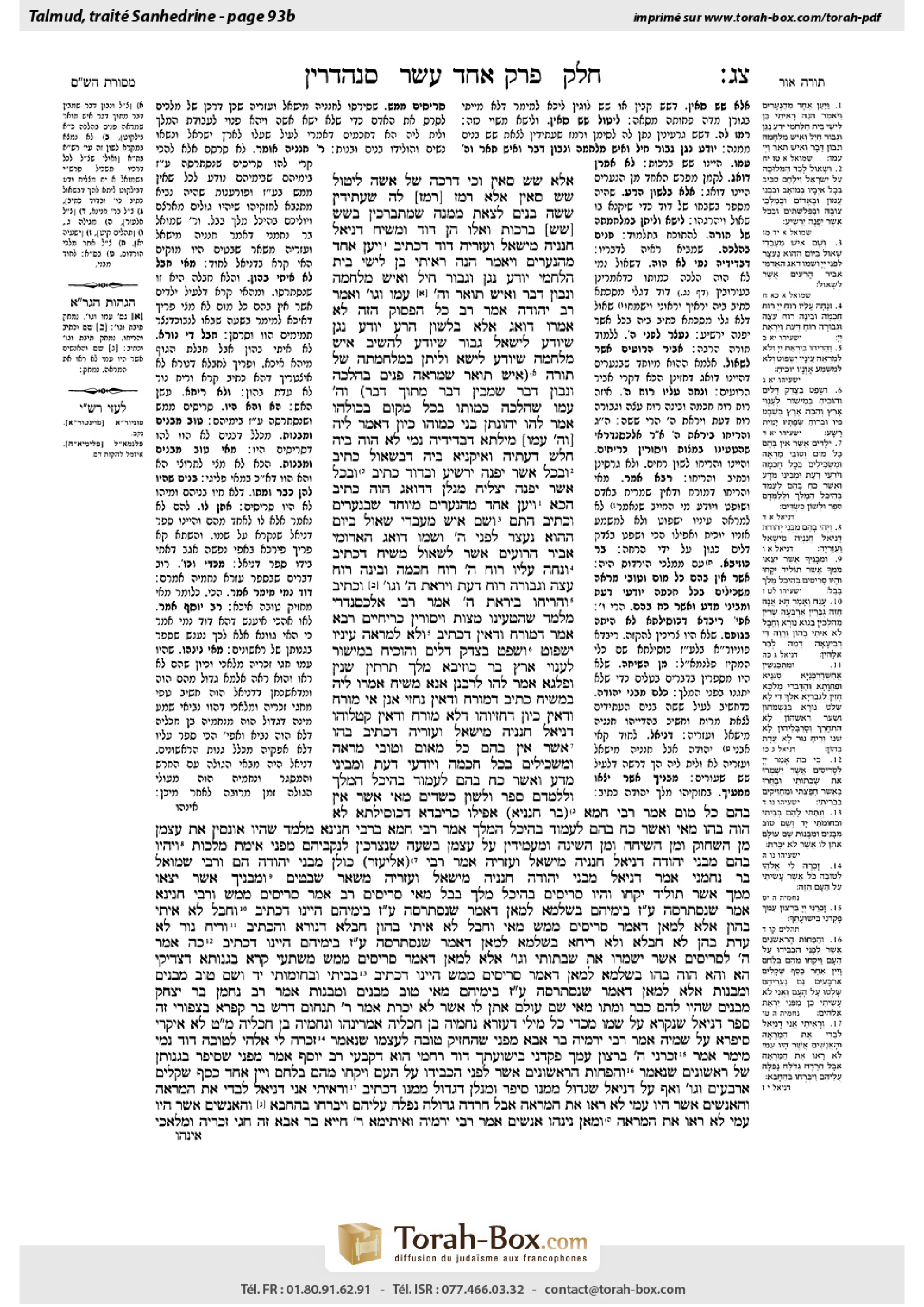
Sanhedrin 93b: Talmud study for Daf Yomi
Daf Yomi is the daily study of one Talmud folio. Explore 37 tractates with scans, Hebrew text, Sefaria English and AI-generated French translations where annotated.
Passage selection and English or AI-generated French translation are available where the scan has annotations. Daf Study is independent of Torah-Box and Sefaria.
Browse Sanhedrin · סנהדרין · All tractatesSanhedrin 93b text and translations
This page of Sanhedrin includes the Aramaic text, an English translation and an AI-generated French translation, alongside the scan above.
סנהדרין צ״ג ב · Aramaic and Hebrew text
אֶלָּא שֵׁשׁ סְאִין.
וְכִי דַּרְכָּהּ שֶׁל אִשָּׁה לִיטּוֹל שֵׁשׁ סְאִין? אֶלָּא רֶמֶז [רָמַז] לָהּ, שֶׁעֲתִידִין שִׁשָּׁה בָּנִים לָצֵאת מִמֶּנָּה שֶׁמִּתְבָּרְכִין בְּשֵׁשׁ [שֵׁשׁ] בְּרָכוֹת. וְאֵלּוּ הֵן: דָּוִד וּמָשִׁיחַ, דָּנִיֵּאל, חֲנַנְיָה, מִישָׁאֵל וַעֲזַרְיָה. דָּוִד, דִּכְתִיב: ״וַיַּעַן אֶחָד מֵהַנְּעָרִים וַיֹּאמֶר הִנֵּה רָאִיתִי בֵּן לְיִשַׁי בֵּית הַלַּחְמִי יֹדֵעַ נַגֵּן וְגִבּוֹר חַיִל וְאִישׁ מִלְחָמָה וּנְבוֹן דָּבָר וְאִישׁ תֹּאַר וַה׳ עִמּוֹ וְגוֹ׳״.
וְאָמַר רַב יְהוּדָה אָמַר רַב: כׇּל הַפָּסוּק הַזֶּה לֹא אֲמָרוֹ דּוֹאֵג אֶלָּא בְּלָשׁוֹן הָרָע. ״יֹדֵעַ נַגֵּן״ – שֶׁיּוֹדֵעַ לִישָּׁאֵל, ״גִּבּוֹר״ – שֶׁיּוֹדֵעַ לְהָשִׁיב, ״אִישׁ מִלְחָמָה״ – שֶׁיּוֹדֵעַ לִישָּׂא וְלִיתֵּן בְּמִלְחַמְתָּהּ שֶׁל תּוֹרָה, ״אִישׁ תֹּאַר״ – שֶׁמַּרְאֶה פָּנִים בַּהֲלָכָה, ״וּנְבוֹן דָּבָר״ – שֶׁמֵּבִין דָּבָר מִתּוֹךְ דָּבָר, ״וַה׳ עִמּוֹ״ – שֶׁהֲלָכָה כְּמוֹתוֹ בְּכׇל מָקוֹם.
בְּכוּלְּהוּ אֲמַר לְהוּ יְהוֹנָתָן בְּנִי כָּמוֹהוּ. כֵּיוָן דַּאֲמַר לֵיהּ ״וַה׳ עִמּוֹ״, מִילְּתָא דִּבְדִידֵיהּ נָמֵי לָא הֲוָה בֵּיהּ, חֲלַשׁ דַּעְתֵּיהּ וְאִיקַּנִּי בֵּיהּ. דִּבְשָׁאוּל כְּתִיב: ״וּבְכֹל אֲשֶׁר יִפְנֶה יַרְשִׁיעַ״, וּבְדָוִד כְּתִיב: ״וּבְכֹל אֲשֶׁר יִפְנֶה יַצְלִיחַ״.
מְנָלַן דְּדוֹאֵג הֲוָה? כְּתִיב הָכָא: ״וַיַּעַן אֶחָד מֵהַנְּעָרִים״ – מְיוּחָד שֶׁבַּנְּעָרִים, וּכְתִיב הָתָם: ״וְשָׁם אִישׁ מֵעַבְדֵי שָׁאוּל בַּיּוֹם הַהוּא נֶעְצָר לִפְנֵי ה׳ וּשְׁמוֹ דֹּאֵג הָאֲדֹמִי אַבִּיר הָרֹעִים אֲשֶׁר לְשָׁאוּל״.
מָשִׁיחַ, דִּכְתִיב: ״וְנָחָה עָלָיו רוּחַ ה׳ רוּחַ חׇכְמָה וּבִינָה רוּחַ עֵצָה וּגְבוּרָה רוּחַ דַּעַת וְיִרְאַת ה׳ וְגוֹ׳״, וּכְתִיב: ״וַהֲרִיחוֹ בְּיִרְאַת ה׳״.
אָמַר רַבִּי אֲלֶכְּסַנְדְּרִי: מְלַמֵּד שֶׁהִטְעִינוֹ מִצְוֹת וְיִסּוּרִין כְּרֵיחַיִים. רָבָא אָמַר: דְּמוֹרַח וְדָאֵין, דִּכְתִיב: ״וְלֹא לְמַרְאֵה עֵינָיו יִשְׁפּוֹט״, ״וְשָׁפַט בְּצֶדֶק דַּלִּים וְהוֹכִיחַ בְּמִישׁוֹר לְעַנְוֵי אָרֶץ״.
בַּר כּוֹזֵיבָא מְלַךְ תַּרְתֵּין שְׁנִין וּפַלְגָא. אֲמַר לְהוּ לְרַבָּנַן: אֲנָא מָשִׁיחַ. אֲמַרוּ לֵיהּ: בְּמָשִׁיחַ כְּתִיב דְּמוֹרַח וְדָאֵין, נֶחְזֵי אֲנַן אִי מוֹרַח וְדָאֵין. כֵּיוָן דְּחַזְיוּהּ דְּלָא מוֹרַח וְדָאֵין, קַטְלוּהּ.
דָּנִיֵּאל חֲנַנְיָה מִישָׁאֵל וַעֲזַרְיָה, דִּכְתִיב בְּהוּ: ״אֲשֶׁר אֵין בָּהֶם כׇּל מְאוּם וְטוֹבֵי מַרְאֶה וּמַשְׂכִּילִים בְּכׇל חׇכְמָה וְיֹדְעֵי דַעַת וּמְבִינֵי מַדָּע וַאֲשֶׁר כֹּחַ בָּהֶם לַעֲמֹד בְּהֵיכַל הַמֶּלֶךְ וּלְלַמְּדָם סֵפֶר וּלְשׁוֹן כַּשְׂדִּים״.
מַאי ״אֲשֶׁר אֵין בָּהֶם כׇּל מוּם״? אָמַר רַבִּי חָמָא בַּר חֲנַנְיָא: אֲפִילּוּ כְּרִיבְדָּא דְכוּסִילְתָּא לָא הֲוָה בְּהוּ. מַאי ״וַאֲשֶׁר כֹּחַ בָּהֶם לַעֲמֹד בְּהֵיכַל הַמֶּלֶךְ״? אָמַר רַבִּי חָמָא בְּרַבִּי חֲנִינָא: מְלַמֵּד שֶׁהָיוּ אוֹנְסִין אֶת עַצְמָן מִן הַשְּׂחוֹק, וּמִן הַשִּׂיחָה, וּמִן הַשֵּׁינָה, וּמַעֲמִידִין עַל עַצְמָן בְּשָׁעָה שֶׁנִּצְרָכִין לְנִקְבֵיהֶם מִפְּנֵי אֵימַת מַלְכוּת.
״וַיְהִי בָהֶם מִבְּנֵי יְהוּדָה דָּנִיֵּאל חֲנַנְיָה מִישָׁאֵל וַעֲזַרְיָה״. אָמַר רַבִּי אֱלִיעֶזֶר: כּוּלָּן מִבְּנֵי יְהוּדָה הֵם. וְרַבִּי שְׁמוּאֵל בַּר נַחְמָנִי אָמַר: דָּנִיאֵל מִבְּנֵי יְהוּדָה, חֲנַנְיָה מִישָׁאֵל וַעֲזַרְיָה מִשְּׁאָר שְׁבָטִים.
״וּמִבָּנֶיךָ אֲשֶׁר יֵצְאוּ מִמְּךָ אֲשֶׁר תּוֹלִיד יִקָּחוּ וְהָיוּ סָרִיסִים בְּהֵיכַל מֶלֶךְ בָּבֶל״. מַאי סָרִיסִים? רַב אָמַר: סָרִיסִים מַמָּשׁ, וְרַבִּי חֲנִינָא אָמַר: שֶׁנִּסְתָּרְסָה עֲבוֹדָה זָרָה בִּימֵיהֶם.
בִּשְׁלָמָא לְמַאן דְּאָמַר שֶׁנִּסְתָּרְסָה עֲבוֹדָה זָרָה בִּימֵיהֶם, הַיְינוּ דִּכְתִיב ״וַחֲבָל לָא אִיתַי בְּהוֹן״. אֶלָּא לְמַאן דְּאָמַר סָרִיסִים מַמָּשׁ, מַאי ״וַחֲבָל לָא אִיתַי בְּהוֹן״? חַבְלָא דְּנוּרָא. וְהָכְתִיב ״וְרֵיחַ נוּר לָא עֲדָת בְּהוֹן״? לָא חַבְלָא וְלָא רֵיחָא.
בִּשְׁלָמָא לְמַאן דְּאָמַר שֶׁנִּסְתָּרְסָה עֲבוֹדָה זָרָה בִּימֵיהֶם, הַיְינוּ דִּכְתִיב: ״כֹּה אָמַר ה׳ לַסָּרִיסִים אֲשֶׁר יִשְׁמְרוּ אֶת שַׁבְּתֹתַי וְגוֹ׳״. אֶלָּא לְמַאן דְּאָמַר סָרִיסִים מַמָּשׁ, מִשְׁתַּעֵי קְרָא בִּגְנוּתָא דְּצַדִּיקֵי? הָא וְהָא הֲוָה בְּהוּ.
בִּשְׁלָמָא לְמַאן דְּאָמַר סָרִיסִים מַמָּשׁ, הַיְינוּ דִּכְתִיב ״בְּבֵיתִי וּבְחוֹמֹתַי יָד וָשֵׁם טוֹב מִבָּנִים וּמִבָּנוֹת״. אֶלָּא לְמַאן דְּאָמַר שֶׁנִּסְתָּרְסָה עֲבוֹדָה זָרָה בִּימֵיהֶם, מַאי ״טוֹב מִבָּנִים וּמִבָּנוֹת״? אָמַר רַב נַחְמָן בַּר יִצְחָק: מִבָּנִים שֶׁהָיוּ לָהֶם כְּבָר וּמֵתוּ. מַאי ״שֵׁם עוֹלָם אֶתֶּן לוֹ אֲשֶׁר לֹא יִכָּרֵת״? אָמַר רַבִּי תַּנְחוּם: דָּרַשׁ בַּר קַפָּרָא בְּצִפּוֹרִי, זֶה סֵפֶר דָּנִיֵּאל שֶׁנִּקְרָא עַל שְׁמוֹ.
מִכְּדֵי כֹּל מִילֵּי דְּעֶזְרָא, נְחֶמְיָה בֶּן חֲכַלְיָה אַמְרִינְהוּ, וּנְחֶמְיָה בֶּן חֲכַלְיָה מַאי טַעְמָא לָא אִיקְּרִי סִיפְרָא עַל שְׁמֵיהּ? אָמַר רַבִּי יִרְמְיָה בַּר אַבָּא: מִפְּנֵי שֶׁהֶחְזִיק טוֹבָה לְעַצְמוֹ, שֶׁנֶּאֱמַר ״זׇכְרָה לִּי אֱלֹהַי לְטוֹבָה״. דָּוִד נָמֵי מֵימָר אָמַר ״זׇכְרֵנִי ה׳ בִּרְצוֹן עַמֶּךָ פׇּקְדֵנִי בִּישׁוּעָתֶךָ״! דָּוִד רַחֲמֵי הוּא דְּקָבָעֵי.
רַב יוֹסֵף אָמַר: מִפְּנֵי שֶׁסִּיפֵּר בִּגְנוּתָן שֶׁל רִאשׁוֹנִים, שֶׁנֶּאֱמַר: ״וְהַפַּחוֹת הָרִאשׁוֹנִים אֲשֶׁר לְפָנַי הִכְבִּידוּ עַל הָעָם וַיִּקְחוּ מֵהֶם בְּלֶחֶם וָיַיִן אַחַר כֶּסֶף שְׁקָלִים אַרְבָּעִים וְגוֹ׳״. וְאַף עַל דָּנִיֵּאל, שֶׁגָּדוֹל מִמֶּנּוּ, סִיפֵּר.
וּמְנָלַן דְּגָדוֹל מִמֶּנּוּ? דִּכְתִיב: ״וְרָאִיתִי אֲנִי דָנִיֵּאל לְבַדִּי אֶת הַמַּרְאָה וְהָאֲנָשִׁים אֲשֶׁר הָיוּ עִמִּי לֹא רָאוּ אֶת הַמַּרְאָה אֲבָל חֲרָדָה גְדֹלָה נָפְלָה עֲלֵיהֶם וַיִּבְרְחוּ בְּהֵחָבֵא״. ״וְהָאֲנָשִׁים אֲשֶׁר הָיוּ עִמִּי לֹא רָאוּ אֶת הַמַּרְאָה״ – וּמַאן נִינְהוּ אֲנָשִׁים? אָמַר רַבִּי יִרְמְיָה, וְאִיתֵּימָא רַבִּי חִיָּיא בַּר אַבָּא: זֶה חַגַּי, זְכַרְיָה, וּמַלְאָכִי.
Sanhedrin 93b · English translation
Rather, he gave her six se’a.
The Gemara asks: And is it the typical manner of a woman to take a heavy burden of six se’a of barley? Rather, Boaz alluded to Ruth that six descendants are destined to emerge from her who would each be blessed with six blessings, and these are they: David, and the Messiah, Daniel, Hananiah, Mishael, and Azariah. The Gemara elaborates: David was blessed with six virtues, as it is written: “And one of the servants answered and said: Behold, I have seen a son of Yishai of the house of Bethlehem who knows to play, and is a fine warrior, and a man of war, and prudent in speech, and a comely man, and the Lord is with him” (I Samuel 16:18).
Rav Yehuda says that Rav says: Doeg the Edomite, one of Saul’s servants, stated this entire verse only as malicious speech, in an attempt to incite Saul to be jealous of David. “Who knows how to play” means that he knows how to ask complex and germane questions about Torah matters. “A fine warrior” means that he knows how to answer questions raised with regard to matters of Torah. “A man of war,” means that he knows to negotiate his way in the battle to understand the Torah. “A comely man” is one who displays understanding in facets of halakha and explains it well. “And prudent in speech [davar]” means that he infers one matter [davar] from another matter. “And the Lord is with him” means that the halakha is ruled in accordance with his opinion in every area of halakha.
The Gemara relates: In response to all of these virtues listed in praise of David, Saul said to his servants: My son Jonathan is his equal. Once Doeg said to Saul: “And the Lord is with him,” meaning that the halakha is ruled in accordance with his opinion in every area of halakha, a matter that did not apply even to Saul himself, he was offended and grew jealous of David. As with regard to Saul it is written: “And wherever he turned he put them to the worse” (I Samuel 14:47), and with regard to David it is written: And wherever he turns he does prosper. Although the verse about Saul is referring to his victories and his prominence in Torah, he was not privileged to have all of his conclusions accepted as halakha.
The Gemara asks: From where do we derive that it was Doeg who listed the virtues in this verse? The Gemara answers that it is written here: “And one [eḥad] of the servants answered,” meaning the most notable [meyuḥad] of the servants. And it is written there: “And a certain man of the servants of Saul was there that day, detained before the Lord, and his name was Doeg the Edomite, the chief of the herdsmen that belonged to Saul” (I Samuel 21:8).
The Messiah was blessed with six virtues, as it is written: “And the spirit of the Lord shall rest upon him, the spirit of wisdom and understanding, the spirit of counsel and might, the spirit of knowledge and of the fear of the Lord” (Isaiah 11:2); and it is written: “And his delight [vahariḥo] shall be the fear of the Lord, and he shall neither judge after the sight of his eyes, nor decide after the hearing of his ears” (Isaiah 11:3).
Rabbi Alexandri says that the term hariḥo teaches that God burdened the Messiah with mitzvot and afflictions like millstones [reiḥayim]. Rava says that hariḥo teaches that the Messiah will smell [demoraḥ] and then judge on that basis, sensing who is right, as it is written: “And he shall neither judge after the sight of [lemareh] his eyes, nor decide after the hearing of his ears; and with righteousness shall he judge the poor, and decide equity for the meek of the earth” (Isaiah 11:3–4).
The Gemara relates: Bar Koziva, i.e., bar Kokheva, ruled for two and a half years. He said to the Sages: I am the Messiah. They said to him: With regard to the Messiah it is written that he is able to smell and judge, so let us see ourselves whether he, bar Kokheva, is able to smell and judge. Once they saw that he was not able to smell and judge, the gentiles killed him.
Six virtues were ascribed to Daniel, Hananiah, Mishael, and Azariah, as it is written in their regard: “Youths in whom was found no blemish, and well favored, and skillful in all wisdom, and discerning in knowledge, and perceptive in understanding, and who had strength in them to stand in the king’s palace, and whom they might teach the learning and the tongue of the Chaldeans” (Daniel 1:4).
The Gemara asks: What is the meaning of the phrase “in whom was found no blemish”? Rabbi Ḥama bar Ḥanina says: Even a scratch like the wound that remains after bloodletting was not found in them. What is the meaning of the phrase “and who had strength in them to stand in the king’s place”? What strength is needed to do so? Rabbi Ḥama, son of Rabbi Ḥanina, says: This teaches that they would force themselves to refrain from laughter, and from conversation, and from sleep, and would restrain themselves when they felt the urge to relieve themselves via their orifices, due to fear of the monarchy.
§ The Gemara explores more of their attributes. The verse states: “Now among these were, of the descendants of Judah: Daniel, Hananiah, Mishael, and Azariah” (Daniel 1:6). Rabbi Eliezer says: They were all of the descendants of Judah. And Rabbi Shmuel bar Naḥmani says: Daniel was of the descendants of Judah, and Hananiah, Mishael, and Azariah were descendants of other tribes.
Isaiah prophesied to Hezekiah: “And of your sons that shall issue from you, they shall be taken away; and they shall be officers [sarisim] in the palace of the king of Babylonia” (Isaiah 39:7). The Gemara asks: What is the meaning of sarisim? Rav says: It means literally eunuchs, whom the Babylonians castrated to render them suitable for employment in all aspects of the king’s service. And Rabbi Ḥanina says: It means that idol worship was emasculated during their lifetime, as it became clear to all that it lacks substance.
The Gemara asks: Granted, according to the one who says that idol worship was emasculated during their lifetime, that is as it is written: “And they have no hurt” (Daniel 3:25), indicating that the bodies of Hananiah, Mishael, and Azariah were intact and they were not castrated. But according to the one who says that they were literally eunuchs, what is the meaning of the phrase “And they have no hurt”? The Gemara answers: It means they had no hurt from the fire of the furnace, not that their bodies were completely intact. The Gemara asks: But isn’t it already written: “Nor had the odor of fire passed over them” (Daniel 3:27)? There was no need to repeat that they were unaffected by the fire. The Gemara answers: This means that there was neither hurt from the fire nor harm from the odor of the fire.
The Gemara asks: Granted, according to the one who says that idol worship was emasculated during their lifetime, that is as it is written: “For so says the Lord to the sarisim who observe My Shabbatot, and choose what pleases Me, and keep My covenant” (Isaiah 56:4). This verse calls them sarisim due to their miraculous deliverance from the furnace. But according to the one who says that they were literally eunuchs, would the verse speak in denigration of the righteous? Would the verse identify Hananiah, Mishael, and Azariah by their blemish rather than by their names? The Gemara answers: According to the one who says that they were literally eunuchs, both this, the physical imperfection, and that, the fact that idol worship was emasculated during their lifetime, were true concerning them.
The Gemara asks from another perspective: Granted, according to the one who says that they were literally eunuchs, that is as it is written in the next verse: “And to them I will give in My house and within My walls a memorial better than sons and daughters: I will give him an everlasting name, that shall not be excised” (Isaiah 56:5). But according to the one who says that idol worship was emasculated during their lifetime, what is the meaning of the phrase “better than sons and daughters”? Rav Naḥman bar Yitzḥak says: It is consolation concerning children that they already had and who died, that they would also be memorialized. The Gemara asks: What is the meaning of the phrase “an everlasting name that shall not be excised”? Rabbi Tanḥum says that bar Kappara taught in Tzippori: This is referring to the book of Daniel, which is called by his name.
§ Apropos books of the Bible named for a prominent person, the Gemara asks: Now with regard to all the matters of the book of Ezra, Nehemiah, son of Hacaliah, said them and wrote most of them; and with regard to Nehemiah, son of Hacaliah, what is the reason that a book was not called by his name? Over the course of many generations, extending many years after the talmudic period, the book that is today named for Nehemiah was not a separate book and was included in the book of Ezra. Rabbi Yirmeya bar Abba says: The book was not named for Nehemiah because he took credit for himself and boasted about his good deeds, as it is stated: “Remember me, God, for good” (Nehemiah 13:31). The Gemara asks: Is that a shortcoming? King David also said: “Remember me, Lord, when You show favor to Your people; visit me with Your salvation” (Psalms 106:4). The Gemara answers: David was asking for compassion and formulated his words as a prayer. Nehemiah stated them as a fact and a demand.
Rav Yosef says: Nehemiah was punished because he spoke in denigration of his predecessors, as it is stated: “But the former governors who were before me placed burdens upon the people, and took from them for bread and wine beyond forty shekels of silver; even their servants ruled over the people; but I did not do so, due to the fear of God” (Nehemiah 5:15). And he related these disparaging statements even about Daniel, who was greater than he was.
The Gemara asks: From where do we derive that Daniel was greater than he was? The Gemara answers: It is derived from a verse, as it is written: “And I, Daniel, alone saw the vision, and the men who were with me did not see the vision; but a great trembling fell upon them, and they fled to hide” (Daniel 10:7). The Gemara asks: “And the men who were with me did not see the vision”; and who were these men? Rabbi Yirmeya, and some say Rabbi Ḥiyya bar Abba, says: That is referring to Haggai, Zechariah, and Malachi, who were with him and did not see. Evidently, Daniel was greater than these prophets, and all the more so was he greater than Nehemiah, who was never privileged to prophesy.
Sanhedrin 93b · Traduction française (IA)
Il lui donna plutôt six séa.
La Guemara demande : Est-il habituel qu’une femme porte une lourde charge de six séa d’orge ? Boaz faisait plutôt allusion à Ruth : six descendants devaient naître d’elle, chacun béni de six bénédictions. Les voici : David, le Messie, Daniel, Hanania, Mishaël et Azaria. La Guemara précise : David fut béni de six qualités, comme il est écrit : « Un des serviteurs répondit : J’ai vu un fils d’Ishaï, de Bethléem, qui sait jouer, qui est un vaillant guerrier, un homme de guerre, habile en paroles, d’un bel aspect, et l’Éternel est avec lui » (I Samuel 16:18).
Rav Yehouda dit au nom de Rav : Doëg l’Édomite, l’un des serviteurs de Saül, ne prononça l’ensemble de ce verset que pour tenir des propos malveillants et inciter Saül à être jaloux de David. « Qui sait jouer » signifie qu’il sait poser des questions complexes et pertinentes sur des sujets de Torah. « Un vaillant guerrier » signifie qu’il sait répondre aux questions soulevées au sujet de la Torah. « Un homme de guerre » signifie qu’il sait mener les négociations nécessaires au combat pour comprendre la Torah. « D’un bel aspect » désigne quelqu’un qui manifeste sa compréhension des différents aspects de la halakha et les explique bien. « Habile en paroles [davar] » signifie qu’il déduit une chose [davar] d’une autre. « Et l’Éternel est avec lui » signifie que la halakha est tranchée conformément à son opinion dans tous les domaines de la halakha.
La Guemara rapporte : En réponse à toutes ces qualités énumérées à la louange de David, Saül dit à ses serviteurs : « Mon fils Jonathan lui est égal. » Lorsque Doëg dit à Saül : « Et l’Éternel est avec lui », c’est-à-dire que la halakha est tranchée conformément à son opinion dans tous les domaines de la halakha, ce qui ne s’appliquait même pas à Saül lui-même, Saül en fut vexé et devint jaloux de David. En effet, il est écrit au sujet de Saül : « Partout où il se tournait, il les mettait en déroute » (I Samuel 14:47), tandis qu’au sujet de David, il est écrit : « Partout où il se tourne, il réussit. » Bien que le verset concernant Saül fasse référence à ses victoires et à sa prééminence en Torah, il n’eut pas le privilège de voir toutes ses conclusions reconnues comme halakha.
La Guemara demande : D’où savons-nous que c’est Doëg qui énuméra les qualités mentionnées dans ce verset ? La Guemara répond qu’il est écrit ici : « Et un [eḥad] des serviteurs répondit », ce qui signifie le plus éminent [meyuḥad] des serviteurs. Et il est écrit là-bas : « Un homme des serviteurs de Saül se trouvait là ce jour-là, retenu devant l’Éternel ; son nom était Doëg l’Édomite, le chef des bergers de Saül » (I Samuel 21:8).
Le Messie fut béni de six qualités, comme il est écrit : « L’esprit de l’Éternel reposera sur lui : esprit de sagesse et d’intelligence, esprit de conseil et de force, esprit de connaissance et de crainte de l’Éternel » (Isaïe 11:2). Et il est écrit : « Son plaisir [vahariḥo] sera dans la crainte de l’Éternel ; il ne jugera pas d’après ce que ses yeux voient, ni ne décidera d’après ce que ses oreilles entendent » (Isaïe 11:3).
Rabbi Alexandri dit que le terme hariḥo enseigne que Dieu accabla le Messie de mitsvot et d’épreuves comme des meules [reiḥayim]. Rava dit que hariḥo enseigne que le Messie sentira [demoraḥ], puis jugera sur cette base, discernant qui a raison, comme il est écrit : « Il ne jugera pas d’après ce que ses yeux voient [lemareh], ni ne décidera d’après ce que ses oreilles entendent ; il jugera les pauvres avec justice et rendra des décisions équitables pour les humbles de la terre » (Isaïe 11:3–4).
La Guemara rapporte : Bar Koziva, c’est-à-dire Bar Kokhba, régna pendant deux ans et demi. Il dit aux Sages : « Je suis le Messie. » Ils lui répondirent : « Au sujet du Messie, il est écrit qu’il est capable de sentir et de juger ; vérifions donc par nous-mêmes si lui, Bar Kokhba, est capable de sentir et de juger. » Lorsqu’ils constatèrent qu’il en était incapable, les nations le tuèrent.
Six qualités furent attribuées à Daniel, Hanania, Mishaël et Azaria, comme il est écrit à leur sujet : « Des jeunes gens sans aucun défaut, beaux d’apparence, habiles en toute sagesse, instruits dans la connaissance, pénétrants dans l’intelligence et ayant la force de se tenir dans le palais du roi, et auxquels on pourrait enseigner la littérature et la langue des Chaldéens » (Daniel 1:4).
La Guemara demande : Que signifie l’expression « sans aucun défaut » ? Rabbi Ḥama bar Ḥanina dit : On ne trouvait même pas sur eux une égratignure semblable à la marque laissée par une saignée. Que signifie l’expression « ayant la force de se tenir dans le palais du roi » ? Quelle force cela exige-t-il ? Rabbi Ḥama, fils de Rabbi Ḥanina, dit : Cela enseigne qu’ils se forçaient à s’abstenir de rire, de parler et de dormir, et qu’ils se retenaient lorsqu’ils avaient envie de se soulager par leurs orifices, par crainte du pouvoir royal.
§ La Guemara examine d’autres qualités les concernant. Le verset dit : « Parmi eux se trouvaient, parmi les descendants de Juda, Daniel, Hanania, Mishaël et Azaria » (Daniel 1:6). Rabbi Eliezer dit : Ils étaient tous des descendants de Juda. Rabbi Shmuel bar Naḥmani dit : Daniel était un descendant de Juda, tandis que Hanania, Mishaël et Azaria descendaient d’autres tribus.
Isaïe prophétisa à Ézéchias : « Des fils qui seront issus de toi seront emmenés, et ils seront des officiers [sarisim] dans le palais du roi de Babylone » (Isaïe 39:7). La Guemara demande : Que signifie sarisim ? Rav dit : Le terme désigne littéralement des eunuques, que les Babyloniens castrèrent afin de les rendre aptes à servir le roi dans tous les domaines. Rabbi Ḥanina dit : Il signifie que le culte idolâtre fut émasculé de leur vivant, car il apparut clairement à tous qu’il était sans substance.
La Guemara demande : Il est compréhensible que, selon celui qui dit que le culte idolâtre fut émasculé de leur vivant, cela corresponde à ce qui est écrit : « Ils ne subirent aucun dommage » (Daniel 3:25), ce qui indique que les corps de Hanania, Mishaël et Azaria étaient intacts et qu’ils n’avaient pas été castrés. Mais selon celui qui dit qu’ils étaient littéralement des eunuques, que signifie l’expression « Ils ne subirent aucun dommage » ? La Guemara répond : Cela signifie qu’ils ne subirent aucun dommage causé par le feu de la fournaise, et non que leurs corps étaient entièrement intacts. La Guemara demande : Mais n’est-il pas déjà écrit : « L’odeur du feu ne les avait pas atteints » (Daniel 3:27) ? Il n’était pas nécessaire de répéter qu’ils n’avaient pas été touchés par le feu. La Guemara répond : Cela signifie qu’ils ne subirent ni dommage causé par le feu, ni atteinte causée par l’odeur du feu.
La Guemara demande : Il est compréhensible que, selon celui qui dit que le culte idolâtre fut émasculé de leur vivant, cela corresponde à ce qui est écrit : « Car ainsi parle l’Éternel aux eunuques qui observent mes Chabbatot, choisissent ce qui me plaît et s’attachent à mon alliance » (Isaïe 56:4). Ce verset les appelle sarisim en raison de leur délivrance miraculeuse de la fournaise. Mais selon celui qui dit qu’ils étaient littéralement des eunuques, le verset parlerait-il des justes de façon dénigrante ? Identifierait-il Hanania, Mishaël et Azaria par leur défaut plutôt que par leurs noms ? La Guemara répond : Selon celui qui dit qu’ils étaient littéralement des eunuques, les deux choses étaient vraies à leur sujet : celle-ci, leur imperfection physique, et celle-là, le fait que le culte idolâtre fut émasculé de leur vivant.
La Guemara pose une question sous un autre angle : Il est compréhensible que, selon celui qui dit qu’ils étaient littéralement des eunuques, cela corresponde à ce qui est écrit dans le verset suivant : « Je leur donnerai dans ma maison et dans mes murs un monument et un nom meilleurs que des fils et des filles ; je leur donnerai un nom éternel qui ne sera pas retranché » (Isaïe 56:5). Mais selon celui qui dit que le culte idolâtre fut émasculé de leur vivant, que signifie l’expression « meilleurs que des fils et des filles » ? Rav Naḥman bar Yitzḥak dit : Il s’agit d’une consolation au sujet des enfants qu’ils avaient déjà eus et qui étaient morts : eux aussi seraient commémorés. La Guemara demande : Que signifie l’expression « un nom éternel qui ne sera pas retranché » ? Rabbi Tanḥum dit que bar Kappara enseignait à Tzippori : Cela fait référence au livre de Daniel, qui porte son nom.
§ À propos des livres de la Bible qui portent le nom d’une personnalité importante, la Guemara demande : Or, Néhémie, fils de Hacalia, rapporta tous les événements du livre d’Ezra et en consigna la plupart ; alors, pourquoi aucun livre ne porte-t-il le nom de Néhémie, fils de Hacalia ? Pendant de nombreuses générations, y compris bien des années après la période talmudique, le livre aujourd’hui nommé d’après Néhémie ne constituait pas un livre distinct et était inclus dans le livre d’Ezra. Rabbi Yirmeya bar Abba dit : Le livre ne fut pas nommé d’après Néhémie parce qu’il s’attribua le mérite et se vanta de ses bonnes actions, comme il est dit : « Souviens-toi de moi, mon Dieu, pour le bien » (Néhémie 13:31). La Guemara demande : Est-ce un défaut ? Le roi David dit lui aussi : « Souviens-toi de moi, Éternel, lorsque tu favorises ton peuple ; visite-moi par ton salut » (Psaumes 106:4). La Guemara répond : David implorait la compassion et formulait ses paroles comme une prière. Néhémie les énonça comme un fait et une exigence.
Rav Yossef dit : Néhémie fut puni parce qu’il dénigra ses prédécesseurs, comme il est dit : « Les gouverneurs précédents, qui m’avaient précédé, imposaient des charges au peuple et prélevaient sur lui, pour le pain et le vin, plus de quarante sicles d’argent ; même leurs serviteurs dominaient le peuple. Mais moi, je n’ai pas agi ainsi, par crainte de Dieu » (Néhémie 5:15). Il tint ces propos dépréciatifs même au sujet de Daniel, qui était plus grand que lui.
La Guemara demande : D’où déduisons-nous que Daniel était plus grand que lui ? La Guemara répond : Cela se déduit d’un verset, comme il est écrit : « Moi, Daniel, je vis seul la vision ; les hommes qui étaient avec moi ne virent pas la vision, mais une grande terreur s’abattit sur eux, et ils s’enfuirent pour se cacher » (Daniel 10:7). La Guemara demande : « Les hommes qui étaient avec moi ne virent pas la vision » ; qui étaient ces hommes ? Rabbi Yirmeya — et certains disent Rabbi Ḥiyya bar Abba — dit : Il s’agit de Haggaï, Zacharie et Malachie, qui étaient avec lui mais ne virent pas la vision. Il est donc évident que Daniel était plus grand que ces prophètes, et à plus forte raison était-il plus grand que Néhémie, qui n’eut jamais le privilège de prophétiser.
Traduction française générée par IA à partir de l’édition anglaise de Sefaria. Vérifie toujours un passage avec le texte source.
Text from Sefaria: William Davidson Edition - Vocalized Aramaic (CC BY NC); William Davidson Edition - English (CC BY NC).