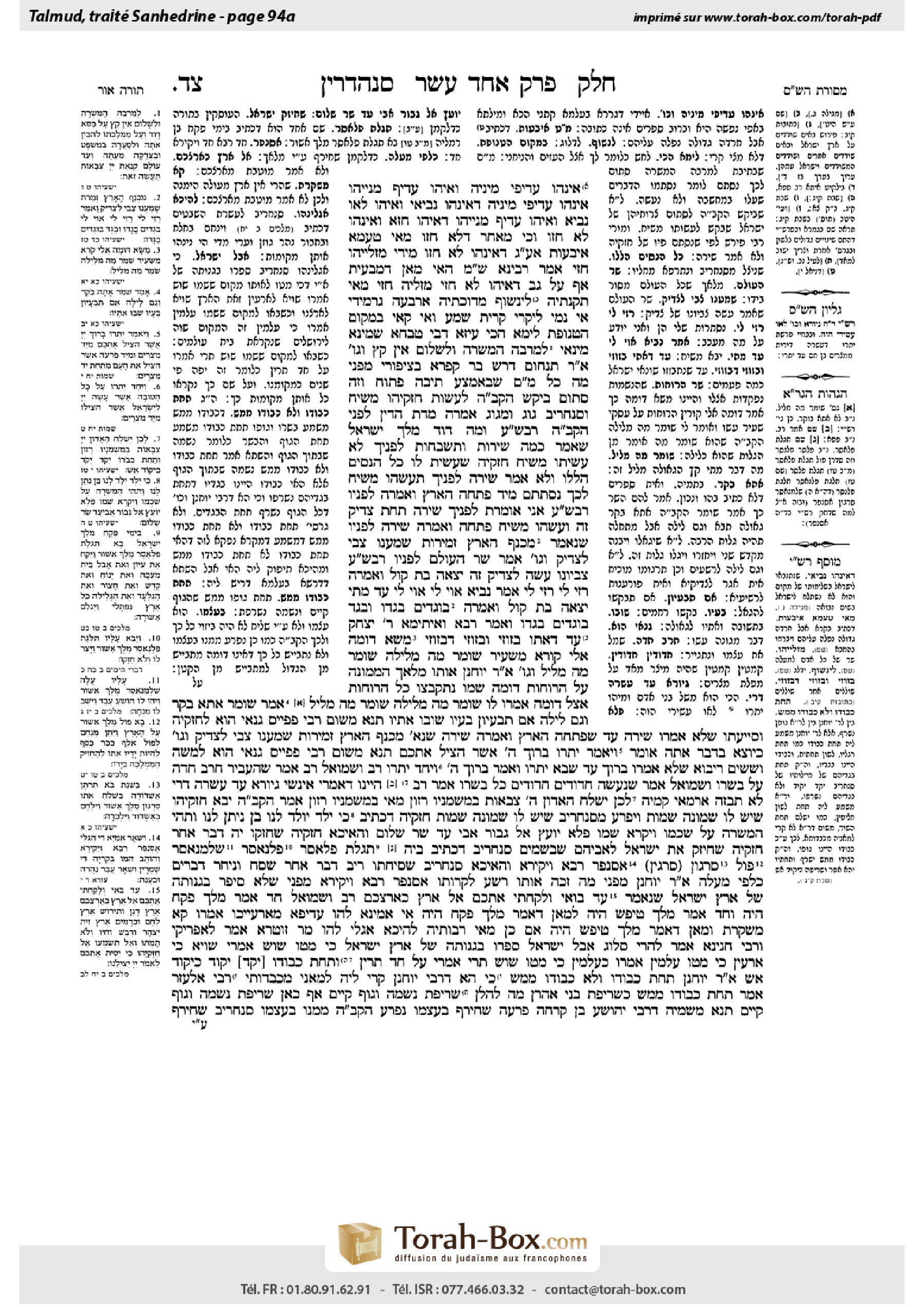
Sanhedrin 94a: Talmud study for Daf Yomi
Daf Yomi is the daily study of one Talmud folio. Explore 37 tractates with scans, Hebrew text, Sefaria English and AI-generated French translations where annotated.
Passage selection and English or AI-generated French translation are available where the scan has annotations. Daf Study is independent of Torah-Box and Sefaria.
Browse Sanhedrin · סנהדרין · All tractatesSanhedrin 94a text and translations
This page of Sanhedrin includes the Aramaic text, an English translation and an AI-generated French translation, alongside the scan above.
סנהדרין צ״ד א · Aramaic and Hebrew text
אִינְהוּ עֲדִיפִי מִינֵּיהּ, וְאִיהוּ עֲדִיף מִנַּיְיהוּ. אִינְהוּ עֲדִיפִי מִינֵּיהּ – דְּאִינְהוּ נְבִיאֵי, וְאִיהוּ לָאו נְבִיָּא. וְאִיהוּ עֲדִיף מִנַּיְיהוּ – דְּאִיהוּ חֲזָא, וְאִינְהוּ לָא חֲזוֹ.
וְכִי מֵאַחַר דְּלָא חֲזוֹ, מַאי טַעְמָא אִיבְּעוּת? אַף עַל גַּב דְּאִינְהוּ לָא חֲזוֹ מִידֵּי, מַזָּלַיְיהוּ חָזֵי. אָמַר רָבִינָא: שְׁמַע מִינַּהּ הַאי מַאן דְּמִבְּעִית, אַף עַל גַּב דְּאִיהוּ לָא חָזֵי, מַזָּלֵיהּ חָזֵי.
מַאי תַּקַּנְתֵּיהּ? לִינְשׁוֹף מִדּוּכְתֵּיהּ אַרְבְּעָה גַּרְמִידֵי. אִי נָמֵי, לִיקְרֵי קְרִיַּת שְׁמַע. וְאִי קָאֵי בִּמְקוֹם הַטִּנּוֹפֶת, לֵימָא הָכִי: ״עִיזָּא דְּבֵי טַבָּחָא שַׁמִּינָא מִינַּאי״.
״לְםַרְבֵּה הַמִּשְׂרָה וּלְשָׁלוֹם אֵין קֵץ וְגוֹ׳״. אָמַר רַבִּי תַּנְחוּם: דָּרַשׁ בַּר קַפָּרָא בְּצִיפּוֹרִי, מִפְּנֵי מָה כׇּל מֵם שֶׁבְּאֶמְצַע תֵּיבָה פָּתוּחַ, וְזֶה סָתוּם? בִּיקֵּשׁ הַקָּדוֹשׁ בָּרוּךְ הוּא לַעֲשׂוֹת חִזְקִיָּהוּ מָשִׁיחַ, וְסַנְחֵרִיב גּוֹג וּמָגוֹג.
אָמְרָה מִדַּת הַדִּין לִפְנֵי הַקָּדוֹשׁ בָּרוּךְ הוּא: רִבּוֹנוֹ שֶׁל עוֹלָם, וּמָה דָּוִד מֶלֶךְ יִשְׂרָאֵל שֶׁאָמַר כַּמָּה שִׁירוֹת וְתִשְׁבָּחוֹת לְפָנֶיךָ – לֹא עֲשִׂיתוֹ מָשִׁיחַ, חִזְקִיָּה שֶׁעָשִׂיתָ לוֹ כׇּל הַנִּסִּים הַלָּלוּ וְלֹא אָמַר שִׁירָה לְפָנֶיךָ – תַּעֲשֵׂהוּ מָשִׁיחַ? לְכָךְ נִסְתַּתֵּם.
מִיָּד פָּתְחָה הָאָרֶץ וְאָמְרָה לְפָנָיו: רִבּוֹנוֹ שֶׁל עוֹלָם, אֲנִי אוֹמֶרֶת לְפָנֶיךָ שִׁירָה תַּחַת צַדִּיק זֶה, וַעֲשֵׂהוּ מָשִׁיחַ. פָּתְחָה וְאָמְרָה שִׁירָה לְפָנָיו, שֶׁנֶּאֱמַר: ״מִכְּנַף הָאָרֶץ זְמִרֹת שָׁמַעְנוּ צְבִי לַצַּדִּיק וְגוֹ׳״.
אָמַר שַׂר הָעוֹלָם לְפָנָיו: רִבּוֹנוֹ שֶׁל עוֹלָם, צִבְיוֹנוֹ עֲשֵׂה לַצַּדִּיק זֶה! יָצְאָה בַּת קוֹל וְאָמְרָה: רָזִי לִי, רָזִי לִי. אָמַר נָבִיא: אוֹי לִי, אוֹי לִי, עַד מָתַי? יָצְאָה בַּת קוֹל וְאָמְרָה: ״בֹּגְדִים בָּגָדוּ וּבֶגֶד בּוֹגְדִים בָּגָדוּ״. וְאָמַר רָבָא, וְאִיתֵּימָא רַבִּי יִצְחָק: עַד דְּאָתוּ בָּזוֹזֵי וּבָזוֹזֵי דְּבָזוֹזֵי.
״מַשָּׂא דּוּמָה אֵלַי קֹרֵא מִשֵּׂעִיר שֹׁמֵר מַה מִּלַּיְלָה שֹׁמֵר מַה מִּלֵּיל וְגוֹ׳״. אָמַר רַבִּי יוֹחָנָן: אוֹתוֹ מַלְאָךְ הַמְמוּנֶּה עַל הָרוּחוֹת דּוּמָה שְׁמוֹ. נִתְקַבְּצוּ כׇּל הָרוּחוֹת אֵצֶל דּוּמָה, אָמְרוּ לוֹ: ״שֹׁמֵר, מַה מִּלַּיְלָה? שֹׁמֵר, מַה מִּלֵּיל?״ ״אָמַר שֹׁמֵר אָתָא בֹקֶר וְגַם לָיְלָה אִם תִּבְעָיוּן בְּעָיוּ שֻׁבוּ אֵתָיוּ״.
תָּנָא מִשּׁוּם רַבִּי פַּפְּיָיס: גְּנַאי הוּא לְחִזְקִיָּה וְסִייעָתוֹ שֶׁלֹּא אָמְרוּ שִׁירָה, עַד שֶׁפָּתְחָה הָאָרֶץ וְאָמְרָה שִׁירָה, שֶׁנֶּאֱמַר: ״מִכְּנַף הָאָרֶץ זְמִרֹת שָׁמַעְנוּ צְבִי לַצַּדִּיק וְגוֹ׳״. כַּיּוֹצֵא בַּדָּבָר אַתָּה אוֹמֵר: ״וַיֹּאמֶר יִתְרוֹ בָּרוּךְ ה׳ אֲשֶׁר הִצִּיל אֶתְכֶם״. תָּנָא מִשּׁוּם רַבִּי פַּפְּיָיס: גְּנַאי הוּא לְמֹשֶׁה וְשִׁשִּׁים רִיבּוֹא שֶׁלֹּא אָמְרוּ ״בָּרוּךְ״ עַד שֶׁבָּא יִתְרוֹ וְאָמַר ״בָּרוּךְ ה׳״.
״וַיִּחַדְּ יִתְרוֹ״ – רַב וּשְׁמוּאֵל. רַב אָמַר: שֶׁהֶעֱבִיר חֶרֶב חַדָּה עַל בְּשָׂרוֹ, וּשְׁמוּאֵל אָמַר: שֶׁנַּעֲשָׂה חִדּוּדִים חִדּוּדִים כׇּל בְּשָׂרוֹ. אָמַר רַב: הַיְינוּ דְּאָמְרִי אִינָשֵׁי, גִּיּוֹרָא עַד עַשְׂרָה דָּרֵי לָא תִּבְזֵה אַרְמַאי קַמֵּיהּ.
״לָכֵן יְשַׁלַּח הָאָדוֹן ה׳ צְבָאוֹת בְּמִשְׁמַנָּיו רָזוֹן״. מַאי ״בְּמִשְׁמַנָּיו רָזוֹן״? אָמַר הַקָּדוֹשׁ בָּרוּךְ הוּא: יָבֹא חִזְקִיָּהוּ שֶׁיֵּשׁ לוֹ שְׁמוֹנָה שֵׁמוֹת, וְיִפָּרַע מִסַּנְחֵרִיב שֶׁיֵּשׁ לוֹ שְׁמוֹנָה שֵׁמוֹת. חִזְקִיָּה, דִּכְתִיב: ״כִּי יֶלֶד יֻלַּד לָנוּ בֵּן נִתַּן לָנוּ וַתְּהִי הַמִּשְׂרָה עַל שִׁכְמוֹ וַיִּקְרָא שְׁמוֹ פֶּלֶא יוֹעֵץ אֵל גִּבּוֹר אֲבִי עַד שַׂר שָׁלוֹם״. וְהָאִיכָּא ״חִזְקִיָּה״? שֶׁחִזְּקוֹ יָהּ. דָּבָר אַחֵר: ״חִזְקִיָּה״ – שֶׁחִיזֵּק אֶת יִשְׂרָאֵל לַאֲבִיהֶם שֶׁבַּשָּׁמַיִם.
סַנְחֵרִיב, דִּכְתִיב בֵּיהּ: תִּגְלַת פִּלְאֶסֶר, פִּלְנְאֶסֶר, שַׁלְמַנְאֶסֶר, פּוֹל, סַרְגוֹן, אׇסְנַפַּר רַבָּא וְיַקִּירָא. וְהָאִיכָּא ״סַנְחֵרִיב״? שֶׁסִּיחָתוֹ רִיב. דָּבָר אַחֵר: שֶׁסָּח וְנִיחֵר דְּבָרִים כְּלַפֵּי מַעְלָה.
אָמַר רַבִּי יוֹחָנָן: מִפְּנֵי מָה זָכָה אוֹתוֹ רָשָׁע לִקְרוֹתוֹ ״אׇסְנַפַּר רַבָּא וְיַקִּירָא״? מִפְּנֵי שֶׁלֹּא סִיפֵּר בִּגְנוּתָהּ שֶׁל אֶרֶץ יִשְׂרָאֵל, שֶׁנֶּאֱמַר: ״עַד בֹּאִי וְלָקַחְתִּי אֶתְכֶם אֶל אֶרֶץ כְּאַרְצְכֶם״.
רַב וּשְׁמוּאֵל: חַד אָמַר מֶלֶךְ פִּקֵּחַ הָיָה, וְחַד אָמַר מֶלֶךְ טִיפֵּשׁ הָיָה. לְמַאן דְּאָמַר מֶלֶךְ פִּקֵּחַ הָיָה – אִי אָמֵינָא לְהוּ ״עֲדִיפָא מֵאַרְעַיְיכוּ״, אָמְרוּ ״קָא מְשַׁקְּרַתְּ״. וּמַאן דְּאָמַר מֶלֶךְ טִיפֵּשׁ הָיָה – אִם כֵּן, מַאי רְבוּתֵיהּ?
לְהֵיכָא אַגְּלִי לְהוּ? מָר זוּטְרָא אָמַר: לְאַפְרִיקִי, וְרַבִּי חֲנִינָא אָמַר: לְהָרֵי סְלוּג. אֲבָל יִשְׂרָאֵל סִפְּרוּ בִּגְנוּתָהּ שֶׁל אֶרֶץ יִשְׂרָאֵל. כִּי מְטוֹ שׂוֹשׂ, אָמְרִי: שָׁוְיָא כִּי אַרְעִין. כִּי מְטוֹ עָלְמִין, אֲמַרוּ: כְּעָלְמִין. כִּי מְטוֹ שׂוֹשׂ תְּרֵי, אָמְרִי: עַל חַד תְּרֵין.
״וְתַחַת כְּבֹדוֹ [יֵקַד] יְקֹד כִּיקוֹד אֵשׁ״. אָמַר רַבִּי יוֹחָנָן: תַּחַת כְּבוֹדוֹ, וְלֹא כְּבוֹדוֹ מַמָּשׁ. כִּי הָא דְּרַבִּי יוֹחָנָן קָרֵי לֵיהּ לְמָאנֵיהּ ״מְכַבְּדוֹתַי״. רַבִּי אֶלְעָזָר אָמַר: תַּחַת כְּבוֹדוֹ מַמָּשׁ, כִּשְׂרֵיפַת בְּנֵי אַהֲרֹן. מָה לְהַלָּן שְׂרֵיפַת נְשָׁמָה וְגוּף קַיָּים, אַף כָּאן שְׂרֵיפַת נְשָׁמָה וְגוּף קַיָּים.
תָּנָא מִשְּׁמֵיהּ דְּרַבִּי יְהוֹשֻׁעַ בֶּן קׇרְחָה: פַּרְעֹה שֶׁחֵירַף בְּעַצְמוֹ, נִפְרַע הַקָּדוֹשׁ בָּרוּךְ הוּא מִמֶּנּוּ בְּעַצְמוֹ. סַנְחֵרִיב שֶׁחֵירַף
Sanhedrin 94a · English translation
Apropos Daniel, Haggai, Zechariah, and Malachi, the Gemara notes: In certain respects, the latter three were greater than Daniel, and in certain respects, Daniel was greater than the latter three. They were greater than he, as they were prophets and he was not a prophet. Haggai, Zechariah, and Malachi were designated to transmit their visions of God to the Jewish people, but Daniel was not designated to share his visions with others. And he was greater than they, as he saw this vision, and they did not see this vision.
The Gemara asks: And since they did not see the vision, what is the reason that they were frightened? The Gemara answers: Although they did not see the vision, their guardian angels saw it, and they were overcome with fear and fled. Ravina said: Conclude from it that in the case of this person who becomes frightened with no apparent cause, although he does not see what causes his fear, his guardian angel sees it.
What is his remedy? Let him leap four cubits from his current location to distance himself from the perceived danger. Alternatively, let him recite Shema, which will afford him protection. And if he is standing in a place of filth, where it is prohibited to recite verses from the Torah, let him say this formula: The goat of the slaughterhouse is fatter than I, and let the demon harm the goat instead.
§ Apropos Hezekiah, the Gemara cites that which is stated: “That the government may be increased [lemarbe] and of peace there be no end, upon the throne of David, and upon his kingdom, to establish it and uphold it through justice and through righteousness, from now and forever; the zeal of the Lord of hosts does perform this” (Isaiah 9:6). Rabbi Tanḥum says that bar Kappara taught in Tzippori: Due to what reason is it that every letter mem in the middle of a word is open and this mem, of the word lemarbe, is closed? In the Masoretic text, the letter mem in the word “lemarbe” is written in the form of a mem that appears at the end of a word, closed on all four sides. This is because the Holy One, Blessed be He, sought to designate King Hezekiah as the Messiah and to designate Sennacherib and Assyria, respectively, as Gog and Magog, all from the prophecy of Ezekiel with regard to the end of days (Ezekiel, chapter 38), and the confrontation between them would culminate in the final redemption.
The attribute of justice said before the Holy One, Blessed be He: Master of the Universe, and if with regard to David, king of Israel, who recited several songs and praises before You, You did not designate him as the Messiah, then with regard to Hezekiah, for whom You performed all these miracles, delivering him from Sennacherib and healing his illness, and he did not recite praise before You, will You designate him as the Messiah? It is for that reason that the mem was closed, because there was an opportunity for redemption that was thwarted.
Immediately, the earth began and stated before Him: Master of the Universe, I will recite song before You in place of that righteous person, i.e., Hezekiah, and designate him as the Messiah. The earth began and recited a song before Him, as it is stated: “From the uttermost part of the earth have we heard songs: Glory to the righteous. But I said, my secret is mine, my secret is mine, woe unto me. The treacherous deal treacherously; the treacherous deal very treacherously” (Isaiah 24:16).
The angel appointed to oversee the world said before Him: Master of the Universe, perform the will of this righteous person. A Divine Voice emerged and said: “My secret is Mine, My secret is Mine”; this matter will remain secret, as I am not yet bringing the redemption. The prophet said: “Woe unto me,” woe unto me; until when will the exile continue? A Divine Voice emerged and said: “The treacherous deal treacherously; the treacherous deal very treacherously” (Isaiah 24:16). And Rava, and some say Rabbi Yitzḥak, says: Until looters and looters of looters come, the Messiah will not come.
On a similar note, Isaiah said: “The burden of Dumah. One calls to me out of Seir: Watchman, what of the night? Watchman, what of the night? The Watchman said: The morning comes and also the night; if you will inquire, inquire; return, come” (Isaiah 21:11–12). Rabbi Yoḥanan says: That angel, who is appointed over the spirits [seirim], his name is Dumah. All the spirits assembled near Dumah and said to him: “Watchman, what of the night? Watchman, what of the night? Does God, Guardian of Israel, say that the time for redemption has arrived?” The angel answered: “The Watchman said: The morning comes and also the night; if you will inquire, inquire; return, come.” The Holy One, Blessed be He, said that the morning of redemption has come as well as the night of the exile. If you inquire and seek repentance, inquire and repent, and return to God and redemption will come.
It was taught in the name of Rabbi Pappeyas: It is a disgrace for Hezekiah and his associates that they did not recite a song themselves and that a song was not recited until the earth began and recited a song, as it is stated: “From the uttermost part of the earth have we heard songs: Glory to the righteous” (Isaiah 24:16). On a similar note, you say: “And Jethro said: Blessed be the Lord, Who has delivered you out of the hand of Egypt and out of the hand of Pharaoh” (Exodus 18:10). It was taught in the name of Rabbi Pappeyas: It is a disgrace for Moses and the six hundred thousand adult men of the children of Israel whom he led out of Egypt that they did not say: Blessed, until Yitro came and said: “Blessed be the Lord.”
It is written in the previous verse: “Vayyiḥad Yitro for all the goodness that the Lord had done to Israel, whom He had delivered out of the hand of Egypt” (Exodus 18:9). Rav and Shmuel disagreed with regard to the meaning of vayyiḥad. Rav says: He passed a sharp [ḥad] sword over his flesh, i.e., he circumcised himself and converted. And Shmuel says: He felt as though cuts [ḥiddudim] were made over his flesh, i.e., he had an unpleasant feeling due to the downfall of Egypt. Rav says with regard to this statement of Shmuel that this is in accordance with the adage that people say: With regard to a convert, for ten generations after his conversion one should not disparage a gentile before him and his descendants, as they continue to identify somewhat with gentiles and remain sensitive to their pain.
§ The verse states: “Therefore shall the Master, the Lord of hosts, send among his fat ones [mishmanav] leanness” (Isaiah 10:16). What is the meaning of the phrase “send among his fat ones leanness”? The meaning is that the Holy One, Blessed be He, said: Let Hezekiah, who has eight [shemona] names, come, and exact retribution from Sennacherib, who has eight names. The Gemara elaborates: The eight names of Hezekiah are as it is written: “For to us a child is born, to us a son is given; and the government is upon his shoulder; and his name is called Pele Joez El Gibbor Abi Ad Sar Shalom” (Isaiah 9:5). The Gemara asks: But isn’t there an additional name, Hezekiah? The Gemara explains: That was not a given name; rather, it is an appellation based on the fact that God strengthened him [ḥizzeko]. Alternatively, he was called Hezekiah due to the fact that he strengthened the devotion of the Jewish people to their Father in Heaven.
The eight names of Sennacherib are as it is written in his regard among the kings of Assyria: “Tiglath-Pileser” (II Kings 15:29), “Tiglath-Pilneser” (II Chronicles 28:20), “Shalmaneser” (II Kings 17:3), “Pul” (II Kings 15:19), “Sargon” (Isaiah 20:1), and “the great and noble Asenappar” (Ezra 4:10). And the Gemara asks: But isn’t there an additional name, Sennacherib [Sanḥeriv]? The Gemara explains: That was not a given name; rather, it is an appellation based on the fact that his speech is contentious [siḥato riv], leading to quarrel and shame. Alternatively, he was called Sanḥeriv due to the fact that he spoke [saḥ] and snorted out [niḥer] contemptuous statements vis-à-vis the Transcendent.
Rabbi Yoḥanan says: For what reason was that wicked person privileged to be named “the great and noble Asenappar”? It was due to the fact that he did not speak [sipper] in disparagement of Eretz Yisrael, as it is stated: “Until I come and take you to a land like your own” (II Kings 18:32), and he did not say that he was taking them to a superior land.
Rav and Shmuel disagreed with regard to that statement of Sennacherib: One says he was a clever king and one says he was a foolish king. According to the one who says he was a clever king, he said that he is taking them to a land like their own, as he thought: If I say to them: I am taking you to a land that is superior to your land, they will say: You are lying. And as for the one who says he was a foolish king, he explains: If so, if he said that he is not taking them to a superior land, what is his greatness and how would they be convinced to go into exile?
The Gemara asks: To where did Sennacherib exile the ten tribes? Mar Zutra says: He exiled them to Afrikei, and Rabbi Ḥanina says: To the Selug Mountains. The Gemara adds: But those exiled from the kingdom of Israel spoke in disparagement of Eretz Yisrael and extolled the land of their exile. When they arrived at one place, they called it Shosh, as they said: It is equal [shaveh] to our land. When they arrived at another place, they called it Almin, as they said: It is like our world [almin], as Eretz Yisrael is also called beit olamim. When they arrived at a third place they called it Shosh the second [terei], as they said: For one measure of good in Eretz Yisrael, there are two [terein] here.
The Gemara cites additional verses written with regard to Sennacherib. “And beneath his glory shall be kindled a blaze like the blaze of a fire” (Isaiah 10:16). Rabbi Yoḥanan says: A blaze was kindled beneath his glory, but it was not actually kindled on his glory. The blaze consumed the bodies of the troops of Sennacherib beneath their garments, which were referred to as glory, as in that practice of Rabbi Yoḥanan, who would call his garments: My glory. Rabbi Elazar says: It means beneath his actual glory, i.e., the blaze consumed their souls, and their flesh was not consumed, like the burning of the sons of Aaron. Just as there, the death of the sons of Aaron entailed the burning of the soul, and the body remained intact, so too here, the death of the troops of Sennacherib entailed the burning of the soul, and the body remained intact.
It was taught in the name of Rabbi Yehoshua ben Korḥa: With regard to Pharaoh, who himself blasphemed God, the Holy One, Blessed be He, Himself exacted retribution from him. With regard to Sennacherib, who blasphemed God
Sanhedrin 94a · Traduction française (IA)
À propos de Daniel, de Haggaï, de Zacharie et de Malachie, la Guemara relève que, sous certains aspects, les trois derniers étaient supérieurs à Daniel, et que, sous d’autres aspects, Daniel leur était supérieur. Ils lui étaient supérieurs, car ils étaient prophètes, tandis que lui ne l’était pas. Haggaï, Zacharie et Malachie avaient été désignés pour transmettre au peuple juif leurs visions de Dieu, alors que Daniel n’avait pas été désigné pour faire part de ses visions à d’autres. Daniel leur était supérieur, car il eut cette vision, tandis qu’eux ne l’eurent pas.
La Guemara demande : puisqu’ils n’eurent pas cette vision, pourquoi furent-ils effrayés ? La Guemara répond : bien qu’ils n’aient pas eu la vision, leurs anges gardiens la virent, furent saisis de peur et s’enfuirent. Ravina dit : déduis-en que, lorsqu’une personne est effrayée sans raison apparente, même si elle ne voit pas ce qui cause sa peur, son ange gardien le voit.
Quel remède peut-elle employer ? Qu’elle fasse un bond de quatre coudées depuis l’endroit où elle se trouve, afin de s’éloigner du danger qu’elle croit percevoir. Ou bien qu’elle récite le Chéma, qui lui assurera une protection. Et si elle se trouve dans un endroit malpropre, où il est interdit de réciter des versets de la Torah, qu’elle prononce cette formule : « Le bouc de l’abattoir est plus gras que moi », et que le démon s’en prenne plutôt au bouc.
§ À propos d’Ézéchias, la Guemara cite ce qui est énoncé : « Que l’autorité s’accroisse [lemarbe] et que la paix soit sans fin, sur le trône de David et sur son royaume, afin de l’affermir et de le soutenir par le droit et par la justice, dès maintenant et pour toujours ; le zèle de l’Éternel des armées accomplira cela » (Isaïe 9:6). Rabbi Tanḥoum rapporte que bar Kappara enseigna à Tsippori : pour quelle raison toute lettre mem au milieu d’un mot est-elle ouverte, tandis que celle-ci, dans le mot lemarbe, est fermée ? Dans le texte massorétique, la lettre mem du mot « lemarbe » est écrite sous la forme d’un mem final, fermé de tous côtés. C’est parce que le Saint, béni soit-Il, voulut désigner le roi Ézéchias comme Messie, et Sennachérib et l’Assyrie, respectivement, comme Gog et Magog, en s’appuyant sur la prophétie d’Ézéchiel concernant la fin des temps (Ézéchiel, chapitre 38) ; leur affrontement devait aboutir à la rédemption finale.
L’attribut de justice dit devant le Saint, béni soit-Il : Maître de l’univers, si Tu n’as pas désigné comme Messie David, roi d’Israël, qui récita devant Toi plusieurs chants et louanges, alors désigneras-Tu comme Messie Ézéchias, pour qui Tu as accompli tous ces miracles — en le délivrant de Sennachérib et en guérissant sa maladie —, alors qu’il ne T’a pas adressé de louange ? C’est pour cette raison que le mem était fermé : une occasion de rédemption s’était présentée, mais elle fut compromise.
Aussitôt, la terre se mit à parler et dit devant Lui : Maître de l’univers, je vais réciter un chant devant Toi à la place de ce juste, c’est-à-dire Ézéchias, et le désigner comme Messie. La terre se mit à chanter devant Lui, comme il est énoncé : « Des extrémités de la terre, nous avons entendu des chants : Gloire au juste. Mais j’ai dit : Mon secret est à moi, mon secret est à moi ; malheur à moi ! Les traîtres agissent traîtreusement ; les traîtres agissent avec une extrême traîtrise » (Isaïe 24:16).
L’ange chargé de veiller sur le monde dit devant Lui : Maître de l’univers, accomplis la volonté de ce juste. Une Voix céleste se fit entendre et dit : « Mon secret est à moi, mon secret est à moi » ; cette affaire restera secrète, car Je n’apporte pas encore la rédemption. Le prophète dit : « Malheur à moi ! » Malheur à moi ! Jusqu’à quand l’exil se prolongera-t-il ? Une Voix céleste se fit entendre et dit : « Les traîtres agissent traîtreusement ; les traîtres agissent avec une extrême traîtrise » (Isaïe 24:16). Rava — et certains disent Rabbi Yitsḥak — dit : le Messie ne viendra pas avant l’arrivée de pillards et de pillards de pillards.
Dans le même ordre d’idées, Isaïe dit : « Oracle sur Douma. On m’appelle depuis Séïr : Sentinelle, qu’en est-il de la nuit ? Sentinelle, qu’en est-il de la nuit ? La sentinelle dit : Le matin vient, et aussi la nuit ; si vous voulez interroger, interrogez ; revenez, venez » (Isaïe 21:11-12). Rabbi Yoḥanan dit : l’ange chargé des esprits [seirim] s’appelle Douma. Tous les esprits se rassemblèrent auprès de Douma et lui dirent : « Sentinelle, qu’en est-il de la nuit ? Sentinelle, qu’en est-il de la nuit ? Dieu, Gardien d’Israël, dit-Il que le temps de la rédemption est arrivé ? » L’ange répondit : « La sentinelle dit : Le matin vient, et aussi la nuit ; si vous voulez interroger, interrogez ; revenez, venez. » Le Saint, béni soit-Il, a dit que le matin de la rédemption est venu, ainsi que la nuit de l’exil. Si vous voulez interroger et rechercher le repentir, interrogez et repentez-vous ; revenez à Dieu, et la rédemption viendra.
Il fut enseigné au nom de Rabbi Pappeyas : c’est une honte pour Ézéchias et ses compagnons de ne pas avoir récité eux-mêmes un chant, et qu’aucun chant n’ait été récité avant que la terre ne se mette à chanter, comme il est énoncé : « Des extrémités de la terre, nous avons entendu des chants : Gloire au juste » (Isaïe 24:16). Dans le même ordre d’idées, on dit : « Et Yitro dit : Béni soit l’Éternel, qui vous a délivrés de la main de l’Égypte et de la main de Pharaon » (Exode 18:10). Il fut enseigné au nom de Rabbi Pappeyas : c’est une honte pour Moïse et les six cent mille hommes adultes des enfants d’Israël qu’il fit sortir d’Égypte de ne pas avoir dit « Béni soit », avant que Yitro ne vienne et dise : « Béni soit l’Éternel. »
Le verset précédent dit : « Vayyiḥad Yitro pour tout le bien que l’Éternel avait fait à Israël, qu’Il avait délivré de la main de l’Égypte » (Exode 18:9). Rav et Shmuel sont en désaccord sur le sens de vayyiḥad. Rav dit : il passa une épée tranchante [ḥad] sur sa chair, c’est-à-dire qu’il se circoncit et se convertit. Shmuel dit : il eut l’impression que des entailles [ḥiddudim] se formaient sur sa chair, c’est-à-dire qu’il éprouva un sentiment pénible à cause de la chute de l’Égypte. À propos de cette déclaration de Shmuel, Rav dit qu’elle est conforme au dicton populaire : à l’égard d’un converti, pendant les dix générations qui suivent sa conversion, il ne faut pas dénigrer un non-Juif devant lui et ses descendants, car ils continuent à s’identifier quelque peu aux non-Juifs et restent sensibles à leur souffrance.
§ Le verset dit : « C’est pourquoi le Maître, l’Éternel des armées, enverra la maigreur parmi ses gras [mishmanav] » (Isaïe 10:16). Que signifie l’expression « enverra la maigreur parmi ses gras » ? Cela signifie que le Saint, béni soit-Il, dit : Qu’Ézéchias, qui porte huit [shemona] noms, vienne et exerce sa vengeance contre Sennachérib, qui porte huit noms. La Guemara précise : les huit noms d’Ézéchias figurent dans ce verset : « Car un enfant nous est né, un fils nous a été donné ; l’autorité reposera sur son épaule ; on l’appellera Pele Joez El Gibbor Abi Ad Sar Shalom » (Isaïe 9:5). La Guemara demande : mais ne porte-t-il pas un nom supplémentaire, Ézéchias ? La Guemara explique : ce n’était pas un nom donné à sa naissance ; c’est plutôt une appellation fondée sur le fait que Dieu l’a fortifié [ḥizzeko]. Ou bien il fut appelé Ézéchias parce qu’il affermit le dévouement du peuple juif envers son Père céleste.
Les huit noms de Sennachérib sont ceux qui figurent à son sujet parmi les rois d’Assyrie : « Tiglath-Pileser » (II Rois 15:29), « Tiglath-Pilneser » (II Chroniques 28:20), « Salmanasar » (II Rois 17:3), « Pul » (II Rois 15:19), « Sargon » (Isaïe 20:1) et « le grand et noble Asénappar » (Esdras 4:10). La Guemara demande : mais ne porte-t-il pas un nom supplémentaire, Sennachérib [Sanḥeriv] ? La Guemara explique : ce n’était pas un nom donné à sa naissance ; c’est plutôt une appellation fondée sur le fait que son discours est querelleur [siḥato riv], provoquant querelle et honte. Ou bien il fut appelé Sanḥeriv parce qu’il parlait [saḥ] et émettait [niḥer] des propos méprisants à l’égard du Très-Haut.
Rabbi Yoḥanan dit : pour quelle raison ce méchant eut-il le privilège d’être nommé « le grand et noble Asénappar » ? Parce qu’il ne parla pas en mal [sipper] d’Eretz Israël, comme il est énoncé : « Jusqu’à ce que je vienne et que je vous emmène dans un pays semblable au vôtre » (II Rois 18:32), et qu’il ne dit pas qu’il les emmènerait dans un pays supérieur.
Rav et Shmuel sont en désaccord au sujet de cette déclaration de Sennachérib : l’un dit qu’il était un roi intelligent, l’autre qu’il était un roi stupide. Selon celui qui dit qu’il était intelligent, il déclara qu’il les emmenait dans un pays semblable au leur, car il se disait : si je leur dis que je les emmène dans un pays supérieur au leur, ils diront : « Tu mens. » Quant à celui qui dit qu’il était stupide, il explique : dans ce cas, s’il leur disait qu’il ne les emmenait pas dans un pays supérieur, en quoi était-il remarquable, et comment les aurait-il convaincus de partir en exil ?
La Guemara demande : où Sennachérib exila-t-il les dix tribus ? Mar Zutra dit : il les exila en Afrikei, et Rabbi Ḥanina dit : dans les monts Seloug. La Guemara ajoute : or, ceux qui furent exilés du royaume d’Israël parlèrent en mal d’Eretz Israël et vantèrent le pays de leur exil. Lorsqu’ils arrivèrent en un endroit, ils l’appelèrent Shosh, car ils disaient : il est égal [shaveh] à notre pays. Lorsqu’ils arrivèrent en un autre endroit, ils l’appelèrent Almin, car ils disaient : il est semblable à notre monde [almin], puisque Eretz Israël est aussi appelée beit olamim. Lorsqu’ils arrivèrent en un troisième endroit, ils l’appelèrent Shosh le second [terei], car ils disaient : pour une mesure de bien en Eretz Israël, il y en a deux [terein] ici.
La Guemara cite d’autres versets concernant Sennachérib. « Sous sa gloire s’allumera une flamme, comme la flamme d’un feu » (Isaïe 10:16). Rabbi Yoḥanan dit : une flamme s’alluma sous sa gloire, mais ne s’alluma pas véritablement sur sa gloire. La flamme consuma les corps des soldats de Sennachérib sous leurs vêtements, désignés comme leur gloire, comme le montre l’habitude de Rabbi Yoḥanan, qui appelait ses vêtements « ma gloire ». Rabbi Elazar dit : cela signifie sous leur gloire véritable, c’est-à-dire que la flamme consuma leurs âmes, mais pas leur chair, comme lors de la mort des fils d’Aharon. De même que là, la mort des fils d’Aharon entraîna la combustion de leur âme, tandis que leur corps resta intact, de même ici, la mort des soldats de Sennachérib entraîna la combustion de leur âme, tandis que leur corps resta intact.
Il fut enseigné au nom de Rabbi Yehoshoua ben Korḥa : au sujet de Pharaon, qui blasphéma lui-même contre Dieu, le Saint, béni soit-Il, exerça lui-même sa vengeance contre lui. Au sujet de Sennachérib, qui blasphéma contre Dieu
Traduction française générée par IA à partir de l’édition anglaise de Sefaria. Vérifie toujours un passage avec le texte source.
Text from Sefaria: William Davidson Edition - Vocalized Aramaic (CC BY NC); William Davidson Edition - English (CC BY NC).