Sanhedrin 94b: Talmud study for Daf Yomi
Daf Yomi is the daily study of one Talmud folio. Explore 37 tractates with scans, Hebrew text, Sefaria English and AI-generated French translations where annotated.
Passage selection and English or AI-generated French translation are available where the scan has annotations. Daf Study is independent of Torah-Box and Sefaria.
Browse Sanhedrin · סנהדרין · All tractatesSanhedrin 94b text and translations
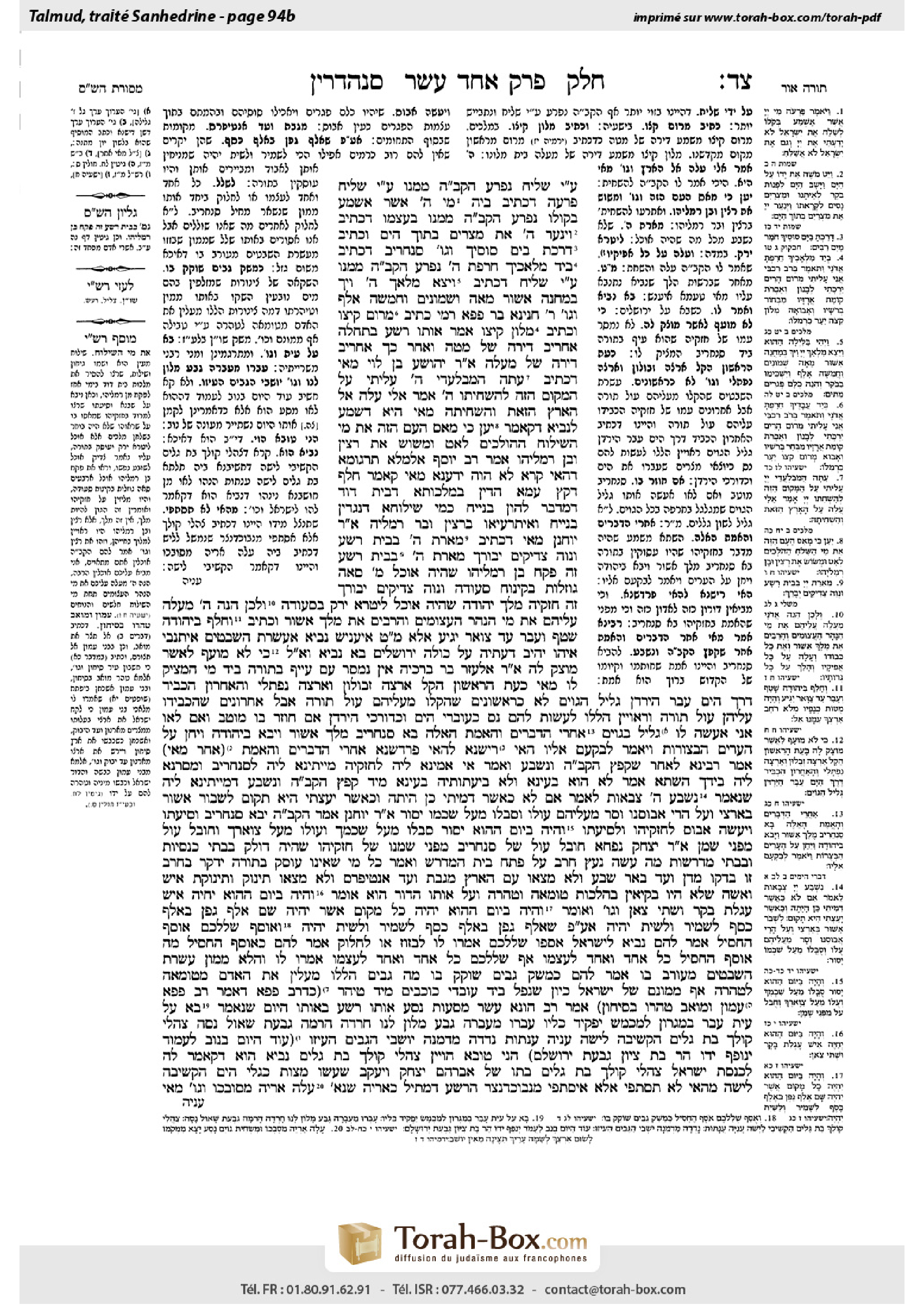
This page of Sanhedrin includes the Aramaic text, an English translation and an AI-generated French translation, alongside the scan above.
סנהדרין צ״ד ב · Aramaic and Hebrew text
עַל יְדֵי שָׁלִיחַ, נִפְרַע הַקָּדוֹשׁ בָּרוּךְ הוּא מִמֶּנּוּ עַל יְדֵי שָׁלִיחַ.
פַּרְעֹה, דִּכְתִיב בֵּיהּ: ״מִי ה׳ אֲשֶׁר אֶשְׁמַע בְּקֹלוֹ״, נִפְרַע הַקָּדוֹשׁ בָּרוּךְ הוּא מִמֶּנּוּ בְּעַצְמוֹ, דִּכְתִיב: ״וַיְנַעֵר ה׳ אֶת מִצְרַיִם בְּתוֹךְ הַיָּם״, וּכְתִיב: ״דָּרַכְתָּ בַּיָּם סוּסֶיךָ וְגוֹ׳״. סַנְחֵרִיב, דִּכְתִיב: ״בְּיַד מַלְאָכֶיךָ חֵרַפְתָּ ה׳״, נִפְרַע הַקָּדוֹשׁ בָּרוּךְ הוּא מִמֶּנּוּ עַל יְדֵי שָׁלִיחַ, דִּכְתִיב: ״וַיֵּצֵא מַלְאַךְ ה׳ וַיַּךְ בְּמַחֲנֵה אַשּׁוּר מֵאָה שְׁמוֹנִים וַחֲמִשָּׁה אֶלֶף וְגוֹ׳״.
רַבִּי חֲנִינָא בַּר פָּפָּא רָמֵי: כְּתִיב ״מְרוֹם קִצּוֹ״, וּכְתִיב ״מְלוֹן קִצּוֹ״. אָמַר אוֹתוֹ רָשָׁע: בַּתְּחִלָּה אַחְרִיב דִּירָה שֶׁל מַטָּה, וְאַחַר כָּךְ אַחְרִיב דִּירָה שֶׁל מַעְלָה.
אָמַר רַבִּי יְהוֹשֻׁעַ בֶּן לֵוִי: מַאי דִּכְתִיב ״עַתָּה הֲמִבַּלְעֲדֵי ה׳ עָלִיתִי עַל הַמָּקוֹם הַזֶּה לְהַשְׁחִתוֹ ה׳ אָמַר אֵלַי עֲלֵה עַל הָאָרֶץ הַזֹּאת וְהַשְׁחִיתָהּ״. מַאי הִיא? דִּשְׁמַע לִנְבִיָּא דְּקָאָמַר: ״יַעַן כִּי מָאַס הָעָם הַזֶּה אֵת מֵי הַשִּׁלֹחַ הַהוֹלְכִים לְאַט וּמְשׂוֹשׂ אֶת רְצִין וּבֶן רְמַלְיָהוּ״.
אָמַר רַב יוֹסֵף: אִלְמָלֵא תַּרְגּוּמָא דְּהַאי קְרָא, לָא הֲוָה יָדַעְנָא מַאי קָאָמַר. ״חֲלַף דְּקָץ עַמָּא הָדֵין בְּמַלְכוּתָא דְּבֵית דָּוִד, דִּמְדַבַּר לְהוֹן בִּנְיָיח, כְּמֵי שִׁילוֹחָא דְּנָגְדִין בִּנְיָיח, וְאִיתְרְעִיאוּ בִּרְצִין וּבַר רְמַלְיָה״.
אָמַר רַבִּי יוֹחָנָן: מַאי דִּכְתִיב ״מְאֵרַת ה׳ בְּבֵית רָשָׁע וּנְוֵה צַדִּיקִים יְבָרֵךְ״? ״מְאֵרַת ה׳ בְּבֵית רָשָׁע״ – זֶה פֶּקַח בֶּן רְמַלְיָהוּ, שֶׁהָיָה אוֹכֵל אַרְבָּעִים סְאָה גּוֹזָלוֹת בְּקִינּוּחַ סְעוּדָה. ״וּנְוֵה צַדִּיקִים יְבָרֵךְ״ – זֶה חִזְקִיָּה מֶלֶךְ יְהוּדָה, שֶׁהָיָה אוֹכֵל לִיטְרָא יָרָק בִּסְעוּדָה.
״וְלָכֵן הִנֵּה ה׳ מַעֲלֶה עֲלֵיהֶם אֶת מֵי הַנָּהָר הָעֲצוּמִים וְהָרַבִּים אֶת מֶלֶךְ אַשּׁוּר״, וּכְתִיב: ״וְחָלַף בִּיהוּדָה שָׁטַף וְעָבַר עַד צַוָּאר יַגִּיעַ״.
אֶלָּא מַאי טַעְמָא אִיעֲנִישׁ? נְבִיָּא אַעֲשֶׂרֶת הַשְּׁבָטִים אִיתְנַבִּי, אִיהוּ יְהַיב דַּעְתֵּיהּ עַל כּוּלַּהּ יְרוּשָׁלֶם. בָּא נָבִיא וְאָמַר לוֹ: ״כִּי לֹא מוּעָף לַאֲשֶׁר מוּצָק לָהּ״. אָמַר רַבִּי אֶלְעָזָר בַּר בֶּרֶכְיָה: אֵין נִמְסָר עַם עָיֵיף בַּתּוֹרָה בְּיַד מִי הַמֵּצִיק לוֹ.
מַאי ״כָּעֵת הָרִאשׁוֹן הֵקַל אַרְצָה זְבוּלֻן וְאַרְצָה נַפְתָּלִי וְהָאַחֲרוֹן הִכְבִּיד דֶּרֶךְ הַיָּם עֵבֶר הַיַּרְדֵּן גְּלִיל הַגּוֹיִם״? לֹא כָּרִאשׁוֹנִים שֶׁהֵקֵלּוּ מֵעֲלֵיהֶם עוֹל תּוֹרָה, אֲבָל אַחֲרוֹנִים שֶׁהִכְבִּידוּ עֲלֵיהֶן עוֹל תּוֹרָה. וּרְאוּיִין הַלָּלוּ לַעֲשׂוֹת לָהֶם נֵס כְּעוֹבְרֵי הַיָּם וּכְדוֹרְכֵי הַיַּרְדֵּן. אִם חוֹזֵר בּוֹ – מוּטָב, וְאִם לָאו – אֲנִי אֶעֱשֶׂה לוֹ גָּלִיל בַּגּוֹיִם.
״אַחֲרֵי הַדְּבָרִים וְהָאֱמֶת הָאֵלֶּה בָּא סַנְחֵרִיב מֶלֶךְ אַשּׁוּר וַיָּבֹא בִיהוּדָה וַיִּחַן עַל הֶעָרִים הַבְּצֻרוֹת וַיֹּאמֶר לְבִקְעָם אֵלָיו״. הַאי רִישָׁנָא לְהַאי פַּרְדָּשְׁנָא?
״אַחֲרֵי הַדְּבָרִים וְהָאֱמֶת״, אַחַר מַאי? אָמַר רָבִינָא: לְאַחַר שֶׁקָּפַץ הַקָּדוֹשׁ בָּרוּךְ הוּא וְנִשְׁבַּע, וְאָמַר: אִי אָמֵינָא לֵיהּ לְחִזְקִיָּה מַיְיתֵינָא לֵיהּ לְסַנְחֵרִיב וּמָסַרְנָא לֵיהּ בִּידָךְ, הַשְׁתָּא אָמַר: לָא הוּא בָּעֵינָא וְלָא בִּיעֲתוּתֵיהּ בָּעֵינָא.
מִיָּד קָפַץ הַקָּדוֹשׁ בָּרוּךְ הוּא וְנִשְׁבַּע: דְּמַיְיתֵינָא לֵיהּ, שֶׁנֶּאֱמַר: ״נִשְׁבַּע ה׳ צְבָאוֹת לֵאמֹר אִם לֹא כַּאֲשֶׁר דִּמִּיתִי כֵּן הָיָתָה וְכַאֲשֶׁר יָעַצְתִּי הִיא תָקוּם. לִשְׁבֹּר אַשּׁוּר בְּאַרְצִי וְעַל הָרַי אֲבוּסֶנּוּ וְסָר מֵעֲלֵיהֶם עֻלּוֹ וְסֻבֳּלוֹ מֵעַל שִׁכְמוֹ יָסוּר״. אָמַר רַבִּי יוֹחָנָן: אָמַר הַקָּדוֹשׁ בָּרוּךְ הוּא: יָבֹא סַנְחֵרִיב וְסִיעָתוֹ וְיֵעָשֶׂה אֵבוּס לְחִזְקִיָּהוּ וּלְסִיעָתוֹ.
״וְהָיָה בַּיּוֹם הַהוּא יָסוּר סֻבֳּלוֹ מֵעַל שִׁכְמֶךָ וְעֻלּוֹ מֵעַל צַוָּארֶךָ וְחֻבַּל עֹל מִפְּנֵי שָׁמֶן״. אָמַר רַבִּי יִצְחָק נַפָּחָא: חוּבַּל עוֹל שֶׁל סַנְחֵרִיב מִפְּנֵי שַׁמְנוֹ שֶׁל חִזְקִיָּהוּ, שֶׁהָיָה דּוֹלֵק בְּבָתֵּי כְנֵסִיּוֹת וּבְבָתֵּי מִדְרָשׁוֹת.
מָה עָשָׂה? נָעַץ חֶרֶב עַל פֶּתַח בֵּית הַמִּדְרָשׁ, וְאָמַר: כׇּל מִי שֶׁאֵינוֹ עוֹסֵק בַּתּוֹרָה יִדָּקֵר בְּחֶרֶב זוֹ. בָּדְקוּ מִדָּן וְעַד בְּאֵר שֶׁבַע, וְלֹא מָצְאוּ עַם הָאָרֶץ. מִגְּבָת וְעַד אַנְטִיפְרַס, וְלֹא מָצְאוּ תִּינוֹק וְתִינוֹקֶת, אִישׁ וְאִשָּׁה, שֶׁלֹּא הָיוּ בְּקִיאִין בְּהִלְכוֹת טוּמְאָה וְטׇהֳרָה.
וְעַל אוֹתוֹ הַדּוֹר הוּא אוֹמֵר: ״וְהָיָה בַּיּוֹם הַהוּא יְחַיֶּה אִישׁ עֶגְלַת בָּקָר וּשְׁתֵּי צֹאן וְגוֹ׳״, וְאוֹמֵר: ״וְהָיָה בַּיּוֹם הַהוּא יִהְיֶה כׇל מָקוֹם אֲשֶׁר יִהְיֶה שָּׁם אֶלֶף גֶּפֶן בְּאֶלֶף כָּסֶף לַשָּׁמִיר וְלַשַּׁיִת יִהְיֶה״. אַף עַל פִּי שֶׁאֶלֶף גֶּפֶן בְּאֶלֶף כָּסֶף, לַשָּׁמִיר וְלַשַּׁיִת יִהְיֶה.
״וְאֻסַּף שְׁלַלְכֶם אֹסֶף הֶחָסִיל״. אָמַר לָהֶם נָבִיא לְיִשְׂרָאֵל: אִסְפוּ שְׁלַלְכֶם. אָמְרוּ לוֹ: לִבְזוֹז אוֹ לַחְלוֹק? אָמַר לָהֶם: ״כְּאֹסֶף הֶחָסִיל״. מָה אֹסֶף הֶחָסִיל – כׇּל אֶחָד וְאֶחָד לְעַצְמוֹ. אַף שְׁלַלְכֶם – כׇּל אֶחָד וְאֶחָד לְעַצְמוֹ.
אָמְרוּ לוֹ: וַהֲלֹא מָמוֹן עֲשֶׂרֶת הַשְּׁבָטִים מְעוֹרָב בּוֹ? אָמַר לָהֶם: ״כְּמַשַּׁק גֵּבִים שׁוֹקֵק בּוֹ״. מָה גֵּבִים הַלָּלוּ מַעֲלִין אֶת הָאָדָם מִטּוּמְאָה לְטׇהֳרָה, אַף מָמוֹנָם שֶׁל יִשְׂרָאֵל – כֵּיוָן שֶׁנָּפַל בְּיַד אוּמּוֹת הָעוֹלָם, מִיָּד טִיהַר. כִּדְרַב פָּפָּא, דְּאָמַר רַב פָּפָּא: עַמּוֹן וּמוֹאָב טָהֲרוּ בְּסִיחוֹן.
אָמַר רַב הוּנָא: עֶשֶׂר מַסָּעוֹת נָסַע אוֹתוֹ רָשָׁע בְּאוֹתוֹ הַיּוֹם, שֶׁנֶּאֱמַר: ״בָּא עַל עַיַּת, עָבַר בְּמִגְרוֹן, לְמִכְמָשׂ יַפְקִיד כֵּלָיו. עָבְרוּ מַעְבָּרָה, גֶּבַע מָלוֹן לָנוּ, חָרְדָה הָרָמָה, גִּבְעַת שָׁאוּל נָסָה. צַהֲלִי קוֹלֵךְ בַּת גַּלִּים, הַקְשִׁיבִי לַיְשָׁה, עֲנִיָּה עֲנָתוֹת. נָדְדָה מַדְמֵנָה, יֹשְׁבֵי הַגֵּבִים הֵעִיזוּ. עוֹד הַיּוֹם בְּנֹב לַעֲמֹד, יְנֹפֵף יָדוֹ הַר בַּת צִיּוֹן גִּבְעַת יְרוּשָׁלִָם״.
הָנֵי טוּבָא הָוְיָין? ״צַהֲלִי קוֹלֵךְ בַּת גַּלִּים״ – נָבִיא הוּא דְּקָאָמַר לַהּ לִכְנֶסֶת יִשְׂרָאֵל: ״צַהֲלִי קוֹלֵךְ בַּת גַּלִּים״, בִּתּוֹ שֶׁל אַבְרָהָם יִצְחָק וְיַעֲקֹב שֶׁעָשׂוּ מִצְוֹת כְּגַלֵּי הַיָּם. ״הַקְשִׁיבִי לַיְשָׁה״ – מֵהַאי לָא תִּסְתְּפַי, אֶלָּא אִיסְתְּפַי מִנְּבוּכַדְנֶצַּר הָרָשָׁע דִּמְתִיל כְּאַרְיֵה, שֶׁנֶּאֱמַר: ״עָלָה אַרְיֵה מִסֻּבְּכוֹ וְגוֹ׳״.
מַאי
Sanhedrin 94b · English translation
by means of an agent, the Holy One, Blessed be He, exacted retribution from him by means of an agent.
Pharaoh blasphemed God, as it is written that he said to Moses and Aaron: “Who is the Lord that I should obey His voice?” (Exodus 5:2) The Holy One, Blessed be He, Himself exacted retribution from him, as it is written: “And the Lord overthrew Egypt in the midst of the sea” (Exodus 14:27), and it is written: “You have trodden through the sea with Your horses” (Habakkuk 3:15). Sennacherib blasphemed God by means of an agent, as it is written: “By your messengers you have taunted the Lord” (II Kings 19:23). The Holy One, Blessed be He, exacted retribution from him by means of an agent, as it is written: “Then the angel of the Lord went forth and smote in the camp of the Assyrians one hundred and eighty-five thousand” (II Kings 19:35).
Rabbi Ḥanina bar Pappa raises a contradiction. It is written that Sennacherib said: “And I will enter into its farthest height” (Isaiah 37:24), and it is written in a parallel verse that he said: “And I have entered into its farthest lodge” (II Kings 19:23). The Gemara resolves the contradiction. That wicked person said: Initially, I will destroy the earthly dwelling place below, i.e., the Temple, its farthest lodge, and thereafter, I will destroy the heavenly dwelling place above, its farthest height.
§ Rabbi Yehoshua ben Levi says: What is the meaning of that which is written in the statement of Rab-shakeh, emissary of Sennacherib: “Have I now come up without the Lord against this place to destroy it? The Lord said to me: Go up against this land and destroy it” (II Kings 18:25). What is this command to destroy the land? Rabbi Yehoshua ben Levi explains: It is referring to the fact that he heard the prophet who said: “Since the people rejected the waters of Shiloah that flow slowly and rejoice with Rezin and the son of Remaliah. Now therefore, behold, the Lord brings upon them…the king of Assyria” (Isaiah 8:6–7).
Rav Yosef says: Were it not for the Aramaic translation of this verse I would not know what it is saying. It is translated: Since this people loathed the reign of the house of David that led them gently, like the waters of the Shiloah, which flow gently, and they preferred Rezin and the son of Remaliah, who were kings from the northern kingdom of Israel. And the verse continues: “Now therefore, behold, the Lord brings upon them…the king of Assyria.”
Rabbi Yoḥanan says: What is the meaning of that which is written: “The curse of the Lord is in the house of the wicked, but He blesses the habitation of the just” (Proverbs 3:33)? “The curse of the Lord is in the house of the wicked”; this is a reference to Pekah, son of Remaliah, who would eat forty se’a of fledglings for dessert and would still not be satiated, as his property was cursed. “But He blesses the habitation of the just”; this is a reference to Hezekiah, king of Judea, who would eat a litra of vegetables at his meal and was satiated, as his property was blessed.
It is written in the verse: “Now therefore, behold, the Lord brings up upon them the strong and abundant waters of the river, the king of Assyria” (Isaiah 8:7). And it is written: “And he shall sweep through Judea; he shall inundate and pass through, reaching even the neck” (Isaiah 8:8). Rab-shakeh alluded to that prophecy when he said in the verse in Kings that the Lord said to destroy the land.
The Gemara asks: But what is the reason that Sennacherib was punished if he was merely fulfilling God’s command? The Gemara answers: The prophet prophesied about the destruction of the kingdom of Israel and the exile of the ten tribes, but he directed his attention to destroy all of Jerusalem. The prophet came and said to him: “For there is no weariness [mu’af ] that is set [mutzak] against her” (Isaiah 8:23). Rabbi Elazar bar Berekhya says that the verse is interpreted homiletically: A nation that is weary [ayef ] from its constant engagement in Torah study is not delivered into the hands of one who oppresses [metzik] it.
What is the meaning of the continuation of the verse, which states: “Now the former has lightly afflicted [hakel] the land of Zebulun and the land of Naphtali but the latter has dealt a more grievous blow [hikhbid] by way of the sea, beyond the Jordan in the district [gelil] of the nations”? The generation in Judea in the time of Hezekiah is not like the former generation of Ahaz, who eased [hekellu] the yoke of Torah from upon the people. But the latter generation of Hezekiah, who intensified [hikhbidu] the yoke of Torah upon the people, is fit for God to perform a miracle for them like the miracles performed for those who crossed the Red Sea and those who trod through the Jordan River. God is saying: If Sennacherib reconsiders his planned conquest, good, but if he does not, I will render him wallowing [galil] in shame among the nations.
The verse states: “After these matters and this truth, Sennacherib, king of Assyria, came and entered Judea and encamped against the fortified cities and sought to breach them for himself” (II Chronicles 32:1). The Gemara asks: Is this gift [rishna], the invasion of Sennacherib, appropriate compensation for that gift [pardashna], Hezekiah’s restoration of the Temple and the worship of God in Judea?
The Gemara explains: When the verse states: “After these matters and this truth [emet],” after what matters is the verse referring to? Ravina says: This is referring to after the Holy One, Blessed be He, preempted and took an oath, referenced with the term emet, that He will deliver the spoils of the army of the king of Assyria into the hands of Hezekiah. And this was because He had said: If I say to Hezekiah: I will bring Sennacherib and I will deliver him into your hands; he will then say: I neither want him delivered into my hands nor do I want the accompanying fear of him.
Immediately, the Holy One, Blessed be He, preempted Hezekiah and took an oath: I take an oath that I will deliver him, as it is stated: “The Lord of hosts has taken an oath, saying: Is it not as I imagined it, so has it come to pass; and as I have proposed, so shall it arise, that I will break Assyria in My land, and upon My mountains subdue him [avusennu]; then shall his yoke depart from them, and his burden depart from its shoulder” (Isaiah 14:24–25). Rabbi Yoḥanan says that the Holy One, Blessed be He, said: Sennacherib and his entourage shall come and be transformed into a feeding trough [evus], in the sense of a source of sustenance for Hezekiah and his entourage.
§ It is stated with regard to the downfall of Assyria: “And it shall come to pass on that day, his burden shall be taken from on your shoulder, and his yoke from on your neck, and the yoke shall be destroyed due to fatness [shamen]” (Isaiah 10:27). Rabbi Yitzḥak Nappaḥa says: The yoke of Sennacherib was destroyed due to the oil [shemen] of Hezekiah that would burn in the synagogues and study halls when the Jewish people were engaged in Torah study at night.
What did Hezekiah do to ensure Torah study? He inserted a sword at the entrance of the study hall and said: Anyone who does not engage in Torah study shall be stabbed with this sword. As a result, they searched from Dan in the north to Beersheba in the south, and did not find an ignoramus. They searched from Gevat to Antipatris and did not find a male child, or a female child, or a man, or a woman who was not expert even in the complex halakhot of ritual purity and impurity.
And it is about that generation that the prophet says: “And it shall come to pass in that day, that a man shall nourish a young calf and two sheep. And it shall come to pass, from the abundance of milk that they produce, he shall eat butter, for butter and honey shall everyone eat, everyone who remains in the midst of the land” (Isaiah 7:21–22). And the prophet continues and says: “And it shall come to pass in that day that every place where there were one thousand vines for one thousand silver coins, it shall be for briars and thorns” (Isaiah 7:23). Although one thousand vines are worth one thousand silver coins and one could earn substantial profits through agricultural labor, the fields will grow briars and thorns due to neglect. The people of that generation were devoted to the study of Torah and engaged in labor only minimally to sustain themselves.
It is written: “And your spoils shall be gathered like the gathering of the locusts; as the advance of the locusts shall he advance” (Isaiah 33:4). The prophet said to the Jewish people: Gather your spoils from the army of Sennacherib. They said to him: Are we to pillage the spoils, each person for himself, or are we to divide the spoils with the monarchy? He said to them: Gather the spoils like the gathering by the locusts. Just as in the gathering by the locusts, each and every one of the locusts takes food for itself, so too, in gathering your spoils, each and every one of you shall take spoils for himself.
They said to him: Since the army of Sennacherib came to Jerusalem after its conquest of the kingdom of Israel, isn’t the property of the ten tribes intermingled with it, and therefore, gathering the spoils would be robbery? He said to them: “As the advance of the locusts [gevim] shall he advance” (Isaiah 33:4). Just as these pools of water elevate a person up from a state of ritual impurity to a state of purity through immersion, so too the property of the Jewish people, once it falls into the hands of gentiles, it immediately purifies the property, in the sense that it is no longer considered robbery to take it, as its owners despair of its recovery. This is in accordance with the statement of Rav Pappa, as Rav Pappa says: The property of Ammon and Moab was purified through the conquest of Sihon. Although the Torah rendered it prohibited to conquer the land of Ammon and Moab, once Sihon conquered their land, it was permitted for the Jewish people to conquer it.
§ Rav Huna says: That wicked Sennacherib traveled ten journeys on that day, as it is stated: “He is come to Aiath, he is passed through Migron; at Michmas he deposited his baggage. They passed [averu] Mabara; they have taken up their lodging at Geba; Ramah trembles; Gibeath Shaul has fled. Cry with a shrill voice, daughter of Gallim; hearken, Laish; poor Anathoth. Madmenah is in flight; the inhabitants of Gebim flee to cover. This very day shall he halt at Nov; he shall shake his hand against the mountain of the daughter of Zion, the hill of Jerusalem” (Isaiah 10:28–32). He traveled to all these places on the same day.
The Gemara asks: Aren’t these more than ten? The Gemara answers that in the verse: “Cry with a shrill voice, daughter of Gallim,” it is the prophet who is saying it to the congregation of Israel: “Cry with a shrill voice, daughter of Gallim,” daughter of Abraham, Isaac, and Jacob, who performed mitzvot as numerous as the waves of the sea. “Hearken, Laish”; from this king, Sennacherib, fear not; but fear Nebuchadnezzar, the wicked who is likened to a lion, as it is stated: “The lion [arye] is gone up from its thicket” (Jeremiah 4:7).
The Gemara asks: What is the meaning of the phrase:
Sanhedrin 94b · Traduction française (IA)
par l’intermédiaire d’un agent, le Saint, béni soit-Il, tira vengeance de lui par l’intermédiaire d’un agent.
Pharaon blasphéma contre Dieu, comme il est écrit qu’il dit à Moïse et à Aaron : « Qui est le Seigneur, pour que j’obéisse à sa voix ? » (Exode 5:2). Le Saint, béni soit-Il, tira lui-même vengeance de lui, comme il est écrit : « Le Seigneur renversa l’Égypte au milieu de la mer » (Exode 14:27), et encore : « Tu as cheminé dans la mer avec tes chevaux » (Habacuc 3:15). Sennachérib blasphéma contre Dieu par l’intermédiaire d’un agent, comme il est écrit : « Par tes messagers, tu as insulté le Seigneur » (II Rois 19:23). Le Saint, béni soit-Il, tira vengeance de lui par l’intermédiaire d’un agent, comme il est écrit : « Alors l’ange du Seigneur sortit et frappa dans le camp des Assyriens cent quatre-vingt-cinq mille hommes » (II Rois 19:35).
Rabbi Ḥanina bar Pappa soulève une contradiction. Il est écrit que Sennachérib dit : « Je monterai jusqu’à son sommet le plus éloigné » (Isaïe 37:24), et un verset parallèle rapporte ces paroles : « Je suis entré dans son pavillon le plus éloigné » (II Rois 19:23). La Guemara résout la contradiction : ce méchant disait : « D’abord, je détruirai le lieu de résidence terrestre, en bas, c’est-à-dire le Temple, son pavillon le plus éloigné ; ensuite, je détruirai le lieu de résidence céleste, en haut, son sommet le plus éloigné. »
§ Rabbi Yehoshua ben Levi dit : Que signifie ce qui est écrit dans la déclaration de Rab-shakeh, envoyé de Sennachérib : « Est-ce sans le Seigneur que je suis monté contre ce lieu pour le détruire ? Le Seigneur m’a dit : Monte contre ce pays et détruis-le » (II Rois 18:25) ? Quel est cet ordre de détruire le pays ? Rabbi Yehoshua ben Levi explique qu’il s’agit du fait que Rab-shakeh avait entendu le prophète dire : « Puisque ce peuple a rejeté les eaux de Shiloah, qui coulent lentement, et se réjouit avec Retzin et le fils de Remalia. C’est pourquoi, voici que le Seigneur fait monter contre eux […] le roi d’Assyrie » (Isaïe 8:6–7).
Rav Yosef dit : Sans la traduction araméenne de ce verset, je n’en comprendrais pas le sens. Elle le traduit ainsi : « Puisque ce peuple a méprisé la royauté de la maison de David, qui le conduisait avec douceur, comme les eaux de Shiloah, qui coulent doucement, et qu’il a préféré Retzin et le fils de Remalia, rois du royaume du Nord d’Israël. » Le verset poursuit : « C’est pourquoi, voici que le Seigneur fait monter contre eux […] le roi d’Assyrie. »
Rabbi Yoḥanan dit : Que signifie ce qui est écrit : « La malédiction du Seigneur est dans la maison du méchant, mais Il bénit la demeure des justes » (Proverbes 3:33) ? « La malédiction du Seigneur est dans la maison du méchant » fait référence à Pekah, fils de Remalia, qui mangeait quarante séa de petits oiseaux en dessert et n’était toujours pas rassasié, car ses biens étaient maudits. « Mais Il bénit la demeure des justes » fait référence à Ézéchias, roi de Judée, qui mangeait une litra de légumes à son repas et était rassasié, car ses biens étaient bénis.
Le verset dit : « C’est pourquoi, voici que le Seigneur fait monter contre eux les eaux puissantes et abondantes du fleuve, le roi d’Assyrie » (Isaïe 8:7). Et il est écrit : « Il déferlera sur la Judée, l’inondera et la traversera, atteignant jusqu’au cou » (Isaïe 8:8). Rab-shakeh faisait allusion à cette prophétie lorsqu’il disait, dans le verset des Rois, que le Seigneur lui avait ordonné de détruire le pays.
La Guemara demande : Pourquoi Sennachérib fut-il puni, s’il ne faisait qu’accomplir l’ordre de Dieu ? La Guemara répond : Le prophète avait prophétisé la destruction du royaume d’Israël et l’exil des dix tribus, mais Sennachérib entendait détruire toute Jérusalem. Le prophète vint lui dire : « Car il n’y a pas de lassitude [mu’af] qui soit imposée [mutzak] contre elle » (Isaïe 8:23). Rabbi Elazar bar Berekhya dit que le verset s’interprète de manière homilétique : une nation lassée [ayef] par son étude constante de la Torah n’est pas livrée aux mains de celui qui l’opprime [metzik].
Que signifie la suite du verset, qui dit : « D’abord, il a légèrement accablé [hakel] le pays de Zabulon et le pays de Nephtali, mais ensuite il a porté un coup plus grave [hikhbid] par la voie de la mer, au-delà du Jourdain, dans le district [gelil] des nations » ? La génération de Judée au temps d’Ézéchias n’était pas comme la génération précédente, celle d’Achaz, qui avait allégé [hekellu] le joug de la Torah pesant sur le peuple. Mais la génération suivante, celle d’Ézéchias, qui avait alourdi [hikhbidu] le joug de la Torah pesant sur le peuple, méritait que Dieu accomplisse pour elle un miracle semblable à ceux accomplis pour ceux qui traversèrent la mer Rouge et ceux qui traversèrent le Jourdain. Dieu dit : si Sennachérib renonce à la conquête qu’il projette, tant mieux ; sinon, Je le ferai se vautrer [galil] dans la honte parmi les nations.
Le verset dit : « Après ces événements et cette fidélité, Sennachérib, roi d’Assyrie, vint en Judée, campa contre les villes fortifiées et chercha à les prendre d’assaut » (II Chroniques 32:1). La Guemara demande : Cette faveur [rishna], l’invasion de Sennachérib, est-elle une juste contrepartie de cette faveur [pardashna], la restauration par Ézéchias du Temple et du culte de Dieu en Judée ?
La Guemara explique : Lorsque le verset dit « Après ces événements et cette vérité [emet] », à quels événements fait-il référence ? Ravina dit : Cela fait référence au moment où le Saint, béni soit-Il, prit les devants et jura — le terme emet y fait allusion — qu’Il livrerait le butin de l’armée du roi d’Assyrie aux mains d’Ézéchias. En effet, Il s’était dit : « Si Je dis à Ézéchias que Je ferai venir Sennachérib et que Je le livrerai entre ses mains, il dira alors : “Je ne veux ni qu’il soit livré entre mes mains, ni avoir à subir la peur qu’il inspire.” »
Aussitôt, le Saint, béni soit-Il, prit les devants sur Ézéchias et jura : « Je jure que Je le livrerai », comme il est dit : « Le Seigneur des armées a juré, disant : N’en sera-t-il pas comme Je l’ai imaginé ? Ce que J’ai résolu ne s’accomplira-t-il pas ? Je briserai l’Assyrie dans Mon pays et, sur Mes montagnes, Je le piétinerai [avusennu] ; alors son joug se retirera d’eux et son fardeau de leurs épaules » (Isaïe 14:24–25). Rabbi Yoḥanan dit que le Saint, béni soit-Il, a dit : « Sennachérib et sa suite viendront et seront transformés en mangeoire [evus] », c’est-à-dire en source de subsistance pour Ézéchias et sa suite.
§ À propos de la chute de l’Assyrie, il est dit : « En ce jour, son fardeau sera ôté de ton épaule et son joug de ton cou ; le joug sera détruit à cause de la graisse [shamen] » (Isaïe 10:27). Rabbi Yitzḥak Nappaḥa dit : Le joug de Sennachérib fut détruit à cause de l’huile [shemen] d’Ézéchias, qui brûlait dans les synagogues et les maisons d’étude lorsque le peuple juif étudiait la Torah durant la nuit.
Que fit Ézéchias pour assurer l’étude de la Torah ? Il plaça une épée à l’entrée de la maison d’étude et dit : « Quiconque n’étudiera pas la Torah sera transpercé par cette épée. » En conséquence, on parcourut le pays de Dan, au nord, jusqu’à Beer-Sheva, au sud, sans trouver un seul ignorant. On parcourut le pays de Gevat à Antipatris et l’on ne trouva pas un seul enfant, garçon ou fille, ni un seul homme ou une seule femme qui ne fût expert même dans les halakhot complexes de pureté et d’impureté rituelles.
C’est à propos de cette génération que le prophète dit : « Il arrivera qu’un homme nourrira un jeune veau et deux brebis. Et il arrivera qu’en raison de l’abondance de lait qu’elles produiront, il mangera du beurre, car tous ceux qui resteront dans le pays mangeront du beurre et du miel » (Isaïe 7:21–22). Le prophète poursuit : « Il arrivera en ce jour que tout endroit où se trouvaient mille vignes valant mille pièces d’argent sera livré aux ronces et aux épines » (Isaïe 7:23). Bien que mille vignes valent mille pièces d’argent et que le travail agricole puisse rapporter des profits substantiels, les champs seront envahis par les ronces et les épines faute d’entretien. Les gens de cette génération se consacraient à l’étude de la Torah et ne travaillaient que très peu, juste assez pour subvenir à leurs besoins.
Il est écrit : « Votre butin sera ramassé comme le ramassage des sauterelles ; comme les sauterelles avancent, il avancera » (Isaïe 33:4). Le prophète dit au peuple juif : « Ramassez votre butin dans le camp de Sennachérib. » Ils lui dirent : « Devons-nous piller le butin, chacun pour soi, ou le partager avec la monarchie ? » Il leur dit : « Ramassez le butin comme les sauterelles ramassent leur nourriture. De même que chaque sauterelle prend de la nourriture pour elle-même, de même, en ramassant votre butin, chacun de vous en prendra pour lui-même. »
Ils lui dirent : « Puisque l’armée de Sennachérib est venue à Jérusalem après avoir conquis le royaume d’Israël, les biens des dix tribus ne s’y trouvent-ils pas mêlés ? Ramasser le butin ne serait-il donc pas un vol ? » Il leur dit : « Comme les sauterelles avancent [gevim], il avancera » (Isaïe 33:4). De même que ces bassins d’eau font passer une personne de l’impureté rituelle à la pureté par l’immersion, de même les biens du peuple juif, une fois tombés aux mains des non-Juifs, sont immédiatement purifiés, en ce sens que les prendre n’est plus considéré comme un vol, puisque leurs propriétaires ont renoncé à les récupérer. Cela correspond à l’enseignement de Rav Pappa, car Rav Pappa dit : Les biens d’Ammon et de Moab furent purifiés par la conquête de Sihon. Bien que la Torah ait interdit de conquérir le territoire d’Ammon et de Moab, dès lors que Sihon avait conquis leur territoire, le peuple juif était autorisé à le conquérir.
§ Rav Huna dit : Ce méchant, Sennachérib, parcourut dix étapes ce jour-là, comme il est dit : « Il est arrivé à Aïath, il a traversé Migron ; à Mikmas, il a déposé ses bagages. Ils ont franchi [averu] le passage ; ils ont établi leur camp à Guéba ; Rama tremble ; Guibéa de Saül a pris la fuite. Crie d’une voix aiguë, fille de Gallim ; prête l’oreille, Laïsha ; pauvre Anatot. Madména s’enfuit ; les habitants de Guébim fuient pour se mettre à couvert. Ce jour même, il s’arrêtera à Nob ; il brandira la main contre la montagne de la fille de Sion, la colline de Jérusalem » (Isaïe 10:28–32). Il se rendit dans tous ces lieux le même jour.
La Guemara demande : Ces étapes ne sont-elles pas plus de dix ? La Guemara répond que, dans le verset « Crie d’une voix aiguë, fille de Gallim », c’est le prophète qui s’adresse à l’assemblée d’Israël : « Crie d’une voix aiguë, fille de Gallim », fille d’Abraham, d’Isaac et de Jacob, qui accomplissaient des mitsvot aussi nombreuses que les vagues de la mer. « Prête l’oreille, Laïsha » : ne crains pas ce roi, Sennachérib ; mais crains Nabuchodonosor, ce méchant qui est comparé à un lion, comme il est dit : « Le lion [arye] est monté de son fourré » (Jérémie 4:7).
La Guemara demande : Que signifie l’expression :
Traduction française générée par IA à partir de l’édition anglaise de Sefaria. Vérifie toujours un passage avec le texte source.
Text from Sefaria: William Davidson Edition - Vocalized Aramaic (CC BY NC); William Davidson Edition - English (CC BY NC).