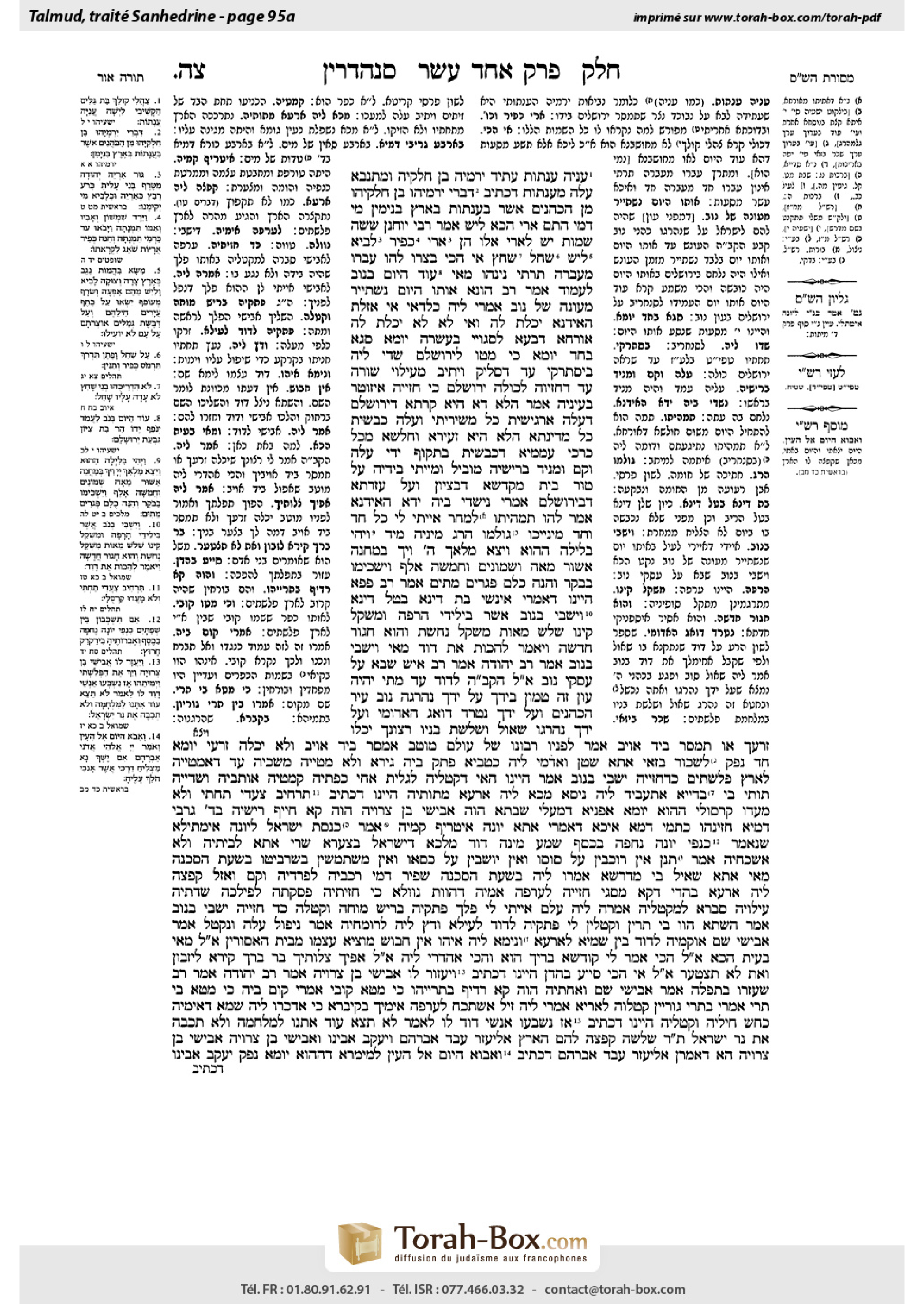
Sanhedrin 95a: Talmud study for Daf Yomi
Daf Yomi is the daily study of one Talmud folio. Explore 37 tractates with scans, Hebrew text, Sefaria English and AI-generated French translations where annotated.
Passage selection and English or AI-generated French translation are available where the scan has annotations. Daf Study is independent of Torah-Box and Sefaria.
Browse Sanhedrin · סנהדרין · All tractatesSanhedrin 95a text and translations
This page of Sanhedrin includes the Aramaic text, an English translation and an AI-generated French translation, alongside the scan above.
סנהדרין צ״ה א · Aramaic and Hebrew text
״עֲנִיָּה עֲנָתוֹת״ – עָתִיד יִרְמְיָה בֶּן חִלְקִיָּה וּמִתְנַבֵּא עֲלַהּ מֵעֲנָתוֹת, דִּכְתִיב: ״דִּבְרֵי יִרְמְיָהוּ בֶּן חִלְקִיָּהוּ מִן הַכֹּהֲנִים אֲשֶׁר בַּעֲנָתוֹת בְּאֶרֶץ בִּנְיָמִין״.
מִי דָּמֵי? הָתָם אֲרִי, הָכָא לַיִשׁ! אָמַר רַבִּי יוֹחָנָן: שִׁשָּׁה שֵׁמוֹת יֵשׁ לַאֲרִי, אֵלּוּ הֵן: אֲרִי, כְּפִיר, לָבִיא, לַיִשׁ, שַׁחַל, שַׁחַץ. אִי הָכִי, בָּצְרוּ לְהוּ! עָבְרוּ מַעְבָּרָה תַּרְתֵּי נִינְהוּ.
מַאי ״עוֹד הַיּוֹם בְּנֹב לַעֲמֹד״? אָמַר רַב הוּנָא: אוֹתוֹ הַיּוֹם נִשְׁתַּיֵּיר מֵעֲוֹנָהּ שֶׁל נוֹב. אָמְרִי לֵיהּ כַּלְדָּאֵי: אִי אָזְלַתְּ הָאִידָּנָא – יָכְלַתְּ לַהּ, וְאִי לָא – לָא יָכְלַתְּ לַהּ. אוֹרְחָא דִּבְעָא לְסַגּוֹיֵי בְּעַשְׂרָה יוֹמֵי, סַגֵּא בְּחַד יוֹמָא.
כִּי מְטוֹ לִירוּשְׁלֶם, שְׁדוֹ לֵיהּ בִּיסְתַּרְקֵי, עַד דִּסְלֵיק וִיתֵיב מֵעִילָּוֵי שׁוּרָא, עַד דְּחַזְיַוהּ לְכוּלַּהּ יְרוּשְׁלֶם. כִּי חַזְיַיהּ, אִיזּוּטַר בְּעֵינֵיהּ. אָמַר: הֲלָא דָּא הִיא קַרְתָּא דִּירוּשְׁלֶם דַּעֲלַהּ אַרְגֵּישִׁית כֹּל מַשְׁירְיָתַי, וַעֲלַהּ כַּבֵּשִׁית כֹּל מְדִינָתָא? הֲלָא הִיא זְעֵירָא וְחַלָּשָׁא מִכֹּל כַּרְכֵי עַמְמַיָּא דְּכַבֵּשִׁית בִּתְקוֹף יְדַי? עֲלַהּ וְקָם וּמָנֵיד בְּרֵישֵׁיהּ, מוֹבֵיל וּמַיְיתֵי בִּידֵיהּ עַל טוּר בֵּית מַקְדְּשָׁא דִּבְצִיּוֹן וְעַל עֲזַרְתָּא דְּבִירוּשְׁלֶם.
אָמְרִי: נִישְׁדֵּי בֵּיהּ יְדָא הָאִידָּנָא. אֲמַר לְהוּ: תָּמְהִיתוּ, לִמְחַר אַיְיתוֹ לִי כֹּל חַד וְחַד מִינַּיְיכוּ גּוּלְמוֹ הֲרַג מִינֵּיהּ. מִיָּד: ״וַיְהִי בַּלַּיְלָה הַהוּא וַיֵּצֵא מַלְאַךְ ה׳ וַיַּךְ בְּמַחֲנֵה אַשּׁוּר מֵאָה שְׁמוֹנִים וַחֲמִשָּׁה אָלֶף וַיַּשְׁכִּימוּ בַבֹּקֶר וְהִנֵּה כֻלָּם פְּגָרִים מֵתִים״. אָמַר רַב פָּפָּא: הַיְינוּ דְּאָמְרִי אִינָשֵׁי: בָּת דִּינָא – בְּטַל דִּינָא.
״וְיִשְׁבִּי בְּנֹב אֲשֶׁר בִּילִידֵי הָרָפָה וּמִשְׁקַל קֵינוֹ שְׁלֹשׁ מֵאוֹת מִשְׁקַל נְחֹשֶׁת וְהוּא חָגוּר חֲדָשָׁה וַיֹּאמֶר לְהַכּוֹת אֶת דָּוִד״. מַאי ״וְיִשְׁבִּי בְּנוֹב״? אָמַר רַב יְהוּדָה אָמַר רַב: אִישׁ שֶׁבָּא עַל עִסְקֵי נוֹב. אֲמַר לֵיהּ הַקָּדוֹשׁ בָּרוּךְ הוּא לְדָוִד: עַד מָתַי יִהְיֶה עָוֹן זֶה טָמוּן בְּיָדְךָ? עַל יָדְךָ נֶהֶרְגָה נוֹב עִיר הַכֹּהֲנִים, וְעַל יָדְךָ נִטְרַד דּוֹאֵג הָאֲדוֹמִי, וְעַל יָדְךָ נֶהֶרְגוּ שָׁאוּל וּשְׁלֹשֶׁת בָּנָיו.
רְצוֹנְךָ יִכְלֶה זַרְעֶךָ, אוֹ תִּמָּסֵר בְּיַד אוֹיֵב? אָמַר לְפָנָיו: רִבּוֹנוֹ שֶׁל עוֹלָם, מוּטָב אֶמָּסֵר בְּיַד אוֹיֵב וְלֹא יִכְלֶה זַרְעִי.
יוֹמָא חַד נְפַק לִשְׁכוֹר בָּזָאֵי, אֲתָא שָׂטָן וְאִידְּמִי לֵיהּ כְּטַבְיָא. פְּתַק בֵּיהּ גִּירָא וְלָא מַטְיֵיהּ. מַשְׁכֵיהּ עַד דְּאַמְטְיֵיהּ לְאֶרֶץ פְּלִשְׁתִּים. כִּדְחַזְיֵיהּ יִשְׁבִּי בְּנוֹב אֲמַר: הַיְינוּ הַאי דְּקַטְלֵיהּ לְגׇלְיָת אֲחִי. כַּפְתֵיהּ, קַמְטֵיהּ, אוֹתְבֵיהּ וְשַׁדְיֵיהּ תּוּתֵי בֵּי סַדְיָיא. אִתְעֲבִיד לֵיהּ נִיסָּא, מָכָא לֵיהּ אַרְעָא מִתּוּתֵיהּ. הַיְינוּ דִּכְתִיב: ״תַּרְחִיב צַעֲדִי תַחְתָּי וְלֹא מָעֲדוּ קַרְסֻלָּי״.
הָהוּא יוֹמָא אַפַּנְיָא דְּמַעֲלֵי שַׁבְּתָא הֲוָה. אֲבִישַׁי בֶּן צְרוּיָה הֲוָה קָא חָיֵיף רֵישֵׁיהּ בְּאַרְבְּעָא גַּרְבֵי דְּמַיָּא. חֲזִינְהוּ כִּתְמֵי דְּמָא. אִיכָּא דְּאָמְרִי: אֲתָא יוֹנָה אִיטְּרִיף קַמֵּיהּ. אֲמַר: כְּנֶסֶת יִשְׂרָאֵל לְיוֹנָה אִימְּתִילָא, שֶׁנֶּאֱמַר ״כַּנְפֵי יוֹנָה נֶחְפָּה בַכֶּסֶף״. שְׁמַע מִינַּהּ דָּוִד מַלְכָּא דְּיִשְׂרָאֵל בְּצַעֲרָא שְׁרֵי. אֲתָא לְבֵיתֵיהּ וְלָא אַשְׁכְּחֵיהּ. אֲמַר, תְּנַן: אֵין רוֹכְבִין עַל סוּסוֹ וְאֵין יוֹשְׁבִין עַל כִּסְאוֹ וְאֵין מִשְׁתַּמְּשִׁין בְּשַׁרְבִיטוֹ. בִּשְׁעַת הַסַּכָּנָה מַאי? אֲתָא שְׁאֵיל בֵּי מִדְרְשָׁא. אֲמַרוּ לֵיהּ: בִּשְׁעַת הַסַּכָּנָה שַׁפִּיר דָּמֵי.
רַכְבֵיהּ לְפִרְדֵּיהּ וְקָם וַאֲזַל. קְפַצָה לֵיהּ אַרְעָא. בַּהֲדֵי דְּקָא מְסַגֵּי, חַזְיַיהּ לְעׇרְפָּה אִמֵּיהּ דַּהֲוָות נָוְולָא. כִּי חֲזֵיתֵיהּ, פְּסַקְתֵּהּ לְפִילְכַּהּ, שְׁדָתֵיהּ עִילָּוֵיהּ, סְבַרָא לְמִקְטְלֵיהּ. אֲמַרָה לֵיהּ: עֻלֵם, אַיְיתִי לִי פְּלַךְ! פַּתְקֵיהּ בְּרֵישׁ מוֹחַהּ, וְקַטְלַהּ.
כַּד חַזְיֵיהּ יִשְׁבִּי בְּנוֹב, אֲמַר: הַשְׁתָּא הָווּ בֵּי תְרֵין וְקָטְלִין לִי. פַּתְקֵיהּ לְדָוִד לְעֵילָּא, וְדָץ לֵיהּ לְרוּמְחֵיהּ. אֲמַר: נִיפּוֹל עֲלֵהּ וְנִקְּטַל. אֲמַר אֲבִישַׁי שֵׁם, אוֹקְמֵיהּ לְדָוִד בֵּין שְׁמַיָּא לְאַרְעָא.
וְנֵימָא לֵיהּ אִיהוּ? אֵין חָבוּשׁ מוֹצִיא עַצְמוֹ מִבֵּית הָאֲסוּרִין.
אֲמַר לֵיהּ: מַאי בָּעֵית הָכָא? אֲמַר לֵיהּ: הָכִי אֲמַר לִי קוּדְשָׁא בְּרִיךְ הוּא, וְהָכִי אַהְדַּרִי לֵיהּ. אֲמַר לֵיהּ: אֵפֹךְ צְלוֹתָיךְ! בַּר בְּרָךְ קִירָא לִיזְבּוֹן, וְאַתְּ לָא תִּצְטַעַר.
אֲמַר לֵיהּ: אִי הָכִי, סַיַּיע בַּהֲדַן. הַיְינוּ דִּכְתִיב: ״וַיַּעֲזׇר לוֹ אֲבִישַׁי בֶּן צְרוּיָה״. אָמַר רַב יְהוּדָה אָמַר רַב: שֶׁעֲזָרוֹ בִּתְפִלָּה. אֲמַר אֲבִישַׁי שֵׁם וְאַחֲתֵיהּ.
הֲוָה קָא רָדֵיף בָּתְרַיְיהוּ. כִּי מְטֹא קוּבֵּי, אָמְרִי: קוּם בֵּיהּ. כִּי מְטֹא בֵּי תְרֵי, אָמְרִי: בִּתְרֵי גּוּרְיָוָן קַטְלוּהּ לְאַרְיָא. אָמְרִי לֵיהּ: זִיל אִשְׁתְּכַח לְעׇרְפָּה אִימָּיךְ בְּקִיבְרָא. כִּי אַדְכַּרוּ לֵיהּ שְׁמָא דְּאִימֵּיהּ, כְּחַשׁ חֵילֵיהּ וְקַטְלוּהּ. הַיְינוּ דִּכְתִיב: ״אָז נִשְׁבְּעוּ אַנְשֵׁי דָוִד לוֹ לֵאמֹר לֹא תֵצֵא עוֹד אִתָּנוּ לַמִּלְחָמָה וְלֹא תְכַבֶּה אֶת נֵר יִשְׂרָאֵל״.
תָּנוּ רַבָּנַן: שְׁלֹשָׁה קָפְצָה לָהֶם הָאָרֶץ – אֱלִיעֶזֶר עֶבֶד אַבְרָהָם, וְיַעֲקֹב אָבִינוּ, וַאֲבִישַׁי בֶּן צְרוּיָה. אֲבִישַׁי בֶּן צְרוּיָה – הָא דַּאֲמַרַן. אֱלִיעֶזֶר עֶבֶד אַבְרָהָם – דִּכְתִיב: ״וָאָבֹא הַיּוֹם אֶל הָעָיִן״, לְמֵימְרָא דְּהָהוּא יוֹמָא נְפַק. יַעֲקֹב אָבִינוּ -
Sanhedrin 95a · English translation
“Poor [aniyya] Anathoth” (Isaiah 10:30)? Jeremiah, son of Hilkiah, is destined to prophesy about Nebuchadnezzar from Anathoth, as it is written: “The statements of Jeremiah, son of Hilkiah, of the priests who were in Anathoth in the land of Benjamin” (Jeremiah 1:1).
The Gemara asks: Are these matters comparable? There, in Jeremiah, Nebuchadnezzar is called ari, as the verse refers to him with the term arye, and here, in Isaiah, Nebuchadnezzar is called laish. The Gemara explains that the verses are not contradictory, as Rabbi Yoḥanan says: There are six Hebrew terms for the lion, and they are: Ari, kefir, lavi, layish, shaḥal, shaḥatz. The Gemara challenges: If it is so that this verse is unrelated to the journeys of Sennacherib, then the places listed in the verse are too few, as there are not ten. The Gemara explains: Averu and Mabara are in fact the names of two separate places.
The Gemara asks: What is the meaning of the phrase: “This very day shall he halt at Nov” (Isaiah 10:32)? Rav Huna says: That was the final day that remained from the punishment that the Jewish people received from the sin of Nov (see I Samuel, chapter 22). The astrologers said to Sennacherib: If you go and conquer them now, you will overcome the Jewish people; and if not, you will not overcome the Jewish people. The Gemara relates: He walked and traversed in one day a road upon which one must walk for ten days in order to traverse it.
When they arrived in Jerusalem they cast mats [bistarkei] for Sennacherib and piled them high until he ascended and sat above the wall, to the extent that he was able to see the entire city of Jerusalem. When he saw it, it seemed small in his eyes and he said: Is this the city of Jerusalem for which I have disrupted all my camps and for which I have conquered all these countries? Is it smaller and weaker than all the cities of the nations that I have conquered with my might? He went up and shook his head in contempt, and dismissively waved his hand at the Temple Mount that is in Zion and at the courtyard that is in Jerusalem.
His officers said to him: Let us attack now and begin the conquest of Jerusalem. Sennacherib said to them: You are weary. Tomorrow, each and every one of you will bring me a piece of a stone from the wall equivalent in size to the seal [gulmo harag] of a letter, and this will suffice to breach the wall and vanquish the city. The verse recounts that immediately: “And it came to pass that night, that the angel of the Lord went forth and smote in the camp of the Assyrians one hundred and eighty-five thousand; and when men arose in the morning, behold, they were all dead corpses” (II Kings 19:35). Rav Pappa says that this is in accordance with the adage that people say: When quarrel lies and is delayed overnight, the quarrel is nullified. Since Jerusalem was not conquered that day, the decree was voided.
§ Apropos the massacre of Nov, the Gemara relates: “And Ishbibenob, who was of the sons of the giant, the weight of whose spear was three hundred shekels of brass; and he was girded with new armor and planned to slay David” (II Samuel 21:16). The Gemara asks: What is the meaning of Ishbibenob? Rav Yehuda says that Rav says: This is a man [ish] who came to punish David over matters of Nov. The Holy One, Blessed be He, said to David: Until when will this sin be concealed in your hand without punishment? Through your actions the inhabitants of Nov, the city of priests, were massacred, and through your actions, Doeg the Edomite was banished from the World-to-Come, and through your actions Saul and his three sons were killed.
God said to David: Your arrival in Nov and your misleading Ahimelech the priest generated the chain of events, and therefore you must be punished. You may choose the punishment. Is it your desire that your descendants will cease to exist or that you will be handed to the enemy? David said before Him: Master of the Universe, it is preferable that I will be handed to the enemy and my descendants will not cease to exist.
One day David went to hunt with a falcon [liskor bazzai]. Satan came and appeared to him as a deer. He shot an arrow at the deer, and the arrow did not reach it. Satan led David to follow the deer until he reached the land of the Philistines. When Ishbibenob saw David he said: This is that person who killed Goliath, my brother. He bound him, doubled him over, and placed him on the ground, and then he cast him under the beam of an olive press to crush him. A miracle was performed for him, and the earth opened beneath him so he was not crushed by the beam. That is the meaning of that which is written: “You have enlarged my steps beneath me, that my feet did not slip” (Psalms 18:37).
The Gemara relates: That day at dusk on Shabbat eve, Abishai ben Zeruiah shampooed his hair with four jugs of water in preparation for Shabbat. He saw four bloodstains. There are those who say: A dove came and fluttered its wings before him. Abishai said: The congregation of Israel is likened to a dove, as it is stated: “You shall shine as the wings of a dove covered with silver and her pinions with yellow gold” (Psalms 68:14); conclude from it that David, king of Israel, is in a state of distress. He came to David’s house and did not find him. Abishai said that we learned in a mishna (22a): One may not ride on the king’s horse, and one may not sit on his throne, and one may not use his scepter. In a period of danger, what is the halakha? He came and asked in the study hall what the ruling is in that situation. They said to him: In a period of danger one may well do so.
He mounted the king’s mule and arose and went to the land of the Philistines. The land miraculously contracted for him and he arrived quickly. As he was progressing he saw Orpah, Ishbibenob’s mother, who was spinning thread with a spindle. When she saw him, she removed her spindle and threw it at him, intending to kill him. After failing to do so, she said to Abishai: Young man, bring me my spindle. He threw the spindle and struck her at the top of her brain and killed her.
When Ishbibenob saw him, he said: Now they are two, David and Abishai, and they will kill me. He threw David up in the air, and stuck his spear into the ground. He said: Let David fall upon it and die. Abishai recited a sacred name of God and suspended David between heaven and earth so that he would not fall.
The Gemara asks: And let David himself recite the name of God and save himself. Why did he need Abishai? The Gemara answers: A prisoner does not release himself from a prison but requires someone else to release him. Similarly, one in danger is incapable of rescuing himself.
Abishai said to David: What do you seek here and why did you fall into Ishbibenob’s hands? David said to him: This is what the Holy One, Blessed be He, said to me, and this is what I responded to Him; the time to submit to my enemy has arrived. Abishai said to him: Reverse your prayer and pray that your descendants will cease to exist rather than that you will be handed to the enemy, in accordance with the adage that people say: Let your son’s son be a poor peddler and sell wax, and you will not suffer. Do not limit your expenses to leave an inheritance for your descendants.
David said to him: If so, help me. That is the meaning of that which is written: “And Abishai, son of Zeruiah, came to his aid, and smote the Philistine and killed him” (II Samuel 21:17). Rav Yehuda says that Rav says: This means that he came to his aid in prayer. Abishai recited another sacred name of God and caused David to land safely after being suspended between heaven and earth, and they fled.
Ishbibenob pursued them, intending to kill them. When they reached the place named Kuvi they said: The name of the place is an abbreviation for the phrase meaning: Stand and battle against him [kum beih]. When they reached a place called Bei Terei, David and Abishai said: With two [bitrei] cubs they killed the lion, meaning they expected to be successful. They said to Ishbibenob: Go find Orpah, your mother, in the grave. When they mentioned his mother’s name to him and told him she died, his strength diminished, and they killed him. The Gemara notes: It is after this that it is written: “Then David’s men took an oath to him saying: You shall not go with us to war anymore and you will not douse the lamp of Israel” (II Samuel 21:17).
§ The Sages taught in a baraita with regard to land contracting to shorten a journey: For three individuals the land contracted, and each one miraculously reached his destination quickly: Eliezer, servant of Abraham, and Jacob our forefather, and Abishai, son of Zeruiah. The Gemara elaborates: The case of Abishai, son of Zeruiah, is that which we said. The case of Eliezer, servant of Abraham, is as it is written: “And I came that day to the well” (Genesis 24:42). His intention was to say to the members of Rebecca’s family that on that day he left Canaan and on the same day he arrived, to underscore the miraculous nature of his undertaking on behalf of Abraham. The case of Jacob our forefather
Sanhedrin 95a · Traduction française (IA)
« Pauvre [aniyya] Anathoth » (Isaïe 10,30) ? Jérémie, fils de Hilqiya, est destiné à prophétiser au sujet de Nabuchodonosor depuis Anathoth, comme il est écrit : « Paroles de Jérémie, fils de Hilqiya, l’un des prêtres qui étaient à Anathoth, au pays de Benjamin » (Jérémie 1,1).
La Guemara demande : Ces propos sont-ils comparables ? Là, dans Jérémie, Nabuchodonosor est appelé ari, car le verset le désigne par le terme arye ; ici, dans Isaïe, Nabuchodonosor est appelé layish. La Guemara explique que les versets ne se contredisent pas, car Rabbi Yoḥanan dit qu’il existe six termes hébreux pour désigner le lion : ari, kefir, lavi, layish, shaḥal et shaḥatz. La Guemara objecte : S’il en est ainsi, et que ce verset n’a aucun rapport avec les étapes du voyage de Sennachérib, les lieux énumérés dans le verset sont trop peu nombreux, puisqu’ils ne sont pas au nombre de dix. La Guemara explique : Averu et Mabara sont en réalité les noms de deux lieux distincts.
La Guemara demande : Que signifie l’expression « Ce jour même, il s’arrêtera à Nov » (Isaïe 10,32) ? Rav Houna dit : C’était le dernier jour qui restait au châtiment que le peuple juif avait subi à cause du péché de Nov (voir I Samuel, chapitre 22). Les astrologues dirent à Sennachérib : Si tu pars les conquérir maintenant, tu vaincras le peuple juif ; sinon, tu ne le vaincras pas. La Guemara rapporte : En un seul jour, il parcourut une route qu’il faut normalement dix jours pour parcourir.
Lorsqu’ils arrivèrent à Jérusalem, ils étendirent des tapis [bistarkei] pour Sennachérib et les empilèrent jusqu’à ce qu’il puisse monter et s’asseoir au-dessus de la muraille, de sorte qu’il puisse voir toute la ville de Jérusalem. Quand il la vit, elle lui parut petite et il dit : Est-ce là la ville de Jérusalem pour laquelle j’ai dispersé tous mes camps et conquis tous ces pays ? Est-elle plus petite et plus faible que toutes les villes des nations que j’ai conquises par ma puissance ? Il monta, secoua la tête avec mépris et agita dédaigneusement la main en direction du mont du Temple, qui est à Sion, et de la cour qui est à Jérusalem.
Ses officiers lui dirent : Attaquons maintenant et commençons la conquête de Jérusalem. Sennachérib leur répondit : Vous êtes épuisés. Demain, que chacun d’entre vous m’apporte un morceau de pierre de la muraille de la taille du sceau [gulmo harag] d’une lettre ; cela suffira pour ouvrir une brèche dans la muraille et conquérir la ville. Le verset rapporte qu’immédiatement : « Cette nuit-là, l’ange de l’Éternel sortit et frappa dans le camp des Assyriens cent quatre-vingt-cinq mille hommes ; et quand on se leva le matin, voici qu’ils étaient tous des cadavres » (II Rois 19,35). Rav Pappa dit que cela correspond au dicton suivant : Quand une querelle persiste jusqu’au lendemain, elle est annulée. Comme Jérusalem n’avait pas été conquise ce jour-là, le décret fut annulé.
§ À propos du massacre de Nov, la Guemara rapporte : « Ishbibenob, qui était l’un des descendants du géant, dont la lance pesait trois cents sicles de bronze ; il était ceint d’une armure neuve et projetait de tuer David » (II Samuel 21,16). La Guemara demande : Que signifie Ishbibenob ? Rav Yéhouda dit au nom de Rav : C’est un homme [ish] venu punir David à cause de l’affaire de Nov. Le Saint, béni soit-Il, dit à David : Jusqu’à quand ce péché restera-t-il impuni, caché sur ta conscience ? À cause de tes actes, les habitants de Nov, la ville des prêtres, ont été massacrés ; à cause de tes actes, Doëg l’Édomite a été exclu du monde à venir ; et à cause de tes actes, Saül et ses trois fils ont été tués.
Dieu dit à David : Ton arrivée à Nov et le fait que tu aies induit en erreur Ahimélekh le prêtre ont déclenché cette succession d’événements ; tu dois donc être puni. Tu peux choisir ton châtiment. Préfères-tu que ta descendance disparaisse ou que tu sois livré à l’ennemi ? David lui dit : Maître de l’Univers, je préfère être livré à l’ennemi plutôt que de voir ma descendance disparaître.
Un jour, David partit chasser avec un faucon [liskor bazzai]. Satan vint et lui apparut sous la forme d’un cerf. David tira une flèche sur le cerf, mais ne l’atteignit pas. Satan entraîna David à poursuivre le cerf jusqu’à ce qu’il arrive au pays des Philistins. Quand Ishbibenob vit David, il dit : C’est celui qui a tué Goliath, mon frère. Il le ligota, le plia en deux et le posa à terre, puis le plaça sous la poutre d’un pressoir à olives afin de l’écraser. Un miracle se produisit : la terre s’ouvrit sous lui et il ne fut pas écrasé par la poutre. C’est le sens de ce qui est écrit : « Tu as élargi mes pas sous moi, et mes pieds n’ont pas glissé » (Psaumes 18,37).
La Guemara rapporte : Ce jour-là, au crépuscule, à la veille du Chabbat, Abishaï ben Tserouya se lava les cheveux avec quatre cruches d’eau en préparation du Chabbat. Il vit quatre taches de sang. Certains disent : Une colombe vint et battit des ailes devant lui. Abishaï dit : L’assemblée d’Israël est comparée à une colombe, comme il est écrit : « Tu resplendiras comme les ailes d’une colombe couvertes d’argent, et ses plumes d’or jaune » (Psaumes 68,14) ; il faut en conclure que David, roi d’Israël, est en détresse. Il se rendit chez David et ne le trouva pas. Abishaï dit : Nous avons appris dans une Michna (22a) qu’il est interdit de monter sur le cheval du roi, de s’asseoir sur son trône et d’utiliser son sceptre. Qu’en est-il en période de danger ? Il se rendit à la maison d’étude pour demander quelle était la règle dans cette situation. On lui répondit : En période de danger, cela est effectivement permis.
Il monta sur la mule du roi, se mit en route et partit au pays des Philistins. La terre se contracta miraculeusement pour lui et il arriva rapidement. En chemin, il vit Orpa, la mère d’Ishbibenob, qui filait avec un fuseau. Quand elle le vit, elle retira son fuseau et le lui lança, dans l’intention de le tuer. N’y parvenant pas, elle dit à Abishaï : Jeune homme, rapporte-moi mon fuseau. Il lui lança le fuseau, la frappa au sommet du crâne et la tua.
Quand Ishbibenob le vit, il dit : Ils sont maintenant deux, David et Abishaï, et ils vont me tuer. Il lança David en l’air et planta sa lance dans le sol. Il dit : Que David tombe dessus et meure. Abishaï prononça un nom sacré de Dieu et suspendit David entre ciel et terre, afin qu’il ne tombe pas.
La Guemara demande : David lui-même n’aurait-il pas pu prononcer le nom de Dieu et se sauver ? Pourquoi avait-il besoin d’Abishaï ? La Guemara répond : Un prisonnier ne se libère pas lui-même de prison ; il a besoin que quelqu’un d’autre le libère. De même, celui qui est en danger est incapable de se sauver lui-même.
Abishaï dit à David : Que viens-tu faire ici, et pourquoi es-tu tombé aux mains d’Ishbibenob ? David lui répondit : Le Saint, béni soit-Il, m’a dit ceci, et je lui ai répondu cela ; le moment est venu de me soumettre à mon ennemi. Abishaï lui dit : Reviens sur ta prière et prie plutôt pour que ta descendance disparaisse, plutôt que d’être livré à l’ennemi, conformément au dicton suivant : Que le petit-fils de ton fils soit un pauvre colporteur vendant de la cire, plutôt que tu ne souffres. Ne limite pas tes dépenses pour laisser un héritage à ta descendance.
David lui dit : Dans ce cas, aide-moi. C’est le sens de ce qui est écrit : « Abishaï, fils de Tserouya, vint à son secours, frappa le Philistin et le tua » (II Samuel 21,17). Rav Yéhouda dit au nom de Rav : Cela signifie qu’il vint à son secours par la prière. Abishaï prononça un autre nom sacré de Dieu et fit descendre David sain et sauf après l’avoir maintenu suspendu entre ciel et terre, puis ils s’enfuirent.
Ishbibenob les poursuivit, dans l’intention de les tuer. Lorsqu’ils arrivèrent au lieu nommé Kuvi, ils dirent : Le nom de ce lieu est une abréviation de l’expression qui signifie : « Tiens-toi debout et combats-le » [kum beih]. Lorsqu’ils arrivèrent à un endroit appelé Bei Terei, David et Abishaï dirent : Avec deux [bitrei] lionceaux, ils ont tué le lion, ce qui signifie qu’ils s’attendaient à réussir. Ils dirent à Ishbibenob : Va retrouver Orpa, ta mère, dans la tombe. Quand ils lui rappelèrent le nom de sa mère et lui annoncèrent qu’elle était morte, ses forces diminuèrent et ils le tuèrent. La Guemara note : C’est après cela qu’il est écrit : « Les hommes de David lui firent jurer, en disant : Tu ne partiras plus à la guerre avec nous et tu n’éteindras pas la lampe d’Israël » (II Samuel 21,17).
§ Les Sages ont enseigné dans une baraïta, au sujet de la contraction de la terre qui raccourcit un voyage : Pour trois personnes, la terre se contracta et chacune d’elles arriva miraculeusement rapidement à destination : Éliézer, le serviteur d’Abraham ; Jacob, notre patriarche ; et Abishaï, fils de Tserouya. La Guemara précise : Le cas d’Abishaï, fils de Tserouya, est celui que nous avons évoqué. Le cas d’Éliézer, le serviteur d’Abraham, est celui dont il est écrit : « Je suis arrivé aujourd’hui au puits » (Genèse 24,42). Il voulait dire à la famille de Rébecca qu’il avait quitté Canaan ce jour-là et qu’il était arrivé le même jour, afin de souligner le caractère miraculeux de sa mission pour le compte d’Abraham. Le cas de Jacob, notre patriarche
Traduction française générée par IA à partir de l’édition anglaise de Sefaria. Vérifie toujours un passage avec le texte source.
Text from Sefaria: William Davidson Edition - Vocalized Aramaic (CC BY NC); William Davidson Edition - English (CC BY NC).