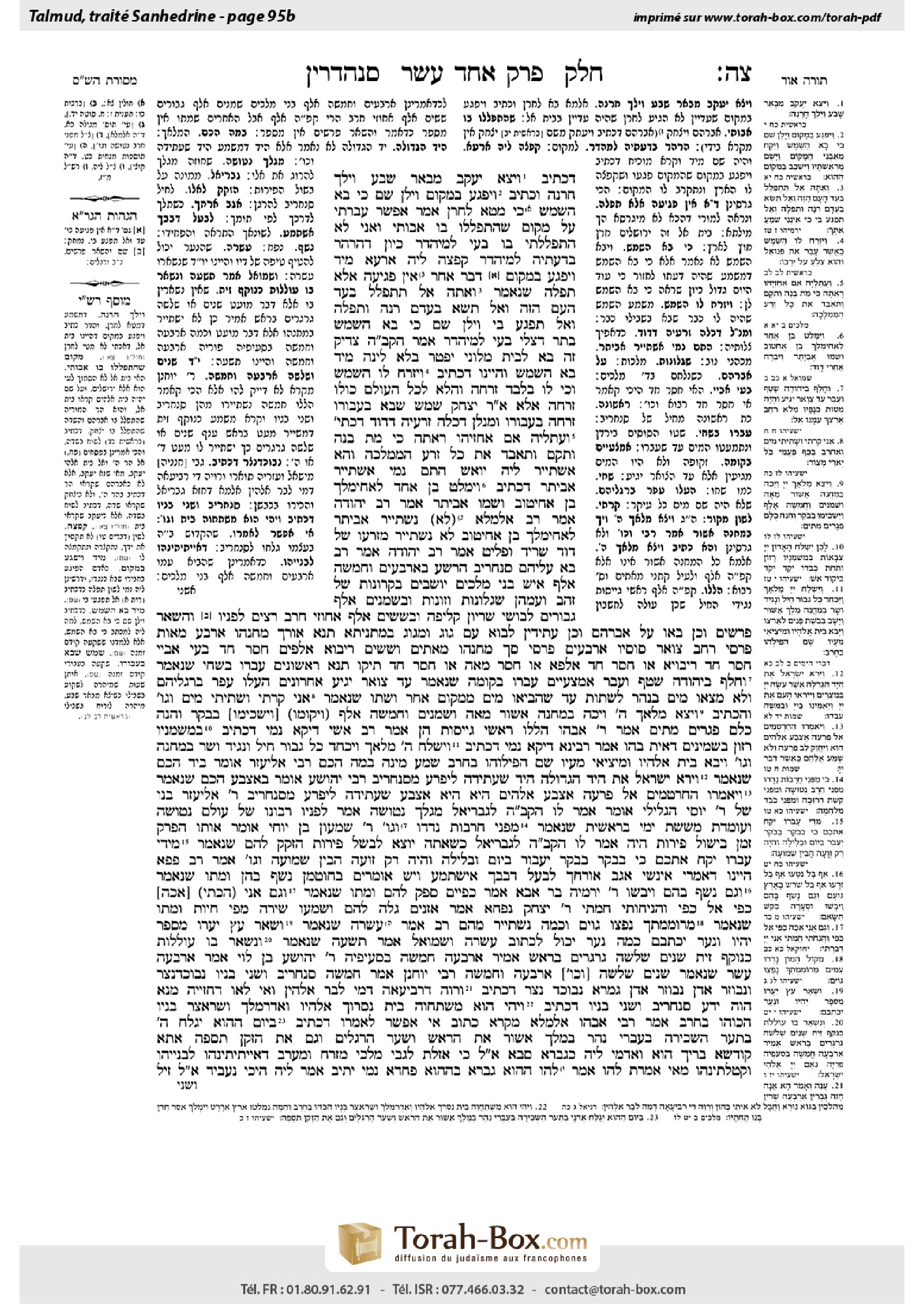
Sanhedrin 95b: Talmud study for Daf Yomi
Daf Yomi is the daily study of one Talmud folio. Explore 37 tractates with scans, Hebrew text, Sefaria English and AI-generated French translations where annotated.
Passage selection and English or AI-generated French translation are available where the scan has annotations. Daf Study is independent of Torah-Box and Sefaria.
Browse Sanhedrin · סנהדרין · All tractatesSanhedrin 95b text and translations
This page of Sanhedrin includes the Aramaic text, an English translation and an AI-generated French translation, alongside the scan above.
סנהדרין צ״ה ב · Aramaic and Hebrew text
דִּכְתִיב: ״וַיֵּצֵא יַעֲקֹב מִבְּאֵר שָׁבַע וַיֵּלֶךְ חָרָנָה״, וּכְתִיב: ״וַיִּפְגַּע בַּמָּקוֹם וַיָּלֶן שָׁם כִּי בָא הַשֶּׁמֶשׁ״. כִּי מְטָא לְחָרָן אֲמַר: אֶפְשָׁר עָבַרְתִּי עַל מְקוֹם שֶׁהִתְפַּלְּלוּ בּוֹ אֲבוֹתַי וַאֲנִי לֹא הִתְפַּלַּלְתִּי בּוֹ? בָּעֵי לְמֶיהְדַּר. כֵּיוָן דְּהַרְהַר בְּדַעְתֵּיהּ לְמִיהְדַּר, קְפַצָה לֵיהּ אַרְעָא. מִיָּד – ״וַיִּפְגַּע בַּמָּקוֹם״.
דָּבָר אַחֵר: אֵין פְּגִיעָה אֶלָּא תְּפִלָּה, שֶׁנֶּאֱמַר: ״וְאַתָּה אַל תִּתְפַּלֵּל בְּעַד הָעָם הַזֶּה וְאַל תִּשָּׂא בַעֲדָם רִנָּה וּתְפִלָּה וְאַל תִּפְגַּע בִּי״.
״וַיָּלֶן שָׁם כִּי בָא הַשֶּׁמֶשׁ״. בָּתַר דְּצַלִּי בָּעֵי לְמִיהְדַּר, אָמַר הַקָּדוֹשׁ בָּרוּךְ הוּא: צַדִּיק זֶה בָּא לְבֵית מְלוֹנִי, יִפָּטֵר בְּלֹא לִינָה? מִיָּד בָּא הַשֶּׁמֶשׁ. וְהַיְינוּ דִּכְתִיב: ״וַיִּזְרַח לוֹ הַשֶּׁמֶשׁ״. וְכִי לוֹ בִּלְבַד זָרְחָה? וַהֲלֹא לְכׇל הָעוֹלָם כּוּלּוֹ זָרְחָה! אֶלָּא אָמַר רַבִּי יִצְחָק: שֶׁמֶשׁ שֶׁבָּאָה בַּעֲבוּרוֹ, זָרְחָה בַּעֲבוּרוֹ.
וּמְנָלַן דִּכְלָה זַרְעֵיהּ דְּדָוִד? דִּכְתִיב: ״וַעֲתַלְיָה אֵם אֲחַזְיָהוּ רָאֲתָה כִּי מֵת בְּנָהּ וַתָּקׇם וַתְּאַבֵּד אֵת כׇּל זֶרַע הַמַּמְלָכָה״. וְהָא אִשְׁתְּיַיר לֵיהּ יוֹאָשׁ? הָתָם נָמֵי אִשְׁתְּיַיר אֶבְיָתָר, דִּכְתִיב: ״וַיִּמָּלֵט בֵּן אֶחָד לַאֲחִימֶלֶךְ בֶּן אֲחִטוּב וּשְׁמוֹ אֶבְיָתָר״. אָמַר רַב יְהוּדָה אָמַר רַב: אִלְמָלֵא לֹא נִשְׁתַּיֵּיר אֶבְיָתָר לַאֲחִימֶלֶךְ בֶּן אֲחִיטוּב, לֹא נִשְׁתַּיֵּיר מִזַּרְעוֹ שֶׁל דָּוִד שָׂרִיד וּפָלִיט.
אָמַר רַב יְהוּדָה אָמַר רַב: בָּא עֲלֵיהֶם סַנְחֵרִיב הָרָשָׁע בְּאַרְבָּעִים וַחֲמִשָּׁה אֶלֶף אִישׁ בְּנֵי מְלָכִים, יוֹשְׁבִים בִּקְרוֹנוֹת שֶׁל זָהָב, וְעִמָּהֶן שִׁגְלוֹנוֹת וְזוֹנוֹת, וּבִשְׁמֹנִים אֶלֶף גִּבּוֹרִים לְבוּשֵׁי שִׁרְיוֹן קְלִיפָּה, וּבְשִׁשִּׁים אֶלֶף אֲחוּזֵי חֶרֶב רָצִים לְפָנָיו, וְהַשְּׁאָר פָּרָשִׁים. וְכֵן בָּאוּ עַל אַבְרָהָם, וְכֵן עֲתִידִין לָבוֹא עִם גּוֹג וּמָגוֹג.
בְּמַתְנִיתָא תָּנָא: אוֹרֶךְ מַחֲנֵהוּ אַרְבַּע מֵאוֹת פַּרְסָה, רֹחַב צַוַּאר סוּסָיו אַרְבָּעִים פַּרְסָה. סַךְ מַחֲנֵהוּ מָאתַיִם וְשִׁשִּׁים רִיבּוֹא אֲלָפִים חָסֵר חַד. בָּעֵי אַבָּיֵי: חָסֵר חַד רִיבּוֹיָא, אוֹ חָסַר חַד אַלְפָּא, אוֹ חָסַר מְאָה, אוֹ חָסַר חַד? תֵּיקוּ.
תָּנָא: רִאשׁוֹנִים עָבְרוּ בִּשְׂחִי, שֶׁנֶּאֱמַר: ״וְחָלַף בִּיהוּדָה שָׁטַף וְעָבַר״. אֶמְצָעִיִּים עָבְרוּ בְּקוֹמָה, שֶׁנֶּאֱמַר: ״עַד צַוָּאר יַגִּיעַ״. אַחֲרוֹנִים הֶעֱלוּ עָפָר בְּרַגְלֵיהֶם וְלֹא מָצְאוּ מַיִם בַּנָּהָר לִשְׁתּוֹת, עַד שֶׁהֵבִיאוּ מַיִם מִמָּקוֹם אַחֵר וְשָׁתוּ, שֶׁנֶּאֱמַר: ״אֲנִי קַרְתִּי וְשָׁתִיתִי מָיִם וְגוֹ׳״.
וְהָכְתִיב: ״וַיֵּצֵא מַלְאַךְ ה׳ וַיַּכֶּה בְּמַחֲנֵה אַשּׁוּר מֵאָה וּשְׁמוֹנִים וַחֲמִשָּׁה אָלֶף, וַיַּשְׁכִּימוּ בַבֹּקֶר וְהִנֵּה כֻלָּם פְּגָרִים מֵתִים״? אָמַר רַבִּי אֲבָהוּ: הַלָּלוּ רָאשֵׁי גְיָיסוֹת הֵן.
אָמַר רַב אָשֵׁי: דַּיְקָא נָמֵי, דִּכְתִיב ״בְּמִשְׁמַנָּיו רָזוֹן״ – בִּשְׁמֵינִים דְּאִית בְּהוּ. אָמַר רָבִינָא: דַּיְקָא נָמֵי, דִּכְתִיב ״וַיִּשְׁלַח ה׳ מַלְאָךְ וַיַּכְחֵד כׇּל גִּבּוֹר חַיִל וְנָגִיד וְשָׂר בְּמַחֲנֵה וְגוֹ׳ וַיָּבֹא בֵּית אֱלֹהָיו וּמִיצִיאֵי מֵעָיו שָׁם הִפִּילֻהוּ בֶחָרֶב״. שְׁמַע מִינַּהּ.
בַּמֶּה הִכָּם? רַבִּי אֱלִיעֶזֶר אוֹמֵר: בַּיָּד הִכָּם, שֶׁנֶּאֱמַר: ״וַיַּרְא יִשְׂרָאֵל אֶת הַיָּד הַגְּדֹלָה״. הַיָּד שֶׁעֲתִידָה לִיפָּרַע מִסַּנְחֵרִיב. רַבִּי יְהוֹשֻׁעַ אוֹמֵר: בְּאֶצְבַּע הִכָּם, שֶׁנֶּאֱמַר: ״וַיֹּאמְרוּ הַחַרְטֻמִּים אֶל פַּרְעֹה אֶצְבַּע אֱלֹהִים הִיא״. הִיא אֶצְבַּע שֶׁעֲתִידָה לִיפָּרַע מִסַּנְחֵרִיב. רַבִּי אֱלִיעֶזֶר בְּנוֹ שֶׁל רַבִּי יוֹסֵי הַגְּלִילִי אוֹמֵר: אָמַר לוֹ הַקָּדוֹשׁ בָּרוּךְ הוּא לְגַבְרִיאֵל: מַגָּלְךָ נְטוּשָׁה? אָמַר לְפָנָיו: רִבּוֹנוֹ שֶׁל עוֹלָם, נְטוּשָׁה וְעוֹמֶדֶת מִשֵּׁשֶׁת יְמֵי בְּרֵאשִׁית, שֶׁנֶּאֱמַר: ״[מִפְּנֵי חֶרֶב נְטוּשָׁה מִפְּנֵי קֶשֶׁת דְּרוּכָה מִפְּנֵי כּוֹבֶד מִלְחָמָה] (וְגוֹ)״.
רַבִּי שִׁמְעוֹן בֶּן יוֹחַי אוֹמֵר: אוֹתוֹ הַפֶּרֶק זְמַן בִּישּׁוּל פֵּירוֹת הָיָה. אָמַר לוֹ הַקָּדוֹשׁ בָּרוּךְ הוּא לְגַבְרִיאֵל: כְּשֶׁאַתָּה יוֹצֵא לְבַשֵּׁל פֵּירוֹת, הִזָּקֵק לָהֶם, שֶׁנֶּאֱמַר: ״מִדֵּי עׇבְרוֹ יִקַּח אֶתְכֶם כִּי בַבֹּקֶר בַּבֹּקֶר יַעֲבֹר בַּיּוֹם וּבַלָּיְלָה וְהָיָה רַק זְוָעָה הָבִין שְׁמוּעָה וְגוֹ׳״. אָמַר רַב פָּפָּא: הַיְינוּ דְּאָמְרִי אִינָשֵׁי, אַגַּב אוֹרְחָךְ, לִבְעֵל דְּבָבָךְ אִישְׁתְּמַע.
וְיֵשׁ אוֹמְרִים: בְּחוֹטְמָן נָשַׁף בָּהֶן וָמֵתוּ, שֶׁנֶּאֱמַר: ״וְגַם נָשַׁף בָּהֶם וַיִּבָשׁוּ״. רַבִּי יִרְמְיָה בַּר אַבָּא אָמַר: כַּפַּיִים סָפַק לָהֶם וָמֵתוּ, שֶׁנֶּאֱמַר: ״וְגַם אֲנִי אַכֶּה כַפִּי אֶל כַּפִּי וַהֲנִחֹתִי חֲמָתִי״. רַבִּי יִצְחָק נַפָּחָא אָמַר: אׇזְנַיִם גָּלָה לָהֶם וְשָׁמְעוּ שִׁירָה מִפִּי חַיּוֹת וָמֵתוּ, שֶׁנֶּאֱמַר: ״מֵרוֹמְמֻתֶךָ נָפְצוּ גּוֹיִם״.
וְכַמָּה נִשְׁתַּיֵּיר מֵהֶם? רַב אָמַר: עֲשָׂרָה, שֶׁנֶּאֱמַר: ״וּשְׁאָר עֵץ יַעְרוֹ מִסְפָּר יִהְיוּ וְנַעַר יִכְתְּבֵם״. כַּמָּה נַעַר יָכוֹל לִכְתּוֹב? עֲשָׂרָה. וּשְׁמוּאֵל אָמַר: תִּשְׁעָה, שֶׁנֶּאֱמַר: ״וְנִשְׁאַר בּוֹ עוֹלֵלֹת כְּנֹקֶף זַיִת שְׁנַיִם שְׁלֹשָׁה גַּרְגְּרִים בְּרֹאשׁ אָמִיר אַרְבָּעָה חֲמִשָּׁה בִּסְעִפֶיהָ״.
רַבִּי יְהוֹשֻׁעַ בֶּן לֵוִי אָמַר: אַרְבָּעָה עָשָׂר, שֶׁנֶּאֱמַר ״שְׁנַיִם שְׁלֹשָׁה [וְכוּ׳] אַרְבָּעָה וַחֲמִשָּׁה״. רַבִּי יוֹחָנָן אָמַר: חֲמִשָּׁה – סַנְחֵרִיב וּשְׁנֵי בָּנָיו, נְבוּכַדְנֶצַּר וּנְבוּזַּרְאֲדָן. נְבוּזַרְאֲדָן – גְּמָרָא. נְבוּכַדְנֶצַּר – דִּכְתִיב: ״וְרֵוֵהּ דִּי רְבִיעָאָה דָּמֵה לְבַר אֱלָהִין״, וְאִי לָאו דְּחַזְיֵיהּ מְנָא הֲוָה יָדַע? סַנְחֵרִיב וּשְׁנֵי בָּנָיו – דִּכְתִיב: ״וַיְהִי הוּא מִשְׁתַּחֲוֶה בֵּית נִסְרֹךְ אֱלֹהָיו וְאַדְרַמֶּלֶךְ וְשַׂרְאֶצֶר בָּנָיו הִכֻּהוּ בַחֶרֶב״.
אָמַר רַבִּי אֲבָהוּ: אִלְמָלֵא מִקְרָא כָּתוּב, אִי אֶפְשָׁר לְאׇמְרוֹ, דִּכְתִיב: ״בַּיּוֹם הַהוּא יְגַלַּח ה׳ בְּתַעַר הַשְּׂכִירָה בְּעֶבְרֵי נָהָר בְּמֶלֶךְ אַשּׁוּר אֶת הָרֹאשׁ וְשַׂעַר הָרַגְלָיִם וְגַם אֶת הַזָּקָן תִּסְפֶּה״.
אֲתָא קוּדְשָׁא בְּרִיךְ הוּא, וְאִדְּמִי לֵיהּ כְּגַבְרָא סָבָא. אֲמַר לֵיהּ: כִּי אָזְלַתְּ לְגַבֵּי מַלְכֵי מִזְרָח וּמַעֲרָב דְּאַיְיתִיתִינְהוּ לִבְנַיְיהוּ וּקְטַלְתִּינְהוּ, מַאי אָמְרַתְּ לְהוּ? אֲמַר לֵיהּ: הַהוּא גַּבְרָא בְּהָהוּא פַּחְדָּא נָמֵי יָתֵיב. אֲמַר לֵיהּ: הֵיכִי נַעֲבֵיד? אֲמַר לֵיהּ: זִיל
Sanhedrin 95b · English translation
is as it is written: “And Jacob departed from Beersheba and went to Haran” (Genesis 28:10), and it is written thereafter, ostensibly after he arrived in Haran: “And he encountered [vayyifga] the place, and he slept there, for the sun had set” (Genesis 28:11). This means that when Jacob arrived at Haran, he said: Is it possible that I bypassed a place where my forefathers prayed and I did not pray there? He sought to return to Beit El. Once he contemplated in his mind to return, the land contracted for him, and immediately: “And he encountered the place,” indicating that he arrived there unexpectedly, sooner than he would have arrived without a miracle.
Alternatively, encounter means nothing other than prayer, as it is stated: “And you, do not pray on behalf of this nation, and do not raise on their behalf song and prayer, and do not encounter [tifga] Me, for I do not hear you” (Jeremiah 7:16).
It is written: “And he slept there because the sun had set” (Genesis 28:11). After Jacob prayed and he sought to return to his travels, the Holy One, Blessed be He, said: This righteous man came to My inn. Will I allow him to take leave without sleeping here? Immediately the sun set, not at the proper time, and that is the meaning of that which is written with regard to Jacob: “And the sun shone for him when he passed Penuel” (Genesis 32:32). The Gemara asks: And did the sun shine only for him? But didn’t the sun shine for the entire world? Rather, Rabbi Yitzḥak says: The sun that set not at the proper time exclusively for him shone not at the proper time exclusively for him in order to rectify the disparity created by the premature sunset.
Apropos David’s prayer that his descendants cease, the Gemara asks: And from where do we derive that David’s descendants ceased to exist? It is derived from a verse, as it is stated: “And Athaliah the mother of Ahaziah saw that her son was dead, and she arose and destroyed all the royal descendants” (II Kings 11:1). The Gemara asks: But didn’t Joash remain alive, and therefore, not all of David’s descendants ceased to exist? The Gemara answers: There too, in the massacre in Nov, Abiathar, one of the priests, remained alive, as it is written: “And one of the sons of Ahimelech, son of Ahitub, named Abiathar, escaped” (I Samuel 22:20). Rav Yehuda says that Rav says: Were it not for the fact that Abiathar remained alive for Ahimelech, son of Ahitub, there would have been no remnant or refugee remaining from the descendants of David.
§ Apropos Sennacherib, Rav Yehuda says that Rav says: Sennacherib the wicked came upon them with forty-five thousand men, sons of kings, sitting in carriages of gold, and with them were consorts and prostitutes, and with eighty thousand warriors each wearing a coat of mail, and with sixty thousand sword-bearers running before him, and the rest were cavalry. And likewise, when the four kings came upon Abraham to wage war in the land of Canaan (see Genesis, chapter 14), they brought forces of that magnitude. And likewise, forces of that magnitude are destined to come with Gog and Magog in the ultimate war.
It was taught in a baraita: The length of the camp of Sennacherib was four hundred parasangs and the width of the necks of his horses side by side was forty parasangs. The total number of soldiers in his camp was 260 ten thousands, i.e., 2,600,000, minus one. Abaye asks: Is the tanna saying minus one unit of ten thousand, or minus one unit of one thousand, or minus one unit of one hundred or minus one? The Gemara concludes: The question shall stand unresolved.
It was taught: The first set of soldiers in the army of Sennacherib crossed by swimming across the Jordan, as it is stated: “And he shall sweep through Judea; he shall overflow and pass” (Isaiah 8:8). Since the water level diminished with their crossing, the middle group of soldiers passed while standing upright, as it is stated: “It shall reach even the neck” (Isaiah 8:8). The last soldiers already kicked up dust with their feet, and they did not find water in the river to drink, and they had no water until they brought water from another place and drank it, as it is stated: “I dug and drank water” (Isaiah 37:25).
The Gemara asks: But isn’t it written: “Then the angel of the Lord went forth and smote in the camp of the Assyrians one hundred and eighty-five thousand. And when they arose early in the morning, behold, they were all dead corpses” (Isaiah 37:36)? Apparently, there were many fewer soldiers than the number listed in the baraita. Rabbi Abbahu says: These listed here are regiment leaders, who commanded numerous soldiers.
Rav Ashi says: It is also precise in the formulation of the verse, as it is written: “Therefore shall the Master, the Lord of hosts, send among his fat ones leanness” (Isaiah 10:16), indicating that it was the fat, i.e., significant, among them who were afflicted. Ravina says: The language is also precise in the formulation of another verse, as it is written: “And the Lord sent an angel, who obliterated the mighty men-at-arms and the leaders and captains in the camp of the king of Assyria. So he returned shamefacedly to his own land. And when he came into the house of his God, his own offspring slew him there with a sword” (II Chronicles 32:21). The Gemara affirms: Conclude from it that the leaders of the regiment were the ones killed.
The Gemara asks: With what did the angel strike them? Rabbi Eliezer says: He struck them by hand, as it is stated: “And Israel saw the great hand” (Exodus 14:31), where the term for hand, yad, is preceded by the definite article ha, indicating that this was the hand that was destined to exact retribution from Sennacherib. Rabbi Yehoshua says: He struck them with His finger, as it is stated: “And the sorcerers said to Pharaoh: This is the finger of God” (Exodus 8:15), indicating that it is the finger that was destined to exact retribution from Sennacherib. Rabbi Eliezer, son of Rabbi Yosei HaGelili, says that the Holy One, Blessed be He, said to Gabriel: Is your scythe honed? Gabriel said before Him: Master of the Universe, it is standing honed from the six days of Creation, as it is stated: “For they have fled from the swords, from the honed sword” (Isaiah 21:15).
Rabbi Shimon ben Yoḥai says: That period was the season of the ripening of the fruit. The Holy One, Blessed be He, said to Gabriel: When you emerge to ripen the fruits, attend to the army of Assyria and destroy them, as it is stated: “As often as it passes through, it shall take you; for morning by morning shall it pass through, by day and by night; and the mere understanding of the report shall bring terror” (Isaiah 28:19), indicating that Gabriel was to kill them while engaged in another activity. Rav Pappa says that this is in accordance with the adage that people say: While on your path, appear before your enemy and afflict him.
And there are those who say: The angel blew into the soldiers of the Assyrian army through their noses and they died, as it is stated: “When he blows upon them, and they wither” (Isaiah 40:24). Rabbi Yirmeya bar Abba says: The angel clapped his hands to them and they died, as it is stated: “I will also strike My hands together and I will assuage My anger” (Ezekiel 21:22). Rabbi Yitzḥak Nappaḥa says: He revealed ears for them and they were able to hear the songs of praise from the mouths of the celestial creatures drawing the chariot of God, and they died, as it is stated: “From Your exaltation the nations were scattered” (Isaiah 33:3), indicating that their death was caused by the revelation of God’s greatness.
And how many of the soldiers remained alive? Rav says: Ten soldiers, as it is stated: “And the rest of the trees of his forest shall be few, that a child may write them” (Isaiah 10:19). And what number can a child easily write? It is the number ten, represented by the letter yod, which is the smallest letter. And Shmuel says: Nine remained, as it is stated: “And gleanings shall be left of him, as in the beating of an olive tree, two or three berries in the top of the uppermost bough, four or five in the branches of a fruitful tree” (Isaiah 17:6). Four and five total nine.
Rabbi Yehoshua ben Levi says: Fourteen remained, as it is stated: “Two or three…four or five,” which total fourteen. Rabbi Yoḥanan says: Five remained: Sennacherib, and his two sons, and Nebuchadnezzar, and Nebuzaradan, the captain of the guard. The fact that Nebuzaradan was among them is learned through tradition. Nebuchadnezzar was among them, as it is written that Nebuchadnezzar said when he saw an angel with Hananiah, Mishael, and Azariah: “And the appearance of the fourth is like that of an angel” (Daniel 3:25). And if he had not seen the angel that smote Sennacherib’s army, from where would he have known that the fourth person looked like an angel? Sennacherib and his two sons were among them, as it is written later in their regard: “And it came to pass as he was worshipping in the house of Nisroch his god that Adrammelech and Sarezer, his sons, smote him with the sword” (II Kings 19:37). Evidently, the three of them survived.
§ Rabbi Abbahu says: Were the following verse not written, it would have been impossible to say it, since it appears to be a desecration of the name of God, as it is written: “On that day shall the Lord shave with a hired razor in the parts beyond the river the king of Assyria, the head, and the hair of the legs, and it shall also sweep away the beard” (Isaiah 7:20). The blasphemous indication is that the Holy One, Blessed be He, will Himself shave Sennacherib.
Rather, this is the incident depicted in the verse: The Holy One, Blessed be He, came and appeared to Sennacherib as an old man. God said to him: When you go to the kings of the east and the west whose children you brought and killed, what will you say to them? Sennacherib said to the Holy One, Blessed be He: That man, referring to himself, also sits overcome with the same fear, as I do not know what to say to them. Sennacherib said to the Holy One, Blessed be He: What should we do? The Holy One, Blessed be He, said to him: Go
Sanhedrin 95b · Traduction française (IA)
comme il est écrit : « Jacob quitta Beer-Shéva et partit pour Haran » (Genèse 28,10), puis, apparemment après son arrivée à Haran, il est écrit : « Il rencontra [vayyifga] l’endroit et y passa la nuit, car le soleil s’était couché » (Genèse 28,11). Cela signifie qu’en arrivant à Haran, Jacob se dit : « Se peut-il que j’aie dépassé un endroit où mes pères priaient sans y prier moi-même ? » Il chercha à retourner à Beit El. Dès qu’il envisagea de revenir, la terre se contracta pour lui, et aussitôt : « Il rencontra l’endroit », ce qui indique qu’il y arriva de façon inattendue, plus tôt qu’il ne l’aurait fait sans miracle.
Par ailleurs, « rencontrer » ne signifie rien d’autre que prier, comme il est dit : « Et toi, ne prie pas en faveur de ce peuple, ne fais monter pour lui ni supplication ni prière, ne Me sollicite [tifga] pas, car Je ne t’écouterai pas » (Jérémie 7,16).
Il est écrit : « Il y passa la nuit, car le soleil s’était couché » (Genèse 28,11). Après que Jacob eut prié et se fut apprêté à reprendre sa route, le Saint, béni soit-Il, dit : « Cet homme juste est venu dans Mon auberge. Le laisserai-Je partir sans qu’il y passe la nuit ? » Aussitôt, le soleil se coucha avant l’heure, et c’est là le sens de ce qui est écrit au sujet de Jacob : « Le soleil brilla pour lui lorsqu’il passa Penouël » (Genèse 32,32). La Guemara demande : Le soleil ne brilla-t-il que pour lui ? N’a-t-il pas brillé pour le monde entier ? Rabbi Yitzḥak répond : Le soleil qui s’était couché avant l’heure spécialement pour lui brilla avant l’heure spécialement pour lui, afin de réparer le déséquilibre causé par ce coucher prématuré.
À propos de la prière de David pour que ses descendants cessent d’exister, la Guemara demande : D’où savons-nous que les descendants de David cessèrent d’exister ? Cela se déduit d’un verset, comme il est dit : « Athalie, mère d’Achazia, vit que son fils était mort ; elle se leva et fit périr toute la descendance royale » (II Rois 11,1). La Guemara demande : Joas n’était-il pas resté en vie, de sorte que les descendants de David n’avaient pas tous cessé d’exister ? La Guemara répond : De même, lors du massacre à Nov, Abiathar, l’un des prêtres, était resté en vie, comme il est écrit : « Un des fils d’Achimélek, fils d’Achitouv, nommé Abiathar, s’échappa » (I Samuel 22,20). Rav Yehuda dit au nom de Rav : Si Abiathar n’était pas resté en vie après Achimélek, fils d’Achitouv, aucun survivant ni aucun réfugié ne serait resté parmi les descendants de David.
§ À propos de Sennachérib, Rav Yehuda dit au nom de Rav : Le méchant Sennachérib vint contre eux avec quarante-cinq mille hommes, fils de rois, assis dans des chars d’or ; ils étaient accompagnés de concubines et de prostituées. Il avait aussi quatre-vingt mille guerriers, chacun portant une cotte de mailles, ainsi que soixante mille porteurs d’épée courant devant lui ; le reste était constitué de cavaliers. De même, lorsque les quatre rois vinrent combattre Abraham au pays de Canaan (voir Genèse, chapitre 14), ils amenèrent des forces de cette ampleur. De même encore, des forces de cette ampleur accompagneront Gog et Magog lors de la guerre ultime.
Il a été enseigné dans une baraïta : Le camp de Sennachérib s’étendait sur quatre cents parasanges, et les encolures de ses chevaux, côte à côte, occupaient une largeur de quarante parasanges. Son camp comptait au total 260 myriades, c’est-à-dire 2 600 000 soldats, moins un. Abaye demande : Le tanna veut-il dire moins une myriade, moins un millier, moins une centaine ou moins un seul ? La Guemara conclut : La question reste sans réponse.
Il a été enseigné : Les premiers soldats de l’armée de Sennachérib traversèrent le Jourdain à la nage, comme il est dit : « Il déferlera sur Juda, débordera et passera » (Isaïe 8,8). Le niveau de l’eau ayant baissé à mesure qu’ils traversaient, les soldats du groupe du milieu passèrent debout, comme il est dit : « Il atteindra jusqu’au cou » (Isaïe 8,8). Les derniers soldats soulevaient déjà la poussière avec leurs pieds ; ils ne trouvèrent pas d’eau à boire dans le fleuve et n’en eurent pas jusqu’à ce qu’ils en apportent d’ailleurs et la boivent, comme il est dit : « J’ai creusé et bu de l’eau » (Isaïe 37,25).
La Guemara demande : Mais n’est-il pas écrit : « Alors l’ange de l’Éternel sortit et frappa dans le camp des Assyriens cent quatre-vingt-cinq mille hommes. Quand ils se levèrent au matin, voici qu’ils étaient tous des cadavres » (Isaïe 37,36) ? Apparemment, il y avait bien moins de soldats que le nombre indiqué dans la baraïta. Rabbi Abbahu dit : Ceux qui sont dénombrés ici sont les chefs de régiment, qui commandaient de nombreux soldats.
Rav Ashi dit : La formulation du verset le confirme également, comme il est écrit : « C’est pourquoi le Maître, l’Éternel des armées, enverra la maigreur parmi ses hommes gras » (Isaïe 10,16), ce qui indique que ceux qui furent frappés parmi eux étaient les hommes gras, c’est-à-dire les plus importants. Ravina dit : La formulation d’un autre verset le confirme aussi, comme il est écrit : « L’Éternel envoya un ange qui anéantit les vaillants guerriers, les chefs et les officiers dans le camp du roi d’Assyrie. Celui-ci retourna couvert de honte dans son pays. Lorsqu’il entra dans la maison de son dieu, ses propres fils le tuèrent là par l’épée » (II Chroniques 32,21). La Guemara confirme : Conclus-en que ce furent les chefs de régiment qui furent tués.
La Guemara demande : Avec quoi l’ange les frappa-t-il ? Rabbi Eliezer dit : Il les frappa de la main, comme il est dit : « Israël vit la grande main » (Exode 14,31). Le terme désignant la main, yad, est précédé de l’article défini ha, ce qui indique qu’il s’agissait de la main destinée à exercer sa vengeance contre Sennachérib. Rabbi Yehoshua dit : Il les frappa de Son doigt, comme il est dit : « Les magiciens dirent à Pharaon : “C’est le doigt de Dieu” » (Exode 8,15), ce qui indique que c’est le doigt qui était destiné à exercer sa vengeance contre Sennachérib. Rabbi Eliezer, fils de Rabbi Yosei HaGelili, dit que le Saint, béni soit-Il, demanda à Gabriel : « Ta faux est-elle aiguisée ? » Gabriel lui répondit : « Maître de l’univers, elle est aiguisée depuis les six jours de la Création », comme il est dit : « Ils fuient devant les épées, devant l’épée aiguisée » (Isaïe 21,15).
Rabbi Shimon ben Yoḥai dit : Cette période correspondait à la saison où les fruits mûrissent. Le Saint, béni soit-Il, dit à Gabriel : « Lorsque tu sortiras faire mûrir les fruits, occupe-toi de l’armée d’Assyrie et détruis-la », comme il est dit : « Chaque fois qu’il passera, il vous emportera ; car il passera matin après matin, de jour et de nuit, et la seule compréhension du récit fera trembler » (Isaïe 28,19), ce qui indique que Gabriel devait les tuer alors qu’il s’adonnait à une autre activité. Rav Pappa dit que cela correspond au dicton que l’on rapporte : « En chemin, présente-toi devant ton ennemi et afflige-le. »
D’autres disent : L’ange souffla dans les narines des soldats de l’armée assyrienne, et ils moururent, comme il est dit : « Lorsqu’Il souffle sur eux, ils se dessèchent » (Isaïe 40,24). Rabbi Yirmeya bar Abba dit : L’ange frappa des mains devant eux, et ils moururent, comme il est dit : « Moi aussi, Je frapperai des mains et J’apaiserai Ma colère » (Ézéchiel 21,22). Rabbi Yitzḥak Nappaḥa dit : Il leur ouvrit les oreilles ; ils purent entendre les chants de louange des créatures célestes qui tirent le char de Dieu, et ils moururent, comme il est dit : « À Ta majesté, les nations se dispersent » (Isaïe 33,3), ce qui indique que leur mort fut causée par la manifestation de la grandeur de Dieu.
Combien de soldats restèrent en vie ? Rav dit : Dix, comme il est dit : « Le reste des arbres de sa forêt sera si peu nombreux qu’un enfant pourrait les compter » (Isaïe 10,19). Quel nombre un enfant peut-il facilement écrire ? Dix, représenté par la lettre yod, qui est la plus petite lettre. Shmuel dit : Neuf restèrent, comme il est dit : « Il en restera des glanures, comme lorsqu’on secoue un olivier : deux ou trois baies au sommet de la plus haute branche, quatre ou cinq sur les branches d’un arbre fertile » (Isaïe 17,6). Quatre et cinq font neuf.
Rabbi Yehoshua ben Levi dit : Quatorze restèrent, comme il est dit : « Deux ou trois… quatre ou cinq », ce qui fait quatorze. Rabbi Yoḥanan dit : Cinq restèrent : Sennachérib, ses deux fils, Nabuchodonosor et Nebuzaradan, le chef des gardes. On sait par tradition que Nebuzaradan était parmi eux. Nabuchodonosor en faisait partie, car il est écrit qu’en voyant un ange avec Hanania, Mishaël et Azaria, il dit : « L’apparence du quatrième est semblable à celle d’un ange » (Daniel 3,25). S’il n’avait pas vu l’ange qui frappa l’armée de Sennachérib, d’où aurait-il su que le quatrième ressemblait à un ange ? Sennachérib et ses deux fils en faisaient partie, comme il est écrit plus loin à leur sujet : « Or, comme il se prosternait dans la maison de Nisrok, son dieu, Adrammélek et Sarétser, ses fils, le frappèrent de l’épée » (II Rois 19,37). Il est donc évident que tous trois avaient survécu.
§ Rabbi Abbahu dit : Si le verset suivant n’était pas écrit, il aurait été impossible de le dire, car il semble profaner le nom de Dieu, comme il est écrit : « En ce jour, le Seigneur rasera, avec un rasoir loué au-delà du fleuve, le roi d’Assyrie, la tête et les poils des jambes, et il emportera aussi la barbe » (Isaïe 7,20). Ce qui semble blasphématoire, c’est que le Saint, béni soit-Il, rasera Lui-même Sennachérib.
Il s’agit plutôt de l’épisode représenté par le verset : Le Saint, béni soit-Il, vint et apparut à Sennachérib sous les traits d’un vieillard. Dieu lui dit : « Lorsque tu iras auprès des rois de l’est et de l’ouest, dont tu as emmené et tué les enfants, que leur diras-tu ? » Sennachérib dit au Saint, béni soit-Il : « Cet homme, c’est-à-dire moi-même, est lui aussi accablé par la même crainte, car je ne sais pas quoi leur dire. » Sennachérib dit au Saint, béni soit-Il : « Que devons-nous faire ? » Le Saint, béni soit-Il, lui dit : « Va »
Traduction française générée par IA à partir de l’édition anglaise de Sefaria. Vérifie toujours un passage avec le texte source.
Text from Sefaria: William Davidson Edition - Vocalized Aramaic (CC BY NC); William Davidson Edition - English (CC BY NC).