Sanhedrin 96a: Talmud study for Daf Yomi
Daf Yomi is the daily study of one Talmud folio. Explore 37 tractates with scans, Hebrew text, Sefaria English and AI-generated French translations where annotated.
Passage selection and English or AI-generated French translation are available where the scan has annotations. Daf Study is independent of Torah-Box and Sefaria.
Browse Sanhedrin · סנהדרין · All tractatesSanhedrin 96a text and translations
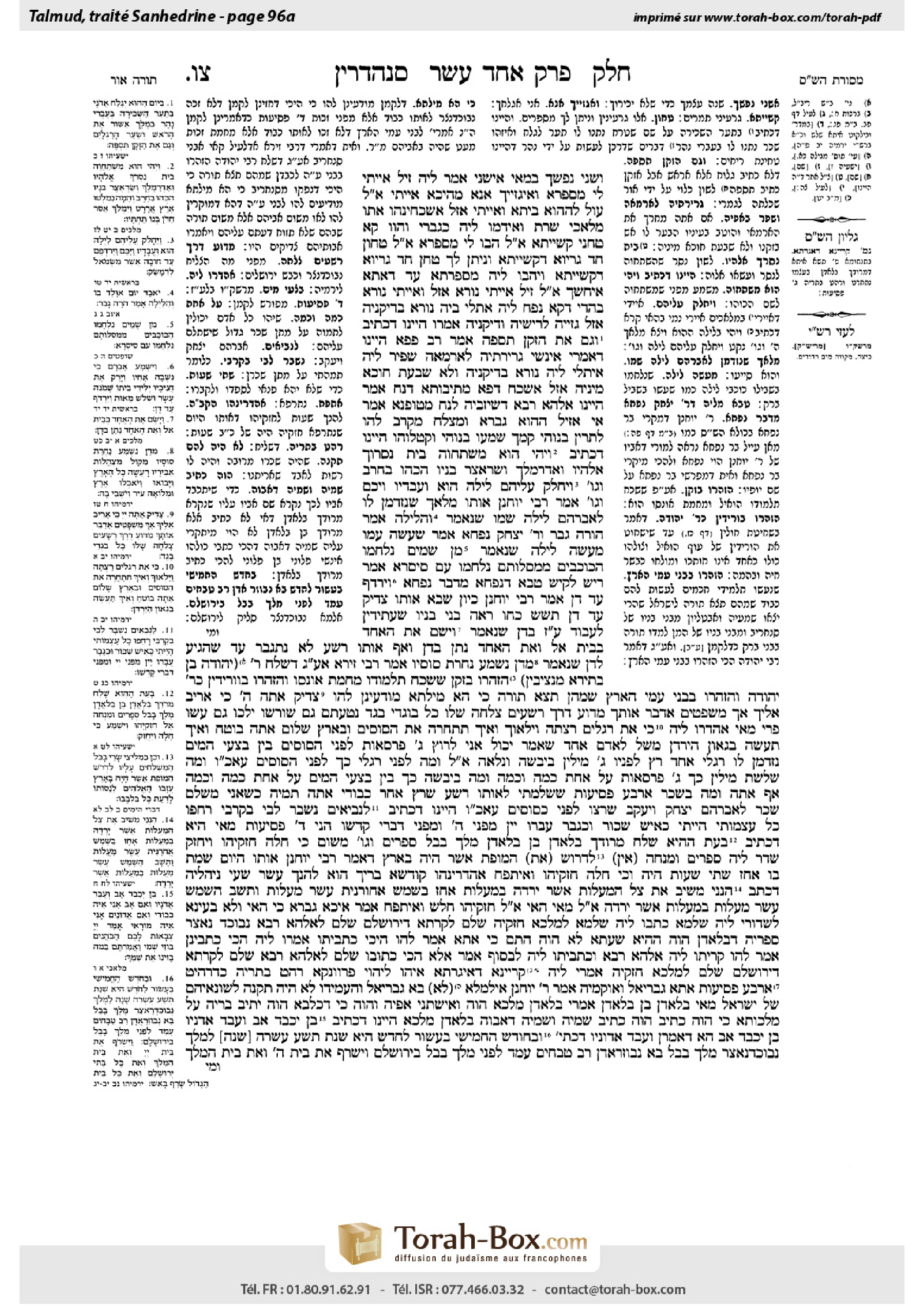
This page of Sanhedrin includes the Aramaic text, an English translation and an AI-generated French translation, alongside the scan above.
סנהדרין צ״ו א · Aramaic and Hebrew text
וְשַׁנִּי נַפְשָׁךְ. בְּמַאי אֵישַׁנֵּי? אֲמַר לֵיהּ: זִיל אַיְיתִי לִי מַסְפְּרָא וְאֶיגְזְיָיךְ אֲנָא. מֵהֵיכָא אַיְיתֵי? אֲמַר לֵיהּ: עוּל לְהָהוּא בֵּיתָא וְאַיְיתֵי. אֲזַל, אַשְׁכְּחִינְהוּ לְמַלְאֲכֵי שָׁרֵת וְאִידְּמוֹ לֵיהּ כְּגַבְרֵי, וַהֲווֹ קָא טָחֲנִי קַשְׁיָיתָא.
אֲמַר לְהוּ: הַבוּ לִי מַסְפְּרָא. אֲמַרוּ לֵיהּ: טְחוֹן חַד גְּרִיוָא דְּקַשְׁיָיתָא וְנִיתֵּן לָךְ. טְחַן חַד גְּרִיוָא דְּקַשְׁיָיתָא וִיהַבוּ לֵיהּ מַסְפַּרְתָּא. עַד דַּאֲתָא, אִיחֲשַׁךְ. אֲמַרוּ לֵיהּ: זִיל אַיְיתִי נוּרָא. אֲזַל וְאַיְיתִי נוּרָא. בַּהֲדֵי דְּקָא נָפַח לֵיהּ, אִתְּלִי בֵּיהּ נוּרָא בְּדִיקְנֵיהּ. אֲזַל גַּזְיֵיהּ לְרֵישֵׁיהּ וְדִיקְנֵיהּ. (אֲמַרוּ): הַיְינוּ דִּכְתִיב ״וְגַם אֶת הַזָּקָן תִּסְפֶּה״. אָמַר רַב פָּפָּא, הַיְינוּ דְּאָמְרִי אִינָשֵׁי: ״גָּרֵירְתֵּיהּ לְאַרְמָאָה שְׁפַר לֵיהּ, אַיתְלֵי לֵיהּ נוּרָא בְּדִיקְנֵיהּ וְלָא שָׂבְעַתְּ חוּכָא מִינֵּיהּ״.
אֲזַל, אַשְׁכַּח דַּפָּא מִתֵּיבוּתָא דְּנֹחַ. אָמַר: הַיְינוּ אֱלָהָא רַבָּא דְּשֵׁיזְבֵיהּ לְנֹחַ מִטּוֹפָנָא. אֲמַר: אִי אָזֵיל הָהוּא גַּבְרָא וּמַצְלַח, מְקָרֵב לְהוּ לִתְרֵין בְּנוֹהִי קַמָּךְ. שְׁמַעוּ בְּנוֹהִי וְקַטְלוּהּ. הַיְינוּ דִּכְתִיב: ״וַיְהִי הוּא מִשְׁתַּחֲוֶה בֵּית נִסְרֹךְ אֱלֹהָיו וְאַדְרַמֶּלֶךְ וְשַׂרְאֶצֶר בָּנָיו הִכֻּהוּ בַחֶרֶב וְגוֹ׳״.
״וַיֵּחָלֵק עֲלֵיהֶם לַיְלָה הוּא וַעֲבָדָיו וַיַּכֵּם וְגוֹ׳״. אָמַר רַבִּי יוֹחָנָן: אוֹתוֹ מַלְאָךְ שֶׁנִּזְדַּמֵּן לוֹ לְאַבְרָהָם, ״לַיְלָה״ שְׁמוֹ, שֶׁנֶּאֱמַר: ״וְהַלַּיְלָה אָמַר הֹרָה גָבֶר״. וְרַבִּי יִצְחָק נַפָּחָא אָמַר: שֶׁעָשָׂה עִמּוֹ מַעֲשֵׂה לַיְלָה, שֶׁנֶּאֱמַר: ״מִן שָׁמַיִם נִלְחָמוּ הַכּוֹכָבִים מִמְּסִלּוֹתָם נִלְחֲמוּ עִם סִיסְרָא״. אָמַר רֵישׁ לָקִישׁ: טָבָא דְּנַפָּחָא מִדְּבַר נַפָּחָא.
״וַיִּרְדֹּף עַד דָּן״. אָמַר רַבִּי יוֹחָנָן: כֵּיוָן שֶׁבָּא אוֹתוֹ צַדִּיק עַד דָּן, תָּשַׁשׁ כֹּחוֹ. רָאָה בְּנֵי בָּנָיו שֶׁעֲתִידִין לַעֲבוֹד עֲבוֹדָה זָרָה בְּדָן, שֶׁנֶּאֱמַר: ״וַיָּשֶׂם אֶת הָאֶחָד בְּבֵית אֵל וְאֶת הָאֶחָד נָתַן בְּדָן״. וְאַף אוֹתוֹ רָשָׁע לֹא נִתְגַּבֵּר עַד שֶׁהִגִּיעַ לְדָן, שֶׁנֶּאֱמַר: ״מִדָּן נִשְׁמַע נַחְרַת סוּסָיו״.
אָמַר רַבִּי זֵירָא: ״אַף עַל גַּב דְּשָׁלַח רַבִּי יְהוּדָה בֶּן בְּתֵירָא מִנְּצִיבִין: הִזָּהֲרוּ בְּזָקֵן שֶׁשָּׁכַח תַּלְמוּדוֹ מֵחֲמַת אוֹנְסוֹ, וְהִזָּהֲרוּ בַּוְּורִידִין כְּרַבִּי יְהוּדָה, וְהִזָּהֲרוּ בִּבְנֵי עַמֵּי הָאָרֶץ שֶׁמֵּהֶן תֵּצֵא תּוֹרָה – כִּי הָא מִילְּתָא מוֹדְעִינַן לְהוּ.
״צַדִּיק אַתָּה ה׳ כִּי אָרִיב אֵלֶיךָ אַךְ מִשְׁפָּטִים אֲדַבֵּר אוֹתָךְ מַדּוּעַ דֶּרֶךְ רְשָׁעִים צָלֵחָה שָׁלוּ כׇּל בֹּגְדֵי בָגֶד. נְטַעְתָּם גַּם שֹׁרָשׁוּ יֵלְכוּ גַּם עָשׂוּ פֶרִי״. מַאי אַהְדַּרוּ לֵיהּ? ״כִּי אֶת רַגְלִים רַצְתָּה וַיַּלְאוּךָ וְאֵיךְ תְּתַחֲרֶה אֶת הַסּוּסִים וּבְאֶרֶץ שָׁלוֹם אַתָּה בוֹטֵחַ וְאֵיךְ תַּעֲשֶׂה בִּגְאוֹן הַיַּרְדֵּן״.
מָשָׁל לְאָדָם אֶחָד שֶׁאָמַר: יָכוֹל אֲנִי לָרוּץ שָׁלֹשׁ פַּרְסָאוֹת לִפְנֵי הַסּוּסִים בֵּין בִּצְעֵי הַמַּיִם. נִזְדַּמֵּן לוֹ רַגְלִי אֶחָד, רָץ לְפָנָיו שְׁלֹשָׁה מִילִין בַּיַּבָּשָׁה וְנִלְאָה. אָמְרוּ לוֹ: וּמָה לִפְנֵי רַגְלִי כָּךְ, לִפְנֵי הַסּוּסִים – עַל אַחַת כַּמָּה וְכַמָּה. וּמָה שְׁלֹשֶׁת מִילִין כָּךְ, שָׁלֹשׁ פַּרְסָאוֹת – עַל אַחַת כַּמָּה וְכַמָּה. וּמָה בַּיַּבָּשָׁה כָּךְ, בֵּין בִּצְעֵי הַמַּיִם – עַל אַחַת כַּמָּה וְכַמָּה.
אַף אַתָּה: וּמָה בִּשְׂכַר אַרְבַּע פְּסִיעוֹת שֶׁשִּׁלַּמְתִּי לְאוֹתוֹ רָשָׁע, שֶׁרָץ אַחַר כְּבוֹדִי, אַתָּה תָּמֵיהַּ? כְּשֶׁאֲנִי מְשַׁלֵּם שָׂכָר לְאַבְרָהָם יִצְחָק וְיַעֲקֹב שֶׁרָצוּ לְפָנַי כְּסוּסִים – עַל אַחַת כַּמָּה וְכַמָּה! הַיְינוּ דִּכְתִיב: ״לַנְּבִאִים נִשְׁבַּר לִבִּי בְקִרְבִּי רָחֲפוּ כׇּל עַצְמֹתַי הָיִיתִי כְּאִישׁ שִׁכּוֹר וּכְגֶבֶר עֲבָרוֹ יָיִן מִפְּנֵי ה׳ וּמִפְּנֵי דִּבְרֵי קׇדְשׁוֹ״.
הָנֵי אַרְבַּע פְּסִיעוֹת מַאי הִיא? דִּכְתִיב: ״בָּעֵת הַהִיא שָׁלַח מְרֹדַךְ בַּלְאֲדָן בֶּן בַּלְאֲדָן מֶלֶךְ בָּבֶל סְפָרִים וְגוֹ׳״. מִשּׁוּם ״כִּי חָלָה חִזְקִיָּהוּ וַיֶּחֱזָק״ שַׁדַּר לֵיהּ סְפָרִים וּמִנְחָה? אִין, לִדְרֹשׁ ״(אֶת) הַמּוֹפֵת אֲשֶׁר הָיָה בָאָרֶץ״. דְּאָמַר רַבִּי יוֹחָנָן: אוֹתוֹ הַיּוֹם שֶׁמֵּת בּוֹ אָחָז שְׁתֵּי שָׁעוֹת הָיָה.
וְכִי חָלָה חִזְקִיָּהוּ וְאִיתְּפַח, אַהְדְּרִינְהוּ קוּדְשָׁא בְּרִיךְ הוּא לְהָנָךְ עֲשַׂר שָׁעֵי נִיהֲלֵיהּ, דִּכְתִיב: ״הִנְנִי מֵשִׁיב אֶת צֵל הַמַּעֲלוֹת אֲשֶׁר יָרְדָה בְמַעֲלוֹת אָחָז בַּשֶּׁמֶשׁ אֲחֹרַנִּית עֶשֶׂר מַעֲלוֹת וַתָּשׇׁב הַשֶּׁמֶשׁ עֶשֶׂר מַעֲלוֹת בַּמַּעֲלוֹת אֲשֶׁר יָרָדָה״. אֲמַר לְהוּ: מַאי הַאי? אֲמַרוּ לֵיהּ: חִזְקִיָּהוּ חֲלַשׁ וְאִיתְּפַח. אֲמַר: אִיכָּא גַּבְרָא כִּי הַאי וְלָא בָּעֵינָא לְשַׁדּוֹרֵי לֵיהּ שְׁלָמָא? כְּתַבוּ לֵיהּ: ״שְׁלָמָא לְמַלְכָּא חִזְקִיָּה, שְׁלָם לְקַרְתָּא דִּירוּשְׁלֶם, שְׁלָם לֶאֱלָהָא רַבָּא״.
נְבוּכַדְנֶאצַּר סָפְרֵיהּ דְּבַלְאֲדָן הֲוָה. הָהִיא שַׁעְתָּא לָא הֲוָה הָתָם. כִּי אֲתָא, אֲמַר לְהוּ: הֵיכִי כָּתְבִיתוּ? אֲמַרוּ לֵיהּ: הָכִי כָּתְבִינַן. אֲמַר לְהוּ: קְרֵיתוּ לֵיהּ ״אֱלָהָא רַבָּא״ וְכָתְבִיתוּ לֵיהּ לְבַסּוֹף? אָמַר: אֶלָּא הָכִי כְּתוּבוּ: ״שְׁלָם לֶאֱלָהָא רַבָּא, שְׁלָם לְקַרְתָּא דִּירוּשְׁלֶם, שְׁלָם לְמַלְכָּא חִזְקִיָּה״. אָמְרִי לֵיהּ: קַרְיָינָא דְּאִיגַּרְתָּא אִיהוּ לֶיהֱוֵי פַּרְוַונְקָא.
רְהַט בָּתְרֵיהּ, כִּדְרָהֵיט אַרְבַּע פְּסִיעוֹת, אֲתָא גַּבְרִיאֵל וְאוֹקְמֵיהּ. אָמַר רַבִּי יוֹחָנָן: אִילְמָלֵא לֹא בָּא גַּבְרִיאֵל וְהֶעֱמִידוֹ, לֹא הָיָה תַּקָּנָה לְשׂוֹנְאֵיהֶם שֶׁל יִשְׂרָאֵל.
מַאי ״בַּלְאֲדָן בֶּן בַּלְאֲדָן״? אָמְרִי: בַּלְאֲדָן מַלְכָּא הֲוָה, וְאִישְׁתַּנִּי אַפֵּיהּ וַהֲוָה כִּי דְּכַלְבָּא. הֲוָה יָתֵיב בְּרֵיהּ עַל מַלְכוּתָא. כִּי הֲוָה כָּתֵיב, הֲוָה כָּתֵיב שְׁמֵיהּ וּשְׁמֵיהּ דַּאֲבוּהּ ״בַּלְאֲדָן מַלְכָּא״. הַיְינוּ דִּכְתִיב: ״בֵּן יְכַבֵּד אָב וְעֶבֶד אֲדֹנָיו״.
״בֵּן יְכַבֵּד אָב״ – הָא דַּאֲמַרַן, ״וְעֶבֶד אֲדֹנָיו״ – דִּכְתִיב: ״וּבַחֹדֶשׁ הַחֲמִישִׁי בֶּעָשׂוֹר לַחֹדֶשׁ הִיא שְׁנַת תְּשַׁע עֶשְׂרֵה שָׁנָה לַמֶּלֶךְ נְבוּכַדְנֶאצַּר מֶלֶךְ בָּבֶל בָּא נְבוּזַרְאֲדָן רַב טַבָּחִים עָמַד לִפְנֵי מֶלֶךְ בָּבֶל בִּירוּשָׁלִָם וַיִּשְׂרֹף אֶת בֵּית ה׳ וְאֶת בֵּית הַמֶּלֶךְ״.
Sanhedrin 96a · English translation
and change your appearance so that they will not recognize you. Sennacherib asked him: With what shall I change it? God said to him: Go bring me scissors and I will shear you Myself. Sennacherib asked: From where should I bring the scissors? The Holy One, Blessed be He, said to him: Go to that house and bring them. He went and found ministering angels, who came and appeared to Sennacherib as men; and the angels were grinding date pits.
Sennacherib said to them: Give me scissors. The ministering angels said to him: Grind a se’a of pits and we will give it to you. He ground a se’a of pits and they gave him scissors. By the time he came back with the scissors it grew dark. The Holy One, Blessed be He, said to Sennacherib: Go and bring fire to provide light. Sennacherib went and brought fire. While he was fanning it, the fire ignited his beard and it spread and sheared his head and his beard. The Sages said: This is the meaning of that which is written: “And it shall also destroy the beard” (Isaiah 7:20). Rav Pappa says that this is in accordance with the adage that people say: If you scorch a gentile and it is pleasant for him, ignite a fire in his beard and you will never tire of ridiculing him. It means that if one does not protest when others ridicule him, they will escalate the ridicule. The adage is based upon this incident involving Sennacherib.
Sennacherib went and found a beam from Noah’s ark, from which he fashioned a god. He said: This beam is the great god who delivered Noah from the flood. He said: If that man, referring to himself, goes and succeeds, he will sacrifice his two sons before you. His sons heard his commitment and killed him. This is the meaning of that which is written: “And it came to pass as he was worshipping in the house of Nisroch his god that Adrammelech and Sarezer, his sons, smote him with the sword, and they fled to Ararat” (II Kings 19:37), where Noah’s ark had come to rest. The Gemara explains that this interpretation is based upon the etymological similarity between neser, the Hebrew term for beam, and Nisroch, the god that Sennacherib fashioned from a beam.
§ Apropos the war between the kings and Abraham mentioned above, the Gemara explains a verse: “And he pursued as far as Dan. And he divided himself against them by night [laila], he and his servants, and smote them” (Genesis 14:14–15). The term “by night” [laila] appears out of place in this verse. Rabbi Yoḥanan says: That angel that happened to come and assist Abraham in that war, Laila is his name, as it is stated: “And Laila said: A man-child is brought forth” (Job 3:3), indicating that there is an angel named Laila. And Rabbi Yitzḥak Nappaḥa says: God performed for him an act of night, i.e., the stars in heaven waged war on his behalf, as it is stated: “They fought from heaven; the stars in their courses fought against Sisera” (Judges 5:20). Reish Lakish said: The statement of Rabbi Yitzḥak Nappaḥa, the smith, is preferable to the statement of the son of the smith, Rabbi Yoḥanan.
With regard to the previous verse: “And he pursued as far as Dan” (Genesis 14:14), Rabbi Yoḥanan says: Once that righteous person, Abraham, came to Dan, his strength weakened. He saw through the Divine Spirit that his descendants were destined to worship idols in Dan, as it is stated: “And he fashioned two calves of gold…and he set one in Bethel, and the other one he placed in Dan” (I Kings 12:28–29). And even that wicked person, Nebuchadnezzar, did not prevail until he reached Dan, as it is stated: “From Dan the snorting of his horses is heard” (Jeremiah 8:16).
Rabbi Zeira says: Even though Rabbi Yehuda ben Beteira sent a statement from Netzivin: Be vigilant with regard to treating with deference an elder who forgot his studies due to circumstances beyond his control, and be vigilant with regard to cutting the jugular veins when slaughtering an animal in accordance with the opinion of Rabbi Yehuda, and be vigilant with regard to treating with respect the children of ignoramuses, as from some of them Torah will emerge, we inform them of a message like this matter.
The verse states: “Right would you be, Lord, were I to contend with You; yet will I reason with You: Why does the path of the wicked prosper; why are all who deal treacherously secure? You have planted them, they have also taken root; they grow, they also bring forth fruit” (Jeremiah 12:1–2). What did they respond to Jeremiah from heaven? “If you have run with the pedestrians, and they have wearied you, how can you contend with horses? And though in a land of peace you feel secure, how will you do in the wild country of the Jordan?” (Jeremiah 12:5).
The Gemara interprets the verse according to its straightforward meaning. This is a parable of a person who said: I can run three parasangs before the horses in the swamplands. He encountered a pedestrian and ran before him for three mil on dry land and wearied. The people said to him: And if running before a pedestrian you grew so weary, then if you were to run before horses, all the more so would you become weary. And if after running three mil you grew so weary, then if you were to run three parasangs, four times that distance, all the more so would you become weary. And if after running on dry land you grew so weary, then if you were to run in the swamplands, all the more so would you become weary.
The Gemara explains: So too, you, Jeremiah: And if with regard to the reward for four paces that I compensated that wicked person, Nebuchadnezzar, who ran in My honor, you are astonished at its magnitude, when I compensate Abraham, Isaac, and Jacob, who ran before Me like horses throughout their lives, all the more so will their reward be great. This teaches the potency of even a minor mitzva. That is the meaning of that which is written: “Concerning the prophets. My heart within me is broken; all my bones shake; I am like a drunken man and like a man whom wine has overcome, due to the Lord and due to His sacred words” (Jeremiah 23:9).
The Gemara asks: With regard to these four paces of Nebuchadnezzar, what is the incident to which the Gemara alludes? The Gemara answers that the incident is as it is written: “At that time Merodach-Baladan, son of Baladan, king of Babylonia, sent a letter and a gift to Hezekiah, as he had heard that he had been ill and was recovered” (Isaiah 39:1). The Gemara asks: Due to the fact that Hezekiah had been ill and was recovered, he sent him a letter and a gift? The Gemara answers: Yes, and he did so in order “to inquire of the wonder that was in the land” (II Chronicles 32:31). As Rabbi Yoḥanan says: On that day that Hezekiah’s father, Ahaz, died, daylight lasted two hours, ten hours shorter than the standard day, so that the wicked Ahaz would be buried hurriedly, without the pomp typically accorded kings.
And when Hezekiah fell ill and recovered, the Holy One, Blessed be He, restored those ten hours to Hezekiah, as it is written: “Behold, I will return the shadow of the dial, which descended on the sundial of Ahaz, ten degrees backward. So the sun returned ten degrees, by which it had gone down” (Isaiah 38:8). Merodach said to his servants: What is this wonder that the day was extended? They said to him: Hezekiah fell ill and recovered, and the sun shone for him. Merodach said: There is a man like that and I do not need to send him greetings? The ministers of Merodach wrote to Hezekiah: Greetings to King Hezekiah, greetings to the city of Jerusalem, and greetings to the great God.
Nebuchadnezzar was the scribe of Baladan, and at that time he was not there. When he came there he said to the other scribes: How did you write the king’s message? They said to him: We wrote this: Greetings to King Hezekiah, greetings to the city of Jerusalem, and greetings to the great God, as we were commanded. Nebuchadnezzar said to the scribes: You called him: The great God, and you wrote Him at the end of the list of greetings? He said: Rather, write this: Greetings to the great God, greetings to the city of Jerusalem, and greetings to King Hezekiah. The scribes said to Nebuchadnezzar: The one who reads the letter, let him be the messenger. You gave the advice; you correct the text.
Nebuchadnezzar pursued the messenger to take the letter from him and revise it. When he ran four paces, the angel Gabriel came and stopped his pursuit. Rabbi Yoḥanan says: If Gabriel had not come and stopped his pursuit there would have been no remedy for the enemies of the Jewish people, a euphemism for the Jewish people. Had Nebuchadnezzar succeeded in revising the letter, his reward would have been so great that he would have been able to destroy the Jewish people, as he desired.
The Gemara asks: What is the meaning of: Merodach-Baladan, son of Baladan? If his name was Merodach it was not Baladan. The Sages say: Baladan was a king, and his visage was transformed and became like that of a dog. His son was sitting on the throne in his stead and when he would write a letter he would write his name and the name of his father, King Baladan. That is the meaning of that which is written with regard to the honor accorded by gentiles to their fathers: “A son honors his father and a servant his master” (Malachi 1:6).
The Gemara elaborates: “A son honors his father” is referring to that which we stated with regard to Baladan. “And a servant his master” is referring to a verse, as it is written: “And in the fifth month, on the tenth day of the month, which was the nineteenth year of Nebuchadnezzar, king of Babylonia, came Nebuzaradan, captain of the guard, who stood before the king of Babylonia, into Jerusalem. And he burned the House of the Lord, and the house of the king” (Jeremiah 52:12–13).
Sanhedrin 96a · Traduction française (IA)
et change ton apparence afin qu’ils ne te reconnaissent pas. Sennachérib lui demanda : Avec quoi la changerai-je ? Dieu lui dit : Va me chercher des ciseaux et je te tondrai moi-même. Sennachérib demanda : Où trouverai-je les ciseaux ? Le Saint, béni soit-Il, lui dit : Va dans cette maison et apporte-les. Il y alla et trouva des anges du Service divin, qui vinrent et apparurent à Sennachérib sous l’aspect d’hommes ; les anges broyaient des noyaux de dattes.
Sennachérib leur dit : Donnez-moi des ciseaux. Les anges du Service divin lui dirent : Broie un séa de noyaux et nous te les donnerons. Il broya un séa de noyaux et ils lui donnèrent des ciseaux. Lorsqu’il revint avec les ciseaux, la nuit était tombée. Le Saint, béni soit-Il, dit à Sennachérib : Va chercher du feu pour éclairer. Sennachérib alla chercher du feu. Tandis qu’il l’attisait, le feu embrasa sa barbe, puis se propagea et lui rasa la tête ainsi que la barbe. Les Sages dirent : Tel est le sens de ce qui est écrit : « Il détruira aussi la barbe » (Isaïe 7:20). Rav Pappa dit que cela correspond au proverbe que les gens récitent : Si tu brûles un non-Juif et qu’il trouve cela agréable, mets le feu à sa barbe et tu ne te lasseras jamais de te moquer de lui. Cela signifie que si quelqu’un ne proteste pas lorsque les autres se moquent de lui, ils intensifieront leurs moqueries. Ce proverbe se fonde sur cet épisode concernant Sennachérib.
Sennachérib alla trouver une poutre de l’arche de Noé et en fit une divinité. Il dit : Cette poutre est le grand dieu qui a sauvé Noé du déluge. Il dit : Si cet homme — il parlait de lui-même — part et réussit, il sacrifiera ses deux fils devant toi. Ses fils entendirent son engagement et le tuèrent. Tel est le sens de ce qui est écrit : « Or, tandis qu’il se prosternait dans la maison de Nisroch, son dieu, Adrammélek et Sarétser, ses fils, le frappèrent de l’épée, puis s’enfuirent au pays d’Ararat » (II Rois 19:37), où l’arche de Noé était venue se poser. La Guemara explique que cette interprétation repose sur la similitude étymologique entre neser, le terme hébreu désignant une poutre, et Nisroch, la divinité que Sennachérib avait façonnée à partir d’une poutre.
§ À propos de la guerre entre les rois et Abraham mentionnée plus haut, la Guemara explique un verset : « Il les poursuivit jusqu’à Dan. Il se répartit contre eux de nuit [laila], lui et ses serviteurs, et les frappa » (Genèse 14:14–15). L’expression « de nuit » [laila] semble déplacée dans ce verset. Rabbi Yoḥanan dit : L’ange qui se présenta pour aider Abraham dans cette guerre s’appelait Laila, comme il est dit : « Laila dit : Un enfant mâle est mis au monde » (Job 3:3), ce qui indique qu’il existe un ange nommé Laila. Rabbi Yitzḥak Nappaḥa dit : Dieu accomplit pour lui un miracle nocturne, c’est-à-dire que les étoiles du ciel combattirent en sa faveur, comme il est dit : « Du ciel, elles combattirent ; les étoiles, depuis leurs orbites, combattirent contre Sisera » (Juges 5:20). Reish Lakish dit : La déclaration de Rabbi Yitzḥak Nappaḥa, le forgeron, est préférable à celle du fils du forgeron, Rabbi Yoḥanan.
À propos du verset précédent : « Il les poursuivit jusqu’à Dan » (Genèse 14:14), Rabbi Yoḥanan dit : Lorsque ce juste, Abraham, arriva à Dan, ses forces faiblirent. Il vit par l’Esprit divin que ses descendants étaient destinés à adorer des idoles à Dan, comme il est dit : « Il fit deux veaux d’or… et il en plaça un à Béthel, et l’autre, il le plaça à Dan » (I Rois 12:28–29). Même ce méchant, Nabuchodonosor, ne fut victorieux qu’après être arrivé à Dan, comme il est dit : « De Dan, on entend le hennissement de ses chevaux » (Jérémie 8:16).
Rabbi Zeira dit : Bien que Rabbi Yehuda ben Beteira ait envoyé depuis Netzivin une déclaration disant : Soyez vigilants quant au respect dû à un ancien qui a oublié ses études en raison de circonstances indépendantes de sa volonté ; soyez vigilants quant à la section des veines jugulaires lors de l’abattage rituel d’un animal, conformément à l’opinion de Rabbi Yehuda ; et soyez vigilants quant au respect dû aux enfants de gens ignorants, car certains d’entre eux produiront des enseignements de Torah, nous leur faisons part d’un message de ce genre.
Le verset dit : « Tu serais juste, Seigneur, si je plaidais contre Toi ; pourtant, je veux discuter avec Toi : Pourquoi la voie des méchants prospère-t-elle ? Pourquoi tous les traîtres sont-ils en sécurité ? Tu les as plantés, ils ont aussi pris racine ; ils poussent, ils portent aussi du fruit » (Jérémie 12:1–2). Que lui répondit-on depuis le ciel ? « Si tu as couru avec les piétons et qu’ils t’ont épuisé, comment rivaliseras-tu avec les chevaux ? Et si, dans un pays paisible, tu te crois en sécurité, que feras-tu dans les fourrés du Jourdain ? » (Jérémie 12:5).
La Guemara interprète le verset selon son sens littéral. C’est la parabole d’un homme qui disait : Je peux courir trois parasanges devant les chevaux dans les marécages. Il rencontra un piéton et courut devant lui sur trois mil, sur la terre ferme, jusqu’à en être épuisé. Les gens lui dirent : Si tu t’es tant épuisé en courant devant un piéton, à plus forte raison serais-tu épuisé si tu courais devant des chevaux. Et si tu t’es tant épuisé après avoir couru trois mil, à plus forte raison le serais-tu si tu courais trois parasanges, soit quatre fois cette distance. Et si tu t’es tant épuisé après avoir couru sur la terre ferme, à plus forte raison le serais-tu si tu courais dans les marécages.
La Guemara explique : Il en va de même pour toi, Jérémie : si tu t’étonnes de l’ampleur de la récompense que j’ai accordée à ce méchant, Nabuchodonosor, pour avoir couru quatre pas en Mon honneur, à plus forte raison la récompense d’Abraham, d’Isaac et de Jacob, qui ont couru devant Moi comme des chevaux toute leur vie, sera-t-elle grande. Cela enseigne la puissance même d’une petite mitsva. Tel est le sens de ce qui est écrit : « À propos des prophètes. Mon cœur se brise en moi, tous mes os tremblent ; je suis comme un homme ivre, comme un homme que le vin a terrassé, à cause du Seigneur et à cause de Ses paroles sacrées » (Jérémie 23:9).
La Guemara demande : À quel épisode ces quatre pas de Nabuchodonosor font-ils allusion ? La Guemara répond qu’il s’agit de ce qui est écrit : « En ce temps-là, Mérodak-Baladan, fils de Baladan, roi de Babylone, envoya une lettre et un présent à Ézéchias, car il avait appris qu’il avait été malade et qu’il était rétabli » (Isaïe 39:1). La Guemara demande : Est-ce parce qu’Ézéchias avait été malade puis rétabli qu’il lui envoya une lettre et un présent ? La Guemara répond : Oui, et il le fit « pour s’informer du prodige qui avait eu lieu dans le pays » (II Chroniques 32:31). Car Rabbi Yoḥanan dit : Le jour où mourut Ahaz, le père d’Ézéchias, la lumière du jour ne dura que deux heures, soit dix heures de moins qu’une journée normale, afin que ce méchant, Ahaz, soit enterré rapidement, sans le faste habituellement accordé aux rois.
Lorsque Ézéchias tomba malade puis se rétablit, le Saint, béni soit-Il, lui rendit ces dix heures, comme il est écrit : « Voici, je ferai reculer de dix degrés l’ombre qui est descendue sur le cadran solaire d’Ahaz. Et le soleil recula de dix degrés, selon les degrés qu’il avait descendus » (Isaïe 38:8). Mérodak demanda à ses serviteurs : Quel est ce prodige, que le jour ait été prolongé ? Ils lui dirent : Ézéchias est tombé malade puis s’est rétabli, et le soleil a brillé pour lui. Mérodak dit : Il existe un homme pareil, et je n’aurais pas besoin de lui envoyer mes salutations ? Les ministres de Mérodak écrivirent à Ézéchias : Salutations au roi Ézéchias, salutations à la ville de Jérusalem et salutations au grand Dieu.
Nabuchodonosor était le scribe de Baladan et, à ce moment-là, il n’était pas présent. Lorsqu’il arriva, il demanda aux autres scribes : Comment avez-vous rédigé le message du roi ? Ils lui dirent : Nous avons écrit ceci : Salutations au roi Ézéchias, salutations à la ville de Jérusalem et salutations au grand Dieu, selon les instructions reçues. Nabuchodonosor dit aux scribes : Vous l’avez appelé « le grand Dieu » et vous l’avez placé à la fin de la liste des salutations ? Il dit : Écrivez plutôt ceci : Salutations au grand Dieu, salutations à la ville de Jérusalem et salutations au roi Ézéchias. Les scribes dirent à Nabuchodonosor : Que celui qui lit la lettre soit le messager. C’est toi qui as donné le conseil ; corrige le texte.
Nabuchodonosor poursuivit le messager pour lui reprendre la lettre et la corriger. Après avoir couru quatre pas, l’ange Gabriel vint interrompre sa poursuite. Rabbi Yoḥanan dit : Si Gabriel n’était pas venu interrompre sa poursuite, il n’y aurait eu aucun remède pour les ennemis du peuple juif, formule euphémique désignant le peuple juif. Si Nabuchodonosor avait réussi à corriger la lettre, sa récompense aurait été si grande qu’il aurait pu détruire le peuple juif, comme il le désirait.
La Guemara demande : Que signifie « Mérodak-Baladan, fils de Baladan » ? Si son nom était Mérodak, il n’était pas Baladan. Les Sages disent : Baladan était un roi, mais son visage fut transformé et prit l’apparence de celui d’un chien. Son fils siégeait à sa place sur le trône et, lorsqu’il écrivait une lettre, il écrivait son nom ainsi que celui de son père, le roi Baladan. Tel est le sens de ce qui est écrit au sujet des honneurs que les non-Juifs rendent à leurs pères : « Un fils honore son père et un serviteur son maître » (Malachie 1:6).
La Guemara développe : « Un fils honore son père » fait référence à ce que nous avons dit au sujet de Baladan. « Et un serviteur son maître » fait référence à un verset, comme il est écrit : « Le cinquième mois, le dixième jour du mois, la dix-neuvième année de Nabuchodonosor, roi de Babylone, Nebuzaradan, chef des gardes, qui se tenait devant le roi de Babylone, arriva à Jérusalem. Il brûla la Maison du Seigneur et la maison du roi » (Jérémie 52:12–13).
Traduction française générée par IA à partir de l’édition anglaise de Sefaria. Vérifie toujours un passage avec le texte source.
Text from Sefaria: William Davidson Edition - Vocalized Aramaic (CC BY NC); William Davidson Edition - English (CC BY NC).