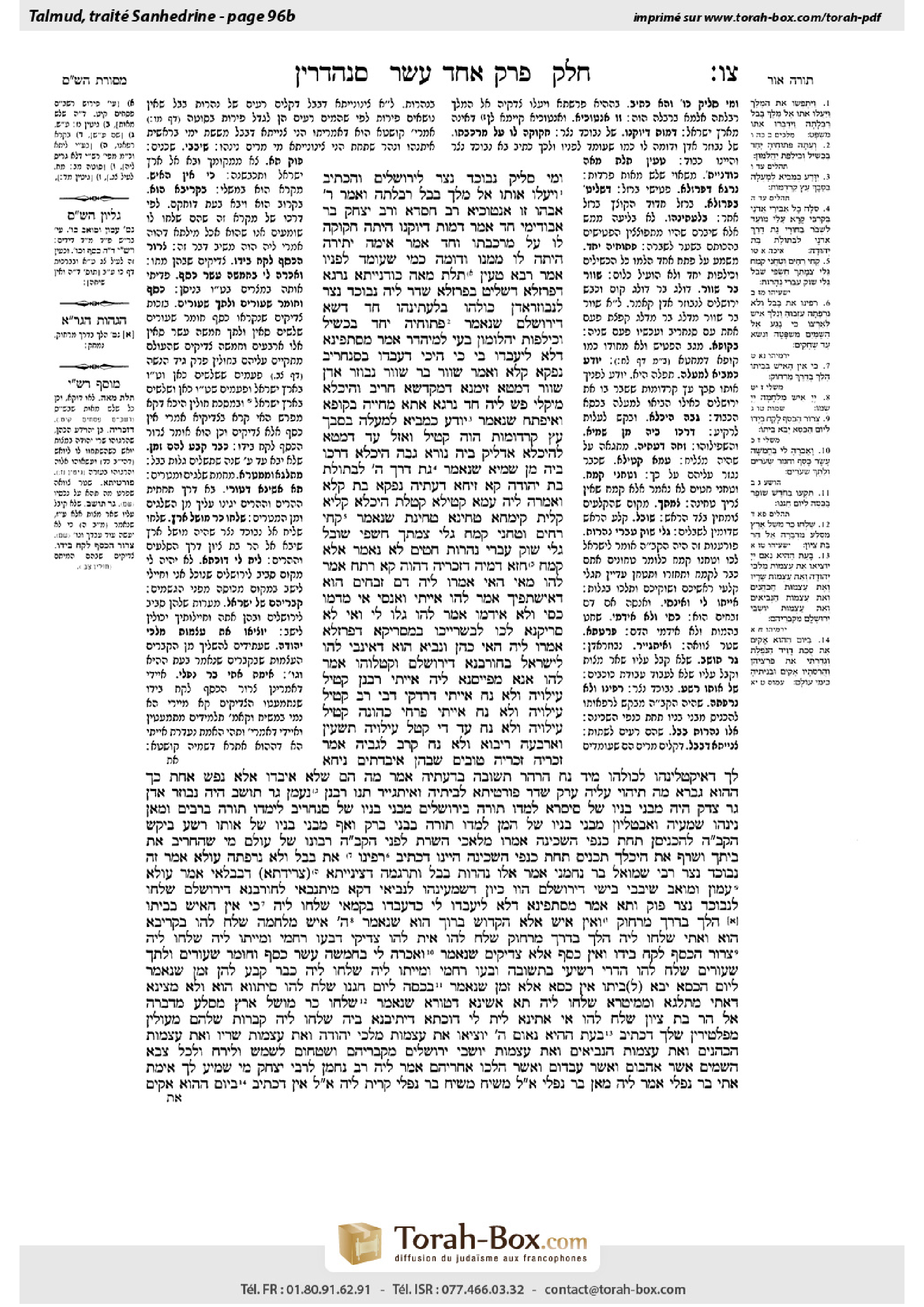
Sanhedrin 96b: Talmud study for Daf Yomi
Daf Yomi is the daily study of one Talmud folio. Explore 37 tractates with scans, Hebrew text, Sefaria English and AI-generated French translations where annotated.
Passage selection and English or AI-generated French translation are available where the scan has annotations. Daf Study is independent of Torah-Box and Sefaria.
Browse Sanhedrin · סנהדרין · All tractatesSanhedrin 96b text and translations
This page of Sanhedrin includes the Aramaic text, an English translation and an AI-generated French translation, alongside the scan above.
סנהדרין צ״ו ב · Aramaic and Hebrew text
וּמִי סְלֵיק נְבוּכַד נֶצַּר לִירוּשָׁלַיִם? וְהָכְתִיב: ״וַיַּעֲלוּ אֹתוֹ אֶל מֶלֶךְ בָּבֶל רִבְלָתָה״, וְאָמַר רַבִּי אֲבָהוּ: זוֹ אַנְטוֹכְיָא! רַב חִסְדָּא וְרַב יִצְחָק בַּר אֲבוּדִימִי, חַד אָמַר: דְּמוּת דְּיוֹקְנוֹ הָיְתָה חֲקוּקָה לוֹ עַל מֶרְכַּבְתּוֹ, וְחַד אָמַר: אֵימָה יְתֵירָה הָיְתָה לוֹ מִמֶּנּוּ וְדוֹמֶה כְּמִי שֶׁעוֹמֵד לְפָנָיו.
אָמַר רָבָא: טְעוֹן תְּלָת מְאָה כּוּדַנְיָיתָא נַרְגָּא דְפַרְזְלָא דְּשָׁלֵיט בְּפַרְזְלָא שַׁדַּר לֵיהּ נְבוּכַדְנֶצַּר לִנְבוּזַרְאֲדָן. כּוּלְּהוּ בְּלַעְתִּינְהוּ חַד דַּשָּׁא דִּירוּשְׁלֶם, שֶׁנֶּאֱמַר: ״פִּתּוּחֶיהָ יָּחַד בְּכַשִּׁיל וְכֵילַפֹּת יַהֲלֹמוּן״. בָּעֵי לְמִיהְדַּר, אָמַר: מִסְתְּפֵינָא דְּלָא לִיעְבְּדוּ בִּי כִּי הֵיכִי דַּעֲבַדוּ בְּסַנְחֵרִיב.
נָפְקָא קָלָא וְאָמַר: ״שָׁוַור בַּר שָׁוַור, נְבוּזַרְאֲדָן, שְׁוַור דִּמְטָא זִימְנָא דְּמַקְדְּשָׁא חֲרִיב וְהֵיכְלָא מִיקְּלֵי״. פָּשׁ לֵיהּ חַד נַרְגָּא. אֲתָא מַחְיֵיהּ בְּקוֹפָא, וְאִיפְּתַח, שֶׁנֶּאֱמַר: ״יִוָּדַע כְּמֵבִיא לְמָעְלָה בִּסְבׇךְ עֵץ קַרְדֻּמּוֹת״.
הֲוָה קָטֵיל וְאָזֵל, עַד דִּמְטָא לְהֵיכְלָא. אַדְלֵיק בֵּיהּ נוּרָא. גְּבַהּ הֵיכְלָא. דְּרַכוּ בֵּיהּ מִן שְׁמַיָּא, שֶׁנֶּאֱמַר: ״גַּת דָּרַךְ ה׳ לִבְתוּלַת בַּת יְהוּדָה״. קָא זִיחָא דַּעְתֵּיהּ. נְפַקָא בַּת קָלָא וַאֲמַרָה לֵיהּ: עַמָּא קְטִילָא קָטְלַתְּ, הֵיכְלָא קַלְיָא קְלֵית, קִימְחָא טְחִינָא טְחֵינְתְּ, שֶׁנֶּאֱמַר: ״קְחִי רֵחַיִם וְטַחֲנִי קָמַח גַּלִּי צַמָּתֵךְ חֶשְׂפִּי שֹׁבֶל גַּלִּי שׁוֹק עִבְרִי נְהָרוֹת״. ״חִטִּים״ לֹא נֶאֱמַר, אֶלָּא ״קֶמַח״.
חֲזָא דְּמֵיהּ דִּזְכַרְיָה דַּהֲוָה קָא רָתַח. אָמַר לְהוּ: מַאי הַאי? אֲמַרוּ לֵיהּ: דַּם זְבָחִים הוּא דְּאִישְׁתְּפִיךְ. אֲמַר לְהוּ: אַיְיתֵי וַאֲנַסֵּי אִי מִדְּמוּ. כַּסִּי וְלָא אִידְּמוֹ. אֲמַר לְהוּ: גַּלּוֹ לִי, וְאִי לָא סָרֵיקְנָא לְכוּ לְבִשְׂרַיְיכוּ בְּמַסְרֵיקָא דְּפַרְזְלָא.
אֲמַרוּ לֵיהּ: הַאי כֹּהֵן וְנָבִיא הוּא, דְּאִינַּבִּי לְהוּ לְיִשְׂרָאֵל בְּחוּרְבָּנָא דִּירוּשְׁלֶם, וְקַטְלוּהּ. אֲמַר לְהוּ: אֲנָא מְפַיֵּיסְנָא לֵיהּ. אַיְיתִי רַבָּנַן, קָטֵיל עִילָּוֵיהּ, וְלָא נָח. אַיְיתִי דַּרְדַּקֵּי דְּבֵי רַב, קָטֵיל עִילָּוֵיהּ, וְלָא נָח. אַיְיתִי פִּרְחֵי כְהוּנָּה, קָטֵיל עִילָּוֵיהּ, וְלָא נָח. עַד דִּי קְטַל עִילָּוֵיהּ תִּשְׁעִין וְאַרְבְּעָה רִיבּוֹא, וְלָא נָח.
קְרַב לְגַבֵּיהּ, אֲמַר: זְכַרְיָה, זְכַרְיָה, טוֹבִים שֶׁבָּהֶן אִיבַּדְתִּים. נִיחָא לָךְ דְּאֶיקְטְלִינְהוּ לְכוּלְּהוּ? מִיָּד נָח. הַרְהַר תְּשׁוּבָה בְּדַעְתֵּיהּ, אֲמַר: מָה הֵם שֶׁלֹּא אִיבְּדוּ אֶלָּא נֶפֶשׁ אַחַת כָּךְ, הָהוּא גַּבְרָא מָה תֶּיהְוֵי עֲלֵיהּ? עֲרַק, שַׁדַּר פּוּרְטֵיתָא לְבֵיתֵיהּ, וְאִיתְגַּיַּיר.
תָּנוּ רַבָּנַן: נַעֲמָן - גֵּר תּוֹשָׁב הָיָה, נְבוּזַר אֲדָן - גֵּר צֶדֶק הָיָה. מִבְּנֵי בָנָיו שֶׁל סִיסְרָא לִמְּדוּ תּוֹרָה בִּירוּשָׁלַיִם, מִבְּנֵי בָנָיו שֶׁל סַנְחֵרִיב לִימְּדוּ תּוֹרָה בָּרַבִּים. וּמַאן נִינְהוּ? שְׁמַעְיָה וְאַבְטַלְיוֹן.
מִבְּנֵי בָּנָיו שֶׁל הָמָן לִמְּדוּ תּוֹרָה בִּבְנֵי בְּרָק. וְאַף מִבְּנֵי בָּנָיו שֶׁל אוֹתוֹ רָשָׁע בִּיקֵּשׁ הַקָּדוֹשׁ בָּרוּךְ הוּא לְהִכְנִיסָן תַּחַת כַּנְפֵי הַשְּׁכִינָה. אָמְרוּ מַלְאֲכֵי הַשָּׁרֵת לִפְנֵי הַקָּדוֹשׁ בָּרוּךְ הוּא: רִבּוֹנוֹ שֶׁל עוֹלָם, מִי שֶׁהֶחֱרִיב אֶת בֵּיתְךָ וְשָׂרַף אֶת הֵיכָלֶךָ תַּכְנִיס תַּחַת כַּנְפֵי הַשְּׁכִינָה? הַיְינוּ דִּכְתִיב: ״רִפִּינוּ אֶת בָּבֶל וְלֹא נִרְפָּתָה״. עוּלָּא אָמַר: זֶה נְבוּכַדְנֶצַּר. רַבִּי שְׁמוּאֵל בַּר נַחְמָנִי אָמַר: אֵלּוּ נַהֲרוֹת בָּבֶל, וְתַרְגֻּמַהּ: צִינְיָיתָא צְרִידָתָא דְּבַבְלָאֵי.
אָמַר עוּלָּא: עַמּוֹן וּמוֹאָב שִׁיבָבֵי בִּישֵׁי דִּירוּשְׁלֶם הֲווֹ. כֵּיוָן דְּשַׁמְעִינְהוּ לִנְבִיאֵי דְּקָא מִיתְנַבְּאִי לְחוּרְבָּנָא דִּירוּשְׁלֶם, שְׁלַחוּ לִנְבוּכַדְנֶצַּר: פּוֹק וְתָא. אָמַר: מִסְתְּפֵינָא דְּלָא לִיעְבְּדוּ לִי כְּדַעֲבַדוּ בְּקַמָּאֵי.
שְׁלַחוּ לֵיהּ: ״כִּי אֵין הָאִישׁ בְּבֵיתוֹ הָלַךְ בְּדֶרֶךְ מֵרָחוֹק״, וְאֵין אִישׁ אֶלָּא הַקָּדוֹשׁ בָּרוּךְ הוּא, שֶׁנֶּאֱמַר: ״ה׳ אִישׁ מִלְחָמָה״. שְׁלַח לְהוּ: בְּקָרִיבָא הוּא וְאָתֵי. שְׁלַחוּ לֵיהּ: ״הָלַךְ בְּדֶרֶךְ מֵרָחוֹק״. שְׁלַח לְהוּ: אִית לְהוּ צַדִּיקֵי דְּבָעוּ רַחֲמֵי וּמַיְיתוּ לֵיהּ.
שְׁלַחוּ לֵיהּ: ״צְרוֹר הַכֶּסֶף לָקַח בְּיָדוֹ״, וְאֵין כֶּסֶף אֶלָּא צַדִּיקִים, שֶׁנֶּאֱמַר: ״וָאֶכְּרֶהָ לִּי בַּחֲמִשָּׁה עָשָׂר כָּסֶף וְחֹמֶר שְׂעֹרִים וְלֵתֶךְ שְׂעֹרִים״.
שְׁלַח לְהוּ: הָדְרִי רַשִּׁיעֵי בִּתְשׁוּבָה, וּבָעוּ רַחֲמֵי וּמַיְיתוּ לֵיהּ. שְׁלַחוּ לֵיהּ: כְּבָר קָבַע לָהֶן זְמַן, שֶׁנֶּאֱמַר ״לְיוֹם הַכֶּסֶא יָבֹא בֵּיתוֹ״. אֵין כֶּסֶא אֶלָּא זְמַן, שֶׁנֶּאֱמַר ״בַּכֵּסֶה לְיוֹם חַגֵּנוּ״. שְׁלַח לְהוּ: סִיתְוָוא הוּא, וְלָא מָצֵינָא דְּאָתֵי מִתַּלְגָא וּמִמִּיטְרָא.
שְׁלַחוּ לֵיהּ: תָּא אַשִּׁינָּא דְּטוּרָא, שֶׁנֶּאֱמַר: ״שִׁלְחוּ כַר מוֹשֵׁל אֶרֶץ מִסֶּלַע מִדְבָּרָה אֶל הַר בַּת צִיּוֹן״. שְׁלַח לְהוּ: אִי אָתֵינָא, לֵית לִי דּוּכְתָּא דְּיָתֵיבְנָא בֵּיהּ. שְׁלַחוּ לֵיהּ: קְבָרוֹת שֶׁלָּהֶם מְעוּלִּין מִפַּלְטֵירִין שֶׁלְּךָ, דִּכְתִיב: ״בָּעֵת הַהִיא נְאֻם ה׳ יוֹצִיאוּ אֶת עַצְמוֹת מַלְכֵי יְהוּדָה וְאֶת עַצְמוֹת שָׂרָיו וְאֶת עַצְמוֹת הַכֹּהֲנִים וְאֵת עַצְמוֹת הַנְּבִיאִים וְאֵת עַצְמוֹת יוֹשְׁבֵי יְרוּשָׁלִָים מִקִּבְרֵיהֶם וּשְׁטָחוּם לַשֶּׁמֶשׁ וְלַיָּרֵחַ וּלְכֹל צְבָא הַשָּׁמַיִם אֲשֶׁר אֲהֵבוּם וַאֲשֶׁר עֲבָדוּם וַאֲשֶׁר הָלְכוּ אַחֲרֵיהֶם״.
אֲמַר לֵיהּ רַב נַחְמָן לְרַבִּי יִצְחָק: מִי שְׁמִיעַ לָךְ אֵימַת אָתֵי בַּר נַפְלֵי? אֲמַר לֵיהּ: מַאן בַּר נַפְלֵי? אֲמַר לֵיהּ: מָשִׁיחַ. מָשִׁיחַ בַּר נַפְלֵי קָרֵית לֵיהּ? אֲמַר לֵיהּ: אִין, דִּכְתִיב ״בַּיּוֹם הַהוּא אָקִים
Sanhedrin 96b · English translation
The Gemara asks: And did Nebuchadnezzar ascend to Jerusalem? But isn’t it written with regard to Zedekiah: “And they took the king, and brought him up to the king of Babylonia, to Riblah” (II Kings 25:6), and Rabbi Abbahu says: This place called Riblah is a reference to Antioch. Apparently, Nebuchadnezzar was in Antioch, not in Jerusalem. Rav Ḥisda and Rav Yitzḥak bar Avudimi resolved this apparent contradiction. One says: An image of Nebuchadnezzar’s likeness was engraved on Nebuzaradan’s chariot, and he regarded that image as though Nebuchadnezzar were actually there. And one says: Nebuzaradan was in extreme fear of Nebuchadnezzar, and it was as though Nebuzaradan was always standing before Nebuchadnezzar. That is an example of the honor of a servant to his master mentioned in the verse.
§ The Gemara proceeds to discuss the role of Nebuzaradan in the destruction of the Temple. Rava says: Nebuchadnezzar sent to Nebuzaradan three hundred mules laden with iron axes that cut iron. All of them were incapacitated in the attempt to breach one gate of Jerusalem, as it is stated: “And now they pound its carved work together with hatchet and with hammers” (Psalms 74:6). Nebuzaradan sought to return to Babylonia and said: I am afraid. I want to ensure that they will not do to me just as they did to Sennacherib, whose downfall was in Jerusalem.
A Divine Voice emerged and said: Leaper, son of a leaper; Nebuzaradan, take the leap, as the time has arrived for the Temple to be destroyed and the Sanctuary to burn. One ax remained for him to use. He went and struck the gate with the dull end of the ax and it opened, as it is stated: “He became known as the wielder of axes upward in a thicket of trees” (Psalms 74:5). At the appropriate time the gate was breached as though the ax were cutting trees.
He was proceeding and killing until he reached the Sanctuary. When he reached the Sanctuary, he ignited a fire in it. The Sanctuary rose, seeking to enter Heaven so that it would not burn. They trod upon it from Heaven and returned it to its place, as it is stated: “The Lord has trodden the virgin, the daughter of Judah, as in a winepress” (Lamentations 1:15). Nebuzaradan became haughty, taking pride in his conquest. A Divine Voice emerged and said to him: Your haughtiness is unwarranted, as you killed a nation that was already dead, you burned a Sanctuary that was already burned, and you ground flour that was already ground, as it is stated with regard to Babylonia: “Take millstones and grind flour; uncover your locks, tuck up the train, uncover the leg, pass over rivers” (Isaiah 47:2). It was not stated: Grind wheat, but “grind flour,” indicating that all the destruction had already been wrought by God, and the role played by the enemy was insignificant.
When he reached the Sanctuary, he saw the blood of Zechariah the priest boiling. It had not calmed since he was killed in the Temple (see II Chronicles 24:20–22). Nebuzaradan said to the priests there: What is this? They said to him: It is the blood of offerings that was spilled. Nebuzaradan said to them: Bring animals and I will test to determine if the blood of the animals is similar to the blood that is boiling. He slaughtered the animals and their blood was not similar to the boiling blood. Nebuzaradan said to the priests: Reveal the source of that blood to me, and if not I will comb your flesh with an iron comb.
The priests said to Nebuzaradan: This blood is the blood of a priest and a prophet who prophesied for the Jewish people with regard to the destruction of Jerusalem and whom they killed. He said to the priests: I will pacify the blood so the boiling will stop. He brought the Sages and killed them over the blood and its boiling did not cease. He brought schoolchildren and killed them over the blood and its boiling did not cease. He brought young priests and killed them over the blood and its boiling did not cease. He continued killing until he killed 940,000 people over the blood, and its boiling did not cease.
Nebuzaradan approached the blood and said: Zechariah, Zechariah, the worthy among them I killed on your behalf. Is it satisfactory for you that I kill them all? Immediately the boiling ceased. Nebuzaradan contemplated repentance. He said: If they, who caused only one person to perish, gained atonement only after all this killing, then with regard to that man, referring to himself, what will be required for him to gain atonement? He deserted his army and dispatched a last will to his house and converted.
The Sages taught in a baraita: Naaman the Aramean (see II Kings, chapter 5) was a ger toshav, meaning that he accepted upon himself to refrain from idol worship but did not convert to Judaism. Nebuzaradan was a completely righteous convert. Among the descendants of Sisera (see Judges, chapter 4) were those who studied Torah in Jerusalem. Among the descendants of Sennacherib were those who taught Torah in public. The Gemara asks: And who are they? The Gemara answers: They were Shemaya and Avtalyon.
The baraita continues: Among the descendants of Haman were those who studied Torah in Bnei Brak. And even among the descendants of that wicked person, Nebuchadnezzar, were those whom the Holy One, Blessed be He, sought to bring beneath the wings of the Divine Presence and have them convert. The ministering angels said before the Holy One, Blessed be He: Master of the Universe: The one who destroyed Your House and burned Your Sanctuary, will You introduce him beneath the wings of the Divine Presence? The Gemara explains: That is the meaning of that which is written: “We have healed Babylonia, but she is not healed” (Jeremiah 51:9). Ulla says: This verse is a reference to Nebuchadnezzar, none of whose children converted. Rabbi Shmuel bar Naḥmani says: This is not a reference to a person; rather, these are the rivers of Babylonia, and interpret it as referring to the bitter saltwater rivers of Babylonia.
§ On a related note, the Gemara describes the events that led to the destruction of the Temple. Ulla says: Ammon and Moab were bad neighbors of Jerusalem. Once they heard the prophets who prophesied about the destruction of the Jerusalem, they sent to Nebuchadnezzar: Emerge from your dwelling place and come conquer them. Nebuchadnezzar said to them: I am afraid. I want to ensure that they will not do to me just as they did to my predecessors.
Ammon and Moab sent to him that it is written: “For the ish is not at home; he is gone on a long journey” (Proverbs 7:19), and ish is referring to no one but the Holy One, Blessed be He, as it is stated: “The Lord is an ish of war” (Exodus 15:3). Nebuchadnezzar sent to them in response: He is in a nearby location, and He will come. They sent to Nebuchadnezzar: “He has gone on a journey from afar” (Proverbs 7:19). Nebuchadnezzar said to them: They have righteous among them who will pray for mercy and bring Him to return.
Ammon and Moab sent to Nebuchadnezzar: “He has taken a bundle of kesef with him” (Proverbs 7:20), and kesef is referring to nothing other than the righteous, as it is stated: “So I bought her to me for fifteen pieces of kesef and for a kor of barley and a half-kor of barley” (Hosea 3:2). The inference is that God acquired the congregation of Israel due to the presence of righteous people among them, and Ammon and Moab sent a message to Nebuchadnezzar that God had already taken the righteous and they no longer offered protection.
Nebuchadnezzar sent to them: Perhaps the wicked will repent and become righteous and they will pray for mercy and they will bring Him to return. Ammon and Moab sent to Nebuchadnezzar: God already designated the time of their redemption, as it is stated: “On the day of the keseh, He will come home” (Proverbs 7:20), and keseh is referring to nothing other than a designated time, as it is stated: “Sound a shofar at the New Moon, at the keseh on the day of our feast” (Psalms 81:4). Since there is a time designated for redemption, until then you can do as you please. Nebuchadnezzar sent to them: It is winter now and I cannot come and conquer Jerusalem due to the snow and the rain.
Ammon and Moab sent to him: Come on the peaks of mountains, where the rain does not pool, as it is stated: “Send the lamb to the ruler of the land from the peaks of the wilderness to the mount of the daughter of Zion” (Isaiah 16:1). Nebuchadnezzar sent to them: If I come to Jerusalem, I will have no place to dwell while laying siege to the city. Ammon and Moab sent to him: Their burial caves are superior to your palaces, and you can clear the caves and dwell there, as it is written: “At that time, says the Lord, they shall remove the bones of the kings of Judea, and the bones of his princes, and the bones of the priests, and the bones of the prophets and the bones of the inhabitants of Jerusalem from their graves; and they shall spread them before the sun and the moon and all of the hosts of heaven, whom they have loved, and whom they have served, and after whom they have walked” (Jeremiah 8:1–2). Ultimately Nebuchadnezzar came to conquer Judea and removed the corpses to make room for his army.
§ Rav Naḥman said to Rabbi Yitzḥak: Have you heard when the son of giants [bar niflei] will come? Rabbi Yitzḥak said to him: Who is the son of giants? Rav Naḥman said to him: He is the Messiah. Rabbi Yitzḥak asked him: Do you call the Messiah son of giants? Rav Naḥman said to him: Yes, as it is written: “On that day I will establish
Sanhedrin 96b · Traduction française (IA)
La Guemara demande : Nabuchodonosor est-il donc monté à Jérusalem ? Pourtant, à propos de Sédécias, il est écrit : « Ils saisirent le roi et l’amenèrent auprès du roi de Babylone, à Ribla » (II Rois 25:6), et Rabbi Abbahou dit que le lieu appelé Ribla désigne Antioche. Il semble donc que Nabuchodonosor se trouvait à Antioche, et non à Jérusalem. Rav Ḥisda et Rav Yitzḥak bar Avudimi résolvent cette contradiction apparente. Selon l’un, une image de Nabuchodonosor était gravée sur le char de Nebuzaradan, et celui-ci considérait cette image comme si Nabuchodonosor était réellement présent. Selon l’autre, Nebuzaradan craignait tellement Nabuchodonosor qu’il lui semblait toujours se tenir devant lui. Voilà un exemple de l’honneur qu’un serviteur rend à son maître, mentionné dans le verset.
§ La Guemara poursuit en évoquant le rôle de Nebuzaradan dans la destruction du Temple. Rava dit : Nabuchodonosor envoya à Nebuzaradan trois cents mulets chargés de haches de fer capables de trancher le fer. Toutes furent mises hors d’usage en tentant de forcer une seule porte de Jérusalem, comme il est dit : « Et maintenant, ils martèlent ensemble ses boiseries sculptées avec des haches et des marteaux » (Psaumes 74:6). Nebuzaradan voulut retourner à Babylone et dit : « J’ai peur. Je veux m’assurer qu’ils ne me feront pas ce qu’ils ont fait à Sennachérib », dont la défaite survint à Jérusalem.
Une Voix céleste se fit entendre et dit : « Sauteur, fils de sauteur, Nebuzaradan, fais le saut, car le moment est venu de détruire le Temple et d’incendier le Sanctuaire. » Il ne lui restait qu’une hache à utiliser. Il alla frapper la porte avec le côté émoussé de la hache, et elle s’ouvrit, comme il est dit : « Il s’est fait connaître comme celui qui brandit des haches en haut, dans un fourré d’arbres » (Psaumes 74:5). Au moment opportun, la porte fut forcée comme si la hache coupait des arbres.
Il avançait en tuant jusqu’à parvenir au Sanctuaire. Lorsqu’il y parvint, il y mit le feu. Le Sanctuaire s’éleva, cherchant à monter au Ciel pour ne pas brûler. Depuis le Ciel, on le piétina et on le ramena à sa place, comme il est dit : « Le Seigneur a foulé aux pieds la vierge, la fille de Juda, comme dans un pressoir » (Lamentations 1:15). Nebuzaradan s’enorgueillit et tira fierté de sa conquête. Une Voix céleste se fit entendre et lui dit : « Ton orgueil est injustifié, car tu as tué une nation qui était déjà morte, brûlé un Sanctuaire qui était déjà brûlé et moulu de la farine qui était déjà moulue », comme il est dit à propos de Babylone : « Prends des meules et mouds de la farine ; découvre tes boucles, retrousse ta traîne, découvre ta jambe, traverse les fleuves » (Isaïe 47:2). Il n’est pas dit : « Mouds le blé », mais « mouds de la farine », ce qui indique que toute la destruction avait déjà été accomplie par Dieu et que le rôle joué par l’ennemi était insignifiant.
Lorsqu’il parvint au Sanctuaire, il vit le sang du prêtre Zacharie bouillonner. Il ne s’était pas apaisé depuis que Zacharie avait été tué dans le Temple (voir II Chroniques 24:20–22). Nebuzaradan dit aux prêtres qui se trouvaient là : « Qu’est-ce que cela ? » Ils lui répondirent : « C’est le sang des sacrifices qui a été répandu. » Nebuzaradan leur dit : « Amenez des animaux, et je vérifierai si leur sang ressemble au sang qui bouillonne. » Il égorgea les animaux, mais leur sang ne ressemblait pas au sang bouillonnant. Nebuzaradan dit aux prêtres : « Révélez-moi l’origine de ce sang, sinon je vous peignerai la chair avec un peigne de fer. »
Les prêtres dirent à Nebuzaradan : « Ce sang est celui d’un prêtre et d’un prophète qui prophétisa au peuple juif la destruction de Jérusalem et que l’on a tué. » Il leur dit : « Je vais apaiser le sang afin qu’il cesse de bouillonner. » Il amena les Sages et les tua au-dessus du sang, mais celui-ci ne cessa pas de bouillonner. Il amena des écoliers et les tua au-dessus du sang, mais celui-ci ne cessa pas de bouillonner. Il amena de jeunes prêtres et les tua au-dessus du sang, mais celui-ci ne cessa pas de bouillonner. Il continua à tuer jusqu’à avoir tué 940 000 personnes au-dessus du sang, mais celui-ci ne cessa pas de bouillonner.
Nebuzaradan s’approcha du sang et dit : « Zacharie, Zacharie, j’ai tué pour toi les meilleurs d’entre eux. Es-tu satisfait que je les tue tous ? » Aussitôt, le sang cessa de bouillonner. Nebuzaradan envisagea de se repentir. Il se dit : « Si ceux qui n’ont fait périr qu’une seule personne n’ont obtenu l’expiation qu’après tout ce massacre, que faudra-t-il donc pour que cet homme — c’est-à-dire moi-même — obtienne l’expiation ? » Il abandonna son armée, envoya ses dernières volontés chez lui et se convertit.
Les Sages ont enseigné dans une baraïta : Naaman l’Araméen (voir II Rois, chapitre 5) était un guer tochav, c’est-à-dire qu’il avait accepté de s’abstenir de pratiquer l’idolâtrie, mais ne s’était pas converti au judaïsme. Nebuzaradan était un converti parfaitement juste. Parmi les descendants de Sisera (voir Juges, chapitre 4), certains étudièrent la Torah à Jérusalem. Parmi les descendants de Sennachérib, certains enseignèrent la Torah en public. La Guemara demande : « Qui étaient-ils ? » La Guemara répond : « Chemaya et Avtalyon. »
La baraïta poursuit : Parmi les descendants de Haman, certains étudièrent la Torah à Bné Brak. Et même parmi les descendants de ce méchant, Nabuchodonosor, il y en eut que le Saint, béni soit-Il, voulut faire entrer sous les ailes de la Présence divine et convertir. Les anges de service dirent devant le Saint, béni soit-Il : « Maître de l’Univers, celui qui a détruit Ta Maison et brûlé Ton Sanctuaire, veux-Tu le faire entrer sous les ailes de la Présence divine ? » La Guemara explique : C’est le sens de ce qui est écrit : « Nous avons soigné Babylone, mais elle n’est pas guérie » (Jérémie 51:9). Oulla dit que ce verset fait référence à Nabuchodonosor, dont aucun enfant ne s’est converti. Rabbi Shmuel bar Naḥmani dit que cela ne fait pas référence à une personne ; il s’agit plutôt des fleuves de Babylone, et il faut comprendre que le verset parle des fleuves salés et amers de Babylone.
§ À ce propos, la Guemara décrit les événements qui ont mené à la destruction du Temple. Oulla dit : Ammon et Moab étaient de mauvais voisins de Jérusalem. Lorsqu’ils entendirent les prophètes annoncer la destruction de Jérusalem, ils envoyèrent ce message à Nabuchodonosor : « Sors de ton lieu de résidence et viens les conquérir. » Nabuchodonosor leur répondit : « J’ai peur. Je veux m’assurer qu’ils ne me feront pas ce qu’ils ont fait à mes prédécesseurs. »
Ammon et Moab lui envoyèrent ce verset : « Car l’ish n’est pas à la maison ; il est parti pour un long voyage » (Proverbes 7:19). Ish ne désigne nul autre que le Saint, béni soit-Il, comme il est dit : « Le Seigneur est un ish de guerre » (Exode 15:3). Nabuchodonosor leur répondit : « Il est dans un endroit proche et Il reviendra. » Ils envoyèrent à Nabuchodonosor : « Il est parti pour un voyage lointain » (Proverbes 7:19). Nabuchodonosor leur dit : « Il y a parmi eux des justes qui prieront pour obtenir miséricorde et Le feront revenir. »
Ammon et Moab envoyèrent à Nabuchodonosor : « Il a emporté avec lui un paquet de kesef » (Proverbes 7:20), et kesef ne désigne rien d’autre que les justes, comme il est dit : « Je l’ai achetée pour moi pour quinze pièces de kesef, un kor d’orge et un demi-kor d’orge » (Osée 3:2). On en déduit que Dieu a acquis l’assemblée d’Israël en raison de la présence de justes parmi eux. Ammon et Moab firent savoir à Nabuchodonosor que Dieu avait déjà emmené les justes et qu’ils n’offraient donc plus de protection.
Nabuchodonosor leur répondit : « Peut-être les méchants se repentiront-ils, deviendront-ils justes, prieront-ils pour obtenir miséricorde et Le feront-ils revenir. » Ammon et Moab envoyèrent à Nabuchodonosor : « Dieu a déjà fixé le moment de leur délivrance », comme il est dit : « Au jour du keseh, il rentrera chez lui » (Proverbes 7:20). Keseh ne désigne rien d’autre qu’un moment fixé, comme il est dit : « Sonnez du chofar à la nouvelle lune, au keseh, au jour de notre fête » (Psaumes 81:4). Puisqu’un moment a été fixé pour la délivrance, tu peux faire ce que tu veux jusque-là. Nabuchodonosor leur répondit : « C’est l’hiver à présent, et je ne peux venir conquérir Jérusalem à cause de la neige et de la pluie. »
Ammon et Moab lui envoyèrent : « Viens par les sommets des montagnes, où la pluie ne s’accumule pas », comme il est dit : « Envoyez l’agneau au souverain du pays, des sommets du désert au mont de la fille de Sion » (Isaïe 16:1). Nabuchodonosor leur répondit : « Si je viens à Jérusalem, je n’aurai aucun endroit où loger pendant le siège de la ville. » Ammon et Moab lui envoyèrent : « Leurs caveaux funéraires sont meilleurs que tes palais ; tu peux vider les caveaux et y habiter », comme il est écrit : « En ce temps-là, dit le Seigneur, on retirera des tombes les os des rois de Juda, les os de ses princes, les os des prêtres, les os des prophètes et les os des habitants de Jérusalem ; on les étendra devant le soleil, la lune et toute l’armée des cieux, qu’ils ont aimés, qu’ils ont servis et suivis » (Jérémie 8:1–2). Finalement, Nabuchodonosor vint conquérir la Judée et fit enlever les cadavres pour faire de la place à son armée.
§ Rav Naḥman dit à Rabbi Yitzḥak : « As-tu entendu quand viendra le fils des géants [bar niflei] ? » Rabbi Yitzḥak lui dit : « Qui est le fils des géants ? » Rav Naḥman lui répondit : « C’est le Messie. » Rabbi Yitzḥak lui demanda : « Appelles-tu le Messie le fils des géants ? » Rav Naḥman lui répondit : « Oui, car il est écrit : “En ce jour, j’établirai”
Traduction française générée par IA à partir de l’édition anglaise de Sefaria. Vérifie toujours un passage avec le texte source.
Text from Sefaria: William Davidson Edition - Vocalized Aramaic (CC BY NC); William Davidson Edition - English (CC BY NC).