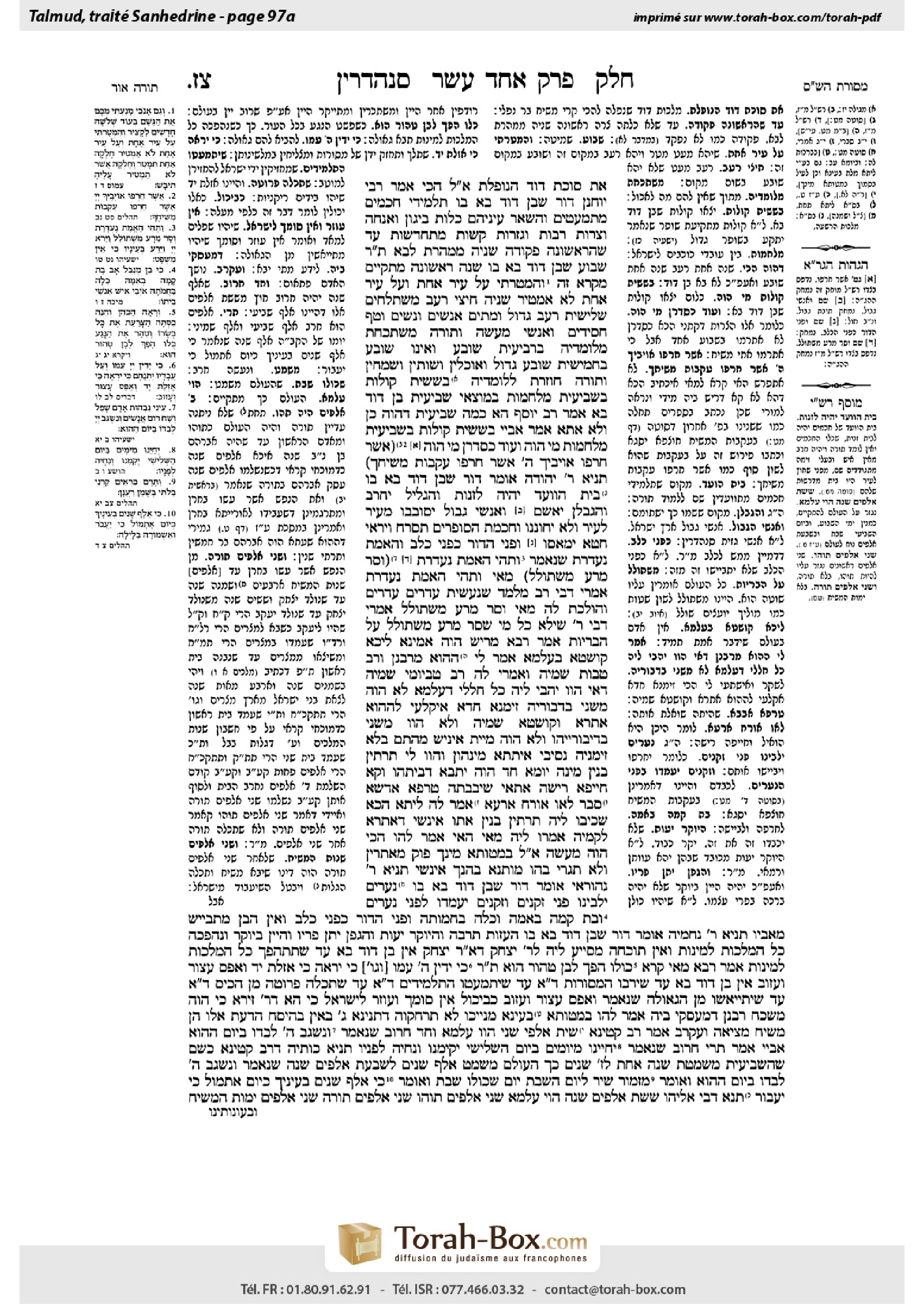
Sanhedrin 97a: Talmud study for Daf Yomi
Daf Yomi is the daily study of one Talmud folio. Explore 37 tractates with scans, Hebrew text, Sefaria English and AI-generated French translations where annotated.
Passage selection and English or AI-generated French translation are available where the scan has annotations. Daf Study is independent of Torah-Box and Sefaria.
Browse Sanhedrin · סנהדרין · All tractatesSanhedrin 97a text and translations
This page of Sanhedrin includes the Aramaic text, an English translation and an AI-generated French translation, alongside the scan above.
סנהדרין צ״ז א · Aramaic and Hebrew text
אֶת סֻכַּת דָּוִיד הַנֹּפֶלֶת״. אֲמַר לֵיהּ: הָכִי אָמַר רַבִּי יוֹחָנָן: דּוֹר שֶׁבֶּן דָּוִד בָּא בּוֹ, תַּלְמִידֵי חֲכָמִים מִתְמַעֲטִים, וְהַשְּׁאָר עֵינֵיהֶם כָּלוֹת בְּיָגוֹן וַאֲנָחָה, וְצָרוֹת רַבּוֹת וּגְזֵרוֹת קָשׁוֹת מִתְחַדְּשׁוֹת, עַד שֶׁהָרִאשׁוֹנָה פְּקוּדָה, שְׁנִיָּה מְמַהֶרֶת לָבֹא.
תָּנוּ רַבָּנַן: שָׁבוּעַ שֶׁבֶּן דָּוִד בָּא בּוֹ, שָׁנָה רִאשׁוֹנָה מִתְקַיֵּים מִקְרָא זֶה ״וְהִמְטַרְתִּי עַל עִיר אֶחָת וְעַל עִיר אַחַת לֹא אַמְטִיר״. שְׁנִיָּה, חִיצֵּי רָעָב מִשְׁתַּלְּחִים. שְׁלִישִׁית, רָעָב גָּדוֹל, וּמֵתִים אֲנָשִׁים וְנָשִׁים וָטַף, חֲסִידִים וְאַנְשֵׁי מַעֲשֶׂה, וְתוֹרָה מִשְׁתַּכַּחַת מִלּוֹמְדֶיהָ. בִּרְבִיעִית, שׂוֹבַע וְאֵינוֹ שׂוֹבַע. בַּחֲמִישִׁית, שׂוֹבַע גָּדוֹל, וְאוֹכְלִין וְשׁוֹתִין וּשְׂמֵחִין, וְתוֹרָה חוֹזֶרֶת לְלוֹמְדֶיהָ. בְּשִׁשִּׁית, קוֹלוֹת. בִּשְׁבִיעִית, מִלְחָמוֹת. בְּמוֹצָאֵי שְׁבִיעִית, בֶּן דָּוִד בָּא.
אָמַר רַב יוֹסֵף: הָא כַּמָּה שָׁבוּעֵי דַּהֲוָה כֵּן, וְלָא אֲתָא! אָמַר אַבָּיֵי: בְּשִׁשִּׁית קוֹלוֹת, בִּשְׁבִיעִית מִלְחָמוֹת – מִי הֲוָה? וְעוֹד, כְּסִדְרָן מִי הֲוָה?
״אֲשֶׁר חֵרְפוּ אוֹיְבֶיךָ ה׳ אֲשֶׁר חֵרְפוּ עִקְּבוֹת מְשִׁיחֶךָ״. תַּנְיָא: רַבִּי יְהוּדָה אוֹמֵר, דּוֹר שֶׁבֶּן דָּוִד בָּא בּוֹ – בֵּית הַוַּועַד יִהְיֶה לִזְנוּת, וְהַגָּלִיל יֶחֱרַב, וְהַגַּבְלָן יֵאשַׁם, וְאַנְשֵׁי גְבוּל יְסוֹבְבוּ מֵעִיר לָעִיר וְלֹא יְחוֹנָנוּ, וְחׇכְמַת הַסּוֹפְרִים תִּסְרַח, וְיִרְאֵי חֵטְא יִמָּאֵסוּ, וּפְנֵי הַדּוֹר כִּפְנֵי כֶלֶב.
״וְהָאֱמֶת נֶעְדֶּרֶת״, שֶׁנֶּאֱמַר: ״וַתְּהִי הָאֱמֶת נֶעְדֶּרֶת וְסָר מֵרָע מִשְׁתּוֹלֵל״. מַאי ״וַתְּהִי הָאֱמֶת נֶעְדֶּרֶת״? אָמְרִי דְּבֵי רַב: מְלַמֵּד שֶׁנַּעֲשֵׂית עֲדָרִים עֲדָרִים וְהוֹלֶכֶת לָהּ. מַאי ״וְסָר מֵרָע מִשְׁתּוֹלֵל״? אָמְרִי דְּבֵי רַבִּי שֵׁילָא: כׇּל מִי שֶׁסָּר מֵרָע מִשְׁתּוֹלֵל עַל הַבְּרִיּוֹת.
אָמַר רָבָא: מֵרֵישׁ הֲוָה אָמֵינָא, לֵיכָּא קוּשְׁטָא בְּעָלְמָא. אֲמַר לִי הָהוּא מֵרַבָּנַן, וְרַב טָבוּת שְׁמֵיהּ – וְאָמְרִי לַהּ רַב טָבְיוֹמֵי שְׁמֵיהּ – דְּאִי הֲווֹ יָהֲבִי לֵיהּ כֹּל חֲלָלֵי דְּעָלְמָא לָא הֲוָה מְשַׁנֵּי בְּדִיבּוּרֵיהּ. זִימְנָא חֲדָא אִיקְּלַעִי לְהָהוּא אַתְרָא, וְקוּשְׁטָא שְׁמֵיהּ, וְלָא הֲווֹ מְשַׁנֵּי בְּדִיבּוּרַיְיהוּ, וְלָא הֲוָה מָיֵית אִינִישׁ מֵהָתָם בְּלָא זִימְנֵיהּ. נְסֵיבִי אִיתְּתָא מִינְּהוֹן, וַהֲווֹ לִי תְּרֵין בְּנִין מִינַּהּ.
יוֹמָא חַד הֲוָה יָתְבָא דְּבֵיתְהוּ וְקָא חָיְיפָא רֵישָׁא. אֲתַאי שִׁיבָבְתַהּ, טְרַפָא אַדַּשָּׁא. סְבַרִי: לָאו אוֹרַח אַרְעָא. אֲמַרִי לַהּ: לֵיתַהּ הָכָא. שְׁכִיבוּ לֵיהּ תְּרֵין בְּנֵיהּ. אֲתוֹ אִינָשֵׁי דְּאַתְרָא לְקַמֵּיהּ, אֲמַרוּ לֵיהּ: מַאי הַאי? אֲמַר לְהוּ: הָכִי הֲוָה מַעֲשֶׂה. אֲמַרוּ לֵיהּ: בְּמָטוּתָא מִינָּךְ, פּוֹק מֵאַתְרִין וְלָא תְּגָרֵי בְּהוּ מוֹתָנָא בְּהָנָךְ אִינָשֵׁי.
תַּנְיָא: רַבִּי נְהוֹרַאי אוֹמֵר, דּוֹר שֶׁבֶּן דָּוִד בָּא בּוֹ – נְעָרִים יַלְבִּינוּ פְּנֵי זְקֵנִים, וּזְקֵנִים יַעַמְדוּ לִפְנֵי נְעָרִים, וּבַת קָמָה בְּאִמָּהּ, וְכַלָּה בַּחֲמוֹתָהּ, וּפְנֵי הַדּוֹר כִּפְנֵי כֶלֶב, וְאֵין הַבֵּן מִתְבַּיֵּישׁ מֵאָבִיו.
תַּנְיָא: רַבִּי נְחֶמְיָה אוֹמֵר, דּוֹר שֶׁבֶּן דָּוִד בָּא בּוֹ, הָעַזּוּת תִּרְבֶּה, וְהַיּוֹקָר יְעַוֵּת, וְהַגֶּפֶן יִתֵּן פִּרְיוֹ וְהַיַּיִן בְּיוֹקֶר, וְנֶהֱפָכָה כׇּל הַמַּלְכוּת לְמִינוּת, וְאֵין תּוֹכֵחָה. מְסַיַּיע לֵיהּ לְרַבִּי יִצְחָק, דְּאָמַר רַבִּי יִצְחָק: אֵין בֶּן דָּוִד בָּא עַד שֶׁתִּתְהַפֵּךְ כׇּל הַמַּלְכוּת לְמִינוּת. אָמַר רָבָא: מַאי קְרָא? ״כֻּלּוֹ הָפַךְ לָבָן טָהוֹר הוּא״.
תָּנוּ רַבָּנַן: ״כִּי יָדִין ה׳ עַמּוֹ [וְגוֹ׳] כִּי יִרְאֶה כִּי אָזְלַת יָד וְאֶפֶס עָצוּר וְעָזוּב״. אֵין בֶּן דָּוִד בָּא עַד שֶׁיִּרְבּוּ הַמָּסוֹרוֹת. דָּבָר אַחֵר: עַד שֶׁיִּתְמַעֲטוּ הַתַּלְמִידִים. דָּבָר אַחֵר: עַד שֶׁתִּכְלֶה פְּרוּטָה מִן הַכִּיס. דָּבָר אַחֵר: עַד שֶׁיִּתְיָיאֲשׁוּ מִן הַגְּאוּלָּה, שֶׁנֶּאֱמַר: ״וְאֶפֶס עָצוּר וְעָזוּב״ – כִּבְיָכוֹל אֵין סוֹמֵךְ וְעוֹזֵר לְיִשְׂרָאֵל.
כִּי הָא דְּרַבִּי זֵירָא, כִּי הֲוָה מַשְׁכַּח רַבָּנַן דְּמִעַסְּקִי בֵּיהּ, אֲמַר לְהוּ: בְּמָטוּתָא, בָּעֵינָא מִנַּיְיכוּ לָא תְּרַחֲקוּהּ, דִּתְנֵינָא: שְׁלֹשָׁה בָּאִין בְּהֶיסַּח הַדַּעַת, אֵלּוּ הֵן: מָשִׁיחַ, מְצִיאָה, וְעַקְרָב.
אָמַר רַב קַטִּינָא: שֵׁית אַלְפֵי שְׁנֵי הָוֵי עָלְמָא, וְחַד חָרוּב, שֶׁנֶּאֱמַר: ״וְנִשְׂגַּב ה׳ לְבַדּוֹ בַּיּוֹם הַהוּא״. אַבָּיֵי אָמַר: תְּרֵי חָרוּב, שֶׁנֶּאֱמַר: ״יְחַיֵּינוּ מִיֹּמָיִם בַּיּוֹם הַשְּׁלִישִׁי יְקִמֵנוּ וְנִחְיֶה לְפָנָיו״.
תַּנְיָא כְּוָתֵיהּ דְּרַב קַטִּינָא: כְּשֵׁם שֶׁהַשְּׁבִיעִית מְשַׁמֶּטֶת שָׁנָה אַחַת לְשֶׁבַע שָׁנִים, כָּךְ הָעוֹלָם מְשַׁמֵּט אֶלֶף שָׁנִים לְשִׁבְעַת אֲלָפִים שָׁנָה, שֶׁנֶּאֱמַר: ״וְנִשְׂגַּב ה׳ לְבַדּוֹ בַּיּוֹם הַהוּא״, וְאוֹמֵר: ״מִזְמוֹר שִׁיר לְיוֹם הַשַּׁבָּת״ – יוֹם שֶׁכּוּלּוֹ שַׁבָּת. וְאוֹמֵר: ״כִּי אֶלֶף שָׁנִים בְּעֵינֶיךָ כְּיוֹם אֶתְמוֹל כִּי יַעֲבֹר״.
תָּנָא דְּבֵי אֵלִיָּהוּ: שֵׁשֶׁת אֲלָפִים שָׁנָה הָוֵי עָלְמָא, שְׁנֵי אֲלָפִים תּוֹהוּ, שְׁנֵי אֲלָפִים תּוֹרָה, שְׁנֵי אֲלָפִים יְמוֹת הַמָּשִׁיחַ.
Sanhedrin 97a · English translation
the Tabernacle of David that is fallen [hanofelet]” (Amos 9:11). That is why the Messiah is called bar nifli. Rabbi Yitzḥak said to him that this is what Rabbi Yoḥanan says: During the generation in which the Messiah, son of David, comes, Torah scholars decrease; and as for the rest of the people, their eyes fail with sorrow and grief, and troubles increase. And the harsh decrees will be introduced; before the first passes the second quickly comes.
The Sages taught in a baraita: With regard to the seven-year period, i.e., the Sabbatical cycle, during which the Messiah, son of David, comes: During the first year, this verse will be fulfilled: “And I will cause it to rain upon one city and cause it not to rain upon another city” (Amos 4:7). During the second year of that period, arrows of famine will be shot, indicating that there will be famine only in certain places. During the third year there will be a great famine, and men, women, children, the pious, and men of action will die, and the Torah is forgotten by those who study it. During the fourth year there will be plenty but not great plenty. During the fifth year there will be great plenty and they will eat, and drink, and rejoice, and the Torah will return to those who study it. During the sixth year, heavenly voices will be heard. During the Sabbatical Year, wars, e.g., the war of Gog and Magog, will be waged involving the Jewish people. During the year after the conclusion of the Sabbatical Year, the son of David will come.
Rav Yosef said: Haven’t there been several Sabbatical cycles during which events transpired in that manner and nevertheless, the Messiah did not come? Abaye said: Have the phenomena: During the sixth year, heavenly voices, and during the Sabbatical Year, wars, transpired? And furthermore, have all these phenomena transpired in the order in which they were listed in the baraita?
The verse states: “That Your enemies taunted, Lord, that they have taunted the footsteps of Your anointed” (Psalms 89:52). It is taught in a baraita that Rabbi Yehuda says: During the generation that the son of David comes, the hall of the assembly of the Sages will be designated for prostitution, and the Galilee will be destroyed, and the Gavlan, i.e., Bashan, will be desolate, and the residents of the border who flee the neighboring gentiles will circulate from city to city and will receive no sympathy. The wisdom of scholars will diminish, and sin-fearing people will be despised. And the face of the generation will be like the face of a dog in its impudence and shamelessness.
And the truth will be lacking, as it is stated: “And the truth is lacking [ne’ederet], and he who departs from evil is negated” (Isaiah 59:15). What is the meaning of the phrase: And the truth is lacking [ne’ederet]? The Sages of the study hall of Rav said: This teaches that truth will become like so many flocks [adarim] and walk away. What is the meaning of the phrase: “And he that departs from evil is negated”? The Sages of the study hall of Rabbi Sheila said: Anyone who deviates from evil is deemed insane by the people.
§ Concerning the lack of truth, Rava says: Initially I would say that there is no truth anywhere in the world. There was a certain one of the Sages, and Rav Tavut is his name, and some say Rav Tavyomei is his name, who was so honest that if they were to give him the entire world, he would not deviate from the truth in his statement. He said to me: One time I happened to come to a certain place, and Truth is its name, and its residents would not deviate from the truth in their statements, and no person from there would die prematurely. I married a woman from among them, and I had two sons from her.
One day his wife was sitting and washing the hair on her head. Her neighbor came and knocked on the door. He thought: It is not proper conduct to tell the neighbor that his wife is bathing. He said to her: She is not here. Since he deviated from the truth his two sons died. The people residing in that place came before him and said to him: What is the meaning of this? He said to them: This was the nature of the incident, and told them what happened. They said to him: Please leave our place and do not provoke premature death upon these people.
The Gemara resumes its discussion of the messianic period. It is taught in a baraita that Rabbi Nehorai says: During the generation in which the son of David comes, youths will humiliate elders and elders will stand in deference before youths, and a daughter will rebel against her mother, and a bride against her mother-in-law, and the face of the generation will be like the face of a dog, and a son will not be ashamed before his father.
It is taught in a baraita that Rabbi Neḥemya says: During the generation that the son of David comes, arrogance will proliferate and the cost of living will corrupt people so they will engage in deceit. The vine will produce its fruit, and nevertheless, the wine will be costly. And the entire gentile monarchy will be converted to the heresy of Christianity, and there will be no inclination among the people to accept rebuke. This baraita supports the opinion of Rabbi Yitzḥak, as Rabbi Yitzḥak says: The son of David will not come until the entire kingdom will be converted to heresy. Rava says: What is the verse from which this statement is derived? It is the verse: “It is all turned white; he is ritually pure” (Leviticus 13:13). One is a leper and ritually impure only if he has a leprous mark, however small, but not if his skin is completely leprous. Similarly, the world will be redeemed only when the Jewish people reach their lowest point.
The Sages taught in a baraita: The verse states: “For the Lord shall judge His people and atone for His servants, when He sees that their power is gone and there is none shut up or left” (Deuteronomy 32:36). From the phrase “their power is gone” it is derived that the son of David will not come until informers will proliferate. Alternatively, the Messiah will not come until the number of students of Torah diminishes. Alternatively, the Messiah will not come until the peruta will cease from the purse. Alternatively, the Messiah will not come until they despair from the redemption, as it is stated: “And there is none shut up or left,” as though there were no supporter or helper for the Jewish people.
This is as in that practice of Rabbi Zeira, who, when he would find Sages who were engaging in discussions about the coming of the Messiah, said to them: Please, I ask of you, do not delay his coming by calculating the end of days. As we learn in a baraita: There are three matters that come only by means of diversion of attention from those matters, and these are they: The Messiah, a lost item, and a scorpion.
§ Rav Ketina says: Six thousand years is the duration of the world, and it is in ruins for one thousand years. The duration of the period during which the world is in ruins is derived from a verse, as it is stated: “And the Lord alone shall be exalted on that day” (Isaiah 2:11), and the day of God lasts one thousand years. Abaye says: It is in ruins for two thousand years, as it is stated: “After two days He will revive us; in the third day He will revive us, and we shall live in His presence” (Hosea 6:2).
It is taught in a baraita in accordance with the opinion of Rav Ketina: Just as the Sabbatical Year abrogates debts once in seven years, so too, the world abrogates its typical existence for one thousand years in every seven thousand years, as it is stated: “And the Lord alone shall be exalted on that day,” and it states: “A psalm, a song for the Shabbat day” (Psalms 92:1), meaning a day, i.e., one thousand years, that is entirely Shabbat. And it says in explanation of the equation between one day and one thousand years: “For a thousand years in Your eyes are but like yesterday when it is past, and like a watch in the night” (Psalms 90:4).
The school of Eliyahu taught: Six thousand years is the duration of the world. Two thousand of the six thousand years are characterized by chaos; two thousand years are characterized by Torah, from the era of the Patriarchs until the end of the mishnaic period; and two thousand years are the period of the coming of the Messiah.
Sanhedrin 97a · Traduction française (IA)
« Le tabernacle de David qui est tombé [hanofelet] » (Amos 9, 11). C’est pourquoi le Messie est appelé bar nifli. Rabbi Yitzḥak lui dit que c’est ce que dit Rabbi Yoḥanan : Durant la génération où viendra le Messie, fils de David, le nombre des érudits en Torah diminuera ; quant au reste du peuple, ses yeux s’éteindront sous l’effet du chagrin et de la douleur, et les malheurs se multiplieront. Des décrets sévères seront promulgués ; avant que le premier ne soit levé, le second surviendra rapidement.
Les Sages ont enseigné dans une baraïta : Au cours de la période de sept ans, c’est-à-dire le cycle sabbatique, pendant laquelle vient le Messie, fils de David, les événements suivants se produiront. Durant la première année, ce verset s’accomplira : « Je ferai pleuvoir sur une ville et ne ferai pas pleuvoir sur une autre ville » (Amos 4, 7). Durant la deuxième année de cette période, des flèches de famine seront décochées, ce qui indique que la famine ne touchera que certains endroits. Durant la troisième année, il y aura une grande famine, et des hommes, des femmes, des enfants, des pieux et des hommes d’action mourront ; ceux qui étudient la Torah l’oublieront. Durant la quatrième année, il y aura l’abondance, mais elle ne sera pas considérable. Durant la cinquième année, l’abondance sera grande ; ils mangeront, boiront et se réjouiront, et la Torah reviendra à ceux qui l’étudient. Durant la sixième année, des voix célestes se feront entendre. Durant l’année sabbatique, des guerres seront menées, notamment celle de Gog et Magog, auxquelles le peuple juif prendra part. L’année suivant la fin de l’année sabbatique, le fils de David viendra.
Rav Yosef dit : N’y a-t-il pas déjà eu plusieurs cycles sabbatiques au cours desquels les événements se sont déroulés ainsi, et pourtant le Messie n’est pas venu ? Abaye dit : Les phénomènes suivants se sont-ils produits : des voix célestes durant la sixième année et des guerres durant l’année sabbatique ? De plus, tous ces phénomènes se sont-ils produits dans l’ordre où ils ont été énumérés dans la baraïta ?
Le verset dit : « Tes ennemis, Seigneur, t’ont outragé, ils ont outragé les pas de ton oint » (Psaumes 89, 52). Une baraïta enseigne que Rabbi Yehuda dit : Durant la génération où viendra le fils de David, la salle de réunion des Sages sera vouée à la prostitution, la Galilée sera détruite et le Gavlan, c’est-à-dire le Bashan, sera désolé. Les habitants des régions frontalières, fuyant les non-Juifs des contrées voisines, erreront de ville en ville sans susciter aucune compassion. La sagesse des érudits diminuera, et ceux qui craignent le péché seront méprisés. Le visage de la génération ressemblera à celui d’un chien, par son insolence et son absence de honte.
Et la vérité fera défaut, comme il est dit : « La vérité fait défaut [ne’ederet], et celui qui s’écarte du mal est écarté » (Isaïe 59, 15). Que signifie l’expression « la vérité fait défaut [ne’ederet] » ? Les Sages de la maison d’étude de Rav disent : Cela enseigne que la vérité deviendra comme de nombreux troupeaux [adarim] et s’en ira. Que signifie l’expression « et celui qui s’écarte du mal est écarté » ? Les Sages de la maison d’étude de Rabbi Sheila disent : Quiconque s’écarte du mal est considéré comme fou par les gens.
§ À propos de l’absence de vérité, Rava dit : Au début, je disais qu’il n’y avait de vérité nulle part dans le monde. Il y avait un certain Sage, qui s’appelait Rav Tavut — certains disent Rav Tavyomei — et il était si honnête que, même si on lui avait donné le monde entier, il n’aurait pas dévié de la vérité dans ses propos. Il me dit : Un jour, il m’arriva de venir dans un certain endroit qui s’appelait Vérité ; ses habitants ne déviaient jamais de la vérité dans leurs propos, et personne parmi eux ne mourait prématurément. J’épousai une femme de là-bas et j’eus deux fils avec elle.
Un jour, sa femme était assise et se lavait les cheveux. Sa voisine vint et frappa à la porte. Il pensa qu’il ne convenait pas de dire à la voisine que sa femme se baignait. Il lui dit : « Elle n’est pas là. » Parce qu’il s’était écarté de la vérité, ses deux fils moururent. Les habitants de cet endroit vinrent le trouver et lui dirent : « Que signifie cela ? » Il leur répondit : « Voici ce qui s’est passé », et leur raconta les faits. Ils lui dirent : « Nous t’en prions, quitte notre endroit et ne provoque pas de mort prématurée parmi ces gens. »
La Guemara reprend sa discussion sur l’ère messianique. Une baraïta enseigne que Rabbi Nehorai dit : Durant la génération où viendra le fils de David, les jeunes humilieront les anciens, et les anciens se tiendront respectueusement devant les jeunes ; une fille se rebellera contre sa mère, et une bru contre sa belle-mère ; le visage de la génération ressemblera à celui d’un chien, et un fils n’aura pas honte devant son père.
Une baraïta enseigne que Rabbi Neḥemya dit : Durant la génération où viendra le fils de David, l’arrogance se répandra et le coût de la vie corrompra les gens, qui se livreront à la tromperie. La vigne donnera ses fruits et pourtant le vin sera cher. Toute la monarchie non juive se convertira à l’hérésie du christianisme, et les gens ne seront nullement enclins à accepter les remontrances. Cette baraïta étaye l’opinion de Rabbi Yitzḥak, car Rabbi Yitzḥak dit : Le fils de David ne viendra pas avant que tout le royaume ne se soit converti à l’hérésie. Rava dit : De quel verset cette affirmation est-elle déduite ? Du verset : « Tout est devenu blanc ; il est rituellement pur » (Lévitique 13, 13). On n’est lépreux et rituellement impur que si l’on a une marque de lèpre, même petite, mais pas si toute la peau est atteinte par la lèpre. De même, le monde ne sera délivré que lorsque le peuple juif aura atteint son point le plus bas.
Les Sages ont enseigné dans une baraïta : Le verset dit : « Car le Seigneur jugera son peuple et aura compassion de ses serviteurs, quand il verra que leur force a disparu et qu’il n’y a ni homme enfermé ni homme laissé libre » (Deutéronome 32, 36). De l’expression « leur force a disparu », on déduit que le fils de David ne viendra pas avant que les délateurs ne se multiplient. Selon une autre interprétation, le Messie ne viendra pas avant que le nombre des étudiants de Torah ne diminue. Selon une autre interprétation, le Messie ne viendra pas avant que la prouta ne disparaisse de la bourse. Selon une autre interprétation, le Messie ne viendra pas avant qu’ils ne désespèrent de la délivrance, comme il est dit : « Et il n’y a ni homme enfermé ni homme laissé libre », comme s’il n’y avait personne pour soutenir ou aider le peuple juif.
C’est ce qu’illustre la conduite de Rabbi Zeira : lorsqu’il trouvait des Sages en train de discuter de la venue du Messie, il leur disait : « Je vous en prie, ne retardez pas sa venue en calculant la fin des jours. » Car nous apprenons dans une baraïta qu’il y a trois choses qui ne viennent que lorsqu’on cesse d’y penser. Les voici : le Messie, un objet perdu et un scorpion.
§ Rav Ketina dit : Le monde durera six mille ans, puis sera en ruines pendant mille ans. La durée de cette période où le monde sera en ruines se déduit d’un verset, comme il est dit : « Le Seigneur seul sera exalté en ce jour-là » (Isaïe 2, 11), et le jour de Dieu dure mille ans. Abaye dit : Il sera en ruines pendant deux mille ans, comme il est dit : « Après deux jours, il nous rendra la vie ; le troisième jour, il nous rendra la vie, et nous vivrons devant lui » (Osée 6, 2).
Une baraïta enseigne conformément à l’opinion de Rav Ketina : De même que l’année sabbatique remet les dettes tous les sept ans, de même le monde renonce à son existence habituelle pendant mille ans tous les sept mille ans, comme il est dit : « Le Seigneur seul sera exalté en ce jour-là », et encore : « Psaume, chant pour le jour du Chabbat » (Psaumes 92, 1), c’est-à-dire un jour — soit mille ans — qui est entièrement Chabbat. Et le verset précise cette équivalence entre un jour et mille ans : « Car mille ans sont à tes yeux comme le jour d’hier, quand il est passé, et comme une veille dans la nuit » (Psaumes 90, 4).
La maison d’étude d’Eliyahu enseigna : Le monde durera six mille ans. Deux mille de ces six mille ans seront caractérisés par le chaos ; deux mille ans seront caractérisés par la Torah, depuis l’époque des Patriarches jusqu’à la fin de la période de la Michna ; et deux mille ans constitueront la période de la venue du Messie.
Traduction française générée par IA à partir de l’édition anglaise de Sefaria. Vérifie toujours un passage avec le texte source.
Text from Sefaria: William Davidson Edition - Vocalized Aramaic (CC BY NC); William Davidson Edition - English (CC BY NC).