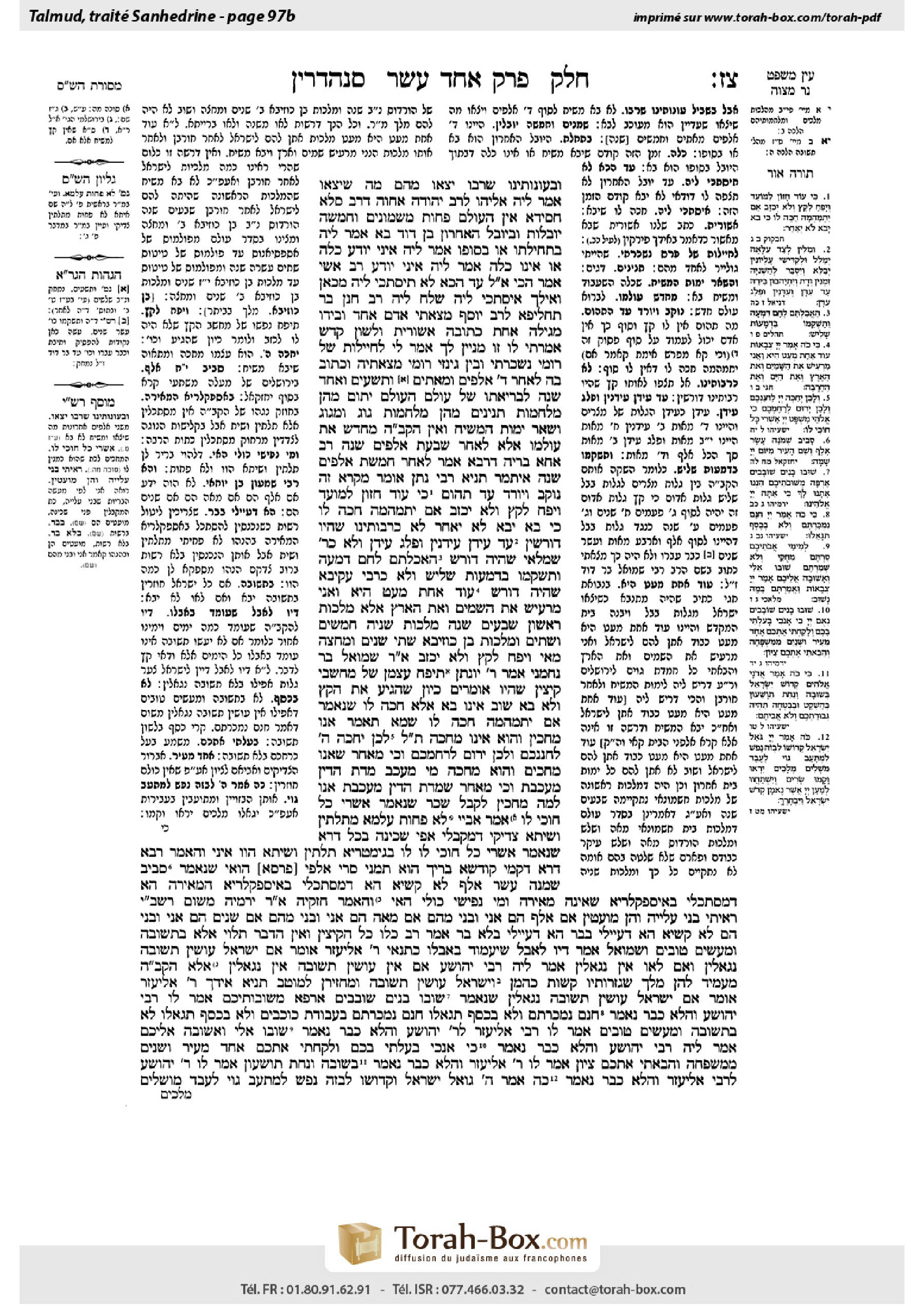
Sanhedrin 97b: Talmud study for Daf Yomi
Daf Yomi is the daily study of one Talmud folio. Explore 37 tractates with scans, Hebrew text, Sefaria English and AI-generated French translations where annotated.
Passage selection and English or AI-generated French translation are available where the scan has annotations. Daf Study is independent of Torah-Box and Sefaria.
Browse Sanhedrin · סנהדרין · All tractatesSanhedrin 97b text and translations
This page of Sanhedrin includes the Aramaic text, an English translation and an AI-generated French translation, alongside the scan above.
סנהדרין צ״ז ב · Aramaic and Hebrew text
וּבַעֲוֹנוֹתֵינוּ שֶׁרַבּוּ, יָצְאוּ מֵהֶם מָה שֶׁיֵּצְאוּ.
אֲמַר לֵיהּ אֵלִיָּהוּ לְרַב יְהוּדָה אֲחוּהּ דְּרַב סַלָּא חֲסִידָא: אֵין הָעוֹלָם פָּחוֹת מִשְּׁמוֹנִים וַחֲמִשָּׁה יוֹבְלוֹת, וּבַיּוֹבֵל הָאַחֲרוֹן בֶּן דָּוִד בָּא. אֲמַר לֵיהּ: בִּתְחִילָּתוֹ אוֹ בְּסוֹפוֹ? אֲמַר לֵיהּ: אֵינִי יוֹדֵעַ. כָּלֶה אוֹ אֵינוֹ כָּלֶה? אֲמַר לֵיהּ: אֵינִי יוֹדֵעַ. רַב אָשֵׁי אָמַר: הָכִי אֲמַר לֵיהּ: עַד הָכָא לָא תִּיסְתַּכֵּי לֵיהּ, מִכָּאן וְאֵילָךְ אִיסְתַּכֵּי לֵיהּ.
שְׁלַח לֵיהּ רַב חָנָן בַּר תַּחְלִיפָא לְרַב יוֹסֵף: מָצָאתִי אָדָם אֶחָד וּבְיָדוֹ מְגִילָּה אַחַת כְּתוּבָה אַשּׁוּרִית וּלְשׁוֹן קֹדֶשׁ. אָמַרְתִּי לוֹ: זוֹ מִנַּיִין לָךְ? אָמַר לִי: לַחֲיָילוֹת שֶׁל רוֹמִי נִשְׂכַּרְתִּי וּבֵין גִּינְזֵי רוֹמִי מְצָאתִיהָ. וְכָתוּב בָּהּ: לְאַחַר אַרְבַּעַת אֲלָפִים וּמָאתַיִם וְתִשְׁעִים וְאֶחָד שָׁנָה לִבְרִיאָתוֹ שֶׁל עוֹלָם, הָעוֹלָם יִתּוֹם. מֵהֶן מִלְחֲמוֹת תַּנִּינִים, מֵהֶן מִלְחָמוֹת גּוֹג וּמָגוֹג, וּשְׁאָר יְמוֹת הַמָּשִׁיחַ. וְאֵין הַקָּדוֹשׁ בָּרוּךְ הוּא מְחַדֵּשׁ אֶת עוֹלָמוֹ אֶלָּא לְאַחַר שִׁבְעַת אֲלָפִים שָׁנָה. רַב אַחָא בְּרֵיהּ דְּרָבָא אָמַר: לְאַחַר חֲמֵשֶׁת אֲלָפִים שָׁנָה אִיתְּמַר.
תַּנְיָא: רַבִּי נָתָן אוֹמֵר, מִקְרָא זֶה נוֹקֵב וְיוֹרֵד עַד תְּהוֹם: ״כִּי עוֹד חֲזוֹן לַמּוֹעֵד וְיָפֵחַ לַקֵּץ וְלֹא יְכַזֵּב אִם יִתְמַהְמָהּ חַכֵּה לוֹ כִּי בֹא יָבֹא לֹא יְאַחֵר״.
לֹא כְּרַבּוֹתֵינוּ שֶׁהָיוּ דּוֹרְשִׁין: ״עַד עִדָּן עִדָּנִין וּפְלַג עִדָּן״.
וְלָא כְּרַבִּי שִׂמְלַאי, שֶׁהָיָה דּוֹרֵשׁ: ״הֶאֱכַלְתָּם לֶחֶם דִּמְעָה וַתַּשְׁקֵמוֹ בִּדְמָעוֹת שְׁלִישׁ״.
וְלָא כְּרַבִּי עֲקִיבָא, שֶׁהָיָה דּוֹרֵשׁ: ״עוֹד אַחַת מְעַט הִיא וַאֲנִי מַרְעִישׁ אֶת הַשָּׁמַיִם וְאֶת הָאָרֶץ״.
אֶלָּא מַלְכוּת רִאשׁוֹנָה – שִׁבְעִים שָׁנָה, מַלְכוּת שְׁנִיָּה – חֲמִשִּׁים וּשְׁתַּיִם, וּמַלְכוּת בֶּן כּוֹזֵיבָא – שְׁתֵּי שָׁנִים וּמֶחֱצָה.
מַאי ״וְיָפֵחַ לַקֵּץ וְלֹא יְכַזֵּב״? אָמַר רַבִּי שְׁמוּאֵל בַּר נַחְמָנִי אָמַר רַבִּי יוֹנָתָן: תִּיפַּח עַצְמָן שֶׁל מְחַשְּׁבֵי קִיצִּין, שֶׁהָיוּ אוֹמְרִים כֵּיוָן שֶׁהִגִּיעַ (אֶת) הַקֵּץ וְלֹא בָּא – שׁוּב אֵינוֹ בָּא. אֶלָּא חַכֵּה לוֹ, שֶׁנֶּאֱמַר: ״אִם יִתְמַהְמָהּ חַכֵּה לוֹ״. שֶׁמָּא תֹּאמַר: אָנוּ מְחַכִּין וְהוּא אֵינוֹ מְחַכֶּה? תַּלְמוּד לוֹמַר: ״וְלָכֵן יְחַכֶּה ה׳ לַחֲנַנְכֶם וְלָכֵן יָרוּם לְרַחֶמְכֶם״.
וְכִי מֵאַחַר שֶׁאָנוּ מְחַכִּים, וְהוּא מְחַכֶּה, מִי מְעַכֵּב? מִדַּת הַדִּין מְעַכֶּבֶת. וְכִי מֵאַחַר שֶׁמִּדַּת הַדִּין מְעַכֶּבֶת, אָנוּ לָמָּה מְחַכִּין? לְקַבֵּל שָׂכָר, שֶׁנֶּאֱמַר: ״אַשְׁרֵי כׇּל חוֹכֵי לוֹ״.
אָמַר אַבָּיֵי: לָא פָּחֵית עָלְמָא מִתְּלָתִין וְשִׁיתָּא צַדִּיקֵי דִּמְקַבְּלִי אַפֵּי שְׁכִינָה בְּכֹל דָּרָא, שֶׁנֶּאֱמַר ״אַשְׁרֵי כׇּל חוֹכֵי לוֹ״ – ״לוֹ״ בְּגִימַטְרִיָּא תְּלָתִין וְשִׁיתָּא הָווּ. אִינִי? וְהָאָמַר רָבָא: דָּרָא דְּקַמֵּי קוּדְשָׁא בְּרִיךְ הוּא תַּמְנֵי סְרֵי אַלְפֵי פַּרְסָה הָוֵאי, שֶׁנֶּאֱמַר ״סָבִיב שְׁמֹנָה עָשָׂר אָלֶף״! לָא קַשְׁיָא: הָא דְּמִסְתַּכְּלִי בְּאִיסְפַּקְלַרְיָא הַמְּאִירָה, הָא דְּמִסְתַּכְּלִי בְּאִיסְפַּקְלַרְיָא שֶׁאֵינָהּ מְאִירָה.
וּמִי נְפִישִׁי כּוּלֵּי הַאי? וְהָאָמַר חִזְקִיָּה אָמַר רַבִּי יִרְמְיָה מִשּׁוּם רַבִּי שִׁמְעוֹן בֶּן יוֹחַי: רָאִיתִי בְּנֵי עֲלִיָּיה וְהֵן מוּעָטִין. אִם אֶלֶף הֵם – אֲנִי וּבְנִי מֵהֶם, אִם מֵאָה הֵם – אֲנִי וּבְנִי מֵהֶם, אִם שְׁנַיִם הֵם – אֲנִי וּבְנִי הֵם.
לָא קַשְׁיָא, הָא דְּעָיְילִי בְּבַר, הָא דְּעָיְילִי בְּלָא בַּר.
אָמַר רַב: כָּלוּ כׇּל הַקִּיצִּין, וְאֵין הַדָּבָר תָּלוּי אֶלָּא בִּתְשׁוּבָה וּמַעֲשִׂים טוֹבִים. וּשְׁמוּאֵל אָמַר: דַּיּוֹ לָאָבֵל שֶׁיַּעֲמוֹד בְּאֶבְלוֹ. כְּתַנָּאֵי: רַבִּי אֱלִיעֶזֶר אוֹמֵר: אִם יִשְׂרָאֵל עוֹשִׂין תְּשׁוּבָה – נִגְאָלִין, וְאִם לָאו – אֵין נִגְאָלִין. אָמַר לוֹ רַבִּי יְהוֹשֻׁעַ: אִם אֵין עוֹשִׂין תְּשׁוּבָה אֵין נִגְאָלִין? אֶלָּא הַקָּדוֹשׁ בָּרוּךְ הוּא מַעֲמִיד לָהֶן מֶלֶךְ שֶׁגְּזֵרוֹתָיו קָשׁוֹת כְּהָמָן, וְיִשְׂרָאֵל עוֹשִׂין תְּשׁוּבָה וּמַחְזִירָן לְמוּטָב.
תַּנְיָא אִידַּךְ: רַבִּי אֱלִיעֶזֶר אוֹמֵר, אִם יִשְׂרָאֵל עוֹשִׂין תְּשׁוּבָה – נִגְאָלִין, שֶׁנֶּאֱמַר: ״שׁוּבוּ בָּנִים שׁוֹבָבִים אֶרְפָּא מְשׁוּבֹתֵיכֶם״. אָמַר לוֹ רַבִּי יְהוֹשֻׁעַ: וַהֲלֹא כְּבָר נֶאֱמַר: ״חִנָּם נִמְכַּרְתֶּם וְלֹא בְכֶסֶף תִּגָּאֵלוּ״? ״חִנָּם נִמְכַּרְתֶּם״ – בַּעֲבוֹדָה זָרָה, ״וְלֹא בְּכֶסֶף תִּגָּאֵלוּ״ – לֹא בִּתְשׁוּבָה וּמַעֲשִׂים טוֹבִים.
אָמַר לוֹ רַבִּי אֱלִיעֶזֶר לְרַבִּי יְהוֹשֻׁעַ: וַהֲלֹא כְּבָר נֶאֱמַר ״שׁוּבוּ אֵלַי וְאָשׁוּבָה אֲלֵיכֶם״? אָמַר לוֹ רַבִּי יְהוֹשֻׁעַ: וַהֲלֹא כְּבָר נֶאֱמַר ״כִּי אָנֹכִי בָּעַלְתִּי בָכֶם וְלָקַחְתִּי אֶתְכֶם אֶחָד מֵעִיר וּשְׁנַיִם מִמִּשְׁפָּחָה וְהֵבֵאתִי אֶתְכֶם צִיּוֹן״?
אָמַר לוֹ רַבִּי אֱלִיעֶזֶר: וַהֲלֹא כְּבָר נֶאֱמַר ״בְּשׁוּבָה וָנַחַת תִּוָּשֵׁעוּן״? אָמַר לוֹ רַבִּי יְהוֹשֻׁעַ לְרַבִּי אֱלִיעֶזֶר: וַהֲלֹא כְּבָר נֶאֱמַר ״כֹּה אָמַר ה׳ גֹּאֵל יִשְׂרָאֵל קְדוֹשׁוֹ לִבְזֹה נֶפֶשׁ לִמְתָעֵב גּוֹי לְעֶבֶד מֹשְׁלִים
Sanhedrin 97b · English translation
That is the course that history was to take, but due to our many sins, the Messiah did not come after four thousand years passed, and furthermore, the years that elapsed since then, which were to have been the messianic era, have elapsed.
Elijah the prophet said to Rav Yehuda, brother of Rav Sala Ḥasida: The world will exist no fewer than eighty-five Jubilee cycles, or 4,250 years. And during the final Jubilee, the son of David will come. Rav Yehuda said to Elijah: Will the Messiah come during the beginning of the Jubilee or during its end? Elijah said to Rav Yehuda: I do not know. Rav Yehuda asked: Will this last Jubilee cycle end before the Messiah comes or will it not yet end before his coming? Elijah said to him: I do not know. Rav Ashi says: This is what Elijah said to him: Until that time do not anticipate his coming; from this point forward anticipate his coming. Elijah did not inform Rav Yehuda of the date of the coming of the Messiah.
Rav Ḥanan bar Taḥlifa sent a message to Rav Yosef: I found one man, and in his hand there was one scroll written in Ashurit script and in the sacred tongue, Hebrew. I said to him: From where did this scroll come into your possession? He said to me: I was hired to serve in the Roman army and I found the scroll among the Roman archives. It was clear that the scroll was written by Jews, not Romans. And it is written in the scroll: After 4,291 years have elapsed from the creation of the world, the world will end; during those years there will be the wars of the sea monsters between the leviathan and the animals, and among those years there will be the wars of Gog and Magog and the remaining years of the messianic period. Then the world will be destroyed. And the Holy One, Blessed be He, will renew His world only after the passage of seven thousand years. Rav Aḥa, son of Rava, says that it was stated: After the passage of five thousand years.
§ It is taught in a baraita that Rabbi Natan says: This verse penetrates and descends until the depths; just as the depths are unfathomable, so too, the period depicted in the following verse is unquantifiable. “For the vision is yet for the appointed time; and it declares of the end, and does not lie; though it tarry, wait for it, because it will surely come; it will not delay” (Habakkuk 2:3).
The Messiah will come not in accordance with the opinion of our Rabbis, who would interpret the verse: “For a period and periods and a half period” (Daniel 7:25), to mean that the duration of the ultimate exile will be three and a half times the duration of the period of the exile in Egypt.
And the Messiah will come not in accordance with the opinion of Rabbi Simlai, who would interpret the verse: “You have fed them with the bread of tears and have given them tears to drink in great measure [shalish]” (Psalms 80:6), to mean that the duration of the ultimate exile will be three times the duration of the period of the exile in Egypt.
And the Messiah will come not in accordance with the opinion of Rabbi Akiva, who would interpret the verse: “Yet once, it is a little while, and I will shake the heavens and the earth” (Haggai 2:6), to mean that the redemption would transpire soon after the destruction of the Temple.
Rather, the first, great, Hasmonean monarchy ruled seventy years. The second kingdom, of Herod and his descendants, ruled fifty-two years, and the duration of the monarchy of bar Koziva, or bar Kokheva, was two and a half years. The duration of the exile that follows is unknown.
The Gemara asks: What is the meaning of the phrase “And it declares [veyafe’aḥ] of the end, and does not lie”? Rabbi Shmuel bar Naḥmani says that Rabbi Yonatan says: May those who calculate the end of days be cursed [tippaḥ], as they would say once the end of days that they calculated arrived and the Messiah did not come, that he will no longer come at all. Rather, the proper behavior is to continue to wait for his coming, as it is stated: “Though it tarry, wait for it.” Lest you say we are expectantly awaiting the end of days and the Holy One, Blessed be He, is not awaiting the end of days and does not want to redeem His people, the verse states: “And therefore will the Lord wait, to be gracious to you; and therefore will He be exalted, to have mercy upon you; for the Lord is a God of judgment; happy are all they who wait for Him” (Isaiah 30:18).
And seemingly, since we are awaiting the end of days and the Holy One, Blessed be He, is also awaiting the end of days, who is preventing the coming of the Messiah? It is the divine attribute of judgment that prevents his coming, as it is written: “For the Lord is a God of judgment,” and we are not worthy. And since the attribute of judgment prevents the coming of the Messiah and we are not worthy of redemption, why do we await his coming daily? We do so in order to receive a reward for awaiting his coming, as it is stated: “Happy are all they who wait for Him.”
Apropos that verse, Abaye said: The world has no fewer than thirty-six righteous people in each generation who greet the Divine Presence, as it is stated: “Happy are all they who wait for Him [lo]” (Isaiah 30:18). The numerical value of lo, spelled lamed vav, is thirty-six. The Gemara asks: Is that so? But doesn’t Rava say: The row of the righteous before the Holy One, Blessed be He, extends eighteen thousand parasangs, as it is stated with regard to the city of God at the end of days: “It shall be eighteen thousand reeds round about, and the name of the city from that day shall be: The Lord is there” (Ezekiel 48:35)? The Gemara answers: It is not difficult; this statement of Abaye refers to the thirty-six righteous people who view the Divine Presence through a luminous crystal [be’ispaklarya], and that statement of Rava refers to the multitudes who view the Divine Presence through a crystal that is not luminous.
The Gemara asks: And are those who view the Divine Presence through a crystal that is luminous so numerous? But doesn’t Ḥizkiyya say that Rabbi Yirmeya says in the name of Rabbi Shimon bar Yoḥai: I have seen members of the group of the spiritually prominent, who are truly righteous, and they are few. If they number one thousand, I and my son are among them. If they number one hundred, I and my son are among them; and if they number two, I and my son are they. Apparently, it is conceivable that there are no more than two who view the Divine Presence through a luminous crystal.
The Gemara answers: It is not difficult. This statement of Abaye is referring to those who may enter to view the Divine Presence only by requesting and being granted permission [bar] from the angels. That statement of Rabbi Shimon ben Yoḥai is referring to the select few who may enter to view the Divine Presence even without requesting permission, for whom the gates of Heaven are open at all times.
§ Rav says: All the ends of days that were calculated passed, and the matter depends only upon repentance and good deeds. When the Jewish people repent, they will be redeemed. And Shmuel says: It is sufficient for the mourner to endure in his mourning to bring about the coming of the Messiah. Even without repentance, they will be worthy of redemption due to the suffering they endured during the exile. The Gemara notes: This dispute is parallel to a dispute between tanna’im: Rabbi Eliezer says: If the Jewish people repent they are redeemed, and if not they are not redeemed. Rabbi Yehoshua said to him: If they do not repent, will they not be redeemed at all? Rather, the Holy One, Blessed be He, will establish a king for them whose decrees are as harsh as those issued by Haman, and the Jewish people will have no choice but to repent, and this will restore them to the right path.
It is taught in another baraita that Rabbi Eliezer says: If the Jewish people repent they are redeemed, as it is stated: “Return, wayward children, I will heal your iniquities” (Jeremiah 3:22). Rabbi Yehoshua said to him: But isn’t it already stated: “So says the Lord: You were sold for naught, and without money you shall be redeemed” (Isaiah 52:3)? Rabbi Yehoshua explains: “You were sold for naught” means you were sold for idol worship, which is a sin with no basis. “And without money you shall be redeemed” means you will be redeemed not through repentance and good deeds, but through the will of God.
Rabbi Eliezer said to Rabbi Yehoshua: But isn’t it already stated: “Return to me and I will return to you” (Malachi 3:7)? Rabbi Yehoshua said to him: But isn’t it already stated: “For I have taken you to Myself; and I will take you one from a city and two from a family, and I will bring you to Zion” (Jeremiah 3:14), unconditionally?
Rabbi Eliezer said to him: But isn’t it already stated: “In ease [beshuva] and rest shall you be saved” (Isaiah 30:15), indicating that redemption is dependent upon repentance [teshuva]? Rabbi Yehoshua said to Rabbi Eliezer: But isn’t it already stated: “So says the Lord, Redeemer of Israel, his Holy One, to him who is despised of man, to him who is abhorred of the nation, to a servant of rulers:
Sanhedrin 97b · Traduction française (IA)
Tel était le cours que devait suivre l’histoire ; mais, à cause de nos nombreux péchés, le Messie n’est pas venu après l’écoulement de quatre mille ans. De plus, les années écoulées depuis lors, qui auraient dû constituer l’ère messianique, se sont elles aussi écoulées.
Le prophète Élie dit à Rav Yehouda, frère de Rav Sala Ḥasida : Le monde existera au moins quatre-vingt-cinq cycles jubilaires, soit 4 250 ans. C’est au cours du dernier cycle jubilaire que viendra le fils de David. Rav Yehouda dit à Élie : Le Messie viendra-t-il au début du cycle jubilaire ou à sa fin ? Élie lui répondit : Je ne sais pas. Rav Yehouda demanda : Ce dernier cycle jubilaire s’achèvera-t-il avant la venue du Messie, ou ne sera-t-il pas encore achevé lorsqu’il viendra ? Élie lui répondit : Je ne sais pas. Rav Ashi dit : Voici ce qu’Élie lui a dit : Jusque-là, n’attends pas sa venue ; à partir de ce moment, attends-la. Élie n’a pas informé Rav Yehouda de la date de la venue du Messie.
Rav Ḥanan bar Taḥlifa envoya un message à Rav Yosef : J’ai trouvé un homme qui tenait un rouleau écrit en caractères assyriens et dans la langue sainte, l’hébreu. Je lui ai demandé : D’où te vient ce rouleau ? Il me répondit : J’ai été engagé pour servir dans l’armée romaine et j’ai trouvé le rouleau dans les archives romaines. Il était évident que le rouleau avait été écrit par des Juifs, et non par des Romains. On y lit : Après que 4 291 ans se seront écoulés depuis la création du monde, le monde prendra fin ; durant ces années auront lieu les guerres des monstres marins, entre le Léviathan et les bêtes, ainsi que les guerres de Gog et Magog et les années restantes de la période messianique. Alors, le monde sera détruit. Le Saint, béni soit-Il, ne renouvellera son monde qu’après l’écoulement de sept mille ans. Rav Aḥa, fils de Rava, dit qu’il a été affirmé : Après l’écoulement de cinq mille ans.
§ Il est enseigné dans une baraïta que Rabbi Natan dit : Ce verset pénètre et descend jusqu’aux profondeurs ; de même que celles-ci sont insondables, la période décrite dans le verset suivant est elle aussi impossible à quantifier : « Car la vision est encore pour le temps fixé ; elle annonce la fin et ne ment pas. Si elle tarde, attends-la, car elle viendra sûrement, elle ne tardera pas » (Habaquq 2:3).
Le Messie ne viendra pas conformément à l’opinion de nos rabbins, qui interpréteraient le verset « Un temps, des temps et la moitié d’un temps » (Daniel 7:25) comme signifiant que la durée de l’exil ultime sera trois fois et demie celle de l’exil d’Égypte.
Le Messie ne viendra pas non plus conformément à l’opinion de Rabbi Simlaï, qui interpréterait le verset « Tu les as nourris du pain des larmes et tu leur as fait boire des larmes en grande mesure [shalish] » (Psaumes 80:6) comme signifiant que la durée de l’exil ultime sera trois fois celle de l’exil d’Égypte.
Le Messie ne viendra pas non plus conformément à l’opinion de Rabbi Akiva, qui interpréterait le verset « Encore une fois, dans peu de temps, j’ébranlerai les cieux et la terre » (Aggée 2:6) comme signifiant que la rédemption aurait lieu peu après la destruction du Temple.
Au contraire, la première grande monarchie, celle des Hasmonéens, régna soixante-dix ans. Le second royaume, celui d’Hérode et de ses descendants, régna cinquante-deux ans, et la monarchie de bar Koziva, ou bar Kokheva, dura deux ans et demi. La durée de l’exil qui suit est inconnue.
La Guemara demande : Que signifie l’expression « Elle annonce [veyafe’aḥ] la fin et ne ment pas » ? Rabbi Shmuel bar Naḥmani dit au nom de Rabbi Yonatan : Que soient maudits [tippaḥ] ceux qui calculent la fin des jours, car lorsque la fin qu’ils ont calculée arrive et que le Messie n’est pas venu, ils disent qu’il ne viendra plus du tout. Il convient plutôt de continuer à attendre sa venue, comme il est dit : « Si elle tarde, attends-la. » De peur que tu ne dises que nous attendons avec impatience la fin des jours, tandis que le Saint, béni soit-Il, ne l’attend pas et ne veut pas délivrer son peuple, le verset dit : « C’est pourquoi le Seigneur attend pour vous faire grâce ; c’est pourquoi il se lèvera pour avoir pitié de vous. Car le Seigneur est un Dieu de justice ; heureux tous ceux qui l’attendent » (Isaïe 30:18).
Et, semble-t-il, puisque nous attendons la fin des jours et que le Saint, béni soit-Il, l’attend lui aussi, qui empêche la venue du Messie ? C’est l’attribut divin de justice qui empêche sa venue, comme il est écrit : « Car le Seigneur est un Dieu de justice », et nous n’en sommes pas dignes. Puisque l’attribut de justice empêche la venue du Messie et que nous ne sommes pas dignes de la rédemption, pourquoi attendons-nous sa venue chaque jour ? Nous le faisons afin de recevoir une récompense pour l’avoir attendue, comme il est dit : « Heureux tous ceux qui l’attendent. »
À propos de ce verset, Abaye dit : Il y a au moins trente-six justes dans chaque génération qui accueillent la Présence divine, comme il est dit : « Heureux tous ceux qui l’attendent [lo] » (Isaïe 30:18). La valeur numérique de lo, écrit lamed vav, est trente-six. La Guemara demande : Est-ce vraiment le cas ? Rava ne dit-il pas que le rang des justes devant le Saint, béni soit-Il, s’étend sur dix-huit mille parasanges, comme il est dit à propos de la ville de Dieu à la fin des jours : « Tout autour, ce sera dix-huit mille cannes, et le nom de la ville, dès ce jour, sera : Le Seigneur est là » (Ézéchiel 48:35) ? La Guemara répond : Il n’y a pas de difficulté : la déclaration d’Abaye concerne les trente-six justes qui contemplent la Présence divine à travers un cristal lumineux [be’ispaklarya], tandis que celle de Rava concerne les multitudes qui la contemplent à travers un cristal non lumineux.
La Guemara demande : Ceux qui contemplent la Présence divine à travers un cristal lumineux sont-ils si nombreux ? Ḥizkiyya ne dit-il pas que Rabbi Yirmeya dit au nom de Rabbi Shimon bar Yoḥai : J’ai vu les membres du groupe des éminents sur le plan spirituel, qui sont véritablement justes, et ils sont peu nombreux. S’ils sont mille, mon fils et moi en faisons partie. S’ils sont cent, mon fils et moi en faisons partie ; et s’ils sont deux, c’est mon fils et moi. Il semble donc concevable qu’il n’y ait pas plus de deux personnes qui contemplent la Présence divine à travers un cristal lumineux.
La Guemara répond : Il n’y a pas de difficulté. La déclaration d’Abaye concerne ceux qui ne peuvent entrer pour contempler la Présence divine qu’en demandant aux anges la permission [bar] et en l’obtenant. La déclaration de Rabbi Shimon ben Yoḥai concerne les quelques élus qui peuvent entrer pour contempler la Présence divine même sans demander la permission, car les portes du Ciel leur sont ouvertes en tout temps.
§ Rav dit : Toutes les dates de la fin qui avaient été calculées sont passées, et tout dépend uniquement du repentir et des bonnes actions. Lorsque le peuple juif se repentira, il sera délivré. Shmuel dit : Il suffit que l’affligé endure son deuil pour amener la venue du Messie. Même sans repentir, les Juifs seront dignes de la rédemption en raison des souffrances qu’ils ont endurées durant l’exil. La Guemara note que cette controverse correspond à une controverse entre tannaïm : Rabbi Eliezer dit : Si le peuple juif se repent, il est délivré ; sinon, il ne l’est pas. Rabbi Yehoshua lui dit : S’il ne se repent pas, ne sera-t-il donc jamais délivré ? Le Saint, béni soit-Il, établira plutôt pour lui un roi dont les décrets seront aussi sévères que ceux promulgués par Haman. Le peuple juif n’aura alors d’autre choix que de se repentir, ce qui le ramènera dans la bonne voie.
Il est enseigné dans une autre baraïta que Rabbi Eliezer dit : Si le peuple juif se repent, il est délivré, comme il est dit : « Revenez, enfants rebelles, je guérirai vos iniquités » (Jérémie 3:22). Rabbi Yehoshua lui dit : N’est-il pas déjà dit : « Ainsi parle le Seigneur : Vous avez été vendus pour rien, et sans argent vous serez rachetés » (Isaïe 52:3) ? Rabbi Yehoshua explique : « Vous avez été vendus pour rien » signifie que vous avez été vendus à cause de l’idolâtrie, un péché sans fondement. « Et sans argent vous serez rachetés » signifie que vous serez rachetés non par le repentir et les bonnes actions, mais par la volonté de Dieu.
Rabbi Eliezer dit à Rabbi Yehoshua : N’est-il pas déjà dit : « Revenez à moi et je reviendrai à vous » (Malachie 3:7) ? Rabbi Yehoshua lui dit : N’est-il pas déjà dit : « Car je vous ai pris pour miens ; je vous prendrai, un d’une ville et deux d’une famille, et je vous conduirai à Sion » (Jérémie 3:14), sans condition ?
Rabbi Eliezer lui dit : N’est-il pas déjà dit : « C’est dans la tranquillité [beshuva] et le repos que vous serez sauvés » (Isaïe 30:15), ce qui indique que la rédemption dépend du repentir [teshuva] ? Rabbi Yehoshua dit à Rabbi Eliezer : N’est-il pas déjà dit : « Ainsi parle le Seigneur, le Rédempteur d’Israël, son Saint, à celui qui est méprisé des hommes, à celui que la nation abhorre, au serviteur des maîtres :
Traduction française générée par IA à partir de l’édition anglaise de Sefaria. Vérifie toujours un passage avec le texte source.
Text from Sefaria: William Davidson Edition - Vocalized Aramaic (CC BY NC); William Davidson Edition - English (CC BY NC).