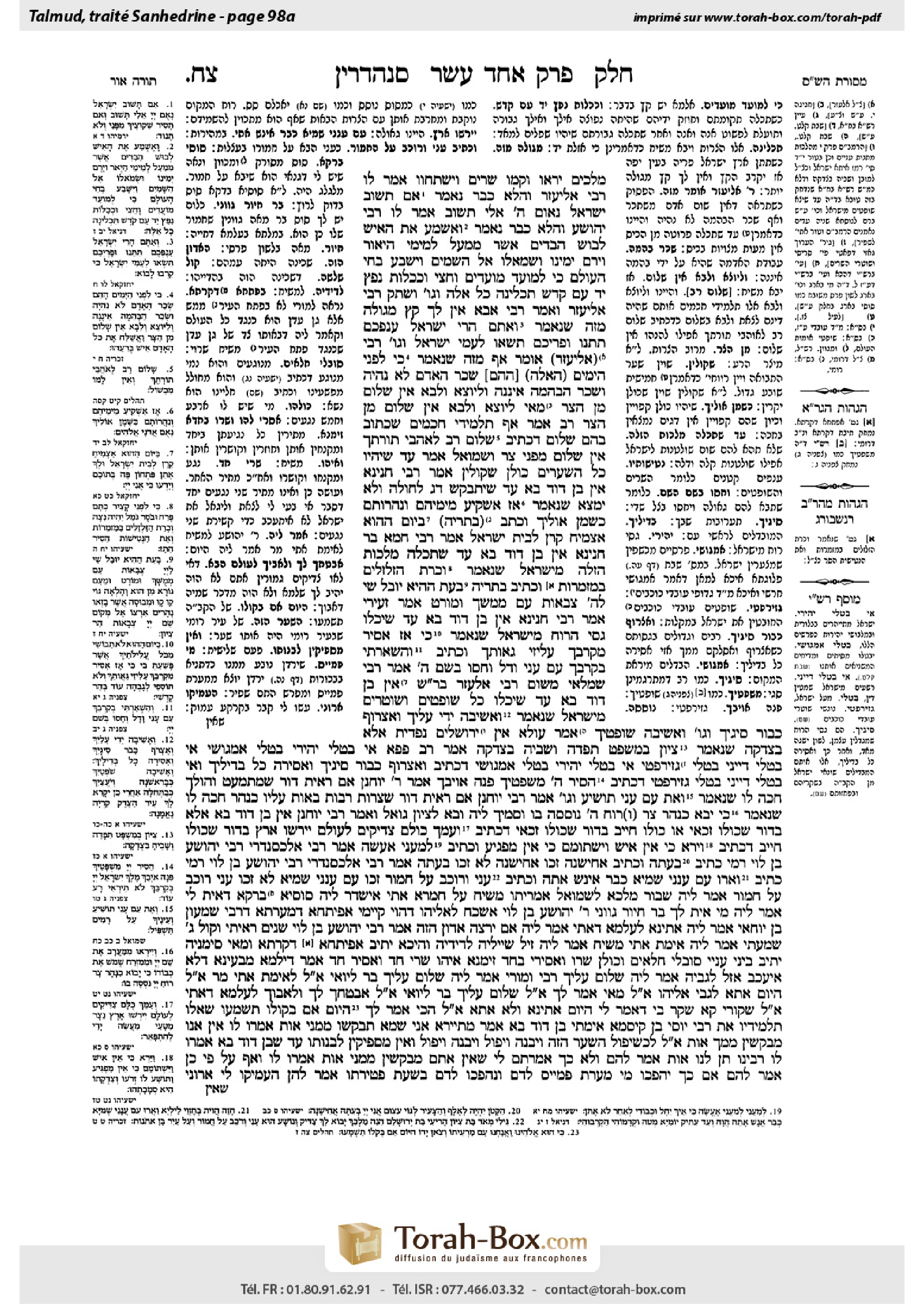
Sanhedrin 98a: Talmud study for Daf Yomi
Daf Yomi is the daily study of one Talmud folio. Explore 37 tractates with scans, Hebrew text, Sefaria English and AI-generated French translations where annotated.
Passage selection and English or AI-generated French translation are available where the scan has annotations. Daf Study is independent of Torah-Box and Sefaria.
Browse Sanhedrin · סנהדרין · All tractatesSanhedrin 98a text and translations
This page of Sanhedrin includes the Aramaic text, an English translation and an AI-generated French translation, alongside the scan above.
סנהדרין צ״ח א · Aramaic and Hebrew text
מְלָכִים יִרְאוּ וָקָמוּ שָׂרִים וְיִשְׁתַּחֲווּ״?
אָמַר לוֹ רַבִּי אֱלִיעֶזֶר: וַהֲלֹא כְּבָר נֶאֱמַר ״אִם תָּשׁוּב יִשְׂרָאֵל נְאֻם ה׳ אֵלַי תָּשׁוּב״? אָמַר לוֹ רַבִּי יְהוֹשֻׁעַ: וַהֲלֹא כְּבָר נֶאֱמַר ״וָאֶשְׁמַע אֶת הָאִישׁ לְבוּשׁ הַבַּדִּים אֲשֶׁר מִמַּעַל לְמֵימֵי הַיְאֹר וַיָּרֶם יְמִינוֹ וּשְׂמֹאלוֹ אֶל הַשָּׁמַיִם וַיִּשָּׁבַע בְּחֵי הָעוֹלָם כִּי לְמוֹעֵד מוֹעֲדִים וָחֵצִי וּכְכַלּוֹת נַפֵּץ יַד עַם קֹדֶשׁ תִּכְלֶינָה כׇל אֵלֶּה וְגוֹ׳״? וְשָׁתַק רַבִּי אֱלִיעֶזֶר.
וְאָמַר רַבִּי אַבָּא: אֵין לְךָ קֵץ מְגוּלֶּה מִזֶּה, שֶׁנֶּאֱמַר: ״וְאַתֶּם הָרֵי יִשְׂרָאֵל עַנְפְּכֶם תִּתֵּנוּ וּפֶרְיְכֶם תִּשְׂאוּ לְעַמִּי יִשְׂרָאֵל וְגוֹ׳״. רַבִּי אֱלִיעֶזֶר אוֹמֵר: אַף מִזֶּה, שֶׁנֶּאֱמַר: ״כִּי לִפְנֵי הַיָּמִים הָהֵם שְׂכַר הָאָדָם לֹא נִהְיָה וּשְׂכַר הַבְּהֵמָה אֵינֶנָּה וְלַיּוֹצֵא וְלַבָּא אֵין שָׁלוֹם מִן הַצָּר״.
מַאי ״לַיּוֹצֵא וְלַבָּא אֵין שָׁלוֹם מִן הַצָּר״? רַב אָמַר: אַף תַּלְמִידֵי חֲכָמִים, שֶׁכָּתוּב בָּהֶם שָׁלוֹם, דִּכְתִיב ״שָׁלוֹם רָב לְאֹהֲבֵי תוֹרָתֶךָ״, אֵין שָׁלוֹם מִפְּנֵי צָר. וּשְׁמוּאֵל אָמַר: עַד שֶׁיִּהְיוּ כׇּל הַשְּׁעָרִים כּוּלָּן שְׁקוּלִין.
אָמַר רַבִּי חֲנִינָא: אֵין בֶּן דָּוִד בָּא עַד שֶׁיִּתְבַּקֵּשׁ דָּג [קָטָן] לְחוֹלֶה וְלֹא יִמָּצֵא, שֶׁנֶּאֱמַר: ״אָז אַשְׁקִיעַ מֵימֵיהֶם וְנַהֲרוֹתָם כַּשֶּׁמֶן אוֹלִיךְ״, וּכְתִיב בָּתְרֵיהּ: ״בַּיּוֹם הַהוּא אַצְמִיחַ קֶרֶן לְבֵית יִשְׂרָאֵל״.
אָמַר רַבִּי חָמָא בַּר חֲנִינָא: אֵין בֶּן דָּוִד בָּא עַד שֶׁתִּכְלֶה מַלְכוּת הַזָּלָה מִיִּשְׂרָאֵל, שֶׁנֶּאֱמַר: ״וְכָרַת הַזַּלְזַלִּים בַּמַּזְמֵרוֹת״, וּכְתִיב בָּתְרֵיהּ: ״בָּעֵת הַהִיא יוּבַל שַׁי לַה׳ צְבָאוֹת עַם מְמֻשָּׁךְ וּמוֹרָט״.
אָמַר זְעֵירִי אָמַר רַבִּי חֲנִינָא: אֵין בֶּן דָּוִד בָּא עַד שֶׁיִּכְלוּ גַּסֵּי הָרוּחַ מִיִּשְׂרָאֵל, שֶׁנֶּאֱמַר: ״כִּי אָז אָסִיר מִקִּרְבֵּךְ עַלִּיזֵי גַּאֲוָתֵךְ״, וּכְתִיב: ״וְהִשְׁאַרְתִּי בְקִרְבֵּךְ עַם עָנִי וָדָל וְחָסוּ בְּשֵׁם ה׳״.
אָמַר רַבִּי שִׂמְלַאי מִשּׁוּם רַבִּי אֶלְעָזָר בְּרַבִּי שִׁמְעוֹן: אֵין בֶּן דָּוִד בָּא עַד שֶׁיִּכְלוּ כׇּל שׁוֹפְטִים וְשׁוֹטְרִים מִיִּשְׂרָאֵל, שֶׁנֶּאֱמַר: ״וְאָשִׁיבָה יָדִי עָלַיִךְ וְאֶצְרֹף כַּבֹּר סִיגָיִךְ וְגוֹ׳ וְאָשִׁיבָה שֹׁפְטַיִךְ״.
אָמַר עוּלָּא: אֵין יְרוּשָׁלָיִם נִפְדֵּית אֶלָּא בִּצְדָקָה, שֶׁנֶּאֱמַר: ״צִיּוֹן בְּמִשְׁפָּט תִּפָּדֶה וְשָׁבֶיהָ בִּצְדָקָה״. אָמַר רַב פָּפָּא: אִי בָּטְלִי יְהִירֵי – בָּטְלִי אַמְגּוּשֵׁי, אִי בָּטְלִי דַּיָּינֵי – בָּטְלִי גְּזִירְפָּטֵי. אִי בָּטְלִי יְהִירֵי בָּטְלִי אַמְגּוּשֵׁי, דִּכְתִיב: ״וְאֶצְרֹף כַּבֹּר סִיגָיִךְ וְאָסִירָה כׇּל בְּדִילָיִךְ״. וְאִי בָּטְלִי דַּיָּינֵי בָּטְלִי גְּזִירְפָּטֵי, דִּכְתִיב: ״הֵסִיר ה׳ מִשְׁפָּטַיִךְ פִּנָּה אֹיְבֵךְ״.
אָמַר רַבִּי יוֹחָנָן: אִם רָאִיתָ דּוֹר שֶׁמִּתְמַעֵט וְהוֹלֵךְ, חַכֵּה לוֹ, שֶׁנֶּאֱמַר: ״וְאֶת עַם עָנִי תּוֹשִׁיעַ וְגוֹ׳״. אָמַר רַבִּי יוֹחָנָן: אִם רָאִיתָ דּוֹר שֶׁצָּרוֹת רַבּוֹת בָּאוֹת עָלָיו כַּנָּהָר, חַכֵּה לוֹ, שֶׁנֶּאֱמַר: ״כִּי יָבֹא כַנָּהָר צָר רוּחַ ה׳ נֹסְסָה בוֹ״, וּסְמִיךְ לֵיהּ: ״וּבָא לְצִיּוֹן גּוֹאֵל״.
וְאָמַר רַבִּי יוֹחָנָן: אֵין בֶּן דָּוִד בָּא אֶלָּא בְּדוֹר שֶׁכּוּלּוֹ זַכַּאי, אוֹ כּוּלּוֹ חַיָּיב. בְּדוֹר שֶׁכּוּלּוֹ זַכַּאי – דִּכְתִיב: ״וְעַמֵּךְ כֻּלָּם צַדִּיקִים לְעוֹלָם יִירְשׁוּ אָרֶץ״. בְּדוֹר שֶׁכּוּלּוֹ חַיָּיב – דִּכְתִיב: ״וַיַּרְא כִּי אֵין אִישׁ וַיִּשְׁתּוֹמֵם כִּי אֵין מַפְגִּיעַ״, וּכְתִיב: ״לְמַעֲנִי אֶעֱשֶׂה״.
אָמַר רַבִּי אֲלֶכְּסַנְדְּרִי: רַבִּי יְהוֹשֻׁעַ בֶּן לֵוִי רָמֵי, כְּתִיב ״בְּעִתָּהּ״ וּכְתִיב ״אֲחִישֶׁנָּה״. זָכוּ – אֲחִישֶׁנָּה, לֹא זָכוּ – בְּעִתָּהּ.
אָמַר רַבִּי אֲלֶכְּסַנְדְּרִי: רַבִּי יְהוֹשֻׁעַ בֶּן לֵוִי רָמֵי, כְּתִיב: ״וַאֲרוּ עִם עֲנָנֵי שְׁמַיָּא כְּבַר אֱנָשׁ אָתֵה״, וּכְתִיב: ״עָנִי וְרֹכֵב עַל חֲמוֹר״. זָכוּ – עִם עֲנָנֵי שְׁמַיָּא, לֹא זָכוּ – עָנִי וְרוֹכֵב עַל חֲמוֹר.
אֲמַר לֵיהּ שַׁבּוּר מַלְכָּא לִשְׁמוּאֵל: אָמְרִיתוּ מָשִׁיחַ עַל חַמְרָא אָתֵי? אֵישַׁדַּר לֵיהּ סוּסְיָא בָּרְקָא דְּאִית לִי! אֲמַר לֵיהּ: מִי אִית לָךְ בַּר חֵיוַר גַּוְונֵי?
רַבִּי יְהוֹשֻׁעַ בֶּן לֵוִי אַשְׁכַּח לְאֵלִיָּהוּ דַּהֲוָה קָאֵי אַפִּיתְחָא דִּמְעָרְתָּא דְּרַבִּי שִׁמְעוֹן בֶּן יוֹחַאי. אֲמַר לֵיהּ: אָתֵינָא לְעָלְמָא דְּאָתֵי? אֲמַר לֵיהּ: אִם יִרְצֶה אָדוֹן הַזֶּה. אָמַר רַבִּי יְהוֹשֻׁעַ בֶּן לֵוִי: שְׁנַיִם רָאִיתִי וְקוֹל שְׁלֹשָׁה שָׁמַעְתִּי.
אֲמַר לֵיהּ: אֵימַת אָתֵי מָשִׁיחַ? אָמַר לֵיהּ: זִיל שַׁיְילֵיהּ לְדִידֵיהּ. וְהֵיכָא יָתֵיב? אַפִּיתְחָא דְּרוֹמִי. וּמַאי סִימָנֵיהּ? יָתֵיב בֵּינֵי עַנְיֵי סוֹבְלֵי חֳלָאִים, וְכוּלָּן שָׁרוּ וְאָסְירִי בְּחַד זִימְנָא, אִיהוּ שָׁרֵי חַד וְאָסַיר חַד. אָמַר: דִּילְמָא מִבְּעֵינָא דְּלָא אִיעַכַּב.
אֲזַל לְגַבֵּיהּ. אֲמַר לֵיהּ: שָׁלוֹם עָלֶיךָ רַבִּי וּמוֹרִי! אֲמַר לֵיהּ: שָׁלוֹם עָלֶיךָ בַּר לֵיוַאי. אֲמַר לֵיהּ: לְאֵימַת אָתֵי מָר? אֲמַר לֵיהּ: הַיּוֹם. אֲתָא לְגַבֵּי אֵלִיָּהוּ. אֲמַר לֵיהּ: מַאי אֲמַר לָךְ? אֲמַר לֵיהּ: שָׁלוֹם עָלֶיךָ בַּר לֵיוַאי. אֲמַר לֵיהּ: אַבְטְחָךְ לָךְ וְלַאֲבוּךְ לְעָלְמָא דְּאָתֵי. אֲמַר לֵיהּ: שַׁקּוֹרֵי קָא שַׁקַּר בִּי, דַּאֲמַר לִי ״הַיּוֹם אָתֵינָא״ וְלָא אֲתָא. אֲמַר לֵיהּ: הָכִי אָמַר לָךְ: ״הַיּוֹם אִם בְּקֹלוֹ תִשְׁמָעוּ״.
שָׁאֲלוּ תַּלְמִידָיו אֶת רַבִּי יוֹסֵי בֶּן קִיסְמָא: אֵימָתַי בֶּן דָּוִד בָּא? אָמַר: מִתְיָירֵא אֲנִי שֶׁמָּא תְּבַקְּשׁוּ מִמֶּנִּי אוֹת. אָמְרוּ לוֹ: אֵין אָנוּ מְבַקְּשִׁין מִמְּךָ אוֹת.
אָמַר לָהֶם: לִכְשֶׁיִּפּוֹל הַשַּׁעַר הַזֶּה, וְיִבָּנֶה, וְיִפּוֹל וְיִבָּנֶה, וְיִפּוֹל, וְאֵין מַסְפִּיקִין לִבְנוֹתוֹ עַד שֶׁבֶּן דָּוִד בָּא. אָמְרוּ לוֹ: רַבֵּינוּ, תֵּן לָנוּ אוֹת! אָמַר לָהֶם: וְלֹא כָּךְ אֲמַרְתֶּם לִי שֶׁאֵין אַתֶּם מְבַקְּשִׁין מִמֶּנִּי אוֹת?
אָמְרוּ לוֹ: וְאַף עַל פִּי כֵן. אָמַר לָהֶם: אִם כָּךְ, יֵהָפְכוּ מֵי מְעָרַת פַּמְיָיס לְדָם. וְנֶהֶפְכוּ לְדָם.
בִּשְׁעַת פְּטִירָתוֹ, אָמַר לָהֶן: הַעֲמִיקוּ לִי אֲרוֹנִי,
Sanhedrin 98a · English translation
Kings shall see and arise, princes shall prostrate themselves, because of the Lord, Who is faithful, and the Holy One of Israel, Who has chosen you” (Isaiah 49:7), indicating that redemption will come independent of repentance?
Rabbi Eliezer said to him: But isn’t it already stated: “If you will return, Israel, says the Lord, return to Me” (Jeremiah 4:1), indicating that redemption is contingent upon repentance? Rabbi Yehoshua said to him: But isn’t it already stated: “And I heard the man clothed in linen, who was above the waters of the river, when he lifted up his right hand and his left hand to heaven and swore by the One Who lives forever that it shall be for a period, periods, and a half; when the crushing of the power of the holy people shall have been completed, all these things shall be finished” (Daniel 12:7), indicating that the time for redemption is set and unrelated to repentance? And Rabbi Eliezer was silent, unable to refute the proof from that verse.
§ And Rabbi Abba says: You have no more explicit manifestation of the end of days than this following phenomenon, as it is stated: “But you, mountains of Israel, you shall give your branches, and yield your fruit to My people of Israel, for they will soon be coming” (Ezekiel 36:8). When produce will grow in abundance in Eretz Yisrael, it is an indication that the Messiah will be coming soon. Rabbi Eliezer says: You have no greater manifestation of the end of days than this following phenomenon as well, as it is stated: “For before these days there was no hire for man, nor any hire for beast; nor was there peace from the oppressor to him who exits and to him who enters” (Zechariah 8:10). When there are no wages for work and no rent paid for use of one’s animal, that is an indication that the coming of the Messiah is at hand.
The Gemara asks: What is the meaning of the phrase: “Nor was there peace from the oppressor to him who exits and to him who enters”? Rav says: It means that even for Torah scholars, with regard to whom the promise of peace is written, as it is written: “Great peace have they who love Your Torah; and there is no obstacle for them” (Psalms 119:165), there will be no peace from the oppressor. And Shmuel says: It means that the Messiah will not come until all the prices are equal.
Rabbi Ḥanina says: The son of David will not come until a fish will be sought for an ill person and will not be found, as it is stated with regard to the downfall of Egypt: “Then I will make their waters clear and cause their rivers to run like oil” (Ezekiel 32:14), meaning that the current in the rivers will come to a virtual standstill. And it is written thereafter: “On that day I will cause the glory of the house of Israel to flourish” (Ezekiel 29:21).
Rabbi Ḥama bar Ḥanina says: The son of David will not come until the contemptuous [hazalla] kingdom of Rome will cease from the Jewish people, as it is stated: “And He shall sever the sprigs [hazalzallim] with pruning hooks” (Isaiah 18:5). And it is written thereafter: “At that time shall a present be brought to the Lord of hosts, by a people scattered and hairless” (Isaiah 18:7).
Ze’eiri says that Rabbi Ḥanina says: The son of David will not come until the arrogant will cease to exist from among the Jewish people, as it is stated: “For then I will remove from your midst your proudly exulting ones” (Zephaniah 3:11), and it is written afterward: “And I will leave in your midst a poor and lowly people, and they shall take refuge in the name of the Lord” (Zephaniah 3:12).
Rabbi Simlai says in the name of Rabbi Elazar, son of Rabbi Shimon: The son of David will not come until all the judges and officers will cease to exist from among the Jewish people, and there will be no more autonomous government in Eretz Yisrael, as it is stated: “And I will turn My hand against you and purge away your dross as with lye and take away your base alloy. And I will restore your judges as at the first” (Isaiah 1:25–26).
Ulla says: Jerusalem is redeemed only by means of righteousness, as it is stated: “Zion shall be redeemed with justice and those who return to it with righteousness” (Isaiah 1:27). Rav Pappa says: If the arrogant will cease to exist, the Persian sorcerers will cease to exist as well. If the deceitful judges will cease to exist, the royal officers [gazirpatei] and taskmasters will cease to exist. Rav Pappa elaborates: If the arrogant will cease, the Persian sorcerers will cease, as it is written: “And I will purge away your dross [sigayikh] as with lye, and I will remove all your alloy [bedilayikh].” When the arrogant [sigim] are purged, the sorcerers, who are separated [muvdalim] from the fear of God, will also cease. And if the deceitful judges cease to exist, the royal officers and taskmasters will cease to exist, as it is written: “The Lord has removed your judgments; cast out your enemy” (Zephaniah 3:15).
Rabbi Yoḥanan says: If you saw a generation whose wisdom and Torah study is steadily diminishing, await the coming of the Messiah, as it is stated: “And the afflicted people You will redeem” (II Samuel 22:28). Rabbi Yoḥanan says: If you saw a generation whose troubles inundate it like a river, await the coming of the Messiah, as it is stated: “When distress will come like a river that the breath of the Lord drives” (Isaiah 59:19). And juxtaposed to it is the verse: “And a redeemer will come to Zion” (Isaiah 59:20).
And Rabbi Yoḥanan says: The son of David will come only in a generation that is entirely innocent, in which case they will be deserving of redemption, or in a generation that is entirely guilty, in which case there will be no alternative to redemption. He may come in a generation that is entirely innocent, as it is written: “And your people also shall be all righteous; they shall inherit the land forever” (Isaiah 60:21). He may come in a generation that is entirely guilty, as it is written: “And He saw that there was no man, and was astonished that there was no intercessor; therefore His arm brought salvation to Him, and His righteousness, it sustained Him” (Isaiah 59:16). And it is written: “For My own sake, for My own sake will I do it; for how should it be profaned? And My glory I will not give it to another” (Isaiah 48:11).
§ Rabbi Alexandri says: Rabbi Yehoshua ben Levi raises a contradiction in a verse addressing God’s commitment to redeem the Jewish people. In the verse: “I the Lord in its time I will hasten it” (Isaiah 60:22), it is written: “In its time,” indicating that there is a designated time for the redemption, and it is written: “I will hasten it,” indicating that there is no set time for the redemption. Rabbi Alexandri explains: If they merit redemption through repentance and good deeds I will hasten the coming of the Messiah. If they do not merit redemption, the coming of the Messiah will be in its designated time.
Rabbi Alexandri says: Rabbi Yehoshua ben Levi raises a contradiction between two depictions of the coming of the Messiah. It is written: “There came with the clouds of heaven, one like unto a son of man…and there was given him dominion and glory and a kingdom…his dominion is an everlasting dominion” (Daniel 7:13–14). And it is written: “Behold, your king will come to you; he is just and victorious; lowly and riding upon a donkey and upon a colt, the foal of a donkey” (Zechariah 9:9). Rabbi Alexandri explains: If the Jewish people merit redemption, the Messiah will come in a miraculous manner with the clouds of heaven. If they do not merit redemption, the Messiah will come lowly and riding upon a donkey.
King Shapur of Persia said to Shmuel mockingly: You say that the Messiah will come on a donkey; I will send him the riding [barka] horse that I have. Shmuel said to him: Do you have a horse with one thousand colors [bar ḥivar gavanei] like the donkey of the Messiah? Certainly his donkey will be miraculous.
Rabbi Yehoshua ben Levi found Elijah the prophet, who was standing at the entrance of the burial cave of Rabbi Shimon ben Yoḥai. Rabbi Yehoshua ben Levi said to him: Will I be privileged to come to the World-to-Come? Elijah said to him: If this Master, the Holy One, Blessed be He, will wish it so. Rabbi Yehoshua ben Levi says: Two I saw, Elijah and me, and the voice of three I heard, as the Divine Presence was also there, and it was in reference to Him that Elijah said: If this Master will wish it so.
Rabbi Yehoshua ben Levi said to Elijah: When will the Messiah come? Elijah said to him: Go ask him. Rabbi Yehoshua ben Levi asked: And where is he sitting? Elijah said to him: At the entrance of the city of Rome. Rabbi Yehoshua ben Levi asked him: And what is his identifying sign by means of which I can recognize him? Elijah answered: He sits among the poor who suffer from illnesses. And all of them untie their bandages and tie them all at once, but the Messiah unties one bandage and ties one at a time. He says: Perhaps I will be needed to serve to bring about the redemption. Therefore, I will never tie more than one bandage, so that I will not be delayed.
Rabbi Yehoshua ben Levi went to the Messiah. He said to the Messiah: Greetings to you, my rabbi and my teacher. The Messiah said to him: Greetings to you, bar Leva’i. Rabbi Yehoshua ben Levi said to him: When will the Master come? The Messiah said to him: Today. Sometime later, Rabbi Yehoshua ben Levi came to Elijah. Elijah said to him: What did the Messiah say to you? He said to Elijah that the Messiah said: Greetings [shalom] to you, bar Leva’i. Elijah said to him: He thereby guaranteed that you and your father will enter the World-to-Come, as he greeted you with shalom. Rabbi Yehoshua ben Levi said to Elijah: The Messiah lied to me, as he said to me: I am coming today, and he did not come. Elijah said to him that this is what he said to you: He said that he will come “today, if you will listen to his voice” (Psalms 95:7).
§ Rabbi Yosei ben Kisma’s students asked him: When will the son of David come? Rabbi Yosei ben Kisma said: I am hesitant to answer you, lest you request from me a sign to corroborate my statement. They said to him: We are not asking you for a sign.
Rabbi Yosei ben Kisma said to them: You will see when this existing gate of Rome falls and will be rebuilt, and will fall a second time and will be rebuilt, and will fall a third time. And they will not manage to rebuild it until the son of David comes. The students said to him: Our rabbi, give us a sign. Rabbi Yosei ben Kisma said to them: But didn’t you say to me that you are not asking me for a sign?
They said to him: And nevertheless, provide us with a sign. Rabbi Yosei ben Kisma said to them: If it is as I say, the water of the Cave of Pamyas will be transformed into blood. The Gemara relates: And it was transformed into blood.
At the time of his death, Rabbi Yosei ben Kisma said to his students: Place my coffin deep in the ground,
Sanhedrin 98a · Traduction française (IA)
« Des rois verront et se lèveront, des princes se prosterneront, à cause du Seigneur, qui est fidèle, et du Saint d’Israël, qui t’a choisi » (Isaïe 49,7), ce qui indique que la rédemption viendra indépendamment du repentir ?
Rabbi Éliézer lui dit : Mais n’est-il pas déjà écrit : « Si tu reviens, Israël, dit le Seigneur, reviens à moi » (Jérémie 4,1), ce qui indique que la rédemption dépend du repentir ? Rabbi Yehoshoua lui dit : Mais n’est-il pas déjà écrit : « J’entendis l’homme vêtu de lin, qui se tenait au-dessus des eaux du fleuve ; il leva sa main droite et sa main gauche vers le ciel, et jura par Celui qui vit éternellement que ce serait pour un temps, des temps et une moitié ; lorsque la force du peuple saint aurait été entièrement brisée, toutes ces choses prendraient fin » (Daniel 12,7), ce qui indique que le moment de la rédemption est fixé et ne dépend pas du repentir ? Rabbi Éliézer garda le silence, incapable de réfuter la preuve tirée de ce verset.
§ Rabbi Abba dit : Il n’est pas de manifestation plus explicite de la fin des temps que le phénomène suivant, comme il est dit : « Mais vous, montagnes d’Israël, vous donnerez vos branches et produirez vos fruits pour mon peuple Israël, car ils ne tarderont pas à venir » (Ézéchiel 36,8). Lorsque les récoltes pousseront en abondance en Eretz Israël, cela indiquera que le Messie viendra bientôt. Rabbi Éliézer dit : Il n’est pas non plus de manifestation plus grande de la fin des temps que le phénomène suivant, comme il est dit : « Car avant ces jours, il n’y avait de salaire ni pour l’homme ni pour la bête ; il n’y avait pas non plus de paix face à l’oppresseur, ni pour celui qui sortait ni pour celui qui entrait » (Zacharie 8,10). Lorsqu’il n’y a plus de salaire pour le travail ni de loyer versé pour l’usage d’un animal, cela indique que la venue du Messie est imminente.
La Guemara demande : Que signifie l’expression « il n’y avait pas non plus de paix face à l’oppresseur, ni pour celui qui sortait ni pour celui qui entrait » ? Rav dit : Cela signifie que même les érudits de la Torah, auxquels la paix est promise — comme il est écrit : « Grande est la paix de ceux qui aiment ta Torah, et rien ne les fait trébucher » (Psaumes 119,165) — ne connaîtront aucune paix face à l’oppresseur. Et Chmouel dit : Cela signifie que le Messie ne viendra pas avant que tous les prix soient égaux.
Rabbi Ḥanina dit : Le fils de David ne viendra pas avant qu’on cherche un poisson pour un malade sans pouvoir en trouver, comme il est dit à propos de la chute de l’Égypte : « Alors je rendrai leurs eaux limpides et ferai couler leurs fleuves comme de l’huile » (Ézéchiel 32,14), c’est-à-dire que le courant des fleuves sera presque complètement arrêté. Et il est écrit ensuite : « En ce jour-là, je ferai fleurir la gloire de la maison d’Israël » (Ézéchiel 29,21).
Rabbi Ḥama bar Ḥanina dit : Le fils de David ne viendra pas avant que le royaume méprisable [hazalla] de Rome cesse d’exister parmi le peuple juif, comme il est dit : « Il coupera les sarments [hazalzallim] avec des serpes » (Isaïe 18,5). Et il est écrit ensuite : « En ce temps-là, un présent sera apporté au Seigneur des armées par un peuple dispersé et dépouillé » (Isaïe 18,7).
Ze’eiri dit au nom de Rabbi Ḥanina : Le fils de David ne viendra pas avant que les arrogants aient disparu du peuple juif, comme il est dit : « Alors je retirerai du milieu de toi ceux qui exultent avec orgueil » (Sophonie 3,11), et il est écrit ensuite : « Je laisserai au milieu de toi un peuple pauvre et humble, qui cherchera refuge dans le nom du Seigneur » (Sophonie 3,12).
Rabbi Simlaï dit au nom de Rabbi Elazar, fils de Rabbi Shimon : Le fils de David ne viendra pas avant que tous les juges et les officiers aient disparu du peuple juif et qu’il n’y ait plus de gouvernement autonome en Eretz Israël, comme il est dit : « Je tournerai ma main contre toi, je purifierai tes scories comme avec de la soude et j’enlèverai ton alliage. Je rétablirai tes juges comme autrefois » (Isaïe 1,25-26).
Oulla dit : Jérusalem ne sera délivrée que par la justice, comme il est dit : « Sion sera rachetée par la justice, et ceux qui y reviendront par la droiture » (Isaïe 1,27). Rav Pappa dit : Si les arrogants disparaissent, les sorciers perses disparaîtront eux aussi. Si les juges fourbes disparaissent, les officiers royaux [gazirpatei] et les chefs de corvée disparaîtront eux aussi. Rav Pappa précise : Si les arrogants disparaissent, les sorciers perses disparaîtront, comme il est écrit : « Je purifierai tes scories [sigayikh] comme avec de la soude et j’enlèverai tout ton alliage [bedilayikh]. » Lorsque les arrogants [sigim] sont purifiés, les sorciers, qui sont séparés [muvdalim] de la crainte de Dieu, disparaissent eux aussi. Et si les juges fourbes disparaissent, les officiers royaux et les chefs de corvée disparaîtront, comme il est écrit : « Le Seigneur a écarté tes jugements ; il a chassé ton ennemi » (Sophonie 3,15).
Rabbi Yoḥanan dit : Si tu vois une génération dont la sagesse et l’étude de la Torah diminuent constamment, attends la venue du Messie, comme il est dit : « Tu délivres le peuple affligé » (II Samuel 22,28). Rabbi Yoḥanan dit : Si tu vois une génération submergée par les malheurs comme par un fleuve, attends la venue du Messie, comme il est dit : « Quand la détresse viendra comme un fleuve que le souffle du Seigneur pousse » (Isaïe 59,19). Le verset qui suit immédiatement est : « Un rédempteur viendra à Sion » (Isaïe 59,20).
Et Rabbi Yoḥanan dit : Le fils de David ne viendra que dans une génération entièrement innocente, qui méritera alors la rédemption, ou dans une génération entièrement coupable, auquel cas il n’y aura pas d’autre issue que la rédemption. Il peut venir dans une génération entièrement innocente, comme il est écrit : « Ton peuple aussi sera tout entier juste ; il possédera le pays pour toujours » (Isaïe 60,21). Il peut venir dans une génération entièrement coupable, comme il est écrit : « Il vit qu’il n’y avait pas d’homme et fut stupéfait qu’il n’y eût pas d’intercesseur ; alors son bras lui apporta le salut, et sa justice le soutint » (Isaïe 59,16). Et il est écrit : « C’est pour moi, pour moi-même, que je le ferai ; comment pourrais-je être profané ? Je ne donnerai pas ma gloire à un autre » (Isaïe 48,11).
§ Rabbi Alexandri dit : Rabbi Yehoshoua ben Levi soulève une contradiction dans un verset qui évoque l’engagement de Dieu à délivrer le peuple juif. Dans le verset « Moi, le Seigneur, je hâterai cela en son temps » (Isaïe 60,22), il est écrit « en son temps », ce qui indique qu’un moment déterminé est fixé pour la rédemption, et il est aussi écrit « je hâterai cela », ce qui indique qu’il n’y a pas de moment fixé pour la rédemption. Rabbi Alexandri explique : S’ils méritent la rédemption par le repentir et les bonnes actions, je hâterai la venue du Messie. S’ils ne méritent pas la rédemption, le Messie viendra au moment qui lui est fixé.
Rabbi Alexandri dit : Rabbi Yehoshoua ben Levi soulève une contradiction entre deux descriptions de la venue du Messie. Il est écrit : « Il venait avec les nuées du ciel, semblable à un fils d’homme… on lui donna la domination, la gloire et un royaume… sa domination est une domination éternelle » (Daniel 7,13-14). Et il est écrit : « Voici, ton roi vient à toi ; il est juste et victorieux, humble et monté sur un âne, sur un ânon, le petit d’une ânesse » (Zacharie 9,9). Rabbi Alexandri explique : Si le peuple juif mérite la rédemption, le Messie viendra miraculeusement sur les nuées du ciel. S’il ne mérite pas la rédemption, le Messie viendra humblement, monté sur un âne.
Le roi Shapour de Perse dit à Chmouel sur le ton de la moquerie : Vous dites que le Messie viendra sur un âne ; je lui enverrai le cheval de selle [barka] que je possède. Chmouel lui dit : As-tu un cheval aux mille couleurs [bar ḥivar gavanei], comme l’âne du Messie ? Son âne sera certainement miraculeux.
Rabbi Yehoshoua ben Levi trouva le prophète Élie, qui se tenait à l’entrée de la grotte funéraire de Rabbi Shimon ben Yoḥai. Rabbi Yehoshoua ben Levi lui dit : Aurai-je le mérite d’accéder au Monde futur ? Élie lui dit : Si ce Maître, le Saint, béni soit-Il, le veut. Rabbi Yehoshoua ben Levi dit : Nous étions deux, Élie et moi, mais j’ai entendu la voix de trois, car la Présence divine était également là ; c’est à son propos qu’Élie a dit : « Si ce Maître le veut. »
Rabbi Yehoshoua ben Levi dit à Élie : Quand le Messie viendra-t-il ? Élie lui dit : Va le lui demander. Rabbi Yehoshoua ben Levi demanda : Et où est-il assis ? Élie lui dit : À l’entrée de la ville de Rome. Rabbi Yehoshoua ben Levi lui demanda : Et quel signe distinctif me permettra de le reconnaître ? Élie répondit : Il est assis parmi les pauvres qui souffrent de maladies. Tous les autres dénouent leurs bandages et les renouent tous à la fois, tandis que le Messie dénoue un bandage et le renoue un à la fois. Il se dit : Peut-être aura-t-on besoin de moi pour contribuer à la rédemption. C’est pourquoi je ne renouerai jamais plus d’un bandage à la fois, afin de ne pas être retardé.
Rabbi Yehoshoua ben Levi alla trouver le Messie. Il lui dit : La paix soit avec toi, mon rabbi et mon maître. Le Messie lui dit : La paix soit avec toi, bar Leva’i. Rabbi Yehoshoua ben Levi lui dit : Quand le Maître viendra-t-il ? Le Messie lui dit : Aujourd’hui. Quelque temps plus tard, Rabbi Yehoshoua ben Levi vint trouver Élie. Élie lui dit : Que t’a dit le Messie ? Il répondit à Élie que le Messie lui avait dit : « La paix [shalom] soit avec toi, bar Leva’i. » Élie lui dit : Il t’a ainsi garanti que toi et ton père entrerez dans le Monde futur, car il t’a salué en te souhaitant la paix. Rabbi Yehoshoua ben Levi dit à Élie : Le Messie m’a menti, car il m’a dit : « Je viens aujourd’hui », et il n’est pas venu. Élie lui dit que voici ce qu’il lui avait dit : Il avait dit qu’il viendrait « aujourd’hui, si vous écoutez sa voix » (Psaumes 95,7).
§ Les élèves de Rabbi Yosei ben Kisma lui demandèrent : Quand le fils de David viendra-t-il ? Rabbi Yosei ben Kisma dit : J’hésite à vous répondre, de peur que vous ne me demandiez un signe pour confirmer mes paroles. Ils lui dirent : Nous ne te demandons pas de signe.
Rabbi Yosei ben Kisma leur dit : Vous le verrez lorsque cette porte de Rome, qui existe encore, s’effondrera et sera reconstruite, puis s’effondrera une deuxième fois et sera reconstruite, puis s’effondrera une troisième fois. Ils ne parviendront pas à la reconstruire avant la venue du fils de David. Les élèves lui dirent : Notre maître, donne-nous un signe. Rabbi Yosei ben Kisma leur dit : Mais ne m’avez-vous pas dit que vous ne me demandiez pas de signe ?
Ils lui dirent : Malgré cela, donne-nous un signe. Rabbi Yosei ben Kisma leur dit : Si ce que je dis est vrai, l’eau de la grotte de Pamyas se transformera en sang. La Guemara rapporte : Et elle se transforma en sang.
Au moment de sa mort, Rabbi Yosei ben Kisma dit à ses élèves : Placez mon cercueil profondément en terre,
Traduction française générée par IA à partir de l’édition anglaise de Sefaria. Vérifie toujours un passage avec le texte source.
Text from Sefaria: William Davidson Edition - Vocalized Aramaic (CC BY NC); William Davidson Edition - English (CC BY NC).