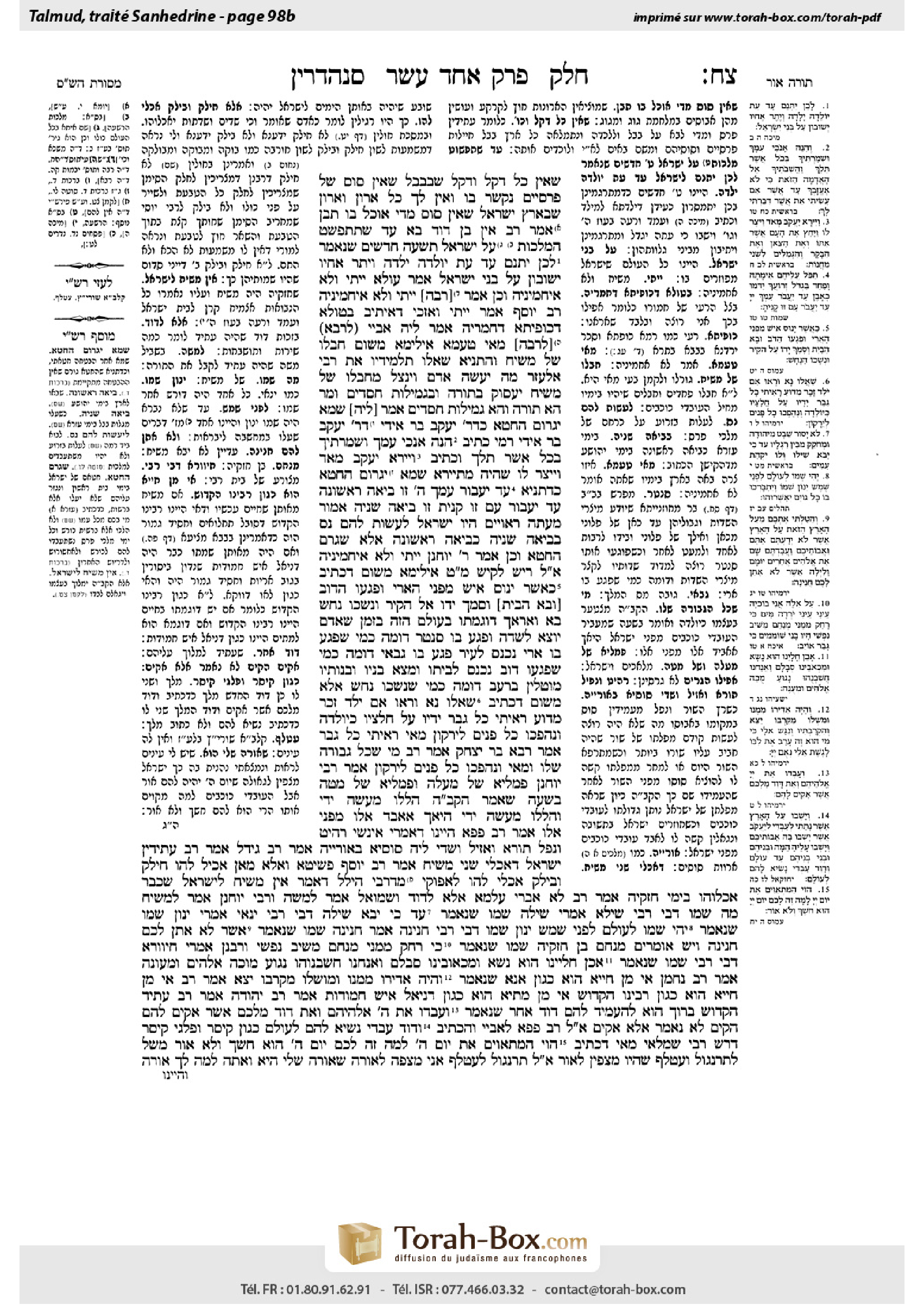
Sanhedrin 98b: Talmud study for Daf Yomi
Daf Yomi is the daily study of one Talmud folio. Explore 37 tractates with scans, Hebrew text, Sefaria English and AI-generated French translations where annotated.
Passage selection and English or AI-generated French translation are available where the scan has annotations. Daf Study is independent of Torah-Box and Sefaria.
Browse Sanhedrin · סנהדרין · All tractatesSanhedrin 98b text and translations
This page of Sanhedrin includes the Aramaic text, an English translation and an AI-generated French translation, alongside the scan above.
סנהדרין צ״ח ב · Aramaic and Hebrew text
שֶׁאֵין כׇּל דֶּקֶל וָדֶקֶל שֶׁבְּבָבֶל, שֶׁאֵין סוּס שֶׁל פָּרְסִיִּים נִקְשָׁר בּוֹ, וְאֵין לָךְ כׇּל אָרוֹן וְאָרוֹן שֶׁבְּאֶרֶץ יִשְׂרָאֵל, שֶׁאֵין סוּס מָדִי אוֹכֵל בּוֹ תֶּבֶן.
אָמַר רַב: אֵין בֶּן דָּוִד בָּא עַד שֶׁתִּתְפַּשֵּׁט מַלְכוּת הָרְשָׁעָה עַל יִשְׂרָאֵל תִּשְׁעָה חֳדָשִׁים, שֶׁנֶּאֱמַר: ״לָכֵן יִתְּנֵם עַד עֵת יוֹלֵדָה יָלָדָה וְיֶתֶר אֶחָיו יְשׁוּבוּן עַל בְּנֵי יִשְׂרָאֵל״.
אָמַר עוּלָּא: יֵיתֵי וְלָא אִיחְמִינֵיהּ. וְכֵן אָמַר [רַבָּה]: יֵיתֵי וְלָא אִיחְמִינֵיהּ. רַב יוֹסֵף אָמַר: יֵיתֵי וְאֶזְכֵּי דְּאֵיתֵיב בְּטוּלָּא דְּכוּפִיתָא דַּחֲמָרֵיהּ.
אֲמַר לֵיהּ אַבָּיֵי לְרַבָּה: מַאי טַעְמָא? אִילֵּימָא מִשּׁוּם חֶבְלוֹ שֶׁל מָשִׁיחַ? וְהָתַנְיָא: שָׁאֲלוּ תַּלְמִידָיו אֶת רַבִּי אֶלְעָזָר: מָה יַעֲשֶׂה אָדָם וְיִנָּצֵל מֵחֶבְלוֹ שֶׁל מָשִׁיחַ? יַעֲסוֹק בְּתוֹרָה וּבִגְמִילוּת חֲסָדִים. וּמָר – הָא תּוֹרָה וְהָא גְּמִילוּת חֲסָדִים!
אֲמַר לֵיהּ: שֶׁמָּא יִגְרוֹם הַחֵטְא, כִּדְרַבִּי יַעֲקֹב בַּר אִידִי, דְּרַבִּי יַעֲקֹב בַּר אִידִי רָמֵי: כְּתִיב ״וְהִנֵּה אָנֹכִי עִמָּךְ וּשְׁמַרְתִּיךָ בְּכֹל אֲשֶׁר תֵּלֵךְ״, וּכְתִיב ״וַיִּירָא יַעֲקֹב מְאֹד וַיֵּצֶר לוֹ״.
שֶׁהָיָה מִתְיָירֵא שֶׁמָּא יִגְרוֹם הַחֵטְא, כִּדְתַנְיָא: ״עַד יַעֲבֹר עַמְּךָ ה׳״ – זוֹ בִּיאָה רִאשׁוֹנָה, ״עַד יַעֲבֹר עַם זוּ קָנִית״ – זוֹ בִּיאָה שְׁנִיָּה.
אֱמוֹר מֵעַתָּה: רְאוּיִים הָיוּ יִשְׂרָאֵל לַעֲשׂוֹת לָהֶם נֵס בְּבִיאָה שְׁנִיָּה כְּבִיאָה רִאשׁוֹנָה, אֶלָּא שֶׁגָּרַם הַחֵטְא.
וְכֵן אָמַר רַבִּי יוֹחָנָן: יֵיתֵי וְלָא אִיחְמִינֵיהּ. אֲמַר לֵיהּ רֵישׁ לָקִישׁ: מַאי טַעְמָא? אִילֵּימָא מִשּׁוּם דִּכְתִיב ״כַּאֲשֶׁר יָנוּס אִישׁ מִפְּנֵי הָאֲרִי וּפְגָעוֹ הַדֹּב [וּבָא הַבַּיִת] וְסָמַךְ יָדוֹ עַל הַקִּיר וּנְשָׁכוֹ הַנָּחָשׁ״? בֹּא וְאַרְאֶךָּ דּוּגְמָתוֹ בָּעוֹלָם הַזֶּה: בִּזְמַן שֶׁאָדָם יוֹצֵא לַשָּׂדֶה וּפָגַע בּוֹ סַנְטָר – דּוֹמֶה כְּמִי שֶׁפָּגַע בּוֹ אֲרִי. נִכְנַס לָעִיר, פָּגַע בּוֹ גַּבַּאי – דּוֹמֶה כְּמִי שֶׁפְּגָעוֹ דֹּב. נִכְנַס לְבֵיתוֹ וּמָצָא בָּנָיו וּבְנוֹתָיו מוּטָלִין בָּרָעָב – דּוֹמֶה כְּמִי שֶׁנְּשָׁכוֹ נָחָשׁ.
אֶלָּא מִשּׁוּם דִּכְתִיב: ״שַׁאֲלוּ נָא וּרְאוּ אִם יֹלֵד זָכָר מַדּוּעַ רָאִיתִי כׇל גֶּבֶר יָדָיו עַל חֲלָצָיו כַּיּוֹלֵדָה וְנֶהֶפְכוּ כׇל פָּנִים לְיֵרָקוֹן״.
מַאי ״רָאִיתִי כָּל גֶּבֶר״? אָמַר רָבָא בַּר יִצְחָק אָמַר רַב: מִי שֶׁכׇּל גְּבוּרָה שֶׁלּוֹ. וּמַאי ״וְנֶהֶפְכוּ כׇל פָּנִים לְיֵרָקוֹן״? אָמַר רַבִּי יוֹחָנָן: פָּמַלְיָא שֶׁל מַעְלָה וּפָמַלְיָא שֶׁל מַטָּה, בְּשָׁעָה שֶׁאָמַר הַקָּדוֹשׁ בָּרוּךְ הוּא: הַלָּלוּ מַעֲשֵׂה יָדַי וְהַלָּלוּ מַעֲשֵׂה יָדַי, הֵיאַךְ אֲאַבֵּד אֵלּוּ מִפְּנֵי אֵלּוּ?
אָמַר רַב פָּפָּא: הַיְינוּ דְּאָמְרִי אִינָשֵׁי, רָהֵיט וְנָפֵל תּוֹרָא, וְאָזֵיל וְשָׁדֵי לֵיהּ סוּסְיָא בְּאוּרְיֵיהּ.
אָמַר רַב גִּידֵּל אָמַר רַב: עֲתִידִין יִשְׂרָאֵל דְּאָכְלִי שְׁנֵי מָשִׁיחַ. אָמַר רַב יוֹסֵף: פְּשִׁיטָא! וְאֶלָּא מַאן אָכֵיל לְהוּ? חִילָק וּבִילָק אָכְלִי לְהוּ? לְאַפּוֹקֵי מִדְּרַבִּי הִילֵּל, דְּאָמַר: אֵין מָשִׁיחַ לְיִשְׂרָאֵל, שֶׁכְּבָר אֲכָלוּהוּ בִּימֵי חִזְקִיָּה.
אָמַר רַב: לָא אִבְּרִי עָלְמָא אֶלָּא לְדָוִד. וּשְׁמוּאֵל אָמַר: לְמֹשֶׁה. וְרַבִּי יוֹחָנָן אָמַר: לְמָשִׁיחַ.
מָה שְׁמוֹ? דְּבֵי רַבִּי שֵׁילָא אָמְרִי: שִׁילֹה שְׁמוֹ, שֶׁנֶּאֱמַר: ״עַד כִּי יָבֹא שִׁילֹה״. דְּבֵי רַבִּי יַנַּאי אָמְרִי: יִנּוֹן שְׁמוֹ, שֶׁנֶּאֱמַר: ״יְהִי שְׁמוֹ לְעוֹלָם לִפְנֵי שֶׁמֶשׁ יִנּוֹן שְׁמוֹ״. דְּבֵי רַבִּי חֲנִינָה אָמְרִי: חֲנִינָה שְׁמוֹ, שֶׁנֶּאֱמַר: ״אֲשֶׁר לֹא אֶתֵּן לָכֶם חֲנִינָה״. וְיֵשׁ אוֹמְרִים: מְנַחֵם בֶּן חִזְקִיָּה שְׁמוֹ, שֶׁנֶּאֱמַר: ״כִּי רָחַק מִמֶּנִּי מְנַחֵם מֵשִׁיב נַפְשִׁי״. וְרַבָּנַן אָמְרִי: חִיוּוֹרָא דְּבֵי רַבִּי שְׁמוֹ, שֶׁנֶּאֱמַר: ״אָכֵן חֳלָיֵינוּ הוּא נָשָׂא וּמַכְאֹבֵינוּ סְבָלָם וַאֲנַחְנוּ חֲשַׁבְנֻהוּ נָגוּעַ מֻכֵּה אֱלֹהִים וּמְעֻנֶּה״.
אָמַר רַב נַחְמָן: אִי מִן חַיַּיָּא הוּא, כְּגוֹן אֲנָא, שֶׁנֶּאֱמַר: ״וְהָיָה אַדִּירוֹ מִמֶּנּוּ וּמֹשְׁלוֹ מִקִּרְבּוֹ יָצָא״. אָמַר רַב: אִי מִן חַיַּיָּא הוּא, כְּגוֹן רַבֵּינוּ הַקָּדוֹשׁ. אִי מִן מִתַיָּא הוּא, כְּגוֹן דָּנִיֵּאל אִישׁ חֲמוּדוֹת.
אָמַר רַב יְהוּדָה אָמַר רַב: עָתִיד הַקָּדוֹשׁ בָּרוּךְ הוּא לְהַעֲמִיד לָהֶם דָּוִד אַחֵר, שֶׁנֶּאֱמַר: ״וְעָבְדוּ אֵת ה׳ אֱלֹהֵיהֶם וְאֵת דָּוִד מַלְכָּם אֲשֶׁר אָקִים לָהֶם״. ״הֵקִים״ לֹא נֶאֱמַר, אֶלָּא ״אָקִים״. אֲמַר לֵיהּ רַב פָּפָּא לְאַבָּיֵי: וְהָכְתִיב: ״וְדָוִד עַבְדִּי נָשִׂיא לָהֶם לְעוֹלָם״? כְּגוֹן קֵיסָר וּפַלְגֵי קֵיסָר.
דָּרַשׁ רַבִּי שִׂמְלַאי: מַאי דִּכְתִיב ״הוֹי הַמִּתְאַוִּים אֶת יוֹם ה׳ לָמָּה זֶּה לָכֶם יוֹם ה׳ הוּא חֹשֶׁךְ וְלֹא אוֹר״? מָשָׁל לְתַרְנְגוֹל וַעֲטַלֵּף שֶׁהָיוּ מְצַפִּין לָאוֹר. אֲמַר לֵיהּ תַּרְנְגוֹל לַעֲטַלֵּף: אֲנִי מְצַפֶּה לָאוֹרָה שֶׁאוֹרָה שֶׁלִּי הִיא, וְאַתָּה לָמָּה לְךָ אוֹרָה?
Sanhedrin 98b · English translation
as there is no palm tree that is in Babylonia to which a horse of the Persians will not be tethered when the Persians and Medes go to conquer other lands. And there is no coffin buried in Eretz Yisrael from which a Median horse will not eat straw. During wars, all the coffins will be removed from the ground and used as animal troughs. I do not want my coffin to be used for that purpose.
Rav says: The son of David will not come until the evil Roman kingdom will disperse throughout Eretz Yisrael for nine months, as it is stated: “Therefore will He give them up, until the time when she who is in labor has given birth; then the remnant of his brethren shall return with the children of Israel” (Micah 5:2). Once a period equivalent to a term of pregnancy passes, the redemption will come.
§ Ulla says: Let the Messiah come, but after my death, so that I will not see him, as I fear the suffering that will precede his coming. Likewise, Rabba says: Let the Messiah come, but after my death, so that I will not see him. Rav Yosef says: Let the Messiah come, and I will be privileged to sit in the shadow of his donkey’s excrement. I am willing to undergo all the pain and disgrace associated with his arrival.
Abaye said to Rabba: What is the reason that you are so concerned? If we say it is due to the pains preceding and accompanying the coming of the Messiah, but isn’t it taught in a baraita that Rabbi Elazar’s students asked Rabbi Elazar: What shall a person do to be spared from the pains preceding the coming of the Messiah? Rabbi Elazar said to them: They shall engage in Torah study and acts of kindness. Abaye continued: And as far as the Master is concerned, isn’t there the Torah and aren’t there the acts of kindness that you performed?
Rabba said to him: I am concerned lest sin cause me to suffer the pain despite the Torah study and the good deeds in which I engage, in accordance with the statement of Rabbi Ya’akov bar Idi. As Rabbi Ya’akov bar Idi raises a contradiction. It is written that God said to Jacob: “And I am with you, and will keep you wherever you go” (Genesis 28:15), and it is written: “And Jacob was greatly afraid and distressed” (Genesis 32:8). If God assured Jacob that He would keep him, why was he concerned?
Rabbi Ya’akov bar Idi explains: He was afraid lest sin on his part cause that assurance to be abrogated, as it is taught in a baraita with regard to the verse: “Until Your people pass over, Lord, until Your people, whom You have acquired, pass over” (Exodus 15:16). “Until Your people pass over, Lord”; this is a reference to the first entry into the land, led by Joshua. “Until Your people, whom You have acquired, pass over”; this is a reference to the second entry into the land, when they returned to Zion from Babylonia.
Rabbi Ya’akov bar Idi explains: Say from now, based on this statement, that the Jewish people were worthy for God to perform a miracle on their behalf in the second entry into the land that was like the miracles that were performed during the exodus from Egypt and the first entry into the land, but the sin caused the second entry to take place in an unremarkable manner, with the Jewish people being subject to the dominion of the gentiles.
And so too Rabbi Yoḥanan said: Let the Messiah come, but after my death, so that I will not see him. Reish Lakish said to him: What is the reason that you are concerned? If we say it is because it is written with regard to the day of God: “As when a man did flee from a lion and a bear met him, or went into the house and leaned his arm on the wall and a snake bit him” (Amos 5:19), that is not a reason. Come, and I will show you a counterpart in this world to the situation described in this verse, as even today one encounters those situations. At a time when a person goes out to the field and is accosted by a guard [santar] who demands payment, his situation is similar to that of one who is accosted by a lion. He then enters the city and is accosted by a royal tax collector. His situation is similar to that of one who is accosted by a bear. He then enters his house and finds his sons and daughters afflicted with famine. His situation is similar to that of one whom a snake bit.
Rabbi Yoḥanan said to him: Rather, the reason I am concerned is that it is written with regard to the day of God: “Ask now, and see whether a man gives birth. Why, then, do I see every man [kol gever] with his hands on his loins, as a woman in labor, and all faces turned green?” (Jeremiah 30:6).
The Gemara clarifies: What is the meaning of the phrase “I see kol gever”? Rava bar Yitzḥak says that Rav says: It is a reference to He Whom all strength is His. It is as though even God will suffer like a woman in labor due to the troubles of the Jewish people. And what is the meaning of the phrase “And all faces turned green”? Rabbi Yoḥanan says: The reference is to the heavenly entourage above, i.e., angels, and the earthly entourage below, i.e., the Jewish people, who will all suffer at the time when the Holy One, Blessed be He, says: These, the Jewish people, are My handiwork, and those, the gentiles, are My handiwork. How shall I destroy those on account of these? It appears that the Holy One, Blessed be He, does not distinguish between the Jewish people and the gentiles. That is why Rabbi Yoḥanan was concerned with regard to the coming of the Messiah.
Rav Pappa says that this is in accordance with the adage that people say: An ox runs and falls, and its owner goes and casts a horse in its place. Although the horse is an inferior work animal relative to the ox, when there is no ox available, a horse must suffice. So too, after the Jewish people sin, it is as though the Holy One, Blessed be He, transfers their prominence to the gentiles.
§ Rav Giddel says that Rav says: The Jewish people are destined to eat from the bounty of, i.e., enjoy, the years of the Messiah. Rav Yosef says: Isn’t this obvious? And rather, who else will eat from them? Will Ḥillak and Billak, two shiftless characters, eat from them? The Gemara explains that Rav Giddel’s statement serves to exclude the statement of Rabbi Hillel, who says: There is no Messiah coming for the Jewish people, as they already ate from him, as all the prophecies relating to the Messiah were already fulfilled during the days of Hezekiah.
Rav says: The world was created only for the sake of David, by virtue of his merit. And Shmuel says: It was created by virtue of the merit of Moses. And Rabbi Yoḥanan says: It was created by virtue of the merit of the Messiah.
Apropos the Messiah, the Gemara asks: What is his name? The school of Rabbi Sheila says: Shiloh is his name, as it is stated: “Until when Shiloh shall come” (Genesis 49:10). The school of Rabbi Yannai says: Yinnon is his name, as it is stated: “May his name endure forever; may his name continue [yinnon] as long as the sun; and may men bless themselves by him” (Psalms 72:17). The school of Rabbi Ḥanina says: Ḥanina is his name, as it is stated: “For I will show you no favor [ḥanina]” (Jeremiah 16:13). And some say that Menaḥem ben Ḥizkiyya is his name, as it is stated: “Because the comforter [menaḥem] that should relieve my soul is far from me” (Lamentations 1:16). And the Rabbis say: The leper of the house of Rabbi Yehuda HaNasi is his name, as it is stated: “Indeed our illnesses he did bear and our pains he endured; yet we did esteem him injured, stricken by God, and afflicted” (Isaiah 53:4).
Rav Naḥman says: If the Messiah is among the living in this generation, he is a person such as me, who already has dominion over the Jewish people, as it is stated: “And their prince shall be of themselves, and their governor shall proceed from their midst” (Jeremiah 30:21), indicating that the redeemer is already in power. Rav says: If the Messiah is among the living in this generation, he is a person such as our saintly Rabbi Yehuda HaNasi, who was renowned for his sanctity, piety, and Torah knowledge. If the Messiah is among the dead he is a person such as Daniel, the beloved man.
Rav Yehuda says that Rav says: The Holy One, Blessed be He, is destined to establish another David for the Jewish people as the Messiah, as it is stated: “And they shall serve the Lord their God, and David their king, whom I will establish for them” (Jeremiah 30:9). It is not stated: I established, but “I will establish,” indicating that the name of the future king will be David. Rav Pappa said to Abaye: But isn’t it written: “And my servant David shall be their prince forever” (Ezekiel 37:25), indicating that King David himself will rule over the Jewish people? Abaye said: They will rule in tandem like an emperor and a viceroy; the Messiah will be king and David will be second-in-command.
§ Rabbi Simlai taught: What is the meaning of that which is written: “Woe to you who desire the day of the Lord. Why would you have this day of the Lord? It is darkness, and not light” (Amos 5:18)? It is comparable to a rooster and a bat who were looking forward to the light of day. The rooster said to the bat: I look forward to light, as light is an indication of my time to be active. But as for you, why do you need light? Nighttime for you is like daytime for me.
Sanhedrin 98b · Traduction française (IA)
car il n’y a pas de palmier en Babylonie auquel ne soit attaché le cheval d’un Perse, lorsque les Perses et les Mèdes partent conquérir d’autres pays. Et il n’y a pas de cercueil enterré en terre d’Israël dont un cheval mède ne mange la paille. Pendant les guerres, tous les cercueils seront déterrés et serviront d’auges pour les animaux. Je ne veux pas que mon cercueil soit utilisé à cette fin.
Rav dit : Le fils de David ne viendra pas avant que le royaume romain impie se soit répandu dans toute la terre d’Israël pendant neuf mois, comme il est dit : « C’est pourquoi Il les livrera jusqu’au moment où celle qui doit enfanter aura enfanté ; alors le reste de ses frères reviendra avec les enfants d’Israël » (Michée 5, 2). Une fois écoulée une période équivalant à la durée d’une grossesse, la rédemption viendra.
§ Oulla dit : Que le Messie vienne, mais après ma mort, afin que je ne le voie pas, car je crains les souffrances qui précéderont sa venue. De même, Rabba dit : Que le Messie vienne, mais après ma mort, afin que je ne le voie pas. Rav Yossef dit : Que le Messie vienne, et j’aurai le mérite de m’asseoir à l’ombre de la fiente de son âne. Je suis prêt à endurer toute la douleur et toute l’humiliation liées à son arrivée.
Abayé dit à Rabba : Pourquoi es-tu si inquiet ? Si nous disons que c’est à cause des douleurs qui précèdent et accompagnent la venue du Messie, n’est-il pas enseigné dans une baraïta que les élèves de Rabbi Elazar lui demandèrent : « Que doit faire une personne pour être épargnée des douleurs qui précèdent la venue du Messie ? » Rabbi Elazar leur répondit : « Qu’ils s’adonnent à l’étude de la Torah et aux actes de bonté. » Abayé poursuivit : Et toi, Maître, n’as-tu pas l’étude de la Torah et les actes de bonté que tu as accomplis ?
Rabba lui répondit : Je crains que le péché ne me fasse souffrir malgré l’étude de la Torah et les bonnes actions auxquelles je m’adonne, conformément à l’enseignement de Rabbi Ya’akov bar Idi, qui soulève une contradiction. Il est écrit que Dieu dit à Jacob : « Je suis avec toi et je te garderai partout où tu iras » (Genèse 28, 15), et il est écrit : « Jacob eut très peur et fut angoissé » (Genèse 32, 8). Si Dieu avait assuré à Jacob qu’Il le garderait, pourquoi était-il inquiet ?
Rabbi Ya’akov bar Idi explique : Il avait peur que son péché n’entraîne l’annulation de cette assurance, comme l’enseigne une baraïta au sujet du verset : « Jusqu’à ce que passe Ton peuple, Seigneur, jusqu’à ce que passe Ton peuple, que Tu as acquis » (Exode 15, 16). « Jusqu’à ce que passe Ton peuple, Seigneur » fait référence à la première entrée dans le pays, sous la conduite de Josué. « Jusqu’à ce que passe Ton peuple, que Tu as acquis » fait référence à la seconde entrée dans le pays, lorsqu’ils revinrent à Sion depuis la Babylonie.
Rabbi Ya’akov bar Idi explique : Concluons dès lors, sur la base de cet enseignement, que le peuple juif était digne que Dieu accomplisse en sa faveur, lors de la seconde entrée dans le pays, un miracle semblable aux miracles accomplis lors de la sortie d’Égypte et de la première entrée dans le pays. Mais le péché fit que la seconde entrée se déroula de manière ordinaire, le peuple juif étant soumis à la domination des nations.
De même, Rabbi Yoḥanan dit : Que le Messie vienne, mais après ma mort, afin que je ne le voie pas. Reish Lakish lui dit : Pourquoi es-tu inquiet ? Si nous disons que c’est parce qu’il est écrit au sujet du jour de Dieu : « Comme un homme qui fuit devant un lion et rencontre un ours, ou qui entre dans la maison, appuie son bras contre le mur et se fait mordre par un serpent » (Amos 5, 19), cela ne constitue pas une raison. Viens, je vais te montrer dans ce monde une situation correspondant à celle décrite dans ce verset, car on rencontre encore aujourd’hui de telles situations. Quand un homme sort aux champs et se fait arrêter par un garde [santar] qui exige un paiement, sa situation est semblable à celle d’un homme qui est accosté par un lion. Il entre ensuite dans la ville et se fait arrêter par un collecteur d’impôts royal. Sa situation est semblable à celle d’un homme qui est accosté par un ours. Puis il entre chez lui et trouve ses fils et ses filles accablés par la famine. Sa situation est semblable à celle d’un homme mordu par un serpent.
Rabbi Yoḥanan lui dit : La raison de mon inquiétude est plutôt qu’il est écrit au sujet du jour de Dieu : « Demande donc et vois : un homme peut-il enfanter ? Pourquoi donc vois-je chaque homme [kol gever] les mains sur les reins, comme une femme en travail, et tous les visages devenus verts ? » (Jérémie 30, 6).
La Guemara précise : Que signifie l’expression « je vois kol gever » ? Rava bar Yitzḥak dit au nom de Rav : Cela désigne Celui à qui appartient toute force. C’est comme si même Dieu souffrait comme une femme en travail, à cause des malheurs du peuple juif. Et que signifie l’expression « tous les visages devenus verts » ? Rabbi Yoḥanan dit : Elle fait référence à la suite céleste d’en haut, c’est-à-dire aux anges, et à la suite terrestre d’en bas, c’est-à-dire au peuple juif, qui souffriront tous lorsque le Saint, béni soit-Il, dira : « Ceux-ci, le peuple juif, sont Mon œuvre, et ceux-là, les nations, sont Mon œuvre. Comment pourrais-Je détruire ceux-là à cause de ceux-ci ? » Il semble que le Saint, béni soit-Il, ne fasse pas de distinction entre le peuple juif et les nations. C’est pourquoi Rabbi Yoḥanan était inquiet au sujet de la venue du Messie.
Rav Pappa dit que cela correspond au proverbe que les gens emploient : « Un bœuf court et tombe, et son propriétaire va chercher un cheval pour le remplacer. » Bien que le cheval soit une bête de travail inférieure au bœuf, en l’absence de bœuf, il faut se contenter d’un cheval. De même, après que le peuple juif a péché, c’est comme si le Saint, béni soit-Il, transférait sa prééminence aux nations.
§ Rav Giddel dit au nom de Rav : Le peuple juif est destiné à manger de l’abondance des années du Messie, c’est-à-dire à en profiter. Rav Yossef dit : N’est-ce pas évident ? Qui d’autre en profiterait ? Est-ce que Ḥillak et Billak, deux personnages oisifs, en profiteront ? La Guemara explique que la déclaration de Rav Giddel vient exclure l’avis de Rabbi Hillel, qui dit : Il n’y aura pas de Messie pour le peuple juif, car il a déjà profité de lui, toutes les prophéties relatives au Messie ayant déjà été accomplies à l’époque d’Ézéchias.
Rav dit : Le monde n’a été créé que pour David, en vertu de son mérite. Shmuel dit : Il a été créé en vertu du mérite de Moïse. Et Rabbi Yoḥanan dit : Il a été créé en vertu du mérite du Messie.
À propos du Messie, la Guemara demande : Quel est son nom ? L’école de Rabbi Sheila dit : Son nom est Shilo, comme il est dit : « Jusqu’à ce que vienne Shilo » (Genèse 49, 10). L’école de Rabbi Yannai dit : Son nom est Yinnon, comme il est dit : « Que son nom demeure à jamais ; que son nom se perpétue [yinnon] tant que le soleil brillera, et que les hommes se bénissent par lui » (Psaumes 72, 17). L’école de Rabbi Ḥanina dit : Son nom est Ḥanina, comme il est dit : « Car Je ne vous accorderai aucune faveur [ḥanina] » (Jérémie 16, 13). Certains disent que son nom est Menaḥem ben Ḥizkiyya, comme il est dit : « Car le consolateur [menaḥem] qui devait ranimer mon âme est loin de moi » (Lamentations 1, 16). Et les Sages disent : Son nom est le lépreux de la maison de Rabbi Yehuda HaNasi, comme il est dit : « En vérité, il a porté nos maladies et s’est chargé de nos douleurs ; et nous, nous le tenions pour frappé, touché par Dieu et affligé » (Isaïe 53, 4).
Rav Naḥman dit : Si le Messie se trouve parmi les vivants de cette génération, c’est une personne telle que moi, qui exerce déjà son autorité sur le peuple juif, comme il est dit : « Leur prince sera issu d’eux, et leur gouverneur sortira de leur milieu » (Jérémie 30, 21), ce qui indique que le rédempteur est déjà au pouvoir. Rav dit : Si le Messie se trouve parmi les vivants de cette génération, c’est une personne telle que notre saint Rabbi Yehuda HaNasi, réputé pour sa sainteté, sa piété et sa connaissance de la Torah. Si le Messie se trouve parmi les morts, c’est une personne telle que Daniel, l’homme bien-aimé.
Rav Yehuda dit au nom de Rav : Le Saint, béni soit-Il, est destiné à susciter un autre David pour le peuple juif comme Messie, comme il est dit : « Ils serviront le Seigneur leur Dieu, ainsi que David leur roi, que Je susciterai pour eux » (Jérémie 30, 9). Il n’est pas dit : « J’ai suscité », mais « Je susciterai », ce qui indique que le nom du futur roi sera David. Rav Pappa dit à Abayé : Mais n’est-il pas écrit : « Mon serviteur David sera leur prince pour toujours » (Ézéchiel 37, 25), ce qui indique que le roi David lui-même régnera sur le peuple juif ? Abayé répondit : Ils régneront ensemble, comme un empereur et un vice-roi ; le Messie sera roi et David sera son second.
§ Rabbi Simlaï enseignait : Que signifie ce qui est écrit : « Malheur à vous qui désirez le jour du Seigneur ! Pourquoi désirez-vous le jour du Seigneur ? Ce sera l’obscurité, et non la lumière » (Amos 5, 18) ? Cela ressemble à un coq et à une chauve-souris qui attendaient avec impatience la lumière du jour. Le coq dit à la chauve-souris : « J’attends la lumière, car elle annonce le moment où je dois être actif. Mais toi, pourquoi as-tu besoin de lumière ? La nuit, pour toi, est comme le jour pour moi. »
Traduction française générée par IA à partir de l’édition anglaise de Sefaria. Vérifie toujours un passage avec le texte source.
Text from Sefaria: William Davidson Edition - Vocalized Aramaic (CC BY NC); William Davidson Edition - English (CC BY NC).