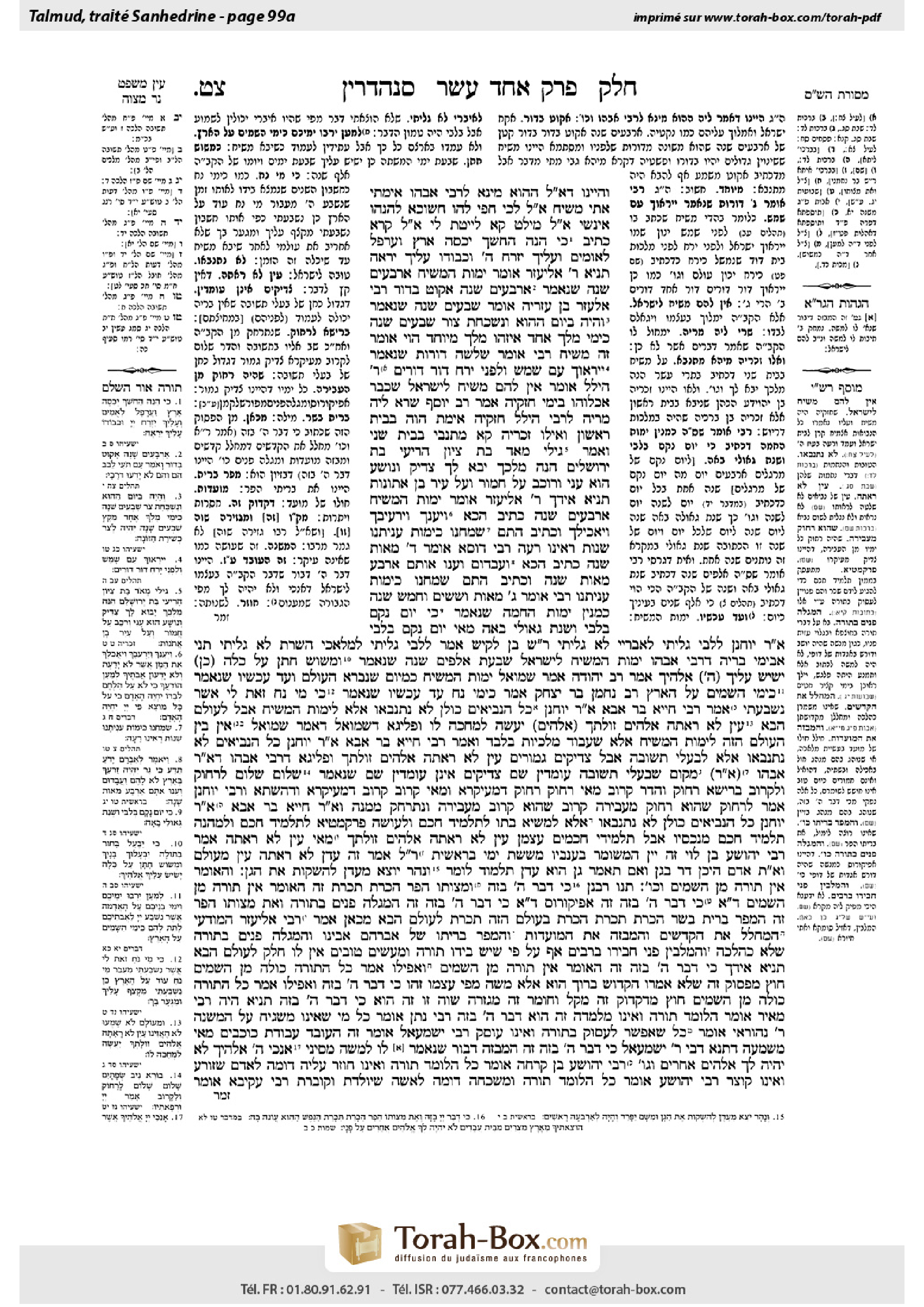
Sanhedrin 99a: Talmud study for Daf Yomi
Daf Yomi is the daily study of one Talmud folio. Explore 37 tractates with scans, Hebrew text, Sefaria English and AI-generated French translations where annotated.
Passage selection and English or AI-generated French translation are available where the scan has annotations. Daf Study is independent of Torah-Box and Sefaria.
Browse Sanhedrin · סנהדרין · All tractatesSanhedrin 99a text and translations
This page of Sanhedrin includes the Aramaic text, an English translation and an AI-generated French translation, alongside the scan above.
סנהדרין צ״ט א · Aramaic and Hebrew text
וְהַיְינוּ דַּאֲמַר לֵיהּ הָהוּא מִינָא לְרַבִּי אֲבָהוּ: אֵימָתַי אָתֵי מָשִׁיחַ? אָמַר לֵיהּ: לְכִי חָפֵי לְהוּ חֲשׁוֹכָא לְהָנְהוּ אִינָשֵׁי. אֲמַר לֵיהּ: מֵילָט קָא לָיְיטַתְּ לִי? אֲמַר לֵיהּ: קְרָא כְּתִיב, ״כִּי הִנֵּה הַחֹשֶׁךְ יְכַסֶּה אֶרֶץ וַעֲרָפֶל לְאֻמִּים וְעָלַיִךְ יִזְרַח ה׳ וּכְבוֹדוֹ עָלַיִךְ יֵרָאֶה״.
תַּנְיָא: רַבִּי אֱלִיעֶזֶר אוֹמֵר, יְמוֹת הַמָּשִׁיחַ אַרְבָּעִים שָׁנָה, שֶׁנֶּאֱמַר ״אַרְבָּעִים שָׁנָה אָקוּט בְּדוֹר״. רַבִּי אֶלְעָזָר בֶּן עֲזַרְיָה אוֹמֵר, שִׁבְעִים שָׁנָה, שֶׁנֶּאֱמַר ״וְהָיָה בַּיּוֹם הַהוּא וְנִשְׁכַּחַת צֹר שִׁבְעִים שָׁנָה כִּימֵי מֶלֶךְ אֶחָד״. אֵיזֶהוּ מֶלֶךְ מְיוּחָד? הֱוֵי אוֹמֵר: זֶה מָשִׁיחַ.
רַבִּי אוֹמֵר: שְׁלֹשָׁה דּוֹרוֹת, שֶׁנֶּאֱמַר: ״יִירָאוּךָ עִם שָׁמֶשׁ וְלִפְנֵי יָרֵחַ דּוֹר דּוֹרִים״. רַבִּי הִילֵּל אוֹמֵר: אֵין לָהֶם מָשִׁיחַ לְיִשְׂרָאֵל, שֶׁכְּבָר אֲכָלוּהוּ בִּימֵי חִזְקִיָּה.
אָמַר רַב יוֹסֵף: שְׁרָא לֵיהּ מָרֵיהּ לְרַבִּי הִילֵּל. חִזְקִיָּה אֵימַת הֲוָה? בְּבַיִת רִאשׁוֹן! וְאִילּוּ זְכַרְיָה קָא מִתְנַבֵּי בְּבַיִת שֵׁנִי, וְאָמַר: ״גִּילִי מְאֹד בַּת צִיּוֹן הָרִיעִי בַּת יְרוּשָׁלִַים הִנֵּה מַלְכֵּךְ יָבוֹא לָךְ צַדִּיק וְנוֹשָׁע הוּא עָנִי וְרֹכֵב עַל חֲמוֹר וְעַל עַיִר בֶּן אֲתֹנוֹת״.
תַּנְיָא אִידַּךְ: רַבִּי אֱלִיעֶזֶר אוֹמֵר, יְמוֹת הַמָּשִׁיחַ אַרְבָּעִים שָׁנָה. כְּתִיב הָכָא: ״וַיְעַנְּךָ וַיַּרְעִבֶךָ וַיַּאֲכִלְךָ״, וּכְתִיב הָתָם: ״שַׂמְּחֵנוּ כִּימוֹת עִנִּיתָנוּ שְׁנוֹת רָאִינוּ רָעָה״.
רַבִּי דּוֹסָא אוֹמֵר: אַרְבַּע מֵאוֹת שָׁנָה. כְּתִיב הָכָא: ״וַעֲבָדוּם וְעִנּוּ אֹתָם אַרְבַּע מֵאוֹת שָׁנָה״, וּכְתִיב הָתָם: ״שַׂמְּחֵנוּ כִּימוֹת עִנִּיתָנוּ״.
רַבִּי אוֹמֵר: שְׁלֹשׁ מֵאוֹת וְשִׁשִּׁים וְחָמֵשׁ שָׁנָה, כְּמִנְיַן יְמוֹת הַחַמָּה, שֶׁנֶּאֱמַר: ״כִּי יוֹם נָקָם בְּלִבִּי וּשְׁנַת גְּאוּלַי בָּאָה״.
מַאי ״יוֹם נָקָם בְּלִבִּי״? אָמַר רַבִּי יוֹחָנָן: לְלִבִּי גִּלִּיתִי, לְאֵבָרַיי לֹא גִּלִּיתִי. רַבִּי שִׁמְעוֹן בֶּן לָקִישׁ אָמַר: לְלִבִּי גִּלִּיתִי, לְמַלְאֲכֵי הַשָּׁרֵת לֹא גִּלִּיתִי.
תָּנֵי אֲבִימִי בְּרֵיהּ דְּרַבִּי אֲבָהוּ: יְמוֹת הַמָּשִׁיחַ לְיִשְׂרָאֵל שִׁבְעַת אֲלָפִים שָׁנָה, שֶׁנֶּאֱמַר: ״וּמְשׂוֹשׂ חָתָן עַל כַּלָּה כֵּן יָשִׂישׂ עָלַיִךְ אֱלֹהֶיךָ״.
אָמַר רַב יְהוּדָה אָמַר שְׁמוּאֵל: יְמוֹת הַמָּשִׁיחַ כְּמִיּוֹם שֶׁנִּבְרָא הָעוֹלָם וְעַד עַכְשָׁיו, שֶׁנֶּאֱמַר: ״כִּימֵי הַשָּׁמַיִם עַל הָאָרֶץ״.
רַב נַחְמָן בַּר יִצְחָק אָמַר: כִּימֵי נֹחַ עַד עַכְשָׁיו, שֶׁנֶּאֱמַר: ״כִּי מֵי נֹחַ זֹאת לִי אֲשֶׁר נִשְׁבַּעְתִּי״.
אָמַר רַבִּי חִיָּיא בַּר אַבָּא אָמַר רַבִּי יוֹחָנָן: כׇּל הַנְּבִיאִים כּוּלָּן לֹא נִתְנַבְּאוּ אֶלָּא לִימוֹת הַמָּשִׁיחַ, אֲבָל לָעוֹלָם הַבָּא – ״עַיִן לֹא רָאָתָה אֱלֹהִים זוּלָתְךָ אֱלֹהִים יַעֲשֶׂה לִמְחַכֵּה לוֹ״. וּפְלִיגָא דִּשְׁמוּאֵל, דְּאָמַר שְׁמוּאֵל: אֵין בֵּין הָעוֹלָם הַזֶּה לִימוֹת הַמָּשִׁיחַ אֶלָּא שִׁעְבּוּד מַלְכִיּוֹת בִּלְבַד.
וְאָמַר רַבִּי חִיָּיא בַּר אַבָּא אָמַר רַבִּי יוֹחָנָן: כׇּל הַנְּבִיאִים לֹא נִתְנַבְּאוּ אֶלָּא לְבַעֲלֵי תְשׁוּבָה, אֲבָל צַדִּיקִים גְּמוּרִים – ״עַיִן לֹא רָאָתָה אֱלֹהִים זוּלָתְךָ״. וּפְלִיגָא דְּרַבִּי אֲבָהוּ, דְּאָמַר רַבִּי אֲבָהוּ אָמַר רַב: מָקוֹם שֶׁבַּעֲלֵי תְשׁוּבָה עוֹמְדִין שָׁם – צַדִּיקִים אֵינָן עוֹמְדִין שָׁם, שֶׁנֶּאֱמַר: ״שָׁלוֹם שָׁלוֹם לָרָחוֹק וְלַקָּרוֹב״. בְּרֵישָׁא רָחוֹק וַהֲדַר קָרוֹב. מַאי ״רָחוֹק״ – רָחוֹק דְּמֵעִיקָּרָא. וּמַאי ״קָרוֹב״ – קָרוֹב דְּמֵעִיקָּרָא וּדְהַשְׁתָּא.
וְרַבִּי יוֹחָנָן אָמַר: ״לָרָחוֹק״ – שֶׁהוּא רָחוֹק מֵעֲבֵירָה, ״קָרוֹב״ – שֶׁהוּא קָרוֹב מֵעֲבֵירָה וְנִתְרַחֵק מִמֶּנָּה.
וְאָמַר רַבִּי חִיָּיא בַּר אַבָּא אָמַר רַבִּי יוֹחָנָן: כׇּל הַנְּבִיאִים כּוּלָּן לֹא נִתְנַבְּאוּ אֶלָּא לְמַשִּׂיא בִּתּוֹ לְתַלְמִיד חָכָם, וּלְעוֹשֶׂה פְּרַקְמַטְיָא לְתַלְמִיד חָכָם, וְלִמְהַנֶּה תַּלְמִיד חָכָם מִנְּכָסָיו. אֲבָל תַּלְמִידֵי חֲכָמִים עַצְמָן – ״עַיִן לֹא רָאָתָה אֱלֹהִים זוּלָתְךָ״.
מַאי ״עַיִן לֹא רָאָתָה״? אָמַר רַבִּי יְהוֹשֻׁעַ בֶּן לֵוִי: זֶה יַיִן הַמְשׁוּמָּר בַּעֲנָבָיו מִשֵּׁשֶׁת יְמֵי בְּרֵאשִׁית. רֵישׁ לָקִישׁ אָמַר: זֶה עֵדֶן, שֶׁלֹּא רָאֲתָה עַיִן מֵעוֹלָם. וְאִם תֹּאמַר: אָדָם הֵיכָן דָּר? בַּגָּן. וְאִם תֹּאמַר: גַּן הוּא עֵדֶן? תַּלְמוּד לוֹמַר: ״וְנָהָר יֹצֵא מֵעֵדֶן לְהַשְׁקוֹת אֶת הַגָּן״.
וְהָאוֹמֵר: אֵין תּוֹרָה מִן הַשָּׁמַיִם וְכוּ׳. תָּנוּ רַבָּנַן: ״כִּי דְבַר ה׳ בָּזָה וּמִצְוָתוֹ הֵפַר הִכָּרֵת תִּכָּרֵת״ – זֶה הָאוֹמֵר: אֵין תּוֹרָה מִן הַשָּׁמַיִם. דָּבָר אַחֵר: ״כִּי דְבַר ה׳ בָּזָה״ – זֶה אֶפִּיקוֹרוֹס.
דָּבָר אַחֵר: ״כִּי דְבַר ה׳ בָּזָה״ – זֶה הַמְגַלֶּה פָּנִים בַּתּוֹרָה. ״וְאֶת מִצְוָתוֹ הֵפַר״ – זֶה הַמֵּפֵר בְּרִית בָּשָׂר. ״הִכָּרֵת תִּכָּרֵת״ – ״הִכָּרֵת״ בָּעוֹלָם הַזֶּה, ״תִּכָּרֵת״ לָעוֹלָם הַבָּא. מִכָּאן אָמַר רַבִּי אֶלְעָזָר הַמּוֹדָעִי: הַמְחַלֵּל אֶת הַקֳּדָשִׁים, וְהַמְבַזֶּה אֶת הַמּוֹעֲדוֹת, וְהַמֵּפֵר בְּרִיתוֹ שֶׁל אַבְרָהָם אָבִינוּ, וְהַמְגַלֶּה פָּנִים בְּתוֹרָה שֶׁלֹּא כַּהֲלָכָה, וְהַמַּלְבִּין פְּנֵי חֲבֵירוֹ בָּרַבִּים, אַף עַל פִּי שֶׁיֵּשׁ בְּיָדוֹ תּוֹרָה וּמַעֲשִׂים טוֹבִים אֵין לוֹ חֵלֶק לָעוֹלָם הַבָּא.
תַּנְיָא אִידַּךְ: ״כִּי דְבַר ה׳ בָּזָה״ – זֶה הָאוֹמֵר אֵין תּוֹרָה מִן הַשָּׁמַיִם. וַאֲפִילּוּ אָמַר כׇּל הַתּוֹרָה כּוּלָּהּ מִן הַשָּׁמַיִם, חוּץ מִפָּסוּק זֶה שֶׁלֹּא אֲמָרוֹ הַקָּדוֹשׁ בָּרוּךְ הוּא אֶלָּא מֹשֶׁה מִפִּי עַצְמוֹ – זֶהוּ ״כִּי דְבַר ה׳ בָּזָה״. וַאֲפִילּוּ אָמַר כׇּל הַתּוֹרָה כּוּלָּהּ מִן הַשָּׁמַיִם, חוּץ מִדִּקְדּוּק זֶה, מִקַּל וָחוֹמֶר זֶה, מִגְּזֵרָה שָׁוָה זוֹ – זֶה הוּא ״כִּי דְבַר ה׳ בָּזָה״.
תַּנְיָא, הָיָה רַבִּי מֵאִיר אוֹמֵר: הַלּוֹמֵד תּוֹרָה וְאֵינוֹ מְלַמְּדָהּ – זֶה הוּא ״דְּבַר ה׳ בָּזָה״. רַבִּי נָתָן אוֹמֵר: כׇּל מִי שֶׁאֵינוֹ מַשְׁגִּיחַ עַל הַמִּשְׁנָה. רַבִּי נְהוֹרַאי אוֹמֵר: כׇּל שֶׁאֶפְשָׁר לַעֲסוֹק בַּתּוֹרָה וְאֵינוֹ עוֹסֵק.
רַבִּי יִשְׁמָעֵאל אוֹמֵר: זֶה הָעוֹבֵד עֲבוֹדָה זָרָה. מַאי מַשְׁמָעָה? דְּתָנָא דְּבֵי רַבִּי יִשְׁמָעֵאל: ״כִּי דְבַר ה׳ בָּזָה״ – זֶה הַמְבַזֶּה דִּבּוּר שֶׁנֶּאֱמַר לוֹ לְמֹשֶׁה מִסִּינַי: ״אָנֹכִי ה׳ אֱלֹהֶיךָ״, ״לֹא יִהְיֶה לְךָ אֱלֹהִים אֲחֵרִים וְגוֹ׳״.
רַבִּי יְהוֹשֻׁעַ בֶּן קׇרְחָה אוֹמֵר: כׇּל הַלּוֹמֵד תּוֹרָה וְאֵינוֹ חוֹזֵר עָלֶיהָ, דּוֹמֶה לְאָדָם שֶׁזּוֹרֵעַ וְאֵינוֹ קוֹצֵר. רַבִּי יְהוֹשֻׁעַ אוֹמֵר: כׇּל הַלּוֹמֵד תּוֹרָה וּמְשַׁכְּחָהּ, דּוֹמֶה לְאִשָּׁה שֶׁיּוֹלֶדֶת וְקוֹבֶרֶת.
רַבִּי עֲקִיבָא אוֹמֵר:
Sanhedrin 99a · English translation
And that is the background for the following exchange, as a certain heretic said to Rabbi Abbahu: When will the Messiah come? Rabbi Abbahu said to him: He will come when the darkness will enshroud these people, i.e., you. The heretic said to him: Are you cursing me for no reason? Rabbi Abbahu said to him, I am merely relating to you a verse that is written: “For behold, the darkness shall cover the earth, and fog the peoples; but the Lord shall shine upon you, and His glory shall be seen upon you” (Isaiah 60:2).
§ It is taught in a baraita: Rabbi Eliezer says: The messianic era will be forty years long, as it is stated: “Forty years will I strive with the generation” (Psalms 95:10). The forty years of strife with the gentiles will be followed by the glory days of the Messiah. Rabbi Elazar ben Azarya says: The messianic era will last seventy years, as it is stated: “And it shall come to pass on that day, that Tyre shall be forgotten seventy years, according to the days of one king” (Isaiah 23:15). In this context, one [eḥad], means unique [meyuḥad]. Which is the unique king? You must say that this is a reference to the Messiah.
Rabbi Yehuda HaNasi says: The messianic era will last three generations, as it is stated: “May they fear You as long as the sun and moon endure, throughout the generations [dor dorim]” (Psalms 72:5). Dor is singular and dorim is plural, for a total of three generations. Rabbi Hillel says: There is no Messiah coming for the Jewish people, as they already ate from him, as all the prophecies relating to the Messiah were already fulfilled, during the days of Hezekiah.
Rav Yosef says: May the Master forgive Rabbi Hillel for stating matters with no basis. With regard to Hezekiah, when was his reign? It was during the First Temple period. Whereas Zechariah ben Berechiah, the prophet, prophesied during the Second Temple period and said: “Rejoice greatly, daughter of Zion; shout, daughter of Jerusalem; behold, your king will come to you; he is just and victorious; lowly and riding upon a donkey and upon a colt, the foal of a donkey” (Zechariah 9:9). In the generations after Hezekiah, there are prophecies about both redemption and the coming of the Messiah.
It is taught in another baraita: Rabbi Eliezer says: The messianic era will be forty years long. It is written here with regard to the forty-year sojourn of the children of Israel in the wilderness: “And He afflicted you, and suffered you to hunger and fed you with manna” (Deuteronomy 8:3); and it is written there: “Make us glad according to the days that You afflicted us, the years that we saw evil” (Psalms 90:15).
Rabbi Dosa says: The messianic era will last four hundred years. It is written here with regard to the Covenant of the Pieces: “And they shall serve them, and they shall afflict them four hundred years” (Genesis 15:13); and it is written there: “Make us glad according to the days that You afflicted us.”
Rabbi Yehuda HaNasi says: The messianic era will last 365 years, corresponding to the number of days of the solar year, as it is stated: “For the day of vengeance is in My heart, and the year of My redeemed is come” (Isaiah 63:4).
The Gemara asks: What is the meaning of the phrase: “For the day of vengeance is in My heart”? Rabbi Yoḥanan says that it means that God said: I revealed the day of vengeance to My heart, but I did not reveal it to My limbs, as it were, as I never stated it explicitly. Rabbi Shimon ben Lakish says that it means that God said: I revealed this secret to My heart, but I did not reveal it to the ministering angels.
Avimi, son of Rabbi Abbahu, taught: The messianic era for the Jewish people will last seven thousand years, as it is stated: “And as the bridegroom rejoices over the bride, so shall your God rejoice over you” (Isaiah 62:5). The bridegroom rejoices over the bride for seven days, and the day of the Holy One, Blessed be He, is one thousand years.
Rav Yehuda says that Shmuel says: The duration of the messianic era is like the duration of the period that runs from the day the world was created until now, i.e., the day when the Messiah will come, as it is stated: “That your days may be multiplied, and the days of your children, in the land that the Lord swore to your fathers to give them, as the days of heaven upon the earth” (Deuteronomy 11:21).
Rav Naḥman bar Yitzḥak says: The duration of the messianic era is like the duration of the period that runs from the days of Noah until now, i.e., the day when the Messiah will come, as it is stated with regard to redemption: “For this is as the seas of [ki mei] Noah to me; as I have sworn that the seas of Noah shall no more go over the earth, so have I sworn that I will not be angry with you nor rebuke you” (Isaiah 54:9). The words ki mei can be understood as one word, kimei, meaning: Like the days of.
§ Rabbi Ḥiyya bar Abba says that Rabbi Yoḥanan says: In their prophecies with regard to redemption and the end of days, all the prophets prophesied only about the messianic era, but with regard to the World-to-Come the reward is not quantifiable, as it states: “No eye has seen it, God, aside from You, Who will do for those who await Him” (Isaiah 64:3). The Gemara notes: And this statement disagrees with the opinion of Shmuel, as Shmuel says: The difference between this world and the messianic era is only with regard to servitude to foreign kingdoms alone, as they will leave Eretz Yisrael.
And Rabbi Ḥiyya bar Abba says that Rabbi Yoḥanan says: All of the prophets prophesied their prophecies of consolation only with regard to penitents, but with regard to the reward of the completely righteous it is stated: “No eye has seen it, God, aside from You.” The Gemara notes: And the opinion expressed in this statement disagrees with the opinion of Rabbi Abbahu, who holds that penitents are superior to the righteous, as Rabbi Abbahu says that Rav says: In the place where penitents stand, even the completely righteous do not stand, as it is stated: “Peace, peace upon him who is far and him who is near” (Isaiah 57:19). Peace and greeting is extended first to him who is far, and only thereafter is peace extended to him who is near. What is the meaning of the term: “Upon him who is far”? It means: One who was initially far, i.e., the penitent. And what is the meaning of the term: “Him who is near”? It means: One who was initially near and continues to be near at present, i.e., the completely righteous individual.
And Rabbi Yoḥanan says: “Upon him who is far” is referring to one who is distant from transgression, the completely righteous individual. “Him who is near” is referring to one who is near to transgression and distanced himself from it, the penitent.
And Rabbi Ḥiyya bar Abba says that Rabbi Yoḥanan says: All of the prophets prophesied their prophecies of consolation only with regard to one who values wisdom and therefore marries his daughter to a Torah scholar, and to one who conducts business [perakmatya] on behalf of a Torah scholar, and to one who utilizes his wealth to benefit a Torah scholar from his property in some other way. But the prophets did not describe the extent of the reward for Torah scholars themselves, whose reward is not quantifiable, as it is stated: “No eye has seen it, God, aside from You.”
The Gemara asks: What reward is indicated in the phrase “no eye has seen it”? Rabbi Yehoshua ben Levi says: This is wine preserved in its grapes from the six days of Creation. No person has drunk that wine and therefore no one can appreciate its quality. Reish Lakish says: This is Eden, which no eye has ever seen. And if you say: Where did Adam the first man live, if not in Eden, the answer is that he lived in the garden. And lest you say: The garden is Eden and they are indistinguishable, the verse states: “And a river emerged from Eden to irrigate the garden” (Genesis 2:10), indicating that they are two distinct places.
§ The mishna teaches that those who have no share in the World-to-Come include: And one who says: The Torah did not originate from Heaven. The Sages taught in a baraita that with regard to the verse: “Because he has despised the word of the Lord and has breached His commandment; that soul shall be excised; his iniquity shall be upon him” (Numbers 15:31), this is a reference to one who says: The Torah did not originate from Heaven. Alternatively, one can explain: “Because he has despised the word of the Lord”; this is a reference to an epikoros, who treats the word of God with contempt.
Alternatively, one can explain: “Because he has despised the word of the Lord”; this is a reference to one who interprets the Torah inappropriately. “And has breached His commandment”; this is a reference to one who breaches the covenant of flesh, who refuses to circumcise his foreskin. “Shall be excised [hikkaret tikkaret]”; “hikkaret” refers to being excised in this world, and “tikkaret” refers to being excised from the World-to-Come. From here Rabbi Elazar HaModa’i says: With regard to one who desecrates consecrated items, e.g., intentionally rendering them impure; and one who treats the intermediate days of the Festivals with contempt; and one who breaches the covenant of Abraham our forefather; and one who reveals aspects in the Torah that are not in accordance with halakha; and one who humiliates another in public, even if he has to his credit Torah study and good deeds, he has no share in the World-to-Come.
It is taught in another baraita: “Because he has despised the word of the Lord”; this is a reference to one who says the Torah did not originate from Heaven. And even if one says the entire Torah originated from Heaven except for this verse, i.e., any one verse, claiming that the Holy One, Blessed be He, did not say it but Moses himself said it on his own, this is included in the category of: “Because he has despised the word of the Lord.” And even if one says the entire Torah originated from Heaven except for this inference inferred by the Sages, or except for this a fortiori inference, or except for this verbal analogy, this is included in the category of: “Because he has despised the word of the Lord.”
It is taught in a baraita that Rabbi Meir would say: With regard to one who studies Torah and does not teach it to others, this person is included in the category of: “He has despised the word of the Lord,” as his conduct indicates that he does not consider the word of God significant enough to teach others. Rabbi Natan says: Anyone who does not pay the requisite attention to the Mishna and does not consider it essential halakha is included in the category of: “Because he has despised the word of the Lord.” Rabbi Nehorai says: Anyone for whom it is possible to engage in Torah study and who nevertheless does not engage in its study is included in the category of: “Because he has despised the word of the Lord.”
Rabbi Yishmael says: This verse: “Because he has despised the word of the Lord,” is a reference to an idol worshipper. The Gemara asks: From where in the verse is this inferred? The Gemara explains: It is derived from a verse, as the school of Rabbi Yishmael taught: “Because he has despised the word [devar] of the Lord”; this is a reference to one who treats with contempt a statement [dibbur] that was stated to Moses at Sinai and heard by all of the Jewish people: “I am the Lord your God…You shall have no other gods beside me” (Exodus 20:2–3).
Apropos Torah study, Rabbi Yehoshua ben Korḥa says: Anyone who studies Torah and does not review it is comparable to a person who sows and does not reap. Rabbi Yehoshua says: Anyone who studies Torah and causes himself to forget it is similar to a woman who gives birth and buries her newborn child.
Rabbi Akiva says:
Sanhedrin 99a · Traduction française (IA)
Tel est le contexte de l’échange suivant : un certain hérétique demanda à Rabbi Abbahou : « Quand le Messie viendra-t-il ? » Rabbi Abbahou lui répondit : « Il viendra lorsque les ténèbres envelopperont ces gens-là », c’est-à-dire toi. L’hérétique lui dit : « Me maudis-tu sans raison ? » Rabbi Abbahou lui répondit : « Je ne fais que te rapporter un verset qui est écrit : “Car voici, les ténèbres couvriront la terre et l’obscurité, les peuples ; mais sur toi le Seigneur resplendira, et sa gloire sera visible sur toi” » (Isaïe 60, 2).
§ Il est enseigné dans une baraïta : Rabbi Eliezer dit : L’ère messianique durera quarante ans, ainsi qu’il est dit : « Pendant quarante ans, j’ai été en querelle avec cette génération » (Psaumes 95, 10). Les quarante années de querelle avec les nations seront suivies par les jours glorieux du Messie. Rabbi Elazar ben Azarya dit : L’ère messianique durera soixante-dix ans, ainsi qu’il est dit : « Et il arrivera qu’en ce jour, Tyr sera oubliée pendant soixante-dix ans, selon les jours d’un roi » (Isaïe 23, 15). Dans ce contexte, « un » [eḥad] signifie « unique » [meyuḥad]. Quel est ce roi unique ? Il faut dire qu’il s’agit du Messie.
Rabbi Yehouda HaNassi dit : L’ère messianique durera trois générations, ainsi qu’il est dit : « Qu’ils te craignent tant que le soleil et la lune dureront, au fil des générations [dor dorim] » (Psaumes 72, 5). Dor est au singulier et dorim au pluriel, soit trois générations en tout. Rabbi Hillel dit : Il n’y aura pas de Messie pour le peuple juif, car celui-ci a déjà vécu les jours du Messie : toutes les prophéties relatives au Messie se sont déjà réalisées à l’époque d’Ézéchias.
Rav Yosef dit : Que le Maître pardonne à Rabbi Hillel d’avoir affirmé des choses sans fondement. Quand Ézéchias a-t-il régné ? À l’époque du Premier Temple. Or le prophète Zacharie, fils de Berekhia, prophétisa à l’époque du Second Temple et dit : « Réjouis-toi grandement, fille de Sion ; pousse des cris, fille de Jérusalem ; voici, ton roi vient à toi ; il est juste et victorieux, humble et monté sur un âne, sur un ânon, le petit d’une ânesse » (Zacharie 9, 9). Dans les générations qui suivirent Ézéchias, des prophéties annoncent à la fois la rédemption et la venue du Messie.
Il est enseigné dans une autre baraïta : Rabbi Eliezer dit : L’ère messianique durera quarante ans. Il est écrit ici, à propos du séjour de quarante ans des enfants d’Israël dans le désert : « Il t’a humilié, il t’a fait souffrir de la faim et il t’a nourri de manne » (Deutéronome 8, 3) ; et il est écrit là : « Rends-nous la joie à la mesure des jours où tu nous as humiliés, des années où nous avons connu le malheur » (Psaumes 90, 15).
Rabbi Dosa dit : L’ère messianique durera quatre cents ans. Il est écrit ici, à propos de l’Alliance entre les morceaux : « Ils les asserviront et les opprimeront pendant quatre cents ans » (Genèse 15, 13) ; et il est écrit là : « Rends-nous la joie à la mesure des jours où tu nous as humiliés. »
Rabbi Yehouda HaNassi dit : L’ère messianique durera 365 ans, ce qui correspond au nombre de jours de l’année solaire, ainsi qu’il est dit : « Car le jour de la vengeance est dans mon cœur, et l’année de mes rachetés est venue » (Isaïe 63, 4).
La Guemara demande : Que signifie l’expression « Car le jour de la vengeance est dans mon cœur » ? Rabbi Yoḥanan dit que Dieu voulait dire : « J’ai révélé le jour de la vengeance à mon cœur, mais je ne l’ai pas révélé à mes membres, pour ainsi dire », car je ne l’ai jamais énoncé explicitement. Rabbi Shimon ben Lakish dit que Dieu voulait dire : « J’ai révélé ce secret à mon cœur, mais je ne l’ai pas révélé aux anges de service. »
Avimi, fils de Rabbi Abbahou, enseigna : L’ère messianique pour le peuple juif durera sept mille ans, ainsi qu’il est dit : « Comme l’époux se réjouit de son épouse, ton Dieu se réjouira de toi » (Isaïe 62, 5). L’époux se réjouit de son épouse pendant sept jours, et le jour du Saint, béni soit-Il, équivaut à mille ans.
Rav Yehouda dit au nom de Shmuel : La durée de l’ère messianique sera égale à celle de la période écoulée depuis le jour de la création du monde jusqu’à présent, c’est-à-dire jusqu’au jour où le Messie viendra, ainsi qu’il est dit : « Afin que vos jours et les jours de vos enfants se multiplient sur la terre que le Seigneur a juré à vos pères de leur donner, aussi longtemps que les cieux seront au-dessus de la terre » (Deutéronome 11, 21).
Rav Naḥman bar Yitzḥak dit : La durée de l’ère messianique sera égale à celle de la période écoulée depuis les jours de Noé jusqu’à présent, c’est-à-dire jusqu’au jour où le Messie viendra, ainsi qu’il est dit à propos de la rédemption : « Car ceci est pour moi comme les mers de [ki mei] Noé ; de même que j’ai juré que les eaux de Noé ne submergeraient plus la terre, de même j’ai juré de ne plus me mettre en colère contre toi ni de te réprimander » (Isaïe 54, 9). Les mots ki mei peuvent être compris comme un seul mot, kimei, qui signifie : « comme les jours de ».
§ Rabbi Ḥiyya bar Abba dit au nom de Rabbi Yoḥanan : Dans leurs prophéties concernant la rédemption et la fin des temps, tous les prophètes n’ont prophétisé qu’au sujet de l’ère messianique ; quant au Monde futur, la récompense ne peut être quantifiée, ainsi qu’il est dit : « Aucun œil ne l’a vue, ô Dieu, hormis toi, qui agiras en faveur de ceux qui t’attendent » (Isaïe 64, 3). La Guemara relève que cette affirmation est en désaccord avec l’opinion de Shmuel, car Shmuel dit : La seule différence entre ce monde et l’ère messianique concerne la soumission aux royaumes étrangers, dont les Juifs seront affranchis en Eretz Israël.
Rabbi Ḥiyya bar Abba dit au nom de Rabbi Yoḥanan : Tous les prophètes n’ont prophétisé leurs prophéties de consolation qu’au sujet des pénitents ; quant à la récompense des justes parfaits, il est dit : « Aucun œil ne l’a vue, ô Dieu, hormis toi. » La Guemara relève que cette affirmation est en désaccord avec l’opinion de Rabbi Abbahou, qui estime que les pénitents sont supérieurs aux justes. En effet, Rabbi Abbahou dit au nom de Rav : À l’endroit où se tiennent les pénitents, même les justes parfaits ne se tiennent pas, ainsi qu’il est dit : « Paix, paix à celui qui est loin et à celui qui est proche » (Isaïe 57, 19). La paix et la salutation sont adressées d’abord à celui qui est loin, et seulement ensuite à celui qui est proche. Que signifie l’expression « à celui qui est loin » ? Elle désigne celui qui était auparavant loin, c’est-à-dire le pénitent. Et que signifie l’expression « à celui qui est proche » ? Elle désigne celui qui était auparavant proche et qui le demeure à présent, c’est-à-dire le juste parfait.
Et Rabbi Yoḥanan dit : « À celui qui est loin » désigne celui qui est éloigné de la faute, le juste parfait. « À celui qui est proche » désigne celui qui est proche de la faute et s’en est éloigné, le pénitent.
Rabbi Ḥiyya bar Abba dit au nom de Rabbi Yoḥanan : Tous les prophètes n’ont prophétisé leurs prophéties de consolation qu’au sujet de celui qui estime la sagesse et, par conséquent, marie sa fille à un érudit de Torah ; de celui qui fait des affaires [perakmatya] pour le compte d’un érudit de Torah ; et de celui qui utilise ses biens pour aider de quelque autre manière un érudit de Torah. Mais les prophètes n’ont pas décrit l’étendue de la récompense des érudits de Torah eux-mêmes, dont la récompense ne peut être quantifiée, ainsi qu’il est dit : « Aucun œil ne l’a vue, ô Dieu, hormis toi. »
La Guemara demande : Quelle récompense est désignée par l’expression « aucun œil ne l’a vue » ? Rabbi Yehoshua ben Levi dit : Il s’agit du vin conservé dans ses raisins depuis les six jours de la Création. Personne n’a bu de ce vin et personne ne peut donc en apprécier la qualité. Reish Lakish dit : Il s’agit de l’Éden, qu’aucun œil n’a jamais vu. Et si tu dis : Où Adam, le premier homme, vivait-il, sinon en Éden ? La réponse est qu’il vivait dans le jardin. Et de peur que tu ne dises que le jardin est l’Éden et qu’ils ne font qu’un, le verset dit : « Un fleuve sortait de l’Éden pour arroser le jardin » (Genèse 2, 10), ce qui indique qu’il s’agit de deux lieux distincts.
§ La Michna enseigne que ceux qui n’ont pas de part au Monde futur comprennent celui qui dit : « La Torah ne vient pas du Ciel. » Les Sages ont enseigné dans une baraïta qu’au sujet du verset : « Parce qu’il a méprisé la parole du Seigneur et transgressé son commandement ; cette personne sera retranchée, sa faute pèsera sur elle » (Nombres 15, 31), il s’agit de celui qui dit : « La Torah ne vient pas du Ciel. » On peut aussi expliquer : « Parce qu’il a méprisé la parole du Seigneur » désigne un épikoros, qui traite la parole de Dieu avec mépris.
On peut aussi expliquer : « Parce qu’il a méprisé la parole du Seigneur » désigne celui qui interprète la Torah de manière inadéquate. « Et transgressé son commandement » désigne celui qui rompt l’alliance de la chair, en refusant de circoncire son prépuce. « Il sera retranché [hikkaret tikkaret] » : « hikkaret » désigne le retranchement dans ce monde, et « tikkaret » le retranchement du Monde futur. De là, Rabbi Elazar HaModa’i dit : Celui qui profane des objets consacrés, par exemple en les rendant intentionnellement impurs ; celui qui traite avec mépris les jours intermédiaires des fêtes ; celui qui rompt l’alliance d’Abraham, notre père ; celui qui révèle dans la Torah des aspects qui ne sont pas conformes à la halakha ; et celui qui humilie autrui en public, même s’il a à son actif l’étude de la Torah et de bonnes actions, n’a pas de part au Monde futur.
Il est enseigné dans une autre baraïta : « Parce qu’il a méprisé la parole du Seigneur » désigne celui qui dit que la Torah ne vient pas du Ciel. Même si quelqu’un dit que toute la Torah vient du Ciel, à l’exception de ce verset, c’est-à-dire d’un seul verset, en affirmant que le Saint, béni soit-Il, ne l’a pas dit et que Moïse l’a prononcé de sa propre initiative, cela relève de la catégorie « Parce qu’il a méprisé la parole du Seigneur ». Et même si quelqu’un dit que toute la Torah vient du Ciel, à l’exception de cette déduction des Sages, ou de ce raisonnement a fortiori, ou de cette analogie verbale, cela relève de la catégorie « Parce qu’il a méprisé la parole du Seigneur ».
Il est enseigné dans une baraïta que Rabbi Meir disait : Celui qui étudie la Torah sans l’enseigner aux autres relève de la catégorie « Il a méprisé la parole du Seigneur », car sa conduite indique qu’il ne considère pas la parole de Dieu assez importante pour l’enseigner aux autres. Rabbi Natan dit : Quiconque ne prête pas à la Michna l’attention requise et ne la considère pas comme une halakha essentielle relève de la catégorie « Parce qu’il a méprisé la parole du Seigneur ». Rabbi Nehorai dit : Quiconque a la possibilité d’étudier la Torah et ne s’y adonne pourtant pas relève de la catégorie « Parce qu’il a méprisé la parole du Seigneur ».
Rabbi Yishmaël dit : Ce verset, « Parce qu’il a méprisé la parole du Seigneur », désigne un idolâtre. La Guemara demande : Sur quoi, dans le verset, cette interprétation se fonde-t-elle ? La Guemara explique : Elle se déduit d’un verset, comme l’enseignait l’école de Rabbi Yishmaël : « Parce qu’il a méprisé la parole [devar] du Seigneur » désigne celui qui traite avec mépris une déclaration [dibbur] faite à Moïse au Sinaï et entendue par tout le peuple juif : « Je suis le Seigneur ton Dieu… Tu n’auras pas d’autres dieux à côté de moi » (Exode 20, 2-3).
À propos de l’étude de la Torah, Rabbi Yehoshua ben Korḥa dit : Quiconque étudie la Torah sans la réviser est comparable à quelqu’un qui sème sans récolter. Rabbi Yehoshua dit : Quiconque étudie la Torah et s’amène lui-même à l’oublier ressemble à une femme qui accouche et enterre son nouveau-né.
Rabbi Akiva dit :
Traduction française générée par IA à partir de l’édition anglaise de Sefaria. Vérifie toujours un passage avec le texte source.
Text from Sefaria: William Davidson Edition - Vocalized Aramaic (CC BY NC); William Davidson Edition - English (CC BY NC).