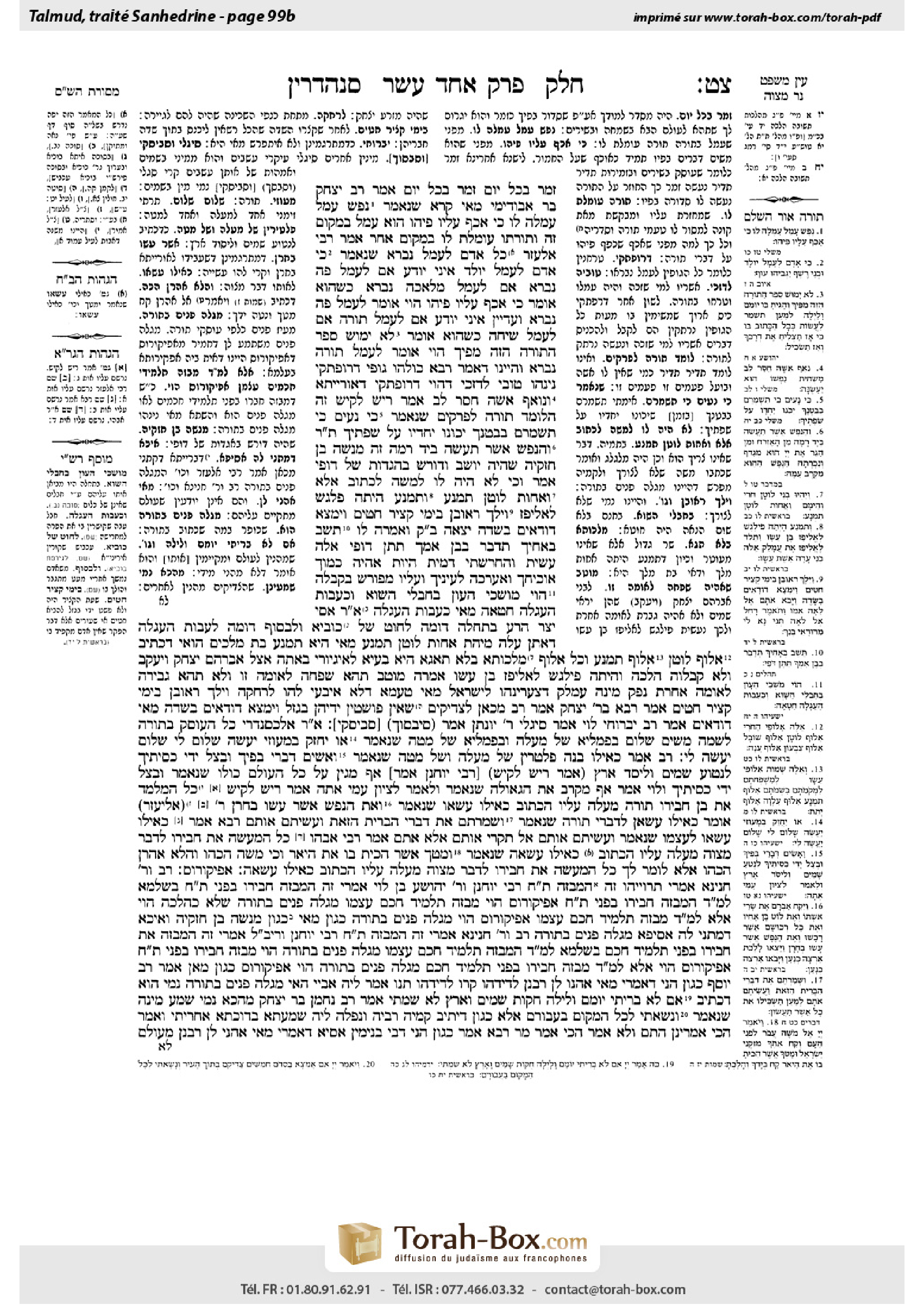
Sanhedrin 99b: Talmud study for Daf Yomi
Daf Yomi is the daily study of one Talmud folio. Explore 37 tractates with scans, Hebrew text, Sefaria English and AI-generated French translations where annotated.
Passage selection and English or AI-generated French translation are available where the scan has annotations. Daf Study is independent of Torah-Box and Sefaria.
Browse Sanhedrin · סנהדרין · All tractatesSanhedrin 99b text and translations
This page of Sanhedrin includes the Aramaic text, an English translation and an AI-generated French translation, alongside the scan above.
סנהדרין צ״ט ב · Aramaic and Hebrew text
זַמֵּר בְּכׇל יוֹם, זַמֵּר בְּכׇל יוֹם. אָמַר רַב יִצְחָק בַּר אֲבוּדִימִי: מַאי קְרָא? שֶׁנֶּאֱמַר: ״נֶפֶשׁ עָמֵל עָמְלָה לּוֹ כִּי אָכַף עָלָיו פִּיהוּ״. הוּא עָמֵל בִּמְקוֹם זֶה, וְתוֹרָתוֹ עוֹמֶלֶת לוֹ בְּמָקוֹם אַחֵר.
אָמַר רַבִּי אֶלְעָזָר: כׇּל אָדָם לְעָמָל נִבְרָא, שֶׁנֶּאֱמַר ״כִּי אָדָם לְעָמָל יוּלָּד״. אֵינִי יוֹדֵעַ אִם לַעֲמַל פֶּה נִבְרָא אִם לַעֲמַל מְלָאכָה נִבְרָא. כְּשֶׁהוּא אוֹמֵר ״כִּי אָכַף עָלָיו פִּיהוּ״, הֱוֵי אוֹמֵר לַעֲמַל פֶּה נִבְרָא. וַעֲדַיִין אֵינִי יוֹדֵעַ אִם לַעֲמַל תּוֹרָה אִם לַעֲמַל שִׂיחָה. כְּשֶׁהוּא אוֹמֵר ״לֹא יָמוּשׁ סֵפֶר הַתּוֹרָה הַזֶּה מִפִּיךָ״, הֱוֵי אוֹמֵר לַעֲמַל תּוֹרָה נִבְרָא. וְהַיְינוּ דְּאָמַר רָבָא: כּוּלְּהוּ גּוּפֵי דְּרוּפְתְּקֵי נִינְהוּ. טוּבֵיהּ לִדְזָכֵי דְּהָוֵי דְּרוּפְתְּקֵי דְּאוֹרָיְיתָא.
״נֹאֵף אִשָּׁה חֲסַר לֵב״. אָמַר רֵישׁ לָקִישׁ: זֶה הַלּוֹמֵד תּוֹרָה לִפְרָקִים, שֶׁנֶּאֱמַר ״כִּי נָעִים כִּי תִשְׁמְרֵם בְּבִטְנֶךָ יִכֹּנוּ יַחְדָּו עַל שְׂפָתֶיךָ״.
תָּנוּ רַבָּנַן: ״וְהַנֶּפֶשׁ אֲשֶׁר תַּעֲשֶׂה בְּיָד רָמָה״ – זֶה מְנַשֶּׁה בֶּן חִזְקִיָּה, שֶׁהָיָה יוֹשֵׁב וְדוֹרֵשׁ בְּהַגָּדוֹת שֶׁל דּוֹפִי.
אָמַר: וְכִי לֹא הָיָה לוֹ לְמֹשֶׁה לִכְתּוֹב אֶלָּא ״וַאֲחוֹת לוֹטָן תִּמְנָע״, ״וְתִמְנַע הָיְתָה פִילֶגֶשׁ לֶאֱלִיפַז״, ״וַיֵּלֶךְ רְאוּבֵן בִּימֵי קְצִיר חִטִּים וַיִּמְצָא דוּדָאִים בַּשָּׂדֶה״? יָצְאָה בַּת קוֹל וְאָמְרָה לוֹ: ״תֵּשֵׁב בְּאָחִיךָ תְדַבֵּר בְּבֶן אִמְּךָ תִּתֶּן דֹּפִי. אֵלֶּה עָשִׂיתָ וְהֶחֱרַשְׁתִּי דִּמִּיתָ הֱיוֹת אֶהְיֶה כָמוֹךָ אוֹכִיחֲךָ וְאֶעֶרְכָה לְעֵינֶיךָ״.
וְעָלָיו מְפוֹרָשׁ בַּקַּבָּלָה: ״הוֹי מֹשְׁכֵי הֶעָוֹן בְּחַבְלֵי הַשָּׁוְא וְכַעֲבוֹת הָעֲגָלָה חַטָּאָה״. מַאי ״כַּעֲבוֹת הָעֲגָלָה״? אָמַר רַבִּי אַסִּי: יֵצֶר הָרָע בַּתְּחִלָּה דּוֹמֶה לְחוּט שֶׁל כּוּבְיָא, וּלְבַסּוֹף דּוֹמֶה לַעֲבוֹת הָעֲגָלָה.
דַּאֲתַן עֲלַהּ, מִיהַת, ״אֲחוֹת לוֹטָן תִּמְנָע״ מַאי הִיא? תִּמְנַע בַּת מְלָכִים הֲוַאי, דִּכְתִיב: ״אַלּוּף לוֹטָן״, ״אַלּוּף תִּמְנָע״, וְכׇל אַלּוּף – מַלְכוּתָא בְּלָא תָּאגָא הִיא.
בָּעֲיָא לְאִיגַּיּוֹרֵי. בָּאתָה אֵצֶל אַבְרָהָם, יִצְחָק וְיַעֲקֹב, וְלֹא קִבְּלוּהָ. הָלְכָה וְהָיְתָה פִילֶגֶשׁ לֶאֱלִיפַז בֶּן עֵשָׂו. אָמְרָה: מוּטָב תְּהֵא שִׁפְחָה לְאוּמָּה זוֹ וְלֹא תְּהֵא גְּבִירָה לְאוּמָּה אַחֶרֶת. נְפַק מִינַּהּ עֲמָלֵק, דְּצַעֲרִינְהוּ לְיִשְׂרָאֵל. מַאי טַעְמָא? דְּלָא אִיבְּעִי לְהוּ לְרַחוֹקַהּ.
״וַיֵּלֶךְ רְאוּבֵן בִּימֵי קְצִיר חִטִּים״. אָמַר רָבָא בְּרַבִּי יִצְחָק אָמַר רַב: מִכָּאן לְצַדִּיקִים שֶׁאֵין פּוֹשְׁטִין יְדֵיהֶן בְּגָזֵל. ״וַיִּמְצָא דּוּדָאִים בַּשָּׂדֶה״. מַאי דּוּדָאִים? אָמַר רַב: יַבְרוּחֵי. לֵוִי אָמַר: סִיגְלֵי. רַבִּי יוֹנָתָן אָמַר: סְבִיסְקֵי.
אָמַר רַבִּי אֲלֶכְּסַנְדְּרִי: כׇּל הָעוֹסֵק בְּתוֹרָה לִשְׁמָהּ מֵשִׂים שָׁלוֹם בְּפָמַלְיָא שֶׁל מַעְלָה וּבְפָמַלְיָא שֶׁל מַטָּה, שֶׁנֶּאֱמַר: ״אוֹ יַחֲזֵק בְּמָעֻזִּי יַעֲשֶׂה שָׁלוֹם לִי שָׁלוֹם יַעֲשֶׂה לִּי״.
רַב אָמַר: כְּאִילּוּ בָּנָה פַּלְטֵרִין שֶׁל מַעְלָה וְשֶׁל מַטָּה, שֶׁנֶּאֱמַר: ״וָאָשִׂים דְּבָרַי בְּפִיךָ וּבְצֵל יָדִי כִּסִּיתִיךָ לִנְטֹעַ שָׁמַיִם וְלִיסֹד אָרֶץ״. רַבִּי יוֹחָנָן אָמַר: אַף מֵגֵין עַל כׇּל הָעוֹלָם כּוּלּוֹ, שֶׁנֶּאֱמַר: ״וּבְצֵל יָדִי כִּסִּיתִיךָ״. וְלֵוִי אָמַר: אַף מְקָרֵב אֶת הַגְּאוּלָּה, שֶׁנֶּאֱמַר: ״וְלֵאמֹר לְצִיּוֹן עַמִּי אָתָּה״.
אָמַר רֵישׁ לָקִישׁ: כׇּל הַמְלַמֵּד אֶת בֶּן חֲבֵירוֹ תּוֹרָה, מַעֲלֶה עָלָיו הַכָּתוּב כְּאִילּוּ עֲשָׂאוֹ, שֶׁנֶּאֱמַר: ״וְאֵת הַנֶּפֶשׁ אֲשֶׁר עָשׂוּ בְחָרָן״. רַבִּי אֶלְעָזָר אוֹמֵר: כְּאִילּוּ עֲשָׂאָן לְדִבְרֵי תוֹרָה, שֶׁנֶּאֱמַר: ״וּשְׁמַרְתֶּם אֶת דִּבְרֵי הַבְּרִית הַזֹּאת וַעֲשִׂיתֶם אֹתָם״. רָבָא אָמַר: כְּאִילּוּ עֲשָׂאוֹ לְעַצְמוֹ, שֶׁנֶּאֱמַר: ״וַעֲשִׂיתֶם אֹתָם״ – אַל תִּקְרֵי ״אֹתָם״ אֶלָּא ״אַתֶּם״.
אָמַר רַבִּי אֲבָהוּ: כׇּל הַמְעַשֶּׂה אֶת חֲבֵירוֹ לִדְבַר מִצְוָה, מַעֲלֶה עָלָיו הַכָּתוּב כְּאִילּוּ עֲשָׂאָהּ, שֶׁנֶּאֱמַר: ״וּמַטְּךָ אֲשֶׁר הִכִּיתָ בּוֹ אֶת הַיְאֹר״. וְכִי מֹשֶׁה הִכָּהוּ? וַהֲלֹא אַהֲרֹן הִכָּהוּ! אֶלָּא לוֹמַר לָךְ: כׇּל הַמְעַשֶּׂה אֶת חֲבֵירוֹ לִדְבַר מִצְוָה, מַעֲלֶה עָלָיו הַכָּתוּב כְּאִילּוּ עֲשָׂאָהּ.
אֶפִּיקוֹרוֹס: רַב וְרַבִּי חֲנִינָא אָמְרִי תַּרְוַיְיהוּ, זֶה הַמְבַזֶּה תַּלְמִיד חָכָם. רַבִּי יוֹחָנָן וְרַבִּי יְהוֹשֻׁעַ בֶּן לֵוִי אָמְרִי, זֶה הַמְבַזֶּה חֲבֵירוֹ בִּפְנֵי תַּלְמִיד חָכָם.
בִּשְׁלָמָא לְמַאן דְּאָמַר: הַמְבַזֶּה חֲבֵירוֹ בִּפְנֵי תַּלְמִיד חָכָם אֶפִּיקוֹרוֹס הָוֵי, מְבַזֶּה תַּלְמִיד חָכָם עַצְמוֹ – מְגַלֶּה פָּנִים בַּתּוֹרָה שֶׁלֹּא כַּהֲלָכָה הָוֵי. אֶלָּא לְמַאן דְּאָמַר: מְבַזֶּה תַּלְמִיד חָכָם עַצְמוֹ אֶפִּיקוֹרוֹס הָוֵי, מְגַלֶּה פָּנִים בַּתּוֹרָה כְּגוֹן מַאי? כְּגוֹן מְנַשֶּׁה בֶּן חִזְקִיָּה.
וְאִיכָּא דְּמַתְנֵי לַהּ אַסֵּיפָא: מְגַלֶּה פָּנִים בַּתּוֹרָה. רַב וְרַבִּי חֲנִינָא אָמְרִי: זֶה הַמְבַזֶּה תַּלְמִיד חָכָם. רַבִּי יוֹחָנָן וְרַבִּי יְהוֹשֻׁעַ בֶּן לֵוִי אָמְרִי: זֶה הַמְבַזֶּה אֶת חֲבֵירוֹ בִּפְנֵי תַּלְמִיד חָכָם.
בִּשְׁלָמָא לְמַאן דְּאָמַר הַמְבַזֶּה תַּלְמִיד חָכָם עַצְמוֹ – מְגַלֶּה פָּנִים בַּתּוֹרָה הָוֵי, מְבַזֶּה חֲבֵירוֹ בִּפְנֵי תַּלְמִיד חָכָם – אֶפִּיקוֹרוֹס הָוֵי, אֶלָּא לְמַאן דְּאָמַר מְבַזֶּה חֲבֵירוֹ בִּפְנֵי תַּלְמִיד חָכָם – מְגַלֶּה פָּנִים בַּתּוֹרָה הָוֵי, אֶפִּיקוֹרוֹס כְּגוֹן מַאן? אָמַר רַב יוֹסֵף: כְּגוֹן הָנֵי דְּאָמְרִי מַאי אַהֲנוֹ לַן רַבָּנַן? לְדִידְהוּ קָרוּ, לְדִידְהוּ תָּנוּ.
אֲמַר לֵיהּ אַבָּיֵי: הַאי מְגַלֶּה פָּנִים בַּתּוֹרָה נָמֵי הוּא, דִּכְתִיב ״אִם לֹא בְרִיתִי יוֹמָם וָלָיְלָה חֻקּוֹת שָׁמַיִם וָאָרֶץ לֹא שָׂמְתִּי״. אָמַר רַב נַחְמָן בַּר יִצְחָק: מֵהָכָא נָמֵי שְׁמַע מִינַּהּ, שֶׁנֶּאֱמַר ״וְנָשָׂאתִי לְכׇל הַמָּקוֹם בַּעֲבוּרָם״.
אֶלָּא, כְּגוֹן דְּיָתֵיב קַמֵּיהּ רַבֵּיהּ, וְנָפְלָה לֵיהּ שְׁמַעְתָּא בְּדוּכְתָּא אַחֲרִיתִי, וְאָמַר: הָכִי אָמְרִינַן הָתָם, וְלָא אָמַר: הָכִי אָמַר מָר. רָבָא אָמַר: כְּגוֹן הָנֵי דְּבֵי בִּנְיָמִין אָסְיָא, דְּאָמְרִי: מַאי אַהֲנוֹ לַן רַבָּנַן מֵעוֹלָם?
Sanhedrin 99b · English translation
Sing every day, sing every day, i.e., review your studies like a song that one sings over and over. Rav Yitzḥak bar Avudimi says: From what verse is this derived? It is as it is stated: “The hunger of the laborer labors for him; for his mouth presses upon him” (Proverbs 16:26), i.e., he exhausts his mouth through constant review and study. He labors in Torah in this place, this world, and his Torah labors for him in another place, the World-to-Come.
Rabbi Elazar says: Every man was created for labor, as it is stated: “Man is born for toil” (Job 5:7). Based on this verse, I do not know whether he was created for toil of the mouth, speech, or whether he was created for the toil of labor. When the verse states: “For his mouth presses upon him” (Proverbs 16:26), you must say that he was created for toil of the mouth. And still I do not know with regard to the toil of the mouth whether it is for the toil of Torah or for the toil of conversation. When the verse states: “This Torah scroll shall not depart from your mouth” (Joshua 1:8), you must say that he was created for the toil of Torah. And that is the meaning of what Rava said: All bodies are like receptacles to store items until use. Happy is one who is privileged, who is a receptacle for Torah.
The verse states: “He who commits adultery with a woman lacks understanding” (Proverbs 6:32). Reish Lakish says: This is a reference to one who studies Torah intermittently, who is like an adulterer, who sins with the other woman intermittently, as it is stated about words of Torah: “For it is a pleasant thing if you keep them within your belly; let them be established on your lips” (Proverbs 22:18) and keep the Torah always available.
§ The Sages taught in a baraita that with regard to the verse: “But the person who acts high-handedly, whether he is born in the land, or a stranger, that person blasphemes the Lord” (Numbers 15:30), this is a reference to Manasseh ben Hezekiah, king of Israel, who would sit and teach flawed interpretations of Torah narratives.
Manasseh said: But did Moses need to write only insignificant matters that teach nothing, for example: “And Lotan’s sister was Timna” (Genesis 36:22), or: “And Timna was concubine to Eliphaz, son of Esau” (Genesis 36:12), or: “And Reuben went in the days of the wheat harvest and found duda’im in the field” (Genesis 30:14)? A Divine Voice emerged and said to him: “You sit and speak against your brother; you slander your own mother’s son. These things you have done, and should I have kept silence, you would imagine that I was like you, but I will reprove you, and set the matter before your eyes” (Psalms 50:20–21). The verses in the Torah are not empty matters, with regard to which you can decide their import.
And about Manasseh ben Hezekiah it is stated explicitly in the texts of tradition, the Prophets: “Woe unto them who draw iniquity with cords of vanity, and sin as with a cart rope” (Isaiah 5:18). What is the meaning of the phrase “as with a cart rope”? Rabbi Asi says: This is a reference to the evil inclination. Initially, it seems like a flimsy spinning [kuveya] thread and ultimately it seems like a sturdy cart rope.
Manasseh began by mocking a few verses and ultimately violated the entire Torah. The Gemara asks: With regard to that verse that we came to discuss, in any event, what is the significance of the phrase in the verse “And Lotan’s sister was Timna”? The Gemara explains: Timna was the daughter of kings, as it is written: “The chief of Lotan” (Genesis 36:29), and: “The chief of Timna” (Genesis 36:40), and each chief is a member of a monarchy, albeit without a crown. That is why they are called chief and not king.
Timna sought to convert. She came before Abraham, Isaac, and Jacob, and they did not accept her. She went and became a concubine of Eliphaz, son of Esau, and said, referring to herself: It is preferable that she will be a maidservant for this nation, and she will not be a noblewoman for another nation. Ultimately, Amalek, son of Eliphaz, emerged from her, and that tribe afflicted the Jewish people. What is the reason that the Jewish people were punished by suffering at the hand of Amalek? It is due to the fact that they should not have rejected her when she sought to convert. Therefore, the verse is significant.
“And Reuben went in the days of the wheat harvest” (Genesis 30:14). Rava, son of Rabbi Yitzḥak, says that Rav says: From here it can be seen that the righteous do not extend their hands to engage in robbery even of small items, as rather than taking wheat, Reuben took only the ownerless duda’im. The verse continues: “And he found duda’im in the field.” The Gemara asks: What are duda’im? Rav says: They are a plant called yavruḥei. Levi says: They are violets. Rabbi Yonatan says: They are seviskei.
§ Apropos the significance of Torah study, Rabbi Alexandri says: Anyone who engages in the study of Torah for its own sake introduces peace into the heavenly entourage above and into the earthly entourage below, as it is stated: “Or let him take hold of My stronghold [ma’uzi], that he may make peace with Me; and he shall make peace with Me” (Isaiah 27:5). One who observes the Torah, which is called oz, introduces peace, even before the presence of God, as it were.
Rav says: It is as though he built a palace of heaven above and of earth below, as it is stated: “And I have placed My words in your mouth, and I have covered you in the shadow of My hand, to plant the heavens and lay the foundations of the earth, and say to Zion, you are My people” (Isaiah 51:16). One who has the word of God placed in his mouth through Torah study has established heaven and earth. Rabbi Yoḥanan says: One who engages in Torah study also protects the entire world, as it is stated: “And I have covered you in the shadow of My hand.” And Levi says: He also advances the coming of the redemption, as it is stated: “And say to Zion, you are My people.”
Reish Lakish said: With regard to anyone who teaches Torah to the son of another, the verse ascribes him credit as though he formed that student, as it is stated: “And Abram took Sarai his wife…and the souls that they formed in Haran” (Genesis 12:5). They are given credit for forming the students to whom they taught Torah. Rabbi Elazar says: It is as though he fashioned [asa’an] the words of Torah themselves, as it is stated: “Observe the words of this covenant, va’asitem otam” (Deuteronomy 29:8), indicating that studying the Torah is like fashioning it. Rava says: It is as though he fashioned himself, as it is stated: “Va’asitem otam.” Do not read “va’asitem otam” as: And you shall fashion them; rather, read it as va’asitem atem, meaning: You shall fashion yourself.
Rabbi Abbahu says: With regard to anyone who causes another to engage in a matter of a mitzva, the verse ascribes him credit as though he performed it himself, as it is stated: “And the Lord said to Moses…and your rod, with which you struck the river, take in your hand and go” (Exodus 17:5). And was it Moses who struck the river? But isn’t it written explicitly (see Exodus 7:19–20) that Aaron struck the river? Rather, that verse serves to say to you: Anyone who causes another to engage in a matter of a mitzva, the verse ascribes him credit as though he performed it himself.
§ The mishna teaches that those who have no share in the World-to-Come include an epikoros. Rav and Rabbi Ḥanina both say: This is one who treats a Torah scholar with contempt. Rabbi Yoḥanan and Rabbi Yehoshua ben Levi say: This is one who treats another with contempt before a Torah scholar.
The Gemara asks: Granted, according to the one who says that one who treats another with contempt before a Torah scholar is the epikoros mentioned in the mishna, one who treats a Torah scholar with contempt is characterized as one who interprets the Torah inappropriately, due to his lowering of the status of a Torah scholar. But according to the one who says that one who treats a Torah scholar himself with contempt is the epikoros mentioned in the mishna, how would he characterize one who interprets the Torah inappropriately? Like what individual does such a person conduct himself? He is like Manasseh, son of Hezekiah, who would teach flawed interpretations of Torah narratives.
And there are those who teach this dispute with regard to the latter clause of the baraita: From here Rabbi Elazar HaModa’i said: One who interprets the Torah inappropriately has no share in the World-to-Come. Rav and Rabbi Ḥanina say: This is one who treats a Torah scholar with contempt. Rabbi Yoḥanan and Rabbi Yehoshua ben Levi say: This is one who treats another with contempt before a Torah scholar.
The Gemara asks: Granted, according to the one who says that one who treats a Torah scholar himself with contempt is the one mentioned in the baraita who interprets the Torah inappropriately, one who treats another with contempt before a Torah scholar is characterized as the epikoros mentioned in the mishna. But according to the one who says that one who treats another with contempt before a Torah scholar is the one mentioned in the baraita who interprets the Torah inappropriately, how would he characterize the epikoros mentioned in the mishna? Like whom does he conduct himself? Rav Yosef says: It is referring to one who conducts himself like those who say: In what manner have the Sages benefited us with all their Torah study? They read the Bible for their own benefit and they study the Mishna for their own benefit.
Abaye said to him: That person who questions the benefit provided by Sages is also in the category of one who interprets the Torah inappropriately, since with that statement he repudiates the Torah itself, as it is written: “If not for My covenant, I would not have appointed day and night, the laws of heaven and earth” (Jeremiah 33:25). The eternal covenant of the Torah is responsible for maintaining the existence of the entire world. Rav Naḥman bar Yitzḥak says: From here too conclude the same concept from it, as it is stated: “If I find in Sodom fifty just men within the city, then I will spare the entire place for their sakes” (Genesis 18:26). The righteous protect the place where they reside.
Rather, the epikoros mentioned in the mishna is referring to one who conducts himself like one who sits before his teacher and a halakha that he learned from another place happens to fall into his consciousness and the student says: This is what we say there, and he does not say deferentially: This is what the Master said, even if he did not learn that matter from his teacher. Rava said: The term epikoros is referring to one who conducts himself like those from the house of Binyamin the doctor, who say: In what manner have the Sages benefited us with all their Torah study? Never
Sanhedrin 99b · Traduction française (IA)
Chante chaque jour, chante chaque jour, c’est-à-dire révise tes études comme une chanson que l’on chante encore et encore. Rav Yitzḥak bar Avudimi dit : De quel verset cela est-il déduit ? Comme il est dit : « L’appétit du travailleur le fait travailler, car sa bouche le presse » (Proverbes 16,26), c’est-à-dire qu’il épuise sa bouche par la révision et l’étude constantes. Il peine dans l’étude de la Torah ici, en ce monde, et son étude de la Torah travaille pour lui ailleurs, dans le Monde futur.
Rabbi Elazar dit : Tout homme a été créé pour peiner, comme il est dit : « L’homme naît pour la peine » (Job 5,7). À partir de ce verset, je ne sais pas s’il a été créé pour la peine de la bouche, c’est-à-dire la parole, ou pour la peine du travail. Lorsque le verset dit : « Car sa bouche le presse » (Proverbes 16,26), il faut donc dire qu’il a été créé pour la peine de la bouche. Mais je ne sais toujours pas si cette peine de la bouche consiste à peiner dans l’étude de la Torah ou dans la conversation. Lorsque le verset dit : « Que ce livre de la Torah ne s’éloigne pas de ta bouche » (Josué 1,8), il faut donc dire qu’il a été créé pour peiner dans l’étude de la Torah. Et c’est le sens de ce que Rava a dit : Tous les corps sont comme des récipients destinés à entreposer des objets jusqu’à leur utilisation. Heureux celui qui a le mérite d’être un récipient pour la Torah.
Le verset dit : « Celui qui commet l’adultère avec une femme manque de discernement » (Proverbes 6,32). Reish Lakish dit : Cela fait référence à celui qui étudie la Torah de manière intermittente, comme un adultère qui pèche par intermittence avec une autre femme. En effet, il est dit au sujet des paroles de la Torah : « Car elles sont agréables si tu les gardes au fond de toi ; qu’elles soient établies sur tes lèvres » (Proverbes 22,18) ; il faut garder la Torah constamment à sa disposition.
§ Les Sages enseignent dans une baraïta que le verset : « Mais celui qui agit avec arrogance, qu’il soit né dans le pays ou qu’il soit étranger, celui-là blasphème contre le Seigneur » (Nombres 15,30), fait référence à Manassé, fils d’Ézéchias, roi d’Israël, qui s’asseyait et enseignait des interprétations erronées des récits de la Torah.
Manassé disait : Moïse devait-il donc écrire uniquement des détails insignifiants qui n’enseignent rien, par exemple : « Et la sœur de Lotan était Timna » (Genèse 36,22), ou : « Et Timna était concubine d’Éliphaz, fils d’Ésaü » (Genèse 36,12), ou : « Et Ruben sortit au temps de la moisson du blé et trouva des duda’im dans le champ » (Genèse 30,14) ? Une Voix céleste se fit entendre et lui dit : « Tu t’assieds et parles contre ton frère, tu calomnies le fils de ta mère. Tu as fait cela, et j’ai gardé le silence ; tu t’imaginais que j’étais comme toi. Mais je vais te reprendre et exposer la chose devant tes yeux » (Psaumes 50,20-21). Les versets de la Torah ne sont pas des paroles vaines dont tu peux décider toi-même le sens.
Et au sujet de Manassé, fils d’Ézéchias, il est explicitement dit dans les écrits de la tradition, les Prophètes : « Malheur à ceux qui tirent l’iniquité avec des cordes de vanité et le péché comme avec une corde de charrette » (Isaïe 5,18). Que signifie l’expression « comme avec une corde de charrette » ? Rabbi Asi dit : Cela fait référence au mauvais penchant. Au début, il semble être un fil à filer fragile [kuveya], mais, à la fin, il semble être une solide corde de charrette.
Manassé commença par tourner en dérision quelques versets et finit par transgresser toute la Torah. La Guemara demande : Quoi qu’il en soit, que signifie l’expression « Et la sœur de Lotan était Timna » dans le verset que nous sommes venus examiner ? La Guemara explique : Timna était la fille de rois, comme il est écrit : « Le chef de Lotan » (Genèse 36,29) et « Le chef de Timna » (Genèse 36,40). Chaque chef appartient à une famille royale, bien qu’il n’ait pas de couronne. C’est pourquoi ils sont appelés chefs et non rois.
Timna chercha à se convertir. Elle se présenta devant Abraham, Isaac et Jacob, mais ils ne l’acceptèrent pas. Elle partit alors et devint la concubine d’Éliphaz, fils d’Ésaü, en se disant, à propos d’elle-même : « Il vaut mieux être servante de ce peuple que noble d’un autre peuple. » Finalement, Amalek, fils d’Éliphaz, naquit d’elle, et cette tribu infligea des souffrances au peuple juif. Pourquoi le peuple juif fut-il puni en souffrant aux mains d’Amalek ? Parce qu’ils n’auraient pas dû la rejeter lorsqu’elle chercha à se convertir. Le verset est donc significatif.
« Et Ruben sortit au temps de la moisson du blé » (Genèse 30,14). Rava, fils de Rabbi Yitzḥak, rapporte au nom de Rav : On voit de là que les justes ne tendent pas la main pour commettre un vol, même de petits objets ; en effet, au lieu de prendre du blé, Ruben ne prit que les duda’im qui n’appartenaient à personne. Le verset poursuit : « Et il trouva des duda’im dans le champ. » La Guemara demande : Que sont les duda’im ? Rav dit : C’est une plante appelée yavruḥei. Levi dit : Ce sont des violettes. Rabbi Yonatan dit : Ce sont des seviskei.
§ À propos de l’importance de l’étude de la Torah, Rabbi Alexandri dit : Quiconque étudie la Torah pour elle-même introduit la paix dans l’entourage céleste, là-haut, et dans l’entourage terrestre, ici-bas, comme il est dit : « Qu’il saisisse ma forteresse [ma’uzi], afin qu’il fasse la paix avec moi ; oui, qu’il fasse la paix avec moi » (Isaïe 27,5). Celui qui observe la Torah, appelée oz, introduit la paix, même en présence de Dieu, pour ainsi dire.
Rav dit : C’est comme s’il construisait un palais au ciel, là-haut, et sur terre, ici-bas, comme il est dit : « J’ai mis mes paroles dans ta bouche et je t’ai couvert de l’ombre de ma main, afin de planter les cieux et de fonder la terre, et de dire à Sion : Tu es mon peuple » (Isaïe 51,16). Celui qui a la parole de Dieu placée dans sa bouche par l’étude de la Torah a établi le ciel et la terre. Rabbi Yoḥanan dit : Celui qui étudie la Torah protège également le monde entier, comme il est dit : « Je t’ai couvert de l’ombre de ma main. » Et Levi dit : Il hâte également la venue de la rédemption, comme il est dit : « Et de dire à Sion : Tu es mon peuple. »
Reish Lakish dit : À quiconque enseigne la Torah au fils d’un autre, le verset attribue le mérite comme s’il avait formé cet élève, comme il est dit : « Abram prit Saraï, sa femme […] et les âmes qu’ils avaient formées à Haran » (Genèse 12,5). Le mérite d’avoir formé les élèves auxquels ils ont enseigné la Torah leur est attribué. Rabbi Elazar dit : C’est comme s’il avait façonné [asa’an] les paroles de la Torah elles-mêmes, comme il est dit : « Observez les paroles de cette alliance, va’asitem otam » (Deutéronome 29,8), ce qui indique qu’étudier la Torah revient à la façonner. Rava dit : C’est comme s’il s’était façonné lui-même, comme il est dit : « Va’asitem otam ». Ne lis pas « va’asitem otam », c’est-à-dire « vous les façonnerez », mais lis va’asitem atem, ce qui signifie : « Vous vous façonnerez vous-mêmes. »
Rabbi Abbahu dit : À quiconque amène une autre personne à accomplir une mitsva, le verset attribue le mérite comme s’il l’avait accomplie lui-même, comme il est dit : « Le Seigneur dit à Moïse […] et ton bâton, avec lequel tu as frappé le fleuve, prends-le dans ta main et va » (Exode 17,5). Est-ce Moïse qui frappa le fleuve ? N’est-il pas explicitement écrit (voir Exode 7,19-20) que c’est Aaron qui frappa le fleuve ? Ce verset vient plutôt t’enseigner que quiconque amène une autre personne à accomplir une mitsva, le verset lui en attribue le mérite comme s’il l’avait accomplie lui-même.
§ La Michna enseigne que ceux qui n’ont pas de part dans le Monde futur comprennent un epikoros. Rav et Rabbi Ḥanina disent tous deux : Il s’agit de celui qui traite un Sage de la Torah avec mépris. Rabbi Yoḥanan et Rabbi Yehoshua ben Levi disent : Il s’agit de celui qui traite quelqu’un avec mépris devant un Sage de la Torah.
La Guemara demande : Il est compréhensible que, selon celui qui dit que l’epikoros mentionné dans la Michna est celui qui traite quelqu’un avec mépris devant un Sage de la Torah, celui qui traite un Sage de la Torah avec mépris soit caractérisé comme quelqu’un qui interprète la Torah de manière inappropriée, puisqu’il rabaisse le statut d’un Sage de la Torah. Mais selon celui qui dit que l’epikoros mentionné dans la Michna est celui qui traite un Sage de la Torah lui-même avec mépris, comment caractériserait-il celui qui interprète la Torah de manière inappropriée ? De quel individu cette personne suit-elle l’exemple ? Elle est comme Manassé, fils d’Ézéchias, qui enseignait des interprétations erronées des récits de la Torah.
Certains transmettent cette controverse au sujet de la dernière clause de la baraïta : De là, Rabbi Elazar HaModa’i a dit : Celui qui interprète la Torah de manière inappropriée n’a pas de part dans le Monde futur. Rav et Rabbi Ḥanina disent : Il s’agit de celui qui traite un Sage de la Torah avec mépris. Rabbi Yoḥanan et Rabbi Yehoshua ben Levi disent : Il s’agit de celui qui traite quelqu’un avec mépris devant un Sage de la Torah.
La Guemara demande : Il est compréhensible que, selon celui qui dit que celui qui traite un Sage de la Torah lui-même avec mépris est celui que la baraïta désigne comme interprétant la Torah de manière inappropriée, celui qui traite quelqu’un avec mépris devant un Sage de la Torah soit caractérisé comme l’epikoros mentionné dans la Michna. Mais selon celui qui dit que celui qui traite quelqu’un avec mépris devant un Sage de la Torah est celui que la baraïta désigne comme interprétant la Torah de manière inappropriée, comment caractériserait-il l’epikoros mentionné dans la Michna ? De qui suit-il l’exemple ? Rav Yosef dit : Cela fait référence à celui qui se conduit comme ceux qui disent : « Quel bénéfice les Sages nous ont-ils apporté avec toute leur étude de la Torah ? Ils lisent la Bible pour leur propre bénéfice et étudient la Michna pour leur propre bénéfice. »
Abaye lui dit : Celui qui met en question le bénéfice apporté par les Sages relève lui aussi de la catégorie de ceux qui interprètent la Torah de manière inappropriée, car, par cette déclaration, il renie la Torah elle-même, comme il est écrit : « Si ce n’était mon alliance, je n’aurais pas établi les lois du jour et de la nuit, du ciel et de la terre » (Jérémie 33,25). L’alliance éternelle de la Torah assure l’existence du monde entier. Rav Naḥman bar Yitzḥak dit : On peut également tirer de là la même conclusion, comme il est dit : « Si je trouve dans Sodome cinquante justes dans la ville, j’épargnerai toute la région à cause d’eux » (Genèse 18,26). Les justes protègent le lieu où ils résident.
L’epikoros mentionné dans la Michna fait plutôt référence à celui qui se conduit comme quelqu’un assis devant son maître, à qui revient soudain à l’esprit une halakha apprise ailleurs, et qui dit : « C’est ce que nous disons là-bas », au lieu de dire avec déférence : « C’est ce que le Maître a dit », même s’il n’a pas appris cette halakha de son maître. Rava dit : Le terme epikoros fait référence à celui qui se conduit comme ceux de la maison de Binyamin le médecin, qui disent : « Quel bénéfice les Sages nous ont-ils apporté avec toute leur étude de la Torah ? Jamais
Traduction française générée par IA à partir de l’édition anglaise de Sefaria. Vérifie toujours un passage avec le texte source.
Text from Sefaria: William Davidson Edition - Vocalized Aramaic (CC BY NC); William Davidson Edition - English (CC BY NC).