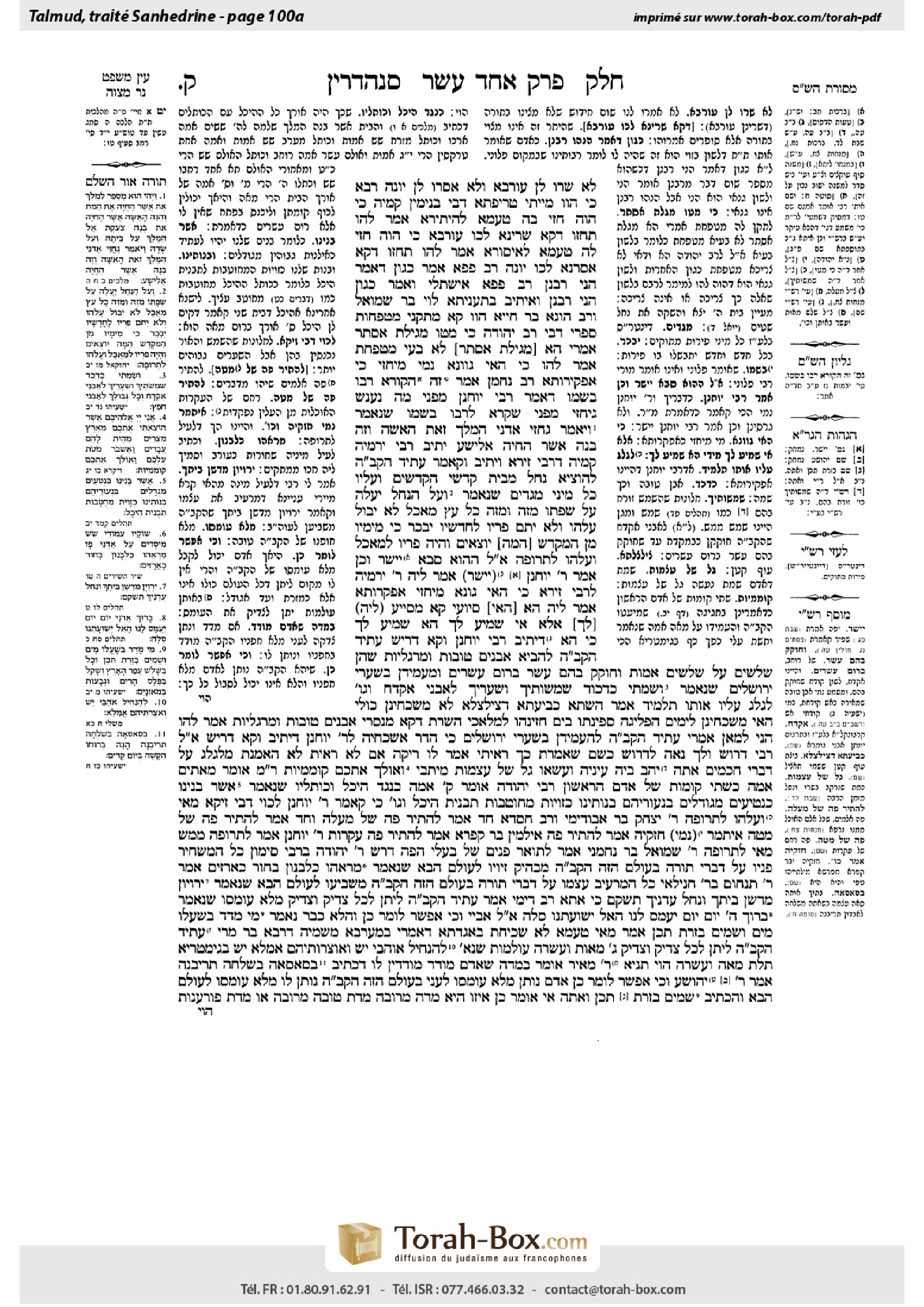
Sanhedrin 100a: Talmud study for Daf Yomi
Daf Yomi is the daily study of one Talmud folio. Explore 37 tractates with scans, Hebrew text, Sefaria English and AI-generated French translations where annotated.
Passage selection and English or AI-generated French translation are available where the scan has annotations. Daf Study is independent of Torah-Box and Sefaria.
Browse Sanhedrin · סנהדרין · All tractatesSanhedrin 100a text and translations
This page of Sanhedrin includes the Aramaic text, an English translation and an AI-generated French translation, alongside the scan above.
סנהדרין ק׳ א · Aramaic and Hebrew text
לָא שְׁרוֹ לַן עוֹרְבָא, וְלָא אֲסַרוּ לַן יוֹנָה.
רָבָא, כִּי הֲווֹ מַיְיתִי טְרֵיפְתָּא דְּבֵי בִנְיָמִין קַמֵּיהּ, כִּי הֲוָה חָזֵי בַּהּ טַעְמָא לְהֶיתֵּירָא, אֲמַר לְהוּ: תֶּחֱזוֹ דְּקָא שָׁרֵינָא לְכוּ עוֹרְבָא. כִּי הֲוָה חָזֵי לַהּ טַעְמָא לְאִיסּוּרָא, אֲמַר לְהוּ: תֶּחֱזוֹ דְּקָא אָסַרְנָא לְכוּ יוֹנָה.
רַב פָּפָּא אָמַר: כְּגוֹן דְּאָמַר ״הָנֵי רַבָּנַן״. רַב פָּפָּא אִישְׁתְּלִי וְאָמַר: ״כְּגוֹן הָנֵי רַבָּנַן״, וְאִיתִּיב בְּתַעֲנִיתָא.
לֵוִי בַּר שְׁמוּאֵל וְרַב הוּנָא בַּר חִיָּיא הֲווֹ קָא מְתַקְּנִי מִטְפְּחוֹת סִפְרֵי דְּבֵי רַב יְהוּדָה. כִּי מָטוּ מְגִילַּת אֶסְתֵּר אָמְרִי: הָא [מְגִילַּת אֶסְתֵּר] לָא בָּעֵי מִטְפַּחַת. אֲמַר לְהוּ: כִּי הַאי גַוְונָא נָמֵי מִיחְזֵי כִּי אַפְקֵירוּתָא.
רַב נַחְמָן אָמַר: זֶה הַקּוֹרֵא רַבּוֹ בִּשְׁמוֹ, דְּאָמַר רַבִּי יוֹחָנָן: מִפְּנֵי מָה נֶעֱנַשׁ גֵּיחֲזִי? מִפְּנֵי שֶׁקָּרָא לְרַבּוֹ בִּשְׁמוֹ, שֶׁנֶּאֱמַר: ״וַיֹּאמֶר גֵּחֲזִי אֲדֹנִי הַמֶּלֶךְ זֹאת הָאִשָּׁה וְזֶה בְּנָהּ אֲשֶׁר הֶחֱיָה אֱלִישָׁע״.
יָתֵיב רַבִּי יִרְמְיָה קַמֵּיהּ דְּרַבִּי זֵירָא, וְיָתֵיב וְקָאָמַר: עָתִיד הַקָּדוֹשׁ בָּרוּךְ הוּא לְהוֹצִיא נַחַל מִבֵּית קׇדְשֵׁי הַקֳּדָשִׁים, וְעָלָיו כׇּל מִינֵי מְגָדִים, שֶׁנֶּאֱמַר: ״וְעַל הַנַּחַל יַעֲלֶה עַל שְׂפָתוֹ מִזֶּה וּמִזֶּה כׇּל עֵץ מַאֲכָל לֹא יִבּוֹל עָלֵהוּ וְלֹא יִתֹּם פִּרְיוֹ לׇחֳדָשָׁיו יְבַכֵּר כִּי מֵימָיו מִן הַמִּקְדָּשׁ [הֵמָּה] יוֹצְאִים וְהָיָה פִרְיוֹ לְמַאֲכָל וְעָלֵהוּ לִתְרוּפָה״. אֲמַר לֵיהּ הָהוּא סָבָא: ״יִישַׁר״, וְכֵן אָמַר רַבִּי יוֹחָנָן: ״יִישַׁר״. אֲמַר לֵיהּ רַבִּי יִרְמְיָה לְרַבִּי זֵירָא: כִּי הַאי גַּוְנָא מִיחְזֵי אַפְקֵרוּתָא?
אֲמַר לֵיהּ: הָא [הַאי] סַיּוֹעֵי קָא מְסַיַּיע לֵיהּ [לָךְ]! אֶלָּא אִי שְׁמִיעַ לָךְ הָא, שְׁמִיעַ לָךְ: כִּי הָא דְּיָתֵיב רַבִּי יוֹחָנָן וְקָא דָרֵישׁ: עָתִיד הַקָּדוֹשׁ בָּרוּךְ הוּא לְהָבִיא אֲבָנִים טוֹבוֹת וּמַרְגָּלִיּוֹת שֶׁהֵן שְׁלֹשִׁים עַל שְׁלֹשִׁים אַמּוֹת, וְחוֹקֵק בָּהֶם עֶשֶׂר בְּרוּם עֶשְׂרִים, וּמַעֲמִידָן בְּשַׁעֲרֵי יְרוּשָׁלַיִם, שֶׁנֶּאֱמַר ״וְשַׂמְתִּי כַּדְכֹד שִׁמְשֹׁתַיִךְ וּשְׁעָרַיִךְ לְאַבְנֵי אֶקְדָּח וְגוֹ׳״. לִגְלֵג עָלָיו אוֹתוֹ תַּלְמִיד, אָמַר: הַשְׁתָּא כְּבֵיעֲתָא דְצִילְצְלָא לָא מַשְׁכְּחִינַן, כּוּלֵּי הַאי מַשְׁכְּחִינַן?
לְיָמִים הִפְלִיגָה סְפִינָתוֹ בַּיָּם. חֲזִינְהוּ לְמַלְאֲכֵי הַשָּׁרֵת דְּקָא מְנַסְּרִי אֲבָנִים טוֹבוֹת וּמַרְגָּלִיּוֹת. אֲמַר לְהוּ: הָנֵי לְמַאן? אָמְרִי: עָתִיד הַקָּדוֹשׁ בָּרוּךְ הוּא לְהַעֲמִידָן בְּשַׁעֲרֵי יְרוּשָׁלַיִם. כִּי הֲדַר אַשְׁכְּחֵיהּ לְרַבִּי יוֹחָנָן דְּיָתֵיב וְקָא דָרֵישׁ. אֲמַר לֵיהּ: רַבִּי, דְּרוֹשׁ וּלְךָ נָאֶה לִדְרוֹשׁ. כְּשֵׁם שֶׁאָמַרְתָּ כָּךְ רָאִיתִי. אָמַר לוֹ: רֵיקָה! אִם לֹא רָאִיתָ לֹא הֶאֱמַנְתָּ? מְלַגְלֵג עַל דִּבְרֵי חֲכָמִים אַתָּה! יְהַב בֵּיהּ עֵינֵיהּ וַעֲשָׂאוֹ גַּל שֶׁל עֲצָמוֹת.
מֵיתִיבִי: ״וָאוֹלֵךְ אֶתְכֶם קוֹמְמִיּוּת״ – רַבִּי מֵאִיר אוֹמֵר: מָאתַיִם אַמָּה, כִּשְׁתֵּי קוֹמוֹת שֶׁל אָדָם הָרִאשׁוֹן. רַבִּי יְהוּדָה אוֹמֵר: מֵאָה אַמָּה, כְּנֶגֶד הֵיכָל וּכְתָלָיו, שֶׁנֶּאֱמַר: ״אֲשֶׁר בָּנֵינוּ כִּנְטִעִים מְגֻדָּלִים בִּנְעוּרֵיהֶם בְּנוֹתֵינוּ כְזָוִיּוֹת מְחֻטָּבוֹת תַּבְנִית הֵיכָל וְגוֹ׳״.
כִּי קָאָמַר רַבִּי יוֹחָנָן, לְכַוֵּי דְּבֵי זִיקָא.
מַאי ״וְעָלֵהוּ לִתְרוּפָה״? רַבִּי יִצְחָק בַּר אֲבוּדִימִי וְרַב חִסְדָּא: חַד אָמַר, לְהַתִּיר פֶּה שֶׁל מַעְלָה; וְחַד אָמַר, לְהַתִּיר פֶּה שֶׁל מַטָּה.
אִיתְּמַר נָמֵי: חִזְקִיָּה אָמַר לְהַתִּיר פֶּה אִילְּמִין, בַּר קַפָּרָא אָמַר לְהַתִּיר פֶּה עֲקָרוֹת, רַבִּי יוֹחָנָן אָמַר לִתְרוּפָה מַמָּשׁ. מַאי לִתְרוּפָה? רַבִּי שְׁמוּאֵל בַּר נַחְמָנִי אָמַר: לְתוֹאַר פָּנִים שֶׁל בַּעֲלֵי הַפֶּה.
דָּרֵשׁ רַבִּי יְהוּדָה בְּרַבִּי סִימוֹן: כָּל הַמַּשְׁחִיר פָּנָיו עַל דִּבְרֵי תּוֹרָה בָּעוֹלָם הַזֶּה, הַקָּדוֹשׁ בָּרוּךְ הוּא מַבְהִיק זִיוָיו לָעוֹלָם הַבָּא, שֶׁנֶּאֱמַר: ״מַרְאֵהוּ כַּלְּבָנוֹן בָּחוּר כָּאֲרָזִים״.
אָמַר רַבִּי תַּנְחוּם בְּרַבִּי חֲנִילַאי: כׇּל הַמַּרְעִיב עַצְמוֹ עַל דִּבְרֵי תוֹרָה בָּעוֹלָם הַזֶּה, הַקָּדוֹשׁ בָּרוּךְ הוּא מַשְׂבִּיעוֹ לָעוֹלָם הַבָּא, שֶׁנֶּאֱמַר: ״יִרְוְיֻן מִדֶּשֶׁן בֵּיתֶךָ וְנַחַל עֲדָנֶיךָ תַשְׁקֵם״.
כִּי אֲתָא רַב דִּימִי אָמַר: עָתִיד הַקָּדוֹשׁ בָּרוּךְ הוּא לִיתֵּן לְכׇל צַדִּיק וְצַדִּיק מְלֹא עוֹמְסוֹ, שֶׁנֶּאֱמַר: ״בָּרוּךְ ה׳ יוֹם יוֹם יַעֲמָס לָנוּ הָאֵל יְשׁוּעָתֵנוּ סֶלָה״. אֲמַר לֵיהּ אַבָּיֵי: וְכִי אֶפְשָׁר לוֹמַר כֵּן? וַהֲלֹא כְּבָר נֶאֱמַר: ״מִי מָדַד בְּשׇׁעֳלוֹ מַיִם וְשָׁמַיִם בַּזֶּרֶת תִּכֵּן״?
אֲמַר: מַאי טַעְמָא לָא שְׁכִיחַתְּ בְּאַגַּדְתָּא? דְּאָמְרִי בְּמַעְרְבָא מִשְּׁמֵיהּ דְּרָבָא בַּר מָרִי: עָתִיד הַקָּדוֹשׁ בָּרוּךְ הוּא לִיתֵּן לְכׇל צַדִּיק וְצַדִּיק שְׁלֹשׁ מֵאוֹת וַעֲשָׂרָה עוֹלָמוֹת, שֶׁנֶּאֱמַר: ״לְהַנְחִיל אֹהֲבַי יֵשׁ וְאֹצְרֹתֵיהֶם אֲמַלֵּא״. ״יֵשׁ״ בְּגִימַטְרִיָּא תְּלָת מְאָה וְעַשְׂרָה הָוֵי.
תַּנְיָא: רַבִּי מֵאִיר אוֹמֵר, בְּמִדָּה שֶׁאָדָם מוֹדֵד – מוֹדְדִין לוֹ, דִּכְתִיב: ״בְּסַאסְּאָה בְּשַׁלְּחָהּ תְּרִיבֶנָּה״.
אָמַר רַבִּי יְהוֹשֻׁעַ: וְכִי אֶפְשָׁר לוֹמַר כֵּן? אָדָם נוֹתֵן מְלֹא עוֹמְסוֹ לְעָנִי בָּעוֹלָם הַזֶּה, הַקָּדוֹשׁ בָּרוּךְ הוּא נוֹתֵן לוֹ מְלֹא עוֹמְסוֹ לָעוֹלָם הַבָּא? וְהָכְתִיב ״שָׁמַיִם בַּזֶּרֶת תִּכֵּן״! וְאַתָּה אִי אוֹמֵר כֵּן? אֵיזוֹ הִיא מִדָּה מְרוּבָּה: מִדָּה טוֹבָה מְרוּבָּה אוֹ מִדַּת פּוּרְעָנוּת?
Sanhedrin 100a · English translation
have they permitted a raven for us nor have they prohibited a dove for us. They merely tell us matters stated explicitly in the Torah.
The Gemara relates with regard to Rava: When they would bring a possible tereifa from the house of Binyamin before him, when he would see in it a reason to permit its consumption, Rava would say to them: See that I am permitting a raven for you, as this is an animal that appeared forbidden. When he would see in it a reason to prohibit its consumption, Rava would say to them: See that I am prohibiting a dove for you.
Rav Pappa says: The epikoros mentioned in the mishna is referring to one who conducts himself like one who says: Those Sages, with contemptuous overtones. The Gemara relates that Rav Pappa himself forgot in one instance and said: Like those Sages, and he observed a fast to achieve atonement for expressing himself in that manner.
The Gemara relates: Levi bar Shmuel and Rav Huna bar Ḥiyya were mending mantles for the sacred scrolls of the school of Rav Yehuda. When they reached the scroll of Esther they said: This scroll of Esther does not require a mantle, as it is not as significant as the other sacred scrolls. Rav Yehuda said to them: A statement of that sort also seems to express irreverence like the irreverence typical of an epikoros, as you should not have referred to the scroll of Esther as: This scroll.
Rav Naḥman says: An epikoros is one who calls his teacher by his name and does not call him Rabbi, as Rabbi Yoḥanan said: For what reason was Gehazi punished? It is due to the fact that he called his teacher by his name, as it is stated: “And Gehazi said: My lord the king, this is the woman, and this is her son, whom Elisha revived” (II Kings 8:5).
§ The Gemara relates: Rabbi Yirmeya sat before Rabbi Zeira, and sat and said: The Holy One, Blessed be He, will cause a river to emerge from the Holy of Holies, and alongside it all sorts of delicacies will grow, as it is stated: “And the river upon its bank, on this side and on that side shall grow every tree for food, whose leaf shall not wither, neither shall its fruit fall; it shall bring forth new fruit every month, because their waters emerged from the Sanctuary; and its fruit shall be for food and its leaf for medicine” (Ezekiel 47:12). A certain elder said to Rabbi Yirmeya: Well done, and so Rabbi Yoḥanan said: Well done. Rabbi Yirmeya said to Rabbi Zeira: Does a statement of that sort, when one who is not a Torah scholar says to a Sage that his statement is correct, seem like the irreverence typical of an epikoros?
Rabbi Zeira said to him: But isn’t he supporting your statement? He meant no disrespect. Rather, if you heard that at times supporting the statement of a Sage is irreverent, this is what you heard: It is like that case in which Rabbi Yoḥanan sat and taught: The Holy One, Blessed be He, is destined to bring precious stones and jewels that are thirty by thirty cubits, and He will bore in them an opening ten cubits wide by twenty cubits in height and place them to serve as the gates of Jerusalem, as it is stated: “And I will make your pinnacles of rubies and your gates of carbuncles” (Isaiah 54:12). A certain student mocked him and said: Now, at present, we do not find precious stones comparable in size to the egg of a palm dove. Will we find stones as large as those that you described?
Sometime later that student’s ship set sail at sea. He saw the ministering angels cutting precious stones that size. He said to the angels: For whom are these stones? The angels said to him: The Holy One, Blessed be He, is destined to place them at the gates of Jerusalem. When the student returned, he found Rabbi Yoḥanan, who was sitting and teaching. The student said to him: My teacher, teach, and it is fitting for you to teach. Just as you said with regard to the precious stones, so I saw. Rabbi Yoḥanan said to him: Good-for-nothing, if you did not see it, you would not believe it? You are one who mocks the statements of the Sages. Rabbi Yoḥanan directed his eyes toward him in anger and rendered him a pile of bones.
The Gemara raises an objection from a baraita to the statement of Rabbi Yoḥanan that the gates will be twenty cubits high. The Sages engaged in a dispute concerning the interpretation of the verse: “And I made you go upright [komemiyyut]” (Leviticus 26:13). Rabbi Meir says that in the end of days people will be two hundred cubits tall, the equivalent of twice the height of Adam the first man, who was one hundred cubits tall. Rabbi Yehuda says: People will be one hundred cubits tall, corresponding to the height of the Sanctuary and its walls, as it is stated: “For our sons are as plants grown up in their youth; our daughters as cornerstones, carved in the fashion of a palace” (Psalms 144:12), indicating that the sons and daughters will be one hundred cubits tall, the height of the Sanctuary. If the people are that tall, how will they enter gates twenty cubits high?
The Gemara answers: When Rabbi Yoḥanan says that the openings would be twenty cubits high he is referring to the windows through which wind enters. The gates through which people enter will extend considerably higher.
§ Apropos the river that will emerge from the Holy of Holies, the Gemara asks: What is the meaning of the phrase: And its leaf for medicine [literufa]? Rabbi Yitzḥak bar Avudimi and Rav Ḥisda disagree. One says: This is an abbreviation for the phrase: To unlock the mouth [lehattir peh] that is above, i.e., the leaf heals the mute. And one says: That is the abbreviation, but it means to unlock the mouth that is below, a euphemism for healing the womb of a barren woman.
It was also stated that other Sages engaged in a dispute concerning this matter. Ḥizkiyya says that the reference is: To unlock the mouth of mutes, and bar Kappara says that the reference is: To unlock the mouth of barren women. Rabbi Yoḥanan says: The reference is to actual medicine. The Gemara asks: According to that opinion, what is the meaning of the term: For medicine [literufa]? Rabbi Shmuel bar Naḥmani says: It is an abbreviation meaning to beautify the countenance [letoar panim] of the keepers of the mouth [peh], i.e., the Sages, who labored with their mouths to study Torah in this world.
Rabbi Yehuda, son of Rabbi Simon, taught: For anyone who blackens his face while toiling over matters of Torah in this world, the Holy One, Blessed be He, shines his brightness in the World-to-Come, as it is stated: “His locks are curly black as a raven” (Song of Songs 5:11), and thereafter it is written: “His countenance is like Lebanon, excellent as the cedars” (Song of Songs 5:15), followed by: “His palate is like sweets” (Song of Songs 5:16). One who engages in sweets, i.e., Torah study, in this world, until he is blackened, black as a raven, is privileged to shining brightness in the World-to-Come.
Rabbi Tanḥum, son of Rabbi Ḥanilai, says: With regard to anyone who starves himself over matters of Torah in this world, the Holy One, Blessed be He, satisfies him in the World-to-Come, as it is stated: “Your judgments are like the great deep” (Psalms 36:7), indicating that God is exacting with the righteous and does not reward them in this world, and it is stated thereafter: “They are abundantly satisfied with the plenty of Your house, and You feed them drink of the river of Your pleasures” (Psalms 36:9).
When Rav Dimi came from Eretz Yisrael to Babylonia he said: The Holy One, Blessed be He, will give each and every righteous person His handful, as it is stated: “Blessed be the Lord, Who day by day bears our burden; God is our salvation, Selah” (Psalms 68:20). Abaye said to him: And is it possible to say so, that the Holy One, Blessed be He, will give them His handful? But wasn’t it already stated: “Who has measured the waters in the hollow of His hand, and meted out heaven with the span, and comprehended the dust of the earth in a measure” (Isaiah 40:12)? And if the span of the Holy One, Blessed be He, is as great as the heavens, how can a person receive a handful from the Holy One, Blessed be He?
Rav Dimi said: What is the reason that you are not familiar with matters of aggada? As they say in the West, Eretz Yisrael, in the name of Rava bar Mari: The Holy One, Blessed be He, will give every righteous person 310 worlds as it is stated: “To bequeath to those who love Me substance [yesh]; and I will fill their treasuries” (Proverbs 8:21). In terms of its numerical value, the word yesh, spelled yod, shin, is 310, indicating that God grants the righteous a full measure.
In a related matter, it is taught in a baraita that Rabbi Meir says: In accordance with the measure that a person metes out for others the heavenly court metes out for him, i.e., the response is commensurate with the action, as it is written: “In full measure [besasse’a] when You send her away do You contend with her” (Isaiah 27:8). The term besasse’a is interpreted as bese’a se’a, meaning that one receives a measure [se’a] commensurate with the measure [bese’a] that he meted out.
Rabbi Yehoshua said to Rabbi Meir: And is it possible to say that if a person gives his handful to a pauper in this world, the Holy One, Blessed be He, gives him His handful in the World-to-Come? But isn’t it written: “And meted out heaven with the span” (Isaiah 40:12)? He asked how one can receive so bountiful a reward. Rabbi Meir answered him: And you do not say so? Which of God’s attributes is greater? Is the attribute of reward greater or is the attribute of punishment greater?
Sanhedrin 100a · Traduction française (IA)
Ils ne nous ont ni permis le corbeau ni interdit la colombe. Ils nous enseignent simplement des choses explicitement énoncées dans la Torah.
La Guemara rapporte au sujet de Rava : lorsqu’on lui amenait de la maison de Binyamin un cas douteux de tereifa, s’il y trouvait une raison d’en autoriser la consommation, Rava leur disait : « Voyez, je vous autorise un corbeau », car cet animal semblait interdit. S’il y trouvait une raison d’en interdire la consommation, Rava leur disait : « Voyez, je vous interdis une colombe. »
Rav Pappa dit : L’epikoros mentionné dans la Michna désigne celui qui se comporte comme quelqu’un qui dit, sur un ton méprisant : « Ces Sages ». La Guemara rapporte que Rav Pappa lui-même oublia une fois et dit : « Comme ces Sages » ; il observa alors un jeûne afin d’expier ses paroles.
La Guemara rapporte : Levi bar Shmuel et Rav Huna bar Ḥiyya réparaient les manteaux destinés aux rouleaux sacrés de l’école de Rav Yehuda. Lorsqu’ils arrivèrent au rouleau d’Esther, ils dirent : « Ce rouleau d’Esther n’a pas besoin de manteau, car il n’est pas aussi important que les autres rouleaux sacrés. » Rav Yehuda leur dit : « Une telle remarque semble également exprimer le manque de respect propre à un epikoros, car vous n’auriez pas dû désigner le rouleau d’Esther par ces mots : “Ce rouleau”. »
Rav Naḥman dit : Un epikoros est celui qui appelle son maître par son nom au lieu de l’appeler Rabbi, comme l’a dit Rabbi Yoḥanan : Pourquoi Gehazi a-t-il été puni ? Parce qu’il a appelé son maître par son nom, comme il est écrit : « Gehazi dit : “Mon seigneur le roi, voici cette femme et voici son fils, qu’Élisée a ramené à la vie” » (II Rois 8:5).
§ La Guemara rapporte : Rabbi Yirmeya était assis devant Rabbi Zeira et dit : « Le Saint, béni soit-Il, fera jaillir un fleuve du Saint des Saints, et toutes sortes de délices pousseront sur ses rives », comme il est écrit : « Et sur les rives du fleuve, de chaque côté, pousseront toutes sortes d’arbres fruitiers ; leurs feuilles ne se flétriront pas et leurs fruits ne manqueront pas. Chaque mois, ils produiront de nouveaux fruits, car leurs eaux sortiront du Sanctuaire ; leurs fruits serviront de nourriture et leurs feuilles de remède » (Ézéchiel 47:12). Un certain ancien dit à Rabbi Yirmeya : « Bien dit, et Rabbi Yoḥanan a dit la même chose. » Rabbi Yirmeya demanda à Rabbi Zeira : « Lorsqu’un homme qui n’est pas un érudit en Torah dit à un Sage que sa déclaration est juste, cela ressemble-t-il au manque de respect propre à un epikoros ? »
Rabbi Zeira lui répondit : « Mais ne soutient-il pas ta déclaration ? Il ne voulait pas manquer de respect. En revanche, si tu as entendu qu’il arrive que soutenir la déclaration d’un Sage soit irrévérencieux, voici à quoi tu as fait allusion : au cas où Rabbi Yoḥanan était assis et enseignait que le Saint, béni soit-Il, fera venir des pierres précieuses et des joyaux de trente coudées sur trente, y percera une ouverture de dix coudées de large sur vingt coudées de haut et les placera pour servir de portes à Jérusalem, comme il est écrit : “Je ferai tes créneaux de rubis et tes portes de pierres d’escarboucle” (Isaïe 54:12). Un certain élève se moqua de lui et dit : “À présent, nous ne trouvons pas de pierres précieuses aussi grandes que l’œuf d’une palombe. En trouverons-nous d’aussi grandes que celles que tu as décrites ?” »
Quelque temps plus tard, le navire de cet élève prit la mer. Il vit des anges de service tailler des pierres précieuses de cette taille. Il leur demanda : « Pour qui sont ces pierres ? » Les anges lui répondirent : « Le Saint, béni soit-Il, les placera un jour aux portes de Jérusalem. » À son retour, l’élève trouva Rabbi Yoḥanan assis et enseignant. Il lui dit : « Mon maître, enseigne, car il convient que tu enseignes. Ce que tu as dit au sujet des pierres précieuses, je l’ai vu. » Rabbi Yoḥanan lui dit : « Misérable ! Si tu ne l’avais pas vu, tu ne l’aurais pas cru ? Tu es de ceux qui se moquent des paroles des Sages. » Rabbi Yoḥanan posa sur lui un regard courroucé et le réduisit à un tas d’ossements.
La Guemara soulève, à partir d’une baraïta, une objection à la déclaration de Rabbi Yoḥanan selon laquelle les portes auront vingt coudées de haut. Les Sages discutèrent de l’interprétation du verset : « Je vous ai fait marcher debout [komemiyyut] » (Lévitique 26:13). Rabbi Meïr dit qu’à la fin des temps, les hommes mesureront deux cents coudées, soit deux fois la taille d’Adam, le premier homme, qui mesurait cent coudées. Rabbi Yehuda dit : « Les hommes mesureront cent coudées, ce qui correspond à la hauteur du Sanctuaire et de ses murs », comme il est écrit : « Nos fils sont comme des plantes qui grandissent dans leur jeunesse ; nos filles, comme des pierres d’angle sculptées à la manière d’un palais » (Psaumes 144:12), ce qui indique que les fils et les filles mesureront cent coudées, soit la hauteur du Sanctuaire. Si les hommes sont aussi grands, comment entreront-ils par des portes de vingt coudées de haut ?
La Guemara répond : Lorsque Rabbi Yoḥanan dit que les ouvertures auraient vingt coudées de haut, il parlait des fenêtres par lesquelles le vent entre. Les portes par lesquelles les gens entrent s’élèveront bien davantage.
§ À propos du fleuve qui jaillira du Saint des Saints, la Guemara demande : Que signifie l’expression « et ses feuilles serviront de remède » [literufa] ? Rabbi Yitzḥak bar Avudimi et Rav Ḥisda sont en désaccord. L’un dit que c’est l’abréviation de l’expression « délier la bouche » [lehattir peh] d’en haut, c’est-à-dire que la feuille guérit les muets. L’autre dit que c’est bien une abréviation, mais qu’elle signifie délier la bouche d’en bas, euphémisme désignant la guérison de la matrice d’une femme stérile.
D’autres Sages ont également débattu de cette question. Ḥizkiyya dit qu’il s’agit de délier la bouche des muets, et bar Kappara dit qu’il s’agit de délier la bouche des femmes stériles. Rabbi Yoḥanan dit qu’il s’agit d’un remède au sens propre. La Guemara demande : Selon cette opinion, que signifie le terme « comme remède » [literufa] ? Rabbi Shmuel bar Naḥmani dit : C’est une abréviation qui signifie « embellir le visage » [letoar panim] de ceux qui gardent la bouche [peh], c’est-à-dire des Sages, qui, dans ce monde, se sont consacrés à l’étude de la Torah par la parole.
Rabbi Yehuda, fils de Rabbi Simon, enseigna : Quiconque se noircit le visage en peinant sur les paroles de Torah dans ce monde, le Saint, béni soit-Il, fera resplendir son éclat dans le Monde à venir, comme il est écrit : « Ses boucles sont frisées, noires comme un corbeau » (Cantique des Cantiques 5:11), puis : « Son aspect est comme le Liban, superbe comme les cèdres » (Cantique des Cantiques 5:15), et ensuite : « Son palais est douceur même » (Cantique des Cantiques 5:16). Celui qui se consacre aux douceurs, c’est-à-dire à l’étude de la Torah, dans ce monde, jusqu’à en devenir noir comme un corbeau, aura le privilège de resplendir dans le Monde à venir.
Rabbi Tanḥum, fils de Rabbi Ḥanilai, dit : Quiconque se prive de nourriture pour étudier la Torah dans ce monde, le Saint, béni soit-Il, le rassasiera dans le Monde à venir, comme il est écrit : « Tes jugements sont comme le grand abîme » (Psaumes 36:7), ce qui indique que Dieu se montre exigeant envers les justes et ne les récompense pas dans ce monde ; puis il est écrit : « Ils sont abondamment rassasiés des biens de ta maison, et tu les abreuves au torrent de tes délices » (Psaumes 36:9).
Lorsque Rav Dimi vint d’Eretz Yisrael en Babylonie, il dit : « Le Saint, béni soit-Il, donnera à chaque juste sa pleine poignée », comme il est écrit : « Béni soit le Seigneur, jour après jour, il porte notre fardeau ; Dieu est notre salut. Sélah » (Psaumes 68:20). Abaye lui dit : « Peut-on dire que le Saint, béni soit-Il, leur donnera sa pleine poignée ? N’est-il pas déjà écrit : “Qui a mesuré les eaux dans le creux de sa main, déployé les cieux à l’empan et contenu la poussière de la terre dans une mesure” (Isaïe 40:12) ? Et si l’empan du Saint, béni soit-Il, est aussi grand que les cieux, comment un homme pourrait-il recevoir de Lui une poignée ? »
Rav Dimi dit : « Pourquoi ne connais-tu pas les enseignements de l’aggada ? Car en Occident, c’est-à-dire en Eretz Yisrael, on rapporte au nom de Rava bar Mari que le Saint, béni soit-Il, donnera trois cent dix mondes à chaque juste, comme il est écrit : “Pour léguer des biens [yesh] à ceux qui m’aiment et remplir leurs trésors” (Proverbes 8:21). Selon sa valeur numérique, le mot yesh, écrit yod, shin, vaut 310, ce qui indique que Dieu accorde aux justes une mesure pleine. »
À ce propos, une baraïta enseigne que Rabbi Meïr dit : Selon la mesure dont une personne use envers autrui, la cour céleste use envers elle ; autrement dit, la réponse est proportionnelle à l’acte, comme il est écrit : « En pleine mesure [besasse’a], lorsque tu la renvoies, tu la disputes » (Isaïe 27:8). Le terme besasse’a est interprété comme bese’a se’a, ce qui signifie qu’on reçoit une mesure [se’a] proportionnelle à celle [bese’a] dont on a usé.
Rabbi Yehoshua dit à Rabbi Meïr : « Peut-on dire que si quelqu’un donne sa pleine poignée à un pauvre dans ce monde, le Saint, béni soit-Il, lui donnera sa pleine poignée dans le Monde à venir ? N’est-il pas écrit : “Il a déployé les cieux à l’empan” (Isaïe 40:12) ? » Il demanda comment on pouvait recevoir une récompense aussi abondante. Rabbi Meïr lui répondit : « Et tu ne dis pas cela ? Quel attribut de Dieu est le plus grand ? L’attribut de la récompense est-il plus grand, ou celui du châtiment ? »
Traduction française générée par IA à partir de l’édition anglaise de Sefaria. Vérifie toujours un passage avec le texte source.
Text from Sefaria: William Davidson Edition - Vocalized Aramaic (CC BY NC); William Davidson Edition - English (CC BY NC).