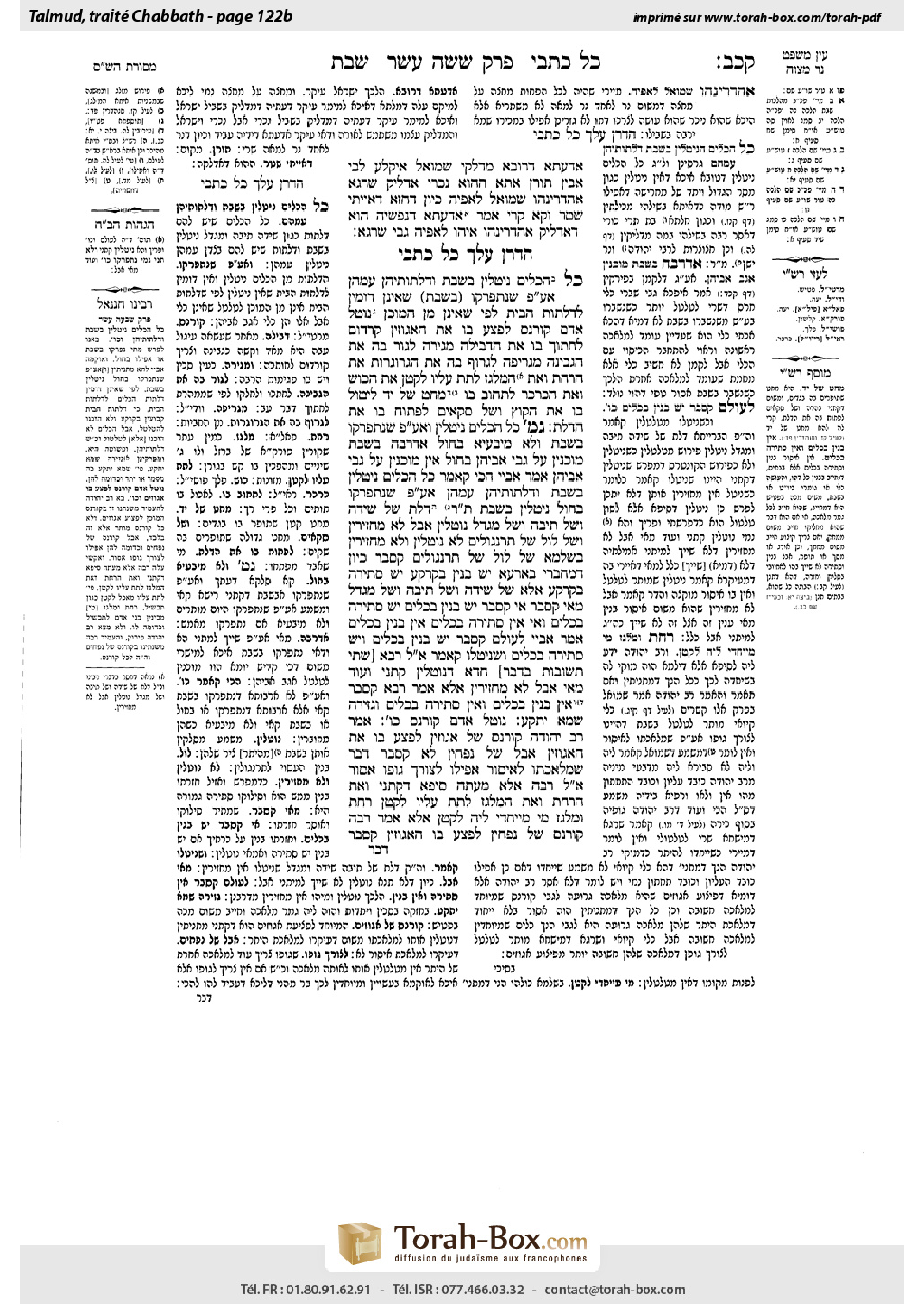
Shabbat 122b: Talmud study for Daf Yomi
Daf Yomi is the daily study of one Talmud folio. Explore 37 tractates with scans, Hebrew text, Sefaria English and AI-generated French translations where annotated.
Passage selection and English or AI-generated French translation are available where the scan has annotations. Daf Study is independent of Torah-Box and Sefaria.
Browse Shabbat · שבת · All tractatesShabbat 122b text and translations
This page of Shabbat includes the Aramaic text, an English translation and an AI-generated French translation, alongside the scan above.
שבת קכ״ב ב · Aramaic and Hebrew text
אַדַּעְתָּא דְרוּבָּא מַדְלְקִי.
שְׁמוּאֵל אִיקְּלַע לְבֵי אֲבִי תוֹרָן. אֲתָא הָהוּא גּוֹי אַדְלֵיק שְׁרָגָא. אַהְדְּרִינְהוּ שְׁמוּאֵל לְאַפֵּיהּ. כֵּיוָן דַּחֲזָא דְּאַיְיתִי שְׁטָר וְקָא קָרֵי, אָמַר: אַדַּעְתָּא דְנַפְשֵׁיהּ הוּא דְּאַדְלֵיק. אַהְדְּרִינְהוּ אִיהוּ לְאַפֵּיהּ גַּבֵּי שְׁרָגָא.
הדרן עלך כל כתבי
מַתְנִי׳ כׇּל הַכֵּלִים נִיטָּלִין בַּשַּׁבָּת, וְדַלְתוֹתֵיהֶן עִמָּהֶן, אַף עַל פִּי שֶׁנִּתְפָּרְקוּ בַּשַּׁבָּת. שֶׁאֵינָן דּוֹמִין לְדַלְתוֹת הַבַּיִת, לְפִי שֶׁאֵינָן מִן הַמּוּכָן.
נוֹטֵל אָדָם קוּרְנָס — לְפַצֵּעַ בּוֹ אֶת הָאֱגוֹזִין, קַרְדּוֹם — לַחְתּוֹךְ בּוֹ אֶת הַדְּבֵילָה. מְגֵירָה — לָגוֹר בָּהּ אֶת הַגְּבִינָה. מַגְרֵיפָה — לִגְרוֹף בָּהּ אֶת הַגְּרוֹגְרוֹת.
אֶת הָרַחַת וְאֶת הַמַּלְגֵּז — לָתֵת עָלָיו לְקָטָן. אֶת הַכּוּשׁ וְאֶת הַכַּרְכֵּר — לִתְחוֹב בּוֹ. מַחַט שֶׁל יָד — לִיטּוֹל בּוֹ אֶת הַקּוֹץ. וְשֶׁל סַקָּאִים — לִפְתּוֹחַ בּוֹ אֶת הַדֶּלֶת.
גְּמָ׳ כׇּל הַכֵּלִים נִיטָּלִין, וְאַף עַל פִּי שֶׁנִּתְפָּרְקוּ בַּשַּׁבָּת, וְלָא מִיבַּעְיָא בְּחוֹל.
אַדְּרַבָּה, בַּשַּׁבָּת מוּכָנִין עַל גַּבֵּי אֲבִיהֶן, בַּחוֹל אֵין מוּכָנִין עַל גַּבֵּי אֲבִיהֶן!
אָמַר אַבָּיֵי, הָכִי קָאָמַר: כׇּל הַכֵּלִים נִיטָּלִין בַּשַּׁבָּת וְדַלְתוֹתֵיהֶן עִמָּהֶן. אַף עַל פִּי שֶׁנִּתְפָּרְקוּ בַּחוֹל — נִיטָּלִין בַּשַּׁבָּת.
תָּנוּ רַבָּנַן: דֶּלֶת שֶׁל שִׁידָּה וְשֶׁל תֵּיבָה וְשֶׁל מִגְדָּל — נוֹטְלִין אֲבָל לֹא מַחֲזִירִין. וְשֶׁל לוּל שֶׁל תַּרְנְגוֹלִים — לֹא נוֹטְלִין וְלֹא מַחֲזִירִין.
בִּשְׁלָמָא שֶׁל לוּל שֶׁל תַּרְנְגוֹלִים, קָסָבַר: כֵּיוָן דִּמְחַבְּרִי בְּאַרְעָא — יֵשׁ בִּנְיָן בְּקַרְקַע יֵשׁ סְתִירָה בְּקַרְקַע. אֶלָּא שֶׁל שִׁידָּה וְשֶׁל תֵּיבָה וְשֶׁל מִגְדָּל, מַאי קָסָבַר?
אִי קָסָבַר יֵשׁ בִּנְיָן בְּכֵלִים — יֵשׁ סְתִירָה בְּכֵלִים, וְאִי אֵין סְתִירָה בְּכֵלִים — אֵין בִּנְיָן בְּכֵלִים?
אָמַר אַבָּיֵי: לְעוֹלָם קָסָבַר יֵשׁ בִּנְיָן בְּכֵלִים וְיֵשׁ סְתִירָה בְּכֵלִים, וְשֶׁנִּיטְּלוּ קָאָמַר.
אֲמַר לֵיהּ רָבָא: [שְׁתֵּי תְּשׁוּבוֹת בַּדָּבָר]. חֲדָא, דְּ״נִיטָּלִין״ קָתָנֵי, וְעוֹד: מַאי ״אֲבָל לֹא מַחֲזִירִין״? אֶלָּא אָמַר רָבָא, קָסָבַר: אֵין בִּנְיָן בְּכֵלִים וְאֵין סְתִירָה בְּכֵלִים — וּגְזֵירָה שֶׁמָּא יִתְקַע.
נוֹטֵל אָדָם קוּרְנָס כּוּ׳. אָמַר רַב יְהוּדָה: קוּרְנָס שֶׁל אֱגוֹזִין לְפַצֵּעַ בּוֹ אֶת הָאֱגוֹזִין, אֲבָל שֶׁל נַפָּחִין — לֹא.
קָסָבַר דָּבָר שֶׁמְּלַאכְתּוֹ לְאִיסּוּר, אֲפִילּוּ לְצוֹרֶךְ גּוּפוֹ — אָסוּר.
אֲמַר לֵיהּ רַבָּה: אֶלָּא מֵעַתָּה, סֵיפָא דְּקָתָנֵי: וְאֶת הָרַחַת וְאֶת הַמַּלְגֵּז לָתֵת עָלָיו לְקָטָן, רַחַת וּמַלְגֵּז מִי מְיַיחֲדִי לֵיהּ לְקָטָן?! אֶלָּא אָמַר רַבָּה: קוּרְנָס שֶׁל נַפָּחִין לְפַצֵּעַ בּוֹ הָאֱגוֹזִין,
קָסָבַר:
Shabbat 122b · English translation
they kindle it with the majority of the those present at the banquet in mind. When the majority of those present are gentiles, it is permitted.
The Gemara relates that Shmuel happened to come to the house of Avin Toran. A certain gentile came and kindled a lamp. Shmuel turned his face back away from the lamp in order to avoid benefitting from the light. When Shmuel saw that the gentile brought a document and was reading it, he said: He kindled it with his own benefit in mind. He turned his face back toward the lamp.
MISHNA: All vessels may be moved on Shabbat, and their doors, which are part of these vessels, along with them, even if they were dismantled on Shabbat, as the doors of these vessels are unlike the doors of the house. It is prohibited to make use of the doors of a house on Shabbat, even if they were removed from the entrance, because they are not prepared from before Shabbat.
Likewise a person may move a mallet, which is generally used for labor prohibited on Shabbat, to crack nuts with it. Likewise, one may move an axe, a tool generally used to chop wood, to cut a cake of figs with it. So too, one may move a saw to cut cheese with it. Similarly, one may move a spade to scoop dried figs with it.
One may also move a winnowing shovel and a pitchfork, both of which are designated for use with crops in a barn, to place food on it for a child. One is likewise permitted to take a reed or a shuttle from a spindle, ordinarily used for weaving, in order to insert it into food like a fork. One is permitted to move an ordinary hand needle used for sewing clothes to extract a thorn with it, and one may move a sack maker’s needle to open the door with it.
GEMARA: The mishna states: All vessels may be moved, and even if they were dismantled on Shabbat. Should we learn from here that there is only a question with regard to vessels which were dismantled on Shabbat, and that there is no need to mention vessels detached during the week, as it is certainly permitted to carry them on Shabbat?
On the contrary, if they were dismantled on Shabbat it can be said that the parts of the vessel were prepared for use at the onset of Shabbat, due to their being attached to their original vessels from which they were removed. However, if they were detached during the week, at the onset of Shabbat they would not have been prepared for use, due to their being detached from their original vessels from which they were removed.
Abaye said that this is what the mishna is saying: All vessels may be moved on Shabbat along with their doors. And even if they came apart during the week, they may be moved on Shabbat.
The Sages taught: With regard to the door of a chest, or of a box, or of a closet, one may remove them from their hinges on Shabbat, but he may not restore them to their original places. And with regard to the door of a chicken coop, one may neither move it nor restore it to its place.
Granted, in the case of a chicken coop the tanna holds: Since the coop is attached to the ground, there is a prohibition against building on the ground and there is a prohibition against dismantling on the ground. Consequently, when one dismantles or restores the door he has performed the prohibited labor of building. However, in the case of the door of a chest, or a box, or a closet, what does he hold?
If the tanna holds that there is a prohibition against building with regard to vessels, then there is also a prohibition against dismantling with regard to vessels and it should be prohibited to remove the door. And if there is no prohibition against dismantling with regard to vessels and it is permitted to remove the door, then there should also be no prohibition against building with regard to vessels. Why, then, is it prohibited to restore a door to its original place?
Abaye said: Actually, he holds that there is a prohibition against building with regard to vessels and there is also a prohibition against dismantling with regard to vessels. To resolve the difficulty, emend the text. Rather than saying: One may remove them, it is saying: The doors of a chest, or a box, or a closet that were already removed may not be restored.
Rava said to him: There are two possible responses with which your statement can be rejected. One is that it is taught in the baraita: One may remove them, ab initio. And furthermore, what is the meaning of: But one may not restore them? According to your emendation, what is the meaning of the word, but, in this context? Rather, Rava said: The tanna holds that there is no prohibition against building with regard to vessels and there is no prohibition against dismantling with regard to vessels, and so why did the tanna rule one may not restore the door? It is due to a decree lest one fix it firmly in place in the manner of a full-fledged prohibited labor, completing the production process of a vessel.
The mishna states: A person may take a mallet on Shabbat in order to crack nuts with it. Rav Yehuda said: The type of hammer in this case is a hammer designated for nuts to crack nuts with it, but blacksmiths’ hammers, no, they may not be used.
That tanna holds that using an object whose primary function is for a prohibited use, even for the purpose of utilizing the object itself to perform a permitted action, is prohibited.
Rabba said to him: But if what you say is so, how do you reconcile this with the latter clause of the mishna in which it is taught: And a winnowing shovel or a pitchfork in order to place food for a child on it; are a winnowing shovel and a pitchfork designated for use by a child? Rather, Rabba said: The mishna should be interpreted as follows: One may use a blacksmiths’ hammer on Shabbat to crack nuts with it.
The tanna holds:
Shabbat 122b · Traduction française (IA)
on l’allume en tenant compte de la majorité des personnes présentes au banquet. Lorsque la majorité des personnes présentes sont des non-Juifs, cela est permis.
La Guemara rapporte que Chmouel se rendit par hasard chez Avin Toran. Un certain non-Juif vint et alluma une lampe. Chmouel détourna le visage de la lampe afin de ne pas profiter de sa lumière. Lorsque Chmouel vit que le non-Juif avait apporté un document et le lisait, il dit : « Il l’a allumée pour son propre usage. » Chmouel tourna alors de nouveau le visage vers la lampe.
MICHNA : Tous les ustensiles peuvent être déplacés pendant Chabbat, ainsi que leurs portes, qui font partie intégrante de ces ustensiles, même si elles en ont été détachées pendant Chabbat, car les portes de ces ustensiles ne sont pas comparables aux portes d’une maison. Il est interdit d’utiliser les portes d’une maison pendant Chabbat, même si elles ont été retirées de l’entrée, car elles n’étaient pas préparées avant Chabbat.
De même, on peut déplacer un maillet, généralement utilisé pour un travail interdit pendant Chabbat, afin de casser des noix avec. On peut également déplacer une hache, généralement utilisée pour couper du bois, afin de découper avec elle un gâteau de figues. De même, on peut déplacer une scie pour couper du fromage, ainsi qu’une pelle pour puiser des figues sèches.
On peut également déplacer une pelle à vanner et une fourche, toutes deux destinées à être utilisées avec les récoltes dans une grange, pour y déposer de la nourriture pour un enfant. De même, il est permis de prendre un roseau ou une navette de fuseau, habituellement utilisés pour tisser, afin de les planter dans un aliment comme une fourchette. On peut déplacer une aiguille ordinaire, utilisée pour coudre des vêtements, afin d’en extraire une épine, et une aiguille de fabricant de sacs pour ouvrir une porte.
GUEMARA : La Michna énonce : « Tous les ustensiles peuvent être déplacés, même s’ils ont été démontés pendant Chabbat. » Faut-il en déduire que la question ne se pose que pour les ustensiles démontés pendant Chabbat, et qu’il n’est pas nécessaire de mentionner ceux qui ont été détachés durant la semaine, puisqu’il est certainement permis de les déplacer pendant Chabbat ?
Au contraire, si les portes ont été détachées pendant Chabbat, on peut dire que les éléments de l’ustensile étaient prêts à être utilisés au début de Chabbat, puisqu’ils étaient alors attachés aux ustensiles d’origine dont ils ont été retirés. En revanche, si elles ont été détachées durant la semaine, elles n’auraient pas été prêtes à être utilisées au début de Chabbat, puisqu’elles étaient détachées des ustensiles d’origine dont elles avaient été retirées.
Abayé dit que voici ce qu’énonce la Michna : Tous les ustensiles peuvent être déplacés pendant Chabbat avec leurs portes. Même si celles-ci ont été détachées durant la semaine, on peut les déplacer pendant Chabbat.
Les Sages ont enseigné : La porte d’un coffre, d’une boîte ou d’une armoire peut être retirée de ses gonds pendant Chabbat, mais ne peut pas être remise à sa place d’origine. Quant à la porte d’un poulailler, on ne peut ni la déplacer ni la remettre à sa place.
Certes, dans le cas d’un poulailler, le tanna considère que, puisque celui-ci est fixé au sol, il est interdit d’y construire et d’y démolir. Par conséquent, lorsqu’on démonte ou remet la porte, on accomplit le travail interdit de construire. Cependant, dans le cas de la porte d’un coffre, d’une boîte ou d’une armoire, quelle est la position du tanna ?
Si le tanna considère qu’il est interdit de construire des ustensiles, alors il est également interdit de les démonter, et il devrait donc être interdit de retirer la porte. Et s’il n’est pas interdit de démonter des ustensiles et qu’il est permis d’en retirer la porte, alors il ne devrait pas non plus être interdit d’en construire. Pourquoi, dès lors, est-il interdit de remettre une porte à sa place d’origine ?
Abayé dit : En réalité, il considère qu’il est interdit de construire des ustensiles et qu’il est également interdit de les démonter. Pour résoudre la difficulté, corrigeons le texte. Au lieu de dire : « On peut les retirer », il faut lire : « Les portes d’un coffre, d’une boîte ou d’une armoire qui ont déjà été retirées ne peuvent pas être remises en place. »
Rava lui dit : Deux réponses permettent de réfuter ton propos. Premièrement, la baraïta enseigne : « On peut les retirer », c’est-à-dire qu’on peut le faire a priori. En outre, que signifie : « Mais on ne peut pas les remettre » ? Selon ta correction, que signifie ici le mot « mais » ? Rava dit plutôt : Le tanna considère qu’il n’est interdit ni de construire des ustensiles ni de les démonter. Pourquoi, dès lors, le tanna a-t-il statué qu’on ne peut pas remettre la porte ? En raison d’un décret, de crainte qu’on ne la fixe solidement, accomplissant ainsi un travail interdit à part entière et achevant le processus de fabrication d’un ustensile.
La Michna énonce : On peut prendre un maillet pendant Chabbat afin de casser des noix avec. Rav Yéhouda dit : Il s’agit d’un marteau destiné à casser des noix ; quant aux marteaux de forgeron, on ne peut pas les utiliser.
Ce tanna considère qu’il est interdit d’utiliser un objet dont l’usage principal est interdit, même pour se servir de l’objet lui-même afin d’accomplir une action permise.
Rabba lui dit : Mais si ce que tu dis est exact, comment concilies-tu cela avec la dernière partie de la Michna, où il est enseigné : « Une pelle à vanner ou une fourche, afin d’y déposer de la nourriture pour un enfant » ? Une pelle à vanner et une fourche sont-elles destinées à l’usage d’un enfant ? Rabba dit plutôt : Il faut interpréter la Michna ainsi : On peut utiliser un marteau de forgeron pendant Chabbat pour casser des noix.
Le tanna considère :
Traduction française générée par IA à partir de l’édition anglaise de Sefaria. Vérifie toujours un passage avec le texte source.
Text from Sefaria: William Davidson Edition - Vocalized Aramaic (CC BY NC); William Davidson Edition - English (CC BY NC).