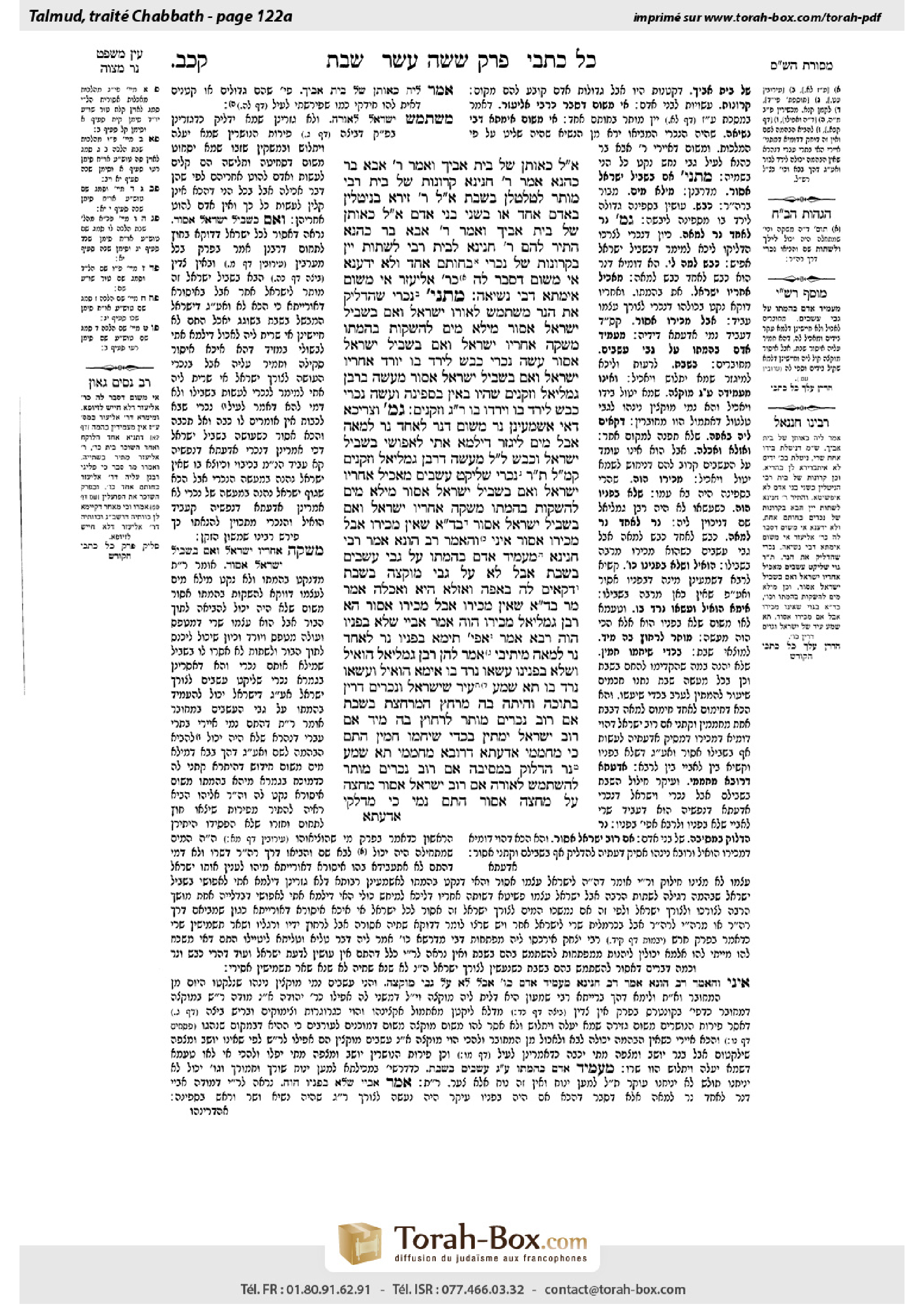
Shabbat 122a: Talmud study for Daf Yomi
Daf Yomi is the daily study of one Talmud folio. Explore 37 tractates with scans, Hebrew text, Sefaria English and AI-generated French translations where annotated.
Passage selection and English or AI-generated French translation are available where the scan has annotations. Daf Study is independent of Torah-Box and Sefaria.
Browse Shabbat · שבת · All tractatesShabbat 122a text and translations
This page of Shabbat includes the Aramaic text, an English translation and an AI-generated French translation, alongside the scan above.
שבת קכ״ב א · Aramaic and Hebrew text
אֲמַר לֵיהּ: כְּאוֹתָן שֶׁל בֵּית אָבִיךָ.
וְאָמַר רַבִּי אַבָּא בַּר כָּהֲנָא אָמַר רַבִּי חֲנִינָא: קְרוֹנוֹת שֶׁל בֵּית רַבִּי מוּתָּר לְטַלְטְלָן בְּשַׁבָּת. אֲמַר לֵיהּ רַבִּי זֵירָא: בְּנִיטָּלִין בְּאָדָם אֶחָד אוֹ בִּשְׁנֵי בְּנֵי אָדָם? אֲמַר לֵיהּ: כְּאוֹתָן שֶׁל בֵּית אָבִיךָ.
וְאָמַר רַבִּי אַבָּא בַּר כָּהֲנָא: הִתִּיר לָהֶם רַבִּי חֲנִינָא לְבֵית רַבִּי לִשְׁתּוֹת יַיִן בִּקְרוֹנוֹת שֶׁל גּוֹי, בְּחוֹתָם אֶחָד, וְלָא יָדַעְנָא אִי מִשּׁוּם דְּסָבַר לַהּ כְּרַבִּי אֱלִיעֶזֶר, אִי מִשּׁוּם אֵימְתָא דְּבֵי נְשִׂיאָה.
מַתְנִי׳ גּוֹי שֶׁהִדְלִיק אֶת הַנֵּר — מִשְׁתַּמֵּשׁ לְאוֹרוֹ יִשְׂרָאֵל. וְאִם בִּשְׁבִיל יִשְׂרָאֵל — אָסוּר. מִילֵּא מַיִם לְהַשְׁקוֹת בְּהֶמְתּוֹ — מַשְׁקֶה אַחֲרָיו יִשְׂרָאֵל, וְאִם בִּשְׁבִיל יִשְׂרָאֵל — אָסוּר. עָשָׂה גּוֹי כֶּבֶשׁ לֵירֵד בּוֹ — יוֹרֵד אַחֲרָיו יִשְׂרָאֵל, וְאִם בִּשְׁבִיל יִשְׂרָאֵל — אָסוּר. מַעֲשֶׂה בְּרַבָּן גַּמְלִיאֵל וּזְקֵנִים שֶׁהָיוּ בָּאִין בִּסְפִינָה וְעָשָׂה גּוֹי כֶּבֶשׁ לֵירֵד בּוֹ, וְיָרְדוּ בּוֹ רַבָּן גַּמְלִיאֵל וּזְקֵנִים.
גְּמָ׳ וּצְרִיכָא, דְּאִי אַשְׁמְעִינַן נֵר, מִשּׁוּם דְּנֵר לְאֶחָד נֵר לְמֵאָה, אֲבָל מַיִם לִיגְזַר, דִּילְמָא אָתֵי לְאַפּוֹשֵׁי בִּשְׁבִיל יִשְׂרָאֵל. וְכֶבֶשׁ לְמָה לִי? מַעֲשֶׂה דְּרַבָּן גַּמְלִיאֵל וּזְקֵנִים קָא מַשְׁמַע לַן.
תָּנוּ רַבָּנַן: גּוֹי שֶׁלִּיקֵּט עֲשָׂבִים — מַאֲכִיל אַחֲרָיו יִשְׂרָאֵל, וְאִם בִּשְׁבִיל יִשְׂרָאֵל — אָסוּר. מִילֵּא מַיִם לְהַשְׁקוֹת בְּהֶמְתּוֹ — מַשְׁקֶה אַחֲרָיו יִשְׂרָאֵל, וְאִם בִּשְׁבִיל יִשְׂרָאֵל — אָסוּר. בַּמֶּה דְּבָרִים אֲמוּרִים — שֶׁאֵין מַכִּירוֹ, אֲבָל מַכִּירוֹ — אָסוּר.
אִינִי?! וְהָאָמַר רַב הוּנָא אָמַר רַבִּי חֲנִינָא: מַעֲמִיד אָדָם בְּהֶמְתּוֹ עַל גַּבֵּי עֲשָׂבִים בְּשַׁבָּת, אֲבָל לֹא עַל גַּבֵּי מוּקְצֶה בְּשַׁבָּת. דְּקָאֵים לַהּ בְּאַפָּהּ, וְאָזְלָא הִיא וְאָכְלָה.
אָמַר מָר: בַּמֶּה דְּבָרִים אֲמוּרִים — שֶׁאֵין מַכִּירוֹ, אֲבָל מַכִּירוֹ — אָסוּר. הָא רַבָּן גַּמְלִיאֵל מַכִּירוֹ הֲוָה! אָמַר אַבָּיֵי: שֶׁלֹּא בְּפָנָיו הֲוָה. רָבָא אָמַר: אֲפִילּוּ תֵּימָא בְּפָנָיו, נֵר לְאֶחָד נֵר לְמֵאָה.
מֵיתִיבִי, אָמַר לָהֶן רַבָּן גַּמְלִיאֵל: הוֹאִיל וְשֶׁלֹּא בְּפָנֵינוּ עֲשָׂאוֹ — נֵרֵד בּוֹ. אֵימָא: הוֹאִיל וַעֲשָׂאוֹ נֵרֵד בּוֹ.
תָּא שְׁמַע: עִיר שֶׁיִּשְׂרָאֵל וְגוֹיִם דָּרִין בְּתוֹכָהּ, וְהָיְתָה בָּהּ מֶרְחָץ הַמַּרְחֶצֶת בְּשַׁבָּת, אִם רוֹב גּוֹיִם — מוּתָּר לִרְחוֹץ בָּהּ מִיָּד. אִם רוֹב יִשְׂרָאֵל — יַמְתִּין בִּכְדֵי שֶׁיֵּחַמּוּ חַמִּין! הָתָם, כִּי מְחַמְּמִי — אַדַּעְתָּא דְרוּבָּא מְחַמְּמִי.
תָּא שְׁמַע: נֵר הַדָּלוּק בִּמְסִיבָּה, אִם רוֹב גּוֹיִם — מוּתָּר לְהִשְׁתַּמֵּשׁ לְאוֹרָהּ, אִם רוֹב יִשְׂרָאֵל — אָסוּר, מֶחֱצָה עַל מֶחֱצָה — אָסוּר. הָתָם נָמֵי, כִּי מַדְלְקִי —
Shabbat 122a · English translation
Rabbi Abba bar Kahana said to him: They are like those from your father’s house, which are large (Tosafot).
And Rabbi Abba bar Kahana said that Rabbi Ḥanina said: The sedan chairs of the house of Rabbi Yehuda HaNasi may be moved on Shabbat. Rabbi Zeira said to Rabbi Abba bar Kahana: Are you referring to sedan chairs that can be moved by one person or those that can be only moved by two people? He said to him: They are like those from your father’s house.
And Rabbi Abba bar Kahana said: Rabbi Ḥanina permitted the members of the household of Rabbi Yehuda HaNasi to drink wine transported in a gentile’s wagons even though the wine was sealed only with one seal. He was not concerned that perhaps the gentile may have opened the barrel and poured wine libations to idolatry from it or touched it, which would prohibit drinking it. Rabbi Abba bar Kahana adds: And I do not know if that is because Rabbi Ḥanina holds in accordance with the opinion of Rabbi Eliezer, who permits drinking wine from a gentile that was protected by a single seal, or if it was because the gentile would not dare to open these specific casks due fear of the household of the Nasi, but in general Rabbi Ḥanina prohibited drinking wine protected by a single seal.
MISHNA: If a gentile kindled a lamp on Shabbat for his own purposes, a Jew also uses its light; and if the gentile kindled it for a Jew, the Sages prohibited to utilize its light. Similarly, if a gentile drew water from a well in the public domain to give his animal to drink, a Jew gives his own animal to drink after him from the same water; and if he drew the water initially for the benefit of a Jew, it is prohibited for a Jew to give his animal to drink from that water. Similarly, if a gentile made a ramp on Shabbat to disembark from a ship, a Jew disembarks after him; and if he made the ramp for a Jew, it is prohibited. There was an incident in which Rabban Gamliel and the Elders were traveling on a ship and a gentile made a ramp on Shabbat in order to disembark from the ship on it; and Rabban Gamliel and the Elders disembarked on it as well.
GEMARA: The Gemara comments: And it was necessary to teach this halakha in all these cases. As, had it taught us only the halakha with regard to a lamp, I would have said that this is the halakha because the light of a lamp for one is the light of a lamp for one hundred people. There is no need to kindle multiple lamps for multiple people; the light of one candle suffices for many. Therefore, it is permitted to use the light of a lamp kindled by a gentile. However, with regard to water, there is room to issue a decree against benefitting from the gentile’s efforts, lest one come to increase the amount of water he draws for a Jew, even without stating that intention. The Gemara asks: And why do I need the mishna to mention that it is permitted to use the ramp? The Gemara answers: It taught us the case of the ramp to cite the incident involving Rabban Gamliel and the Elders to indicate that they followed this ruling in practice.
The Sages taught: If a gentile collected grass on Shabbat for himself, in order to feed his animal, a Jew may feed his own animal after him, and if he collected it for the benefit of a Jew, it is prohibited. If he drew water to give his animal to drink, a Jew may give water to his own animal to drink after him, and if he drew it for the benefit of a Jew it is prohibited. In what case is this statement, that if the gentile acted for himself it is permitted for a Jew to benefit, said? When the gentile does not know him; however, if the gentile knows him, it is prohibited, as in that case, he certainly intended to benefit his Jewish acquaintance as well.
The Gemara asks: Is that so? Didn’t Rav Huna say that Rabbi Ḥanina said: One may position his animal over grass on Shabbat, even grass that is growing in the ground, and there is no concern lest he detach the grass and feed the animal; however, he may not position the animal over an item that is set aside on Shabbat, since there is concern lest one lift the item with his hand. The grass that the gentile collects for himself is certainly set aside, so why may the Jew feed it to his animal? The Gemara answers: Indeed, a Jew may not position his animal over the grass that a gentile picked; he may only position it in before the grass at a distance, and the animal goes on its own and eats.
We learned above that the Master said: In what case is this statement, that if the gentile acted for himself it is permitted for a Jew to benefit, said? When the gentile does not know him; however, if the gentile knows him, it is prohibited. The Gemara asks: However, in the incident involving Rabban Gamliel and the ship, it is a case where the gentile knows him as they traveled together on the ship. Abaye said: The action was not performed in Rabban Gamliel’s presence, and since the gentile had not seen him he intended to make it only for himself. Rava said: Even if you say that the gentile made the ramp in his presence, that is irrelevant because a lamp for one is a lamp for one hundred; similarly, with regard to a ramp, once the gentile constructs it for his own use it can be used by others with no further adjustments.
The Gemara raises an objection to Rava’s statement based on the Tosefta: Rabban Gamliel said to them: Since he made it not in our presence, we will disembark on it. Rabban Gamliel made use of the ramp only for this reason, contrary to Rava’s explanation. The Gemara rejects this: Say the Tosefta in an emended form: Rabban Gamliel said to them: Since he made it, we will disembark on it.
Come and hear proof from another baraita with regard to the dispute between Abaye and Rava: With regard to a city where both Jews and gentiles live and there was a bathhouse in it in which there is bathing on Shabbat, if the majority of the city’s residents are gentiles, it is permitted to bathe in the bathhouse immediately after Shabbat because the bathhouse was heated on Shabbat to serve the gentiles. However, if there is a majority of Jews in the city, one waits after Shabbat for a period of time sufficient for them to heat the hot water so as not to benefit from prohibited labor performed on Shabbat. Apparently, even when an action is not performed in the presence of a Jew, there is concern that it may have been performed for the benefit of Jews. The Gemara rejects this proof: There, in the case of the baraita, when they heat the water, they heat it with the majority of the city’s inhabitants in mind, and the owner of the bathhouse sets the heating schedule to service the majority.
Come and hear a proof from the following baraita: With regard to a lamp kindled at a banquet in which several people are participating, if the majority of those present are gentiles it is permitted for a Jew to utilize its light, and if the majority of those present are Jews it is prohibited, as in that case, the lamp was certainly lit for the Jews’ benefit. If those present are half Jews and half gentiles, it is prohibited. Since they are participating in the same banquet, the gentile certainly knows the Jew. Why, then, is it permitted for a Jew to utilize the light of the lamp even when the majority of those present are gentiles? The Gemara rejects this proof: There, too, when they kindle the lamp,
Shabbat 122a · Traduction française (IA)
Rabbi Abba bar Kahana lui dit : Ils sont comme ceux de la maison de ton père, qui sont grands (Tosafot).
Et Rabbi Abba bar Kahana dit au nom de Rabbi Ḥanina : Les litières de la maison de Rabbi Yehuda HaNasi peuvent être déplacées pendant Chabbat. Rabbi Zeira demanda à Rabbi Abba bar Kahana : Parles-tu de litières qu’une seule personne peut déplacer ou de celles que seules deux personnes peuvent déplacer ? Il lui répondit : Elles sont comme celles de la maison de ton père.
Et Rabbi Abba bar Kahana dit : Rabbi Ḥanina autorisa les membres de la maison de Rabbi Yehuda HaNasi à boire du vin transporté dans les chariots d’un non-Juif, même si le vin n’était scellé que d’un seul sceau. Il ne craignait pas que le non-Juif ait ouvert le tonneau et en ait versé du vin en libation à une idole, ou qu’il l’ait touché, ce qui en aurait interdit la consommation. Rabbi Abba bar Kahana ajoute : Je ne sais pas si c’est parce que Rabbi Ḥanina suit l’opinion de Rabbi Eliezer, qui autorise à boire du vin provenant d’un non-Juif lorsqu’il n’est protégé que par un seul sceau, ou si c’est parce que le non-Juif n’aurait pas osé ouvrir ces tonneaux précis, par crainte de la maison du Nasi ; mais, en général, Rabbi Ḥanina interdisait de boire du vin protégé par un seul sceau.
Michna : Si un non-Juif a allumé une lampe pendant Chabbat pour son propre usage, un Juif peut lui aussi profiter de sa lumière ; mais si le non-Juif l’a allumée pour un Juif, les Sages ont interdit d’en utiliser la lumière. De même, si un non-Juif a puisé de l’eau dans un puits situé dans le domaine public pour faire boire son animal, un Juif peut faire boire le sien après lui avec cette même eau ; mais s’il a puisé l’eau dès le départ au profit d’un Juif, il est interdit à un Juif d’en faire boire son animal. De même, si un non-Juif a construit une rampe pendant Chabbat pour débarquer d’un bateau, un Juif peut débarquer après lui ; mais s’il a construit la rampe pour un Juif, cela est interdit. Un incident s’est produit : Rabban Gamliel et les Anciens voyageaient sur un bateau, et un non-Juif construisit une rampe pendant Chabbat pour débarquer du bateau ; Rabban Gamliel et les Anciens débarquèrent eux aussi par cette rampe.
Guemara : La Guemara fait remarquer qu’il était nécessaire d’enseigner cette halakha dans tous ces cas. En effet, si elle ne nous avait enseigné que la halakha concernant une lampe, j’aurais dit que c’est parce que la lumière d’une lampe pour une personne est aussi celle d’une lampe pour cent personnes. Il n’est pas nécessaire d’allumer plusieurs lampes pour plusieurs personnes ; la lumière d’une seule lampe suffit à beaucoup. Il est donc permis d’utiliser la lumière d’une lampe allumée par un non-Juif. Toutefois, concernant l’eau, il y a lieu de décréter qu’il est interdit de profiter du travail du non-Juif, de peur qu’il n’en vienne à augmenter la quantité d’eau puisée pour un Juif, même sans exprimer cette intention. La Guemara demande : Pourquoi la Michna doit-elle mentionner qu’il est permis d’utiliser la rampe ? La Guemara répond : Elle nous a enseigné le cas de la rampe afin de citer l’incident de Rabban Gamliel et des Anciens, pour indiquer qu’ils ont mis cette décision en pratique.
Les Sages ont enseigné : Si un non-Juif a ramassé de l’herbe pendant Chabbat pour lui-même, afin de nourrir son animal, un Juif peut nourrir le sien après lui ; mais s’il l’a ramassée au profit d’un Juif, cela est interdit. S’il a puisé de l’eau pour faire boire son animal, un Juif peut faire boire le sien après lui ; mais s’il l’a puisée au profit d’un Juif, cela est interdit. Dans quel cas a-t-on dit que, si le non-Juif a agi pour lui-même, un Juif peut en profiter ? Lorsque le non-Juif ne le connaît pas ; toutefois, s’il le connaît, cela est interdit, car il a alors certainement eu aussi l’intention de rendre service à cette connaissance juive.
La Guemara demande : Est-ce vraiment ainsi ? Rav Huna n’a-t-il pas dit au nom de Rabbi Ḥanina : On peut placer son animal devant de l’herbe pendant Chabbat, même si elle pousse en terre, sans craindre que l’animal l’arrache pour se nourrir ; toutefois, on ne peut pas placer l’animal devant un objet mis de côté pendant Chabbat, car on craint qu’il ne le soulève de la main. L’herbe que le non-Juif a ramassée pour lui-même est certainement mise de côté ; pourquoi, dès lors, le Juif peut-il la donner à son animal ? La Guemara répond : En effet, un Juif ne peut pas placer son animal devant l’herbe cueillie par un non-Juif ; il peut seulement le placer devant l’herbe, à distance, et l’animal s’avance de lui-même pour la manger.
Nous avons appris plus haut que le Maître a dit : Dans quel cas a-t-on dit que, si le non-Juif a agi pour lui-même, un Juif peut en profiter ? Lorsque le non-Juif ne le connaît pas ; toutefois, s’il le connaît, cela est interdit. La Guemara demande : Mais, dans l’incident de Rabban Gamliel et du bateau, le non-Juif le connaissait, puisqu’ils voyageaient ensemble sur le bateau. Abaye dit : L’action n’a pas été accomplie en présence de Rabban Gamliel ; puisque le non-Juif ne l’avait pas vu, il avait l’intention de construire la rampe uniquement pour lui-même. Rava dit : Même si tu dis que le non-Juif a construit la rampe en sa présence, cela ne change rien, car une lampe pour une personne est une lampe pour cent ; de même, une fois que le non-Juif construit une rampe pour son propre usage, d’autres peuvent l’utiliser sans qu’il soit nécessaire d’y apporter la moindre modification.
La Guemara soulève une objection à l’affirmation de Rava à partir de la Tossefta : Rabban Gamliel leur dit : « Puisqu’il l’a construite en notre absence, nous débarquerons par cette rampe. » Rabban Gamliel n’utilisa la rampe que pour cette raison, ce qui contredit l’explication de Rava. La Guemara rejette cette objection : Il faut lire la Tossefta sous une forme corrigée : Rabban Gamliel leur dit : « Puisqu’il l’a construite, nous débarquerons par cette rampe. »
Viens et entends une preuve tirée d’une autre baraïta concernant le désaccord entre Abaye et Rava : Dans une ville habitée à la fois par des Juifs et des non-Juifs, où se trouve un bain public dans lequel on se baigne pendant Chabbat, si la majorité des habitants sont des non-Juifs, il est permis de s’y baigner immédiatement après Chabbat, car le bain a été chauffé pendant Chabbat pour les non-Juifs. Toutefois, si la majorité des habitants sont des Juifs, on attend après Chabbat le temps nécessaire pour qu’ils chauffent l’eau, afin de ne pas profiter d’un travail interdit effectué pendant Chabbat. Il apparaît donc que, même lorsqu’une action n’est pas accomplie en présence d’un Juif, on craint qu’elle ait pu l’être au profit de Juifs. La Guemara rejette cette preuve : Dans le cas de cette baraïta, lorsqu’ils chauffent l’eau, ils le font en tenant compte de la majorité des habitants de la ville, et le propriétaire du bain règle les horaires de chauffage en fonction de cette majorité.
Viens et entends une preuve tirée de la baraïta suivante : Concernant une lampe allumée lors d’un banquet auquel participent plusieurs personnes, si la majorité des personnes présentes sont des non-Juifs, un Juif peut profiter de sa lumière ; mais si la majorité des personnes présentes sont des Juifs, cela est interdit, car la lampe a alors certainement été allumée au profit des Juifs. Si les personnes présentes sont en nombre égal, Juifs et non-Juifs, cela est interdit. Puisqu’ils participent au même banquet, le non-Juif connaît certainement le Juif. Pourquoi, dès lors, un Juif peut-il profiter de la lumière de la lampe même lorsque la majorité des personnes présentes sont des non-Juifs ? La Guemara rejette cette preuve : Là aussi, lorsqu’ils allument la lampe,
Traduction française générée par IA à partir de l’édition anglaise de Sefaria. Vérifie toujours un passage avec le texte source.
Text from Sefaria: William Davidson Edition - Vocalized Aramaic (CC BY NC); William Davidson Edition - English (CC BY NC).