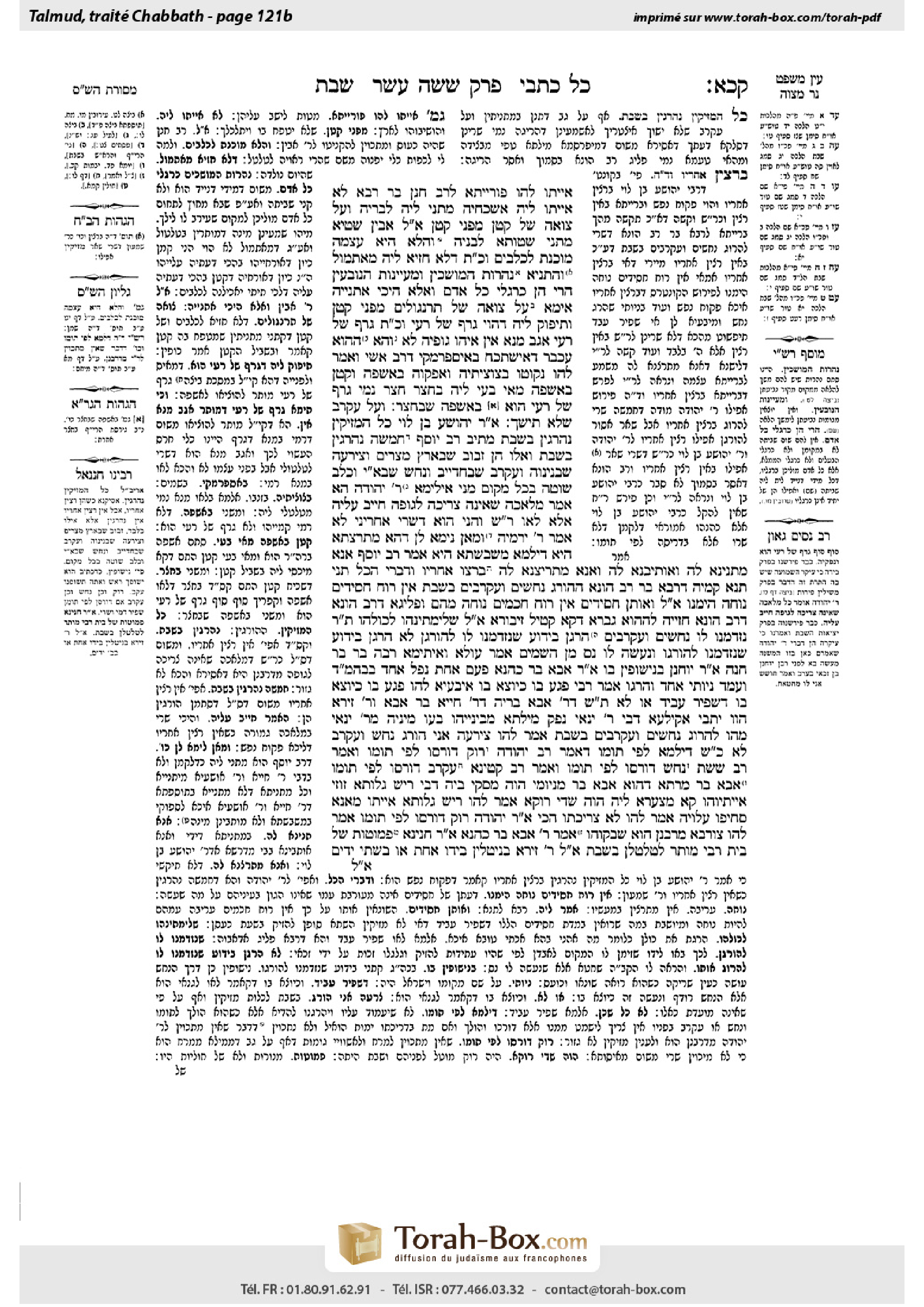
Shabbat 121b: Talmud study for Daf Yomi
Daf Yomi is the daily study of one Talmud folio. Explore 37 tractates with scans, Hebrew text, Sefaria English and AI-generated French translations where annotated.
Passage selection and English or AI-generated French translation are available where the scan has annotations. Daf Study is independent of Torah-Box and Sefaria.
Browse Shabbat · שבת · All tractatesShabbat 121b text and translations
This page of Shabbat includes the Aramaic text, an English translation and an AI-generated French translation, alongside the scan above.
שבת קכ״א ב · Aramaic and Hebrew text
אַיְיתוֹ לְהוּ פּוּרְיָיתָא, לְרַב חָנָן בַּר רָבָא לָא אַיְיתוֹ לֵיהּ. אַשְׁכְּחֵיהּ מַתְנֵי לֵיהּ לִבְרֵיהּ: וְעַל צוֹאָה שֶׁל קָטָן מִפְּנֵי קָטָן. אֲמַר לֵיהּ: אָבִין שָׁטְיָא מַתְנֵי שְׁטוּתָא לִבְנֵיהּ, וַהֲלֹא הִיא עַצְמָהּ מוּכֶנֶת לִכְלָבִים! וְכִי תֵּימָא דְּלָא חַזְיָא לֵיהּ מֵאֶתְמוֹל — וְהָתַנְיָא: נְהָרוֹת הַמּוֹשְׁכִין וּמַעֲיָינוֹת הַנּוֹבְעִין — הֲרֵי הֵן כְּרַגְלֵי כׇּל אָדָם.
וְאֶלָּא הֵיכִי אַתְנְיֵיהּ? אֵימָא: עַל צוֹאָה שֶׁל תַּרְנְגוֹלִים מִפְּנֵי קָטָן.
וְתִיפּוֹק לֵיהּ דְּהָוֵי גְּרָף שֶׁל רְעִי! וְכִי תֵּימָא: גְּרָף שֶׁל רְעִי אַגַּב מָנָא — אִין, אִיהוּ גּוּפֵיהּ — לָא, וְהָא הָהוּא עַכְבָּר דְּאִישְׁתְּכַח בְּאִיסְפַּרְמָקֵי דְּרַב אָשֵׁי, וַאֲמַר לְהוּ: נִקְטוּהּ בְּצוּצִיתֵיהּ וְאַפְּקוּהּ! בְּאַשְׁפָּה. וְקָטָן בְּאַשְׁפָּה מַאי בָּעֵי לֵיהּ? בְּחָצֵר. חָצֵר נָמֵי, גְּרָף שֶׁל רְעִי הוּא! בְּאַשְׁפָּה שֶׁבְּחָצֵר.
וְעַל עַקְרָב שֶׁלֹּא תִּישָּׁךְ. אָמַר רַבִּי יְהוֹשֻׁעַ בֶּן לֵוִי: כׇּל הַמַּזִּיקִין נֶהֱרָגִין בְּשַׁבָּת. מֵתִיב רַב יוֹסֵף: חֲמִשָּׁה נֶהֱרָגִין בְּשַׁבָּת, וְאֵלּוּ הֵן: זְבוּב שֶׁבְּאֶרֶץ מִצְרַיִם, וְצִירְעָה שֶׁבְּנִינְוֵה, וְעַקְרָב שֶׁבְּחַדְיָיב, וְנָחָשׁ שֶׁבְּאֶרֶץ יִשְׂרָאֵל, וְכֶלֶב שׁוֹטֶה בְּכׇל מָקוֹם. מַנִּי? אִילֵימָא רַבִּי יְהוּדָה — הָא אָמַר: מְלָאכָה שֶׁאֵינָהּ צְרִיכָה לְגוּפָהּ חַיָּיב עָלֶיהָ. אֶלָּא לָאו רַבִּי שִׁמְעוֹן, וְהָנֵי הוּא דְּשָׁרֵי, אַחֲרִינֵי — לָא!
אָמַר רַבִּי יִרְמְיָה: וּמַאן נֵימָא לַן דְּהָא מְתָרַצְתָּא הִיא? דִּילְמָא מְשַׁבַּשְׁתָּא הִיא? אָמַר רַב יוֹסֵף: אֲנָא מַתְנֵינָא לַהּ, וְאוֹתֵיבְנָא לַהּ, וַאֲנָא מְתָרֵיצְנָא לַהּ: בְּרָצִין אַחֲרָיו, וְדִבְרֵי הַכֹּל.
תָּנֵי תַּנָּא קַמֵּיהּ דְּרָבָא בַּר רַב הוּנָא: הַהוֹרֵג נְחָשִׁים וְעַקְרַבִּים בְּשַׁבָּת — אֵין רוּחַ חֲסִידִים נוֹחָה הֵימֶנּוּ. אֲמַר לֵיהּ: וְאוֹתָן חֲסִידִים אֵין רוּחַ חֲכָמִים נוֹחָה מֵהֶם. וּפְלִיגָא דְּרַב הוּנָא. דְּרַב הוּנָא חַזְיֵיהּ לְהָהוּא גַּבְרָא דְּקָא קָטֵיל זִיבּוּרָא, אֲמַר לֵיהּ: שַׁלֵּימְתִּינְהוּ לְכוּלְּהוּ?
תָּנוּ רַבָּנַן: נִזְדַּמְּנוּ לוֹ נְחָשִׁים וְעַקְרַבִּים, הֲרָגָן — בְּיָדוּעַ שֶׁנִּזְדַּמְּנוּ לוֹ לְהוֹרְגָן. לֹא הֲרָגָן — בְּיָדוּעַ שֶׁנִּזְדַּמְּנוּ לְהוֹרְגוֹ וְנַעֲשָׂה לוֹ נֵס מִן הַשָּׁמַיִם. אָמַר עוּלָּא וְאִיתֵּימָא רַבָּה בַּר בַּר חָנָה אָמַר רַבִּי יוֹחָנָן: בְּנִישּׁוֹפִין בּוֹ.
אָמַר רַבִּי אַבָּא בַּר כָּהֲנָא: פַּעַם אַחַת נָפַל אֶחָד בְּבֵית הַמִּדְרָשׁ, וְעָמַד נִיוְתִּי אֶחָד וַהֲרָגוֹ. אָמַר רַבִּי: פָּגַע בּוֹ כַּיּוֹצֵא בּוֹ!
אִיבַּעְיָא לְהוּ: ״פָּגַע בּוֹ כַּיּוֹצֵא בּוֹ״ דְּשַׁפִּיר עֲבַד, אוֹ לָא? תָּא שְׁמַע, דְּרַבִּי אַבָּא בְּרֵיהּ דְּרַבִּי חִיָּיא בַּר אַבָּא וְרַבִּי זֵירָא הֲווֹ יָתְבִי אַקִּילְעָא דְּבֵי רַבִּי יַנַּאי. נְפַק מִילְּתָא מִבֵּינַיְיהוּ, בְּעוֹ מִינֵּיהּ מֵרַבִּי יַנַּאי: מַהוּ לַהֲרוֹג נְחָשִׁים וְעַקְרַבִּים בְּשַׁבָּת? אֲמַר לְהוּ: צִירְעָה אֲנִי הוֹרֵג, נָחָשׁ וְעַקְרָב — לֹא כׇּל שֶׁכֵּן?! דִילְמָא לְפִי תּוּמּוֹ. דַּאֲמַר רַב יְהוּדָה: רוֹק דּוֹרְסוֹ לְפִי תּוּמּוֹ. וְאָמַר רַב שֵׁשֶׁת: נָחָשׁ דּוֹרְסוֹ לְפִי תּוּמּוֹ. וְאָמַר רַב קַטִּינָא: עַקְרָב דּוֹרְסוֹ לְפִי תּוּמּוֹ.
אַבָּא בַּר מָרְתָא דְּהוּא אַבָּא בַּר מִנְיוֹמֵי הֲווֹ מַסְּקִי בֵּיהּ דְּבֵי רֵישׁ גָּלוּתָא זוּזֵי. אַיְיתְיוּהּ, קָא מְצַעֲרִי לֵיהּ. הֲוָה שְׁדֵי רוּקָּא. אֲמַר לְהוּ רֵישׁ גָּלוּתָא: אַיְיתוֹ מָאנָא סְחִיפוּ עִלָּוֵיהּ, אֲמַר לְהוּ: לָא צְרִיכִיתוּ, הָכִי אָמַר רַבִּי יְהוּדָה: רוֹק דּוֹרְסוֹ לְפִי תּוּמּוֹ. אֲמַר לְהוּ: צוּרְבָּא מֵרַבָּנַן הוּא, שִׁבְקוּהּ.
אָמַר רַבִּי אַבָּא בַּר כָּהֲנָא אָמַר רַבִּי חֲנִינָא: פָּמוֹטוֹת שֶׁל בֵּית רַבִּי מוּתָּר לְטַלְטְלָן בְּשַׁבָּת, אֲמַר לֵיהּ רַבִּי זֵירָא: בְּנִיטָּלִין בְּיָדוֹ אַחַת, אוֹ בִּשְׁתֵּי יָדַיִם?
Shabbat 121b · English translation
they brought beds for them to sit on, whereas for Rav Ḥanan bar Rava, they did not bring one for him. Rav Ḥanan was insulted and got angry at his host. He found Rabbi Avin teaching his son the mishna and saying: And one may place a bowl on top of the feces of a child due to the child so that he will not touch it and dirty himself. Rav Ḥanan said to him: Avin the fool is teaching his son folly; aren’t the feces themselves prepared as food for dogs? An object that is fit for consumption by a dog may be carried, so why need one cover the feces if he can remove them? And if you say these feces were not prepared for that use from yesterday, that would not prohibit moving them. Wasn’t it taught in a baraita: With regard to rivers that flow and springs that gush, they do not have specific Shabbat boundaries, but they may be used anywhere and their boundaries are like the feet of all people who draw from them. Even though the water was not within the boundaries when Shabbat began, since the nature of flowing water is to move from place to place, it is as if they were prepared for this purpose. So too, here, since a child will relieve himself in any place, it is as if it was prepared from before Shabbat.
Rabbi Avin asked: And how, then, should I teach it to him? Rav Ḥanan answered: Say, one may place a bowl on top of chicken feces due to a child.
The Gemara asks: And derive that it is permitted to remove the feces because it is like a chamber pot of feces, which may be moved out of the room because it is disgusting. And if you say that a chamber pot of feces together with the vessel, yes, it may be moved; but feces itself, no, it may not be moved. What about that mouse that was found among the spices [isperamaki] of Rav Ashi, and he said to his servants: Take it by its tail and remove it? Apparently, a disgusting object may be moved even without a vessel. Rather, we must say that the feces were in the garbage dump, and since the feces were not before the household members it was only permitted to conceal them, not to move them. The Gemara asks: And what is a child doing in the garbage dump in the public domain? It is not adjacent to the house; how would the child get there? The Gemara answers that the feces were not in the garbage dump but were in the courtyard. The Gemara rejects this: In the courtyard, it is also considered a chamber pot of feces and may be moved. Rather, it is referring to a garbage dump that is in the courtyard, to which the child sometimes has access. Feces in a place designated for garbage are no more disgusting than their surroundings, and therefore it is prohibited to move the feces.
And we also learned in the mishna that one may cover a scorpion with a bowl on Shabbat so that it will not bite. Rabbi Yehoshua ben Levi said: All harmful creatures are killed on Shabbat. Rav Yosef raised an objection to this from the following baraita: Five creatures may be killed even on Shabbat, and they are: The poisonous fly that is in the land of Egypt, and the hornet that is in Ninveh, and the scorpion that is in Ḥadyab, and the snake that is in Eretz Yisrael, and a mad dog in any place. The Gemara clarifies this: In accordance with whose opinion is this baraita? If you say it is in accordance with the opinion of Rabbi Yehuda, didn’t he say that one is liable for a prohibited labor that is not needed for its own sake, and it is therefore prohibited to kill even these creatures? Rather, is it not in accordance with the opinion of Rabbi Shimon, and these are those creatures that it is permitted to kill; others, no, it is not permitted to kill?
Rabbi Yirmeya said: And who will say to us that this baraita is accurate? Perhaps it is corrupted, and an objection cannot be raised from it. Rav Yosef said: I taught the baraita and raised an objection from it, and I will answer it as follows: Rabbi Yehoshua ben Levi permitted killing all harmful creatures on Shabbat when they are running after him; as in that case the danger is real, and therefore it is permitted to kill them according to all opinions.
The tanna who recited tannaitic literature before Rava bar Rav Huna taught a baraita: One who kills snakes and scorpions on Shabbat, the spirit of the pious is not pleased with him. Rava bar Rav Huna said to him: And with regard to those pious, the spirit of the Sages is not pleased with them, as snakes and scorpions harm people. The Gemara comments: And this statement disagrees with the opinion of Rav Huna, for Rav Huna saw a person killing a hornet on Shabbat and said to him: Have you finished killing all the hornets? This indicates that he was not pleased with him.
The Sages taught in a baraita: One who snakes and scorpions happened before him, if he killed them, it is clear that they happened before him in order for him to kill them. If he did not kill them it is clear that they happened before him in order for them to kill him, but a miracle from heaven transpired for him and he was saved. Ulla said, and some say it was Rabba bar bar Ḥana who said that Rabbi Yoḥanan said: This is referring to when they were touching and brushing up against him (Rabbeinu Ḥananel), as in that case if they cause him no harm, it is surely a miracle that saved him.
Rabbi Abba bar Kahana said: One time, a snake fell into the study hall on Shabbat, and a Nabatean [Nivati] stood and killed it. Rabbi Yehuda HaNasi said: One of its type killed it.
A dilemma was raised before the Sages: When Rabbi Yehuda HaNasi said: One of its type killed it, did he mean that he acted properly or not? Come and hear a resolution to this dilemma from that which was related about Rabbi Abba, son of Rabbi Ḥiyya bar Abba, and Rabbi Zeira, who were sitting in the courtyard of Rabbi Yannai’s house. A matter emerged from among them, and they raised a dilemma before Rabbi Yannai: What is the ruling with regard to killing snakes and scorpions on Shabbat? He said to them: I would kill a hornet, all the more so would I kill a snake or a scorpion, as they are more dangerous and it is permitted to kill them. The Gemara rejects this: There is no conclusive proof from this, as perhaps it is only permitted when one steps on it innocently as he is walking, so that it does not appear to others that he intended to step on it. As Rav Yehuda said: With regard to spittle on Shabbat, one may trample it innocently and need not be concerned about the prohibitions of smoothing or leveling holes. And Rav Sheshet said: With regard to a snake, one may trample it innocently. And Rav Ketina said: With regard to a scorpion, one may trample it innocently.
The Gemara relates: Abba bar Marta, who is Abba bar Manyomi, owed money to members of the Exilarch’s household. They brought him to the house of the Exilarch on Shabbat and they tormented him to force him to pay. There was spittle there. The Exilarch said to the members of his household: Bring me a vessel and place it over the spittle so that people will not step on it. Abba bar Manyomi said to them: You need not do so, as Rav Yehuda said as follows: With regard to spittle, one may trample it innocently. The Exilarch said to the members of his household: He is a Torah scholar, leave him alone.
Apropos Rabbi Abba bar Kahana, the Gemara cites additional statements of his. Rabbi Abba bar Kahana said that Rabbi Ḥanina said: With regard to the candlesticks of the house of Rabbi Yehuda HaNasi, it is permitted to move them on Shabbat. It was not clear what the nature of these candlesticks was, and Rabbi Zeira said to him: Is this referring to candlesticks that are small, which are moved with one hand, or even to those that are moved with two hands?
Shabbat 121b · Traduction française (IA)
On leur apporta des lits pour s’asseoir, mais on n’en apporta pas à Rav Ḥanan bar Rava. Rav Ḥanan fut insulté et se mit en colère contre son hôte. Il trouva Rabbi Avin qui enseignait la Michna à son fils et disait : « On peut poser un bol sur les excréments d’un enfant à cause de l’enfant, afin qu’il ne les touche pas et ne se salisse pas. » Rav Ḥanan lui dit : « Avin l’insensé enseigne des sottises à son fils ! Les excréments eux-mêmes ne sont-ils pas préparés comme nourriture pour les chiens ? Un objet qui peut être consommé par un chien peut être déplacé ; pourquoi donc faut-il couvrir les excréments, puisqu’on peut les enlever ? Et si tu dis que ces excréments n’avaient pas été préparés à cet usage depuis la veille, cela n’interdirait pas de les déplacer. N’a-t-on pas enseigné dans une baraïta : Quant aux fleuves qui coulent et aux sources qui jaillissent, ils n’ont pas de limites de Chabbat fixes, mais on peut en utiliser l’eau partout et leurs limites sont celles des pieds de tous ceux qui y puisent. Bien que l’eau ne se soit pas trouvée dans ces limites au début du Chabbat, puisque l’eau courante se déplace naturellement d’un endroit à un autre, c’est comme si elle avait été préparée à cet effet. De même ici, puisque l’enfant peut faire ses besoins n’importe où, c’est comme si ces excréments avaient été préparés avant Chabbat. »
Rabbi Avin demanda : « Comment dois-je donc l’enseigner à mon fils ? » Rav Ḥanan répondit : « Dis : On peut poser un bol sur des fientes de poule à cause d’un enfant. »
La Guemara demande : Ne peut-on pas déduire qu’il est permis d’enlever les excréments, puisqu’ils sont comme le contenu d’un pot de chambre, qu’on peut sortir de la pièce parce qu’il est répugnant ? Et si tu dis qu’on peut déplacer un pot de chambre contenant des excréments avec son récipient, mais pas les excréments eux-mêmes, qu’en est-il de cette souris trouvée parmi les épices [isperamaki] de Rav Ashi, au sujet de laquelle il dit à ses serviteurs : « Prenez-la par la queue et enlevez-la » ? Il semble donc qu’un objet répugnant puisse être déplacé même sans récipient. Il faut plutôt dire que les excréments se trouvaient dans le dépotoir et que, puisqu’ils n’étaient pas sous les yeux des membres du foyer, il était seulement permis de les recouvrir, et non de les déplacer. La Guemara demande : Que ferait donc un enfant dans un dépotoir situé dans le domaine public ? Celui-ci n’est pas adjacent à la maison ; comment l’enfant pourrait-il s’y rendre ? La Guemara répond que les excréments ne se trouvaient pas dans un dépotoir, mais dans la cour. La Guemara objecte : Dans la cour aussi, ils sont considérés comme le contenu d’un pot de chambre et peuvent être déplacés. Il s’agit plutôt d’un dépotoir situé dans la cour, auquel l’enfant a parfois accès. Les excréments qui se trouvent dans un endroit destiné aux ordures ne sont pas plus répugnants que leur environnement ; il est donc interdit de les déplacer.
Nous avons également appris dans la Michna qu’on peut couvrir un scorpion avec un bol pendant Chabbat afin qu’il ne pique pas. Rabbi Yehoshua ben Levi dit : « On tue toutes les créatures nuisibles pendant Chabbat. » Rav Yosef souleva une objection à partir de la baraïta suivante : « Cinq créatures peuvent être tuées même pendant Chabbat : la mouche venimeuse qui se trouve en Égypte, le frelon qui se trouve à Ninive, le scorpion qui se trouve à Ḥadyab, le serpent qui se trouve en terre d’Israël et le chien enragé, où qu’il soit. » La Guemara précise : De l’avis de qui est cette baraïta ? Si tu dis qu’elle est conforme à l’opinion de Rabbi Yehouda, n’a-t-il pas dit qu’on est passible pour un travail interdit qui n’est pas accompli pour lui-même ? Il serait donc interdit de tuer même ces créatures. Ne faut-il pas plutôt dire qu’elle est conforme à l’opinion de Rabbi Chimon, et que ce sont là les créatures qu’il est permis de tuer, mais pas les autres ?
Rabbi Yirmeya dit : « Et qui nous garantit que cette baraïta est exacte ? Elle est peut-être corrompue, et on ne peut pas soulever d’objection à partir d’elle. » Rav Yosef dit : « J’ai enseigné cette baraïta et j’ai soulevé une objection à partir d’elle. Voici comment j’y répondrai : Rabbi Yehoshua ben Levi a permis de tuer toutes les créatures nuisibles pendant Chabbat lorsqu’elles le poursuivent, car, dans ce cas, le danger est réel et il est donc permis de les tuer selon toutes les opinions. »
Le tanna qui récitait des enseignements tannaitiques devant Rava bar Rav Huna enseigna une baraïta : « Celui qui tue des serpents et des scorpions pendant Chabbat ne réjouit pas l’esprit des pieux. » Rava bar Rav Huna lui dit : « Quant à ces pieux, l’esprit des Sages n’est pas réjoui par eux, puisque les serpents et les scorpions font du mal aux gens. » La Guemara fait remarquer que cette déclaration contredit l’opinion de Rav Huna, car Rav Huna vit un homme tuer un frelon pendant Chabbat et lui dit : « As-tu fini de tuer tous les frelons ? » Cela indique qu’il ne l’approuvait pas.
Les Sages enseignèrent dans une baraïta : « Si des serpents et des scorpions se présentent devant quelqu’un et qu’il les tue, il est évident qu’ils se sont présentés devant lui afin qu’il les tue. S’il ne les tue pas, il est évident qu’ils se sont présentés devant lui afin de le tuer, mais qu’un miracle venu du Ciel s’est produit et qu’il a été sauvé. » Oula dit, et certains disent que c’est Rabba bar bar Ḥana qui rapporta ces propos au nom de Rabbi Yoḥanan : « Cela concerne le cas où ils le touchaient et se frottaient contre lui » (Rabbeinu Ḥananel), car si, dans ce cas, ils ne lui font aucun mal, c’est assurément un miracle qui l’a sauvé.
Rabbi Abba bar Kahana dit : « Un jour, un serpent tomba dans la maison d’étude pendant Chabbat, et un Nabatéen [Nivati] se leva et le tua. Rabbi Yehouda HaNassi dit : “Un congénère l’a tué.” »
Une question fut posée aux Sages : Lorsque Rabbi Yehouda HaNassi dit : « Un congénère l’a tué », voulait-il dire que l’homme avait agi comme il convenait ou non ? Écoute une réponse à cette question à partir du récit suivant au sujet de Rabbi Abba, fils de Rabbi Ḥiyya bar Abba, et de Rabbi Zeira, qui étaient assis dans la cour de la maison de Rabbi Yannai. Une question se posa entre eux, et ils la soumirent à Rabbi Yannai : « Quel est le statut de celui qui tue des serpents et des scorpions pendant Chabbat ? » Il leur dit : « Si je tuais un frelon, à plus forte raison tuerais-je un serpent ou un scorpion », car ils sont plus dangereux et il est permis de les tuer. La Guemara rejette cette réponse : Il n’y a là aucune preuve décisive, car il n’est peut-être permis de le faire que si l’on marche dessus sans en avoir l’intention, en avançant, de sorte que les autres ne voient pas qu’on a voulu marcher dessus. En effet, Rav Yehouda a dit : « À propos de salive pendant Chabbat, on peut marcher dessus sans en avoir l’intention, sans craindre d’enfreindre les interdictions de lisser ou de niveler des trous. » Rav Sheshet a dit : « À propos d’un serpent, on peut marcher dessus sans en avoir l’intention. » Et Rav Ketina a dit : « À propos d’un scorpion, on peut marcher dessus sans en avoir l’intention. »
La Guemara rapporte : Abba bar Marta, qui est Abba bar Manyomi, devait de l’argent aux membres de la maison de l’Exilarque. Ils l’emmenèrent dans la maison de l’Exilarque pendant Chabbat et le tourmentèrent pour le contraindre à payer. Il y avait de la salive à cet endroit. L’Exilarque dit aux membres de sa maison : « Apportez-moi un récipient et posez-le sur la salive afin que les gens ne marchent pas dessus. » Abba bar Manyomi leur dit : « Ce n’est pas nécessaire, car Rav Yehouda a dit ceci : À propos de salive, on peut marcher dessus sans en avoir l’intention. » L’Exilarque dit aux membres de sa maison : « C’est un érudit en Torah ; laissez-le tranquille. »
À propos de Rabbi Abba bar Kahana, la Guemara rapporte d’autres déclarations de sa part. Rabbi Abba bar Kahana dit au nom de Rabbi Ḥanina : « Il est permis de déplacer pendant Chabbat les chandeliers de la maison de Rabbi Yehouda HaNassi. » On ne savait pas de quel type de chandeliers il s’agissait, et Rabbi Zeira lui dit : « S’agit-il de petits chandeliers, que l’on déplace d’une seule main, ou même de ceux que l’on déplace à deux mains ? »
Traduction française générée par IA à partir de l’édition anglaise de Sefaria. Vérifie toujours un passage avec le texte source.
Text from Sefaria: William Davidson Edition - Vocalized Aramaic (CC BY NC); William Davidson Edition - English (CC BY NC).