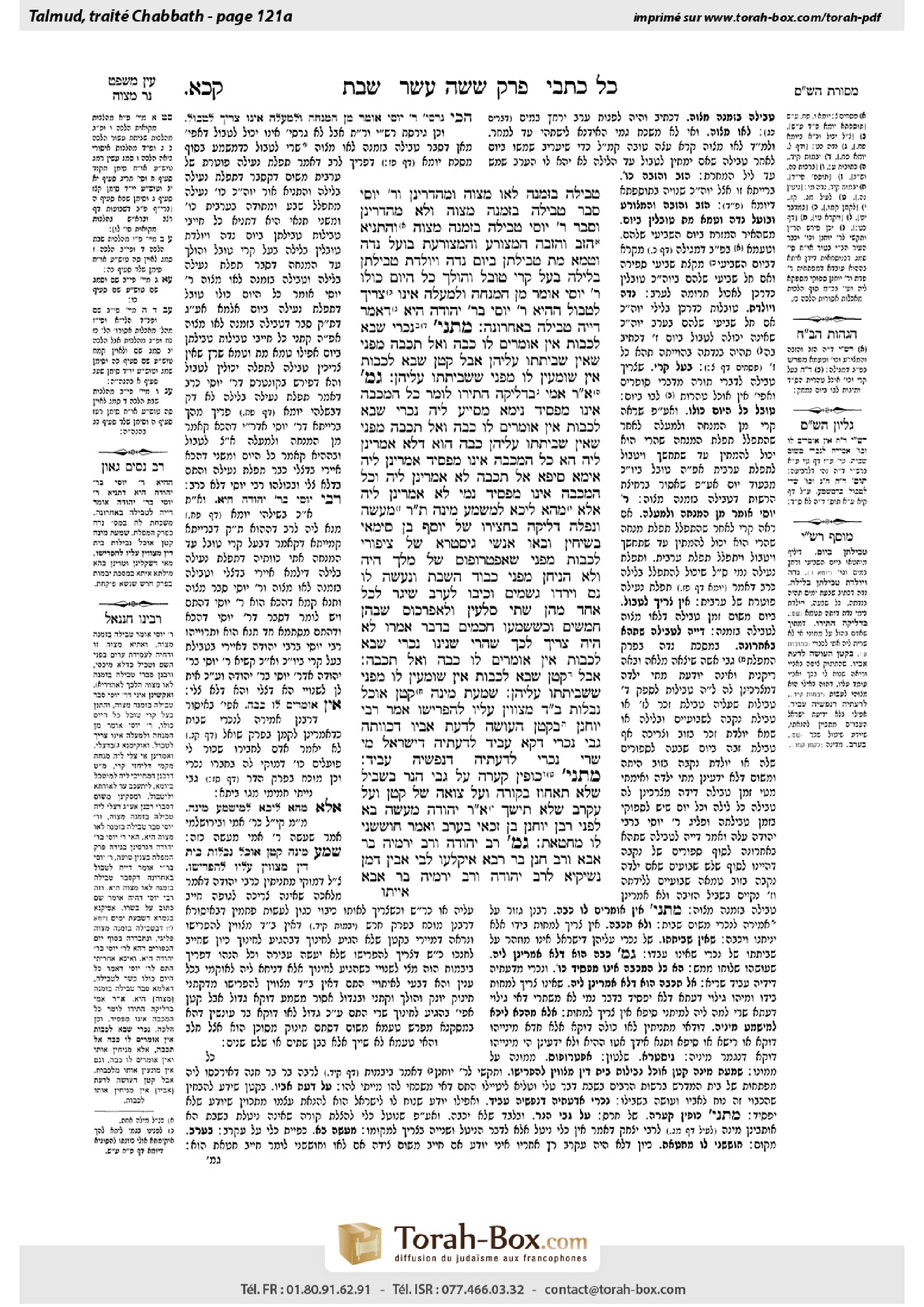
Shabbat 121a: Talmud study for Daf Yomi
Daf Yomi is the daily study of one Talmud folio. Explore 37 tractates with scans, Hebrew text, Sefaria English and AI-generated French translations where annotated.
Passage selection and English or AI-generated French translation are available where the scan has annotations. Daf Study is independent of Torah-Box and Sefaria.
Browse Shabbat · שבת · All tractatesShabbat 121a text and translations
This page of Shabbat includes the Aramaic text, an English translation and an AI-generated French translation, alongside the scan above.
שבת קכ״א א · Aramaic and Hebrew text
טְבִילָה בִּזְמַנָּהּ לָאו מִצְוָה וּמַהְדְּרִינַן, וְרַבִּי יוֹסֵי סָבַר טְבִילָה בִּזְמַנָּהּ מִצְוָה וְלָא מַהְדְּרִינַן.
וְסָבַר רַבִּי יוֹסֵי טְבִילָה בִּזְמַנָּהּ מִצְוָה? וְהָתַנְיָא: הַזָּב וְהַזָּבָה, הַמְצוֹרָע וְהַמְצוֹרֶעֶת, בּוֹעֵל נִדָּה וּטְמֵא מֵת, טְבִילָתָן בַּיּוֹם. נִדָּה וְיוֹלֶדֶת — טְבִילָתָן בַּלַּיְלָה. בַּעַל קֶרִי — טוֹבֵל וְהוֹלֵךְ כׇּל הַיּוֹם כּוּלּוֹ. רַבִּי יוֹסֵי אוֹמֵר: מִן הַמִּנְחָה וּלְמַעְלָה אֵינוֹ צָרִיךְ לִטְבּוֹל! הַהִיא, רַבִּי יוֹסֵי בְּרַבִּי יְהוּדָה הִיא, דְּאָמַר: דַּיָּיהּ טְבִילָה בָּאַחֲרוֹנָה.
מַתְנִי׳ גּוֹי שֶׁבָּא לְכַבּוֹת — אֵין אוֹמְרִים לוֹ ״כַּבֵּה״ וְ״אַל תְּכַבֶּה״, מִפְּנֵי שֶׁאֵין שְׁבִיתָתוֹ עֲלֵיהֶן. אֲבָל קָטָן שֶׁבָּא לְכַבּוֹת — אֵין שׁוֹמְעִין לוֹ, מִפְּנֵי שֶׁשְּׁבִיתָתוֹ עֲלֵיהֶן.
גְּמָ׳ אָמַר רַבִּי אַמֵּי: בִּדְלֵיקָה הִתִּירוּ לוֹמַר ״כׇּל הַמְכַבֶּה אֵינוֹ מַפְסִיד״. נֵימָא מְסַיַּיע לֵיהּ: גּוֹי שֶׁבָּא לְכַבּוֹת — אֵין אוֹמְרִים לוֹ ״כַּבֵּה״ וְ״אַל תְּכַבֶּה״ מִפְּנֵי שֶׁאֵין שְׁבִיתָתוֹ עֲלֵיהֶן. ״כַּבֵּה״ הוּא דְּלָא אָמְרִינַן לֵיהּ, הָא ״כׇּל הַמְכַבֶּה אֵינוֹ מַפְסִיד״ — אָמְרִינַן לֵיהּ. אֵימָא סֵיפָא, ״אַל תְּכַבֶּה״ לָא אָמְרִינַן לֵיהּ, וְ״כׇל הַמְכַבֶּה אֵינוֹ מַפְסִיד״ נָמֵי לָא אָמְרִינַן לֵיהּ. אֶלָּא מֵהָא לֵיכָּא לְמִשְׁמַע מִינַּהּ.
תָּנוּ רַבָּנַן: מַעֲשֶׂה וְנָפְלָה דְּלֵיקָה בַּחֲצֵירוֹ שֶׁל יוֹסֵף בֶּן סִימַאי בְּשִׁיחִין, וּבָאוּ אַנְשֵׁי גִּיסְטְרָא שֶׁל צִיפּוֹרִי לְכַבּוֹת, מִפְּנֵי שֶׁאַפִּטְרוֹפּוֹס שֶׁל מֶלֶךְ הָיָה, וְלֹא הִנִּיחָן מִפְּנֵי כְּבוֹד הַשַּׁבָּת, וְנַעֲשָׂה לוֹ נֵס וְיָרְדוּ גְּשָׁמִים וְכִיבּוּ. לָעֶרֶב שִׁיגֵּר לְכׇל אֶחָד מֵהֶן שְׁתֵּי סְלָעִין, וְלָאִפַּרְכוֹס שֶׁבָּהֶן — חֲמִשִּׁים. וּכְשֶׁשָּׁמְעוּ חֲכָמִים בְּדָבָר, אָמְרוּ: לֹא הָיָה צָרִיךְ לְכָךְ, שֶׁהֲרֵי שָׁנִינוּ: גּוֹי שֶׁבָּא לְכַבּוֹת — אֵין אוֹמְרִים לוֹ ״כַּבֵּה״ וְ״אַל תְּכַבֶּה״.
אֲבָל קָטָן שֶׁבָּא לְכַבּוֹת אֵין שׁוֹמְעִין לוֹ מִפְּנֵי שֶׁשְּׁבִיתָתוֹ עֲלֵיהֶן. שָׁמְעַתְּ מִינַּהּ קָטָן אוֹכֵל נְבֵלוֹת, בֵּית דִּין מְצֻוִּוין עָלָיו לְהַפְרִישׁוֹ. אָמַר רַבִּי יוֹחָנָן: בְּקָטָן הָעוֹשֶׂה לְדַעַת אָבִיו. דִּכְווֹתַהּ גַּבֵּי גּוֹי, דְּקָא עָבֵיד לְדַעְתֵּיהּ דְּיִשְׂרָאֵל — מִי שְׁרֵי?! גּוֹי לְדַעְתֵּיהּ דְּנַפְשֵׁיהּ עָבֵיד.
מַתְנִי׳ כּוֹפִין קְעָרָה עַל גַּבֵּי הַנֵּר בִּשְׁבִיל שֶׁלֹּא תֶּאֱחוֹז בַּקּוֹרָה, וְעַל צוֹאָה שֶׁל קָטָן, וְעַל עַקְרָב שֶׁלֹּא תִּישָּׁךְ. אָמַר רַבִּי יְהוּדָה: מַעֲשֶׂה בָּא לִפְנֵי רַבָּן יוֹחָנָן בֶּן זַכַּאי בַּעֲרָב, וְאָמַר: חוֹשְׁשַׁנִי לוֹ מֵחַטָּאת.
גְּמָ׳ רַב יְהוּדָה וְרַב יִרְמְיָה בַּר אַבָּא וְרַב חָנָן בַּר רָבָא אִיקְּלַעוּ לְבֵי אָבִין דְּמִן נְשִׁיקְיָא. לְרַב יְהוּדָה וְרַב יִרְמְיָה בַּר אַבָּא
Shabbat 121a · English translation
that performing immersion at its designated time is not a mitzva, and we seek a reed to wrap around God’s name even if it means postponing immersion to the next day, and Rabbi Yosei holds that immersion at its designated time is a mitzva, and therefore we do not seek a reed, since immersion cannot be postponed.
The Gemara asks: And does Rabbi Yosei hold that immersion at its designated time is a mitzva? Wasn’t it taught in a baraita: With regard to a zav and a zava, a male and female leper, one who has relations with a menstruating woman, and a person impure with impurity imparted by a corpse, their immersion is during the day. They immerse at the designated time even on Yom Kippur, when bathing is prohibited. A menstruating woman and a woman after childbirth immerse at night. A man who has had a seminal emission immerses at any point during the entire day after the emission. Rabbi Yosei says: From the time that he recited the afternoon prayer and on he does not immerse. Since he already recited the afternoon prayer, he waits until after Yom Kippur to immerse, and then recites the evening prayer in a state of purity. Apparently, Rabbi Yosei holds that immersion at the designated time is not a mitzva. The Gemara rejects this: In that baraita the reference is not to the Rabbi Yosei most commonly cited in tannaitic literature without a patronymic, Rabbi Yosei ben Ḥalafta, but it is to Rabbi Yosei, son of Rabbi Yehuda, who said: Her latest immersion is sufficient. A woman who is uncertain with regard to the correct time for her immersion need not immerse multiple times. She may postpone her immersion until a time when she will be certain to fulfill her obligation, even though it might not be immersion at the designated time.
MISHNA: If a gentile comes to extinguish a Jew’s fire on Shabbat, one may not say to him: Extinguish, and: Do not extinguish, because responsibility for his rest is not incumbent upon the Jew. However, if a Jewish child comes to extinguish a fire on Shabbat, they do not listen to him and allow him to extinguish it, even though he is not yet obligated in mitzva observance, because responsibility for his rest is incumbent upon the Jew.
GEMARA: Rabbi Ami said: During a fire, the Sages permitted to say in the presence of gentiles: Anyone who extinguishes the fire will not lose, so that the gentiles will come and extinguish the fire; it is only prohibited to tell gentiles to do so explicitly. The Gemara suggests: Let us say that the mishna supports his statement: If a gentile comes to extinguish a Jew’s fire on Shabbat, one may not say to him: Extinguish, and: Do not extinguish, because responsibility for his rest is not incumbent upon the Jew. It can be inferred from the language of the mishna: It is a direct command, e.g., extinguish, that we may not say to him; however, anyone who extinguishes will not lose, we may tell him, which supports Rabbi Ami’s statement. The Gemara rejects this. Say the latter clause of the mishna: Do not extinguish, we do not tell him. It can be inferred that neither do we say to him: Anyone who extinguishes will not lose. Rather, nothing can be inferred from this mishna.
The Sages taught in a baraita: There was an incident that a fire ignited on Shabbat in the courtyard of Yosef ben Simai in a place called Shiḥin. And men came from the fortress [gistera] of Tzippori to extinguish the fire, because he was a steward [apotropos] of the king and they wanted to help him. However, Yosef ben Simai would not allow them to extinguish the fire in deference to Shabbat; and a miracle transpired for him and rain fell and extinguished the fire. That evening after Shabbat he sent two sela to each one of the soldiers who came to his aid, and fifty to their commander [iparkhos]. And when the Sages heard about this, they said: He need not have prevented them from extinguishing the fire, as we learned in the mishna: If a gentile comes to extinguish a Jew’s fire on Shabbat, one may not say to him: Extinguish, and: Do not extinguish, because responsibility for his rest is not incumbent upon the Jew; rather, the gentile may do as he pleases.
We learned in the mishna: However, if a Jewish child comes to extinguish a fire on Shabbat, they do not listen to him and allow him to extinguish it, even though he is not yet obligated in mitzva observance, because responsibility for his rest is incumbent upon the Jew. The Gemara seeks to conclude: Learn from this that a child who eats meat from unslaughtered animals or violates other prohibitions, the court is commanded to prevent him from eating it. This mishna would resolve a dilemma that arose regarding that issue. The Gemara rejects this suggestion: Rabbi Yoḥanan said: This mishna is referring to a child who is acting with the intention of fulfilling his father’s will, and therefore one is obligated to prevent him from doing so. However, if a child sins of his own volition, one is not obligated to prevent him from doing so. The Gemara asks: If so, the case with regard to a gentile in the mishna must be interpreted in a similar manner as referring to a case where he is acting with the intention to fulfill the will of a Jew. Is that permitted? It is prohibited to derive benefit from an action performed by a gentile for a Jew on Shabbat. The Gemara responds: This is not the case; the gentile is acting of his own volition. Because he is paid for extinguishing the fire he is not doing so in order to help the Jew.
MISHNA: One may overturn a bowl on top of a lamp so that fire will not take hold in the ceiling beam on Shabbat. And similarly, one may overturn a bowl on top of a child’s feces inside the house so he will not touch it and dirty himself, and on top of a scorpion so that it will not bite. Rabbi Yehuda said: An incident came before Rabban Yoḥanan ben Zakkai in his village of Arav, where a person covered a scorpion on Shabbat, and Rabban Yoḥanan said: I am concerned that he is liable to bring a sin-offering because he might have violated a Torah prohibition.
GEMARA: The Gemara relates: Rav Yehuda and Rav Yirmeya bar Abba and Rav Ḥanan bar Rava happened to come to the house of Avin from a place called Nashikiya. For Rav Yehuda and Rav Yirmeya bar Abba,
Shabbat 121a · Traduction française (IA)
[Il estime] que l’immersion au moment prévu n’est pas une mitsva, et l’on cherche un roseau pour envelopper le Nom de Dieu, même si cela signifie reporter l’immersion au lendemain. Rabbi Yosei, lui, considère que l’immersion au moment prévu est une mitsva ; c’est pourquoi on ne cherche pas de roseau, puisque l’immersion ne peut être reportée.
La Guemara demande : Rabbi Yosei considère-t-il donc que l’immersion au moment prévu est une mitsva ? N’a-t-il pas été enseigné dans une baraïta : Dans le cas d’un zav et d’une zava, d’un homme et d’une femme lépreux, de celui qui a des relations avec une femme menstruée, ainsi que d’une personne impure en raison de l’impureté transmise par un cadavre, l’immersion a lieu pendant la journée. Ils s’immergent au moment prévu, même à Yom Kippour, où il est interdit de se baigner. Une femme menstruée et une femme après l’accouchement s’immergent la nuit. Un homme qui a eu une émission séminale s’immerge à n’importe quel moment de la journée entière qui suit l’émission. Rabbi Yosei dit : À partir du moment où il a récité la prière de l’après-midi, il ne s’immerge plus. Puisqu’il a déjà récité la prière de l’après-midi, il attend la fin de Yom Kippour pour s’immerger, puis récite la prière du soir en état de pureté. Il apparaît donc que Rabbi Yosei considère que l’immersion au moment prévu n’est pas une mitsva. La Guemara rejette cette interprétation : dans cette baraïta, il ne s’agit pas du Rabbi Yosei le plus souvent cité sans patronyme dans la littérature tannaitique, Rabbi Yosei ben Ḥalafta, mais de Rabbi Yosei, fils de Rabbi Yehuda, qui disait : « Une seule immersion, à la dernière échéance, suffit. » Une femme qui ne sait pas avec certitude à quel moment elle doit s’immerger n’a pas besoin de s’immerger plusieurs fois. Elle peut reporter son immersion jusqu’à un moment où elle sera certaine de s’acquitter de son obligation, même si ce n’est pas au moment prévu.
MICHNA : Si un non-Juif vient éteindre le feu d’un Juif pendant Chabbat, on ne peut pas lui dire : « Éteins », ni : « N’éteins pas », car le Juif n’est pas responsable de son repos. En revanche, si un enfant juif vient éteindre un feu pendant Chabbat, on ne l’écoute pas et on ne le laisse pas l’éteindre, même s’il n’est pas encore tenu d’observer les mitsvot, car le Juif est responsable de son repos.
GUEMARA : Rabbi Ami dit : En cas d’incendie, les Sages ont permis de dire en présence de non-Juifs : « Quiconque éteindra le feu n’y perdra rien », afin que les non-Juifs viennent éteindre le feu ; seule leur donner explicitement l’ordre de le faire est interdit. La Guemara suggère : Disons que la Michna appuie ses propos : Si un non-Juif vient éteindre le feu d’un Juif pendant Chabbat, on ne peut pas lui dire : « Éteins », ni : « N’éteins pas », car le Juif n’est pas responsable de son repos. On peut déduire de la formulation de la Michna que c’est un ordre direct, par exemple « Éteins », qu’on ne peut pas lui donner ; mais on peut lui dire : « Quiconque éteindra n’y perdra rien », ce qui appuie l’avis de Rabbi Ami. La Guemara rejette cette interprétation. Considère la dernière partie de la Michna : on ne lui dit pas : « N’éteins pas ». On peut en déduire qu’on ne lui dit pas non plus : « Quiconque éteindra n’y perdra rien ». On ne peut donc rien déduire de cette Michna.
Les Sages ont enseigné dans une baraïta : Un jour, un incendie se déclara pendant Chabbat dans la cour de Yosef ben Simai, dans un lieu appelé Shiḥin. Des hommes vinrent de la forteresse [gistera] de Tzippori pour éteindre le feu, car il était administrateur [apotropos] du roi et ils voulaient lui venir en aide. Cependant, Yosef ben Simai ne les laissa pas éteindre le feu, par égard pour Chabbat ; un miracle se produisit pour lui : la pluie tomba et éteignit le feu. Ce soir-là, après Chabbat, il envoya deux sela à chacun des soldats venus à son aide, et cinquante à leur commandant [iparkhos]. Lorsque les Sages l’apprirent, ils dirent : Il n’aurait pas dû les empêcher d’éteindre le feu, car nous avons appris dans la Michna : Si un non-Juif vient éteindre le feu d’un Juif pendant Chabbat, on ne peut pas lui dire : « Éteins », ni : « N’éteins pas », car le Juif n’est pas responsable de son repos ; le non-Juif peut plutôt agir comme bon lui semble.
Nous avons appris dans la Michna : En revanche, si un enfant juif vient éteindre un feu pendant Chabbat, on ne l’écoute pas et on ne le laisse pas l’éteindre, même s’il n’est pas encore tenu d’observer les mitsvot, car le Juif est responsable de son repos. La Guemara cherche à en conclure que, lorsqu’un enfant mange de la viande provenant d’animaux qui n’ont pas été abattus rituellement, ou transgresse d’autres interdits, le tribunal a l’obligation de l’en empêcher. Cette Michna permettrait de résoudre une question soulevée à ce sujet. La Guemara rejette cette proposition : Rabbi Yoḥanan dit que cette Michna parle d’un enfant qui agit dans l’intention d’accomplir la volonté de son père ; on est donc tenu de l’en empêcher. En revanche, si l’enfant commet une faute de sa propre initiative, on n’est pas tenu de l’en empêcher. La Guemara demande : Dans ce cas, le cas du non-Juif mentionné dans la Michna doit être compris de la même manière, comme s’il agissait dans l’intention d’accomplir la volonté d’un Juif. Cela serait-il permis ? Il est interdit de tirer profit, pendant Chabbat, d’une action accomplie par un non-Juif pour un Juif. La Guemara répond : Ce n’est pas le cas ; le non-Juif agit de sa propre initiative. Comme il est rémunéré pour éteindre le feu, il ne le fait pas pour aider le Juif.
MICHNA : On peut renverser un bol sur une lampe afin que le feu ne se propage pas à la poutre du plafond pendant Chabbat. De même, on peut renverser un bol sur les excréments d’un enfant à l’intérieur de la maison, afin qu’il ne les touche pas et ne se salisse pas, et sur un scorpion afin qu’il ne pique pas. Rabbi Yehuda dit : Un cas fut porté devant Rabban Yoḥanan ben Zakkai dans son village d’Arav : un homme avait couvert un scorpion pendant Chabbat, et Rabban Yoḥanan dit : « Je crains qu’il ne soit passible d’apporter un sacrifice expiatoire, car il a peut-être transgressé une interdiction de la Torah. »
GUEMARA : La Guemara rapporte : Rav Yehuda, Rav Yirmeya bar Abba et Rav Ḥanan bar Rava arrivèrent par hasard chez Avin, en provenance d’un lieu appelé Nashikiya. En effet, Rav Yehuda et Rav Yirmeya bar Abba,
Traduction française générée par IA à partir de l’édition anglaise de Sefaria. Vérifie toujours un passage avec le texte source.
Text from Sefaria: William Davidson Edition - Vocalized Aramaic (CC BY NC); William Davidson Edition - English (CC BY NC).