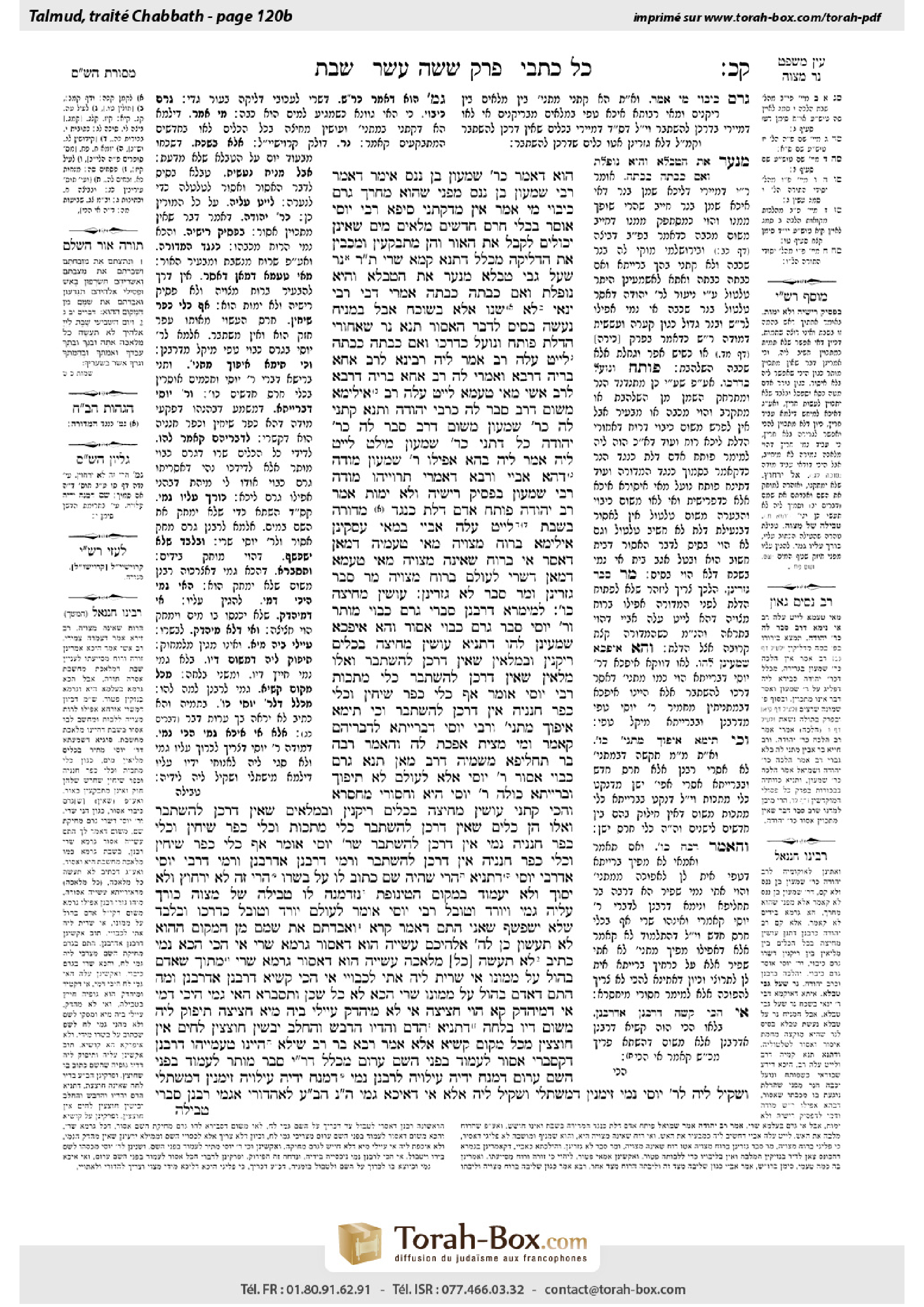
Shabbat 120b: Talmud study for Daf Yomi
Daf Yomi is the daily study of one Talmud folio. Explore 37 tractates with scans, Hebrew text, Sefaria English and AI-generated French translations where annotated.
Passage selection and English or AI-generated French translation are available where the scan has annotations. Daf Study is independent of Torah-Box and Sefaria.
Browse Shabbat · שבת · All tractatesShabbat 120b text and translations
This page of Shabbat includes the Aramaic text, an English translation and an AI-generated French translation, alongside the scan above.
שבת ק״כ ב · Aramaic and Hebrew text
הוּא דְּאָמַר כְּרַבִּי שִׁמְעוֹן בֶּן נַנָּס.
אֵימַר דְּאָמַר רַבִּי שִׁמְעוֹן בֶּן נַנָּס ״מִפְּנֵי שֶׁהוּא מְחָרֵךְ״, גְּרַם כִּיבּוּי מִי אָמַר? אִין, מִדְּקָתָנֵי סֵיפָא רַבִּי יוֹסֵי אוֹסֵר בִּכְלֵי חֶרֶס חֲדָשִׁים מְלֵאִים מַיִם, שֶׁאֵינָן יְכוֹלִים לְקַבֵּל אֶת הָאוּר וְהֵן מִתְבַּקְּעִין וּמְכַבִּין אֶת הַדְּלֵיקָה — מִכְּלָל דְּתַנָּא קַמָּא שָׁרֵי.
תָּנוּ רַבָּנַן: נֵר שֶׁעַל גַּבֵּי טַבְלָא — מְנַעֵר אֶת הַטַּבְלָא וְהִיא נוֹפֶלֶת, וְאִם כָּבְתָה — כָּבְתָה. אָמְרִי דְּבֵי רַבִּי יַנַּאי: לֹא שָׁנוּ אֶלָּא בְּשׁוֹכֵחַ, אֲבָל בְּמַנִּיחַ — נַעֲשָׂה בָּסִיס לְדָבָר הָאָסוּר.
תָּנָא: נֵר שֶׁאֲחוֹרֵי הַדֶּלֶת — פּוֹתֵחַ וְנוֹעֵל כְּדַרְכּוֹ, וְאִם כָּבְתָה — כָּבְתָה. לָיֵיט עֲלַהּ רַב. אֲמַר לֵיהּ רָבִינָא לְרַב אַחָא בְּרֵיהּ דְּרָבָא, וְאָמְרִי לַהּ רַב אַחָא בְּרֵיהּ דְּרָבָא לְרַב אָשֵׁי: מַאי טַעְמָא לָיֵיט עֲלַהּ רַב? אִילֵּימָא מִשּׁוּם דְּרַב סָבַר לַהּ כְּרַבִּי יְהוּדָה, וְתָנָא קָתָנֵי לַהּ כְּרַבִּי שִׁמְעוֹן. מִשּׁוּם דְּרַב סָבַר לַהּ כְּרַבִּי יְהוּדָה, כׇּל דְּתָנֵי כְּרַבִּי שִׁמְעוֹן מֵילָט לָיֵיט לֵיהּ?!
אֲמַר לֵיהּ: בְּהָא אֲפִילּוּ רַבִּי שִׁמְעוֹן מוֹדֶה. דְּהָא אַבָּיֵי וְרָבָא דְּאָמְרִי תַּרְוַיְיהוּ: מוֹדֶה רַבִּי שִׁמְעוֹן בִּ״פְסִיק רֵישֵׁיהּ וְלָא יְמוּת״.
אָמַר רַב יְהוּדָה: פּוֹתֵחַ אָדָם דֶּלֶת כְּנֶגֶד מְדוּרָה בְּשַׁבָּת. לָיֵיט עֲלַהּ אַבָּיֵי. בְּמַאי עָסְקִינַן? אִילֵימָא בְּרוּחַ מְצוּיָה — מַאי טַעְמֵיהּ דְמַאן דְּאָסַר?! אִי בְּרוּחַ שֶׁאֵינָהּ מְצוּיָה — מַאי טַעְמָא דְמַאן דְּשָׁרֵי?! לְעוֹלָם בְּרוּחַ מְצוּיָה: מָר סָבַר גָּזְרִינַן, וּמָר סָבַר לָא גָּזְרִינַן.
עוֹשִׂין מְחִיצָה כּוּ׳. לְמֵימְרָא דְּרַבָּנַן סָבְרִי גְּרַם כִּבּוּי מוּתָּר, וְרַבִּי יוֹסֵי סָבַר גְּרַם כִּבּוּי אָסוּר? וְהָא אִיפְּכָא שָׁמְעִינַן לְהוּ. דְּתַנְיָא: עוֹשִׂין מְחִיצָה בְּכֵלִים רֵיקָנִין, וּבִמְלֵאִין שֶׁאֵין דַּרְכָּן לְהִשְׁתַּבֵּר. וְאֵלּוּ מְלֵאִין שֶׁאֵין דַּרְכָּן לְהִשְׁתַּבֵּר — כְּלֵי מַתָּכוֹת. רַבִּי יוֹסֵי אוֹמֵר: אַף כְּלֵי כְּפַר שִׁיחִין וּכְלֵי כְּפַר חֲנַנְיָה אֵין דַּרְכָּן לְהִשְׁתַּבֵּר. וְכִי תֵּימָא: אֵיפוֹךְ מַתְנִיתִין, וְרַבִּי יוֹסֵי דְּבָרַיְיתָא לְדִבְרֵיהֶם קָאָמַר. וּמִי מָצֵית אָפְכַתְּ לַהּ? וְהָאָמַר רַבָּה בַּר תַּחְלִיפָא מִשְּׁמֵיהּ דְּרַב: מַאן תָּנָא גְּרַם כִּבּוּי אָסוּר — רַבִּי יוֹסֵי!
אֶלָּא לְעוֹלָם לָא תֵּיפוֹךְ, וּבָרָיְיתָא כּוּלָּהּ רַבִּי יוֹסֵי הִיא. וְחַסּוֹרֵי מְחַסְּרָא וְהָכִי קָתָנֵי: עוֹשִׂין מְחִיצָה בְּכֵלִים רֵיקָנִין וּבִמְלֵאִים שֶׁאֵין דַּרְכָּן לְהִשְׁתַּבֵּר. וְאֵלּוּ הֵן כֵּלִים שֶׁאֵין דַּרְכָּן לְהִשְׁתַּבֵּר: כְּלֵי מַתָּכוֹת. וּכְלֵי כְּפַר שִׁיחִין וּכְלֵי כְּפַר חֲנַנְיָה נָמֵי אֵין דַּרְכָּן לְהִשְׁתַּבֵּר, שֶׁרַבִּי יוֹסֵי אוֹמֵר: אַף כְּלִי כְּפַר שִׁיחִין וּכְלֵי כְּפַר חֲנַנְיָה אֵין דַּרְכָּן לְהִשְׁתַּבֵּר.
וְרָמֵי דְּרַבָּנַן אַדְּרַבָּנַן, וְרָמֵי דְּרַבִּי יוֹסֵי אַדְּרַבִּי יוֹסֵי. דְּתַנְיָא: הֲרֵי שֶׁהָיָה שֵׁם כָּתוּב לוֹ עַל בְּשָׂרוֹ — הֲרֵי זֶה לֹא יִרְחוֹץ וְלֹא יָסוּךְ וְלֹא יַעֲמוֹד בִּמְקוֹם הַטִּינּוֹפֶת. נִזְדַּמְּנָה לוֹ טְבִילָה שֶׁל מִצְוָה — כּוֹרֵךְ עָלֶיהָ גֶּמִי, וְיוֹרֵד וְטוֹבֵל. רַבִּי יוֹסֵי אוֹמֵר: לְעוֹלָם יוֹרֵד וְטוֹבֵל כְּדַרְכּוֹ, וּבִלְבַד שֶׁלֹּא יְשַׁפְשֵׁף!
שָׁאנֵי הָתָם דְּאָמַר קְרָא: ״וְאִבַּדְתֶּם אֶת שְׁמָם מִן הַמָּקוֹם הַהוּא לֹא תַעֲשׂוּן כֵּן לַה׳ אֱלֹהֵיכֶם״ — עֲשִׂיָּיה הוּא דְּאָסוּר, גְּרָמָא שְׁרֵי.
אִי הָכִי, הָכָא נָמֵי, כְּתִיב: ״לֹא תַעֲשֶׂה [כׇל] מְלָאכָה״ — עֲשִׂיָּיה הוּא דְּאָסוּר, גְּרָמָא שְׁרֵי! מִתּוֹךְ שֶׁאָדָם בָּהוּל עַל מָמוֹנוֹ, אִי שָׁרֵית לֵיהּ — אָתֵי לְכַבּוֹיֵי.
אִי הָכִי קַשְׁיָא דְּרַבָּנַן אַדְּרַבָּנַן: וּמָה הָתָם דְּאָדָם בָּהוּל עַל מָמוֹנוֹ — שְׁרֵי, הָכָא לֹא כׇּל שֶׁכֵּן?!
וְתִסְבְּרָא הַאי גֶּמִי הֵיכִי דָּמֵי? אִי דְּמִיהַדַּק — קָא הָוֵי חֲצִיצָה, אִי לָא מִיהַדַּק — עָיְילִי בֵּיהּ מַיָּא! חֲצִיצָה, תִּיפּוֹק לֵיהּ מִשּׁוּם דְּיוֹ! בְּלַחָה. דְּתַנְיָא: הַדָּם וְהַדְּיוֹ הַדְּבַשׁ וְהֶחָלָב, יְבֵשִׁין — חוֹצְצִין, לַחִים — אֵין חוֹצְצִין. מִכׇּל מָקוֹם קַשְׁיָא?
אֶלָּא אָמַר רָבָא בַּר רַב שֵׁילָא, הַיְינוּ טַעְמַיְיהוּ דְּרַבָּנַן, דְּקָסָבְרִי: אָסוּר לַעֲמוֹד בִּפְנֵי הַשֵּׁם עָרוֹם. מִכְּלָל דְּרַבִּי יוֹסֵי סָבַר מוּתָּר לַעֲמוֹד בִּפְנֵי הַשֵּׁם עָרוֹם? דְּמַנַּח יְדֵיהּ עִילָּוֵיהּ.
לְרַבָּנַן נָמֵי, דְּמַנַּח יְדֵיהּ עִילָּוֵיהּ! זִימְנִין דְּמִשְׁתְּלֵי וְשָׁקֵיל לֵיהּ. לְרַבִּי יוֹסֵי נָמֵי, זִימְנִין דְּמִשְׁתְּלֵי וְשָׁקֵיל לֵיהּ? אֶלָּא: אִי דְּאִיכָּא גֶּמִי — הָכִי נָמֵי, הָכָא בְּמַאי עָסְקִינַן — לְהַדּוֹרֵי אַגֶּמִי, רַבָּנַן סָבְרִי
Shabbat 120b · English translation
The Gemara answers: It was Rav who said his statement in accordance with the opinion of Rabbi Shimon ben Nannas in the mishna.
The Gemara asks: Say that Rabbi Shimon ben Nannas said it is permitted to place the goat’s hide on the burning item because it singes and does not burn; did he say it is permitted to indirectly cause the fire to extinguish? The Gemara answers: Yes, Rabbi Shimon ben Nannas permitted that as well, and we learn this from that which is taught in the latter clause in the mishna: Rabbi Yosei prohibits using new earthenware vessels that are full of water, because they cannot withstand the fire and will burst and extinguish the fire. This proves by inference that the first tanna, Rabbi Shimon ben Nannas, permits it.
The Sages taught: With regard to a candle that is atop a board, one shakes the board and the candle falls, and if it is extinguished, it is extinguished. The Sages of the school of Rabbi Yannai said: They only taught that this is permitted in a case where one forgets the candle atop the board when Shabbat began. However, in a case where one places it there, the board becomes a base for a prohibited object and may not be moved.
It was taught: With regard to a candle behind a door, one may open and shut the door in his usual manner, and if it is extinguished, it is extinguished. Rav would curse one who did so. Ravina said to Rav Aḥa, son of Rava, and some say that Rav Aḥa, son of Rava, said to Rav Ashi: What is the reason that Rav cursed and reprimanded one who did so? If you say it is because Rav holds in accordance with the opinion of Rabbi Yehuda that it is prohibited to perform an unintentional act from which a prohibited labor could ensue, and the tanna taught in accordance with the opinion of Rabbi Shimon that it is permitted to perform an unintentional act in those circumstances; because Rav holds in accordance with the opinion of Rabbi Yehuda, he curses anyone who teaches the halakha in accordance with the opinion of Rabbi Shimon? They rely on the ruling of a tanna, whose opinion is legitimate.
He said to him: In this case, even Rabbi Shimon concedes that it is prohibited, as it was Abaye and Rava who both said that Rabbi Shimon concedes in a case of: Cut off its head, will it not die? In an instance where the unintentional act leads to an inevitable prohibited consequence, even Rabbi Shimon agrees that the person who performs the unintentional act is liable.
Rav Yehuda said: A person opens a door opposite a fire on Shabbat. The Gemara relates that Abaye would curse anyone who did so. The Gemara clarifies: With what are we dealing? If you say this is referring to a case where a typical wind is blowing outside, what is the reason of the one who prohibits opening the door? A typical wind will neither fan nor extinguish the fire. And if it is referring to a case where an atypical wind is blowing outside, what is the reason of the one who permits opening the door? The Gemara answers: Actually, it is referring to the case of a typical wind. However, one Sage, Abaye, holds that we issue a decree prohibiting to open the door in the case of a typical wind due to a case of an atypical wind, and the other Sage, Rav Yehuda, holds that we do not issue that decree.
We learned in the mishna that one may establish a barrier with all earthenware vessels, and Rabbi Yosei prohibits using new earthenware vessels. The Gemara asks: Is that to say that the Rabbis hold that indirect extinguishing is permitted on Shabbat, and Rabbi Yosei holds that indirect extinguishing is prohibited? Didn’t we hear them state the opposite, as it was taught in a baraita: One may establish a barrier with empty vessels, and with full ones that do not typically break. And these are full vessels that do not typically break; metal vessels. Rabbi Yosei says: Even earthenware vessels from the village of Shiḥin and vessels from the village of Ḥananya do not typically break. Apparently, Rabbi Yosei’s opinion is more lenient than the opinions of the Rabbis. And if you say: Reverse the attribution of opinions in the mishna and attribute Rabbi Yosei’s opinion to the Rabbis, and say that Rabbi Yosei is saying his statement in the baraita in accordance with the opinion of the Rabbis, although he himself disagrees and permits using all vessels. But can you reverse the mishna? Didn’t Rabba bar Taḥalifa say in the name of Rav: Who is the tanna who teaches that indirect extinguishing is prohibited? It is Rabbi Yosei.
Rather, actually, do not reverse the attribution of the opinions in the mishna, and the entire baraita is in accordance with the opinion of Rabbi Yosei, and it is incomplete and is teaching the following: One may establish a barrier with empty vessels and full ones that do not typically break. And these are vessels that do not typically break: Metal vessels; and vessels from the village of Shiḥin and vessels from the village of Ḥananya also do not typically break, as Rabbi Yosei says: Even vessels from the village of Shiḥin and vessels from the village of Ḥananya do not typically break.
The conclusion is that Rabbi Yosei prohibits indirect extinguishing, and the Rabbis permit it. The Gemara raises a contradiction between one statement of the Rabbis and a second statement of the Rabbis; and it raises a contradiction between one statement of Rabbi Yosei and a second statement of Rabbi Yosei. As it was taught in a baraita: If one had a sacred name of God written on his skin he may neither wash it in water lest it be erased, nor may he smear it with oil, nor may he stand in a place of filth because it is disrespectful of God’s name. If an immersion of mitzva happened to present itself, he wraps a reed over God’s name and then descends and immerses. Rabbi Yosei says: Actually, he descends and immerses in his usual manner, even if it is not an immersion of mitzva, provided that he does not rub the spot and erase the name. Apparently, Rabbi Yosei’s opinion is more lenient than that of the Sages with regard to indirectly causing a prohibited outcome.
The Gemara answers: It is different there because the verse says: “And you shall break down their altars, and you shall smash their pillars, and their sacred trees, and burn with fire, and the graven images of their gods you shall hew down and you shall destroy their name from that place. You shall not do so to the Lord your God” (Deuteronomy 12:3–4). From the prohibition: “You shall not do so,” Rabbi Yosei derives that actually doing so is that which is prohibited; indirectly causing that result is permitted.
The Gemara asks: If so, here too, with regard to Shabbat, it is written: “And the seventh day is Shabbat for the Lord your God, you shall not perform any labor” (Exodus 20:9). And here, too, one could derive: Performance is that which is prohibited; indirectly causing a prohibited action is permitted. The Gemara answers: Actually, Rabbi Yosei maintains there is no prohibition in indirectly causing a fire to be extinguished; however, since a person is agitated about his property, if you permit him to indirectly extinguish the fire, he will come to extinguish it directly.
The Gemara asks: If so, there is a contradiction between one statement of the Rabbis and another statement of the Rabbis: If in the case of a fire, where a person is agitated about his property, nevertheless, the Rabbis hold that indirect extinguishing is permitted; here, in the case of erasing God’s name, all the more so it should be permitted to indirectly cause erasure of God’s name. Why did the Rabbis in the baraita issue a stringent ruling in this matter?
The Gemara rejects this: And how can you understand it that way? What are the circumstances of this reed with which God’s name is covered while immersing according to the Rabbis? If it is firmly attached, it is an interposition; if it is not firmly attached, the water enters and erases the name. The Gemara questions this: If the concern is with regard to an interposition, derive that it is an interposition in any case due to the ink on his skin. The Gemara answers: This is referring to moist ink that does not interpose, as it was taught in a baraita: With regard to blood, and ink, and honey, and milk on a person’s skin, when they are dry, they interpose during immersion; when they are moist, they do not interpose. The Gemara continues: Nevertheless, it is difficult: Why do the Rabbis require wrapping a reed around God’s name?
Rather, Rava bar Rav Sheila said that this is the reasoning of the Rabbis: They hold that it is prohibited for a person to stand before the name of God while naked, and therefore there must be a barrier between one’s naked body and the name. The Gemara asks: Is that to say by inference that Rabbi Yosei holds that it is permitted to stand before the name while naked? The Gemara answers: No, he does not allow doing so; however, he does not require that the name be covered with a reed. It is sufficient for one to place his hand over the name.
The Gemara asks: If so, according to the Rabbis it should also be sufficient for one to place his hand over it. The Gemara explains: The Rabbis are concerned because sometimes one will forget and remove his hand. The Gemara asks: Shouldn’t Rabbi Yosei also be concerned because sometimes one will forget and remove his hand? Rather, if there is a reed available, Rabbi Yosei indeed concedes that one covers God’s name with it. However, with what situation are we dealing here? We are dealing with a case in which one would have to seek a reed. In that case, the Rabbis hold
Shabbat 120b · Traduction française (IA)
La Guemara répond : C’est Rav qui a énoncé cette déclaration conformément à l’opinion de Rabbi Shimon ben Nannas dans la Michna.
La Guemara demande : Rabbi Shimon ben Nannas a-t-il dit qu’il est permis de placer la peau du bouc sur l’objet en feu parce qu’elle se roussit sans brûler ? A-t-il également dit qu’il est permis de provoquer indirectement l’extinction du feu ? La Guemara répond : Oui, Rabbi Shimon ben Nannas l’a également permis. Nous l’apprenons de ce qui est enseigné dans la dernière partie de la Michna : Rabbi Yosei interdit d’utiliser des récipients neufs en terre cuite remplis d’eau, car ils ne résistent pas au feu et éclatent, éteignant ainsi le feu. On en déduit que le premier tanna, Rabbi Shimon ben Nannas, le permet.
Les Sages ont enseigné : Lorsqu’une lampe est posée sur une planche, on secoue la planche et la lampe tombe ; si elle s’éteint, elle s’éteint. Les Sages de l’école de Rabbi Yannai ont dit : Ils n’ont enseigné que dans le cas où l’on a oublié la lampe sur la planche au début du Chabbat, auquel cas cela est permis. En revanche, si on l’y a placée, la planche devient un support d’un objet interdit et ne peut être déplacée.
Il a été enseigné : Lorsqu’une lampe se trouve derrière une porte, on peut ouvrir et fermer la porte comme à l’accoutumée ; si la lampe s’éteint, elle s’éteint. Rav maudissait celui qui agissait ainsi. Ravina dit à Rav Aḥa, fils de Rava — et certains disent que Rav Aḥa, fils de Rava, dit à Rav Ashi : Pour quelle raison Rav maudissait-il et réprimandait-il celui qui agissait ainsi ? Si tu dis que c’est parce que Rav suit l’opinion de Rabbi Yehuda, selon laquelle il est interdit d’accomplir un acte involontaire susceptible d’entraîner un travail interdit, tandis que le tanna a enseigné conformément à l’opinion de Rabbi Shimon, selon laquelle il est permis d’accomplir un acte involontaire dans de telles circonstances, Rav maudirait-il quiconque enseigne la halakha conformément à l’opinion de Rabbi Shimon sous prétexte qu’il suit celle de Rabbi Yehuda ? Ils s’appuient sur la décision d’un tanna dont l’opinion est légitime.
Il lui dit : Dans ce cas, même Rabbi Shimon reconnaît que c’est interdit, car Abaye et Rava ont tous deux dit que Rabbi Shimon reconnaît le principe suivant : « Si on lui coupe la tête, ne mourra-t-il pas ? » Lorsqu’un acte involontaire entraîne inévitablement une conséquence interdite, même Rabbi Shimon convient que celui qui l’accomplit est passible.
Rav Yehuda a dit : Une personne peut ouvrir une porte face à un feu pendant Chabbat. La Guemara rapporte qu’Abaye maudissait quiconque agissait ainsi. La Guemara précise : De quel cas s’agit-il ? Si tu dis qu’un vent ordinaire souffle dehors, pourquoi celui qui interdit d’ouvrir la porte l’interdirait-il ? Un vent ordinaire n’attisera ni n’éteindra le feu. Et s’il s’agit d’un vent inhabituel qui souffle dehors, pourquoi celui qui permet d’ouvrir la porte le permettrait-il ? La Guemara répond : En réalité, il s’agit d’un vent ordinaire. Cependant, l’un des Sages, Abaye, estime qu’il faut décréter qu’il est interdit d’ouvrir la porte par vent ordinaire, par crainte d’un vent inhabituel ; l’autre Sage, Rav Yehuda, estime qu’il ne faut pas prendre ce décret.
Nous avons appris dans la Michna que l’on peut ériger une barrière avec tous les récipients en terre cuite, tandis que Rabbi Yosei interdit d’utiliser des récipients neufs en terre cuite. La Guemara demande : Cela signifie-t-il que les Rabbins estiment que l’extinction indirecte est permise pendant Chabbat, tandis que Rabbi Yosei estime qu’elle est interdite ? Ne les avons-nous pas entendus dire le contraire, comme il est enseigné dans une baraïta : On peut ériger une barrière avec des récipients vides ainsi qu’avec des récipients pleins qui ne se brisent pas habituellement. Les récipients pleins qui ne se brisent pas habituellement sont les récipients en métal. Rabbi Yosei dit : Même les récipients en terre cuite du village de Shiḥin et ceux du village de Ḥananya ne se brisent pas habituellement. Apparemment, l’opinion de Rabbi Yosei est plus indulgente que celle des Rabbins. Et si tu dis : Inverse l’attribution des opinions dans la Michna, attribue aux Rabbins l’opinion de Rabbi Yosei et dis que Rabbi Yosei énonce dans la baraïta sa déclaration conformément à l’opinion des Rabbins, bien qu’il soit lui-même en désaccord avec eux et permette d’utiliser tous les récipients. Mais peut-on inverser la Michna ? Rabba bar Taḥalifa n’a-t-il pas dit au nom de Rav : Qui est le tanna qui enseigne que l’extinction indirecte est interdite ? C’est Rabbi Yosei.
En réalité, n’inverse pas l’attribution des opinions dans la Michna : toute la baraïta suit l’opinion de Rabbi Yosei, mais elle est incomplète et enseigne ce qui suit : On peut ériger une barrière avec des récipients vides et avec des récipients pleins qui ne se brisent pas habituellement. Les récipients qui ne se brisent pas habituellement sont les récipients en métal ; les récipients du village de Shiḥin et ceux du village de Ḥananya ne se brisent pas non plus habituellement, comme le dit Rabbi Yosei : « Même les récipients du village de Shiḥin et ceux du village de Ḥananya ne se brisent pas habituellement. »
La conclusion est que Rabbi Yosei interdit l’extinction indirecte et que les Rabbins la permettent. La Guemara soulève une contradiction entre une déclaration des Rabbins et une autre déclaration des Rabbins, ainsi qu’entre une déclaration de Rabbi Yosei et une autre déclaration de Rabbi Yosei. En effet, il est enseigné dans une baraïta : Si le nom sacré de Dieu est inscrit sur la peau d’une personne, celle-ci ne doit ni la laver à l’eau, de peur que le nom ne s’efface, ni l’enduire d’huile, ni se tenir dans un endroit sale, car cela constitue un manque de respect envers le nom de Dieu. Si une immersion pour une mitsva se présente, elle recouvre le nom de Dieu d’un roseau, puis descend et s’immerge. Rabbi Yosei dit : En réalité, elle descend et s’immerge comme à l’accoutumée, même si ce n’est pas une immersion pour une mitsva, à condition de ne pas frotter l’endroit et d’effacer le nom. Apparemment, l’opinion de Rabbi Yosei est plus indulgente que celle des Sages en ce qui concerne le fait de provoquer indirectement une conséquence interdite.
La Guemara répond : Le cas est différent, car le verset dit : « Vous démolirez leurs autels, vous briserez leurs stèles, vous couperez leurs arbres sacrés, vous les brûlerez au feu, vous abattrez les images sculptées de leurs dieux et vous ferez disparaître leur nom de ce lieu. Vous n’agirez pas ainsi envers le Seigneur votre Dieu » (Deutéronome 12, 3-4). De l’interdiction « Vous n’agirez pas ainsi », Rabbi Yosei déduit que c’est l’acte accompli directement qui est interdit ; provoquer indirectement ce résultat est permis.
La Guemara demande : Si tel est le cas, ici aussi, à propos du Chabbat, il est écrit : « Le septième jour est le Chabbat pour le Seigneur ton Dieu ; tu n’accompliras aucun travail » (Exode 20, 9). Ici aussi, on pourrait déduire que c’est l’acte accompli directement qui est interdit et qu’il est permis de provoquer indirectement un acte interdit. La Guemara répond : En réalité, Rabbi Yosei estime qu’il n’est pas interdit de provoquer indirectement l’extinction d’un feu ; toutefois, comme une personne est préoccupée par ses biens, si on lui permet d’éteindre indirectement le feu, elle finira par l’éteindre directement.
La Guemara demande : Si tel est le cas, il y a une contradiction entre une déclaration des Rabbins et une autre déclaration des Rabbins : dans le cas d’un incendie, où une personne est préoccupée par ses biens, les Rabbins estiment néanmoins que l’extinction indirecte est permise ; ici, dans le cas de l’effacement du nom de Dieu, à plus forte raison devrait-il être permis de provoquer indirectement son effacement. Pourquoi les Rabbins ont-ils rendu une décision rigoureuse sur ce point dans la baraïta ?
La Guemara rejette cette explication : Comment peux-tu comprendre les choses ainsi ? Dans quelles circonstances, selon les Rabbins, le roseau recouvre-t-il le nom de Dieu pendant l’immersion ? S’il est fermement fixé, il constitue une interposition ; s’il ne l’est pas, l’eau pénètre et efface le nom. La Guemara objecte : Si la préoccupation porte sur une interposition, déduis qu’il y a interposition dans tous les cas en raison de l’encre sur sa peau. La Guemara répond : Il s’agit d’encre humide, qui ne constitue pas une interposition, comme il est enseigné dans une baraïta : Le sang, l’encre, le miel et le lait sur la peau d’une personne constituent une interposition lors de l’immersion lorsqu’ils sont secs ; lorsqu’ils sont humides, ils ne constituent pas d’interposition. La Guemara poursuit : Néanmoins, la difficulté demeure : pourquoi les Rabbins exigent-ils qu’on entoure le nom de Dieu d’un roseau ?
Rava bar Rav Sheila a plutôt dit que telle est la raison des Rabbins : ils estiment qu’il est interdit à une personne de se tenir nue devant le nom de Dieu ; il faut donc une séparation entre son corps nu et le nom. La Guemara demande : Cela signifie-t-il, par déduction, que Rabbi Yosei estime qu’il est permis de se tenir nu devant le nom ? La Guemara répond : Non, il ne permet pas d’agir ainsi ; toutefois, il n’exige pas que le nom soit couvert d’un roseau. Il suffit de placer sa main sur le nom.
La Guemara demande : Si tel est le cas, selon les Rabbins aussi, il devrait suffire de placer sa main dessus. La Guemara explique : Les Rabbins craignent que la personne oublie et retire sa main. La Guemara demande : Rabbi Yosei ne devrait-il pas, lui aussi, craindre que la personne oublie et retire sa main ? En réalité, si un roseau est disponible, Rabbi Yosei reconnaît effectivement qu’on doit en recouvrir le nom de Dieu. Mais de quel cas s’agit-il ici ? D’un cas où il faudrait aller chercher un roseau. Dans ce cas, les Rabbins estiment
Traduction française générée par IA à partir de l’édition anglaise de Sefaria. Vérifie toujours un passage avec le texte source.
Text from Sefaria: William Davidson Edition - Vocalized Aramaic (CC BY NC); William Davidson Edition - English (CC BY NC).